

Universality Reconsidered: Diversity in Making Meaning of Facial Expressions
Open accessThe DOI matches its Crossref record; 42 of the 43 references it cites were found in a registry or an index.
Abstract
It has long been claimed that certain facial movements are universally perceived as emotional expressions. The critical tests of this universality thesis were conducted between 1969 and 1975 in small-scale societies in the Pacific using confirmation-based research methods. New studies conducted since 2008 have examined a wider sample of small-scale societies, including on the African and South American continents. They used more discovery-based research methods, providing an important opportunity for reevaluating the universality thesis. These new studies reveal diversity, rather than uniformity, in how perceivers make sense of facial movements, calling the universality thesis into doubt. Instead, they support a perceiver-constructed account of emotion perception that is consistent with the broader literature on perception.
Overview
The claims and statistics of this paper haven’t been checked yet.
Free: it reads the open-access text and checks the first 5 claims that cite a source we can check. Create a free account to check every claim.
Integrity signals
Registry
Cites
Statistics
Figures
Verification
Claims the paper makes
The claims and statistics of this paper haven’t been checked yet.
Free: it reads the open-access text and checks the first 5 claims that cite a source we can check. Create a free account to check every claim.
Claims other papers make about this one
Each is checked against this paper’s own text: does it say what the citing paper says it does?
The source backs part of the claim, not all of it — or backs it for a different population, condition or comparison.
In the citing paper
“The notion that discrete emotion categories can be reliably identified by specific behavioural patterns and/or physiological features has been seriously called into doubt by the marked variability within instances of the same category as well as similarities across categories.”
From A new science of emotion: implications for functional neurological disorder (2022) · cites this paper as [53]
Experimental — accuracy not yet measuredThe cited source says what the claim attributes to it.
In the citing paper
“Lastly, new evidence over the last decade calls into question claims of the universality of emotion categories across cultures.53”
From A new science of emotion: implications for functional neurological disorder (2022) · cites this paper as [53]
Self-check
Percentages, sums and reported differences re-computed from the paper’s own numbers.
The self-check needs the paper’s full text.
Citations
Cites
Core affect and the psychological construction of emotion.
Russell, J. A. (2003) · Psychological Review · doi:10.1037/0033-295x.110.1.145 · Cited by 6,113 · cited 2×
“Affective properties such as pleasantness-unpleasantness (i.e., valence) and high-low activation (i.e., arousal) are consistently perceived in facial movements across industrialized societies (Russell, 2003) and smallscale societies.”
BackgroundConstants across cultures in the face and emotion.
Ekman, P., & Friesen, W. V. (1971) · Journal of Personality and Social Psychology · doi:10.1037/h0030377 · Cited by 5,509 · cited 3×
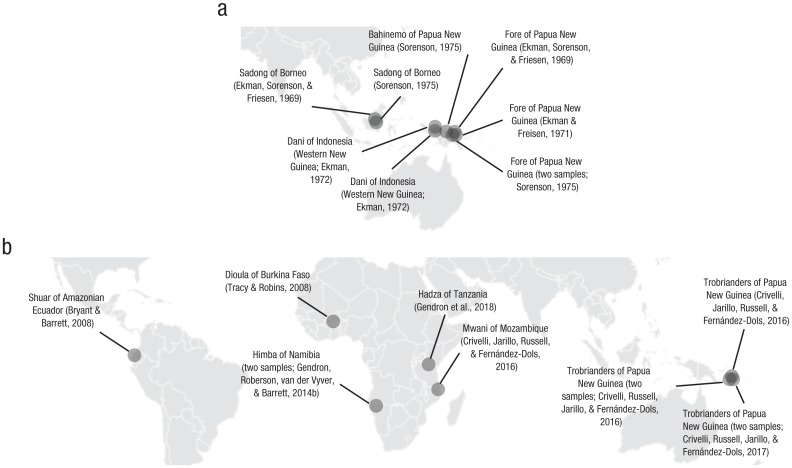
“Second, the Fore samples in Ekman and Friesen (1971) and Sorenson (1975) were the exact same size (189 adults and 130 children) and yielded nearly identical results; they are reported separately because Ekman (1994) indicated that the samples were distinct.”
BackgroundResult(2017) · Cited by 2,433
Self-citationOn the universality and cultural specificity of emotion recognition: a meta-analysis
Elfenbein, H. A., & Ambady, N. (2002) · Psychological Bulletin · doi:10.1037/0033-2909.128.2.203 · Cited by 2,049 · cited 2×
“…perception across cultures (extending beyond studies of small-scale societies) has been designed to validate the universality thesis rather than to discover or rule out diversity in how people make meaning of other people’s facial movements (e.g., Elfenbein & Ambady, 2002; Nelson & Russell, 2013).”
BackgroundMethodPan-cultural elements in facial displays of emotion
Ekman, P., Sorenson, E. R., & Friesen, W. V. (1969) · Science · doi:10.1126/science.164.3875.86 · Cited by 1,775 · cited 1×
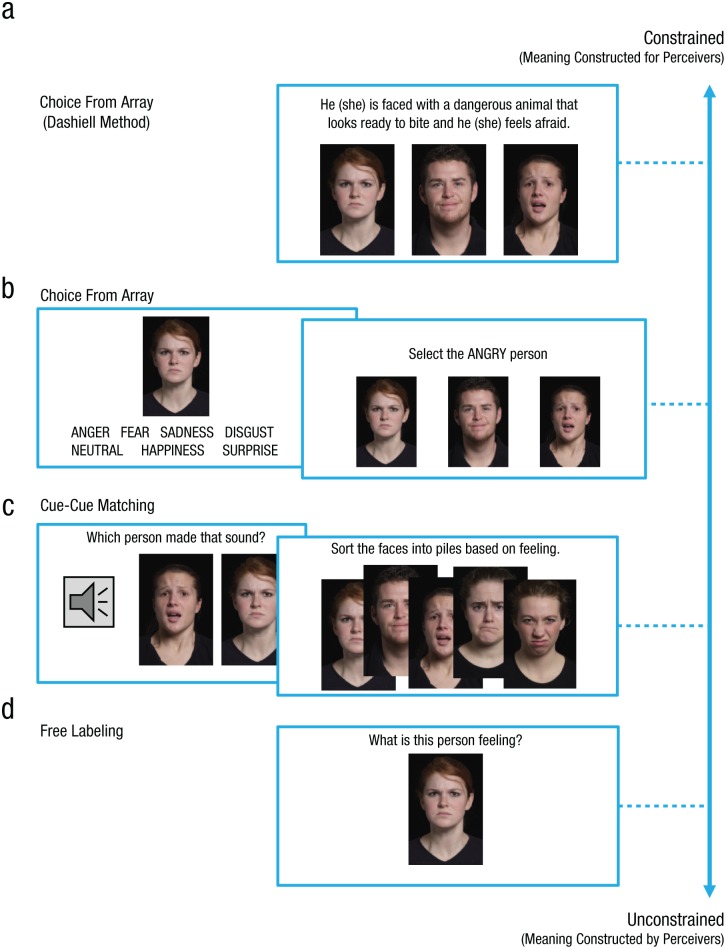
“…labeling None Dani of New Guinea (Indonesia) 34 adults Ekman (1972) X Choice from array (Dashiell method) None Fore of Papua New Guinea 32 adults Ekman, Sorenson, and Friesen (1969)a X Choice from array None Fore of Papua New Guinea 130 children, 189 adults Ekman and Friesen (1971) X Choice…”
MethodRussell, J. A. (1994) · Psychological Bulletin · doi:10.1037/0033-2909.115.1.102 · Cited by 1,640 · cited 9×
“Several of these samples were written up only in brief, resulting in omissions in reporting data and statistical analysis (Russell, 1994).”
BackgroundMethodResultInfluentialThe cultural niche: Why social learning is essential for human adaptation
Boyd, R., Richerson, P. J., & Henrich, J. (2011) · Proceedings of the National Academy of Sciences · doi:10.1073/pnas.1100290108 · Cited by 1,303
The Essential Child: Origins of Essentialism in Everyday Thought
Gelman, S. A. (2003) · doi:10.1093/acprof:oso/9780195154061.001.0001 · Cited by 1,247 · cited 1×
“For example, words often serve as placeholders for undefined mental essences that are thought to cause observable features (Gelman, 2003).”
Strong evidence for universals in facial expressions: A reply to Russell's mistaken critique.
Ekman, P. (1994) · Psychological Bulletin · doi:10.1037//0033-2909.115.2.268 · Cited by 1,130 · cited 1×
“Second, the Fore samples in Ekman and Friesen (1971) and Sorenson (1975) were the exact same size (189 adults and 130 children) and yielded nearly identical results; they are reported separately because Ekman (1994) indicated that the samples were distinct.”
ResultBarrett, L. F., Mesquita, B., & Gendron, M. (2011) · Current Directions in Psychological Science · doi:10.1177/0963721411422522 · Cited by 921
Self-citation
Research works printed but not linked: 1
- Ekman P. (1972). Universals and cultural differences in facial expressions of emotion. In Cole J. (Ed.), Nebraska Symposium on Motivation, 1971: Cultural Psychology (Vol. 19, pp. 207– 282). Lincoln: University of Nebraska Press.
Cited by
Emotional expressions reconsidered: Challenges to inferring emotion from human facial movements
Barrett, L. F., Adolphs, R., Marsella, S., Martinez, A. M., & Pollak, S. D. (2019) · Psychological Science in the Public Interest · doi:10.1177/1529100619832930 · Cited by 1,748
Self-citationEmotion semantics show both cultural variation and universal structure
Jackson, J. C., Watts, J., Henry, T. R., List, J.-M., Forkel, R., Mucha, P. J., Greenhill, S. J., Gray, R. D., & Lindquist, K. A. (2019) · Science · doi:10.1126/science.aaw8160 · Cited by 425
Emotion words, emotion concepts, and emotional development in children: A constructionist hypothesis
Hoemann, K., Xu, F., & Barrett, L. F. (2019) · Developmental Psychology · doi:10.1037/dev0000686 · Cited by 354
Self-citationFacial Displays Are Tools for Social Influence
Crivelli, C., & Fridlund, A. J. (2018) · Trends in Cognitive Sciences · doi:10.1016/j.tics.2018.02.006 · Cited by 330
Self-citationBeyond WEIRD: A review of the last decade and a look ahead to the global laboratory of the future
Apicella, C., Norenzayan, A., & Henrich, J. (2020) · Evolution and Human Behavior · doi:10.1016/j.evolhumbehav.2020.07.015 · Cited by 281
The future of service: The power of emotion in human-robot interaction
Chuah, S. H.-W., & Yu, J. (2021) · Journal of Retailing and Consumer Services · doi:10.1016/j.jretconser.2021.102551 · Cited by 265
The impact of facemasks on emotion recognition, trust attribution and re-identification
Marini, M., Ansani, A., Paglieri, F., Caruana, F., & Viola, M. (2021) · Scientific Reports · doi:10.1038/s41598-021-84806-5 · Cited by 238
Estimation of continuous valence and arousal levels from faces in naturalistic conditions
Toisoul, A., Kossaifi, J., Bulat, A., Tzimiropoulos, G., & Pantic, M. (2021) · Nature Machine Intelligence · doi:10.1038/s42256-020-00280-0 · Cited by 232
A new science of emotion: implications for functional neurological disorder
Jungilligens, J., Paredes-Echeverri, S., Popkirov, S., Barrett, L. F., & Perez, D. L. (2022) · Brain · doi:10.1093/brain/awac204 · Cited by 164
Self-citationInside-Out: From Basic Emotions Theory to the Behavioral Ecology View
Crivelli, C., & Fridlund, A. J. (2019) · Journal of Nonverbal Behavior · doi:10.1007/s10919-019-00294-2 · Cited by 159
Self-citationEfficient Facial Feature Learning with Wide Ensemble-Based Convolutional Neural Networks
Siqueira, H. L., Magg, S., & Wermter, S. (2020) · Proceedings of the AAAI Conference on Artificial Intelligence · doi:10.1609/aaai.v34i04.6037 · Cited by 175
The cultural evolution of emotion
Lindquist, K. A., Jackson, J. C., Leshin, J. C., Satpute, A. B., & Gendron, M. (2022) · Nature Reviews Psychology · doi:10.1038/s44159-022-00105-4 · Cited by 181
“However, studies claiming evidence for universal emotion perception have been heavily critiqued because of their demand characteristics and analytic approaches 1,20,34,35 .”
Self-citationDeveloping an understanding of emotion categories: Lessons from objects
Hoemann, K., Wu, R., LoBue, V., Oakes, L. M., Xu, F., & Barrett, L. F. (2020) · Trends in Cognitive Sciences · doi:10.1016/j.tics.2019.10.010 · Cited by 123
Self-citationThe neuroscience of sadness: A multidisciplinary synthesis and collaborative review
Arias, J. A., Williams, C., Raghvani, R., Aghajani, M., Baez, S., Belzung, C., Booij, L., Busatto, G., Chiarella, J., Fu, C. H., et al. (2020) · Neuroscience & Biobehavioral Reviews · doi:10.1016/j.neubiorev.2020.01.006 · Cited by 119
Distribution Matching for Heterogeneous Multi-Task Learning: a Large-scale Face StudyPreprint
Kollias, D., Sharmanska, V., & Zafeiriou, S. P. (2021) · arXiv (Cornell University) · doi:10.48550/arxiv.2105.03790 · Cited by 277
“, facial expressions are displayed and interpreted differently depending on the cultural background of subjects and annotators [59], [60] ; ii) the exact valence and arousal value for a particular affect is also not consistent among databases; iii) the AU annotation process is hard to do and error prone, creating inco…”
BackgroundBarrett, L. F. (2022) · American Psychologist · doi:10.1037/amp0001054 · Cited by 152
“…shown that these contextual constraints harmonize participants’ responses and increase the consistency of their answers within a study as well as across studies, particularly when testing people from non-Western cultures (for reviews, see Barrett et al., 2019; Gendron et al., 2018; Russell, 1994).”
BackgroundSelf-citationFacial Expressions of Basic Emotions in Japanese Laypeople
Sato, W., Hyniewska, S., Minemoto, K., & Yoshikawa, S. (2019) · Frontiers in Psychology · doi:10.3389/fpsyg.2019.00259 · Cited by 113
Detection of potential customers’ empathy behavior towards customers' reviews
Hossain, M. S., & Rahman, M. F. (2021) · Journal of Retailing and Consumer Services · doi:10.1016/j.jretconser.2021.102881 · Cited by 102
Hoemann, K., Nielson, C., Yuen, A., Gurera, J. W., Quigley, K. S., & Barrett, L. F. (2021) · Psychological Bulletin · doi:10.1037/bul0000327 · Cited by 83
“This possibility is particularly relevant given widely documented sociocultural variation in emotion-related processes (e.g., Boiger et al., 2018; Gendron et al., 2018; Niedenthal et al., 2019; Tamir et al., 2016) and must be dealt with to ensure the generalizability of our proposed framework.”
Self-citationKittel, A. F. D., Olderbak, S. G., & Wilhelm, O. (2021) · Assessment · doi:10.1177/1073191121996469 · Cited by 98
“There are also cultural aspects influencing how thoughts and feelings are conveyed (Gendron et al., 2018).”
BackgroundAzari, B., Westlin, C., Satpute, A. B., Hutchinson, J. B., Kragel, P. A., Hoemann, K., Khan, Z., Wormwood, J. B., Quigley, K. S., Erdogmus, D., et al. (2020) · Scientific Reports · doi:10.1038/s41598-020-77117-8 · Cited by 91
Self-citationLe Mau, T., Hoemann, K., Lyons, S. H., Fugate, J. M. B., Brown, E. N., Gendron, M., & Barrett, L. F. (2021) · Nature Communications · doi:10.1038/s41467-021-25352-6 · Cited by 74
Self-citationEmotional and the normative aspects of customers’ reviews
Pashchenko, Y., Rahman, M. F., Hossain, M. S., Uddin, M. K., & Islam, T. (2022) · Journal of Retailing and Consumer Services · doi:10.1016/j.jretconser.2022.103011 · Cited by 83
The Sound of Emotional Prosody: Nearly 3 Decades of Research and Future Directions
Larrouy-Maestri, P., Poeppel, D., & Pell, M. D. (2024) · Perspectives on Psychological Science · doi:10.1177/17456916231217722 · Cited by 108
“…screams and the expression of fear; see Arnal et al., 2015; for a review on neural response patterning, see Cowen & Keltner, 2021) and a more complex one (see Barrett, 2017; for an example in the visual domain, see Barrett et al., 2019; for a discussion on uni-versality, see Gendron et al., 2018).”
BackgroundFour Misconceptions About Nonverbal Communication
Patterson, M. L., Fridlund, A. J., & Crivelli, C. (2023) · Perspectives on Psychological Science · doi:10.1177/17456916221148142 · Cited by 105
“In addition, these studies used both classic forced-choice methods and innovative ones that allowed for more data-driven results using less constrained methods of inquiry (Gendron et al., 2015, 2018).”
BackgroundMethodSelf-citationRecognizing Emotions through Facial Expressions: A Largescale Experimental Study
Dores, A. R., Barbosa, F., Queirós, C. M. L., Carvalho, I. P., & Griffiths, M. D. (2020) · International Journal of Environmental Research and Public Health · doi:10.3390/ijerph17207420 · Cited by 64
“Recent studies of emotion perception conducted in small-scale societies show evidence of human diversity [20], which has received support from the behavioral, cognitive, and biological sciences [21–24].”
BackgroundEmotion perception in Hadza hunter-gatherers
Gendron, M., Hoemann, K., Crittenden, A. N., Mangola, S. M., Ruark, G. A., & Barrett, L. F. (2020) · Scientific Reports · doi:10.1038/s41598-020-60257-2 · Cited by 52
Self-citationTranslation and emotion: A psychological perspective
López, A. M. R. (2019) · Translation Studies · doi:10.1080/14781700.2019.1605308 · Cited by 51
“Similarly, Barrett and her colleagues (see for instance, Gendron, Crivelli, and Barrett 2018) provide evidence that faces and bodies on their own do not serve to communicate any emotion in any consistent way.”
BackgroundWords are a context for mental inference.
Betz, N., Hoemann, K., & Barrett, L. F. (2019) · Emotion · doi:10.1037/emo0000510 · Cited by 53
Self-citationThe Theory of Constructed Emotion: More Than a Feeling
Barrett, L. F., Atzil, S., Bliss‐Moreau, E., Chanes, L., Gendron, M., Hoemann, K., Katsumi, Y., Kleckner, I. R., Lindquist, K. A., Quigley, K. S., et al. (2025) · Perspectives on Psychological Science · doi:10.1177/17456916251319045 · Cited by 88
“…for substantial cultural variation in emotion perception is now considerably stronger and more robust than evidence for universal similarities (Gendron et al., 2018), including in hunter-gatherers who live a foraging lifestyle that is similar to the niche in which presumed basic emotion…”
Self-citationAffective computing scholarship and the rise of China: a view from 25 years of bibliometric data
Ho, T. M., Mantello, P. A., Nguyen, H. T., & Vuong, Q. (2021) · Humanities and Social Sciences Communications · doi:10.1057/s41599-021-00959-8 · Cited by 60
“Moreover, as technologies move across national and cultural borders, it is likely that researchers will fi nd greater cultural differences and nuances in the way people express and infer emotions (Gendron et al., 2018), which will expose the shortcomings of the current generation of techniques.”
BackgroundNavigating the science of emotion
Barrett, L. F., & Westlin, C. (2021) · Elsevier eBooks · doi:10.1016/b978-0-12-821124-3.00002-8 · Cited by 63
Self-citationAI weighs in on debate about universal facial expressions
Barrett, L. F. (2020) · Nature · doi:10.1038/d41586-020-03509-5 · Cited by 47
Self-citationUniversal interpretations of vocal music
Yurdum, L., Singh, M., Glowacki, L., Vardy, T., Atkinson, Q. D., Hilton, C. B., Sauter, D. A., Krasnow, M. M., & Mehr, S. A. (2023) · Proceedings of the National Academy of Sciences · doi:10.1073/pnas.2218593120 · Cited by 55
Emotionally adaptive support: a narrative review of affective computing for mental health
Schlicher, M., Li, Y., Murthy, S. M. K., Sun, Q., & Schuller, B. W. (2025) · Frontiers in Digital Health · doi:10.3389/fdgth.2025.1657031 · Cited by 62
“This can be explained by the currently dominating opinion that emotions are not entirely universal across cultures, but can be perceived differently (43).”
Context facilitates performance on a classic cross-cultural emotion perception task.
Hoemann, K., Crittenden, A. N., Mangola, S. M., Liu, Q., Li, C., Roberson, D. D., Ruark, G. A., Gendron, M., & Barrett, L. F. (2019) · Emotion · doi:10.1037/emo0000501 · Cited by 41
Self-citationIn the face of stress: Interpreting individual differences in stress-induced facial expressions
Mayo, L. M., & Heilig, M. A. (2019) · Neurobiology of Stress · doi:10.1016/j.ynstr.2019.100166 · Cited by 41
Ogren, M., & Johnson, S. P. (2020) · Human Development · doi:10.1159/000511628 · Cited by 46
“Prior research has indicated that interpretations of emotional facial expressions vary across cultures (Gendron et al., 2018), that the same emotion categories can be associated with different facial configurations (Elfenbein et al., 2007), and that emotion socialization can be dissimilar in terms…”
BackgroundPereira, M. R., Barbosa, F., de Haan, M. D. H., & Ferreira‐Santos, F. (2019) · Developmental Psychology · doi:10.1037/dev0000706 · Cited by 37
Does Music Training Improve Emotion Recognition Abilities? A Critical Review
Martins, M., Pinheiro, A. P., & Lima, C. F. (2021) · Emotion Review · doi:10.1177/17540739211022035 · Cited by 51
“This recognition process is fast, automatic (Lima et al., 2019; Tracy & Robins, 2008), and partly governed by universal principles (e.g., Chronaki et al., 2018; Laukka & Elfenbein, 2020; Sauter et al., 2010, 2015; but see Gendron et al., 2018).”
BackgroundEssentialist Biases in Reasoning About Emotions
Berent, I., Barrett, L. F., & Platt, M. (2020) · Frontiers in Psychology · doi:10.3389/fpsyg.2020.562666 · Cited by 35
Self-citationCulture, Mind, and Brain: Emerging Concepts, Models, and Applications
Kirmayer, L. J., Worthman, C. M., Kitayama, S., Lemelson, R., & Cummings, C. (2020) · Cambridge University Press eBooks · doi:10.1017/9781108695374 · Cited by 32
Culture in Mind – An Enactivist Account: Not Cognitive Penetration but Cultural Permeation
Hutto, D. D., Gallagher, S., Ilundáin‐Agurruza, J., & Hipólito, I. (2020) · Cambridge University Press eBooks · doi:10.1017/9781108695374.009 · Cited by 40
Xie, C., Zhu, J., Xie, Y., & Liang, C. (2025) · Electronic Commerce Research and Applications · doi:10.1016/j.elerap.2025.101488 · Cited by 31
Emotion words link faces to emotional scenarios in early childhood.
Ogren, M., & Sandhofer, C. M. (2022) · Emotion · doi:10.1037/emo0001063 · Cited by 30
Heart to Heart: How Your Emotions Affect Other People
Parkinson, B. (2019) · Cambridge University Press eBooks · doi:10.1017/9781108696234 · Cited by 33
What We Can Learn About Emotion by Talking With the Hadza
Hoemann, K., Gendron, M., Crittenden, A. N., Mangola, S. M., Endeko, E. S., Dussault, È., Barrett, L. F., & Mesquita, B. (2023) · Perspectives on Psychological Science · doi:10.1177/17456916231178555 · Cited by 39
“…inconsistent with the evolutionary hypothesis, instead replicating studies that have shown cultural variation in emotion perception (e.g., Crivelli et al., 2017; Crivelli, Jarillo, et al., 2016; Crivelli, Russell, et al., 2016; Gendron et al., 2014a, 2014b; for a review, see Gendron et al., 2018).”
BackgroundResultInfluentialSelf-citationPerceiving ingroup and outgroup faces within and across nations
Kawakami, K., Friesen, J. P., & Fang, X. (2022) · British Journal of Psychology · doi:10.1111/bjop.12563 · Cited by 28
Cowen, A., Brooks, J. A., Prasad, G., Tanaka, M., Kamitani, Y., Kirilyuk, V., Somandepalli, K., Jou, B., Schroff, F., Adam, H., et al. (2024) · Frontiers in Psychology · doi:10.3389/fpsyg.2024.1350631 · Cited by 52
Jacques, C., Courchesne, V., Mineau, S., Dawson, M., & Mottron, L. (2022) · Autism · doi:10.1177/13623613211068221 · Cited by 26
“The quality of valence, from positive to neutral to negative, is more fundamental and underlies emotional experience and expression (Barrett, 2006; Shuman et al., 2013), including facial expressions (Gendron et al., 2018; Kring & Sloan, 2007).”
BackgroundBasic emotion theory, social constructionism, and the universal ethogram
TenHouten, W. D. (2021) · Social Science Information · doi:10.1177/05390184211046481 · Cited by 34
“First, since 2008, additional studies of cross-cultural face recognition have been carried out, using a greater diversity of cultures, and based on more transparent and rigorous research methodologies (reviewed in Gendron et al., 2018).”
BackgroundGendron, M., Mesquita, B., & Barrett, L. F. (2020) · Culture, Mind, and Brain · doi:10.1017/9781108695374.010 · Cited by 20
Self-citationHeart to Heart: A Relation-Alignment Approach to Emotion’s Social Effects
Parkinson, B. (2021) · Emotion Review · doi:10.1177/1754073921990733 · Cited by 30
Thornton, M. A., Wolf, S., Reilly, B. J., Slingerland, E., & Tamir, D. (2022) · Affective Science · doi:10.1007/s42761-021-00089-z · Cited by 18
Zhang, N., Fan, X., He, L., Cheng, X., Zhang, L., & Liu, R. (2024) · Journal of Retailing and Consumer Services · doi:10.1016/j.jretconser.2024.103932 · Cited by 20
Calibrating emotional orientations: Social appraisal and other kinds of relation alignment
Parkinson, B. (2019) · Cambridge University Press eBooks · doi:10.1017/9781108661362.006 · Cited by 17
Pain E-motion Faces Database (PEMF): Pain-related micro-clips for emotion research
Fernandes-Magalhaes, R., Carpio, A., Ferrera, D., Ryckeghem, D. M. L. V., Peláez, I., Barjola, P., Lahoz, M. E. D., Martín-Buro, M. C., Hinojosa, J. A., Damme, S. V., et al. (2022) · Behavior Research Methods · doi:10.3758/s13428-022-01992-4 · Cited by 21
“According to some views, six basic facial expressions (i.e., happiness, surprise, fear, disgust, anger and sadness) have been proposed as universal emotions across all cultures (Ekman, 1989, 1992a, 1992b, 1994; but see Gendron et al., 2018).”
BackgroundEvidence for cultural differences in affect during mother–infant interactions
Salih, M. A., Abargil, M., Badarneh, S., Selle, N. K., Irani, M., & Atzil, S. (2023) · Scientific Reports · doi:10.1038/s41598-023-31907-y · Cited by 20
Culture, Mind, and Brain: Emerging Concepts, Models, and Applications
Kirmayer, L. J., Worthman, C. M., Kitayama, S., Lemelson, R., & Cummings, C. A. (2020) · Cited by 48
How Tone, Intonation and Emotion Shape the Development of Infants’ Fundamental Frequency Perception
Liu, L., Götz, A., Lorette, P., & Tyler, M. D. (2022) · Frontiers in Psychology · doi:10.3389/fpsyg.2022.906848 · Cited by 25
EmBody/EmFace as a new open tool to assess emotion recognition from body and face expressions
Lott-Sandkamp, L. L., Spengler, F. B., Stächele, T., Schiller, B., & Heinrichs, M. (2022) · Scientific Reports · doi:10.1038/s41598-022-17866-w · Cited by 16
“…the social message transported via facial emotional expressions has long been considered to be largely universal 88 , recent research has challenged this notion, instead highlighting the existence of inter-and intracul-tural variability in the nonverbal communication of emotions (see 58,89–91 ).”
BackgroundHow do children view and categorise human and dog facial expressions?
Correia‐Caeiro, C., Lawrence, A., Abdelrahman, A., Guo, K., & Mills, D. S. (2022) · Developmental Science · doi:10.1111/desc.13332 · Cited by 17
Dylman, A. S., Champoux‐Larsson, M., & Zakrisson, I. (2020) · Online Readings in Psychology and Culture · doi:10.9707/2307-0919.1167 · Cited by 23
“Nevertheless, the basic emotions perspectives are sometimes criticized based on methodological concerns and conceptual issues (e.g., Gendron et al., 2018; Russell, 1994).”
BackgroundLende, D. H., Casper, B. I., Hoyt, K. B., & Collura, G. L. (2021) · Frontiers in Psychology · doi:10.3389/fpsyg.2021.509611 · Cited by 19
The Human AffectomePreprint
Schiller, D., Yu, A. N. C., Alia‐Klein, N., Becker, S., Cromwell, H. C., Dolcos, F., Eslinger, P. J., Frewen, P., Kemp, A. H., Pace-Schott, E. F., et al. (2022) · PsyArXiv (OSF Preprints) · doi:10.31234/osf.io/9nu32 · Cited by 31
Dewaele, J., Lorette, P., & Petrides, K. V. (2019) · Pragmatics & beyond. New series · doi:10.1075/pbns.302.11dew · Cited by 15
How emotion is experienced and expressed in multiple cultures: a large-scale experimentPreprint
Cowen, A., Prasad, G., Tanaka, M., Kamitani, Y., Kirilyuk, V., Somandepalli, K., Jou, B., Schroff, F., Hartwig, A., Brooks, J. A., et al. (2021) · doi:10.31234/osf.io/gbqtc · Cited by 13
The Role of Language in the Construction of Emotion and Memory: A Predictive Coding View
Satpute, A. B., Nook, E. C., & Cakar, M. E. (2020) · Oxford University Press eBooks · doi:10.1093/oso/9780190881511.003.0004 · Cited by 23
Furley, P., Laborde, S., Robazza, C., & Lane, A. M. (2023) · Springer eBooks · doi:10.1007/978-3-031-03921-8_11 · Cited by 22
Parkinson, B. (2023) · Emotion Review · doi:10.1177/17540739231182680 · Cited by 16
“Indeed, current evidence suggests that perceived associations between preselected photographs of many “ emotion ” expressions and “ basic emotion ” labels decrease as researchers sample populations which are increasingly remote from Anglophone societies (e.g., Crivelli et al., 2017; Gendron et al., 2018; Nelson & Russ…”
BackgroundCan we get human nature right?
Berent, I. (2021) · Proceedings of the National Academy of Sciences · doi:10.1073/pnas.2108274118 · Cited by 30
Cross-cultural and inter-group research on emotion perception
Fang, X., Rychlowska, M., & Lange, J. (2022) · Journal of Cultural Cognitive Science · doi:10.1007/s41809-022-00102-2 · Cited by 16
“Emotion perception across cultures The extent to which emotion perception is universal versus culturally specific is the subject of considerable debate (e.g., Ekman & Cordaro, 2011; Elfenbein & Ambady, 2003; Gendron et al., 2018; Jack et al., 2012; Keltner et al., 2019).”
BackgroundSchmid, I., Witkower, Z., Götz, F. M., & Stieger, S. (2022) · Scientific Reports · doi:10.1038/s41598-022-22709-9 · Cited by 16
The construction of awe in science communication
Luna, D. S., & Bering, J. M. (2020) · Public Understanding of Science · doi:10.1177/0963662520963256 · Cited by 17
“More important, perhaps, are recent findings of culture-specific ways in which people perceive, express, and experience emotion (e.g. Boiger et al., 2018; Gendron et al., 2018), echoing the claims of anthropologists who, decades earlier, stressed the cultural relativity of emotion (e.g. Lutz, 1988).”
BackgroundLorette, P. (2021) · Frontiers in Psychology · doi:10.3389/fpsyg.2021.662610 · Cited by 12
How do you Feel about Cybersecurity? – A Literature Review on Emotions in Cybersecurity
von Preuschen, A., Zimmermann, V., & Schuhmacher, M. C. (2023) · Sciendo eBooks · doi:10.2478/9788366675896-001 · Cited by 12
Neuroanthropological Perspectives on Culture, Mind, and Brain
Lende, D. H., & Downey, G. (2020) · Cambridge University Press eBooks · doi:10.1017/9781108695374.014 · Cited by 10
Spencer, C., Koc, I. A., Suga, C., Lee, A., Dhareshwar, A. M., Franzén, E., Iozzo, M., Morrison, G., & McKeown, G. J. (2020) · PsyArXiv (OSF Preprints) · doi:10.31234/osf.io/en5r3 · Cited by 12
Social aspects of teaching with XR: the intersection of the virtual and physical classrooms
Bailey, J. O., & Won, A. S. (2024) · Communication Education · doi:10.1080/03634523.2024.2312871 · Cited by 9
“For instance, diversity exists in the cultural meaning of various facial expressions (Gendron et al., 2018), and algorithms created with a focus on one community may misrepresent the intentions of students from a di ff ering culture.”
BackgroundAoudni, Y., Balasubramani, M., Natarajan, K., Sabeenian, R. S., Rao, V. S., & Lakshmi, P. N. S. S. (2024) · Entertainment Computing · doi:10.1016/j.entcom.2024.100770 · Cited by 14
Cultural Differences in Visual Attention Emerge in Infancy
Heise, M. J., Meristo, M., Ueno, M., Itakura, S., & Carlson, S. M. (2025) · Infancy · doi:10.1111/infa.12651 · Cited by 13
Harris, P. L., & Cheng, L. (2022) · International Journal of Behavioral Development · doi:10.1177/01650254221077329 · Cited by 10
“First, despite Ekman’s pioneering and influential cross-cultural research, there is persuasive evidence that the same facial expression can be interpreted differently depending on the larger context in which it is viewed (Barrett et al., 2019; Gendron et al., 2018; Russell, 1994).”
BackgroundDevelopment and Validation of the AIIMS Facial Toolbox for Emotion Recognition
Verma, R., Kalsi, N., Shrivastava, N. P., & Sheerha, A. (2022) · Indian Journal of Psychological Medicine · doi:10.1177/02537176221111578 · Cited by 9
An (E)Affective Bind: Situated Affectivity and the Prospect of Affect Recognition
Branford, J. (2023) · IEEE Transactions on Affective Computing · doi:10.1109/taffc.2023.3281069 · Cited by 8
“As such, serious doubts over whether there even are such things as “basic” or “universal” emotional expressions have been revealed that undermine this foundational premise shared by many ARTs available today (cf. [25], [26]).”
BackgroundAugmenting salivation, but not evaluations, through subliminal conditioning of eating-related words
Passarelli, D. A., Amd, M., de Oliveira, M. A., & de Rose, J. C. C. (2021) · Behavioural Processes · doi:10.1016/j.beproc.2021.104541 · Cited by 9
Cavagnis, E. E. C., Michelini, Y., Belaus, A., Mola, D. J., Godoy, J. C., & Reyna, C. (2018) · Suma Psicológica · doi:10.14349/sumapsi.2018.v25.n2.5 · Cited by 8
“Even more, when considering the growing body of evidence that reveals great variation among human populations in many domains (Henrich, Heine, & Norenzayan, 2010), especially regarding emotion (e.g. Gendron, Crivelli, & Feldman Barrett, 2018).”
BackgroundMutual Constitution of Culture and the Mind: Insights from Cultural Neuroscience
Kitayama, S., & Yu, Q. (2020) · Cambridge University Press eBooks · doi:10.1017/9781108695374.006 · Cited by 10
Lorette, P., & Dewaele, J. (2024) · Bilingualism Language and Cognition · doi:10.1017/s1366728923000925 · Cited by 10
“One of the most influential artefacts is the use of forced-choice response format, which boosts interpersonal and intercultural agreement in perceptions (Gendron et al., 2014b, 2014a, 2018).”
Facial Expressions as an Index of Listening Difficulty and Emotional Response
Venkitakrishnan, S., & Wu, Y.-H. (2023) · Seminars in Hearing · doi:10.1055/s-0043-1766104 · Cited by 8
Efficient Labelling of Affective Video Datasets via Few-Shot & Multi-Task Contrastive Learning
Parameshwara, R., Radwan, I., Asthana, A., Abbasnejad, I., Subramanian, R., & Goecke, R. (2023) · ACM International Conference on Multimedia (ACM MM) · doi:10.1145/3581783.3613784 · Cited by 10
“Annotations could provide a subjective judgement [15] of the presented emotion creating plausible bias.”
BackgroundEpilogue: Interdisciplinarity in the Study of Culture, Mind, and Brain
Kirmayer, L. J., Worthman, C. M., & Kitayama, S. (2020) · Cambridge University Press eBooks · doi:10.1017/9781108695374.028 · Cited by 9
Design (Non) Fiction: Deconstructing/Reconstructing the Definitional Dualism of AI
Pilling, F. L., Lindley, J., Akmal, H. A., & Coulton, P. (2021) · INTERNATIONAL JOURNAL OF FILM AND MEDIA ARTS · doi:10.24140/ijfma.v6.n1.01 · Cited by 7
“This research is a considerable undertaking, as recent studies suggest that facial movements are not universality perceived as emotional expressions (Gendron et al., 2018).”
BackgroundValence/Arousal Estimation of Occluded Faces from VR Headsets
Gotsman, T., Polydorou, N., & Edalat, A. (2021) · IEEE International Conference on Cognitive Machine Intelligence (CogMI) · doi:10.1109/cogmi52975.2021.00021 · Cited by 8
“Specifically when it comes to emotion recognition, there can be further bias as there can be cultural differences in the way we express emotions [53].”
BackgroundSex differences in emotional perception: Evidence from population of Tuvans (Southern Siberia)
Mezentseva, A. A., Rostovtseva, V. V., Ananyeva, K. I., Демидов, А. А., & Butovskaya, M. (2022) · Frontiers in Psychology · doi:10.3389/fpsyg.2022.924486 · Cited by 8
Facial Expression Recognition of Emotional Situations in Mild and Moderate Alzheimer’s Disease
Brandt, M., Silva, F. D. O., Neto, J. P. S., Baptista, M. A. T., Belfort, T. T., Lacerda, I. B., & Dourado, M. C. N. (2023) · Journal of Geriatric Psychiatry and Neurology · doi:10.1177/08919887231175432 · Cited by 10
“15,17 Gendron et al 20 showed that in facial expression recognition, perceptual and affective information is interpreted using semantic knowledge and contextual information, which would contribute to the categorization of speci fi c expressions.”
BackgroundBani, M., Russo, S., Ardenghi, S., Rampoldi, G., Wickline, V. B., Nowicki, S., & Strepparava, M. G. (2023) · Quarterly Journal of Experimental Psychology · doi:10.1177/17470218231198145 · Cited by 7
“The use of a forced-choices format in emotion recognition tasks could have biased the answers, preventing respond-ents from advancing their thorough interpretation of the facial expressions (Gendron et al., 2018).”
BackgroundNeurodiversity as a Conceptual Lens and Topic of Cross-Cultural Study
Cascio, M. A. (2020) · Cambridge University Press eBooks · doi:10.1017/9781108695374.027 · Cited by 10
The Universality of Emotion: Perspectives from the Sciences and Humanities
Irish, B. J. (2025) · Cambridge University Press eBooks · doi:10.1017/9781009442534 · Cited by 11
Does the good life feel good? The role of positive emotion in competing conceptions of the good life
Novak, L. F., & Kiknadze, N. C. (2024) · Frontiers in Psychology · doi:10.3389/fpsyg.2024.1425415 · Cited by 12
“However, these models have faced theoretical and empirical critiques, leading to the emergence of constructionist theories, which view emotions as products of social interaction and cultural context (Kövecses, 2003; Gendron et al., 2018).”
BackgroundFurley, P., & Laborde, S. (2019) · Springer eBooks · doi:10.1007/978-3-662-56802-6_11 · Cited by 14
Metadata
- Authors
- Gendron, M., Crivelli, C., & Barrett, L. F.
- Affiliations
- Northeastern University (US)
- De Montfort University (GB)
- Corresponding author
- Gendron, Maria
- Venue
- Current Directions in Psychological Science
- Publisher
- SAGE Publications
- Published
- 2018-07-31
- Volume
- 27
- Issue
- 4
- Pages
- 211-219
- ISSN
- 0963-7214 (ISSN-L)
- 1467-8721
- PMC
- PMC6099968
- OpenAlex
- W2885466588
- Semantic Scholar
- 27a434cb0b4042f72601cc15fa01868200541d50
- Cited by
- 205
- References
- 43
- Citations by year
- 2026: 13 · 2025: 16 · 2024: 17 · 2023: 17 · 2022: 27 · 2021: 30 · 2020: 52 · 2019: 30 · 2018: 3
- FWCI
- 17.12
- Type
- journal article
- Language
- en
- Open access
- hybrid
- doi.org
- Licence
- Locations
- Current Directions in Psychological Science (publishedVersion, cc-by-nc)
- Europe PMC (PubMed Central) (publishedVersion, cc-by-nc)
- PubMed Central (publishedVersion, cc-by-nc)
- PubMed (publishedVersion)
- DMU Open Research Archive (De Montfort University) (submittedVersion)
- Funders
- National Institute of Mental Health (5F32MH105052)
- Army Research Institute for the Behavioral and Social Sciences (W911NF-15-1-0647)
- Topics
- Life Sciences › Neuroscience › Cognitive Neuroscience › Face Recognition and Perception
- Social Sciences › Psychology › Social Psychology › Cultural Differences and Values
- Social Sciences › Psychology › Experimental and Cognitive Psychology › Evolutionary Psychology and Human Behavior
- Keywords
- universal emotions, facial expressions, emotion perception, cross-cultural variation, small-scale societies, cross-cultural psychology
About these checks
Registry, retraction, Cites and statistics results are computed, not judged, with one exception: a printed reference that no index lists is read once by a model before it counts as a citation error. Claims are extracted by a model and kept only when their quote appears verbatim in the text; each cited source is then checked, with a model’s help, for whether it says what the claim relies on. Those verdicts can be wrong — read the claim’s quote and the cited source before relying on one.
Statistics and arithmetic are recomputed, not judged.
Confidence bands are shown only for fields calibrated on our annotated test set. None is calibrated yet, so no band is shown.
What counts as a claim ›How we measure confidence ›How we check this ›
Are you an author, or do you see a problem with this page? Request a review
Data sources
Bibliographic data: Semantic Scholar, OpenAlex, Crossref.
Contains information from the Semantic Scholar Academic Graph Datasets, made available under the ODC Attribution License (ODC-BY 1.0).
Semantic Scholar’s data is described in: Kinney, R., et al. (2023). The Semantic Scholar Open Data Platform. arXiv:2301.10140.
