

Universality Reconsidered: Diversity in Making Meaning of Facial Expressions
Open accessThe DOI matches its Crossref record; 42 of the 43 references it cites were found in a registry or an index.
Abstract
It has long been claimed that certain facial movements are universally perceived as emotional expressions. The critical tests of this universality thesis were conducted between 1969 and 1975 in small-scale societies in the Pacific using confirmation-based research methods. New studies conducted since 2008 have examined a wider sample of small-scale societies, including on the African and South American continents. They used more discovery-based research methods, providing an important opportunity for reevaluating the universality thesis. These new studies reveal diversity, rather than uniformity, in how perceivers make sense of facial movements, calling the universality thesis into doubt. Instead, they support a perceiver-constructed account of emotion perception that is consistent with the broader literature on perception.
Overview
The claims and statistics of this paper haven’t been checked yet.
Free: it reads the open-access text and checks the first 5 claims that cite a source we can check. Create a free account to check every claim.
Integrity signals
Registry
Cites
Statistics
Figures
Verification
Claims the paper makes
The claims and statistics of this paper haven’t been checked yet.
Free: it reads the open-access text and checks the first 5 claims that cite a source we can check. Create a free account to check every claim.
Claims other papers make about this one
Each is checked against this paper’s own text: does it say what the citing paper says it does?
The source backs part of the claim, not all of it — or backs it for a different population, condition or comparison.
In the citing paper
“The notion that discrete emotion categories can be reliably identified by specific behavioural patterns and/or physiological features has been seriously called into doubt by the marked variability within instances of the same category as well as similarities across categories.”
From A new science of emotion: implications for functional neurological disorder (2022) · cites this paper as [53]
Experimental — accuracy not yet measuredThe cited source says what the claim attributes to it.
In the citing paper
“Lastly, new evidence over the last decade calls into question claims of the universality of emotion categories across cultures.53”
From A new science of emotion: implications for functional neurological disorder (2022) · cites this paper as [53]
Self-check
Percentages, sums and reported differences re-computed from the paper’s own numbers.
The self-check needs the paper’s full text.
Citations
Cites
Core affect and the psychological construction of emotion.
Russell, J. A. (2003) · Psychological Review · doi:10.1037/0033-295x.110.1.145 · Cited by 6,113 · cited 2×
“Affective properties such as pleasantness-unpleasantness (i.e., valence) and high-low activation (i.e., arousal) are consistently perceived in facial movements across industrialized societies (Russell, 2003) and smallscale societies.”
BackgroundConstants across cultures in the face and emotion.
Ekman, P., & Friesen, W. V. (1971) · Journal of Personality and Social Psychology · doi:10.1037/h0030377 · Cited by 5,509 · cited 3×
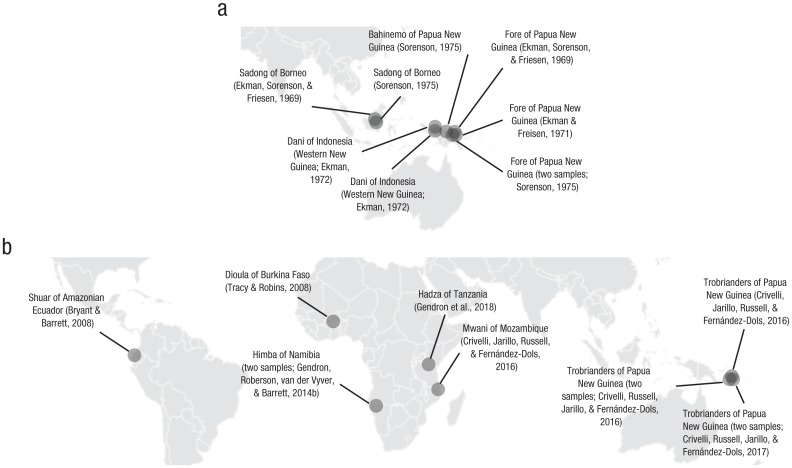
“Second, the Fore samples in Ekman and Friesen (1971) and Sorenson (1975) were the exact same size (189 adults and 130 children) and yielded nearly identical results; they are reported separately because Ekman (1994) indicated that the samples were distinct.”
BackgroundResult(2017) · Cited by 2,433
Self-citationOn the universality and cultural specificity of emotion recognition: a meta-analysis
Elfenbein, H. A., & Ambady, N. (2002) · Psychological Bulletin · doi:10.1037/0033-2909.128.2.203 · Cited by 2,049 · cited 2×
“…perception across cultures (extending beyond studies of small-scale societies) has been designed to validate the universality thesis rather than to discover or rule out diversity in how people make meaning of other people’s facial movements (e.g., Elfenbein & Ambady, 2002; Nelson & Russell, 2013).”
BackgroundMethodPan-cultural elements in facial displays of emotion
Ekman, P., Sorenson, E. R., & Friesen, W. V. (1969) · Science · doi:10.1126/science.164.3875.86 · Cited by 1,775 · cited 1×
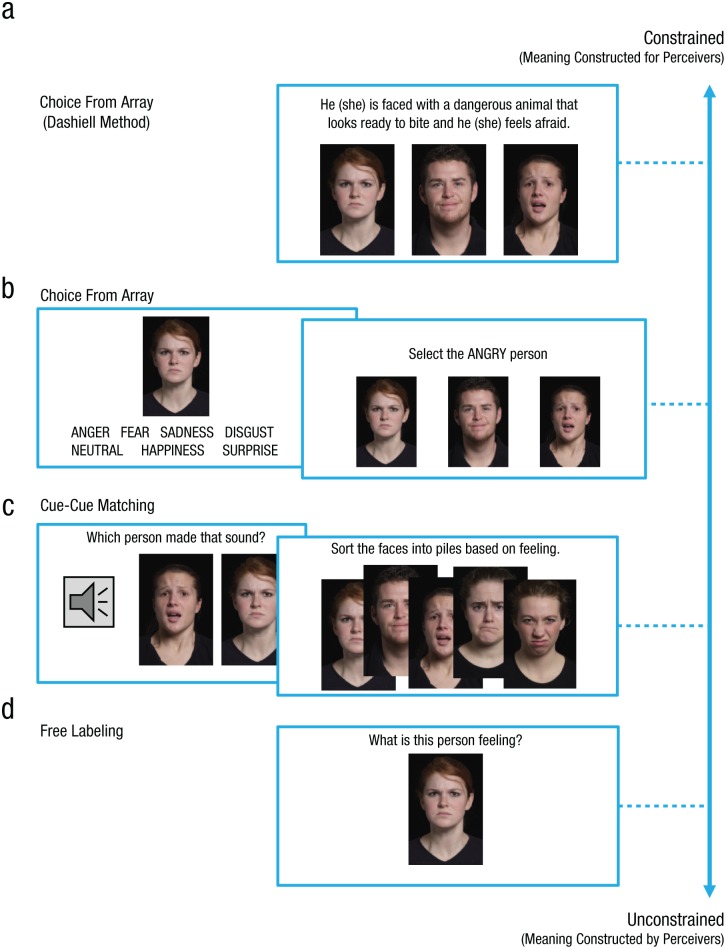
“…labeling None Dani of New Guinea (Indonesia) 34 adults Ekman (1972) X Choice from array (Dashiell method) None Fore of Papua New Guinea 32 adults Ekman, Sorenson, and Friesen (1969)a X Choice from array None Fore of Papua New Guinea 130 children, 189 adults Ekman and Friesen (1971) X Choice…”
MethodRussell, J. A. (1994) · Psychological Bulletin · doi:10.1037/0033-2909.115.1.102 · Cited by 1,640 · cited 9×
“Several of these samples were written up only in brief, resulting in omissions in reporting data and statistical analysis (Russell, 1994).”
BackgroundMethodResultInfluentialThe cultural niche: Why social learning is essential for human adaptation
Boyd, R., Richerson, P. J., & Henrich, J. (2011) · Proceedings of the National Academy of Sciences · doi:10.1073/pnas.1100290108 · Cited by 1,303
The Essential Child: Origins of Essentialism in Everyday Thought
Gelman, S. A. (2003) · doi:10.1093/acprof:oso/9780195154061.001.0001 · Cited by 1,247 · cited 1×
“For example, words often serve as placeholders for undefined mental essences that are thought to cause observable features (Gelman, 2003).”
Strong evidence for universals in facial expressions: A reply to Russell's mistaken critique.
Ekman, P. (1994) · Psychological Bulletin · doi:10.1037//0033-2909.115.2.268 · Cited by 1,130 · cited 1×
“Second, the Fore samples in Ekman and Friesen (1971) and Sorenson (1975) were the exact same size (189 adults and 130 children) and yielded nearly identical results; they are reported separately because Ekman (1994) indicated that the samples were distinct.”
ResultBarrett, L. F., Mesquita, B., & Gendron, M. (2011) · Current Directions in Psychological Science · doi:10.1177/0963721411422522 · Cited by 921
Self-citation
Research works printed but not linked: 1
- Ekman P. (1972). Universals and cultural differences in facial expressions of emotion. In Cole J. (Ed.), Nebraska Symposium on Motivation, 1971: Cultural Psychology (Vol. 19, pp. 207– 282). Lincoln: University of Nebraska Press.
Cited by
Items 201–205 of 205
Emotion Dynamics in Multicultural Societies
Leersnyder, J. D. (2026) · Cambridge University Press eBooks · doi:10.1017/9781108768436.010
Emotions across Languages and Cultures
Lorette, P., & Dewaele, J. (2026) · Cambridge University Press eBooks · doi:10.1017/9781108768436.012
HERA: Hybrid Emotion Recognition Model for Alexithymia Assessment Using AI and Multimodal Data
Seong, Y. J., Yoo, S., Kim, S., Son, D., & Oh, H. (2026) · ACM Symposium on Applied Computing · doi:10.1145/3748522.3779953
“These constraints become more pronounced in alexithymia, where attenuated facial reactivity, gaze avoidance, and sparse emotional vocabulary reduce the diagnostic utility of unimodal cues [19, 22].”
Küster, D., Rammohan, R. A., Liu, H., Schultz, T., & Koschke, R. (2026) · Communications in computer and information science · doi:10.1007/978-3-032-34456-4_3
Socially embedded predictive construction: a model of emotional experience
Grimaldi, R. (2026) · Academia Neuroscience and Brain Research · doi:10.20935/acadneurosci8594
Metadata
- Authors
- Gendron, M., Crivelli, C., & Barrett, L. F.
- Affiliations
- Northeastern University (US)
- De Montfort University (GB)
- Corresponding author
- Gendron, Maria
- Venue
- Current Directions in Psychological Science
- Publisher
- SAGE Publications
- Published
- 2018-07-31
- Volume
- 27
- Issue
- 4
- Pages
- 211-219
- ISSN
- 0963-7214 (ISSN-L)
- 1467-8721
- PMC
- PMC6099968
- OpenAlex
- W2885466588
- Semantic Scholar
- 27a434cb0b4042f72601cc15fa01868200541d50
- Cited by
- 205
- References
- 43
- Citations by year
- 2026: 13 · 2025: 16 · 2024: 17 · 2023: 17 · 2022: 27 · 2021: 30 · 2020: 52 · 2019: 30 · 2018: 3
- FWCI
- 17.12
- Type
- journal article
- Language
- en
- Open access
- hybrid
- doi.org
- Licence
- Locations
- Current Directions in Psychological Science (publishedVersion, cc-by-nc)
- Europe PMC (PubMed Central) (publishedVersion, cc-by-nc)
- PubMed Central (publishedVersion, cc-by-nc)
- PubMed (publishedVersion)
- DMU Open Research Archive (De Montfort University) (submittedVersion)
- Funders
- National Institute of Mental Health (5F32MH105052)
- Army Research Institute for the Behavioral and Social Sciences (W911NF-15-1-0647)
- Topics
- Life Sciences › Neuroscience › Cognitive Neuroscience › Face Recognition and Perception
- Social Sciences › Psychology › Social Psychology › Cultural Differences and Values
- Social Sciences › Psychology › Experimental and Cognitive Psychology › Evolutionary Psychology and Human Behavior
- Keywords
- universal emotions, facial expressions, emotion perception, cross-cultural variation, small-scale societies, cross-cultural psychology
About these checks
Registry, retraction, Cites and statistics results are computed, not judged, with one exception: a printed reference that no index lists is read once by a model before it counts as a citation error. Claims are extracted by a model and kept only when their quote appears verbatim in the text; each cited source is then checked, with a model’s help, for whether it says what the claim relies on. Those verdicts can be wrong — read the claim’s quote and the cited source before relying on one.
Statistics and arithmetic are recomputed, not judged.
Confidence bands are shown only for fields calibrated on our annotated test set. None is calibrated yet, so no band is shown.
What counts as a claim ›How we measure confidence ›How we check this ›
Are you an author, or do you see a problem with this page? Request a review
Data sources
Bibliographic data: Semantic Scholar, OpenAlex, Crossref.
Contains information from the Semantic Scholar Academic Graph Datasets, made available under the ODC Attribution License (ODC-BY 1.0).
Semantic Scholar’s data is described in: Kinney, R., et al. (2023). The Semantic Scholar Open Data Platform. arXiv:2301.10140.
