

The DOI matches its Crossref record; 8 of the 8 references it cites were found in a registry or an index.
‘Corona? 5G? or both?’: the dynamics of COVID-19/5G conspiracy theories on Facebook
Open accessAbstract
Focussing in detail on one key component of the infodemic surrounding COVID-19, this article traces the dissemination dynamics of rumours that the pandemic outbreak was somehow related to the rollout of 5G mobile telephony technology in Wuhan and around the world. Drawing on a mixture of quantitative and qualitative methods including time-series analysis, network analysis and in-depth close reading, our analysis shows the dissemination of the rumour on Facebook from its obscure origins in pre-existing conspiracist groups through greater uptake in more diverse communities to substantial amplification by celebrities, sports stars and media outlets. The in-depth tracing of COVID-related mis- and disinformation across social networks offers important new insights into the dynamics of online information dissemination and points to opportunities to slow and stop the spread of false information, or at least to combat it more directly with accurate counterinformation.
Overview
The claims and statistics of this paper haven’t been checked yet.
Run the check — free, no account needed. It reads the open-access text and checks the sources it cites.
Integrity signals
Registry
Cites
Statistics
Figures
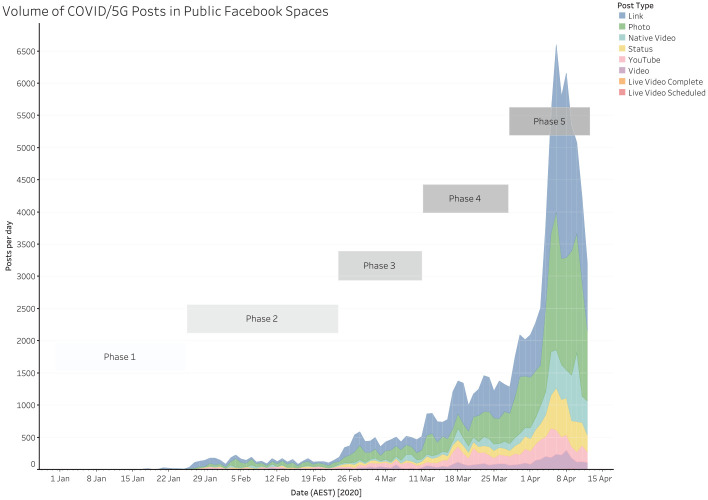
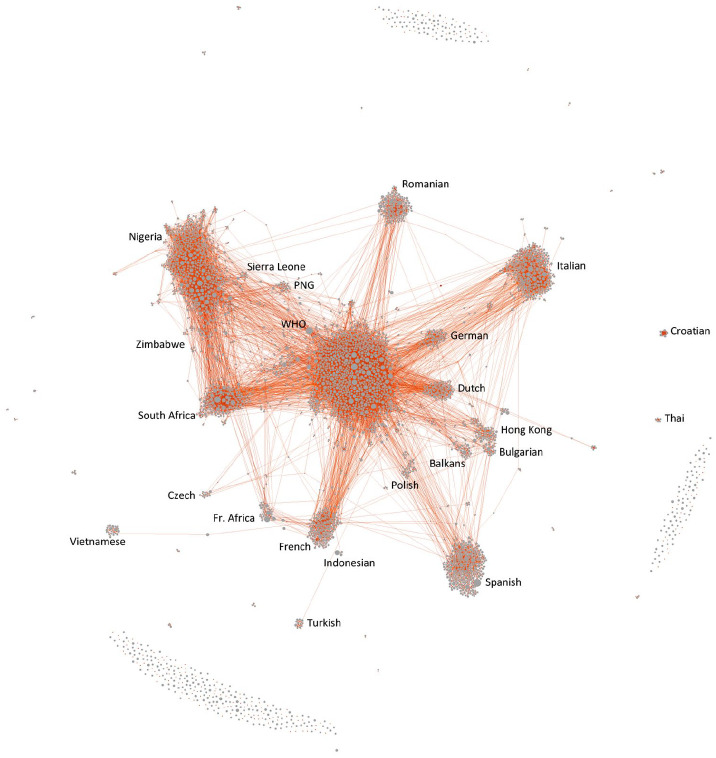
Verification
Claims the paper makes
The claims and statistics of this paper haven’t been checked yet.
Run the check — free, no account needed. It reads the open-access text and checks the sources it cites.
Claims other papers make about this one
Each is checked against this paper’s own text: does it say what the citing paper says it does?
The source backs part of the claim, not all of it — or backs it for a different population, condition or comparison.
In the citing paper
“More recently, Bruns et al. (2020) demonstrated that the conspiracy theory linking 5G to COVID-19 emerged by merging two existing conspiracy theories -one positing that the pandemic was a deliberate event and the other asserting that 5G emissions have adverse health effects.”
From The Seed of Doubt: Examining the Role of Alternative Social and News Media for the Birth of a Conspiracy Theory (2024) · cites this paper as Bruns et al., 2020
Experimental — accuracy not yet measured
Self-check
Percentages, sums and reported differences re-computed from the paper’s own numbers.
The self-check needs the paper’s full text.
Citations
Cites
Gephi: An Open Source Software for Exploring and Manipulating Networks
Bastian, M., Heymann, S., & Jacomy, M. (2009) · Proceedings of the International AAAI Conference on Web and Social Media · doi:10.1609/icwsm.v3i1.13937 · Cited by 11,675
When Corrections Fail: The Persistence of Political Misperceptions
Nyhan, B., & Reifler, J. (2010) · Political Behavior · doi:10.1007/s11109-010-9112-2 · Cited by 3,173
Jacomy, M., Venturini, T., Heymann, S., & Bastian, M. (2014) · PLoS ONE · doi:10.1371/journal.pone.0098679 · Cited by 2,909
Populist online practices: the function of the Internet in right-wing populism
Krämer, B. (2017) · Information Communication & Society · doi:10.1080/1369118x.2017.1328520 · Cited by 386
After the ‘APIcalypse’: social media platforms and their fight against critical scholarly research
Bruns, A. (2019) · Information, Communication & Society · doi:10.1080/1369118x.2019.1637447 · Cited by 319
Self-citationAllport, G. W., & Postman, L. (1946) · Public Opinion Quarterly · doi:10.1093/poq/10.4.501 · Cited by 244
Conspiracy Theories as a Russian Public Diplomacy Tool: The Case of Russia Today (RT)
Yablokov, I. (2015) · Politics · doi:10.1111/1467-9256.12097 · Cited by 211
Amarasingam, A. (2019) · I.B.Tauris eBooks · doi:10.5040/9781788315579.ch-004 · Cited by 6
Research works printed but not linked: 4
- 10.1086/265813 · DOI
- Benkelman S (2019) The sound of silence: strategic amplification. In: Getting It Right: Strategies for Truth-Telling in a Time of Misinformation and Polarization. American Press Institute. Available at: https://www.americanpressinstitute.org/publications/reports/strategy-studies/the-sound-of-silence-strategic-amplification/ (accessed 28 May 2020).
- Hall S (1980) Encoding/decoding. In: Hall S, Hobson D, Lowe A, et al. (eds) Culture, Media, Language: Working Papers in Cultural Studies, 1972-79. London: Unwin Hyman, pp. 128–139.
- Oswald ME, Grosjean S (2004) Confirmation bias. In: Pohl RF (ed.) Cognitive Illusions: A Handbook on Fallacies and Biases in Thinking, Judgement and Memory. Hove: Psychology Press, pp. 79–96.
Cited by
Sorted by citations
What social media told us in the time of COVID-19: A scoping review
Tsao, S.-F., Chen, H., Tisseverasinghe, T., Yang, Y., Li, L., & Butt, Z. A. (2021) · The Lancet Digital Health · doi:10.1016/s2589-7500(20)30315-0 · Cited by 816
An epidemic of uncertainty: rumors, conspiracy theories and vaccine hesitancy
Pertwee, E., Simas, C., & Larson, H. J. (2022) · Nature Medicine · doi:10.1038/s41591-022-01728-z · Cited by 356
Antecedents and consequences of COVID-19 conspiracy beliefs: A systematic review
van Mulukom, V., Pummerer, L., Alper, S., Bai, H., Čavojová, V., Farias, J. E. M., Kay, C. S., Lazarević, L. B., Lobato, E. J. C., Marinthe, G., et al. (2022) · Social Science & Medicine · doi:10.1016/j.socscimed.2022.114912 · Cited by 437
Kwok, S. W. H., Vadde, S. K., & Wang, G. (2021) · Journal of Medical Internet Research · doi:10.2196/26953 · Cited by 198
Mahl, D., Schäfer, M. S., & Zeng, J. (2022) · New Media & Society · doi:10.1177/14614448221075759 · Cited by 132
Internet Memes as Partial Stories: Identifying Political Narratives in Coronavirus Memes
Laurent, C. D. S., Glăveanu, V. P., & Literat, I. (2021) · Social Media + Society · doi:10.1177/2056305121988932 · Cited by 103
Bruns, A. (2023) · Communication Theory · doi:10.1093/ct/qtad007 · Cited by 141
Self-citationConceptualizing “Dark Platforms”. Covid-19-Related Conspiracy Theories on 8kun and Gab
Zeng, J., & Schäfer, M. S. (2021) · Digital Journalism · doi:10.1080/21670811.2021.1938165 · Cited by 125
CoVerifi: A COVID-19 news verification system
Kolluri, N. L., & Murthy, D. (2021) · Online Social Networks and Media · doi:10.1016/j.osnem.2021.100123 · Cited by 84
COVID-19, 5G conspiracies and infrastructural futures
Meese, J., Frith, J., & Wilken, R. (2020) · Media International Australia · doi:10.1177/1329878x20952165 · Cited by 76
Misinformation and the epistemic integrity of democracy
Lewandowsky, S., Ecker, U. K. H., Cook, J., van der Linden, S., Roozenbeek, J., & Орескес, Н. (2023) · Current Opinion in Psychology · doi:10.1016/j.copsyc.2023.101711 · Cited by 123
Antecedents and consequences of COVID-19 conspiracy beliefs: a systematic reviewPreprint
van Mulukom, V., Pummerer, L., Alper, S., Bai, H., Čavojová, V., Farias, J. E. M., Kay, C. S., Lazarević, L. B., Lobato, E. J. C., Marinthe, G., et al. (2020) · doi:10.31234/osf.io/u8yah · Cited by 71
Pagallo, U., O’Sullivan, S., Nevejans, N., Holzinger, A., Friebe, M., Jeanquartier, F., Jean-Quartier, C., & Miernik, A. J. (2023) · Health and Technology · doi:10.1007/s12553-023-00806-7 · Cited by 81
Hartman, T. K., Marshall, M., Stocks, T. V. A., McKay, R., Bennett, K. M., Butter, S., Miller, J. G., Hyland, P., Levita, L., Martínez, A. P., et al. (2021) · Frontiers in Political Science · doi:10.3389/fpos.2021.642510 · Cited by 76
Mahl, D., Zeng, J., & Schäfer, M. S. (2021) · Social Media + Society · doi:10.1177/20563051211017482 · Cited by 81
Recuero, R., Soares, F. B., & Zago, G. D. S. (2021) · Revista Contracampo · doi:10.22409/contracampo.v40i1.45611 · Cited by 65
Plandemic Revisited: A Product of Planned Disinformation Amplifying the COVID-19 “infodemic”
Nazar, S., & Pieters, T. (2021) · Frontiers in Public Health · doi:10.3389/fpubh.2021.649930 · Cited by 63
Schwarzenegger, C. (2022) · Digital Journalism · doi:10.1080/21670811.2021.2000454 · Cited by 61
Defining Misinformation and Related Terms in Health-Related Literature: Scoping Review
Mikati, I. K. E., Hoteit, R., Harb, T., Zein, O. E., Piggott, T., Melki, J. P., Mustafa, R. A., & Akl, E. A. (2023) · Journal of Medical Internet Research · doi:10.2196/45731 · Cited by 73
Brüggemann, M., & Meyer, H. (2023) · Communication Theory · doi:10.1093/ct/qtad012 · Cited by 60
COVID-19 fake news diffusion across Latin America
Ceron, W., Sanseverino, G. G., de‐Lima‐Santos, M., & Quiles, M. G. (2021) · Social Network Analysis and Mining · doi:10.1007/s13278-021-00753-z · Cited by 64
Conspiracy Beliefs and Acceptance of COVID-Vaccine: An Exploratory Study in Italy
Pivetti, M., Melotti, G., Bonomo, M., & Hakoköngäs, E. J. (2021) · Social Sciences · doi:10.3390/socsci10030108 · Cited by 67
Learning about COVID-19: a qualitative interview study of Australians’ use of information sources
Lupton, D. A., & Lewis, S. C. (2021) · BMC Public Health · doi:10.1186/s12889-021-10743-7 · Cited by 60
A New Dark Age? Truth, Trust, and Environmental Science
Gundersen, T., Alinejad, D., Branch, T. Y., Duffy, B., Hewlett, K., Holst, C., Owens, S. E., Panizza, F., Tellmann, S. M., van Dijck, J., et al. (2022) · Annual Review of Environment and Resources · doi:10.1146/annurev-environ-120920-015909 · Cited by 61
The Affective Algorithms of Conspiracy TikTok
Grandinetti, J. J., & Bruinsma, J. (2022) · Journal of Broadcasting & Electronic Media · doi:10.1080/08838151.2022.2140806 · Cited by 75
Xiao, X. (2022) · New Media & Society · doi:10.1177/14614448221104948 · Cited by 54
Zeng, J., & Chan, C. (2021) · Online Information Review · doi:10.1108/oir-09-2020-0417 · Cited by 56
Demystifying the COVID-19 Infodemic: Conspiracies, Context, and the Agency of Users
Gagliardone, I., Diepeveen, S., Findlay, K., Olaniran, S., Pohjonen, M., & Tallam, E. (2021) · Social Media + Society · doi:10.1177/20563051211044233 · Cited by 49
Incidental news exposure and COVID-19 misperceptions: A moderated-mediation model
Borah, P., Su, Y., Xiao, X., & Lee, D. K. L. (2021) · Computers in Human Behavior · doi:10.1016/j.chb.2021.107173 · Cited by 57
Kauk, J., Kreysa, H., & Schweinberger, S. R. (2021) · PLoS ONE · doi:10.1371/journal.pone.0256179 · Cited by 52
Darius, P., & Urquhart, M. (2021) · Online Social Networks and Media · doi:10.1016/j.osnem.2021.100174 · Cited by 57
Deep state phobia: Narrative convergence in coronavirus conspiracism on Instagram
Tuters, M., & Willaert, T. (2022) · Convergence The International Journal of Research into New Media Technologies · doi:10.1177/13548565221118751 · Cited by 45
Fake news agenda in the era of COVID-19: identifying trends through fact-checking content
Ceron, W. (., de‐Lima‐Santos, M., & Quiles, M. G. (. G. ). (2021) · Deposito Adademico Digital Universidad De Navarra (University of Navarra) · Cited by 44
Irrational Beliefs about COVID-19: A Scoping Review
Magarini, F. M., Pinelli, M., Sinisi, A., Ferrari, S., Fazio, G. L. D., & Galeazzi, G. M. (2021) · International Journal of Environmental Research and Public Health · doi:10.3390/ijerph18199839 · Cited by 47
Rise of Conspiracy Theories in the Pandemic Times
Kużelewska, E., & Tomaszuk, M. (2022) · International Journal for the Semiotics of Law - Revue internationale de Sémiotique juridique · doi:10.1007/s11196-022-09910-9 · Cited by 43
What’s “Up Next”? Investigating Algorithmic Recommendations on YouTube Across Issues and Over Time
Matamoros-Fernández, A., Gray, J. E., Bartolo, L., Burgess, J., & Suzor, N. P. (2021) · Media and Communication · doi:10.17645/mac.v9i4.4184 · Cited by 54
Alternative Counter-News Use and Fake News Recall During the COVID-19 Crisis
Frischlich, L., Kuhfeldt, L., Schatto-Eckrodt, T., & Clever, L. (2023) · Digital Journalism · doi:10.1080/21670811.2022.2106259 · Cited by 38
McCarthy, M., Murphy, K., Sargeant, E., & Williamson, H. (2021) · Analyses of Social Issues and Public Policy · doi:10.1111/asap.12291 · Cited by 40
Covering Conspiracy: Approaches to Reporting the COVID/5G Conspiracy Theory
Bruns, A., Hurcombe, E., & Harrington, S. (2021) · Digital Journalism · doi:10.1080/21670811.2021.1968921 · Cited by 37
Self-citationMarginalizing the Mainstream: How Social Media Privilege Political Information
Rogers, R. (2021) · Frontiers in Big Data · doi:10.3389/fdata.2021.689036 · Cited by 36
Conspiracy beliefs and attitudes toward COVID-19 vaccinations
Pivetti, M., Battista, S. D., Paleari, F. G., & Hakoköngäs, E. J. (2021) · Journal of Pacific Rim Psychology · doi:10.1177/18344909211039893 · Cited by 39
Smart water metering: adoption, regulatory and social considerations
Koech, R., Cardell‐Oliver, R., & Syme, G. J. (2021) · Australasian Journal of Water Resources · doi:10.1080/13241583.2021.1983968 · Cited by 34
Vaughan, P., Lenette, C., & Boydell, K. (2022) · BMJ Open · doi:10.1136/bmjopen-2021-057393 · Cited by 34
Liberty and the pursuit of science denial
Lewandowsky, S. (2021) · Current Opinion in Behavioral Sciences · doi:10.1016/j.cobeha.2021.02.024 · Cited by 40
Schatto-Eckrodt, T., Clever, L., & Frischlich, L. (2024) · Social Science Computer Review · doi:10.1177/08944393241246281 · Cited by 32
“…of the 5G conspiracy theory across Facebook, originating from “ obscure origins in pre-existing conspiracist groups, spreading to more diverse communities, and ultimately gaining substantial traction through endorsement by celebrities, sports fi gures, and media outlets ” (Bruns et al., 2020, p. 1).”
InfluentialInterconnectedness and (in)coherence as a signature of conspiracy worldviews
Miani, A., Hills, T. T., & Bangerter, A. (2022) · Science Advances · doi:10.1126/sciadv.abq3668 · Cited by 35
Debate on online social networks at the time of COVID-19: An Italian case study
Trevisan, M., Vassio, L., & Giordano, D. (2021) · Online Social Networks and Media · doi:10.1016/j.osnem.2021.100136 · Cited by 30
Doing your own research and other impossible acts of epistemic superheroism
Buzzell, A., & Rini, R. A. (2022) · Philosophical Psychology · doi:10.1080/09515089.2022.2138019 · Cited by 30
Re-thinking Information Ethics: Truth, Conspiracy Theories, and Librarians in the COVID-19 Era
Lor, P. J., Wiles, B., & Britz, J. (2021) · Libri · doi:10.1515/libri-2020-0158 · Cited by 32
Nowak, B. M., Miedziarek, C., Pełczyński, S., & Rzymski, P. (2021) · International Journal of Environmental Research and Public Health · doi:10.3390/ijerph182212266 · Cited by 30
Madziva, R., Nachipo, B., Musuka, G., Chitungo, I. J. B., Murewanhema, G., Phiri, B., & Dzinamarira, T. (2022) · Health Promotion Perspectives · doi:10.34172/hpp.2022.03 · Cited by 28
Raza, S. H., Yousaf, M. T., Zaman, U., Khan, S. W., Core, R. S., & Malik, A. N. (2023) · Vaccine · doi:10.1016/j.vaccine.2023.01.047 · Cited by 31
Jenal, C., Endreß, S., Kühne, O., & Zylka, C. (2021) · Sustainability · doi:10.3390/su132413550 · Cited by 27
Ng, J. Y., Verhoeff, N., & Steen, J. P. (2023) · BMC Complementary Medicine and Therapies · doi:10.1186/s12906-023-03856-6 · Cited by 29
COVID-19 Conspiracies, Trust in Authorities, and Duty to Comply with Social Distancing Restrictions
Murphy, K., McCarthy, M., Sargeant, E., & Williamson, H. (2022) · International Criminology · doi:10.1007/s43576-021-00042-x · Cited by 34
Lee, E. W. J., Zheng, H., Goh, D. H., Lee, C. S., & Theng, Y. L. (2023) · Health Communication · doi:10.1080/10410236.2023.2170201 · Cited by 27
Guardians of truth? Fact-checking the ‘disinfodemic’ in Southern Africa during the COVID-19 pandemic
Mare, A., & Munoriyarwa, A. (2022) · Journal of African Media Studies · doi:10.1386/jams_00065_1 · Cited by 25
Public policy and conspiracies: The case of mandates
Lewandowsky, S., Holford, D. L., & Schmid, P. (2022) · Current Opinion in Psychology · doi:10.1016/j.copsyc.2022.101427 · Cited by 24
Пути российской инфодемии: от WhatsApp до Следственного комитета
Arkhipova, A., Radchenko, D., Козлова, И. В., Пейгин, Б. С., Гаврилова, М. В., & Петров, Н. В. (2020) · Monitoring obŝestvennogo mneniâ: èkonomičeskie i socialʹnye peremeny · doi:10.14515/monitoring.2020.6.1778 · Cited by 28
How Sustainable Is Human Resource Management Really? An Argument for Radical Sustainability
Bal, P. M., & Brookes, A. (2022) · Sustainability · doi:10.3390/su14074219 · Cited by 24
Taylor, Z. A., & Abidin, C. (2024) · International Journal of Cultural Studies · doi:10.1177/13678779241276751 · Cited by 27
Deepfakes and documentary practice in an age of misinformation
Hight, C. (2021) · Continuum · doi:10.1080/10304312.2021.2003756 · Cited by 23
Toepfl, F., Kravets, D., Ryzhova, A., & Beseler, A. (2022) · Information Communication & Society · doi:10.1080/1369118x.2022.2065213 · Cited by 22
Mindsets of conspiracy: A typology of affinities towards conspiracy myths in digital environments
Schwaiger, L., Schneider, J., Rauchfleisch, A., & Eisenegger, M. (2022) · Convergence The International Journal of Research into New Media Technologies · doi:10.1177/13548565221106427 · Cited by 31
Gruzd, A. A., Mai, P., & Soares, F. B. (2022) · Social Network Analysis and Mining · doi:10.1007/s13278-022-00948-y · Cited by 22
Conspiracy theories in digital environments: Moving the research field forward
Zeng, J., Schäfer, M. S., & Oliveira, T. M. (2022) · Convergence: The International Journal of Research into New Media Technologies · doi:10.1177/13548565221117474 · Cited by 21
Measuring the diffusion of conspiracy theories in digital information ecologies
Heft, A., & Buehling, K. (2022) · Convergence The International Journal of Research into New Media Technologies · doi:10.1177/13548565221091809 · Cited by 22
Heft, A., Buehling, K., Zhang, X., Schindler, D. J., & Milzner, M. (2023) · Journal of Information Technology & Politics · doi:10.1080/19331681.2023.2250779 · Cited by 21
Motta, M. (2024) · doi:10.1093/9780197788844.001.0001 · Cited by 26
Bruns, A., Harrington, S., & Hurcombe, E. (2021) · Springer eBooks · doi:10.1007/978-3-030-79735-5_12 · Cited by 18
Self-citationInformation needs and seeking behaviors of Israeli citizens during the COVID-19 outbreak
Yavetz, G., Aharony, N., & Sofer, Y. Y. (2022) · Aslib Journal of Information Management · doi:10.1108/ajim-06-2021-0167 · Cited by 18
Nera, K., Mora, Y. L., Klein, P., Roblain, A., Oost, P. V., Terache, J., & Klein, O. (2022) · Psychologica Belgica · doi:10.5334/pb.1086 · Cited by 14
Himelboim, I., Borah, P., Lee, D. K. L., Lee, J. J., Su, Y., Vishnevskaya, A., & Xiao, X. (2023) · New Media & Society · doi:10.1177/14614448221142800 · Cited by 18
Dasgupta, S., Leong, C., Simonich, M. T., Truong, L., Liu, H., & Tanguay, R. L. (2022) · Environmental Science & Technology Letters · doi:10.1021/acs.estlett.2c00037 · Cited by 18
Bernsteiner, A., Schubatzky, T., & Haagen‐Schützenhöfer, C. (2023) · Sustainability · doi:10.3390/su15108161 · Cited by 17
People’s Perspectives on Social Media Use during COVID-19 Pandemic
Karhu, M., Suoheimo, M., & Häkkilä, J. (2021) · International Conference on Mobile and Ubiquitous Multimedia (MUM) · doi:10.1145/3490632.3490666 · Cited by 20
Kristensen, J. B., Henriksen, F. M., & Mayerhöffer, E. (2023) · Social Media + Society · doi:10.1177/20563051231192963 · Cited by 18
COVID-19 and 5G conspiracy theories: long term observation of a digital wildfire
Langguth, J., Filkuková, P., Brenner, S., Schroeder, D. T., & Pogorelov, K. (2022) · International Journal of Data Science and Analytics · doi:10.1007/s41060-022-00322-3 · Cited by 17
Fake news et théories du complot en période(s) pandémique(s)
Giry, J. (2022) · Quaderni · doi:10.4000/quaderni.2303 · Cited by 22
Ali, Y., & Khan, H. U. (2023) · Computer Networks · doi:10.1016/j.comnet.2023.109605 · Cited by 17
“ COVID19 is_”: The Perpetuation of Coronavirus Conspiracy Theories via Google Autocomplete
Houli, D., Radford, M. L., & Singh, V. K. (2021) · Proceedings of the Association for Information Science and Technology · doi:10.1002/pra2.450 · Cited by 15
Where conspiracy theories flourish: A study of YouTube comments and Bill Gates conspiracy theories
Ha, L. T., Graham, T., & Gray, J. E. (2022) · Harvard Kennedy School Misinformation Review · doi:10.37016/mr-2020-107 · Cited by 14
Contesting Infrastructural Futures: 5G Opposition as a Technological Drama
Butot, V., & van Zoonen, L. (2022) · Science Technology & Human Values · doi:10.1177/01622439221147347 · Cited by 16
Interpretations of Innovation: The Role of Technology in Explanation Seeking Related to Psychosis
Higgins, O., Short, B., Chalup, S. K., & Wilson, R. L. (2023) · Perspectives In Psychiatric Care · doi:10.1155/2023/4464934 · Cited by 19
Haupt, M. R., Chiu, M., Chang, J., Li, Z., Cuomo, R. E., & Mackey, T. K. (2023) · PLoS ONE · doi:10.1371/journal.pone.0295414 · Cited by 17
Alperín, J. P., Fleerackers, A., Riedlinger, M. E., & Haustein, S. (2024) · Quantitative Science Studies · doi:10.1162/qss_a_00298 · Cited by 18
Pagallo, U., & Durante, M. (2022) · J — Multidisciplinary Scientific Journal · doi:10.3390/j5010011 · Cited by 13
Xu, G., Qian, M., & Meng, L. (2025) · Humanities and Social Sciences Communications · doi:10.1057/s41599-025-06067-1 · Cited by 26
New Insights Into the Social Rumor Characteristics During the COVID-19 Pandemic in China
Lv, W., Zhou, W., Gao, B., Han, Y., & Fang, H. (2022) · Frontiers in Public Health · doi:10.3389/fpubh.2022.864955 · Cited by 12
Мусолфф, А. (2022) · Discourse approaches to politics, society and culture · doi:10.1075/dapsac.98.06mus · Cited by 12
Lubicz-Zaorski, C., Newlands, M., & Petray, T. (2023) · Public Understanding of Science · doi:10.1177/09636625231202117 · Cited by 12
Navigating the Disinformation Maze: A Bibliometric Analysis of Scholarly Efforts
Tataru, G.-C., Domenteanu, A., Delcea, C., Florescu, M., Orzan, M., & Cotfas, L.-A. (2024) · Inf. · doi:10.3390/info15120742 · Cited by 13
Looking back to look forward: 5G/COVID-19 conspiracies and the long history of infrastructural fears
Frith, J., Campbell, S. W., & Komen, L. J. (2022) · Mobile Media & Communication · doi:10.1177/20501579221133950 · Cited by 13
Küçükaydın, M. A., Seher, E. S. E. N., & Gürbüzer, S. (2023) · Applied Cognitive Psychology · doi:10.1002/acp.4120 · Cited by 12
Motta, M., Hwang, J., & Stecula, D. (2024) · Health Communication · doi:10.1080/10410236.2023.2254583 · Cited by 11
Marques, F. P. J., Ferracioli, P., Comel, N., & Kniess, A. B. (2023) · Journalism · doi:10.1177/14648849231165579 · Cited by 11
From TikTok Trends to Pandemic Essentials
Meriç, E., & Çakıcı, Z. (2023) · Advances in multimedia and interactive technologies book series · doi:10.4018/979-8-3693-0896-7.ch001 · Cited by 11
Australia’s DIGI Code: what can we learn from the EU experience?
Hurcombe, E., & Meese, J. (2022) · Australian Journal of Political Science · doi:10.1080/10361146.2022.2122774 · Cited by 11
Self-citationMamalipurath, J. M., & Notley, T. (2022) · Journal of Intercultural Studies · doi:10.1080/07256868.2022.2128088 · Cited by 11
Scandurra, C., Pizzo, R., Pinto, L. E., Cafasso, C., Pellegrini, R., Cafaggi, F., D’Anna, O., Muzii, B., Bochicchio, V., & Maldonato, M. N. (2022) · European Journal of Investigation in Health Psychology and Education · doi:10.3390/ejihpe12100109 · Cited by 16
Metadata
- Authors
- Bruns, A., Harrington, S., & Hurcombe, E.
- Affiliations
- Queensland University of Technology (AU)
- Corresponding author
- Bruns, Axel
- Venue
- Media International Australia
- Publisher
- SAGE Publications
- Published
- 2020-08-04
- Volume
- 177
- Issue
- 1
- Pages
- 12-29
- ISSN
- 1324-5325 (ISSN-L)
- 1329-878X
- 2200-467X
- PMC
- PMC7404088
- OpenAlex
- W3047084175
- Cited by
- 291
- References
- 8
- Citations by year
- 2026: 18 · 2025: 23 · 2024: 54 · 2023: 56 · 2022: 72 · 2021: 62 · 2020: 6
- FWCI
- 65.57
- Type
- journal article
- Language
- en
- Open access
- hybrid
- doi.org
- Locations
- Media International Australia (publishedVersion, cc-by)
- PubMed Central (publishedVersion, cc-by)
- QUT ePrints (Queensland University of Technology) (submittedVersion, cc-by)
- Figshare (submittedVersion)
- Funders
- Australian Research Council (DP200101317 Evaluating the Challenge of ‘Fake Ne, FT130100703 Understanding Intermedia Information F)
- Topics
- Social Sciences › Sociology and Political Science › Misinformation and Its Impacts
- Social Sciences › Communication › Communication and COVID-19 Impact
- Physical Sciences › Physics and Astronomy › Statistical and Nonlinear Physics › Complex Network Analysis Techniques
- Keywords
- COVID-19 conspiracy theories, 5G, infodemic, disinformation, Facebook, online information dissemination, counter-information
About these checks
Registry, retraction, Cites and statistics results are computed, not judged, with one exception: a printed reference that no index lists is read once by a model before it counts as a citation error. Claims are extracted by a model and kept only when their quote appears verbatim in the text; each cited source is then checked, with a model’s help, for whether it says what the claim relies on. Those verdicts can be wrong — read the claim’s quote and the cited source before relying on one.
Statistics and arithmetic are recomputed, not judged.
Confidence bands are shown only for fields calibrated on our annotated test set. None is calibrated yet, so no band is shown.
What counts as a claim ›How we measure confidence ›How we check this ›
Are you an author, or do you see a problem with this page? Request a review
