

The DOI matches its Crossref record; 52 of the 52 references it cites were found in a registry or an index.
A trial of an iPad ™ intervention targeting social communication skills in children with autism
Open accessAbstract
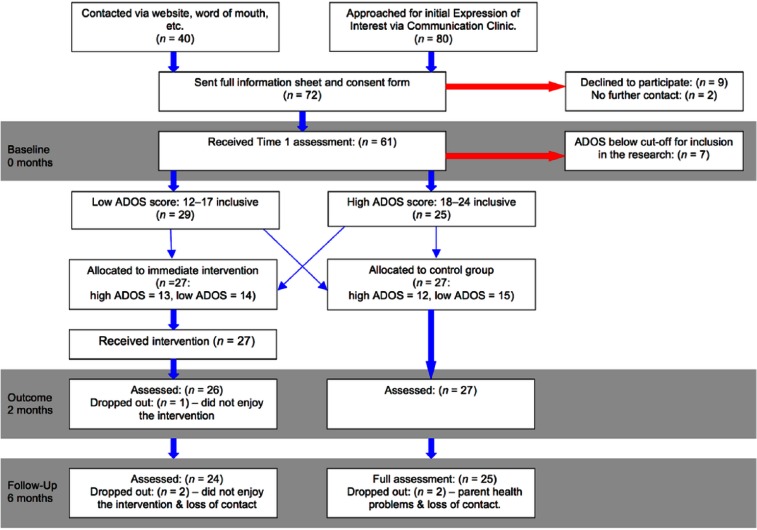
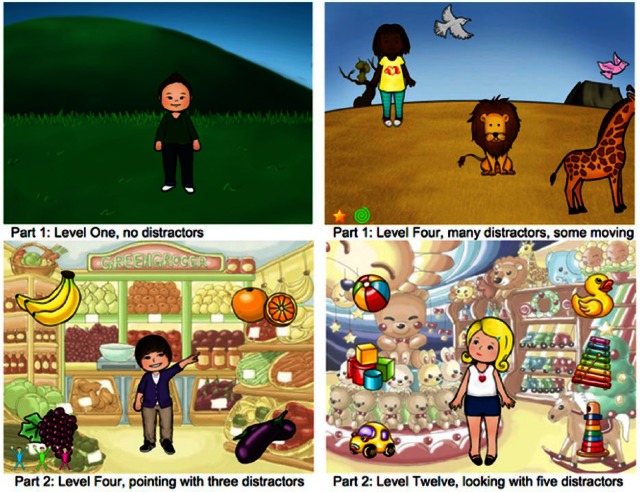
This study evaluated a technology-based early intervention for social communication skills in pre-schoolers in a randomised controlled trial. Participants were 54 children aged under 6 years with a diagnosis of autism, assigned to either intervention or control conditions. The app engaged children, who played consistently, regardless of developmental level, and was rated highly by parents. There were no significant group differences in parent-report measures post-intervention, nor in a measure of parent-child play at follow-up. Therefore, this intervention did not have an observable impact on real-world social communication skills and caution is recommended about the potential usefulness of iPad(™) apps for amelioration of difficulties in interaction. However, positive attitudes among participants, lack of harms and the potential of apps to deliver therapeutic content at low economic cost suggest this approach is worth pursuing further, perhaps targeting other skill domains.
Overview
The claims and statistics of this paper haven’t been checked yet.
Run the check — free, no account needed. It reads the open-access text and checks the sources it cites.
Integrity signals
Registry
Cites
Statistics
Figures
Verification
Claims the paper makes
The claims and statistics of this paper haven’t been checked yet.
Run the check — free, no account needed. It reads the open-access text and checks the sources it cites.
Claims other papers make about this one
Each is checked against this paper’s own text: does it say what the citing paper says it does?
In the citing paper
“adolescents with neurodevelopmental disorders have higher rates of social media use [28] and may use screens to support social and communication skills [29]”
From The Conceptual and Methodological Mayhem of “Screen Time” (2020) · cites this paper as [29]
Self-check
Percentages, sums and reported differences re-computed from the paper’s own numbers.
The self-check needs the paper’s full text.
Citations
Cites
Jacobson, N. S., & Truax, P. (1991) · Journal of Consulting and Clinical Psychology · doi:10.1037/0022-006x.59.1.12 · Cited by 7,770
The weak coherence account: detail-focused cognitive style in autism spectrum disorders
Happé, F., & Frith, U. (2006) · Journal of Autism and Developmental Disorders · doi:10.1007/s10803-005-0039-0 · Cited by 2,884
Mullen Scales of Early Learning
Bradley‐Johnson, S. (1997) · Psychology in the Schools · doi:10.1002/(sici)1520-6807(199710)34:4 · Cited by 2,329
Autism Diagnostic Observation Schedule
Lord, C., Rutter, M. L., Goode, S., Heemsbergen, J., Jordan, H., Mawhood, L., & Schopler, E. (1989) · PsycTESTS Dataset · doi:10.1037/t54175-000 · Cited by 1,697
Children with Autism Fail to Orient to Naturally Occurring Social Stimuli
Dawson, G., Meltzoff, A. N., Osterling, J., Rinaldi, J., & Brown, E. (1998) · Journal of Autism and Developmental Disorders · doi:10.1023/a:1026043926488 · Cited by 1,065
White, S. W., Keonig, K., & Scahill, L. D. (2006) · Journal of Autism and Developmental Disorders · doi:10.1007/s10803-006-0320-x · Cited by 992
Kasari, C., Freeman, S., & Paparella, T. (2006) · Journal of Child Psychology and Psychiatry · doi:10.1111/j.1469-7610.2005.01567.x · Cited by 951
Attention, Joint Attention, and Social Cognition
Mundy, P. C., & Newell, L. C. (2007) · Current Directions in Psychological Science · doi:10.1111/j.1467-8721.2007.00518.x · Cited by 907
Moore, C. L., Dunham, P. J., & Dunham, P. (2014) · Psychology Press eBooks · doi:10.4324/9781315806617 · Cited by 867
Green, J., Charman, T., McConachie, H., Aldred, C., Slonims, V., Howlin, P., Le Couteur, A., Leadbitter, K., Hudry, K., Byford, S., et al. (2010) · The Lancet · doi:10.1016/s0140-6736(10)60587-9 · Cited by 857
Why is joint attention a pivotal skill in autism?
Charman, T. (2003) · Philosophical Transactions of the Royal Society B Biological Sciences · doi:10.1098/rstb.2002.1199 · Cited by 708
GOLAN, O., & BARON-COHEN, S. (2006) · Development and Psychopathology · doi:10.1017/s0954579406060305 · Cited by 645
Innovative technology-based interventions for autism spectrum disorders: a meta-analysis
Grynszpan, O., Weiss, P. L. (., Perez-Diaz, F., & Gal, E. (2014) · Autism · doi:10.1177/1362361313476767 · Cited by 621
Kagohara, D. M., van der Meer, L. A. J., Ramdoss, S. T., O’Reilly, M. F., Lancioni, G. E., Davis, T. N., Rispoli, M. J., Lang, R. B., Marschik, P. B., Sutherland, D., et al. (2012) · Research in Developmental Disabilities · doi:10.1016/j.ridd.2012.07.027 · Cited by 585
Golan, O., Ashwin, E., Granader, Y., McClintock, S. W., Day, K. A., Leggett, V., & Baron‐Cohen, S. (2009) · Journal of Autism and Developmental Disorders · doi:10.1007/s10803-009-0862-9 · Cited by 481
Autism Diagnostic Observation Schedule
Carr, T. (2013) · Springer eBooks · doi:10.1007/978-1-4419-1698-3_896 · Cited by 451
Aldred, C., Green, J., & Adams, C. (2004) · Journal of Child Psychology and Psychiatry · doi:10.1111/j.1469-7610.2004.00338.x · Cited by 449
Systematic review of tools to measure outcomes for young children with autism spectrum disorder
McConachie, H., Parr, J. R., Glod, M., Hanratty, J., Livingstone, N., Oono, I. P., Robalino, S., Baird, G., Beresford, B., Charman, T., et al. (2015) · Health Technology Assessment · doi:10.3310/hta19410 · Cited by 403
Beaumont, R., & Sofronoff, K. (2008) · Journal of Child Psychology and Psychiatry · doi:10.1111/j.1469-7610.2008.01920.x · Cited by 384
Hopkins, I. M., Gower, M. W., Perez, T. A., Smith, D. S., Amthor, F. R., Wimsatt, F. C., & Biasini, F. J. (2011) · Journal of Autism and Developmental Disorders · doi:10.1007/s10803-011-1179-z · Cited by 371
Mullen Scales of Early Learning
Hutchins, T. L., Vivanti, G., Mateljevic, N., Jou, R. J., Shic, F., Cornew, L., Roberts, T. P. L., Oakes, L. A., Gray, S. A. O., Ray-Subramanian, C. E., et al. (2012) · Springer eBooks · doi:10.1007/978-1-4419-1698-3_596 · Cited by 323
Targets and cues: Gaze-following in children with autism
Leekam, S. R., Hunnisett, E., & Moore, C. (1998) · Journal of Child Psychology and Psychiatry · doi:10.1111/1469-7610.00398 · Cited by 283
Ramdoss, S. T., Machalicek, W., Rispoli, M. J., Mulloy, A. M., Lang, R. B., & O’Reilly, M. F. (2012) · Developmental Neurorehabilitation · doi:10.3109/17518423.2011.651655 · Cited by 270
Interventions based on the Theory of Mind cognitive model for autism spectrum disorder (ASD)
Fletcher‐Watson, S., McConnell, F., Manola, E., & McConachie, H. (2014) · Cochrane Database of Systematic Reviews · doi:10.1002/14651858.cd008785.pub2 · Cited by 259
Ramdoss, S. T., Lang, R. B., Mulloy, A. M., Franco, J. H., O’Reilly, M. F., Didden, R., & Lancioni, G. E. (2010) · Journal of Behavioral Education · doi:10.1007/s10864-010-9112-7 · Cited by 236
Frankel, F., Myatt, R., Sugar, C. A., Whitham, C., Gorospe, C. M., & Laugeson, E. A. (2010) · Journal of Autism and Developmental Disorders · doi:10.1007/s10803-009-0932-z · Cited by 235
Can Children with Autism be Taught to Understand False Belief Using Computers?
Swettenham, J. (1996) · Journal of Child Psychology and Psychiatry · doi:10.1111/j.1469-7610.1996.tb01387.x · Cited by 229
Pennington, R. C. (2010) · Focus on Autism and Other Developmental Disabilities · doi:10.1177/1088357610378291 · Cited by 228
Intervening in infancy: implications for autism spectrum disorders
Wallace, K. S., & Rogers, S. J. (2010) · Journal of Child Psychology and Psychiatry · doi:10.1111/j.1469-7610.2010.02308.x · Cited by 221
Training Attentional Control in Infancy
Wass, S. V., Porayska‐Pomsta, K., & Johnson, M. H. (2011) · Current Biology · doi:10.1016/j.cub.2011.08.004 · Cited by 216
Williams, C. L., Wright, B., Callaghan, G., & Coughlan, B. (2002) · Autism · doi:10.1177/1362361302006001006 · Cited by 208
Social cognition in the first year
Striano, T., & Reid, V. M. (2006) · Trends in Cognitive Sciences · doi:10.1016/j.tics.2006.08.006 · Cited by 197
Kaale, A., Smith, L., & Sponheim, E. (2011) · Journal of Child Psychology and Psychiatry · doi:10.1111/j.1469-7610.2011.02450.x · Cited by 182
Preschool Based JASPER Intervention in Minimally Verbal Children with Autism: Pilot RCT
Goods, K. S., Ishijima, E., Chang, Y., & Kasari, C. L. (2012) · Journal of Autism and Developmental Disorders · doi:10.1007/s10803-012-1644-3 · Cited by 170
Videogames and Young People with Developmental Disorders
Durkin, K. (2010) · Review of General Psychology · doi:10.1037/a0019438 · Cited by 161
Use of early intervention for young children with autism spectrum disorder across Europe
Salomone, E., Beranová, Š., Bonnet‐Brilhault, F., Lauritsen, M. B., Budișteanu, M., Buitelaar, J. K., Canal‐Bedia, R., Felhosi, G., Fletcher‐Watson, S., Freitag, C. M., et al. (2015) · Autism · doi:10.1177/1362361315577218 · Cited by 145
Use of an iPad Play Story to Increase Play Dialogue of Preschoolers with Autism Spectrum Disorders
Murdock, L. C., Ganz, J. B., & Crittendon, J. (2013) · Journal of Autism and Developmental Disorders · doi:10.1007/s10803-013-1770-6 · Cited by 132
Wong, V. C. N., & Kwok-loi, Q. K. (2009) · Journal of Autism and Developmental Disorders · doi:10.1007/s10803-009-0916-z · Cited by 128
Fletcher‐Watson, S. (2013) · Review Journal of Autism and Developmental Disorders · doi:10.1007/s40489-013-0003-4 · Cited by 126
Ramdoss, S. T., Mulloy, A. M., Lang, R. B., O’Reilly, M. F., Sigafoos, J., Lancioni, G. E., Didden, R., & Zein, F. E. (2011) · Research in Autism · doi:10.1016/j.rasd.2011.03.004 · Cited by 123
Communication and Symbolic Behavior Scales – Developmental Profile
Child Study Center) (2013) · Springer eBooks · doi:10.1007/978-1-4419-1698-3_100339 · Cited by 104
Aldred, C., Green, J., & Adams, C. (2004) · Journal of Child Psychology and Psychiatry · doi:10.1111/j.1469-7610.2004.00848.x · Cited by 100
Yoder, P. J., Bottema‐Beutel, K., Woynaroski, T. G., Chandrasekhar, R., & Sandbank, M. P. (2013) · Evidence-Based Communication Assessment and Intervention · doi:10.1080/17489539.2014.917780 · Cited by 97
Williams, B. T., Gray, K. M., & Tonge, B. J. (2012) · Journal of Child Psychology and Psychiatry · doi:10.1111/j.1469-7610.2012.02593.x · Cited by 90
Professional and Parental Attitudes Toward iPad Application Use in Autism Spectrum Disorder
Clark, M., Austin, D., & Craike, M. J. (2014) · Focus on Autism and Other Developmental Disabilities · doi:10.1177/1088357614537353 · Cited by 66
Jonsson, U., Olsson, N. C., & Bölte, S. (2015) · Autism · doi:10.1177/1362361315583817 · Cited by 51
Failure to learn from feedback underlies word learning difficulties in toddlers at risk for autism
Bedford, R., Gliga, T., FRAME, K., Hudry, K., Chandler, S., Johnson, M. H., Charman, T., & THE BASIS TEAM (2012) · Journal of Child Language · doi:10.1017/s0305000912000086 · Cited by 40
Fletcher‐Watson, S. (2014) · TechTrends · doi:10.1007/s11528-014-0825-7 · Cited by 36
The Search for an Early Intervention Outcome Measurement Tool in Autism
Fletcher‐Watson, S., & McConachie, H. (2015) · Focus on Autism and Other Developmental Disabilities · doi:10.1177/1088357615583468 · Cited by 24
The International Meeting for Autism Research
(2008) · Autism Research · doi:10.1002/aur.60 · Cited by 23
Parent-delivered touchscreen intervention for children with fragile X syndrome
Díez‐Juan, M., Schneider, A., Phillips, T., Lozano, R., Tassone, F., Solomon, M., & Hagerman, R. J. (2014) · Intractable & Rare Diseases Research · doi:10.5582/irdr.2014.01026 · Cited by 15
Fletcher-Watson, S., Hammond, S. T., O'Hare, A. E., Pain, H., Petrou, A., & McConachie, H. (2013) · Cited by 7
Research works printed but not linked: 1
- Fenson L, 1993, MacArthur Communicative Development Inventory: User’s Guide and Technical Manual
Cited by
Sorted by citations
Hollis, C., Falconer, C. J., Martin, J. L., Whittington, C., Stockton, S., Glazebrook, C., & Davies, E. B. (2017) · Journal of Child Psychology and Psychiatry · doi:10.1111/jcpp.12663 · Cited by 846
The Lancet Commission on the future of care and clinical research in autism
Lord, C., Charman, T., Havdahl, A., Carbone, P., Anagnostou, E., Boyd, B., Carr, T., de Vries, P. J., Dissanayake, C., Divan, G., et al. (2022) · The Lancet · doi:10.1016/s0140-6736(21)01541-5 · Cited by 924
Project AIM: Autism intervention meta-analysis for studies of young children.
Sandbank, M., Bottema-Beutel, K., Crowley, S., Cassidy, M., Dunham, K., Feldman, J. I., Crank, J., Albarran, S. A., Raj, S., Mahbub, P., et al. (2020) · Psychological Bulletin · doi:10.1037/bul0000215 · Cited by 606
The Conceptual and Methodological Mayhem of “Screen Time”
K. Kaye, L., Orben, A., A. Ellis, D., C. Hunter, S., & Houghton, S. (2020) · International Journal of Environmental Research and Public Health · doi:10.3390/ijerph17103661 · Cited by 304
Agency of Autistic Children in Technology Research—A Critical Literature Review
Spiel, K., Frauenberger, C., Keyes, O., & Fitzpatrick, G. (2019) · ACM Transactions on Computer-Human Interaction · doi:10.1145/3344919 · Cited by 312
Metadata
- Authors
- Fletcher-Watson, S., Petrou, A., Scott-Barrett, J., Dicks, P., Graham, C., O’Hare, A., Pain, H., & McConachie, H.
- Affiliations
- The University of Edinburgh, UK
- Newcastle University (GB)
- University of Edinburgh (GB)
- University of Aberdeen (GB)
- Western General Hospital (GB)
- Venue
- Autism
- Publisher
- SAGE Publications
- Published
- 2016-07-09
- Volume
- 20
- Issue
- 7
- Pages
- 771-782
- ISSN
- 1362-3613 (ISSN-L)
- 1461-7005
- PMC
- PMC5015758
- OpenAlex
- W1883175783
- Cited by
- 160
- References
- 52
- Citations by year
- 2026: 16 · 2025: 16 · 2024: 11 · 2023: 12 · 2022: 14 · 2021: 15 · 2020: 24 · 2019: 17 · 2018: 12 · 2017: 12 · 2016: 11
- FWCI
- 7.02
- Type
- journal article
- Language
- en
- Open access
- hybrid
- doi.org
- Locations
- Autism (publishedVersion, cc-by-nc)
- PubMed Central (publishedVersion, cc-by-nc)
- PubMed (publishedVersion)
- Edinburgh Research Explorer (University of Edinburgh) (submittedVersion, cc-by-nc)
- Newcastle University ePrints (Newcastle Univesity) (cc-by-nc)
- Funders
- Nuffield Foundation (NCF/36343)
- Topics
- Life Sciences › Neuroscience › Cognitive Neuroscience › Autism Spectrum Disorder Research
- Health Sciences › Health Professions › Occupational Therapy › Assistive Technology in Communication and Mobility
- Social Sciences › Education › Child Development and Digital Technology
- Keywords
- social communication skills, iPad apps, technology-based interventions, early intervention, preschool children, parent-child play, parent-reported outcomes, mobile health
- MeSH terms
- Autistic Disorder, Child, Preschool, Communication, Female, Humans, Interpersonal Relations, Male, Play Therapy, Software, Therapy, Computer-Assisted, Treatment Outcome, Early Intervention, Educational, Social Skills
About these checks
Registry, retraction, Cites and statistics results are computed, not judged, with one exception: a printed reference that no index lists is read once by a model before it counts as a citation error. Claims are extracted by a model and kept only when their quote appears verbatim in the text; each cited source is then checked, with a model’s help, for whether it says what the claim relies on. Those verdicts can be wrong — read the claim’s quote and the cited source before relying on one.
Statistics and arithmetic are recomputed, not judged.
Confidence bands are shown only for fields calibrated on our annotated test set. None is calibrated yet, so no band is shown.
What counts as a claim ›How we measure confidence ›How we check this ›
Are you an author, or do you see a problem with this page? Request a review
