

Distinct glial functions are associated with Alzheimer's disease based on cell-type- and pathway-specific polygenic risk score analysis
Open accessThe DOI matches its Crossref record; 59 of the 59 references it cites were found in a registry or an index; none of the 42 sources its claims cite is checked for support yet.
Abstract
Background: Alzheimer's disease (AD) is a neurodegenerative disorder characterized by cognitive decline, amyloid plaques, neurofibrillary tangles, and neuroinflammation. Glial cells—astrocytes, microglia, and oligodendrocytes—play essential roles in AD progression, but their pathway-specific genetic contributions remain unclear. Objective: To identify glial cell type-specific biological pathways associated with AD using pathway-based polygenic risk score (PRS) analysis. Methods: We applied PRSet to evaluate associations between glial-specific pathways and AD in a discovery dataset (ADc1234ADA), adjusting for the top two principal components (Model 1), and additionally for sex, age, and APOE ε4 status (Model 2). Pathways with nominal significance ( p < 0.05) were further tested in an independent replication dataset (ADNI). Results from both datasets were meta-analyzed and assessed for statistical significance using Bonferroni correction. Competitive p -values were used to determine the relative contribution of each pathway within glial types. Genes from significant pathways were used in a follow-up gene-based PRS analysis, following the same modeling and validation steps. Results: In Model 1, we identified four significant astrocytic, six microglial, and one oligodendrocyte pathways. In Model 2, five astrocytic and three oligodendrocytic pathways remained significant; no microglial pathways met significance. The top pathways were the immune system in astrocytes, antigen processing in microglia, and transport and trafficking in oligodendrocytes. At the gene level, BCL3 and BIN1 were significant in Model 1, while only BIN1 remained in Model 2. Conclusions: These findings highlight distinct glia-specific genetic contributions to AD, particularly involving immune-related pathways, and demonstrate the value of cell-type-specific PRS approaches in AD research.
Overview
CoChat Summary
TL;DR
In a pathway-based PRS analysis using PRSet, glial cell-type-specific pathways were associated with Alzheimer’s disease, with immune-related pathways prominent in astrocytes and microglia and transport/trafficking in oligodendrocytes. Gene-level analysis identified microglial and oligodendrocytic genes, but only BIN1 remained significant after adjustment for sex, age, and APOE ε4.
Key findings
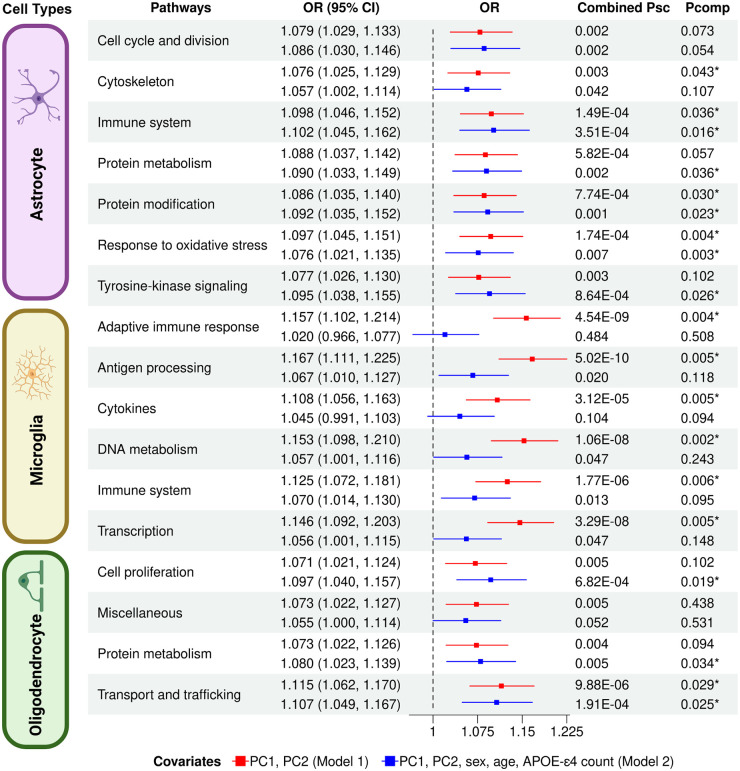
- In Model 1, the Results report 7 astrocyte pathways passing Bonferroni-corrected psc (0.05/9 = 0.0056), 6 microglial pathways passing psc (0.05/10 = 0.005), and 4 oligodendrocyte pathways passing psc (0.05/10 = 0.005); competitive pcomp < 0.05 identified 4 astrocytic, all 6 microglial, and 1 oligodendrocytic enriched pathway. The Abstract summarizes these as 4 astrocytic, 6 microglial, and 1 oligodendrocyte pathway.
- Top pathways included the immune system in astrocytes (OR = 1.098, 95% CI = 1.046–1.152, psc = 1.49 × 10⁻⁴), antigen processing in microglia (OR = 1.167, 95% CI = 1.111–1.225, psc = 5.02 × 10⁻¹⁰), and transport and trafficking in oligodendrocytes (OR = 1.115, 95% CI = 1.062–1.170, psc = 9.88 × 10⁻⁶).
- In Model 2, no microglial pathways met Bonferroni significance; astrocytic pathways remained (same 7 passed, 5 enriched), and oligodendrocytic pathways showed 3 enriched pathways: cell proliferation, protein metabolism, and transport and trafficking. The Abstract states 5 astrocytic and 3 oligodendrocytic pathways remained significant.
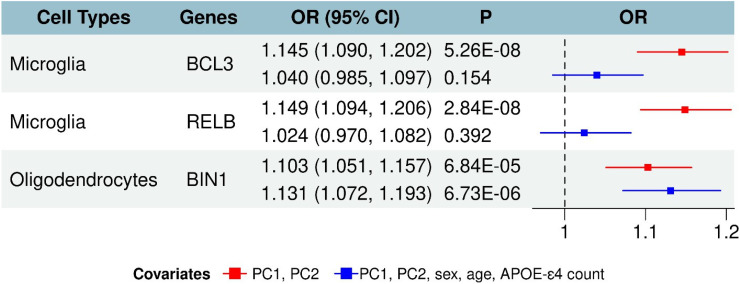
- Gene-based PRS: the Results report BCL3 and RELB as significant microglial genes in Model 1 (BCL3 OR = 1.145, 95% CI = 1.090–1.202, p = 5.26 × 10⁻⁸; RELB OR = 1.149, 95% CI = 1.049–1.206, p = 2.84 × 10⁻⁸), but not in Model 2; BIN1 was significant in oligodendrocytes in both Model 1 (OR = 1.103, 95% CI = 1.051–1.157, p = 6.84 × 10⁻⁵) and Model 2 (OR = 1.131, 95% CI = 1.072–1.193, p = 6.73 × 10⁻⁶). The Abstract states BCL3 and BIN1 were significant in Model 1, while only BIN1 remained in Model 2.
Methods
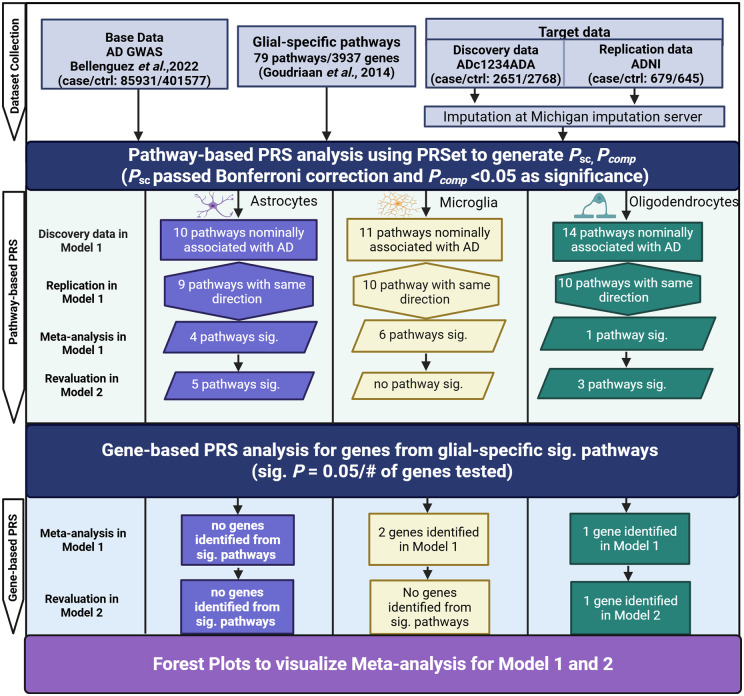
- Design: pathway-based PRS using PRSet v2.3.5 with default LD clumping (250 kb, r2 = 0.1, no p-value threshold), applied to 79 glial gene sets (31 astrocyte pathways/1,998 genes; 19 microglial pathways/289 genes; 29 oligodendrocyte pathways/1,650 genes) from a previous study; APOE was excluded.
- Data: base AD GWAS summary statistics (39,106 clinically diagnosed AD cases, 46,828 proxy AD cases, 401,577 controls); discovery target dataset ADc1234ADA (2,651 cases/2,768 controls) from NIA/LOAD and GenADA; replication dataset ADNI (679 cases/645 controls); all European ancestry. Genotype data were imputed with minimac4 using 1000 Genomes Phase 3v5, with QC retaining SNPs with INFO > 0.3, MAF > 0.01, HWE p > 0.000001, and missing rates < 0.01.
- Analysis: logistic regression Model 1 adjusted for PC1 and PC2; Model 2 additionally adjusted for sex, age, and APOE ε4 allele count. Pathways with nominal p < 0.05 in discovery were tested in replication; same-direction effects were meta-analyzed with a fixed-effect model (metafor), with Bonferroni correction within each glial type. Competitive p-values used PRSet permutation (--set-perm 1000). Gene-based PRS followed the same modeling and validation steps for genes from significant pathways.
Limitations
- The paper states that pathway-based PRS relies heavily on accurate, well-defined pathways and complete databases, and may overlook crucial variants not associated with known pathways.
- The paper states that the exclusive focus on individuals of European ancestry restricts generalizability, because allele frequencies, LD patterns, and variant effect sizes can differ across populations; microglial gene expression and immune-related pathways may also vary across ancestries.
- Evident from the text: the Abstract and Results differ in reported counts of significant pathways and genes (e.g., Abstract: 4 astrocytic, 6 microglial, 1 oligodendrocyte pathway in Model 1 and BCL3/BIN1 genes; Results: 7 astrocytic, 6 microglial, 4 oligodendrocyte pathways passing Bonferroni and BCL3/RELB microglial genes). The paper also notes that it remains unclear why microglial pathway significance was lost in Model 2.
Model-written summary. Check it against the paper before relying on it.
Integrity signals
Registry
Cites
Statistics
Figures
Verification
Claims the paper makes
0 Valid · 3 Not valid · 21 Not checked · 65 Own results and interpretations
A result the paper reports from its own data — it cites no other source for it, so there is none to check. The quote shows it is in the paper.
In the paper
“Out of the original 1650 oligodendrocyte-specific genes, and after the gene duplicates were removed, only 470 genes were associated with the three pathways and had passed the Bonferroni-corrected p-value threshold (0.05/10 = 0.005) in Model 1.”
§ Distinct glial functions are associated with Alzheimer's disease based on cell-type- and pathway-specific polygenic risk score analysis > Results > Significant pathways associated with AD in oligodendrocytes
plainstates an association- Asserted: passes — The authors put it forward as true.
- Checkable: passes — It can be checked against evidence.
- Load-bearing: passes — The paper’s conclusions depend on it.
- Based: passes — The paper gives a reason why it holds.
- Rests on an assumption not shown here.
A result the paper reports from its own data — it cites no other source for it, so there is none to check. The quote shows it is in the paper.
In the paper
“The three pathways were cell proliferation (OR = 1.097, 95% CI = 1.040–1.157, p = 6.82 × 10⁻⁴)”
- Also stated in: § Significant pathways associated with AD in oligodendrocytes · plain
“| Cell Proliferation | 1.071 (1.021–1.124) | 5.00E-03 | 0.102 | 1.097 (1.040–1.157) | 6.82E-04 | 0.019* |”
§ Distinct glial functions are associated with Alzheimer's disease based on cell-type- and pathway-specific polygenic risk score analysis > Results > Significant pathways associated with AD in oligodendrocytes
plainstates an association- Asserted: passes — The authors put it forward as true.
- Checkable: passes — It can be checked against evidence.
- Load-bearing: passes — The paper’s conclusions depend on it.
- Based: passes — The paper gives a reason why it holds.
- Also stated in: § Significant pathways associated with AD in oligodendrocytes · plain
A result the paper reports from its own data — it cites no other source for it, so there is none to check. The quote shows it is in the paper.
In the paper
“In Model 2, five astrocytic and three oligodendrocytic pathways remained significant; no microglial pathways met significance.”
§ Distinct glial functions are associated with Alzheimer's disease based on cell-type- and pathway-specific polygenic risk score analysis > Abstract > Results
plainstates an association- Asserted: passes — The authors put it forward as true.
- Checkable: passes — It can be checked against evidence.
- Load-bearing: passes — The paper’s conclusions depend on it.
- Based: passes — The paper gives a reason why it holds.
A result the paper reports from its own data — it cites no other source for it, so there is none to check. The quote shows it is in the paper.
In the paper
“However, none of the pathways passed the Bonferroni-corrected psc-value threshold (0.05/10 = 0.005) in the meta-analysis”
- Also stated in: § Results · plain
“In Model 2, five astrocytic and three oligodendrocytic pathways remained significant; no microglial pathways met significance.”
§ Distinct glial functions are associated with Alzheimer's disease based on cell-type- and pathway-specific polygenic risk score analysis > Results > Significant pathways associated with AD in microglia
plain- Asserted: passes — The authors put it forward as true.
- Checkable: passes — It can be checked against evidence.
- Load-bearing: passes — The paper’s conclusions depend on it.
- Based: passes — The paper gives a reason why it holds.
- Also stated in: § Results · plain
A result the paper reports from its own data — it cites no other source for it, so there is none to check. The quote shows it is in the paper.
In the paper
“Oligodendrocytes showed enrichment in Metabolism of proteins, Post-translational protein modification, Antigen processing: Ubiquitination and proteasome degradation, Deubiquitination, and Class I MHC-mediated antigen processing and presentation.”
§ Distinct glial functions are associated with Alzheimer's disease based on cell-type- and pathway-specific polygenic risk score analysis > Results > Reactome analysis
plainstates an association- Asserted: passes — The authors put it forward as true.
- Checkable: passes — It can be checked against evidence.
- Load-bearing: passes — The paper’s conclusions depend on it.
- Based: passes — The paper gives a reason why it holds.
31 more claims
Create a free account to see all 89 claims and to verify the 40 references still open.
- It may state two separate claims as one. 37
- The quote only partly states this claim. 2
- Probably not a substantial claim. 31
Self-check
Percentages, sums and reported differences re-computed from the paper’s own numbers.
Rated minor: it would not touch a result — a value no result rests on, a p-value that stays on the same side of the significance level, or a conflict that is clerical, resolved elsewhere in the paper, or outside its own findings.
In the paper
“| APOE | rs7412 | C/C, n (%) | 2487 (93.8) | 2404 (86.8) | 4891 (90.3) | 641 (94.4) | 562 (87.1) | 1065 (88.9) |”
§ Distinct glial functions are associated with Alzheimer's disease based on cell-type- and pathway-specific polygenic risk score analysis > Methods > Data sources
Reported 1065 · recomputed 1203
Rated minor: it would not touch a result — a value no result rests on, a p-value that stays on the same side of the significance level, or a conflict that is clerical, resolved elsewhere in the paper, or outside its own findings.
In the paper
“| APOE | rs7412 | C/T, n (%) | 162 (6.1) | 352 (12.7) | 514 (9.5) | 37 (5.5) | 80 (12.4) | 129 (10.8) |”
§ Distinct glial functions are associated with Alzheimer's disease based on cell-type- and pathway-specific polygenic risk score analysis > Methods > Data sources
Reported 129 · recomputed 117
Citations
Cites
Conducting Meta-Analyses in R with the metafor Package
Viechtbauer, W. (2010) · Journal of Statistical Software · doi:10.18637/jss.v036.i03 · Cited by 20,464
A global reference for human genetic variation
The 1000 Genomes Project Consortium, authors, C., Auton, A., Abecasis, G. R., Steering committee, Altshuler, D. M., Durbin, R. M., Abecasis, G. R., Bentley, D. R., Chakravarti, A., et al. (2015) · Nature · doi:10.1038/nature15393 · Cited by 18,247
Second-generation PLINK: rising to the challenge of larger and richer datasets
Chang, C. C., Chow, C. C., Tellier, L. C., Vattikuti, S., Purcell, S. M., & Lee, J. J. (2015) · Gigascience · doi:10.1186/s13742-015-0047-8 · Cited by 12,709
Principal components analysis corrects for stratification in genome-wide association studies
Price, A. L., Patterson, N. J., Plenge, R. M., Weinblatt, M. E., Shadick, N. A., & Reich, D. (2006) · Nature Genetics · doi:10.1038/ng1847 · Cited by 10,248
Inflammatory responses and inflammation-associated diseases in organs
Chen, L., Deng, H., Cui, H., Fang, J., Zuo, Z., Deng, J., Li, Y., Wang, X., & Zhao, L. (2018) · Oncotarget · doi:10.18632/oncotarget.23208 · Cited by 5,143
Research criteria for the diagnosis of Alzheimer's disease: revising the NINCDS–ADRDA criteria
Dubois, B., Feldman, H. H., Jacova, C., DeKosky, S. T., Barberger-Gateau, P., Cummings, J., Delacourte, A., Galasko, D., Gauthier, S., Jicha, G., et al. (2007) · The Lancet Neurology · doi:10.1016/s1474-4422(07)70178-3 · Cited by 4,411
Next-generation genotype imputation service and methods
Das, S., Forer, L., Schönherr, S., Sidore, C., Locke, A. E., Kwong, A., Vrieze, S. I., Chew, E. Y., Levy, S., McGue, M., et al. (2016) · Nature Genetics · doi:10.1038/ng.3656 · Cited by 3,808
Alzheimer's Disease Neuroimaging Initiative (ADNI): Clinical characterization
Petersen, R. C., Aisen, P. S., Beckett, L. A., Donohue, M. C., Gamst, A. C., Harvey, D. J., Jack, C. R., Jagust, W. J., Shaw, L. M., Toga, A. W., et al. (2010) · Neurology · doi:10.1212/wnl.0b013e3181cb3e25 · Cited by 3,060
The NF- B Family of Transcription Factors and Its Regulation
Oeckinghaus, A., & Ghosh, S. (2009) · Cold Spring Harbor Perspectives in Biology · doi:10.1101/cshperspect.a000034 · Cited by 2,842
2024 Alzheimer's disease facts and figures
(2024) · Alzheimer's & Dementia · doi:10.1002/alz.13809 · Cited by 2,536 · cited 1×
“1 While much research has focused on neuronal dysfunction in AD, emerging evidence suggests that glial cells — astrocytes, microglia, and oligodendrocytes — play crucial roles in the disease ’ s pathogenesis.”
New insights into the genetic etiology of Alzheimer’s disease and related dementias
Bellenguez, C., Küçükali, F., Jansen, I. E., Kleineidam, L., Moreno-Grau, S., Amin, N., Naj, A. C., Campos-Martin, R., Grenier-Boley, B., Andrade, V., et al. (2022) · Nature Genetics · doi:10.1038/s41588-022-01024-z · Cited by 2,498
NF-κB in biology and targeted therapy: new insights and translational implications
Guo, Q., Jin, Y., Chen, X., Ye, X., Shen, X., Lin, M., Zeng, C., Zhou, T., & Zhang, J. (2024) · Signal Transduction and Targeted Therapy · doi:10.1038/s41392-024-01757-9 · Cited by 2,047
The Cellular Phase of Alzheimer’s Disease
De Strooper, B., & Karran, E. (2016) · Cell · doi:10.1016/j.cell.2015.12.056 · Cited by 1,990
Microglia states and nomenclature: A field at its crossroads
Paolicelli, R. C., Sierra, A., Stevens, B., Tremblay, M.-E., Aguzzi, A., Ajami, B., Amit, I., Audinat, E., Bechmann, I., Bennett, M., et al. (2022) · Neuron · doi:10.1016/j.neuron.2022.10.020 · Cited by 1,973
Tutorial: a guide to performing polygenic risk score analyses
Choi, S. W., Mak, T. S.-H., & O’Reilly, P. F. (2020) · Nature Protocols · doi:10.1038/s41596-020-0353-1 · Cited by 1,946
Genome-wide association studies
Uffelmann, E., Huang, Q. Q., Munung, N. S., de Vries, J., Okada, Y., Martin, A. R., Martin, H. C., Lappalainen, T., & Posthuma, D. (2021) · Nature Reviews Methods Primers · doi:10.1038/s43586-021-00056-9 · Cited by 1,849
Reactome: a database of reactions, pathways and biological processes
Croft, D., O'Kelly, G., Wu, G., Haw, R., Gillespie, M., Matthews, L., Caudy, M., Garapati, P., Gopinath, G., Jassal, B., et al. (2011) · Nucleic Acids Research · doi:10.1093/nar/gkq1018 · Cited by 1,751
Pathways of Antigen Processing
Blum, J. S., Wearsch, P. A., & Cresswell, P. (2013) · Annual Review of Immunology · doi:10.1146/annurev-immunol-032712-095910 · Cited by 1,547
A guide to antigen processing and presentation
Pishesha, N., Harmand, T. J., & Ploegh, H. L. (2022) · Nature Reviews Immunology · doi:10.1038/s41577-022-00707-2 · Cited by 805
Cytokine networks in neuroinflammation
Becher, B., Spath, S., & Goverman, J. (2017) · Nature Reviews Immunology · doi:10.1038/nri.2016.123 · Cited by 697
Function and therapeutic value of astrocytes in neurological diseases
Lee, H.-G., Wheeler, M. A., & Quintana, F. J. (2022) · Nature Reviews Drug Discovery · doi:10.1038/s41573-022-00390-x · Cited by 662 · cited 2×
“21,22 Prolonged activation of astrocytes can contribute to neuroin-fl ammation andcognitive decline.”
Neurotoxic reactive astrocytes induce cell death via saturated lipids
Guttenplan, K. A., Weigel, M. K., Prakash, P., Wijewardhane, P. R., Hasel, P., Rufen-Blanchette, U., Münch, A. E., Blum, J. A., Fine, J., Neal, M. C., et al. (2021) · Nature · doi:10.1038/s41586-021-03960-y · Cited by 578 · cited 2×
“21 Astrocytes can convert into two reactive forms: A1 (neurotoxic) and A2 (neuroprotective).”
Candidate single-nucleotide polymorphisms from a genomewide association study of Alzheimer disease
Li, H., Wetten, S., Li, L., St. Jean, P. L., Upmanyu, R., Surh, L., Hosford, D., Barnes, M. R., Briley, J. D., Borrie, M., et al. (2008) · Archives of Neurology · doi:10.1001/archneurol.2007.3 · Cited by 499
Neuromodulation by the immune system: a focus on cytokines
Salvador, A. F., de Lima, K. A., & Kipnis, J. (2021) · Nature Reviews Immunology · doi:10.1038/s41577-021-00508-z · Cited by 389
The Pivotal Role of NF-kB in the Pathogenesis and Therapeutics of Alzheimer’s Disease
Sun, E., Motolani, A., Campos, L., & Lu, T. (2022) · International Journal of Molecular Sciences · doi:10.3390/ijms23168972 · Cited by 361
Apoptosis in Alzheimer’s disease: Insight into the signaling pathways and therapeutic avenues
Kumari, S., Dhapola, R., & Reddy, D. H. (2023) · Apoptosis · doi:10.1007/s10495-023-01848-y · Cited by 324
Astrocytes: a double-edged sword in neurodegenerative diseases
Yan, Y.-Q., Ma, C.-G., Ding, Z.-B., Song, L.-J., Wang, Q., & Kumar, G. (2021) · Neural Regeneration Research · doi:10.4103/1673-5374.306064 · Cited by 241
Identifying individuals with high risk of Alzheimer’s disease using polygenic risk scores
Leonenko, G., Baker, E., Stevenson-Hoare, J., Sierksma, A., Fiers, M., Williams, J., de Strooper, B., & Escott-Price, V. (2021) · Nature Communications · doi:10.1038/s41467-021-24082-z · Cited by 227
The role of cell cycle‐mediated events in Alzheimer's disease
Raina, A. K., Monteiro, M. J., Mcshea, A., & Smith, M. A. (1999) · International Journal of Experimental Pathology · doi:10.1046/j.1365-2613.1999.00106.x · Cited by 226
Exploiting innate immunity for cancer immunotherapy
Yi, M., Li, T., Niu, M., Mei, Q., Zhao, B., Chu, Q., Dai, Z., & Wu, K. (2023) · Molecular Cancer · doi:10.1186/s12943-023-01885-w · Cited by 225
Antigen processing and presentation
(2019) · International Review of Cell and Molecular Biology · doi:10.1016/bs.ircmb.2019.07.005 · Cited by 194
The role of the adaptive immune system and T cell dysfunction in neurodegenerative diseases
DeMaio, A., Mehrotra, S., Sambamurti, K., & Husain, S. (2022) · Journal of Neuroinflammation · doi:10.1186/s12974-022-02605-9 · Cited by 174
Dysfunction of antigen processing and presentation by dendritic cells in cancer
Bandola-Simon, J., & Roche, P. A. (2019) · Molecular Immunology · doi:10.1016/j.molimm.2018.03.025 · Cited by 144
PRSet: Pathway-based polygenic risk score analyses and software
Choi, S. W., García-González, J., Ruan, Y., Wu, H. M., Porras, C., Johnson, J., Bipolar Disorder Working group of the Psychiatric Genomics Consortium, Hoggart, C. J., & O’Reilly, P. F. (2023) · PLOS Genetics · doi:10.1371/journal.pgen.1010624 · Cited by 141
Darst, B. F., Koscik, R. L., Racine, A. M., Oh, J. M., Krause, R. A., Carlsson, C. M., Zetterberg, H., Blennow, K., Christian, B. T., Bendlin, B. B., et al. (2016) · Journal of Alzheimer's Disease · doi:10.3233/jad-160195 · Cited by 131
Lee, J. H. (2008) · Archives of Neurology · doi:10.1001/archneur.65.11.1518 · Cited by 127
Inflammation in Focus: The Beginning and the End
Kiss, A. L. (2022) · Pathology & Oncology Research · doi:10.3389/pore.2021.1610136 · Cited by 115
Specific Glial Functions Contribute to Schizophrenia Susceptibility
Goudriaan, A., de Leeuw, C., Ripke, S., Hultman, C. M., Sklar, P., Sullivan, P. F., Smit, A. B., Posthuma, D., & Verheijen, M. H. G. (2014) · Schizophrenia Bulletin · doi:10.1093/schbul/sbt109 · Cited by 114 · cited 1×
“To this end, we obtained the functional gene sets across three glial cell types (Supplemental Table 1) from a previous study 26 and used AD GWAS summary statistics of European ancestry as our base data.”
Microglia and Astrocytes in Alzheimer’s Disease: Significance and Summary of Recent Advances
Deng, Q., Wu, C., Parker, E., Liu, T. C.-Y., Duan, R., & Yang, L. (2023) · Aging and disease · doi:10.14336/ad.2023.0907 · Cited by 102 · cited 1×
“2,3 Glial cells are known to play an important role in homeostasis maintenance, immune responses, and neuronal support and protection within the central nervous system (CNS).”
Self-citationOligodendroglial Cells in Alzheimer’s Disease
Butt, A. M., De La Rocha, I. C., & Rivera, A. (2019) · Advances in Experimental Medicine and Biology · doi:10.1007/978-981-13-9913-8_12 · Cited by 90
Tesi, N., van der Lee, S. J., Hulsman, M., Jansen, I. E., Stringa, N., van Schoor, N. M., Scheltens, P., van der Flier, W. M., Huisman, M., Reinders, M. J. T., et al. (2020) · Translational Psychiatry · doi:10.1038/s41398-020-01018-7 · Cited by 67
Saha, O., Melo de Farias, A. R., Pelletier, A., Siedlecki-Wullich, D., Landeira, B. S., Gadaut, J., Carrier, A., Vreulx, A.-C., Guyot, K., Shen, Y., et al. (2024) · Molecular Psychiatry · doi:10.1038/s41380-024-02502-y · Cited by 66
Age-dependent effect of APOE and polygenic component on Alzheimer's disease
Bellou, E., Baker, E., Leonenko, G., Bracher-Smith, M., Daunt, P., Menzies, G., Williams, J., & Escott-Price, V. (2020) · Neurobiology of Aging · doi:10.1016/j.neurobiolaging.2020.04.024 · Cited by 58
Glia in Neurodegeneration: The Housekeeper, the Defender and the Perpetrator
Sheeler, C., Rosa, J.-G., Ferro, A., McAdams, B., Borgenheimer, E., & Cvetanovic, M. (2020) · International Journal of Molecular Sciences · doi:10.3390/ijms21239188 · Cited by 54
Cytokine signaling convergence regulates the microglial state transition in Alzheimer’s disease
Lau, S.-F., Fu, A. K. Y., & Ip, N. Y. (2021) · Cellular and Molecular Life Sciences · doi:10.1007/s00018-021-03810-0 · Cited by 52
Updated Meta-Analysis of BIN1, CR1, MS4A6A, CLU, and ABCA7 Variants in Alzheimer’s Disease
Almeida, J. F. F., dos Santos, L. R., Trancozo, M., & de Paula, F. (2018) · Journal of Molecular Neuroscience · doi:10.1007/s12031-018-1045-y · Cited by 48
(ADNI), F. T. A. D. N. I., Nho, K., Kim, S., Horgusluoglu, E., Risacher, S. L., Shen, L., Kim, D., Lee, S., Foroud, T., Shaw, L. M., et al. (2017) · BMC Medical Genomics · doi:10.1186/s12920-017-0267-0 · Cited by 44
Self-citationAhmad, S., Bannister, C., van der Lee, S. J., Vojinovic, D., Adams, H. H. H., Ramirez, A., Escott‐Price, V., Sims, R., Baker, E., Williams, J., et al. (2018) · Alzheimer's & Dementia · doi:10.1016/j.jalz.2018.01.005 · Cited by 44
Bcl-3: A Double-Edged Sword in Immune Cells and Inflammation
Liu, H., Zeng, L., Yang, Y., Guo, C., & Wang, H. (2022) · Frontiers in Immunology · doi:10.3389/fimmu.2022.847699 · Cited by 44
Mockenhaupt, K., Gonsiewski, A., & Kordula, T. (2021) · Cells · doi:10.3390/cells10071609 · Cited by 42
Qu, W., Canoll, P., & Hargus, G. (2023) · Neuroscience · doi:10.1016/j.neuroscience.2022.05.006 · Cited by 24
Harrison, J. R., Foley, S. F., Baker, E., Bracher-Smith, M., Holmans, P., Stergiakouli, E., Linden, D. E. J., Caseras, X., Jones, D. K., & Escott-Price, V. (2023) · Brain Communications · doi:10.1093/braincomms/fcad229 · Cited by 24
Mitochondrial pathway polygenic risk scores are associated with Alzheimer's Disease
Paliwal, D., McInerney, T. W., Pa, J., Swerdlow, R. H., Easteal, S., & Andrews, S. J. (2021) · Neurobiology of Aging · doi:10.1016/j.neurobiolaging.2021.08.005 · Cited by 22
Schork, N. J., Elman, J. A., & Initiative, F. T. A. D. N. (2023) · Journal of Alzheimer’s Disease · doi:10.3233/jad-230548 · Cited by 21
Self-citationA Pathway-Specific Polygenic Risk Score Is Associated with Tau Pathology and Cognitive Decline
Sun, Y., Wang, M., Zhao, Y., Hu, K., Liu, Y., Liu, B., & Initiative, A. D. N. (2022) · Journal of Alzheimer’s Disease · doi:10.3233/jad-215163 · Cited by 18
Self-citationXu, Y., Vasiljevic, E., Deming, Y. K., Jonaitis, E. M., Koscik, R. L., Van Hulle, C. A., Lu, Q., Carboni, M., Kollmorgen, G., Wild, N., et al. (2023) · Journal of Alzheimer's Disease · doi:10.3233/jad-230097 · Cited by 14
Assaying Homodimers of NF-κB in Live Single Cells
Martin, E. W., Chakraborty, S., Presman, D. M., Tomassoni Ardori, F., Oh, K.-S., Kaileh, M., Tessarollo, L., & Sung, M.-H. (2019) · Frontiers in Immunology · doi:10.3389/fimmu.2019.02609 · Cited by 9
Innate Immune Tolerance in Microglia Does Not Impact on Central Nervous System Prion Disease
Pal, R., Bradford, B. M., & Mabbott, N. A. (2022) · Frontiers in Cellular Neuroscience · doi:10.3389/fncel.2022.918883 · Cited by 7
Caspers, S., Röckner, M. E., Jockwitz, C., Bittner, N., Teumer, A., Herms, S., Hoffmann, P., Nöthen, M. M., Moebus, S., Amunts, K., et al. (2019) · Cerebral Cortex · doi:10.1093/cercor/bhz127 · Cited by 6
Research works printed but not linked: 3
- Darst BF Koscik RL Racine AM, et al. Pathway-specific polygenic risk scores as predictors of amyloid-β deposition and cognitive function in a sample at increased risk for Alzheimer’s disease. J Alzheimers Dis 2017; 55: 473– 484. 27662287 PMC5123972 · DOI · Paper page
- Sun Y Wang M Zhao Y, et al. A pathway-specific polygenic risk score is associated with tau pathology and cognitive decline. J Alzheimers Dis 2022; 85: 1745– 1754. 34958026 · DOI · Paper page
- In brief: The innate and adaptive immune systems. In: InformedHealth.org [Internet]. Institute for Quality and Efficiency in Health Care (IQWiG), https://www.ncbi.nlm.nih.gov/books/NBK279396/ (2023, accessed 27 November 2024).
Cited by
Astrocyte epigenetics in development, aging, and neurodegeneration: a DNA methylation perspective
Bhaskar, U., & Carless, M. A. (2026) · Frontiers in Molecular Neuroscience · doi:10.3389/fnmol.2026.1876219
Mourtzi, N., Avramopoulos, D., Sampatakakis, S. N., Ramirez, A., Yannakoulia, M., Ntanasi, E., Kosmidis, M. H., Dardiotis, E., Hadjigeorgiou, G., Sakka, P., et al. (2026) · European Archives of Psychiatry and Clinical Neuroscience · doi:10.1007/s00406-026-02413-9
Metadata
- Authors
- Pratt, T., Lee, A., Zheng, J., Tavacoli, F., Ho, H., Liu, T., Zhan, H., Chen, J., & Initiative, A. D. N.
- Affiliations
- University of Nevada, Las Vegas (US)
- Corresponding author
- Pratt, Tyrell
- Lee, Alice
- ORCID
- Venue
- Journal of Alzheimer’s Disease
- Publisher
- SAGE Publications
- Published
- 2025-09
- Volume
- 107
- Issue
- 2
- Pages
- 755-768
- ISSN
- 1387-2877 (ISSN-L)
- 1875-8908
- PMC
- PMC12417609
- OpenAlex
- W4413050036
- Semantic Scholar
- 56aed2da2439b12ce4ea7c82b1a87bc946f9451b
- Cited by
- 2
- References
- 59
- Citations by year
- 2026: 2
- FWCI
- 0.48
- Type
- journal article
- Language
- en
- Open access
- hybrid
- doi.org
- Licence
- cc-by-nc
- creativecommons.org/licenses/by-nc/4.0/ (vor)
- journals.sagepub.com/page/policies/text-and-data-mining-license (tdm)
- Locations
- Journal of Alzheimer s Disease (publishedVersion, cc-by-nc)
- PubMed Central (publishedVersion, cc-by-nc)
- PubMed (publishedVersion)
- Funders
- National Institute of General Medical Sciences (U54GM104944)
- NIH (R15AG083618-01A1)
- Infectious Diseases Society of America Foundation (70823173)
- Topics
- Life Sciences › Neuroscience › Cellular and Molecular Neuroscience › Alzheimer's disease research and treatments
- Life Sciences › Neuroscience › Neurology › Neuroinflammation and Neurodegeneration Mechanisms
- Health Sciences › Medicine › Psychiatry and Mental health › Dementia and Cognitive Impairment Research
- Keywords
- Alzheimer's disease, glial cells
- MeSH terms
- Genetic Risk Score, Aged, Aged, 80 and over, Alzheimer Disease, Astrocytes, Female, Humans, Male, Neuroglia, Oligodendroglia, Microglia, Genetic Predisposition to Disease, Multifactorial Inheritance
About these checks
Registry, retraction, Cites and statistics results are computed, not judged, with one exception: a printed reference that no index lists is read once by a model before it counts as a citation error. Claims are extracted by a model and kept only when their quote appears verbatim in the text; each cited source is then checked, with a model’s help, for whether it says what the claim relies on. Those verdicts can be wrong — read the claim’s quote and the cited source before relying on one.
A language model drew the claims from the paper on 2026-11-26, under version 3 of the claim definition (model deepseek-v4.1-flash, prompt extract-v3).
A second model labelled each claim on 2026-11-26 (model jev-1.13-20260917, definition revision gold-guideline-v0.2).
Statistics and arithmetic are recomputed, not judged.
Confidence bands are shown only for fields calibrated on our annotated test set. None is calibrated yet, so no band is shown.
What counts as a claim ›How we measure confidence ›How we check this ›
Are you an author, or do you see a problem with this page? Request a review
Data sources
Bibliographic data: Semantic Scholar, OpenAlex, Crossref.
Contains information from the Semantic Scholar Academic Graph Datasets, made available under the ODC Attribution License (ODC-BY 1.0).
Semantic Scholar’s data is described in: Kinney, R., et al. (2023). The Semantic Scholar Open Data Platform. arXiv:2301.10140.
