

A scoping review of gaps and priorities in dementia care in Europe
Open accessThe DOI matches its Crossref record; 34 of the 34 references it cites were found in a registry or an index.
Abstract
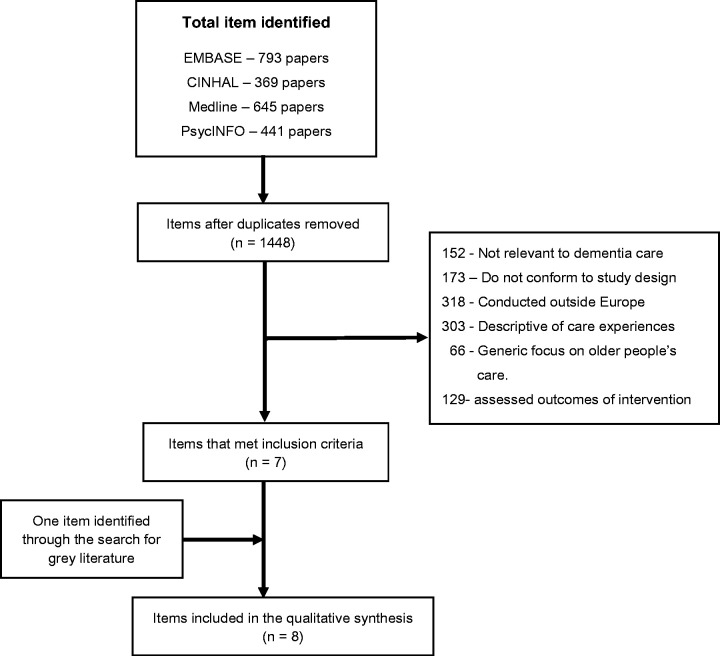
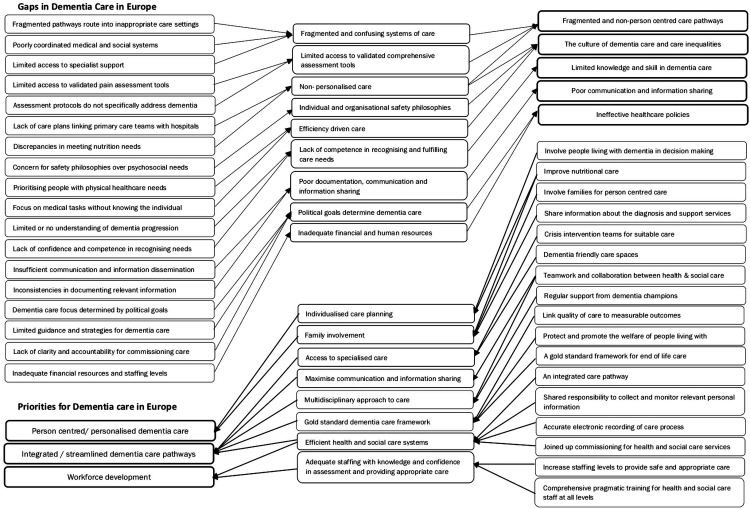
Dementia is a widely recognized public health priority due to the increasing number of people living with the condition and its attendant health, social, and economic costs. Delivering appropriate care is a challenge in many countries in Europe contributing to unmet needs of people living with dementia. Acute hospital settings are often the default route in pursuit for dementia care due to the lack of or limited knowledge of local service provisions. The care environment and the skillsets in acute hospitals do not fully embrace the personhood necessary in dementia care. Predictions of an exponential increase in people living with dementia in the coming 30 years require evidence-based strategies for advancing dementia care and maximizing independent living. However, the evidence required to inform priorities for enabling improvements in dementia care is rarely presented in a way that stimulates and sustains political interests. This scoping review of the literature drew on principles of meta-ethnography to clarify the gaps and priorities in dementia care in Europe. The review constituted eight papers (n = 8) and a stakeholder consultation involving three organizations implementing dementia care programs in Europe comprising Emmaus Elderly Care in Belgium, Residential Care Holy Heart in Belgium, and ZorgSaam in the Netherlands. Overarching concepts of gaps identified include fragmented non-person-centered care pathways, the culture of dementia care, limited knowledge and skills, poor communication and information sharing, and ineffective healthcare policies. Key areas distinguished from the literature for narrowing the gaps to improve care experiences and the support for people living with dementia care encompass person-centered care, integrated care pathways, and healthcare workforce development. Action for advancing care and maximizing independent living needs to go beyond mere inclusions on political agendas to incorporate a shift in health and social care policies to address the needs of people living with dementia.
Overview
The claims and statistics of this paper haven’t been checked yet.
Free: it reads the open-access text and checks the first 5 claims that cite a source we can check. Create a free account to check every claim.
Integrity signals
Registry
Cites
Statistics
Figures
Verification
Claims the paper makes
The claims and statistics of this paper haven’t been checked yet.
Free: it reads the open-access text and checks the first 5 claims that cite a source we can check. Create a free account to check every claim.
Claims other papers make about this one
Each is checked against this paper’s own text: does it say what the citing paper says it does?
The cited source says what the claim attributes to it.
In the citing paper
“Despite the critical importance of coordinated care during these transitions, people with dementia often experience care fragmentation (Fogg et al., 2018; Martin et al., 2020; Smith et al., 2021).”
From Mind the gap: a systematic review of barriers, facilitators, and experiences of care transitions for people living with dementia and their informal caregivers. (2026) · cites this paper as Martin et al., 2020
The cited source says what the claim attributes to it.
In the citing paper
“The persistence of structural health and social care fragmentation and information gaps suggests that existing health care systems remain poorly equipped to meet the needs of this population, despite long-standing recognition of these issues in the literature (Giebel et al., 2021; Martin et al., 2020).”
From Mind the gap: a systematic review of barriers, facilitators, and experiences of care transitions for people living with dementia and their informal caregivers. (2026) · cites this paper as Martin et al., 2020
Self-check
Percentages, sums and reported differences re-computed from the paper’s own numbers.
The self-check needs the paper’s full text.
Citations
Cites
Scoping studies: towards a methodological framework
Arksey, H., & O'Malley, L. (2005) · International Journal of Social Research Methodology · doi:10.1080/1364557032000119616 · Cited by 36,742
Noblit, G., & Hare, R. (1988) · doi:10.4135/9781412985000 · Cited by 2,723
Huber, M., Knottnerus, J. A., Green, L., Horst, H. V. D., Jadad, A. R., Kromhout, D., Leonard, B., Lorig, K., Loureiro, M. I., Meer, J. W. M. V. D., et al. (2011) · BMJ · doi:10.1136/bmj.d4163 · Cited by 2,637 · cited 1×
“This is when people are supported to develop strategies for maintaining balance between opportunities and limitations to manage life with some independence to participate in social activities for individual growth (Brooker & Latham, 2015; Huber et al., 2011).”
BackgroundBeyond PICO: The SPIDER Tool for Qualitative Evidence Synthesis
Cooke, A., Smith, D., & Booth, A. (2012) · Qualitative Health Research · doi:10.1177/1049732312452938 · Cited by 2,608
Dixon-Woods, M., Cavers, D., Agarwal, S., Annandale, E., Arthur, A., Harvey, J., Hsu, R., Katbamna, S., Olsen, R., Smith, L., et al. (2006) · BMC Medical Research Methodology · doi:10.1186/1471-2288-6-35 · Cited by 2,289
The Problem of Fragmentation and the Need for Integrative Solutions
Stange, K. C. (2009) · The Annals of Family Medicine · doi:10.1370/afm.971 · Cited by 569 · cited 1×
“This dichotomy breeds experiences of poor quality service and futile efforts for improvement (Stange, 2009).”
BackgroundEggenberger, E., Heimerl, K., & Bennett, M. I. (2013) · International Psychogeriatrics · doi:10.1017/s1041610212001664 · Cited by 340
Toye, F., Seers, K., Allcock, N., Briggs, M., Carr, E., & Barker, K. (2014) · BMC Medical Research Methodology · doi:10.1186/1471-2288-14-80 · Cited by 322 · cited 1×
“For many qualitative reviews, researchers feel the need to succumb unnecessarily to the pressure of appraising papers for inclusion to avoid the health community stigma related to gold standard methods (Toye et al., 2014).”
BackgroundDewing, J., & Dijk, S. (2016) · Dementia · doi:10.1177/1471301213520172 · Cited by 318
Erwin, E. J., Brotherson, M. J., & Summers, J. A. (2011) · Journal of Early Intervention · doi:10.1177/1053815111425493 · Cited by 272
Inequalities in dementia care across Europe: key findings of the Facing Dementia Survey
Bond, J., Stave, C., Sganga, A., Vincenzino, O., O'connell, B., & Stanley, R. L. (2005) · International Journal of Clinical Practice · doi:10.1111/j.1368-504x.2005.00480.x · Cited by 185 · cited 1×
“However, the stigmatization of dementia as a condition without economic viability foils the commitment to policy transformation and the financial resources needed for improvements (Bond et al., 2005).”
BackgroundWhitlatch, C. J., & Orsulic-Jeras, S. (2018) · The Gerontologist · doi:10.1093/geront/gnx162 · Cited by 161 · cited 1×
“Various programs have been developed in response to appeals for adequate staff training in dementia care, but their effectiveness is yet to be established (Whitlatch & Orsulic-Jeras, 2018).”
Lloyd-Sherlock, P. G., McKee, M., Ebrahim, S. B. J., Gorman, M., Greengross, S., Prince, M. J., Pruchno, R. A., GUTMAN, G. M., Kirkwood, T. B. L., O’Neill, D. J., et al. (2012) · The Lancet · doi:10.1016/s0140-6736(12)60519-4 · Cited by 159
Predictors of job strain in residential dementia care nursing staff
Edvardsson, D., Sandman, P., Nay, R., & Karlsson, S. (2008) · Journal of Nursing Management · doi:10.1111/j.1365-2834.2008.00891.x · Cited by 126
Houghton, C., Murphy, K., Brooker, D., & Casey, D. (2016) · International Journal of Nursing Studies · doi:10.1016/j.ijnurstu.2016.06.001 · Cited by 126
Barriers to providing end-of-life care for people with dementia: a whole-system qualitative study
Dening, K. H., Greenish, W., Jones, L., Mandal, U., & Sampson, E. L. (2012) · BMJ Supportive & Palliative Care · doi:10.1136/bmjspcare-2011-000178 · Cited by 105 · cited 11×
“…care systems allow for alignment of dementia champions and palliative crisis intervention teams with other health and social care teams to provide support in different care contexts and reduce inappropriate hospital admissions, especially at the end of life (Dening et al., 2012; RCP, 2017).”
BackgroundInfluentialUsing drama to improve person‐centred dementia care
Kontos, P., Mitchell, G. J., Mistry, B., & Ballon, B. (2010) · International Journal of Older People Nursing · doi:10.1111/j.1748-3743.2010.00221.x · Cited by 100
Turner, A., Eccles, F. J. R., Elvish, R., Simpson, J., & Keady, J. (2017) · Aging & Mental Health · doi:10.1080/13607863.2015.1109057 · Cited by 82 · cited 8×
“Healthcare workforce development Evidence in the literature identifies a critical need to address the capacity of the workforce involved in dementia care, to enhance the quality of care, and to retain the expertise within health and social care systems (Buswell et al., 2014; Dening et al., 2012; Houghton et al., 2016;…”
BackgroundMethodInfluentialSocial health in dementia. Towards a positive dementia discourse
de Vugt, M., & Dröes, R.-M. (2017) · Aging & Mental Health · doi:10.1080/13607863.2016.1262822 · Cited by 82
Banerjee, S., Farina, N., Daley, S., Grosvenor, W., Hughes, L., Hebditch, M., Mackrell, S., Nilforooshan, R., Wyatt, C., de Vries, K., et al. (2017) · International Journal of Geriatric Psychiatry · doi:10.1002/gps.4602 · Cited by 80
Nakanishi, M., Nakashima, T., Shindo, Y., Miyamoto, Y., Gove, D., Radbruch, L., & van der Steen, J. T. (2015) · International Psychogeriatrics · doi:10.1017/s1041610215000150 · Cited by 69
Lathren, C. R., Sloane, P. D., Hoyle, J. D., Zimmerman, S., & Kaufer, D. I. (2013) · BMC Geriatrics · doi:10.1186/1471-2318-13-134 · Cited by 52
Golden, S. H., Hager, D. N., Gould, L. J., Mathioudakis, N. N., & Pronovost, P. J. (2016) · The Joint Commission Journal on Quality and Patient Safety · doi:10.1016/j.jcjq.2016.10.004 · Cited by 51
Integrated Care Needs Integrated Information Management and Technology
Protti, D. (2009) · Healthcare Quarterly · doi:10.12927/hcq.2009.21093 · Cited by 48 · cited 2×
“…storage systems across health and social care organizational boundaries maximize opportunities for sharing relevant information to enable personalized care, timely communication, collaborative working, and continuity of care across the dementia trajectory (Protti, 2009; Risco et al., 2016).”
BackgroundRobinson, L., Bamford, C., Briel, R., Spencer, J., & Whitty, P. (2010) · International Psychogeriatrics · doi:10.1017/s1041610209990482 · Cited by 35
The role of the music therapist in training caregivers of people who have advanced dementia
Beer, L. E. (2016) · Nordic Journal of Music Therapy · doi:10.1080/08098131.2016.1186109 · Cited by 33 · cited 1×
“The literature around training staff for improved practices in dementia care underscores the significance of at least foundation knowledge in principles of person-centered care, effective communication, and establishing meaningful interaction with people with dementia (Beer, 2017; Eggenberger, Heimerl, & Bennett, 2013…”
BackgroundEmilsson, U. M. (2009) · European Journal of Social Work · doi:10.1080/13691450902981467 · Cited by 32 · cited 8×
“Melin Emilsson, U. (2009).”
BackgroundInfluentialPilkington, H. (2017) · Qualitative Research · doi:10.1177/1468794117707805 · Cited by 31 · cited 3×
“Meta-ethnography involves reinterpretation of interpretations of published qualitative research (Pilkington, 2018).”
BackgroundInfluentialRisco, E., Cabrera, E., Farré, M., Alvira, C., Miguel, S., & Zabalegui, A. (2015) · American Journal of Alzheimer s Disease & Other Dementias® · doi:10.1177/1533317515603818 · Cited by 26 · cited 13×
“11 2146 Dementia 19(7) specialized dementia friendly spaces and well-coordinated personalized care across different health and social care settings (Risco et al., 2016).”
InfluentialBuswell, M., Lumbard, P., Prothero, L. S., Lee, C. Y., Martin, S., Fleming, J., & Goodman, C. M. (2014) · Emergency Medicine Journal · doi:10.1136/emermed-2014-203941 · Cited by 24 · cited 10×
“Healthcare workforce development Evidence in the literature identifies a critical need to address the capacity of the workforce involved in dementia care, to enhance the quality of care, and to retain the expertise within health and social care systems (Buswell et al., 2014; Dening et al., 2012; Houghton et al., 2016;…”
InfluentialZeroing out preventable disability: Daring to dream the impossible dream for dementia care
Khachaturian, A. S., Hoffman, D. P., Frank, L. B., Petersen, R. C., Carson, B. R., & Khachaturian, Z. S. (2017) · Alzheimer s & Dementia · doi:10.1016/j.jalz.2017.09.003 · Cited by 20 · cited 1×
“On the other hand, healthcare systems are learning organizations (Khachaturian et al., 2017), and thus the focus should not be the “dementia” but advancing care and scientific knowledge to tackle a public health issue effectively.”
BackgroundIntégration des services : obstacles et facteurs facilitant leur implantation
de Stampa, M., Vedel, I., Trouvé, H., Saint‐Jean, O., Ankri, J., & Somme, D. (2013) · Revue d Épidémiologie et de Santé Publique · doi:10.1016/j.respe.2012.07.004 · Cited by 15
Fighting dementia in Europe: the time to act is now
Quaglio, G., Brand, H., & Dario, C. (2016) · The Lancet Neurology · doi:10.1016/s1474-4422(16)00079-x · Cited by 12 · cited 1×
“This variation combined with a lack of political commitment to advancing dementia care present challenges to reliably good care and support for people with dementia (Quaglio et al., 2016).”
BackgroundCommissioning care for people with dementia at the end of life: a mixed - methods study
Gotts, Z. M., Baur, N., McLellan, E., Goodman, C. M., Robinson, L. A., & Lee, R. P. (2016) · BMJ Open · doi:10.1136/bmjopen-2016-013554 · Cited by 8 · cited 6×
“In England, for example, the confusing, non-standardized, and fragmented commissioning guidance places dementia care on the periphery of the healthcare commissioning framework (Gotts et al., 2016).”
BackgroundInfluential
Research works printed but not linked: 3
- Brooker D. Latham I. (2015). Person-centred dementia care: Making services better with the VIPS framework. London, England: Jessica Kingsley.
- Van de Voorde C. Van den Heede K. Beguin C. Bouckaert N. Camberlin C. de Bekker P., … Grau C. (2017). Required hospital capacity in 2025 and criteria for rationalisation of complex cancer surgery, radiotherapy and maternity services (No. 289). Retrieved from Belgian Health Care Knowledge Centre (KCE): http://www.bravo-radiotherapie.be/en/mod_news/required-hospital-capacity-in-2025-and-criteria-for-rationalisation-of-complex-cancer-surgery-radiotherapy-and-maternity-services-1/ · DOI
- Von Bertalanffy L. (1977). The role of systems theory in present day science technology and philosophy. In Schaefer K. E Hensel H. Brady R. (Eds), A new image of man in medicine: Proceedings of toward a man-centered medical science symposium (pp. 11–15). Mt Kisco, NY: Futura Publishing Company.
Cited by
Teaching and learning about dementia care among undergraduate nursing students: A scoping review
Cariñanos-Ayala, S., Arrue, M., & Zarandona, J. (2022) · Nurse Education in Practice · doi:10.1016/j.nepr.2022.103326 · Cited by 43
Hoe, J., Trickey, A., & McGraw, C. (2022) · International Journal of Older People Nursing · doi:10.1111/opn.12491 · Cited by 39
Structures for the care of people with dementia: a European comparison
Schmachtenberg, T., Monsees, J., & Thyrian, J. R. (2022) · BMC Health Services Research · doi:10.1186/s12913-022-08715-7 · Cited by 39
Messina, A., Amati, R., Albanese, E., & Fiordelli, M. (2022) · International Journal of Environmental Research and Public Health · doi:10.3390/ijerph19127504 · Cited by 36
“A better understanding of help-seeking behaviors and needs in family caregivers of people with dementia is needed to close the gap between the availability of support measures and their access and use, with potential benefits for the caregiver and the person with dementia [21,22].”
BackgroundArmstrong, M. J., Bedenfield, N., Slande Alliance, Majid, T., Taylor, A., Kurasz, A. M., Patel, B., & Smith, G. E. (2021) · Alzheimer Disease & Associated Disorders · doi:10.1097/wad.0000000000000459 · Cited by 27
“Study inclusion criteria were: (1) patient or caregiver of a patient followed at the center, (2) patient diagnosis of DLB,5 (3) if an individual with DLB, clinician-judged mild-moderate dementia severity (to allow study participation), and (4) willingness to do a telephone interview.”
Background
Metadata
- Authors
- Martin, A., O’Connor, S., & Jackson, C.
- Affiliations
- Canterbury Christ Church University (GB)
- Corresponding author
- Martin, Anne
- Venue
- Dementia
- Publisher
- SAGE Publications
- Published
- 2018-11-29
- Volume
- 19
- Issue
- 7
- Pages
- 2135-2151
- ISSN
- 1471-3012 (ISSN-L)
- 1741-2684
- PMC
- PMC7917562
- OpenAlex
- W2903518651
- Cited by
- 80
- References
- 34
- Citations by year
- 2026: 12 · 2025: 9 · 2024: 15 · 2023: 23 · 2022: 15 · 2021: 2 · 2020: 3 · 2019: 1
- FWCI
- 1.17
- Type
- journal article
- Language
- en
- Open access
- hybrid
- doi.org
- Licence
- Locations
- Dementia (publishedVersion, cc-by-nc)
- PubMed Central (publishedVersion, cc-by-nc)
- PubMed (publishedVersion)
- Create (Canterbury Christ Church University) (acceptedVersion)
- UEA Digital Repository (University of East Anglia) (submittedVersion)
- Funders
- Interreg 2 Seas Mers Zeeen (Not applicable)
- Topics
- Health Sciences › Medicine › Psychiatry and Mental health › Dementia and Cognitive Impairment Research
- Health Sciences › Medicine › Geriatrics and Gerontology › Geriatric Care and Nursing Homes
- Health Sciences › Medicine › Public Health, Environmental and Occupational Health › Palliative Care and End-of-Life Issues
- Keywords
- dementia care, person-centred care, acute hospital care, care pathways, health workforce development, independent living, dementia policy, communication and information sharing, stakeholder consultation, Europe
- MeSH terms
- Aged, Aged, 80 and over, Belgium, Delivery of Health Care, Dementia, Europe, Humans, Netherlands
About these checks
Registry, retraction, Cites and statistics results are computed, not judged, with one exception: a printed reference that no index lists is read once by a model before it counts as a citation error. Claims are extracted by a model and kept only when their quote appears verbatim in the text; each cited source is then checked, with a model’s help, for whether it says what the claim relies on. Those verdicts can be wrong — read the claim’s quote and the cited source before relying on one.
Statistics and arithmetic are recomputed, not judged.
Confidence bands are shown only for fields calibrated on our annotated test set. None is calibrated yet, so no band is shown.
What counts as a claim ›How we measure confidence ›How we check this ›
Are you an author, or do you see a problem with this page? Request a review
Data sources
Bibliographic data: Semantic Scholar, OpenAlex, Crossref.
Contains information from the Semantic Scholar Academic Graph Datasets, made available under the ODC Attribution License (ODC-BY 1.0).
Semantic Scholar’s data is described in: Kinney, R., et al. (2023). The Semantic Scholar Open Data Platform. arXiv:2301.10140.
