

A Systematic Review on Hate Speech among Children and Adolescents: Definitions, Prevalence, and Overlap with Related Phenomena
Open accessThe DOI matches its Crossref record; 51 of the 54 references it cites were found in a registry or an index; 48 of the 209 sources its claims cite were checked for support.
Abstract
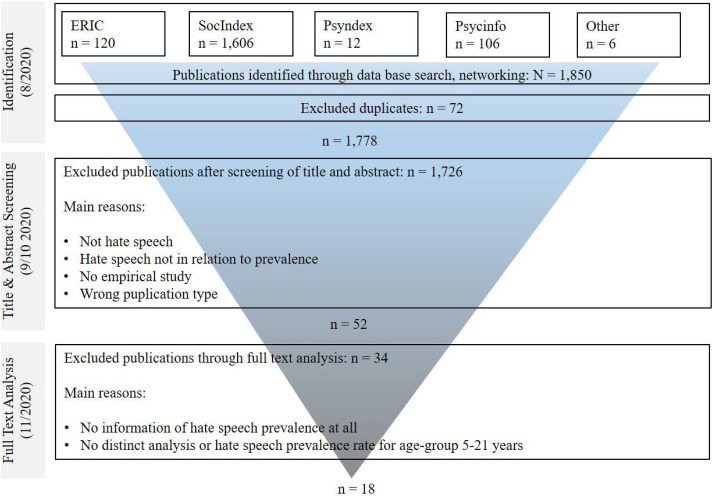
Little is known about the current state of research on the involvement of young people in hate speech. Thus, this systematic review presents findings on a) the prevalence of hate speech among children and adolescents and on hate speech definitions that guide prevalence assessments for this population; and b) the theoretical and empirical overlap of hate speech with related concepts. This review was guided by the Cochrane approach. To be included, publications were required to deal with real-life experiences of hate speech, to provide empirical data on prevalence for samples aged 5 to 21 years and they had to be published in academic formats. Included publications were full-text coded using two raters (κ = .80) and their quality was assessed. The string-guided electronic search (ERIC, SocInfo, Psycinfo, Psyndex) yielded 1,850 publications. Eighteen publications based on 10 studies met the inclusion criteria and their findings were systematized. Twelve publications were of medium quality due to minor deficiencies in their theoretical or methodological foundations. All studies used samples of adolescents and none of younger children. Nine out of 10 studies applied quantitative methodologies. Eighteen publications based on 10 studies were included. Results showed that frequencies for hate speech exposure were higher than those related to victimization and perpetration. Definitions of hate speech and assessment instruments were heterogeneous. Empirical evidence for an often theorized overlap between hate speech and bullying was found. The paper concludes by presenting a definition of hate speech, including implications for practice, policy, and research.
Overview
CoChat Summary
TL;DR
This systematic review of 18 publications based on 10 studies found heterogeneous definitions and assessment instruments for hate speech among children and adolescents, with exposure more common than victimization or perpetration. It also found theoretical and empirical overlap between hate speech and bullying, and proposes a definition of hate speech.
Key findings
- Eighteen publications based on 10 studies met inclusion criteria; 4 publications were high quality, 12 medium, and 2 low. All studies used samples of adolescents, and none looked at children younger than 12 years old.
- Definitions and assessment instruments were heterogeneous: no standard definition emerged, most definitions referred to online hate speech, and medium-scope definitions were more common than broad or narrow definitions. Most studies used self-assessments with single or multiple items.
- Exposure frequencies were higher than victimization and perpetration: exposure ranged from 26% to 69%, victimization from 7% to 24%, and perpetration from 5% to 32%. Online exposure ranged from 31.4% in India to 68.5% in Spain; offline exposure was 39.2% in 1999 and dropped to 26% by 2013. Victimization ranged from 7% in a US sample to 23.4% in a Finnish Facebook sample; perpetration ranged from 4.2% in South Korea to 32.2% in Thailand.
- Empirical overlap with bullying was found: cyberhate victimization and traditional bullying victimization correlated at r = .47; cyberhate perpetration correlated with traditional bullying perpetration at r = .30 and with cyberbullying perpetration at r = .32; cyberbullying perpetration predicted cyberhate perpetration at β = .19.
Methods
- The review used the Cochrane approach. Searches were run on August 7, 2020 in Psyndex, Psycinfo, SocIndex, and ERIC with no publication-date limit, using hate-speech and youth-related search terms. Inclusion required real-life hate speech experiences, empirical prevalence data, samples aged 5 to 21 years, and academic formats. The search yielded 1,850 publications; after removing 72 duplicates and screening, 52 full texts were double-rated, producing a final pool of 18 publications based on 10 studies.
- Two raters conducted blinded full-text coding; interrater reliability was κ = .80 for full-text coding and κ = .63 for down-selection. Quality appraisal rated publications high, moderate, low, or very low, using GRADE-based criteria for quantitative publications and Mayring-based criteria for qualitative publications.
- Eight of 10 studies used quantitative methods, one used ethnography, and one used quantitative and qualitative elements. Samples generally consisted of adolescents up to 18 years, with two studies using a broader age range of 8 years; most data were collected in North America and Europe, and the only multi-country study also included countries in Asia.
Limitations
- The authors state that the search strategy may have missed relevant publications because it only searched English and German, so findings published in other languages were not identified. They also note that future reviews might use a more extensive network approach to identify preprints or studies not listed in the databases accessed, and that assessing the quality of whole studies rather than individual publications could be of interest.
- Evident in the text: no study looked at children younger than 12 years old despite the review’s 5-to-21 age criterion, so findings do not cover younger children. The prevalence, group-difference, and overlap evidence is based on only 10 studies and 18 publications, and definitions and assessment instruments were heterogeneous with no established psychometric instrument. Most publications were of medium quality (12 of 18), with 2 low-quality publications.
Model-written summary. Check it against the paper before relying on it.
Integrity signals
Registry
Cites
Statistics
Figures
Verification
Claims the paper makes
19 Valid · 9 Not valid · 96 Not checked · 97 Own results and interpretations
At least one cited source doesn’t support this claim or points to a different paper, and none confirmed it — see the verdicts below.
In the paper
“Three publications, related to two studies, used vignettes with participants being asked to consider incidents of hate speech experience over the course of their lives (Soral et al., 2018; Wachs et al., 2020).”
§ A Systematic Review on Hate Speech among Children and Adolescents: Definitions, Prevalence, and Overlap with Related Phenomena > Results > Assessment of Hate Speech Prevalences
What the sources say
- Not checked — no full text of the sourcecites Soral et al., 2018 matched to “Exposure to hate speech increases prejudice through desensitization” (2018) source
- Disputedcites Wachs et al., 2020 matched to ““DNT LET ’EM H8 U!”: Applying the routine activity framework to understand cyberhate victimization among adolescents across eight countries” (2021) sourceExperimental — accuracy not yet measured
The Methods (sections 2.1–2.2; page unavailable) describe a questionnaire about adolescents’ own cyberhate experiences, not vignettes. Its victimization and witnessing items ask about the last twelve months, contrary to the claimed lifetime timeframe. (LLM, conf=0.89)
Checked by a reasoning model — may be wrong.
plain- Asserted: passes — The authors put it forward as true.
- Checkable: passes — It can be checked against evidence.
- Load-bearing: unclear — It is unclear whether the paper’s conclusions depend on it.
- Based: passes — The paper gives a reason why it holds.
The sources with a verdict support this claim; the rest weren’t checked yet, have no full text we could read, or their verdicts aren’t rated yet.
In the paper
“The prevalence of hate speech was generally studied and reported in online contexts (Blaya et al., 2020; Blaya & Audrin, 2019; Oksanen et al., 2014; Räsänen et al., 2016; Tynes, 2005; Wachs et al., 2019b, 2019a, 2020, 2021a, Wachs & Wright, 2018, 2019, 2020).”
§ A Systematic Review on Hate Speech among Children and Adolescents: Definitions, Prevalence, and Overlap with Related Phenomena > Results > Prevalence of Hate Speech among Children and Adolescents
What the sources say
- Supportedcites Blaya et al., 2020 matched to “School Bullying, Perpetration, and Cyberhate: Overlapping Issues” (2022) source
The Participants section (page unavailable) reports the prevalence of cyberhate victimization and perpetration among surveyed students. The Cyberhate section defines the behavior studied as hateful online expression, so this paper is an example of prevalence being studied and reported in an online context. (LLM, conf=0.89)
- Could not verifycites Blaya & Audrin, 2019 matched to “Corrigendum: Toward an Understanding of the Characteristics of Secondary School Cyberhate Perpetrators” (2019) sourceExperimental — accuracy not yet measured
The Correction section (p. 1) addresses a mislabeled figure in a study of secondary-school cyberhate perpetrators. It does not discuss the prevalence of hate speech or whether prevalence is generally studied and reported in online contexts; searches for those points found no relevant passage in our copy. (LLM, conf=0.78)
- Not checked — no full text of the sourcecites Oksanen et al., 2014 matched to “Exposure to Online Hate among Young Social Media Users” (2014) source
plain- Asserted: passes — The authors put it forward as true.
- Checkable: passes — It can be checked against evidence.
- Load-bearing: unclear — It is unclear whether the paper’s conclusions depend on it.
- Based: passes — The paper gives a reason why it holds.
- Supported
The cited sources that could be checked couldn’t confirm or dispute this claim.
In the paper
“The main group difference reported in terms of personal characteristics was gender (Blaya & Audrin, 2019; Elpus & Carter, 2016; Räsänen et al., 2016; Wachs et al., 2019a, 2019, 2020, Wachs & Wright, 2018, 2019).”
§ A Systematic Review on Hate Speech among Children and Adolescents: Definitions, Prevalence, and Overlap with Related Phenomena > Results > Prevalence of Hate Speech among Children and Adolescents
What the sources say
- Could not verifycites Blaya & Audrin, 2019 matched to “Corrigendum: Toward an Understanding of the Characteristics of Secondary School Cyberhate Perpetrators” (2019) sourceExperimental — accuracy not yet measured
The corrigendum (p. 1) corrects a label in Figure 1 but reports no group differences in personal characteristics. Searches for gender and group differences found no passage in our copy addressing the claim; the original article is identified but is not part of this source's text. (LLM, conf=0.77)
- Not checked — no full text of the sourcecites Elpus & Carter, 2016 matched to “Bullying Victimization Among Music Ensemble and Theatre Students in the United States” (2016) source
- Not checked — no full text of the sourcecites Räsänen et al., 2016 matched to “Targets of Online Hate: Examining Determinants of Victimization Among Young Finnish Facebook Users” (2016) source
plainstates an association- Asserted: passes — The authors put it forward as true.
- Checkable: passes — It can be checked against evidence.
- Load-bearing: unclear — It is unclear whether the paper’s conclusions depend on it.
- Based: passes — The paper gives a reason why it holds.
- Could not verify
The cited sources support only part of this claim — read each source’s verdict below.
In the paper
“In Western European countries, perpetration rates varied from 5.2% in France (Blaya & Audrin, 2019; Blaya et al., 2020) to 11.3% in Germany (Wachs et al., 2019a, 2019, Wachs & Wright, 2018, 2019, 2020).”
§ A Systematic Review on Hate Speech among Children and Adolescents: Definitions, Prevalence, and Overlap with Related Phenomena > Results > Prevalence of Hate Speech among Children and Adolescents
What the sources say
- Could not verifycites Blaya & Audrin, 2019 matched to “Corrigendum: Toward an Understanding of the Characteristics of Secondary School Cyberhate Perpetrators” (2019) sourceExperimental — accuracy not yet measured
Our copy of DOI 10.3389/feduc.2019.00083 is only the two-page correction notice: it identifies the original article (Blaya & Audrin 2019, Front. Educ. 4:46, doi 10.3389/feduc.2019.00046), states that 'Trust in proximal institutions' was duplicated in Figure 1 and should read 'Trust in distal institutions', and supplies the corrected figure caption ('Standardized regression estimates between latent factors', p. 1-2). Searches for perpetration rates, prevalence percentages, 5.2%, France and Western European comparisons returned no passage containing any figure or rate; the notice carries no results text. Nothing contrary is stated, so the 5.2% French perpetration rate attributed here cannot be checked against this copy. (LLM, conf=0.72)
- Supportedcites Blaya et al., 2020 matched to “School Bullying, Perpetration, and Cyberhate: Overlapping Issues” (2022) source
Our copy's Participants/Results section states that among 1900 French secondary school students aged 12-20 (data collected spring 2016, 16 schools in France), 'one out of ten (10.5%) respondents reported cyberhate victimization while 5.2% acknowledged cyberhate perpetration' — this is the figure the citing sentence attaches to Blaya et al. for France. The cross-national framing and the 11.3% German figure are carried by the separate Wachs citations, and our copy makes no such European comparison (searched: Germany/Wachs prevalence, 5.2% perpetration), so nothing here conflicts with the attributed part. The only qualifier worth noting is that the 5.2% is adolescent cyberhate perpetration in a convenience sample of French school students, not a national population estimate. (LLM, conf=0.85)
- Not matchedcites Wachs et al., 2019a
More than one paper fits this citation.
plain- Asserted: passes — The authors put it forward as true.
- Checkable: passes — It can be checked against evidence.
- Load-bearing: unclear — It is unclear whether the paper’s conclusions depend on it.
- Based: passes — The paper gives a reason why it holds.
- Could not verify
The cited sources that could be checked couldn’t confirm or dispute this claim.
In the paper
“and even seek revenge (Wachs et al., 2020).”
§ A Systematic Review on Hate Speech among Children and Adolescents: Definitions, Prevalence, and Overlap with Related Phenomena > Abstract
What the sources say
- Could not verifycites Wachs et al., 2020 matched to ““DNT LET ’EM H8 U!”: Applying the routine activity framework to understand cyberhate victimization among adolescents across eight countries” (2021) sourceExperimental — accuracy not yet measured
Our copy of Wachs et al. (2021, Comput & Educ) contains no passage on victims seeking revenge or retaliating; searches for 'revenge', 'retaliation/getting even after victimization', and 'victim-offender overlap/perpetration' returned only routine-activity material (Sections 1.2, 1.2.1 Exposure to a Potential Offender, 1.2.3 Suitable Target, 4 Discussion). The paper's outcome variables are cyberhate victimization predicted by witnessing cyberhate, online disclosure, and parental mediation, with the Discussion noting only that mechanisms behind the witnessing–victimization link need study (e.g., 'lack of productive coping strategies'). Where the paper does touch victim-perpetration associations it credits other works (Wachs & Wright, 2018, 2019; Wachs et al., 2019), not a revenge motive, so the claim is neither supported nor contradicted here. (LLM, conf=0.70)
hedgedstates a possible cause- Asserted: passes — The authors put it forward as true.
- Checkable: passes — It can be checked against evidence.
- Load-bearing: unclear — It is unclear whether the paper’s conclusions depend on it.
- Based: passes — The paper gives a reason why it holds.
- Could not verify
103 more claims · 21 with their cited sources checked
Create a free account to see all 221 claims and to verify the 10 references still open.
- It may state two separate claims as one. 35
- Probably not a substantial claim. 93
Self-check
Percentages, sums and reported differences re-computed from the paper’s own numbers.
Each contradiction between two passages listed here was confirmed by an independent check.
Rated major: it would touch a result — a value a result rests on, reported and recomputed p-values on opposite sides of the significance level, two passages that conflict with no sign which is right, or a cited work retracted before this paper was published.
In the paper
“But 43.6% (n = 61) indicated that they had experienced some form of bullying at least once”
§ A Systematic Review on Hate Speech among Children and Adolescents: Definitions, Prevalence, and Overlap with Related Phenomena > Results > Empirical Overlap of Hate Speech and Related Phenomena
Reported 43.6 · recomputed 61
Rated major: it would touch a result — a value a result rests on, reported and recomputed p-values on opposite sides of the significance level, two passages that conflict with no sign which is right, or a cited work retracted before this paper was published.
In the paper
“from their survey of cyberhate perpetrators (N = 100), a total of 51.4% (n = 73) were never bullied”
§ A Systematic Review on Hate Speech among Children and Adolescents: Definitions, Prevalence, and Overlap with Related Phenomena > Results > Empirical Overlap of Hate Speech and Related Phenomena
Reported 51.4 · recomputed 73
Rated minor: it would not touch a result — a value no result rests on, a p-value that stays on the same side of the significance level, or a conflict that is clerical, resolved elsewhere in the paper, or outside its own findings.
In the paper
§ A Systematic Review on Hate Speech among Children and Adolescents: Definitions, Prevalence, and Overlap with Related Phenomena > Results > Main Characteristics of Publications Included and Underlying Studies
“| 12–18 years | 5 | 50 | High | 4 | 22 | | 12–20 years | 1 | 10 | Moderate | 12 | 67 | | 13–17 years | 1 | 10 | Low | 2 | 11 | | 15–18 years | 2 | 20 | Very low | 0 | 0 | | 13–21 years | 1 | 10 | | | |”
§ A Systematic Review on Hate Speech among Children and Adolescents: Definitions, Prevalence, and Overlap with Related Phenomena > Results > Definitions and Prevalence of Hate Speech in Empirical Research on Children and Adolescents
“| 1,480 | 12–17 | School | Germany |”
Rated minor: it would not touch a result — a value no result rests on, a p-value that stays on the same side of the significance level, or a conflict that is clerical, resolved elsewhere in the paper, or outside its own findings.
In the paper
§ A Systematic Review on Hate Speech among Children and Adolescents: Definitions, Prevalence, and Overlap with Related Phenomena > Results > Prevalence of Hate Speech among Children and Adolescents
“The remaining publications reported exposure rates within this range (Blaya et al., 2020; Blaya & Audrin, 2019; Lehmann, 2019, 2020; Oksanen et al., 2014; Räsänen et al., 2016; Tynes, 2005; van Dorn, 2004; Wachs et al., 2019; Wachs & Wright, 2018).”
§ A Systematic Review on Hate Speech among Children and Adolescents: Definitions, Prevalence, and Overlap with Related Phenomena > Results > Prevalence of Hate Speech among Children and Adolescents
“with the frequency dropping to 26% by 2013 (Lehmann, 2019; 2020; van Dorn, 2004).”
Rated minor: it would not touch a result — a value no result rests on, a p-value that stays on the same side of the significance level, or a conflict that is clerical, resolved elsewhere in the paper, or outside its own findings.
In the paper
§ A Systematic Review on Hate Speech among Children and Adolescents: Definitions, Prevalence, and Overlap with Related Phenomena > Results > Empirical Overlap of Hate Speech and Related Phenomena
“• Exposure (26% to 69%) was more common than victimization (7% to 24%) or perpetration (5% to 32%)”
§ A Systematic Review on Hate Speech among Children and Adolescents: Definitions, Prevalence, and Overlap with Related Phenomena > Results > Prevalence of Hate Speech among Children and Adolescents
“The prevalence of online hate speech perpetration ranged from a minimum of 4.2% for a population of 12-to-17-year-old adolescents in South Korea to a maximum of 32.2% for a comparable population in Thailand”
1 more finding
Create a free account to see every finding of this check.
Citations
Cites
Statistical Power Analysis for the Behavioral Sciences
Muller, K. (1989) · Technometrics · doi:10.1080/00401706.1989.10488618 · Cited by 99,167
The Measurement of Observer Agreement for Categorical Data
Landis, J. R., & Koch, G. G. (1977) · Biometrics · doi:10.2307/2529310 · Cited by 81,148
Multilevel analysis : an introduction to basic and advanced multilevel modeling
Snijders, T. A. B., & Bosker, R. (1999) · Cited by 14,026
Predicting and Changing Behavior
Fishbein, M., & Ajzen, I. (2011) · doi:10.4324/9780203838020 · Cited by 2,807
How to Construct a Mixed Methods Research Design
Schoonenboom, J., & Johnson, R. B. (2017) · KZfSS Kölner Zeitschrift für Soziologie und Sozialpsychologie · doi:10.1007/s11577-017-0454-1 · Cited by 1,757 · cited 1×
“A socio-ecological framework (Bronfenbrenner, 1994), a mixed method design (Schoonenboom & Johnson, 2017), and multi-level analytics (e.g., Snijders & Bosker, 2011) thus all represent useful tools to guide both research and practical efforts alike.”
The international encyclopedia of education
Watson, K. (1994) · International Journal of Educational Development · doi:10.1016/0738-0593(94)90060-4 · Cited by 1,487
Words that wound: critical race theory, assaultive speech, and the First Amendment
(1993) · Choice Reviews Online · doi:10.5860/choice.31-2366 · Cited by 1,379 · cited 1×
“In line with critical race theorist Mary Matsuda et al. (1993), Vaught connected hate speech to a shared norm that justifies any conduct aimed at upholding the power and supreme status of the dominant social group (here: white people).”
Snijders, T. A. B. (2011) · International Encyclopedia of Statistical Science · doi:10.1007/978-3-642-04898-2_387 · Cited by 546
Zych, I., Ortega-Ruiz, R., & Del Rey, R. (2015) · Aggression and Violent Behavior · doi:10.1016/j.avb.2015.10.001 · Cited by 439
Adolescents’ Intense and Problematic Social Media Use and Their Well-Being in 29 Countries
Boer, M., van den Eijnden, R. J. J. M., Boniel-Nissim, M., Wong, S.-L., Inchley, J. C., Badura, P., Craig, W. M., Gobina, I., Kleszczewska, D., Klanšček, H. J., et al. (2020) · Journal of Adolescent Health · doi:10.1016/j.jadohealth.2020.02.014 · Cited by 434
Research works printed but not linked: 9
- Hawdon J. Oksanen A. Räsänen P. (2015). Online extremism and online hate: Exposure among adolescents and young adults in four nations. Nordicom Information: Medie-Och Kommunikationsforskning I Norden, 37(3–4), 29– 37.
- Higgins J. P. T. Thomas J. Chandler J. Cumpston M. Li T. Page M. J. Welch V. A. (2021). Cochrane Handbook for systematic reviews of interventions version 6.2. Cochrane. www.training.cochrane.org/handbook
- Mayring P. A. E. (2016). Einführung in die qualitative Sozialforschung. Beltz Verlag.
- Ryan R. Hill S. (2016). How to GRADE the quality of the evidence version 3.0 December 2016. Cochrane Consumers and Communication Group. http://cccrg.cochrane.org/author-resources
- Sponholz L. (2020). Der Begriff „Hate Speech“ in der deutschsprachigen Forschung. Eine empirische Begriffsanalyse [The concept »hate speech« in German-speaking research. An empirical conceptual analysis]. SWS Rundschau, 60(1), 43– 65.
- Stefan Bartory Foundation (2014). Hate speech in Poland—summary of the national opinion poll. Stefan Bartory Foundation. https://www.batory.org.pl/upload/files/Programydotacyjne/ObywateledlaDemokracji/Hate_speech_Poland_2014.pdf
- * Tynes B. M. (2005). Toward a textual promised land: Youth culture, race and identity on the Internet. In: ProQuest Dissertations & theses global database. Purdue University. [Doctoral dissertation].
- UK Safer Internet Centre. (2016). Creating a better internet for all: Young people’s experiences of online empowerment + online hate. UK Safer Internet Centre. http://childnetsic.s3.amazonaws.com/ufiles/SID2016//CreatingaBetterInternetforAll.pdf.
- United Nations Children’s Fund (2018). Developing a global indicator on bullying of school-aged children. In Innocenti working paper No. 2018–11. UNICEF Office of Research. https://www.unicef-irc.org/publications/pdf/WP2018-11.pdf
Cited by
Wachs, S., Krause, N., Wright, M. F., & Gámez‐Guadix, M. (2023) · Journal of Youth and Adolescence · doi:10.1007/s10964-023-01753-2 · Cited by 67
“Hate speech among youth is a serious and widespread problem that plagues schools worldwide (Kansok-Dusche et al., 2022).”
BackgroundSelf-citationHate speech in adolescents: A binational study on prevalence and demographic differences
Castellanos, M., Wettstein, A., Wachs, S., Kansok-Dusche, J., Ballaschk, C., Krause, N., & Bilz, L. (2023) · Frontiers in Education · doi:10.3389/feduc.2023.1076249 · Cited by 39
Self-citationWachs, S., Castellanos, M., Wettstein, A., Bilz, L., & Gámez‐Guadix, M. (2022) · Journal of Interpersonal Violence · doi:10.1177/08862605221120905 · Cited by 51
“While current hate speech research involving adolescents has mainly focused on hate speech witnessing, perpetration, and victimization, other forms of involvement, such as countering hate speech (counterspeech), remain blind spots (Kansok-Dusche et al., 2022).”
BackgroundSelf-citationWachs, S., Wright, M. F., & Gámez‐Guadix, M. (2024) · Computers in Human Behavior · doi:10.1016/j.chb.2024.108250 · Cited by 45
Self-citationOnline hate speech victimization: consequences for victims’ feelings of insecurity
Dreißigacker, A., Müller, P., Isenhardt, A., & Schemmel, J. (2024) · Crime Science · doi:10.1186/s40163-024-00204-y · Cited by 81
“…on detection (Qian et al., 2021; Schmidt & Wiegand, 2017; Warner & Hirschberg, 2012), prevalence (Dreißigacker et al., 2020; Geschke et al., 2019; Kansok-Dusche et al., 2022; Saha et al., 2019), the consequences for society (Bilewicz & Soral, 2020), regulation (Bleich, 2011; Judge & Nel, 2018;…”
Madriaza, P., Hassan, G., Brouillette‐Alarie, S., Mounchingam, A. N., Durocher‐Corfa, L., Borokhovski, E., Pickup, D. I., & Paillé, S. (2025) · Campbell Systematic Reviews · doi:10.1002/cl2.70018 · Cited by 62
“Kansok ‐ Dusche et al. (2023), in a recent systematic review, attempted to establish the prevalence of hate speech among adolescents and children and also to identify the definitions and constructs underlying prevalence assessments, as well as the theoretical and empirical relationship of hate…”
Wachs, S., Bilz, L., Wettstein, A., & Espelage, D. L. (2023) · Aggressive Behavior · doi:10.1002/ab.22105 · Cited by 30
Self-citationMetaHate: A Dataset for Unifying Efforts on Hate Speech Detection
Piot, P., Martín-Rodilla, P., & Parapar, J. (2024) · Proceedings of the International AAAI Conference on Web and Social Media · doi:10.1609/icwsm.v18i1.31445 · Cited by 60
The eradication of hate speech on social media: a systematic review
Calandín, J. G., & Montoya, L. S. (2023) · Journal of Information Communication and Ethics in Society · doi:10.1108/jices-11-2022-0098 · Cited by 33
Wachs, S., Valido, A., Espelage, D. L., Castellanos, M., Wettstein, A., & Bilz, L. (2023) · Journal of Adolescence · doi:10.1002/jad.12180 · Cited by 31
Self-citationListen to Me! Target Perceptions of Digital Hate: A Scoping Review of Recent Research
Khaleghipour, M., Koban, K., & Matthes, J. (2025) · Trauma Violence & Abuse · doi:10.1177/15248380241303725 · Cited by 18
Castellanos, M., Wettstein, A., Wachs, S., & Bilz, L. (2023) · Aggressive Behavior · doi:10.1002/ab.22100 · Cited by 26
Self-citationLlorent, V.-J., Mejía, C. S., & Vélez‐Calvo, X. (2023) · Comunicar · doi:10.3916/c77-2023-09 · Cited by 22
The Effects of Social Approval Signals on the Production of Online Hate: A Theoretical Explication
Walther, J. B. (2024) · Communication Research · doi:10.1177/00936502241278944 · Cited by 26
Wachs, S., Wettstein, A., Bilz, L., Espelage, D. L., Wright, M. F., & Gámez‐Guadix, M. (2024) · Journal of Youth and Adolescence · doi:10.1007/s10964-024-01968-x · Cited by 20
“The current fi ndings extend research revealing a negative link between openness to diversity and the perpetration of hate speech (Kansok-Dusche et al., 2023).”
BackgroundSelf-citationBedrosova, M. J., Dufková, E., Macháčková, H., Huang, Y., & Blaya, C. (2024) · Trauma Violence & Abuse · doi:10.1177/15248380241275971 · Cited by 15
Cyber democracy in the digital age: Characterizing hate networks in the 2022 US midterm elections
Rozo, A. Z., Campo-Archbold, A., López, D. D., Gray, I. W., Pastor-Galindo, J., Nespoli, P., Mármol, F. G., & McCoy, D. (2024) · Information Fusion · doi:10.1016/j.inffus.2024.102459 · Cited by 19
Matter, D., Schirmer, M., Grinberg, N., & Pfeffer, J. (2024) · Frontiers in Social Psychology · doi:10.3389/frsps.2024.1383152 · Cited by 32
Hate Speech Against Asian American Youth: Pre-Pandemic Trends and The Role of School Factors
Gee, K. A., Cooc, N., & Yu, P. K. (2024) · Journal of Youth and Adolescence · doi:10.1007/s10964-024-01987-8 · Cited by 11
“…is no singular agreed upon de fi nition of hate speech, it is widely understood to involve derogatory remarks that intentionally demean and harm individuals or groups of individuals based on characteristics such as their race, ethnicity, sexual orientation, gender, etc. (Kansok-Dusche et al., 2023).”
BackgroundShmulewitz, D., Levitin, M. D., Skvirsky, V., Vider, M., Lev‐Ran, S., & Mikulincer, M. (2025) · Scientific Reports · doi:10.1038/s41598-025-16168-1 · Cited by 20
“Hate speech is often defined as hostile communication against an individual or group based on a group characteristic, such as nationality, ethnicity, or religion 6,7 .”
Schulbezogene Programme zum Umgang mit Hatespeech – Eine kriteriengeleitete Bestandsaufnahme
Seemann-Herz, L., Kansok‐Dusche, J., Dix, A., Wachs, S., Krause, N., Ballaschk, C., Schulze-Reichelt, F., & Bilz, L. (2022) · Zeitschrift für Bildungsforschung · doi:10.1007/s35834-022-00348-4 · Cited by 15
“Empirisch zeigt sich, dass Hatespeech außer- und innerhalb von sequenziellen Mobbingprozessen auftreten kann (Kansok-Dusche et al. 2022; Blaya et al. 2020; Wachs et al. 2019).”
BackgroundSelf-citationWeber, I., Vandebosch, H., Poels, K., & Pabian, S. (2024) · Aggressive Behavior · doi:10.1002/ab.22136 · Cited by 9
Teachers’ intervention strategies for handling hate-speech incidents in schools
Bilz, L., Fischer, S. M., Kansok‐Dusche, J., Wachs, S., & Wettstein, A. (2024) · Social Psychology of Education · doi:10.1007/s11218-024-09929-9 · Cited by 18
Self-citationKansok‐Dusche, J., Wettstein, A., Castellanos, M., Schwab, C., Subramaniam, A., Wachs, S., & Bilz, L. (2023) · Victims & Offenders · doi:10.1080/15564886.2023.2189191 · Cited by 14
Self-citationPapcunová, J., Martončik, M., Fedáková, D., Kentoš, M., & Adamkovic, M. (2023) · Cyberpsychology Behavior and Social Networking · doi:10.1089/cyber.2022.0191 · Cited by 15
“12 Generally, people have an inner understanding of hate speech 13 ; however, the content and form of their evaluation of hateful material can vary greatly.”
Wang, W., Huang, J., Huang, J.-T., Chen, C., Gu, J., He, P., & Lyu, M. R.-T. (2023) · IEEE/ACM International Conference on Automated Software Engineering (ASE) · doi:10.1109/ase56229.2023.00189 · Cited by 16
“Hate speech exposure among children and adolescents poses a higher chance of victimization and perpetration [6].”
BackgroundFrischlich, L., Schmid, U. K., & Rieger, D. (2023) · Springer eBooks · doi:10.1007/978-3-662-66608-1_14 · Cited by 13
Stances on hate speech: Population opinions and attitudes
Zapatero, M. D. C., Brändle, G., & Rebollo, M. A. P. (2023) · El Profesional de la Informacion · doi:10.3145/epi.2023.jul.10 · Cited by 14
Castellanos, M., Wettstein, A., Bilz, L., & Wachs, S. (2023) · International Journal of Developmental Science · doi:10.3233/dev-230341 · Cited by 8
“Although hate speech and bullying share commonalities (e.g., in both, there is a power imbalance), they differ regarding targets, frequency, and perpetrators’ goals (Kansok-Dusche et al., 2022).”
InfluentialSelf-citationNaranjo‐Pou, S., & Zych, I. (2024) · Journal of Adolescence · doi:10.1002/jad.12433 · Cited by 11
Ruscher, J. B. (2024) · Cambridge University Press eBooks · doi:10.1017/9781009534666 · Cited by 12
Cyberhate in adolescents and youths: A systematic review of labels and associated factors
Jiménez-Díaz, O., & Rey, R. D. (2024) · Aggression and Violent Behavior · doi:10.1016/j.avb.2024.102023 · Cited by 12
Sustainable use of a smartphone and regulatory needs
Kögler, M., Paulick, K., Scheffran, J., & Birkholz, M. (2024) · Sustainable Development · doi:10.1002/sd.2995 · Cited by 10
Dynamics of hate speech in social media: insights from Indonesia
Margono, H., Saud, M., & Ashfaq, A. (2024) · Global Knowledge, Memory and Communication · doi:10.1108/gkmc-11-2023-0464 · Cited by 29
Ballaschk, C., Schulze-Reichelt, F., Wachs, S., Krause, N., Wettstein, A., Kansok‐Dusche, J., Bilz, L., & Schubarth, W. (2022) · Zeitschrift für Bildungsforschung · doi:10.1007/s35834-022-00367-1 · Cited by 13
“Für Hatespeech bei Jugendlichen sind solche Verflechtungen ein Forschungsdesiderat, da die bisherige Forschung Hatespeech entweder nur in Schulen (Lehman 2019, 2020) oder ausschließlich digital erforschte (Kansok-Dusche et al. 2022).”
BackgroundSelf-citationJiménez-Díaz, O., Wachs, S., Rey, R. D., & Mora-Merchán, J. A. (2025) · Cyberpsychology Behavior and Social Networking · doi:10.1089/cyber.2024.0305 · Cited by 6
Self-citationWachs, S., Schittenhelm, C., Kops, M., & Wright, M. F. (2025) · Journal of Interpersonal Violence · doi:10.1177/08862605241308296 · Cited by 10
Self-citationAt Risk and A Risk: Disrupting Anti-Black Hate Toward Black Males in K-12 Schools
Howard, J., McAdoo, G., & Howard, T. C. (2025) · Urban Education · doi:10.1177/00420859251371682 · Cited by 5
“This includes spreading ste-reotypes, false ideas, or engaging in cruel actions that perpetuate bias and discrimination toward marginalized identity groups (Kansok-Dusche et al., 2023; Wachs et al., 2022).”
Levin, J., Neri, N. C., & Retelsdorf, J. (2025) · Computers in Human Behavior · doi:10.1016/j.chb.2025.108626 · Cited by 8
Krause, N., & Wachs, S. (2025) · Zeitschrift für Bildungsforschung · doi:10.1007/s35834-024-00463-4 · Cited by 6
“Hatespeech bezeichnet Äußerun-gen, mit denen Menschen aufgrund einer zugeschriebenen Zugehörigkeit zu einer Gruppe abgewertet und verletzt werden sollen (Kansok-Dusche et al. 2022).”
Self-citationPfetsch, J. S., & Ulucinar, D. (2023) · International Journal of Developmental Science · doi:10.3233/dev-230346 · Cited by 4
Kansok‐Dusche, J., Wettstein, A., Fischer, S. M., Wachs, S., & Bilz, L. (2024) · Frontiers in Education · doi:10.3389/feduc.2024.1432013 · Cited by 4
Self-citationHate Speech Detection by Using Rationales for Judging Sarcasm
Mamun, M. B., Tsunakawa, T., Nishida, M., & Nishimura, M. (2024) · Applied Sciences · doi:10.3390/app14114898 · Cited by 9
Oehmer, F., & Pedrazzi, S. (2024) · Communications · doi:10.1515/commun-2023-0117 · Cited by 8
Korol, L., & Blaya, C. (2025) · British Journal of Psychology · doi:10.1111/bjop.12766 · Cited by 6
Towards Efficient and Explainable Hate Speech Detection via Model Distillation
Piot, P., & Parapar, J. (2025) · Lecture notes in computer science · doi:10.1007/978-3-031-88711-6_24 · Cited by 26
“Regarding the gravity of this phenomenon in the online world, studies reveal that about 30% of youth experience cyberbullying [24], and 46% of Black and African American adults encounter online racial harassment [2].”
Leveraging a Multi-agent LLM-Based System to Educate Teachers in Hate Incidents Management
Gajewska, E., Wawer, M., Budzyńska, K., & Chudziak, J. A. (2025) · Lecture notes in computer science · doi:10.1007/978-3-031-98462-4_42 · Cited by 9
Jiménez-Díaz, O., Rey, R. D., Espino, E., & Casas, J. A. (2025) · Journal for the Study of Education and Development Infancia y Aprendizaje · doi:10.1177/02103702251356207 · Cited by 5
Krause, N., Wachs, S., Bilz, L., & Schubarth, W. (2023) · Zeitschrift für Erziehungswissenschaft · doi:10.1007/s11618-023-01179-3 · Cited by 7
Self-citationStefanelli, F., Menesini, E., Nocentini, A., & Palladino, B. E. (2023) · Cyberpsychology Behavior and Social Networking · doi:10.1089/cyber.2022.0198 · Cited by 3
Papcunová, J., Martončik, M., Fedáková, D., Kentoš, M., & Adamkovic, M. (2022) · doi:10.31234/osf.io/wvmfd · Cited by 3
WATCHED: A Web AI Agent Tool for Combating Hate speech by Expanding Data
Piot, P., Sánchez, D. F., & Parapar, J. (2025) · SoftwareX · doi:10.1016/j.softx.2025.102431 · Cited by 3
Bedrosova, M. J., Tercova, N., Coninck, D. D., Pyżalski, J., Waechter, N., & Macháčková, H. (2025) · Journal of Children and Media · doi:10.1080/17482798.2025.2480091 · Cited by 4
“…attacks directed at entire groups but also on individuals who possess (or are thought to possess by the aggressors) characteristics of the group, such as ethnicity, religion, sexual orientation, or gender (e.g., Chetty & Alathur, 2018; Jaron Bedrosova et al., 2024; Kansok-Dusche et al., 2022).”
Mateos‐Pérez, E., Martínez‐Bacaicoa, J., Wachs, S., & Gámez‐Guadix, M. (2025) · Journal for the Study of Education and Development Infancia y Aprendizaje · doi:10.1177/02103702251352943 · Cited by 7
Self-citationLlorent, V. J., Núñez-Flores, M., Marín‐López, I., & Zych, I. (2025) · Education and Information Technologies · doi:10.1007/s10639-025-13802-3 · Cited by 2
“Cyberhate among adolescents and young people has been analyzed in recent studies (Kansok-Dusche et al., 2022; Reichelmann et al., 2021).”
Íñiguez‐Berrozpe, T., Elboj-Saso, C., Marcaletti, F., & Bautista, P. (2025) · International Journal of Computer-Supported Collaborative Learning · doi:10.1007/s11412-025-09460-9 · Cited by 5
“…started searching for potential prevention and coping strategies, particularly designed to deal with hate speech in its manifestations on the Internet, on social networks, in online games, and in all other virtual environments where minors can interact with one another (Kansok-Dusche et al., 2022).”
Political Polarization, Political Hate Speech and Social Media: The Experience of Spanish Teenagers
Paz-Rebollo, M. A., Feijoo, B., & Rivera-Guerrero, A. (2026) · Young · doi:10.1177/11033088251414549 · Cited by 5
Reclaimed Homophobic Hate Speech Backfires: Desensitization and Mood Deterioration
Puchała, D., Bilewicz, M., & Świderska, A. (2026) · European Journal of Social Psychology · doi:10.1002/ejsp.70056 · Cited by 2
Evolving Definitions of Hate Speech: The Impact of a Lack of Standardized Definitions
Lee, S. K., & Gilliland, A. J. (2024) · Lecture notes in computer science · doi:10.1007/978-3-031-57860-1_11 · Cited by 5
Child Vulnerability in the Digital World
Калмус, В., Batista, S., Opermann, S., Tercova, N., & Bedrosova, M. J. (2024) · Children's well-being · doi:10.1007/978-3-031-61333-3_8 · Cited by 7
Identifying Risk Factors of Gender-Based Harassment
Goruk, K. J., Blais, J., & McArthur, J. L. (2024) · Victims & Offenders · doi:10.1080/15564886.2024.2412812 · Cited by 3
de Lucas, B. C., Amate-García, M., Martín, F. D. F., & Tirado, J. L. A. (2024) · Journal of Interpersonal Violence · doi:10.1177/08862605241286028 · Cited by 8
Infusing Taoist Principles into Early Literacy Professional Learning
Zhang, C. (2024) · Journal of Literacy Research · doi:10.1177/1086296x241300349 · Cited by 2
Adekola, A. P. (2025) · Journal of Ecohumanism · doi:10.62754/joe.v4i4.6857 · Cited by 1
Cricchio, M. G. L., Stefanelli, F., Menesini, E., & Nocentini, A. (2023) · Cyberpsychology Journal of Psychosocial Research on Cyberspace · doi:10.5817/cp2023-5-4 · Cited by 3
“Among other aspects, in fact, a recent systematic review (Kansok-Dusche et al., 2022) has considered the associations between OHS and offline school bullying (not ethnic in particular) finding only two studies (Blaya & Audrin, 2019; Blaya et al., 2022) within the search results.”
BackgroundInfluentialLirola, F. V., & Martínez, P. R. (2025) · Social Sciences · doi:10.3390/socsci14060349 · Cited by 1
Wachs, S., Schittenhelm, C., Kops, M., Gámez‐Guadix, M., & Wright, M. F. (2025) · Journal of Adolescence · doi:10.1002/jad.12525 · Cited by 2
Self-citationMapping the Landscape of Online Discrimination: An Integrated Transdisciplinary Approach
Imperato, C., & Mancini, T. (2025) · Human Behavior and Emerging Technologies · doi:10.1155/hbe2/6627162 · Cited by 1
Pabian, S., van Moorsel, E., & van Zon, J. (2026) · Behaviour and Information Technology · doi:10.1080/0144929x.2026.2614046 · Cited by 2
Mullah, N. S., Zainon, W. M. N. W., Ridzuan, F., & Abiodun, E. O. (2026) · PeerJ Computer Science · doi:10.7717/peerj-cs.3537 · Cited by 4
Hung, W.-L. (2026) · International Journal of Environmental Research and Public Health · doi:10.3390/ijerph23040525 · Cited by 3
“Theoretical and empirical studies further suggest that online hate speech and cyberbul-lying overlap substantially with OGBV in both etiology and psychological consequences, particularly in their long-term effects on emotional regulation and social functioning [44].”
Cicirelli, P. G., Sportelli, C., Paciello, M., Wachs, S., & D’Errico, F. (2026) · Social Psychology of Education · doi:10.1007/s11218-026-10220-2 · Cited by 1
Self-citationLexicon-enhanced Pre-trained Language Models for Chinese Ethics-related TasksPreprint
Gu, T., Bao, T., Li, L., Chang, L., & Feng, X. (2023) · doi:10.36227/techrxiv.23689404.v1
Lexicon-enhanced Pre-trained Language Models for Chinese Ethics-related TasksPreprint
Gu, T., Bao, T., Li, L., Chang, L., & Feng, X. (2023) · doi:10.36227/techrxiv.23689404
Online/Offline discrepancies in moral judgement among social media users: A mixed methods study
Classen, B. (2024) · Open Access Victoria University of Wellington | Te Herenga Waka (Figshare) · doi:10.26686/wgtn.24993774 · Cited by 2
Prevalence and Impact of Hate Speech among Politicians in Switzerland
Albrecht, J. N., Endrass, J., Dreifuss, M. S., Schnyder, N., & Rossegger, A. (2024) · Societies · doi:10.3390/soc14070098
Online Hate Speech Among Adolescents: Theory, Research, and Recommendations
Wachs, S., Mazzone, A., Schultze‐Krumbholz, A., Wright, M. F., Döring, N. M., Espelage, D. L., Gámez‐Guadix, M., & Hong, J. S. (2024) · Springer eBooks · doi:10.1007/978-3-031-69362-5_62 · Cited by 4
Self-citationGkantona, G., & Ntagkas, F. (2025) · Advances in social networking and online communities book series · doi:10.4018/979-8-3693-4191-9.ch008 · Cited by 2
Oehmer, F., & Pedrazzi, S. (2025) · Medien & Kommunikationswissenschaft · doi:10.5771/1615-634x-2025-2-235
Gaud, N., & Poonkuntran, S. (2026) · Lecture notes in electrical engineering · doi:10.1007/978-981-95-1058-0_23
Ankita, F. R., & Atikuzzaman, M. (2026) · Global Knowledge, Memory and Communication · doi:10.1108/gkmc-12-2024-0859 · Cited by 1
Using generative AI in hate speech detection for primary and secondary school students
Drašković, D., Cincović, J., Radenković, U., et al. (2025) · IEEE International Conference on Teaching, Assessment, and Learning for Engineering · doi:10.1109/tale66047.2025.11346657
“Hate speech is particularly prevalent among children and adolescents today, so work must be done to develop Artificial Intelligence (AI) tools that would prevent such speech and educate young people [1].”
Verschwörungserzählungen, Fake News und Hatespeech
Krause, N., & Kleps, N. (2026) · Erlebniswelten · doi:10.1007/978-3-658-48327-2_13
Self-citationService-learning as a strategy to prevent online hate speech perpetration in secondary education
de Lucas, B. C., Amate-García, M., Arco-Tirado, J. L., & Martín, F. D. F. (2026) · International Journal of Educational Research · doi:10.1016/j.ijer.2026.102964
The influence of hate speech on adolescents' bystander intention and TNB aggression
Gorostiaga-Marcos, N., Cortázar, N., & Calvete, E. (2026) · Journal of Research on Adolescence · doi:10.1111/jora.70170
Coping With Digital Hostility: How Witnessing and Receiving Hate Speech Elicit Divergent Responses
Jing, D., Gao, X., Liu, J., & Lai, K.-H. (2026) · Social Media + Society · doi:10.1177/20563051261433500 · Cited by 1
Kops, M., Schittenhelm, C., D'Errico, F., & Wachs, S. (2026) · Computers in Human Behavior Reports · doi:10.1016/j.chbr.2026.100991 · Cited by 1
Self-citationConstructions of Antisemitism on Social Media: A Content Analysis of Emerging Adults’ Media Diaries
Odağ, Ö., Kraj, A. M., Niedick, J., Kohl, J., Buhin, L., Juang, L. P., & Dobslaw, G. (2026) · Journal of Media Psychology Theories Methods and Applications · doi:10.1027/1864-1105/a000505
Li, C., & Zhang, M. F. (2026) · Information Processing & Management · doi:10.1016/j.ipm.2026.104779 · Cited by 1
Online Hate Speech – Folgen für das allgemeine Sicherheitsgefühl der Betroffenen
Müller, P., Dreißigacker, A., Isenhardt, A., & Schemmel, J. (2026) · Springer eBooks · doi:10.1007/978-3-658-48467-5_24
Cyber Social Threats – Definition und Messung personenbezogener Cybercrime-Delikte
Pospisil, B., Huber, E., Treytl, A., & Sauter, T. (2026) · Springer eBooks · doi:10.1007/978-3-658-48467-5_19
Understanding Online Hate Toward Sexual and Gender Minorities: A Systematic Review
Mariotto, M., Costa, S., Brango, N. D., Corbelli, G., Verbena, S., Palladino, B. E., Zuffianò, A., & Ioverno, S. (2026) · Trauma Violence & Abuse · doi:10.1177/15248380261429520 · Cited by 2
Adolescents' Experiences of Hate Speech and Psychological Needs: A Reflexive Thematic Analysis
Jungert, T., Forsberg, C., Thornberg, R., Nordlund, L., Hansen, E., Lagerstedt, E., & Levesque, C. (2026) · Journal of Adolescence · doi:10.1002/jad.70169 · Cited by 1
Jiménez-Díaz, O., Bedrosova, M. J., Macháčková, H., Rey, R. D., & Mora-Merchán, J. A. (2026) · Technology in Society · doi:10.1016/j.techsoc.2026.103385 · Cited by 2
Piot, P., Campos, J. R. P., & Parapar, J. (2026) · Language Resources and Evaluation · doi:10.1007/s10579-026-09921-z
Children and Parents Learning About Transgender Topics Through TikTok
Srouji, J., & Chang‐Kredl, S. (2026) · Journal of Childhood Studies · doi:10.18357/jcs513202621772
Kansok‐Dusche, J., Fischer, S. M., Bartholomäus, P., & Bilz, L. (2026) · Review of Education · doi:10.1002/rev3.70159
Self-citationBezzaoui, I., Voronin, G., & Schewina, K. (2026) · Lecture notes in information systems and organisation · doi:10.1007/978-3-032-08486-6_3
Wachs, S., Kansok‐Dusche, J., Hong, J. S., Bilz, L., Wettstein, A., & Gámez‐Guadix, M. (2026) · Frontiers in Education · doi:10.3389/feduc.2026.1813373
Self-citation
Metadata
- Authors
- Kansok-Dusche, J., Ballaschk, C., Krause, N., Zeißig, A., Seemann-Herz, L., Wachs, S., & Bilz, L.
- Affiliations
- Department of Health Sciences, Brandenburg University of Technology Cottbus-Senftenberg, Cottbus, Germany
- University of Potsdam (DE)
- Brandenburg University of Technology Cottbus-Senftenberg (DE)
- ORCID
- Venue
- Trauma, Violence, & Abuse
- Publisher
- SAGE Publications
- Published
- 2022-06-22
- Volume
- 24
- Issue
- 4
- Pages
- 2598-2615
- ISSN
- 1524-8380 (ISSN-L)
- 1552-8324
- PMC
- PMC10486144
- OpenAlex
- W4283319036
- Cited by
- 112
- References
- 50
- Citations by year
- 2026: 36 · 2025: 25 · 2024: 28 · 2023: 19 · 2022: 4
- FWCI
- 2.84
- Type
- journal article
- Language
- en
- Open access
- hybrid
- doi.org
- Locations
- Trauma Violence & Abuse (publishedVersion, cc-by)
- PubMed Central (publishedVersion, cc-by)
- PubMed (publishedVersion)
- publish.UP (University of Potsdam) (submittedVersion, cc-by)
- Funders
- German Research Foundation (BI 1046/9-1)
- Topics
- Social Sciences › Psychology › Social Psychology › Bullying, Victimization, and Aggression
- Physical Sciences › Computer Science › Artificial Intelligence › Hate Speech and Cyberbullying Detection
- Social Sciences › Psychology › Clinical Psychology › Child Abuse and Trauma
- Keywords
- hate speech, children, adolescents, prevalence, bullying, assessment instruments
- MeSH terms
- Adolescent, Child, Hate, Humans, Speech, Prevalence, Crime Victims, Bullying
About these checks
Registry, retraction, Cites and statistics results are computed, not judged, with one exception: a printed reference that no index lists is read once by a model before it counts as a citation error. Claims are extracted by a model and kept only when their quote appears verbatim in the text; each cited source is then checked, with a model’s help, for whether it says what the claim relies on. Those verdicts can be wrong — read the claim’s quote and the cited source before relying on one.
The claim verdicts this report counts are experimental: their accuracy is not yet measured.
A language model drew the claims from the paper on 2026-10-10, under version 3 of the claim definition (model deepseek-v4.1-flash, prompt extract-v3).
A second model labelled each claim on 2026-10-10 (model jev-1.13-20260917, definition revision gold-guideline-v0.2).
Cited sources are checked with a language model’s help (gpt-6-sol and qwen3.8-omni-flash).
Statistics and arithmetic are recomputed, not judged.
Confidence bands are shown only for fields calibrated on our annotated test set. None is calibrated yet, so no band is shown.
What counts as a claim ›How we measure confidence ›How we check this ›
Are you an author, or do you see a problem with this page? Request a review
Data sources
Bibliographic data: Semantic Scholar, OpenAlex, Crossref.
Contains information from the Semantic Scholar Academic Graph Datasets, made available under the ODC Attribution License (ODC-BY 1.0).
Semantic Scholar’s data is described in: Kinney, R., et al. (2023). The Semantic Scholar Open Data Platform. arXiv:2301.10140.
