

A Systematic Review on Hate Speech among Children and Adolescents: Definitions, Prevalence, and Overlap with Related Phenomena
Open accessThe DOI matches its Crossref record; 51 of the 54 references it cites were found in a registry or an index; 48 of the 209 sources its claims cite were checked for support.
Abstract
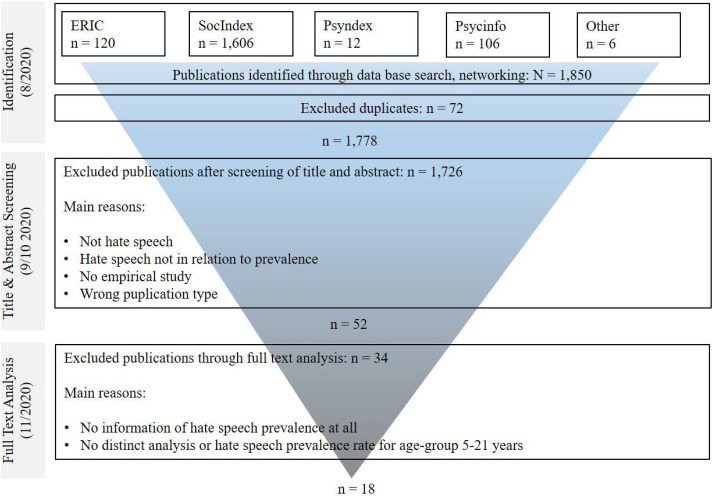
Little is known about the current state of research on the involvement of young people in hate speech. Thus, this systematic review presents findings on a) the prevalence of hate speech among children and adolescents and on hate speech definitions that guide prevalence assessments for this population; and b) the theoretical and empirical overlap of hate speech with related concepts. This review was guided by the Cochrane approach. To be included, publications were required to deal with real-life experiences of hate speech, to provide empirical data on prevalence for samples aged 5 to 21 years and they had to be published in academic formats. Included publications were full-text coded using two raters (κ = .80) and their quality was assessed. The string-guided electronic search (ERIC, SocInfo, Psycinfo, Psyndex) yielded 1,850 publications. Eighteen publications based on 10 studies met the inclusion criteria and their findings were systematized. Twelve publications were of medium quality due to minor deficiencies in their theoretical or methodological foundations. All studies used samples of adolescents and none of younger children. Nine out of 10 studies applied quantitative methodologies. Eighteen publications based on 10 studies were included. Results showed that frequencies for hate speech exposure were higher than those related to victimization and perpetration. Definitions of hate speech and assessment instruments were heterogeneous. Empirical evidence for an often theorized overlap between hate speech and bullying was found. The paper concludes by presenting a definition of hate speech, including implications for practice, policy, and research.
Overview
CoChat Summary
TL;DR
This systematic review of 18 publications based on 10 studies found heterogeneous definitions and assessment instruments for hate speech among children and adolescents, with exposure more common than victimization or perpetration. It also found theoretical and empirical overlap between hate speech and bullying, and proposes a definition of hate speech.
Key findings
- Eighteen publications based on 10 studies met inclusion criteria; 4 publications were high quality, 12 medium, and 2 low. All studies used samples of adolescents, and none looked at children younger than 12 years old.
- Definitions and assessment instruments were heterogeneous: no standard definition emerged, most definitions referred to online hate speech, and medium-scope definitions were more common than broad or narrow definitions. Most studies used self-assessments with single or multiple items.
- Exposure frequencies were higher than victimization and perpetration: exposure ranged from 26% to 69%, victimization from 7% to 24%, and perpetration from 5% to 32%. Online exposure ranged from 31.4% in India to 68.5% in Spain; offline exposure was 39.2% in 1999 and dropped to 26% by 2013. Victimization ranged from 7% in a US sample to 23.4% in a Finnish Facebook sample; perpetration ranged from 4.2% in South Korea to 32.2% in Thailand.
- Empirical overlap with bullying was found: cyberhate victimization and traditional bullying victimization correlated at r = .47; cyberhate perpetration correlated with traditional bullying perpetration at r = .30 and with cyberbullying perpetration at r = .32; cyberbullying perpetration predicted cyberhate perpetration at β = .19.
Methods
- The review used the Cochrane approach. Searches were run on August 7, 2020 in Psyndex, Psycinfo, SocIndex, and ERIC with no publication-date limit, using hate-speech and youth-related search terms. Inclusion required real-life hate speech experiences, empirical prevalence data, samples aged 5 to 21 years, and academic formats. The search yielded 1,850 publications; after removing 72 duplicates and screening, 52 full texts were double-rated, producing a final pool of 18 publications based on 10 studies.
- Two raters conducted blinded full-text coding; interrater reliability was κ = .80 for full-text coding and κ = .63 for down-selection. Quality appraisal rated publications high, moderate, low, or very low, using GRADE-based criteria for quantitative publications and Mayring-based criteria for qualitative publications.
- Eight of 10 studies used quantitative methods, one used ethnography, and one used quantitative and qualitative elements. Samples generally consisted of adolescents up to 18 years, with two studies using a broader age range of 8 years; most data were collected in North America and Europe, and the only multi-country study also included countries in Asia.
Limitations
- The authors state that the search strategy may have missed relevant publications because it only searched English and German, so findings published in other languages were not identified. They also note that future reviews might use a more extensive network approach to identify preprints or studies not listed in the databases accessed, and that assessing the quality of whole studies rather than individual publications could be of interest.
- Evident in the text: no study looked at children younger than 12 years old despite the review’s 5-to-21 age criterion, so findings do not cover younger children. The prevalence, group-difference, and overlap evidence is based on only 10 studies and 18 publications, and definitions and assessment instruments were heterogeneous with no established psychometric instrument. Most publications were of medium quality (12 of 18), with 2 low-quality publications.
Model-written summary. Check it against the paper before relying on it.
Integrity signals
Registry
Cites
Statistics
Figures
Verification
Claims the paper makes
19 Valid · 11 Not valid · 94 Not checked · 97 Own results and interpretations
At least one cited source doesn’t support this claim or points to a different paper, and none confirmed it — see the verdicts below.
In the paper
“Three publications, related to two studies, used vignettes with participants being asked to consider incidents of hate speech experience over the course of their lives (Soral et al., 2018; Wachs et al., 2020).”
§ A Systematic Review on Hate Speech among Children and Adolescents: Definitions, Prevalence, and Overlap with Related Phenomena > Results > Assessment of Hate Speech Prevalences
What the sources say
- Not checked — no full text of the sourcecites Soral et al., 2018 matched to “Exposure to hate speech increases prejudice through desensitization” (2018) source
- Disputedcites Wachs et al., 2020 matched to ““DNT LET ’EM H8 U!”: Applying the routine activity framework to understand cyberhate victimization among adolescents across eight countries” (2021) sourceExperimental — accuracy not yet measured
The Methods (sections 2.1–2.2; page unavailable) describe a questionnaire about adolescents’ own cyberhate experiences, not vignettes. Its victimization and witnessing items ask about the last twelve months, contrary to the claimed lifetime timeframe. (LLM, conf=0.89)
Checked by a reasoning model — may be wrong.
plain- Asserted: passes — The authors put it forward as true.
- Checkable: passes — It can be checked against evidence.
- Load-bearing: unclear — It is unclear whether the paper’s conclusions depend on it.
- Based: passes — The paper gives a reason why it holds.
The sources with a verdict support this claim; the rest weren’t checked yet, have no full text we could read, or their verdicts aren’t rated yet.
In the paper
“The prevalence of hate speech was generally studied and reported in online contexts (Blaya et al., 2020; Blaya & Audrin, 2019; Oksanen et al., 2014; Räsänen et al., 2016; Tynes, 2005; Wachs et al., 2019b, 2019a, 2020, 2021a, Wachs & Wright, 2018, 2019, 2020).”
§ A Systematic Review on Hate Speech among Children and Adolescents: Definitions, Prevalence, and Overlap with Related Phenomena > Results > Prevalence of Hate Speech among Children and Adolescents
What the sources say
- Supportedcites Blaya et al., 2020 matched to “School Bullying, Perpetration, and Cyberhate: Overlapping Issues” (2022) source
The Participants section (page unavailable) reports the prevalence of cyberhate victimization and perpetration among surveyed students. The Cyberhate section defines the behavior studied as hateful online expression, so this paper is an example of prevalence being studied and reported in an online context. (LLM, conf=0.89)
- Could not verifycites Blaya & Audrin, 2019 matched to “Corrigendum: Toward an Understanding of the Characteristics of Secondary School Cyberhate Perpetrators” (2019) sourceExperimental — accuracy not yet measured
The Correction section (p. 1) addresses a mislabeled figure in a study of secondary-school cyberhate perpetrators. It does not discuss the prevalence of hate speech or whether prevalence is generally studied and reported in online contexts; searches for those points found no relevant passage in our copy. (LLM, conf=0.78)
- Not checked — no full text of the sourcecites Oksanen et al., 2014 matched to “Exposure to Online Hate among Young Social Media Users” (2014) source
plain- Asserted: passes — The authors put it forward as true.
- Checkable: passes — It can be checked against evidence.
- Load-bearing: unclear — It is unclear whether the paper’s conclusions depend on it.
- Based: passes — The paper gives a reason why it holds.
- Supported
The cited sources that could be checked couldn’t confirm or dispute this claim.
In the paper
“The main group difference reported in terms of personal characteristics was gender (Blaya & Audrin, 2019; Elpus & Carter, 2016; Räsänen et al., 2016; Wachs et al., 2019a, 2019, 2020, Wachs & Wright, 2018, 2019).”
§ A Systematic Review on Hate Speech among Children and Adolescents: Definitions, Prevalence, and Overlap with Related Phenomena > Results > Prevalence of Hate Speech among Children and Adolescents
What the sources say
- Could not verifycites Blaya & Audrin, 2019 matched to “Corrigendum: Toward an Understanding of the Characteristics of Secondary School Cyberhate Perpetrators” (2019) sourceExperimental — accuracy not yet measured
The corrigendum (p. 1) corrects a label in Figure 1 but reports no group differences in personal characteristics. Searches for gender and group differences found no passage in our copy addressing the claim; the original article is identified but is not part of this source's text. (LLM, conf=0.77)
- Not checked — no full text of the sourcecites Elpus & Carter, 2016 matched to “Bullying Victimization Among Music Ensemble and Theatre Students in the United States” (2016) source
- Not checked — no full text of the sourcecites Räsänen et al., 2016 matched to “Targets of Online Hate: Examining Determinants of Victimization Among Young Finnish Facebook Users” (2016) source
plainstates an association- Asserted: passes — The authors put it forward as true.
- Checkable: passes — It can be checked against evidence.
- Load-bearing: unclear — It is unclear whether the paper’s conclusions depend on it.
- Based: passes — The paper gives a reason why it holds.
- Could not verify
The cited sources support only part of this claim — read each source’s verdict below.
In the paper
“In Western European countries, perpetration rates varied from 5.2% in France (Blaya & Audrin, 2019; Blaya et al., 2020) to 11.3% in Germany (Wachs et al., 2019a, 2019, Wachs & Wright, 2018, 2019, 2020).”
§ A Systematic Review on Hate Speech among Children and Adolescents: Definitions, Prevalence, and Overlap with Related Phenomena > Results > Prevalence of Hate Speech among Children and Adolescents
What the sources say
- Could not verifycites Blaya & Audrin, 2019 matched to “Corrigendum: Toward an Understanding of the Characteristics of Secondary School Cyberhate Perpetrators” (2019) sourceExperimental — accuracy not yet measured
Our copy of DOI 10.3389/feduc.2019.00083 is only the two-page correction notice: it identifies the original article (Blaya & Audrin 2019, Front. Educ. 4:46, doi 10.3389/feduc.2019.00046), states that 'Trust in proximal institutions' was duplicated in Figure 1 and should read 'Trust in distal institutions', and supplies the corrected figure caption ('Standardized regression estimates between latent factors', p. 1-2). Searches for perpetration rates, prevalence percentages, 5.2%, France and Western European comparisons returned no passage containing any figure or rate; the notice carries no results text. Nothing contrary is stated, so the 5.2% French perpetration rate attributed here cannot be checked against this copy. (LLM, conf=0.72)
- Supportedcites Blaya et al., 2020 matched to “School Bullying, Perpetration, and Cyberhate: Overlapping Issues” (2022) source
Our copy's Participants/Results section states that among 1900 French secondary school students aged 12-20 (data collected spring 2016, 16 schools in France), 'one out of ten (10.5%) respondents reported cyberhate victimization while 5.2% acknowledged cyberhate perpetration' — this is the figure the citing sentence attaches to Blaya et al. for France. The cross-national framing and the 11.3% German figure are carried by the separate Wachs citations, and our copy makes no such European comparison (searched: Germany/Wachs prevalence, 5.2% perpetration), so nothing here conflicts with the attributed part. The only qualifier worth noting is that the 5.2% is adolescent cyberhate perpetration in a convenience sample of French school students, not a national population estimate. (LLM, conf=0.85)
- Not matchedcites Wachs et al., 2019a
More than one paper fits this citation.
plain- Asserted: passes — The authors put it forward as true.
- Checkable: passes — It can be checked against evidence.
- Load-bearing: unclear — It is unclear whether the paper’s conclusions depend on it.
- Based: passes — The paper gives a reason why it holds.
- Could not verify
The cited sources that could be checked couldn’t confirm or dispute this claim.
In the paper
“and even seek revenge (Wachs et al., 2020).”
§ A Systematic Review on Hate Speech among Children and Adolescents: Definitions, Prevalence, and Overlap with Related Phenomena > Abstract
What the sources say
- Could not verifycites Wachs et al., 2020 matched to ““DNT LET ’EM H8 U!”: Applying the routine activity framework to understand cyberhate victimization among adolescents across eight countries” (2021) sourceExperimental — accuracy not yet measured
Our copy of Wachs et al. (2021, Comput & Educ) contains no passage on victims seeking revenge or retaliating; searches for 'revenge', 'retaliation/getting even after victimization', and 'victim-offender overlap/perpetration' returned only routine-activity material (Sections 1.2, 1.2.1 Exposure to a Potential Offender, 1.2.3 Suitable Target, 4 Discussion). The paper's outcome variables are cyberhate victimization predicted by witnessing cyberhate, online disclosure, and parental mediation, with the Discussion noting only that mechanisms behind the witnessing–victimization link need study (e.g., 'lack of productive coping strategies'). Where the paper does touch victim-perpetration associations it credits other works (Wachs & Wright, 2018, 2019; Wachs et al., 2019), not a revenge motive, so the claim is neither supported nor contradicted here. (LLM, conf=0.70)
hedgedstates a possible cause- Asserted: passes — The authors put it forward as true.
- Checkable: passes — It can be checked against evidence.
- Load-bearing: unclear — It is unclear whether the paper’s conclusions depend on it.
- Based: passes — The paper gives a reason why it holds.
- Could not verify
103 more claims · 21 with their cited sources checked
Create a free account to see all 221 claims and to verify the 6 references still open.
- It may state two separate claims as one. 35
- Probably not a substantial claim. 93
Self-check
Percentages, sums and reported differences re-computed from the paper’s own numbers.
Each contradiction between two passages listed here was confirmed by an independent check.
Rated major: it would touch a result — a value a result rests on, reported and recomputed p-values on opposite sides of the significance level, two passages that conflict with no sign which is right, or a cited work retracted before this paper was published.
In the paper
“But 43.6% (n = 61) indicated that they had experienced some form of bullying at least once”
§ A Systematic Review on Hate Speech among Children and Adolescents: Definitions, Prevalence, and Overlap with Related Phenomena > Results > Empirical Overlap of Hate Speech and Related Phenomena
Reported 43.6 · recomputed 61
Rated major: it would touch a result — a value a result rests on, reported and recomputed p-values on opposite sides of the significance level, two passages that conflict with no sign which is right, or a cited work retracted before this paper was published.
In the paper
“from their survey of cyberhate perpetrators (N = 100), a total of 51.4% (n = 73) were never bullied”
§ A Systematic Review on Hate Speech among Children and Adolescents: Definitions, Prevalence, and Overlap with Related Phenomena > Results > Empirical Overlap of Hate Speech and Related Phenomena
Reported 51.4 · recomputed 73
Rated minor: it would not touch a result — a value no result rests on, a p-value that stays on the same side of the significance level, or a conflict that is clerical, resolved elsewhere in the paper, or outside its own findings.
In the paper
§ A Systematic Review on Hate Speech among Children and Adolescents: Definitions, Prevalence, and Overlap with Related Phenomena > Results > Main Characteristics of Publications Included and Underlying Studies
“| 12–18 years | 5 | 50 | High | 4 | 22 | | 12–20 years | 1 | 10 | Moderate | 12 | 67 | | 13–17 years | 1 | 10 | Low | 2 | 11 | | 15–18 years | 2 | 20 | Very low | 0 | 0 | | 13–21 years | 1 | 10 | | | |”
§ A Systematic Review on Hate Speech among Children and Adolescents: Definitions, Prevalence, and Overlap with Related Phenomena > Results > Definitions and Prevalence of Hate Speech in Empirical Research on Children and Adolescents
“| 1,480 | 12–17 | School | Germany |”
Rated minor: it would not touch a result — a value no result rests on, a p-value that stays on the same side of the significance level, or a conflict that is clerical, resolved elsewhere in the paper, or outside its own findings.
In the paper
§ A Systematic Review on Hate Speech among Children and Adolescents: Definitions, Prevalence, and Overlap with Related Phenomena > Results > Prevalence of Hate Speech among Children and Adolescents
“The remaining publications reported exposure rates within this range (Blaya et al., 2020; Blaya & Audrin, 2019; Lehmann, 2019, 2020; Oksanen et al., 2014; Räsänen et al., 2016; Tynes, 2005; van Dorn, 2004; Wachs et al., 2019; Wachs & Wright, 2018).”
§ A Systematic Review on Hate Speech among Children and Adolescents: Definitions, Prevalence, and Overlap with Related Phenomena > Results > Prevalence of Hate Speech among Children and Adolescents
“with the frequency dropping to 26% by 2013 (Lehmann, 2019; 2020; van Dorn, 2004).”
Rated minor: it would not touch a result — a value no result rests on, a p-value that stays on the same side of the significance level, or a conflict that is clerical, resolved elsewhere in the paper, or outside its own findings.
In the paper
§ A Systematic Review on Hate Speech among Children and Adolescents: Definitions, Prevalence, and Overlap with Related Phenomena > Results > Empirical Overlap of Hate Speech and Related Phenomena
“• Exposure (26% to 69%) was more common than victimization (7% to 24%) or perpetration (5% to 32%)”
§ A Systematic Review on Hate Speech among Children and Adolescents: Definitions, Prevalence, and Overlap with Related Phenomena > Results > Prevalence of Hate Speech among Children and Adolescents
“The prevalence of online hate speech perpetration ranged from a minimum of 4.2% for a population of 12-to-17-year-old adolescents in South Korea to a maximum of 32.2% for a comparable population in Thailand”
1 more finding
Create a free account to see every finding of this check.
Citations
Cites
Statistical Power Analysis for the Behavioral Sciences
Muller, K. (1989) · Technometrics · doi:10.1080/00401706.1989.10488618 · Cited by 99,167
The Measurement of Observer Agreement for Categorical Data
Landis, J. R., & Koch, G. G. (1977) · Biometrics · doi:10.2307/2529310 · Cited by 81,148
Multilevel analysis : an introduction to basic and advanced multilevel modeling
Snijders, T. A. B., & Bosker, R. (1999) · Cited by 13,923
Predicting and Changing Behavior
Fishbein, M., & Ajzen, I. (2011) · doi:10.4324/9780203838020 · Cited by 2,807
How to Construct a Mixed Methods Research Design
Schoonenboom, J., & Johnson, R. B. (2017) · KZfSS Kölner Zeitschrift für Soziologie und Sozialpsychologie · doi:10.1007/s11577-017-0454-1 · Cited by 1,757 · cited 1×
“A socio-ecological framework (Bronfenbrenner, 1994), a mixed method design (Schoonenboom & Johnson, 2017), and multi-level analytics (e.g., Snijders & Bosker, 2011) thus all represent useful tools to guide both research and practical efforts alike.”
The international encyclopedia of education
Watson, K. (1994) · International Journal of Educational Development · doi:10.1016/0738-0593(94)90060-4 · Cited by 1,487
Words that wound: critical race theory, assaultive speech, and the First Amendment
(1993) · Choice Reviews Online · doi:10.5860/choice.31-2366 · Cited by 1,379 · cited 1×
“In line with critical race theorist Mary Matsuda et al. (1993), Vaught connected hate speech to a shared norm that justifies any conduct aimed at upholding the power and supreme status of the dominant social group (here: white people).”
Snijders, T. A. B. (2011) · International Encyclopedia of Statistical Science · doi:10.1007/978-3-642-04898-2_387 · Cited by 546
Zych, I., Ortega-Ruiz, R., & Del Rey, R. (2015) · Aggression and Violent Behavior · doi:10.1016/j.avb.2015.10.001 · Cited by 439
Adolescents’ Intense and Problematic Social Media Use and Their Well-Being in 29 Countries
Boer, M., van den Eijnden, R. J. J. M., Boniel-Nissim, M., Wong, S.-L., Inchley, J. C., Badura, P., Craig, W. M., Gobina, I., Kleszczewska, D., Klanšček, H. J., et al. (2020) · Journal of Adolescent Health · doi:10.1016/j.jadohealth.2020.02.014 · Cited by 434
Zero to eight: young children and their internet use
(2013) · London School of Economics and Political Science Research Online (London School of Economics and Political Science) · Cited by 341
Exposure to hate speech increases prejudice through desensitization
Soral, W., Bilewicz, M., & Winiewski, M. (2018) · Aggressive Behavior · doi:10.1002/ab.21737 · Cited by 320 · cited 5×
“Three publications (Elpus & Carter, 2016; Soral et al., 2018; Tynes, 2005) were not assessed due to missing definitions.”
BackgroundMethodInfluentialBilewicz, M., & Soral, W. (2020) · Political Psychology · doi:10.1111/pops.12670 · Cited by 283
Cyberbullying Definition and Measurement: Some Critical Considerations
Menesini, E., & Nocentini, A. (2009) · Zeitschrift für Psychologie / Journal of Psychology · doi:10.1027/0044-3409.217.4.230 · Cited by 247
What is hate speech? Part 1: The Myth of Hate
Brown, A. (2017) · Law and Philosophy · doi:10.1007/s10982-017-9297-1 · Cited by 246 · cited 1×
“The popularity of the term hate speech in public discourse is associated with a “panoply” of differing definitions (Brown, 2017, p. 422); no clear consensus has yet emerged on the essential constituents of hate speech.”
Exposure to Online Hate in Four Nations: A Cross-National Consideration
Hawdon, J., Oksanen, A., & Räsänen, P. (2017) · Deviant Behavior · doi:10.1080/01639625.2016.1196985 · Cited by 234 · cited 1×
“Eight publications were excluded because they reported hate speech frequencies for mixed samples of adolescents and adults only (Costello et al., 2016; 2017; 2020; Costello & Hawdon, 2018; Hawdon et al., 2017; Murray, 2011; Näsi et al., 2015; Savimäki et al., 2020).”
BackgroundYoung Children (0-8) and Digital Technology - A qualitative study across Europe
Stéphane, C., Rosanna, D. G., & Monica, G. (2017) · Joint Research Centre (European Commission) · doi:10.2760/294383 · Cited by 200 · cited 1×
“However, children start to use the Internet at an early age (Holloway et al., 2013) and six-to-nine-year-olds are, at times, exposed to frightening or violent content online (Chaudron et al., 2018).”
Wachs, S., & Wright, M. F. (2018) · International Journal of Environmental Research and Public Health · doi:10.3390/ijerph15092030 · Cited by 150
Self-citationWho views online extremism? Individual attributes leading to exposure
Costello, M., E.Hawdon, J., Ratliff, T. N., & Grantham, T. (2016) · Computers in Human Behavior · doi:10.1016/j.chb.2016.05.033 · Cited by 142 · cited 1×
“Eight publications were excluded because they reported hate speech frequencies for mixed samples of adolescents and adults only (Costello et al., 2016; 2017; 2020; Costello & Hawdon, 2018; Hawdon et al., 2017; Murray, 2011; Näsi et al., 2015; Savimäki et al., 2020).”
BackgroundWachs, S., Wright, M. F., & Vazsonyi, A. T. (2019) · Criminal Behaviour and Mental Health · doi:10.1002/cbm.2116 · Cited by 133 · cited 43×
“Other authors connect hate speech and bullying via the perpetrator’s intention to harm a person or group (e.g., Blaya et al., 2020; Blaya & Audrin, 2019; Lehmann, 2020; Räsänen et al., 2016; Wachs et al., 2019, 2020; Wachs & Wright, 2019).”
InfluentialSelf-citationSellars, A. (2016) · SSRN Electronic Journal · doi:10.2139/ssrn.2882244 · Cited by 130 · cited 1×
“Being aware that a speaker’s intent may be obscured, denied, not disclosed, that speakers may lie about their intent, and that online identification is difficult (Sellars, 2016), the definition implies that the consideration of intent is crucial to balancing out principles of speech.”
BackgroundThe Language of Derogation and Hate: Functions, Consequences, and Reappropriation
Cervone, C., Augoustinos, M., & Maass, A. (2020) · Journal of Language and Social Psychology · doi:10.1177/0261927x20967394 · Cited by 124 · cited 2×
“The linguistic properties of hate speech, compared to other forms of derogatory expressions, such as ethnophaulisms, slurs or epithets, do overlap (Cervone et al., 2021) and also require more theoretical clarification.”
After the Genocide: Psychological Perspectives on Victim, Bystander, and Perpetrator Groups
Vollhardt, J. R., & Bilewicz, M. (2013) · Journal of Social Issues · doi:10.1111/josi.12000 · Cited by 119 · cited 1×
“The prevalence or frequency of hate speech was framed with the bystander-perpetrator-victim paradigm (for a review, see Vollhardt & Bilewicz, 2013).”
Exposure to online hate material and social trust among Finnish youth
Näsi, M., Räsänen, P., Hawdon, J., Holkeri, E., & Oksanen, A. (2015) · Information Technology & People · doi:10.1108/itp-09-2014-0198 · Cited by 107 · cited 4×
“Eight publications were excluded because they reported hate speech frequencies for mixed samples of adolescents and adults only (Costello et al., 2016; 2017; 2020; Costello & Hawdon, 2018; Hawdon et al., 2017; Murray, 2011; Näsi et al., 2015; Savimäki et al., 2020).”
InfluentialTargets of Online Hate: Examining Determinants of Victimization Among Young Finnish Facebook Users
Räsänen, P., Hawdon, J., Holkeri, E., Keipi, T., Näsi, M., & Oksanen, A. (2016) · Violence and Victims · doi:10.1891/0886-6708.vv-d-14-00079 · Cited by 95 · cited 42×
“In their respective theory sections, Räsänen et al. (2016) and van Dorn (2004) did not refer to overlapping concepts or phenomena, but they reported relevant empirical results.”
InfluentialExposure to Online Hate among Young Social Media Users
Oksanen, A., Hawdon, J., Holkeri, E., Näsi, M., & Räsänen, P. (2014) · Sociological Studies of Children and Youth · doi:10.1108/s1537-466120140000018021 · Cited by 92
Costello, M., & Hawdon, J. (2018) · Violence and Gender · doi:10.1089/vio.2017.0048 · Cited by 90
United Nations Strategy and Plan of Action on Hate Speech
Kim, J. S. (2021) · Democratic Legal Studies · doi:10.15756/dls.2021..75.203 · Cited by 83
Costello, M., Hawdon, J., & Ratliff, T. N. (2017) · Social Science Computer Review · doi:10.1177/0894439316666272 · Cited by 77
Wachs, S., & Wright, M. F. (2019) · Cyberpsychology, Behavior, and Social Networking · doi:10.1089/cyber.2018.0551 · Cited by 67
Self-citationTeachers’ Self-efficacy in Preventing and Intervening in School Bullying: a Systematic Review
Fischer, S. M., John, N., & Bilz, L. (2021) · International Journal of Bullying Prevention · doi:10.1007/s42380-020-00079-y · Cited by 67
Self-citationPredictors of Viewing Online Extremism Among America’s Youth
Costello, M., Barrett-Fox, R., Bernatzky, C., Hawdon, J., & Mendes, K. (2020) · Youth & Society · doi:10.1177/0044118x18768115 · Cited by 66 · cited 1×
“Eight publications were excluded because they reported hate speech frequencies for mixed samples of adolescents and adults only (Costello et al., 2016; 2017; 2020; Costello & Hawdon, 2018; Hawdon et al., 2017; Murray, 2011; Näsi et al., 2015; Savimäki et al., 2020).”
Wachs, S., Costello, M., Wright, M. F., Flora, K., Daskalou, V., Maziridou, E., Kwon, Y., Na, E.-Y., Sittichai, R., Biswal, R., et al. (2021) · Computers & Education · doi:10.1016/j.compedu.2020.104026 · Cited by 66 · cited 22×
“Three publications provided group differences based on age (Räsänen et al., 2016; Wachs et al., 2019, 2021a) and two, respectively, on socio-economic status (Oksanen et al., 2014; Wachs & Wright, 2019) and with regards to respondents’ country of residence (Wachs et al., 2019, 2021a).”
InfluentialSelf-citationWachs, S., Wright, M. F., Sittichai, R., Singh, R., Biswal, R., Kim, E.-M., Yang, S., Gámez-Guadix, M., Almendros, C., Flora, K., et al. (2019) · International Journal of Environmental Research and Public Health · doi:10.3390/ijerph16203992 · Cited by 60 · cited 43×
“Other authors connect hate speech and bullying via the perpetrator’s intention to harm a person or group (e.g., Blaya et al., 2020; Blaya & Audrin, 2019; Lehmann, 2020; Räsänen et al., 2016; Wachs et al., 2019, 2020; Wachs & Wright, 2019).”
InfluentialSelf-citationWachs, S., Gámez-Guadix, M., Wright, M. F., Görzig, A., & Schubarth, W. (2020) · Computers in Human Behavior · doi:10.1016/j.chb.2019.106167 · Cited by 54
Self-citationPapcunová, J., Martončik, M., Fedáková, D., Kentoš, M., Bozogáňová, M., Srba, I., Moro, R., Pikuliak, M., Šimko, M., & Adamkovič, M. (2023) · Complex & Intelligent Systems · doi:10.1007/s40747-021-00561-0 · Cited by 51
Estimation and hypothesis testing for seemingly unrelated regressions: A sociological application
Felmlee, D. H., & Hargens, L. L. (1988) · Social Science Research · doi:10.1016/0049-089x(88)90010-5 · Cited by 48 · cited 1×
“He applied the method of seemingly unrelated regression analysis (Felmlee & Hargens, 1988) and found that the presence of school security and/or police only predicts increased odds of students reporting hate-related (but not bullying-related) outcomes.”
Bullying Victimization Among Music Ensemble and Theatre Students in the United States
Elpus, K., & Carter, B. A. (2016) · Journal of Research in Music Education · doi:10.1177/0022429416658642 · Cited by 43
Disquieted by Online Hate: Negative Experiences of Finnish Adolescents and Young Adults
Savimäki, T., Kaakinen, M., Räsänen, P., & Oksanen, A. (2018) · European Journal on Criminal Policy and Research · doi:10.1007/s10610-018-9393-2 · Cited by 43 · cited 1×
“Eight publications were excluded because they reported hate speech frequencies for mixed samples of adolescents and adults only (Costello et al., 2016; 2017; 2020; Costello & Hawdon, 2018; Hawdon et al., 2017; Murray, 2011; Näsi et al., 2015; Savimäki et al., 2020).”
BackgroundCorrelates of Violent and Nonviolent Victimization in a Sample of Public High School Students
Van Dorn, R. A. (2004) · Violence and Victims · doi:10.1891/vivi.19.3.303.65768 · Cited by 38 · cited 21×
“In their respective theory sections, Räsänen et al. (2016) and van Dorn (2004) did not refer to overlapping concepts or phenomena, but they reported relevant empirical results.”
InfluentialNational Crime Victimization Survey (NCVS)
Davis, M. S. (2002) · Sage eBooks · doi:10.4135/9781452229300.n1257 · Cited by 38
Global Kids Online Comparative ReportPreprint
Livingstone, S., Winther, D. K., & Saeed, M. (2019) · RePEc: Research Papers in Economics · Cited by 32
Krause, N., Ballaschk, C., Schulze-Reichelt, F., Kansok-Dusche, J., Wachs, S., Schubarth, W., & Bilz, L. (2021) · Zeitschrift für Bildungsforschung · doi:10.1007/s35834-021-00291-w · Cited by 31 · cited 2×
“…the rising developmental significance of the internet (specifically social media) as a socialization context for adolescents (Boer et al., 2020), hate speech incidents may still also take place in the context of face-to-face encounters (e.g., with peers or teachers at school; Krause et al., 2021).”
Self-citationHate at school: victimization and disorder associated with school avoidance
Lehman, B. (2020) · Sociological Spectrum · doi:10.1080/02732173.2020.1734890 · Cited by 30
School Bullying, Perpetration, and Cyberhate: Overlapping Issues
Blaya, C., Audrin, C., & Skrzypiec, G. (2022) · Contemporary School Psychology · doi:10.1007/s40688-020-00318-5 · Cited by 30 · cited 34×
“Other authors connect hate speech and bullying via the perpetrator’s intention to harm a person or group (e.g., Blaya et al., 2020; Blaya & Audrin, 2019; Lehmann, 2020; Räsänen et al., 2016; Wachs et al., 2019, 2020; Wachs & Wright, 2019).”
InfluentialLehman, B. (2019) · Sociological Inquiry · doi:10.1111/soin.12296 · Cited by 25
The rising threat of cyberhate for young people around the globe
Bauman, S., Perry, V. M., & Wachs, S. (2021) · Child and Adolescent Online Risk Exposure · doi:10.1016/b978-0-12-817499-9.00008-9 · Cited by 17 · cited 1×
“Finally, a recent narrative review (Bauman et al., 2020) on the frequency of online hate speech (cyberhate) among children and adolescents acknowledges a variety of definitions and assessment methods and a paucity of empirical studies focused on young people.”
BackgroundSelf-citationWachs, S., & Wright, M. F. (2021) · MedienPädagogik Zeitschrift für Theorie und Praxis der Medienbildung · doi:10.21240/mpaed/jb16/2021.01.14.x · Cited by 15
Self-citationHate Speech als Herausforderung für Schule und Lehrkräftebildung
Wachs, S., Schubarth, W., Krause, N., Ballaschk, C., Schulze-Reichelt, F., & Bilz, L. (2021) · Springer eBooks · doi:10.1007/978-3-658-31793-5_12 · Cited by 12
Self-citationConditional Objectivism: A Strategy for Connecting the Social Sciences and Practical Decision-Making
Reber, R., & Bullot, N. J. (2019) · Theory and History in the Human and Social Sciences · doi:10.1007/978-3-030-33099-6_5 · Cited by 7 · cited 1×
“Academics, on the other hand, are bound to follow the principle of a conditional objectivism (Reber & Bullot, 2019).”
Hate Speech in a Juvenile Male Prison School and in US Schooling
Vaught, S. E. (2012) · The Urban Review · doi:10.1007/s11256-011-0190-1 · Cited by 6
Blaya, C., & Audrin, C. (2019) · Frontiers in Education · doi:10.3389/feduc.2019.00083 · Cited by 5
Do words harm? The perceptions and attitudes of African American college students to hate speech
Murray, R. (n.d.) · ProQuest Demo Repository · Cited by 3
Sociological Studies of Children and Youth
(2014) · Sociological studies of children and youth · doi:10.1108/s1537-466120140000018022 · Cited by 3
Research works printed but not linked: 9
- Hawdon J. Oksanen A. Räsänen P. (2015). Online extremism and online hate: Exposure among adolescents and young adults in four nations. Nordicom Information: Medie-Och Kommunikationsforskning I Norden, 37(3–4), 29– 37.
- Higgins J. P. T. Thomas J. Chandler J. Cumpston M. Li T. Page M. J. Welch V. A. (2021). Cochrane Handbook for systematic reviews of interventions version 6.2. Cochrane. www.training.cochrane.org/handbook
- Mayring P. A. E. (2016). Einführung in die qualitative Sozialforschung. Beltz Verlag.
- Ryan R. Hill S. (2016). How to GRADE the quality of the evidence version 3.0 December 2016. Cochrane Consumers and Communication Group. http://cccrg.cochrane.org/author-resources
- Sponholz L. (2020). Der Begriff „Hate Speech“ in der deutschsprachigen Forschung. Eine empirische Begriffsanalyse [The concept »hate speech« in German-speaking research. An empirical conceptual analysis]. SWS Rundschau, 60(1), 43– 65.
- Stefan Bartory Foundation (2014). Hate speech in Poland—summary of the national opinion poll. Stefan Bartory Foundation. https://www.batory.org.pl/upload/files/Programydotacyjne/ObywateledlaDemokracji/Hate_speech_Poland_2014.pdf
- * Tynes B. M. (2005). Toward a textual promised land: Youth culture, race and identity on the Internet. In: ProQuest Dissertations & theses global database. Purdue University. [Doctoral dissertation].
- UK Safer Internet Centre. (2016). Creating a better internet for all: Young people’s experiences of online empowerment + online hate. UK Safer Internet Centre. http://childnetsic.s3.amazonaws.com/ufiles/SID2016//CreatingaBetterInternetforAll.pdf.
- United Nations Children’s Fund (2018). Developing a global indicator on bullying of school-aged children. In Innocenti working paper No. 2018–11. UNICEF Office of Research. https://www.unicef-irc.org/publications/pdf/WP2018-11.pdf
Cited by
Wachs, S., Krause, N., Wright, M. F., & Gámez‐Guadix, M. (2023) · Journal of Youth and Adolescence · doi:10.1007/s10964-023-01753-2 · Cited by 67
“Hate speech among youth is a serious and widespread problem that plagues schools worldwide (Kansok-Dusche et al., 2022).”
BackgroundSelf-citationHate speech in adolescents: A binational study on prevalence and demographic differences
Castellanos, M., Wettstein, A., Wachs, S., Kansok-Dusche, J., Ballaschk, C., Krause, N., & Bilz, L. (2023) · Frontiers in Education · doi:10.3389/feduc.2023.1076249 · Cited by 39
Self-citationWachs, S., Castellanos, M., Wettstein, A., Bilz, L., & Gámez‐Guadix, M. (2022) · Journal of Interpersonal Violence · doi:10.1177/08862605221120905 · Cited by 51
“While current hate speech research involving adolescents has mainly focused on hate speech witnessing, perpetration, and victimization, other forms of involvement, such as countering hate speech (counterspeech), remain blind spots (Kansok-Dusche et al., 2022).”
BackgroundSelf-citationWachs, S., Wright, M. F., & Gámez‐Guadix, M. (2024) · Computers in Human Behavior · doi:10.1016/j.chb.2024.108250 · Cited by 45
Self-citationOnline hate speech victimization: consequences for victims’ feelings of insecurity
Dreißigacker, A., Müller, P., Isenhardt, A., & Schemmel, J. (2024) · Crime Science · doi:10.1186/s40163-024-00204-y · Cited by 80
“…on detection (Qian et al., 2021; Schmidt & Wiegand, 2017; Warner & Hirschberg, 2012), prevalence (Dreißigacker et al., 2020; Geschke et al., 2019; Kansok-Dusche et al., 2022; Saha et al., 2019), the consequences for society (Bilewicz & Soral, 2020), regulation (Bleich, 2011; Judge & Nel, 2018;…”
Metadata
- Authors
- Kansok-Dusche, J., Ballaschk, C., Krause, N., Zeißig, A., Seemann-Herz, L., Wachs, S., & Bilz, L.
- Affiliations
- Department of Health Sciences, Brandenburg University of Technology Cottbus-Senftenberg, Cottbus, Germany
- University of Potsdam (DE)
- Brandenburg University of Technology Cottbus-Senftenberg (DE)
- ORCID
- Venue
- Trauma, Violence, & Abuse
- Publisher
- SAGE Publications
- Published
- 2022-06-22
- Volume
- 24
- Issue
- 4
- Pages
- 2598-2615
- ISSN
- 1524-8380 (ISSN-L)
- 1552-8324
- PMC
- PMC10486144
- OpenAlex
- W4283319036
- Cited by
- 112
- References
- 50
- Citations by year
- 2026: 36 · 2025: 25 · 2024: 28 · 2023: 19 · 2022: 4
- FWCI
- 2.84
- Type
- journal article
- Language
- en
- Open access
- hybrid
- doi.org
- Locations
- Trauma Violence & Abuse (publishedVersion, cc-by)
- PubMed Central (publishedVersion, cc-by)
- PubMed (publishedVersion)
- publish.UP (University of Potsdam) (submittedVersion, cc-by)
- Funders
- German Research Foundation (BI 1046/9-1)
- Topics
- Social Sciences › Psychology › Social Psychology › Bullying, Victimization, and Aggression
- Physical Sciences › Computer Science › Artificial Intelligence › Hate Speech and Cyberbullying Detection
- Social Sciences › Psychology › Clinical Psychology › Child Abuse and Trauma
- Keywords
- hate speech, children, adolescents, prevalence, bullying, assessment instruments
- MeSH terms
- Adolescent, Child, Hate, Humans, Speech, Prevalence, Crime Victims, Bullying
About these checks
Registry, retraction, Cites and statistics results are computed, not judged, with one exception: a printed reference that no index lists is read once by a model before it counts as a citation error. Claims are extracted by a model and kept only when their quote appears verbatim in the text; each cited source is then checked, with a model’s help, for whether it says what the claim relies on. Those verdicts can be wrong — read the claim’s quote and the cited source before relying on one.
The claim verdicts this report counts are experimental: their accuracy is not yet measured.
A language model drew the claims from the paper on 2026-10-10, under version 3 of the claim definition (model deepseek-v4.1-flash, prompt extract-v3).
A second model labelled each claim on 2026-10-10 (model jev-1.13-20260917, definition revision gold-guideline-v0.2).
Cited sources are checked with a language model’s help (gpt-6-sol and qwen3.8-omni-flash).
Statistics and arithmetic are recomputed, not judged.
Confidence bands are shown only for fields calibrated on our annotated test set. None is calibrated yet, so no band is shown.
What counts as a claim ›How we measure confidence ›How we check this ›
Are you an author, or do you see a problem with this page? Request a review
Data sources
Bibliographic data: Semantic Scholar, OpenAlex, Crossref.
Contains information from the Semantic Scholar Academic Graph Datasets, made available under the ODC Attribution License (ODC-BY 1.0).
Semantic Scholar’s data is described in: Kinney, R., et al. (2023). The Semantic Scholar Open Data Platform. arXiv:2301.10140.
