

The Effect of Mindfulness-Based Stress Reduction Group Counseling on Psychological and Inflammatory Responses of the Women With Breast Cancer
Open accessThe DOI matches its Crossref record; 47 of the 48 references it cites were found in a registry or an index; 1 of the 39 sources its claims cite were checked for support.
Abstract
Introduction: Breast cancer is common among women and reduces their quality of life. The current study aimed to investigate the effectiveness of mindfulness-based stress reduction group counseling in alleviating psychological responses such as anxiety, depression, stress, and regulating laboratory tests including cortisol and C-reactive protein (CRP) in women with breast cancer. Methods: This randomized clinical trial was conducted based on convenience sampling. Participants were divided into 2 groups (control and intervention groups) with block randomization. The intervention group received mindfulness-based stress reduction group counseling during 8 weeks. The participants completed the Beck anxiety inventory, Beck-II depression inventory, and perceived stress scale before and after the intervention and their blood samples were taken to check their cortisol and CRP. Results: After the intervention, the MBSR group had significantly lower anxiety compared with the control group ( P < .001). No significant difference was found between the 2 groups in the reduction of perceived stress and depression ( P < .05). In addition, no significant difference was found between the 2 groups in CRP and cortisol levels after the intervention ( P > .05). Conclusion: The present study showed the effectiveness of mindfulness-based cognitive therapy in improving anxiety rather than the stress, depression, and inflammatory laboratory factors such as cortisol and CRP in women with breast cancer. Therefore, the psychological symptoms of these patients can be improved at different stages of treatment by providing this type of training.
Overview
CoChat Summary
TL;DR
In a randomized trial of 44 women with breast cancer in Iran, 8 weeks of mindfulness-based stress reduction (MBSR) group counseling significantly improved anxiety compared with routine care, but not depression, perceived stress, cortisol, or C-reactive protein (CRP) after adjustment. The authors conclude MBSR may improve anxiety in these patients, while effects on stress, depression, and inflammatory markers were not statistically significant.
Key findings
- Anxiety decreased in the MBSR group from a mean of 31.18 to 23.50, while it increased in the control group from 25.41 to 35.0. The post-intervention between-group difference was significant (Table 2: P = .004; abstract reports P < .001; ANCOVA P = .01, mean difference = −10.88).
- Depression decreased in the MBSR group from 29.00 to 17.18 versus 21.04 to 21.59 in controls; the pre–post difference between groups was significant (P = .005), but ANCOVA controlling for baseline score and treatment type showed no significant post-intervention difference (P = .15).
- Perceived stress decreased in the MBSR group from 33.68 to 28.09 versus 28.64 to 28.04 in controls; ANCOVA showed no significant post-intervention difference (P = .14).
- CRP and cortisol showed no significant between-group differences after intervention (CRP ANCOVA P = .61, mean difference = 1.15; cortisol ANCOVA P = .08, mean difference = 2.31). Within-group CRP decreased in both groups (control P = .03; intervention P = .003), but between-group comparisons were not significant. No adverse effects were reported.
Methods
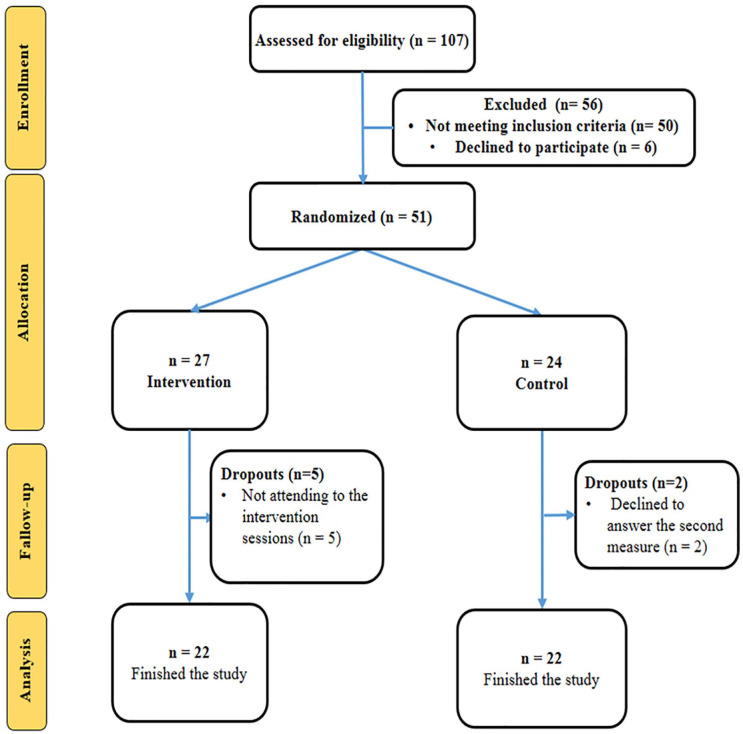
- Parallel randomized clinical trial with 1:1 allocation, block randomization (block size 4), and convenience sampling in Kerman, southeast Iran, from August 2017 to November 2019. Of 57 eligible participants, 6 refused and 44 completed the study (22 per group).
- Participants were women with breast cancer meeting inclusion/exclusion criteria. The intervention group received MBSR group counseling in 90-minute sessions once weekly for 8 weeks (groups of 12–14); the control group received routine care. Outcomes included Beck Anxiety Inventory, Beck Depression Inventory-II, Perceived Stress Scale, and morning brachial vein blood samples for cortisol and CRP before and after the intervention.
- Analysis used SPSS 18 with chi-square/Fisher’s exact tests, Wilcoxon and Mann–Whitney tests, independent and paired t-tests, and ANCOVA to control for confounders; significance level was 0.05.
Limitations
- The paper states that many individual and family characteristics and individual motivations might influence results; patients were reluctant to participate because they were in a stressful situation; many patients were unaware of their disease or treatment process, so sampling lasted nearly a year, which may have influenced results; and findings should be generalized to other populations with caution.
- Evident from the text: the sample was small (22 per group); baseline depression, perceived stress, and type of treatment differed significantly between groups (treatment type P = .009) despite randomization; psychological outcomes relied on self-report questionnaires; and the text does not describe blinding of participants or assessors.
Model-written summary. Check it against the paper before relying on it.
Integrity signals
Registry
Cites
Statistics
Figures
Verification
Claims the paper makes
1 Valid · 0 Not valid · 30 Not checked · 49 Own results and interpretations
The cited sources support only part of this claim — read each source’s verdict below.
In the paper
“Some previous studies showed the effectiveness of mindfulness in improving psychological status,31-33 regulating cortisol level31,33 improving the immune system in breast cancer patients,34 and reducing CRP levels in healthy individuals.33,34”
§ The Effect of Mindfulness-Based Stress Reduction Group Counseling on Psychological and Inflammatory Responses of the Women With Breast Cancer > Introduction
What the sources say
- Partly supportedcites [34] Meyer JD Hayney MS Coe CL Ninos CL Barrett BP. Differential reduction of IP-10 and C-reactive protein via aerobic exercise or mindfulness-based stress-reduction training in a large randomized controlled trial. J Sport Exerc Psychol. 2019; 41: 96- 106. 31027457 PMC6777863 sourceExperimental — accuracy not yet measured
The Abstract and Discussion report that mindfulness-based stress reduction was associated with lower CRP, an inflammatory biomarker, 17 weeks after training. The participants were generally healthy adults, not breast cancer patients, and the paper does not establish improved immune-system function in that population. (LLM, conf=0.85)
plainstates a cause- Asserted: passes — The authors put it forward as true.
- Checkable: passes — It can be checked against evidence.
- Load-bearing: unclear — It is unclear whether the paper’s conclusions depend on it.
- Based: passes — The paper gives a reason why it holds.
- Partly supported
A result the paper reports from its own data — it cites no other source for it, so there is none to check. The quote shows it is in the paper.
In the paper
“After the intervention, the MBSR group had significantly lower anxiety compared with the control group (P < .001).”
§ The Effect of Mindfulness-Based Stress Reduction Group Counseling on Psychological and Inflammatory Responses of the Women With Breast Cancer > Abstract
plain- Asserted: passes — The authors put it forward as true.
- Checkable: passes — It can be checked against evidence.
- Load-bearing: passes — The paper’s conclusions depend on it.
- Based: passes — The paper gives a reason why it holds.
A result the paper reports from its own data — it cites no other source for it, so there is none to check. The quote shows it is in the paper.
In the paper
“No significant difference was found between the 2 groups in the reduction of perceived stress and depression (P < .05).”
§ The Effect of Mindfulness-Based Stress Reduction Group Counseling on Psychological and Inflammatory Responses of the Women With Breast Cancer > Abstract
plain- Asserted: passes — The authors put it forward as true.
- Checkable: passes — It can be checked against evidence.
- Load-bearing: passes — The paper’s conclusions depend on it.
- Based: passes — The paper gives a reason why it holds.
- Rests on an assumption not shown here.
A result the paper reports from its own data — it cites no other source for it, so there is none to check. The quote shows it is in the paper.
In the paper
“In addition, no significant difference was found between the 2 groups in CRP and cortisol levels after the intervention (P > .05).”
§ The Effect of Mindfulness-Based Stress Reduction Group Counseling on Psychological and Inflammatory Responses of the Women With Breast Cancer > Abstract
plain- Asserted: passes — The authors put it forward as true.
- Checkable: passes — It can be checked against evidence.
- Load-bearing: passes — The paper’s conclusions depend on it.
- Based: passes — The paper gives a reason why it holds.
- Rests on an assumption not shown here.
A result the paper reports from its own data — it cites no other source for it, so there is none to check. The quote shows it is in the paper.
In the paper
“The mean score of perceived stress in the intervention group decreased from 33.68 to 28.09 after the intervention.”
§ The Effect of Mindfulness-Based Stress Reduction Group Counseling on Psychological and Inflammatory Responses of the Women With Breast Cancer > Results
plain- Asserted: passes — The authors put it forward as true.
- Checkable: passes — It can be checked against evidence.
- Load-bearing: passes — The paper’s conclusions depend on it.
- Based: passes — The paper gives a reason why it holds.
30 more claims
Create a free account to see all 80 claims and to verify the 38 references still open.
- It may state two separate claims as one. 21
- Probably not a substantial claim. 33
Claims other papers make about this one
Each is checked against this paper’s own text: does it say what the citing paper says it does?
The cited source says what the claim attributes to it.
In the citing paper
“In a 2020 study, Mirmahmoodi et al. found that Iranian breast cancer patients provided an 8-week MBSR group demonstrated significantly less anxiety than the control group [27].”
From Psychological Intervention and Breast Cancer (2024) · cites this paper as [27]
Self-check
Percentages, sums and reported differences re-computed from the paper’s own numbers.
Each contradiction between two passages listed here was confirmed by an independent check.
Rated minor: it would not touch a result — a value no result rests on, a p-value that stays on the same side of the significance level, or a conflict that is clerical, resolved elsewhere in the paper, or outside its own findings.
In the paper
§ The Effect of Mindfulness-Based Stress Reduction Group Counseling on Psychological and Inflammatory Responses of the Women With Breast Cancer > Abstract
“No significant difference was found between the 2 groups in the reduction of perceived stress and depression (P < .05).”
§ The Effect of Mindfulness-Based Stress Reduction Group Counseling on Psychological and Inflammatory Responses of the Women With Breast Cancer > Method and Materials > Statistical Analysis
“Significance level was considered 0.05.”
Rated minor: it would not touch a result — a value no result rests on, a p-value that stays on the same side of the significance level, or a conflict that is clerical, resolved elsewhere in the paper, or outside its own findings.
In the paper
§ The Effect of Mindfulness-Based Stress Reduction Group Counseling on Psychological and Inflammatory Responses of the Women With Breast Cancer > Abstract
“After the intervention, the MBSR group had significantly lower anxiety compared with the control group (P < .001).”
§ The Effect of Mindfulness-Based Stress Reduction Group Counseling on Psychological and Inflammatory Responses of the Women With Breast Cancer > Results
“Anxiety | P value | .20 | .20 | .004 | .004 | | | <.001 | <.001”
Citations
Cites
Bray, F., Ferlay, J., Soerjomataram, I., Siegel, R. L., Torre, L. A., & Jemal, A. (2018) · CA: A Cancer Journal for Clinicians · doi:10.3322/caac.21492 · Cited by 84,109
A Global Measure of Perceived Stress
Cohen, S., Kamarck, T., & Mermelstein, R. (1983) · Journal of Health and Social Behavior · doi:10.2307/2136404 · Cited by 32,807
Siegel, R. L., Miller, K. D., & Jemal, A. (2019) · CA: A Cancer Journal for Clinicians · doi:10.3322/caac.21551 · Cited by 20,160
An inventory for measuring clinical anxiety: Psychometric properties.
Beck, A. T., Epstein, N., Brown, G., & Steer, R. A. (1988) · Journal of Consulting and Clinical Psychology · doi:10.1037/0022-006x.56.6.893 · Cited by 14,407
Lozano, R., Naghavi, M., Foreman, K., Lim, S., Shibuya, K., Aboyans, V., Abraham, J., Adair, T., Aggarwal, R., Ahn, S. Y., et al. (2012) · The Lancet · doi:10.1016/s0140-6736(12)61728-0 · Cited by 14,070
Psychometric properties of the Beck Depression Inventory: Twenty-five years of evaluation
Beck, A. T., Steer, R. A., & Carbin, M. G. (1988) · Clinical Psychology Review · doi:10.1016/0272-7358(88)90050-5 · Cited by 11,696
Associations of depression with C-reactive protein, IL-1, and IL-6: a meta-analysis.
Howren, M. B., Lamkin, D. M., & Suls, J. (2009) · Psychosomatic Medicine · doi:10.1097/psy.0b013e3181907c1b · Cited by 2,766
Mindfulness-based stress reduction for healthy individuals: A meta-analysis
Khoury, B., Sharma, M., Rush, S. E., & Fournier, C. (2015) · Journal of Psychosomatic Research · doi:10.1016/j.jpsychores.2015.03.009 · Cited by 1,617
Runowicz, C. D., Leach, C. R., Henry, N. L., Henry, K. S., Mackey, H. T., Cowens-Alvarado, R. L., Cannady, R. S., Pratt-Chapman, M. L., Edge, S. B., Jacobs, L. A., et al. (2016) · Journal of Clinical Oncology · doi:10.1200/jco.2015.64.3809 · Cited by 1,071
What defines mindfulness-based programs? The warp and the weft
Crane, R. S., Brewer, J., Feldman, C., Kabat-Zinn, J., Santorelli, S., Williams, J. M. G., & Kuyken, W. (2017) · Psychological Medicine · doi:10.1017/s0033291716003317 · Cited by 868
Research works printed but not linked: 7
- Asgarian F Mirzaei M Asgarian S Jazayeri M. Epidemiology of breast cancer and the age distribution of patients over a period of ten years. Iran J Breast Dis. 2016; 9: 31- 36.
- Nafissi N Khayamzadeh M Zeinali Z Pazooki D Hosseini M Akbari ME. Epidemiology and histopathology of breast cancer in Iran versus other Middle Eastern countries. Middle East J Cancer. 2018; 9: 243- 251.
- Gheibizadeh M Pourghane P Mosaffa Khomami H Heidari F Atrkar Roushan Z. The relationship between stressors and coping strategies employed by retired elderly. J Nurs Educ. 2017; 4: 36- 43.
- Safai M Shokri O. Assessing stress in cancer patient: factorial validity of the stress scale in Iran. Iran J Psychiatr Nurs. 2014; 2: 13- 22.
- McPherson RA Pincus MR. Henry’s Clinical Diagnosis and Management by Laboratory Methods E-Book. Philadelphia, PA: Elsevier Health Sciences; 2011.
- Shaban M Monjamed Z Mehran A Hasanpour Dehkordi A. The relation between the cancer characteristics and quality of life in the patients under chemotherapy. Hayat. 2004; 10: 79- 84.
- Pourghane P Sharif Azar E Zaer Sabet F Khorsandi M. Survey the effect of religious beliefs in stress reduction in students of langroud faculty of medical sciences. J Holist Nurs Midwifery. 2010; 20: 10- 15.
Cited by
Shchaslyvyi, A. Y., Antonenko, S. V., & Telegeev, G. D. (2024) · International Journal of Environmental Research and Public Health · doi:10.3390/ijerph21081077 · Cited by 73
Dunn, T. J., & Dimolareva, M. (2022) · Clinical Psychology Review · doi:10.1016/j.cpr.2022.102124 · Cited by 80
Psychological interventions for women with non-metastatic breast cancer
Jassim, G. A., Doherty, S., Whitford, D. L., & Khashan, A. S. (2023) · Cochrane Database of Systematic Reviews · doi:10.1002/14651858.cd008729.pub3 · Cited by 58
The use of mindfulness-based stress reduction (MBSR) for breast cancer patients-meta-analysis
Dong, X., Liu, Y., Fang, K., Xue, Z., Hao, X., & Wang, Z. (2024) · BMC Psychology · doi:10.1186/s40359-024-02092-y · Cited by 51
“To investigate the end-of-intervention effect of MBSR on anxiety, the meta-analysis included 7 studies [17, 19, 21, 23, 26–28], including 931 patients with breast cancer.”
MethodBehrouian, M., Ramezani, T., Dehghan, M., Sabahi, A., & Zarandi, B. E. (2021) · BMC Psychology · doi:10.1186/s40359-021-00542-5 · Cited by 52
“com/simpl e-rando miser / v1/lists ) to generate the randomization list [21].”
MethodSelf-citationPsychological intervention to treat distress: An emerging frontier in cancer prevention and therapy
Yang, M., Zhang, Z., Nice, E. C., Wang, C., Zhang, W., & Huang, C. (2021) · Biochimica et Biophysica Acta (BBA) - Reviews on Cancer · doi:10.1016/j.bbcan.2021.188665 · Cited by 39
Ding, X., Zhao, F., Zhu, M., Wang, Q., Wei, S., Xue, J., & Li, Z. (2023) · Complementary Therapies in Clinical Practice · doi:10.1016/j.ctcp.2023.101803 · Cited by 36
Yu, J., Han, M., Miao, F., & Hua, D. (2023) · Medicine · doi:10.1097/md.0000000000034917 · Cited by 40
“These studies were performed between the years 2009 and 2020, and located in the United States,[20,23,30,32,36–38] Sweden,[17,31] Canada,[18] the United Kingdom,[33] Denmark,[34] Iran,[22,35] and China.”
BackgroundBallesio, A., Zagaria, A., Vacca, M., Pariante, C. M., & Lombardo, C. (2023) · Brain Behavior and Immunity · doi:10.1016/j.bbi.2023.05.006 · Cited by 32
Purgato, M., Prina, E., Ceccarelli, C., Cadorin, C., Abdulmalik, J. O., Amaddeo, F., Arcari, L., Churchill, R., Jordans, M. J., Lund, C., et al. (2023) · Cochrane Database of Systematic Reviews · doi:10.1002/14651858.cd014722.pub2 · Cited by 27
Effects of mindfulness-based stress reduction training on rumination in patients with breast cancer
Bagherzadeh, R., Sohrabineghad, R., Gharibi, T., Mehboodi, F., & Vahedparast, H. (2022) · BMC Women s Health · doi:10.1186/s12905-022-02124-y · Cited by 27
“, the concept of rumination has received less attention from healthcare providers [17].”
BackgroundWu, H., Li, F., & Zhang, F. (2022) · Translational Cancer Research · doi:10.21037/tcr-22-2530 · Cited by 28
Fu, X., Sun, J., Wang, X., Cui, M., & Zhang, Q. (2022) · Frontiers in Public Health · doi:10.3389/fpubh.2022.927370 · Cited by 24
“(25) conducted MBSR intervention on breast cancer patients for 8 weeks (once a week, 90min each time), which significantly reduced patients’ anxiety.”
BackgroundPsychological Intervention and Breast Cancer
Ashton, K., & Oney, K. (2024) · Current Breast Cancer Reports · doi:10.1007/s12609-024-00559-w · Cited by 21
“In a 2020 study, Mirmahmoodi et al. found that Iranian breast cancer patients provided an 8-week MBSR group demonstrated significantly less anxiety than the control group [27].”
Reangsing, C., Punsuwun, S., & Keller, K. (2023) · Integrative Cancer Therapies · doi:10.1177/15347354231220617 · Cited by 28
Pâslaru, A. M., Pleșea-Condratovici, A., Moroianu, L.-A., Isailă, O.-M., Rebegea, L. F., Pavel, L. L., & Ciubară, A. (2025) · Medicina · doi:10.3390/medicina61061086 · Cited by 36
“Mirmah-moodi et al. [62] examined stress reduction techniques in women with breast cancer and noted substantial psychological improvement.”
Lee, S.-C., Tsai, P.-H., Yu, K.-H., & Chan, T.-M. (2025) · Healthcare · doi:10.3390/healthcare13080952 · Cited by 25
Yılmazer, E., & Altinok, A. (2024) · International Journal of Social and Psychological Aspects of Healthcare · doi:10.51847/4u9e1zvfms · Cited by 20
Global trends of research on depression in breast cancer: A bibliometric study based on VOSviewer
Chen, L., Ren, T., Tan, Y., & Li, H. (2022) · Frontiers in Psychology · doi:10.3389/fpsyg.2022.969679 · Cited by 21
Ladenbauer, S., & Singer, J. (2022) · Current Oncology · doi:10.3390/curroncol29100615 · Cited by 17
“Mirmahmoodi et al. (2020) [7] showed in their study that the BAI score of the intervention group decreased from 31.18 to 23.50, indicating a better outcome for anxiety levels, whereas it increased from 25.41 to 35 in the control group.”
BackgroundMethodResultInfluentialSakki, S. E., Penttinen, H., Hilgert, O., Volanen, S., Saarto, T. H., & Raevuori, A. (2022) · BMC Women s Health · doi:10.1186/s12905-022-02116-y · Cited by 22
Gorman, J. R., Drizin, J. H., Smith, E., Corey, S. L., Temple, M., & Rendle, K. A. S. (2022) · The Journal of Sexual Medicine · doi:10.1016/j.jsxm.2022.03.618 · Cited by 18
Arefian, M., & Asgari, K. (2025) · European Journal of Oncology Nursing · doi:10.1016/j.ejon.2025.102881 · Cited by 15
Pehlivan, M., & Eyı, S. (2024) · Cancer Nursing · doi:10.1097/ncc.0000000000001427 · Cited by 24
Xu, B., Li, S., Bian, W., et al. (2021) · Journal of Nursing Management · doi:10.1111/jonm.13506 · Cited by 13
Gorman, J. R., Drizin, J. H., Al-Ghadban, F., & Rendle, K. A. S. (2021) · Translational Behavioral Medicine · doi:10.1093/tbm/ibab083 · Cited by 15
Depressive Disorder Affects TME and Hormonal Changes Promoting Tumour Deterioration Development
Dong, J., Du, J., Liu, R., Gao, X., Wang, Y., Ma, L., Yang, Y., Wu, J. H., Yu, J., & Liu, N. (2025) · Immunology · doi:10.1111/imm.13933 · Cited by 12
The Influence of Meditative Interventions on Immune Functioning: A Meta-Analysis
Oyler, D. L., Hulett, J. M., Pratscher, S. D., Price‐Blackshear, M. A., Murphy, E. A., & Bettencourt, B. A. (2023) · Mindfulness · doi:10.1007/s12671-023-02157-w · Cited by 12
Štánerová, E., Zelenayová, V., & Rajčáni, J. (2025) · Journal of Psychosomatic Research · doi:10.1016/j.jpsychores.2025.112312 · Cited by 22
Oswald, L. B., Fox, R. S., Murphy, K. M., Salsman, J. M., Sanford, S. D., McDade, T. W., & Victorson, D. E. (2022) · International Journal of Behavioral Medicine · doi:10.1007/s12529-021-10050-w · Cited by 12
“Studies in various samples of individuals affected by cancer have found that MBSR is associated with decreased concentrations of proinflammatory cytokines [25, 28–30], though findings related to CRP are mixed [24, 31].”
BackgroundMatiz, A., Scaggiante, B., Conversano, C., Gemignani, A., Pascoletti, G., Fabbro, F., & Crescentini, C. (2024) · Stress and Health · doi:10.1002/smi.3375 · Cited by 12
Yılmazer, E., & Altınok, A. (2024) · Clinical Cancer Investigation Journal · doi:10.51847/lrpe9pz2wg · Cited by 9
“[33]”
Shahraki, S. K., Adelian, H., Miri, S., & Farokhzadian, J. (2022) · Psychology Health & Medicine · doi:10.1080/13548506.2022.2055771 · Cited by 8
“…significant at level of ≤ 0.05 Bold p-values are significant at level of ≤ 0.05 In Iran, several studies corroborated our findings reporting positive effects of MBSR on participants’ perceived stress (Mirmahmoodi et al., 2020; Khajoei Nejad et al., 2021; Sanaei et al., 2017; Sobhani et al., 2019).”
ResultInfluentialUtilization of Mind–Body Intervention for Integrative Health Care of COVID-19 Patients and Survivors
Yang, H., Setou, N., & Koh, E. (2022) · International Journal of Environmental Research and Public Health · doi:10.3390/ijerph19116618 · Cited by 8
“While breast cancer patients undergoing active therapy did not show significant differences in CRP levels by MBSR [60], breast cancer patients after active therapy (e.”
BackgroundMethodJiang, C., Liu, T., Lv, J., Ding, L., Huang, J., & Zhang, Z.-L. (2024) · Current Psychology · doi:10.1007/s12144-024-06725-8 · Cited by 6
“…to improve their confidence in fighting against the disease, or using peer education (Zhang et al., 2022) and group psychological counseling (Mirmahmoodi et al., 2020) as complementary methods of traditional medical care services during the recovery of lung cancer patients, to help…”
Yu, M., Jin, Y., An, J., & Zheng, P. (2025) · Neuroscience & Biobehavioral Reviews · doi:10.1016/j.neubiorev.2025.106396 · Cited by 6
Huang, X., Lv, J., Zhu, D., Peng, H., & Yu, T. (2025) · Biogerontology · doi:10.1007/s10522-025-10287-y · Cited by 7
“…et al. 2022; Hecht et al. 2018; Järvelä-Reijonen et al. 2020; Jedel et al. 2014; Malarkey et al. 2013; Marciniak et al. 2020; Meyer et al. 2019; Mirmahmoodi et al. 2020; Montero-Marin et al. 2019; Ng et al. 2020; Nijjar et al. 2019; Oken et al. 2010; Oswald et al. 2022; Robins et al. 2016;…”
Core preoperative symptoms and patients’ symptom experiences in oral cancer: a mixed-methods study
Zhang, Y., Yu, J., Liu, T., Kuang, L., & Bi, X. (2025) · Supportive Care in Cancer · doi:10.1007/s00520-025-09370-4 · Cited by 17
“Evidence suggests psychosocial and physical interventions like mindfulness, aerobic exercise, and Tai Chi effectively manage psychological symptoms [39, 40].”
Naskar, S., Dixit, S., Varadharasu, S., Pattnaik, J. I., & Singh, R. (2024) · Journal of Family Medicine and Primary Care · doi:10.4103/jfmpc.jfmpc_1713_23 · Cited by 5
“An Randomized Controlled Trial (RCT) was conducted by Motahareh Mirmahmoodi et al. in 2020 [11] on “The Effect of”
BackgroundMethodDing, X., Zhu, M., Zhao, F., Wang, Q., Shi, J., & Li, Z. (2024) · British Journal of Health Psychology · doi:10.1111/bjhp.12716 · Cited by 7
Li, S., Yin, D., & Guo, X.-C. (2023) · World Journal of Clinical Cases · doi:10.12998/wjcc.v11.i35.8276 · Cited by 6
Palliative care needs of patients with multiple sclerosis in southeast Iran
Dadsetan, F., Shahrbabaki, P. M., Mirzaee, M., & Nouhi, E. (2021) · BMC Palliative Care · doi:10.1186/s12904-021-00867-3 · Cited by 6
Self-citationNursing Interventions for Symptom Management in Breast Cancer: A Systematic Review
Trisyani, Y., Nuraeni, A., Anna, A., Priambodo, A. P., & Sugiharto, F. (2026) · International Journal of Women s Health · doi:10.2147/ijwh.s573338 · Cited by 12
“25 In addition, Bidstrup et al (2023) demonstrated that anxiety outcomes were not significant at 6 and 12-month follow-up, and patient activation did not reach statistical significance at 18 months.”
Xiang, Z., Li, X., & Ma, Y. (2025) · European Journal of Cancer Care · doi:10.1155/ecc/1656569 · Cited by 4
Solution-Focused Group Counseling on Mental States in Hemodialysis Patients with Anxiety
Chen, P., & Lin, D. (2024) · Actas Españolas de Psiquiatría · doi:10.62641/aep.v52i2.1562 · Cited by 4
“[15] have conducted mindfulness-based group counseling in cancer patients with anxiety, and the perceived stress score in the management group decreased significantly after management, which was similar to the results of this study.”
ResultYegane, Z. A., Nasiri, A., Sahranavard, S., & Sebzari, A. (2023) · Modern Care Journal · doi:10.5812/mcj-134503 · Cited by 5
“In the United States, 271,000 cases of breast cancer were diagnosed in 2018 (3).”
BackgroundPosttraumatic Growth in Cancer Patients: A Meta-analysis Study
Ahmadi, A., Heidarzadeh, A., Hosseinzadeh, A., & Forouzi, M. A. (2022) · Majallah-i dānishgāh-i ̒ulum-i pizishkī-i Kirmān. · doi:10.34172/jkmu.2022.60 · Cited by 3
“Volume 29, Number 5, 2022 495 Journal of Kerman University of Medical Sciences.”
BackgroundInfluentialSelf-citationMindfulness-based therapies for cancer patients and families: a systematic review
Torricelli, L., Rabitti, E., Cafaro, V., Cavuto, S., Vincenzo, F. D., Cavuoto, M., Turola, E., & Leo, S. D. (2022) · BMJ Supportive & Palliative Care · doi:10.1136/bmjspcare-2021-003392 · Cited by 3
Su, R. J., Wang, R., Li, Z., Wang, Y., Zhao, X., Sun, Y., Ni, J., Zhu, Y., Luan, J., Tian, G., et al. (2025) · International Journal of Clinical Oncology · doi:10.1007/s10147-025-02875-2 · Cited by 5
Association Between Mindfulness and Perceived Stress Among Breast Cancer Patients in Saudi ArabiaPreprint
Al-Ghareeb, S. A., Asiri, M. Y., & Aboshaiqah, A. E. (2025) · Research Square · doi:10.21203/rs.3.rs-7371670/v1 · Cited by 2
Ajele, K. W., & Idemudia, E. S. (2026) · Psycho-Oncology · doi:10.1002/pon.70424 · Cited by 3
Al-Ghareeb, S. A., Asiri, M. Y., & Aboshaiqah, A. E. (2025) · Discover Psychology · doi:10.1007/s44202-025-00552-z · Cited by 3
“In contrast, a previous study found that mindfulness did not significantly reduce perceived stress ( P > .05) [ 48].”
InfluentialThe role of emotion regulation through mindfulness in oncological patients: A pilot study
Yélamos, C., Suárez, S. L., García, M. R., Canto, R. S., Belisario, R. A., Baute, T. H., Luna, C. H., Loriente, S. I., Fernández, M. M., Espinar, M. P., et al. (2024) · Journal of Psychosocial Oncology · doi:10.1080/07347332.2024.2389094 · Cited by 1
Shi, R. (2023) · Highlights in Science Engineering and Technology · doi:10.54097/hset.v30i.4955 · Cited by 4
Jing, L., & He, M. (2026) · Frontiers in Oncology · doi:10.3389/fonc.2026.1780224
Lee, Y., Kang, H., & Kim, M. (2026) · Journal of Integrative and Complementary Medicine · doi:10.1177/27683605261456020
Ajele, K. W., & Idemudia, E. S. (2026) · Journal of Psychosocial Oncology · doi:10.1080/07347332.2026.2679584 · Cited by 2
Peng, Y., Du, P., & Meng, K. (2026) · Psycho-Oncologie · doi:10.18282/po5634
Yuan, Y., Chen, H.-B., Yuan, Y., Chen, B.-A., Xu, S., Yang, Q.-H., Zhang, J.-H., Liu, H., Yang, Z.-W., Ban, W.-K., et al. (2026) · European Journal of Oncology Nursing · doi:10.1016/j.ejon.2026.103158 · Cited by 1
Yu, J., Kuang, L., Yu, X., Zhang, Y. Q. (., Yang, X., Bai, L., Mao, L., & Bi, X. (2026) · Supportive Care in Cancer · doi:10.1007/s00520-025-10301-6
“Previous research supports the effectiveness of mindfulness-based stress reduction, aerobic exercise, and Tai Chi in alleviating psychological symptoms and enhancing resilience during cancer treatment [44] [45].”
Chen, G., Ding, C., Liu, H., & Xue, W. (2026) · Psycho-Oncologie · doi:10.18282/po4113
Yu, R., Han, X., & Ma, W. (2025) · Scientific Reports · doi:10.1038/s41598-025-17249-x · Cited by 1
Reangsing, C., Punsuwun, S., & Wongsuraprakit, S. (2025) · Journal of Integrative and Complementary Medicine · doi:10.1089/jicm.2024.0943 · Cited by 1
Rong, Y. U., Han, X., & Ma, W. (2024) · Research Square · doi:10.21203/rs.3.rs-4749713/v1
Astri, N. A., Sukartini, T., & Nihayati, H. E. (2022) · Journal of Telenursing (JOTING) · doi:10.31539/joting.v4i2.4032
Mechanism of chronic stress to promote tumor development and the intervention.
Liu, Y., Zeng, Y., Li, Y., Ke, J., Pan, Y., Liu, X., Peng, Y., & Wu, F. (2022) · PubMed Central · doi:10.11817/j.issn.1672-7347.2022.210589 · Cited by 1
Metadata
- Authors
- Mirmahmoodi, M., Mangalian, P., Ahmadi, A., & Dehghan, M.
- Affiliations
- Kerman University of Medical Sciences (IR)
- Nursing Research Center, Kerman University of Medical Sciences, Kerman, Iran
- Corresponding author
- Dehghan, Mahlagha
- Venue
- Integrative Cancer Therapies
- Publisher
- SAGE Publications
- Published
- 2020-01
- Volume
- 19
- Pages
- 1534735420946819-1534735420946819
- ISSN
- 1534-7354 (ISSN-L)
- 1552-695X
- PMC
- PMC7594228
- OpenAlex
- W3093124557
- Semantic Scholar
- 2b5c43787f121200104284f477f7a7314b5dec46
- Cited by
- 67
- References
- 48
- Citations by year
- 2026: 9 · 2025: 14 · 2024: 13 · 2023: 11 · 2022: 15 · 2021: 5
- FWCI
- 3.10
- Type
- journal article
- Language
- en
- Open access
- gold
- doi.org
- Licence
- Locations
- Integrative Cancer Therapies (publishedVersion, cc-by-nc)
- PubMed Central (publishedVersion, cc-by-nc)
- PubMed (publishedVersion)
- DOAJ (DOAJ: Directory of Open Access Journals) (submittedVersion, cc-by-sa)
- Research Information System of Ardabil University of Medical Sciences (Ardabil University of Medical Sciences) (submittedVersion)
- Topics
- Social Sciences › Psychology › Clinical Psychology › Mindfulness and Compassion Interventions
- Health Sciences › Medicine › Oncology › Cancer survivorship and care
- Life Sciences › Biochemistry, Genetics and Molecular Biology › Cancer Research › Cancer, Stress, Anesthesia, and Immune Response
- Keywords
- mindfulness-based stress reduction, group counseling, breast cancer, anxiety, depression, perceived stress, cortisol, C-reactive protein, inflammatory markers, psychological intervention, women with cancer
- MeSH terms
- Anxiety, Breast Neoplasms, Counseling, Depression, Female, Humans, Quality of Life, Stress, Psychological, Treatment Outcome, Mindfulness
About these checks
Registry, retraction, Cites and statistics results are computed, not judged, with one exception: a printed reference that no index lists is read once by a model before it counts as a citation error. Claims are extracted by a model and kept only when their quote appears verbatim in the text; each cited source is then checked, with a model’s help, for whether it says what the claim relies on. Those verdicts can be wrong — read the claim’s quote and the cited source before relying on one.
The claim verdicts this report counts are experimental: their accuracy is not yet measured.
A language model drew the claims from the paper on 2026-10-04, under version 3 of the claim definition (model deepseek-v4.1-flash, prompt extract-v3).
A second model labelled each claim on 2026-10-04 (model jev-1.13-20260917, definition revision gold-guideline-v0.2).
Cited sources are checked with a language model’s help (gpt-6-sol).
Statistics and arithmetic are recomputed, not judged.
Confidence bands are shown only for fields calibrated on our annotated test set. None is calibrated yet, so no band is shown.
What counts as a claim ›How we measure confidence ›How we check this ›
Are you an author, or do you see a problem with this page? Request a review
Data sources
Bibliographic data: Semantic Scholar, OpenAlex, Crossref.
Contains information from the Semantic Scholar Academic Graph Datasets, made available under the ODC Attribution License (ODC-BY 1.0).
Semantic Scholar’s data is described in: Kinney, R., et al. (2023). The Semantic Scholar Open Data Platform. arXiv:2301.10140.
