

The DOI matches its Crossref record; 155 of the 156 references it cites were found in a registry or an index.
Women’s sexual dysfunction associated with psychiatric disorders and their treatment
Open accessAbstract
Impairment of mental health is the most important risk factor for female sexual dysfunction. Women living with psychiatric illness, despite their frequent sexual difficulties, consider sexuality to be an important aspect of their quality of life. Antidepressant and antipsychotic medication, the neurobiology and symptoms of the illness, past trauma, difficulties in establishing relationships and stigmatization can all contribute to sexual dysfunction. Low sexual desire is strongly linked to depression. Lack of subjective arousal and pleasure are linked to trait anxiety: the sensations of physical sexual arousal may lead to fear rather than to pleasure. The most common type of sexual pain is 10 times more common in women with previous diagnoses of anxiety disorder. Clinicians often do not routinely inquire about their patients’ sexual concerns, particularly in the context of psychotic illness but careful assessment, diagnosis and explanation of their situation is necessary and in keeping with patients’ wishes. Evidence-based pharmacological and non-pharmacological interventions are available but poorly researched in the context of psychotic illness.
Overview
The claims and statistics of this paper haven’t been checked yet.
Run the check — free, no account needed. It reads the open-access text and checks the sources it cites.
Integrity signals
Registry
Cites
Statistics
Figures
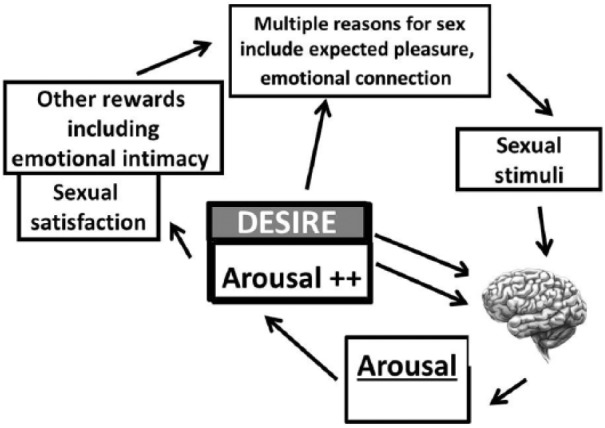
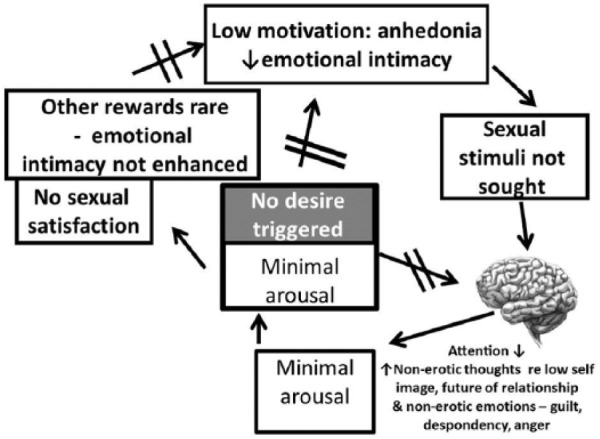
Verification
Claims the paper makes
The claims and statistics of this paper haven’t been checked yet.
Run the check — free, no account needed. It reads the open-access text and checks the sources it cites.
Claims other papers make about this one
Each is checked against this paper’s own text: does it say what the citing paper says it does?
The source backs part of the claim, not all of it — or backs it for a different population, condition or comparison.
In the citing paper
“After all, a female brain cannot simultaneously turn off BT-related impulses and turn on sexual impulses (Basson & Gilks, 2018;Fleming, 2005;Nowak et al., 2023).”
From “Your Addiction, her Sexual Suffering”—A Qualitative Inquiry into the Effects of Compulsive Sexual Behaviors on Intimate Female Partners (2025) · cites this paper as Basson & Gilks, 2018
Experimental — accuracy not yet measuredThe source backs part of the claim, not all of it — or backs it for a different population, condition or comparison.
In the citing paper
“One of the most important causes of sexual dysfunction in women is depression, which has been proven in various studies [40, 41].”
From Effect of l-arginine compared to placebo on sexual function in women with major depressive disorder: a randomized controlled trial (2024) · cites this paper as [41]
Experimental — accuracy not yet measuredThe cited source says what the claim attributes to it.
In the citing paper
“The greatest significant risk factor for female sexual dysfunction is mental health deterioration (Basson & Gilks, 2018, Blycker, 2023;Leeners et al., 2014).”
From “Your Addiction, her Sexual Suffering”—A Qualitative Inquiry into the Effects of Compulsive Sexual Behaviors on Intimate Female Partners (2025) · cites this paper as Basson & Gilks, 2018
Self-check
Percentages, sums and reported differences re-computed from the paper’s own numbers.
The self-check needs the paper’s full text.
Citations
Cites
Diagnostic and Statistical Manual of Mental Disorders
American Psychiatric Association (2013) · doi:10.1176/appi.books.9780890425596 · Cited by 116,369
Rosen, C. B. (2000) · Journal of Sex & Marital Therapy · doi:10.1080/009262300278597 · Cited by 6,593
Kabat-Zinn, J. (1982) · General Hospital Psychiatry · doi:10.1016/0163-8343(82)90026-3 · Cited by 4,255
The Cerebral Signature for Pain Perception and Its Modulation
Tracey, I., & Mantyh, P. W. (2007) · Neuron · doi:10.1016/j.neuron.2007.07.012 · Cited by 1,843
Fox, K. C. R., Nijeboer, S., Dixon, M. L., Floman, J. L., Ellamil, M., Rumak, S. P., Sedlmeier, P., & Christoff, K. (2014) · Neuroscience & Biobehavioral Reviews · doi:10.1016/j.neubiorev.2014.03.016 · Cited by 804
Meston, C. M., & Buss, D. M. (2007) · Archives of Sexual Behavior · doi:10.1007/s10508-007-9175-2 · Cited by 781
&NA;, &. (1971) · Southern Medical Journal · doi:10.1097/00007611-197103000-00035 · Cited by 698
Brain Mechanisms Supporting the Modulation of Pain by Mindfulness Meditation
Zeidan, F., Martucci, K. T., Kraft, R. A., Gordon, N. S., McHaffie, J. G., & Coghill, R. C. (2011) · The Journal of Neuroscience · doi:10.1523/jneurosci.5791-10.2011 · Cited by 640
Psychological and Interpersonal Dimensions of Sexual Function and Dysfunction
McCabe, M. P., Althof, S. E., Assalian, P., Chevret‐Méasson, M., Leiblum, S. R., Simonelli, C., & Wylie, K. R. (2010) · The Journal of Sexual Medicine · doi:10.1111/j.1743-6109.2009.01618.x · Cited by 607
Flynn, K. E., Lin, L., Bruner, D. W., Cyranowski, J. M., Hahn, E. A., Jeffery, D. D., Reese, J. B., Reeve, B. B., Shelby, R. A., & Weinfurt, K. P. (2016) · The Journal of Sexual Medicine · doi:10.1016/j.jsxm.2016.08.011 · Cited by 591
Research works printed but not linked: 14
- Mitchell KR, 2013, Lancet, 26, 1
- Nnaji R, 2008, Psychiatrist, 32, 208
- Both S, 2007, The psychophysiology of sex, 327
- Basson R., 2001, Obstet Gynecol, 98, 350
- 10.1037/0021-843X.99.4.403 · DOI
- Montejo AL, 2001, J Clin Psychiatry, 62, 10
- Boyarsky BK, 2000, Essent Psychopharmacol, 3, 39
- Fava M, 2011, Prim Care Companion CNS Disord, 13, e1
- Peitl M, 2009, Eur J Psychiatry, 23, 37
- Chiesa A, 2013, Clin Neuropsychiatry, 10, 31
- Dording CM, 2015, Evid Based Compl Altern Med, 2015, 949036
- Clayton AH, 2016, Psychiatric Clinics, 39, 427
- Snabes MC, 2012, J Sex Med, 9, 171
- Sahebkar A, 2016, Curr Drug Metab, 18, 78
Cited by
Sorted by citations
Kim, I.-S. (2021) · Antioxidants · doi:10.3390/antiox10071064 · Cited by 337
Supporting sexuality and improving sexual function in transgender persons
Holmberg, M., Arver, S., & Dhejne, C. (2018) · Nature Reviews Urology · doi:10.1038/s41585-018-0108-8 · Cited by 131
Pyke, R. E. (2019) · Sexual Medicine Reviews · doi:10.1016/j.sxmr.2019.07.001 · Cited by 90
Mernone, L., Fiacco, S., & Ehlert, U. (2019) · Frontiers in Psychology · doi:10.3389/fpsyg.2019.00546 · Cited by 87
Ko, N., Lu, W.-H., Chen, Y., Li, D., Chang, Y., Wu, C.-F., Wang, P., & Yen, C. (2020) · International Journal of Environmental Research and Public Health · doi:10.3390/ijerph17165822 · Cited by 71
Mirzaei, N., Sadatmahalleh, S. J., Khomami, M. B., Moini, A., & Kazemnejad, A. (2021) · Health and Quality of Life Outcomes · doi:10.1186/s12955-021-01720-0 · Cited by 52
Lafortune, D., Girard, M., Dussault, É., Philibert, M. D., Hébert, M., Boislard, M.-A., Goyette, M., & Godbout, N. (2023) · PLoS ONE · doi:10.1371/journal.pone.0282618 · Cited by 49
Howard, L. M., Wilson, C. A., Reilly, T. J., Moss, K. M., Mishra, G. D., Coupland‐Smith, E., Riecher‐Rössler, A., Seedat, S., Smith, S. M., Steinberg, J. R., et al. (2025) · World Psychiatry · doi:10.1002/wps.21305 · Cited by 61
Brubaker, L. W., & Guntupalli, S. R. (2020) · Obstetrics and Gynecology · doi:10.1097/aog.0000000000003941 · Cited by 52
Sexual health of women with schizophrenia: A review
Barker, L. C., & Vigod, S. N. (2020) · Frontiers in Neuroendocrinology · doi:10.1016/j.yfrne.2020.100840 · Cited by 47
Management Strategies for Antipsychotic-Related Sexual Dysfunction: A Clinical Approach
Montejo, A. L., de Alarcón, R., Prieto, N., Acosta, J. M., Buch-Vicente, B., & Montejo, L. (2021) · Journal of Clinical Medicine · doi:10.3390/jcm10020308 · Cited by 43
Women who suffer from schizophrenia: Critical issues
Seeman, M. V. (2018) · World Journal of Psychiatry · doi:10.5498/wjp.v8.i5.125 · Cited by 38
Urry, K., Chur‐Hansen, A., & Khaw, C. (2019) · International Journal of Mental Health Nursing · doi:10.1111/inm.12633 · Cited by 27
Gupta, N., Rasmussen, S. E. V. P., Haney, N. M., Smith, A. K., Pierorazio, P. M., Johnson, M. H., Hoffman-Censits, J. H., & Bivalacqua, T. J. (2020) · Urology · doi:10.1016/j.urology.2020.08.018 · Cited by 27
Sürücü, Ş. G., Vurgeç, B. A., Şenol, D. K., Gözüyeşil, E., Bilgiç, D., Köroğlu, C. O., Dağlar, G., Avcı, N., Çayır, G., Haliloğlu, B., et al. (2022) · Journal of obstetrics and gynaecology research · doi:10.1111/jog.15227 · Cited by 26
Fernandes, J., Pedro, J., Costa, M. E., & Martins, M. V. (2021) · Psychology and Health · doi:10.1080/08870446.2021.1955115 · Cited by 26
Sexually Transmitted Infections in Older Adults
Epps, P. V., Musoke, L., & McNeil, C. J. (2023) · Infectious Disease Clinics of North America · doi:10.1016/j.idc.2022.11.003 · Cited by 23
Sexual function and dysfunction among women with anorexia nervosa: A systematic scoping review
Price, T., Zebitz, M., Giraldi, A. G. E., Lokind, T. S., Treasure, J. L., & Sjögren, J. M. (2020) · International Journal of Eating Disorders · doi:10.1002/eat.23299 · Cited by 20
The Paradox of Sexual Dysfunction Observed during Pregnancy
Dăescu, A.-M. C., Navolan, D.-B., Dehelean, L., Frandeș, M., Gaitoane, A.-I., Dăescu, A., Daniluc, R.-I., & Stoian, D. L. (2023) · Healthcare · doi:10.3390/healthcare11131914 · Cited by 21
Sexual script flexibility and sexual well-being in long-term couples: a dyadic longitudinal study
Bouchard, K. N., Cormier, M., Huberman, J. S., & Rosen, N. O. (2023) · The Journal of Sexual Medicine · doi:10.1093/jsxmed/qdad067 · Cited by 25
COVID-19 pandemic effect on female sexual function
Ilgen, O., Kurt, S., Aydin, C., Bilen, E., & Kula, H. (2021) · Ginekologia Polska · doi:10.5603/gp.a2021.0084 · Cited by 20
Logan, S. J. S., Thu, W. P. P., Ho, K., Cauley, J. A., Kramer, M. S., & Yong, E. (2021) · Maturitas · doi:10.1016/j.maturitas.2021.07.002 · Cited by 20
Exploring romantic need as part of mental health social care practice
Forrester‐Jones, R., Dixon, J., & Jaynes, B. (2023) · Disability & Society · doi:10.1080/09687599.2023.2222900 · Cited by 17
Meyers, M., Margraf, J., & Velten, J. (2020) · JMIR Research Protocols · doi:10.2196/20326 · Cited by 18
Women's sexual function before and during COVID ‐19 pandemic: A systematic review and meta‐analysis
Hessami, K., Sayegh, N., Abdolmaleki, A. S., Bakht, S., Qaderi, S., Darabi, M. H., Shamsi, T., & Bagheri, F. (2022) · Journal of obstetrics and gynaecology research · doi:10.1111/jog.15337 · Cited by 17
Sexual Desire, Depressive Symptoms and Medication Use Among Women With Fibromyalgia in Flanders
Overmeire, R. V., Vesentini, L., Vanclooster, S., Muysewinkel, E., & Bilsen, J. J. R. (2021) · Sexual Medicine · doi:10.1016/j.esxm.2021.100457 · Cited by 16
Dyadic and Solitary Sexual Desire in Patients With Fibromyalgia: A Controlled Study
López‐Rodriguez, M. M., Pérez‐Fernández, A., Hernández‐Padilla, J. M., Fernández‐Sola, C., Fernández‐Medina, I. M., & Granero‐Molina, J. (2019) · The Journal of Sexual Medicine · doi:10.1016/j.jsxm.2019.07.026 · Cited by 16
Jepsen, D., Healy, K. V., Bernard, M., Markert, J., & Brzank, P. J. (2024) · Archives of Sexual Behavior · doi:10.1007/s10508-024-02877-7 · Cited by 16
Mamali, F. C., Chapman, M., Lehane, C. M., & Dammeyer, J. (2020) · Sexuality and Disability · doi:10.1007/s11195-020-09645-0 · Cited by 15
Benedict, C., Fisher, S. E., Kumar, D., Pollom, E. L., Schapira, L., Kurian, A. W., Berek, J. S., & Palesh, O. G. (2022) · Seminars in Oncology Nursing · doi:10.1016/j.soncn.2022.151316 · Cited by 21
Sexual desire, mood disorders and sleep disturbances in female BMS patients: A controlled study
Leuci, S., Coppola, N., Adamo, D., Crocetto, F., Barone, B., Baldares, S., Canfora, F., & Mignogna, M. D. (2022) · Journal of Oral Pathology and Medicine · doi:10.1111/jop.13362 · Cited by 15
Schonewille, N. N., van den Eijnden, M. J. M., Jonkman, N. H., van Kempen, A. A. M. W., van Pampus, M. G., Goedhart, F. G., van den Heuvel, O. A., & Broekman, B. F. P. (2023) · International Journal of Environmental Research and Public Health · doi:10.3390/ijerph20043070 · Cited by 15
Associations of pelvic floor dysfunction and postnatal mental health: a systematic review
VanWiel, L., Unke, M., Samuelson, R. J., & Whitaker, K. M. (2024) · Journal of Reproductive and Infant Psychology · doi:10.1080/02646838.2024.2314720 · Cited by 15
Weiss, J., Steil, R., Priebe, K., Lindauer, P., Kleindienst, N., Fydrich, T., & Müller‐Engelmann, M. (2023) · Archives of Sexual Behavior · doi:10.1007/s10508-023-02652-0 · Cited by 17
Diseño y validación de la segunda edición del Cuestionario de Función Sexual de la Mujer, FSM-2
Sánchez-Sánchez, F., Ferrer-Casanova, C., Ponce-Buj, B., Sipán-Sarrión, Y., Jurado-Lopez, A. R., Blanco, C. S. M., Tijeras-Úbeda, M. J., & Infante, A. F. (2020) · Medicina de Familia SEMERGEN · doi:10.1016/j.semerg.2020.01.004 · Cited by 13
Sexual dysfunction and quality of life in female patients with major depression disorder
Eissa, M. F., Missiry, M. A. G. E., Kamel, K. F. W., & Mahmoud, D. A. M. (2022) · Middle East Current Psychiatry · doi:10.1186/s43045-022-00206-z · Cited by 16
Rasmussen, A. L., Larsen, S. V., Ozenne, B., Köhler‐Forsberg, K., Stenbæk, D. S., Jørgensen, M. B., Giraldi, A. G. E., & Frøkjær, V. G. (2023) · Translational Psychiatry · doi:10.1038/s41398-023-02551-x · Cited by 12
Female sexual function and distress and time-to-pregnancy in a prospective preconception cohort
Bond, J. C., Heaton, B., White, K. O., Abrams, J. A., Kuohung, W., Fisher, R. R., Wesselink, A. K., Fox, M. P., & Wise, L. A. (2024) · American Journal of Obstetrics and Gynecology · doi:10.1016/j.ajog.2024.09.117 · Cited by 14
Sexual response in obsessive–compulsive disorder: the role of obsessive beliefs
Pozza, A., Marazziti, D., Mucci, F., Angelo, N. L., Prestía, D., & Dèttore, D. (2020) · CNS Spectrums · doi:10.1017/s1092852920001649 · Cited by 12
Sexuality, pelvic floor/vaginal health and contraception at menopause
Nappi, R. E., & Cucinella, L. (2021) · Best Practice & Research Clinical Obstetrics & Gynaecology · doi:10.1016/j.bpobgyn.2021.11.006 · Cited by 13
Is cognitive performance of women sensitive to the severity of menopausal symptoms?
Kaur, M., & Kaur, M. (2022) · Menopause The Journal of The North American Menopause Society · doi:10.1097/gme.0000000000001910 · Cited by 12
The role of personal factors in quality of life among Iranian women with vaginismus: a path analysis
Velayati, A., Sadatmahalleh, S. J., Ziaei, S., & Kazemnejad, A. (2021) · Health and Quality of Life Outcomes · doi:10.1186/s12955-021-01799-5 · Cited by 12
Liu, D., Liu, S., Xiu, M., Deng, H., Guo, H., Liu, W., Zhang, D., Mao, Z., Huang, D. F., Huang, D., et al. (2022) · Frontiers in Psychiatry · doi:10.3389/fpsyt.2021.761598 · Cited by 11
The impact of COVID-19 and long COVID on sexual function in cisgender women
Seehuus, M., Fertig, M. R., Handy, A. B., Clifton, J., & Stanton, A. M. (2023) · The Journal of Sexual Medicine · doi:10.1093/jsxmed/qdad155 · Cited by 11
Strizzi, J. M., Hald, G. M., Pavan, S., Heymann-Szlachcinska, A. M., Øllgaard, M., Winding, C., Dilling-Hansen, D., Jensen, A. M., Frøslev, M., Larsen, H., et al. (2024) · The Journal of Sex Research · doi:10.1080/00224499.2024.2432608 · Cited by 15
Mode of delivery and maternal sexual wellbeing: A longitudinal study
Martin, F. Z., Madley‐Dowd, P., Ahlqvist, V. H., Jónsson‐Bachmann, E., Fraser, A., & Forbes, H. J. (2022) · BJOG An International Journal of Obstetrics & Gynaecology · doi:10.1111/1471-0528.17262 · Cited by 12
Fusco, H. C. S. D. C., Pontes, M. A., Consolo, R. T., Lunardi, A. C., & Ferreira, E. A. G. (2020) · Rheumatology International · doi:10.1007/s00296-020-04595-4 · Cited by 11
Dinçer, B., Ayaz, E. Y., & Oğuz, A. (2021) · Sexuality and Disability · doi:10.1007/s11195-021-09693-0 · Cited by 13
Novick, A. M., Johnson, R. L., Lazorwitz, A. M., Belyavskaya, A., Berkowitz, L. N., Norton, A., Sammel, M. D., & Epperson, C. N. (2022) · The European Journal of Contraception & Reproductive Health Care · doi:10.1080/13625187.2022.2030702 · Cited by 11
Women’s sexual health in later life: Gaps and opportunities in research and practice
Nowakowski, A. C. H., & Sumerau, J. E. (2019) · Women s Health · doi:10.1177/1745506519878092 · Cited by 10
Sexual functioning during the lockdown period in India
Grover, S., Vaishnav, M., Tripathi, A., Rao, T. S., Avasthi, A., Dalal, P., Mehra, A., Sahoo, S., Manohar, S., Chandran, S., et al. (2021) · Indian Journal of Psychiatry · doi:10.4103/psychiatry.indianjpsychiatry_860_20 · Cited by 10
Understanding Hypoactive Sexual Desire Disorder (HSDD) in Women: Etiology, Diagnosis, and Treatment
Ronghe, V., Pannase, K., Gomase, K., & Mahakalkar, M. (2023) · Cureus · doi:10.7759/cureus.49690 · Cited by 9
Evaluation of Sexual Function of Transgender Individuals
Barcelos, T. M. R., Brito, L. G. O., Ferreira, C. H. J., Franceschini, S. A., Troncon, J. K., Ferriani, R. A., & Lara, L. A. D. S. (2024) · International Urogynecology Journal · doi:10.1007/s00192-024-05857-6 · Cited by 9
Kashani, L., Aslzadeh, S., Shokraee, K., Shamabadi, A., Najafabadi, B. T., Jafarinia, M., Esalatmanesh, S., & Akhondzadeh, S. (2022) · PubMed Central · doi:10.22038/ajp.2022.19714 · Cited by 9
Sexual dysfunction, distress, and care-seeking among females during the preconception period
Bond, J. C., White, K. O., Abrams, J. A., Wesselink, A. K., & Wise, L. A. (2023) · American Journal of Obstetrics and Gynecology · doi:10.1016/j.ajog.2023.03.037 · Cited by 11
Montejo, A. L., Sánchez, F. S., de Alarcón, R., Matías, J., Cortés, B., Matos, C., Martín-Pinto, T., Ríos, P., García, N. G., & Acosta, J. M. (2024) · Journal of Clinical Medicine · doi:10.3390/jcm13020546 · Cited by 10
Challenges in the Practice of Sexual Medicine in the Time of COVID-19 in the United States
Shindel, A. W., & Rowen, T. S. (2020) · The Journal of Sexual Medicine · doi:10.1016/j.jsxm.2020.05.011 · Cited by 9
Introducing sexual dysfunction in mental care
Gombert, M., Ballester, P., Segura, A., & Peiró, A. M. (2020) · Expert Opinion on Drug Safety · doi:10.1080/14740338.2020.1849135 · Cited by 9
Stroumsa, D., Raja, N. S., & Russell, C. B. (2024) · Reproduction · doi:10.1530/rep-24-0054 · Cited by 8
“Anger, embarrassment, less than a woman”: the emotional impact of Black women’s sexual pain
Malone, N. J., Thorpe, S. Y., Jester, J. K., Dogan, J. N., Stevens-Watkins, D. J., & Hargons, C. N. (2022) · Women & Health · doi:10.1080/03630242.2022.2155899 · Cited by 8
Managing antipsychotic-related sexual dysfunction in patients with schizophrenia
Silva, C. M., Rebelo, M., & Chendo, I. (2023) · Expert Review of Neurotherapeutics · doi:10.1080/14737175.2023.2281399 · Cited by 8
Suanrueang, P., & Peltzer, K. (2024) · Journal of Human Behavior in the Social Environment · doi:10.1080/10911359.2024.2316127 · Cited by 8
Psychiatric Comorbidities and Sexual Health
Moghalu, O. I., Hotaling, J. M., & Pastuszak, A. W. (2020) · Current Sexual Health Reports · doi:10.1007/s11930-020-00264-6 · Cited by 9
Obstructive sleep apnea syndrome as a potential cause of sexual dysfunction in women
Kabak, M., & Akbudak, M. (2021) · Sleep And Breathing · doi:10.1007/s11325-020-02275-y · Cited by 8
Schizophrenia and Related Psychoses
(2021) · Wiley eBooks · doi:10.1002/9781119870203.mpg001 · Cited by 9
Perspectives of Mental Health Nurses About Sexual Safety in Acute Inpatient Mental Health Units
Olasoji, M., Taylah, P., Megan, L., Hui, T. T., Nathan, A., Caroline, B., Anderson, S., Belmore, S., & Joseph, B. (2024) · International Journal of Mental Health Nursing · doi:10.1111/inm.13370 · Cited by 7
Management of hypoactive sexual desire disorder in women in the gynecological setting
Lara, L. A. D. S., Scalco, S. C. P., Rufino, A. C., de Paula, S. R. C., Fernandes, E. S., Pereira, J. M. D. L., de França, S. S., Reis, S., de Almeida, S. B., Vale, F. B. C., et al. (2021) · Revista Brasileira Ginecologia e Obstetrícia · doi:10.1055/s-0041-1731410 · Cited by 7
Do oral combined contraceptive pills modify body image and sexual function?
Nowosielski, K. (2022) · Reproductive Biology and Endocrinology · doi:10.1186/s12958-022-00968-5 · Cited by 7
Gambrah, H. A., Hagedorn, J. C., Dmochowski, R. R., & Johnsen, N. V. (2022) · The Journal of Sexual Medicine · doi:10.1016/j.jsxm.2022.08.198 · Cited by 9
Sexual dysfunction and associated factors in Behçet’s disease: a case–control study
Varkal, G., Türk, İ., Tüzün, Z., Agbuga, O. D., Mete, B., Coşkun, N. S. Ş., Evran, M., & Özbek, S. (2023) · Rheumatology International · doi:10.1007/s00296-023-05470-8 · Cited by 7
Mulvehill, S., & Tishler, J. (2024) · Sexual Medicine · doi:10.1093/sexmed/qfae023 · Cited by 7
What is the “weight” of body mass index on sexual functioning in women? A mediation model
Nardo, M. D., Conti, C. M., Francesco, G. D., Nicolardi, G., Guagnano, M. T., & Porcelli, P. (2020) · Eating and Weight Disorders - Studies on Anorexia Bulimia and Obesity · doi:10.1007/s40519-020-00995-4 · Cited by 7
Sha'ari, N., Woon, L. S., Sidi, H., Das, S., Bousman, C., & Saini, S. M. (2021) · Phytomedicine · doi:10.1016/j.phymed.2021.153760 · Cited by 8
Mind-Body-Spirit Model for the Medical Management of Female Sexual Well-Being
Lorenz, T. K., & Finley, N. (2020) · Current Sexual Health Reports · doi:10.1007/s11930-020-00291-3 · Cited by 7
Parish, S. J., & Pope, R. (2024) · Obstetrics and Gynecology Clinics of North America · doi:10.1016/j.ogc.2024.03.002 · Cited by 6
Substance Abuse and Sexual Functioning: An Overview of Mechanisms
Soltaninejad, M., Naderi, Y., Rouhi, L., & Banazadeh, M. (2024) · Addiction and Health · doi:10.34172/ahj.1515 · Cited by 8
Premenstrual dysphoric disorder and sexual function: a narrative review
Susser, L., Parish, S. J., Dumas, E., & Nappi, R. E. (2023) · Sexual Medicine Reviews · doi:10.1093/sxmrev/qead007 · Cited by 6
Mick, A., Wecker, H., Ziehfreund, S., Maul, J., Biedermann, T., & Zink, A. (2024) · Archives of Dermatological Research · doi:10.1007/s00403-024-02841-4 · Cited by 6
The psychiatric impact of COVID-19 pandemic on sexual health
Paul, G. M., Nascimento, B., Afif‐Abdo, J., Coutinho, F., Miranda, E., & Abdo, C. H. N. (2020) · Brazilian Journal of Psychiatry · doi:10.1590/1516-4446-2020-1197 · Cited by 6
Urrunaga‐Pastor, D., Mezones‐Holguín, E., Blümel, J. E., Apolaya-Segura, M., Barón, G., Belzares, E., Bencosme, A., Calle, A., Espinoza, M. T., Flores, D., et al. (2022) · Menopause The Journal of The North American Menopause Society · doi:10.1097/gme.0000000000001973 · Cited by 6
Double perinatal stress reduces the sexual response of adult female Wistar rats
Ferraz, M. R., Cavalheira, M. A., de Santana, A. O. M., Barboza, V. E., Nântua, M. D. S., Santos, L. N., & Pereira, S. (2023) · The Journal of Sexual Medicine · doi:10.1093/jsxmed/qdad036 · Cited by 6
Sexual health and emotional wellbeing of patients with haematological malignancies: general review.
Alsuliman, T., Rojas, R. M. M., Moukalled, N., Brissot, E., Quarez-Blaise, L., Marjanovic, Z., Blaise, D., Murphy, D., Logue, M., Savani, B., et al. (2024) · The Lancet Haematology · doi:10.1016/s2352-3026(24)00208-4 · Cited by 5
Bitzer, J., & Kirana, P. (2020) · Springer eBooks · doi:10.1007/978-3-030-52298-8_10 · Cited by 6
Abstracts of III International Scientific and Practical Conference
Гордієнко, К. О. (2021) · doi:10.46299/isg.2021.ii.iii · Cited by 8
Rowen, T. S., Abdo, C. H. N., Kak, F. E., Maseroli, E., Pope, R., Prasad, P., Velten, J., & Vignozzi, L. (2025) · Sexual Medicine Reviews · doi:10.1093/sxmrev/qeaf057 · Cited by 5
Luria, M., Park, K., Gewirtz‐Meydan, A., Arbanas, G., Ho, C. C. K., Ros, C. T. D., Srini, V. S., & Faubion, S. S. (2025) · Sexual Medicine Reviews · doi:10.1093/sxmrev/qeaf069 · Cited by 6
Gollapudi, M., Thomas, A., Yogarajah, A., Ospina, D., Daher, J. C., Rahman, A., Santistevan, L., Patel, R. V., Abraham, J., Oommen, S. G., et al. (2024) · Cureus · doi:10.7759/cureus.62788 · Cited by 6
(2022) · American Psychiatric Association Publishing eBooks · doi:10.1176/appi.books.9780890425787.x13_sexual_dysfunctions · Cited by 6
Barbagallo, F., Pedrielli, G., Bosoni, D., Tiranini, L., Cucinella, L., Calogero, A. E., Facchinetti, F., & Nappi, R. E. (2023) · Journal of Endocrinological Investigation · doi:10.1007/s40618-023-02021-7 · Cited by 5
Jąderek, I., Obarska, K., & Lew‐Starowicz, M. (2023) · Sexual Medicine · doi:10.1093/sexmed/qfad022 · Cited by 5
Darnell, C. (2021) · Sexual & Relationship Therapy · doi:10.1080/14681994.2021.1881771 · Cited by 5
Barchielli, B., Accinni, T., Ferracuti, S., Carlone, L., Petrini, F., Biondi, M., & Pasquini, M. (2022) · Journal of Clinical Medicine · doi:10.3390/jcm11030505 · Cited by 5
Psychaesthenic Syndrome: A Review on its Implication in Female Sexual Arousal
Koneru, A., Manohar, S., & Rao, T. S. (2019) · Journal of Psychosexual Health · doi:10.1177/2631831818821542 · Cited by 5
Endocrine disrupting chemicals and female sexual health: An emerging research priority
Bond, J. C., Schildroth, S., & Wise, L. A. (2025) · Environmental Research · doi:10.1016/j.envres.2025.122728 · Cited by 6
Kronthaler, S. M., Tissen‐Diabaté, T., Karsten, M. M., Blohmer, J., Beier, K. M., & Hatzler, L. (2025) · Journal of Participatory Medicine · doi:10.2196/71301 · Cited by 4
Evidence for the Impact of Stress and Trauma on Sexual Function in Women
Lapping-Carr, L. R., & Pappa, M. L. (2024) · Obstetrics and Gynecology Clinics of North America · doi:10.1016/j.ogc.2024.02.003 · Cited by 4
Chen, M., Yi, R., & Zhang, Z. (2025) · Journal of Affective Disorders · doi:10.1016/j.jad.2025.01.043 · Cited by 5
O’Neill-King, F. I., Jackowich, R. A., & Pukall, C. F. (2025) · The Journal of Sexual Medicine · doi:10.1093/jsxmed/qdaf097 · Cited by 5
Pérez-López, F. R., López-Baena, M. T., Pérez‐Roncero, G. R., Dieste-Pérez, P., Savirón‐Cornudella, R., & Tajada, M. (2022) · Gynecological Endocrinology · doi:10.1080/09513590.2022.2082404 · Cited by 4
Kantipudi, S. J., Suresh, N., Ayyadurai, P., & Sathianathan, R. (2020) · Journal of Psychosexual Health · doi:10.1177/2631831820918133 · Cited by 4
Metadata
- Authors
- Basson, R., & Gilks, T.
- Affiliations
- University of British Columbia (CA)
- Corresponding author
- Basson, Rosemary
- ORCID
- Basson, Rosemary
- Venue
- Women's Health
- Publisher
- SAGE Publications
- Published
- 2018-01-01
- Volume
- 14
- Pages
- 1745506518762664-1745506518762664
- ISSN
- 1745-5057 (ISSN-L)
- 1745-5065
- PMC
- PMC5900810
- OpenAlex
- W2797764559
- Cited by
- 225
- References
- 156
- Citations by year
- 2026: 28 · 2025: 29 · 2024: 43 · 2023: 41 · 2022: 32 · 2021: 23 · 2020: 20 · 2019: 7 · 2018: 2
- FWCI
- 10.23
- Type
- journal article
- Language
- en
- Open access
- gold
- doi.org
- Locations
- Women s Health (publishedVersion, cc-by-nc)
- Europe PMC (PubMed Central) (publishedVersion, cc-by-nc)
- PubMed Central (publishedVersion, cc-by-nc)
- PubMed (publishedVersion)
- DOAJ (DOAJ: Directory of Open Access Journals) (submittedVersion, cc-by-sa)
- Topics
- Health Sciences › Medicine › Psychiatry and Mental health › Sexual function and dysfunction studies
- Social Sciences › Psychology › Clinical Psychology › Sexuality, Behavior, and Technology
- Social Sciences › Sociology and Political Science › Sex work and related issues
- Keywords
- female sexual dysfunction, mental illness, depression, anxiety disorders, antipsychotic drugs, antidepressant side effects, sexual desire, sexual arousal, sexual pain, psychosis, sexual health assessment, quality of life, stigma
- MeSH terms
- Anxiety, Arousal, Depression, Female, Humans, Libido, Sexual Behavior, Sexual Dysfunction, Physiological, Women's Health, Sexual Dysfunctions, Psychological
About these checks
Registry, retraction, Cites and statistics results are computed, not judged, with one exception: a printed reference that no index lists is read once by a model before it counts as a citation error. Claims are extracted by a model and kept only when their quote appears verbatim in the text; each cited source is then checked, with a model’s help, for whether it says what the claim relies on. Those verdicts can be wrong — read the claim’s quote and the cited source before relying on one.
Statistics and arithmetic are recomputed, not judged.
Confidence bands are shown only for fields calibrated on our annotated test set. None is calibrated yet, so no band is shown.
What counts as a claim ›How we measure confidence ›How we check this ›
Are you an author, or do you see a problem with this page? Request a review
