

The DOI matches its Crossref record; 46 of the 46 references it cites were found in a registry or an index.
Effects of COVID-19 pandemic on mental health of children and adolescents: A systematic review of survey studies
Open accessAbstract
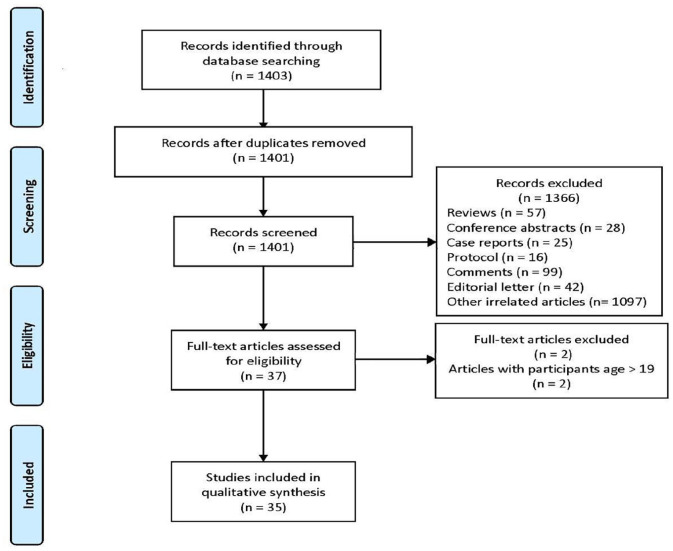
Objective: Mental health problems among children and adolescents are increasingly observed during the outbreak of COVID-19, leading to significant healthcare concerns. Survey studies provide unique opportunities for research during this pandemic, while there are no existing systematic reviews in this setting. The objective was to summarize existing survey studies addressing the effects of the current COVID-19 pandemic on the mental health of children and adolescents. Methods: For this systematic review, we performed an electronic search in multiple databases from December 2019 to December 2020. The quality appraisal of the included studies was performed with the Critical Appraisal Skills Programme Qualitative Checklist. Because of the high methodological heterogeneity between studies, a narrative synthesis of the qualitative data was used. Results: In total, 35 survey studies with 65,508 participants, ranging from 4 to 19 years of age, are included in this review. Anxiety (28%), depression (23%), loneliness (5%), stress (5%), fear (5%), tension (3%), anger (3%), fatigue (3%), confusion (3%), and worry (3%) were the most common mental health issues reported. Children and adolescents with psychiatric and/or developmental disorders, such as severe obesity, chronic lung disease, attention deficit hyperactivity disorder, cystic fibrosis, and obsessive-compulsive disorders, were especially vulnerable to the mental health effects of the COVID-19 pandemic. Age, gender, psychological quality, and negative coping strategies were identified as risk factors for the development of mental health problems. Social and family support, along with a positive coping style, was associated with better outcomes. Conclusion: The impact of the COVID-19 pandemic on mental health of children and adolescents is multifaceted and substantial. Survey studies regarding child and adolescent mental health amid COVID-19 indicated that anxiety, depression, loneliness, stress, and tension are the most observed symptoms. Positive coping strategies with family and social support may be important to achieving better outcomes. Due to limited available evidence, more well-designed studies in this area are urgently needed.
Overview
The claims and statistics of this paper haven’t been checked yet.
Run the check — free, no account needed. It reads the open-access text and checks the sources it cites.
Integrity signals
Registry
Cites
Statistics
Figures
Verification
Claims the paper makes
The claims and statistics of this paper haven’t been checked yet.
Run the check — free, no account needed. It reads the open-access text and checks the sources it cites.
Claims other papers make about this one
Each is checked against this paper’s own text: does it say what the citing paper says it does?
The source backs part of the claim, not all of it — or backs it for a different population, condition or comparison.
In the citing paper
“Systematic reviews have estimated the global prevalence of childhood and teenage depression at 23% and anxiety at 28% [2]”
From Psychological Interventions and Those With Elements of Positive Psychology for Child and Youth Mental Health During the COVID-19 Pandemic: Literature Review, Lessons Learned, and Areas for Future Knowledge Dissemination (2024) · cites this paper as [2]
Experimental — accuracy not yet measuredThe cited source says what the claim attributes to it.
In the citing paper
“Furthermore, the COVID-19 pandemic has exerted a substantial influence on the mental well-being of children and adolescents, with specific subgroups being especially susceptible to the psychological consequences of the pandemic [55].”
From Clinical Efficacy of Psychotherapeutic Interventions for Post-Traumatic Stress Disorder in Children and Adolescents: A Systematic Review and Analysis. (2024) · cites this paper as [55]
In the citing paper
“Several systematic reviews also found that certain child and adolescent populations were at risk for experiencing poorer well-being outcomes, including older adolescents, girls, neurodivergent populations, and/or chronic physical conditions [23], and populations with psychiatric or developmental disorders (e.g., obesity, lung disease, attention deficit hyperactivity disorder (ADHD), obsessive comp”
From Loneliness and Well-Being in Children and Adolescents during the COVID-19 Pandemic: A Systematic Review (2023) · cites this paper as [25]
In the citing paper
“Methods of increasing children’s and adolescents’ feelings of belonging to a social group and experiencing positive social rewards can include access to physical exercise, social hobbies, and entertainment [25,71].”
From Loneliness and Well-Being in Children and Adolescents during the COVID-19 Pandemic: A Systematic Review (2023) · cites this paper as [25]
Self-check
Percentages, sums and reported differences re-computed from the paper’s own numbers.
The self-check needs the paper’s full text.
Citations
Cites
Liberati, A., Altman, D. G., Tetzlaff, J., Mulrow, C., Gøtzsche, P. C., Ioannidis, J. P. A., Clarke, M., Devereaux, P. J., Kleijnen, J., & Moher, D. (2009) · PLoS Medicine · doi:10.1371/journal.pmed.1000100 · Cited by 28,164
The Psychological Impact of Quarantine and How to Reduce It: Rapid Review of the Evidence
Brooks, S. K., Webster, R. K., Smith, L. E., Woodland, L., Wessely, S., Greenberg, N., & Rubin, G. J. (2020) · doi:10.2139/ssrn.3532534 · Cited by 16,394
The psychological impact of quarantine and how to reduce it: Rapid review of the evidence
Brooks, S. K., Webster, R. K., Smith, L. E., Woodland, L., Wessely, S., Greenberg, N., & Rubin, G. J. (2020) · The Lancet · doi:10.1016/s0140-6736(20)30460-8 · Cited by 16,378
Fegert, J. M., Vitiello, B., Plener, P. L., & Clemens, V. (2020) · Child and Adolescent Psychiatry and Mental Health · doi:10.1186/s13034-020-00329-3 · Cited by 1,807
Magson, N. R., Freeman, J. Y. A., Rapee, R. M., Richardson, C. E., Oar, E. L., & Fardouly, J. (2021) · Journal of Youth and Adolescence · doi:10.1007/s10964-020-01332-9 · Cited by 1,498
Behavioral and emotional disorders in children during the COVID-19 epidemic
Jiao, W. Y., Wang, L. N., Liu, J., Fang, S. F., Jiao, F. Y., Pettoello-Mantovani, M., & Somekh, E. (2020) · The Journal of Pediatrics · doi:10.1016/j.jpeds.2020.03.013 · Cited by 1,468
Zhou, S.-J., Zhang, L.-G., Wang, L.-L., Guo, Z.-C., Wang, J.-Q., Chen, J.-C., Liu, M., Chen, X., & Chen, J.-X. (2020) · European Child & Adolescent Psychiatry · doi:10.1007/s00787-020-01541-4 · Cited by 1,464
Posttraumatic stress disorder in parents and youth after health-related disasters
Sprang, G., & Silman, M. (2013) · Disaster Medicine and Public Health Preparedness · doi:10.1017/dmp.2013.22 · Cited by 1,114
Epidemiology of mental health problems in COVID-19: a review
Hossain, M. M., Tasnim, S., Sultana, A., Faizah, F., Mazumder, H., Zou, L., McKyer, E. L. J., Ahmed, H. U., & Ma, P. (2020) · F1000Research · doi:10.12688/f1000research.24457.1 · Cited by 1,113
The impact of COVID-19 lockdown on child and adolescent mental health: systematic review
Panchal, U., Salazar de Pablo, G., Franco, M., Moreno, C., Parellada, M., Arango, C., & Fusar-Poli, P. (2023) · European Child & Adolescent Psychiatry · doi:10.1007/s00787-021-01856-w · Cited by 1,028
Research works printed but not linked: 2
- Pavone P, 2020, Eur Rev Med Pharmacol Sci, 24, 4572
- Kilincel S, 2020, Asia Pac Psychiatry, 13
Cited by
Sorted by citations
Items 201–243 of 243
Percepção e informação de estudantes universitários sobre vírus e a pandemia de COVID-19
Borgio, I. L., Santos, M. D. S. M., & Batistote, M. (2024) · Scientific Electronic Archives · doi:10.36560/17320241903
Assessing the Impact of the Pandemic on Child and Adolescent Mental Health
Sahu, P. (2024) · International Journal of Science and Research (IJSR) · doi:10.21275/sr23626120217
Rodriguez-Hernandez, Y., Horney, J. A., & Burke, R. V. (2024) · American Journal of Health Promotion · doi:10.1177/08901171241266610
“21”
Caruso, A. J., Basu, A., Hosoda-Urban, T., Kaskas, M. M., Rotter, N., Wozniak, J. R., & Friedman, D. S. (2024) · Frontiers in Psychology · doi:10.3389/fpsyg.2024.1354544 · Cited by 1
Alomari, I. (2024) · Journal of Languages and Language Teaching · doi:10.33394/jollt.v12i3.11454
“…empirical investigations, Gender dynamics further complicate emotional responses, considering the arguments of both Shahrour and Dardas (2020) and Theberath et al. (2022), noting that females tend to express emotions more openly and seek support effectively during stress, fostering resilience…”
BackgroundMcMahon, J., Dowling, K., Gallagher, E. A., Donnellan, A., Houghton, S., Ryan, M., O’Connor, C., & Walsh, E. H. (2024) · Frontiers in Psychology · doi:10.3389/fpsyg.2023.1095892 · Cited by 1
“Emerging evidence indicates that adolescents are at particular risk for developing poor mental health outcomes from the pandemic (Hossain et al., 2022; Mansfield et al., 2022; Theberath et al., 2022).”
BackgroundKonopka, A., Führer, A., Binder, M., Diexer, S., Frese, T., Gekle, M., Girndt, M., Gottschick, C., Hoell, J. I., Klee, B., et al. (2024) · Psychiatry International · doi:10.3390/psychiatryint5040050
APR3NDE: apoyo al aprendizaje infantil mediante un videojuego de refuerzo educativo en Android
Carrillo-Prieto, H., Morales-García, J., & Terroso-Sáenz, F. (2024) · Innovación educativa · doi:10.15304/ie.34.9515
Shenaar‐Golan, V., Yatzkar, U., & Hen, M. (2025) · SSRN Electronic Journal · doi:10.2139/ssrn.5115517
Families’ Engagement and Perception of Social-Emotional/Behavioral Services in Schools
Bender, S., Hendricker, E., & Ouye, J. (2025) · Contemporary School Psychology · doi:10.1007/s40688-025-00536-9
“Therefore, supports at all levels for students are increasingly important (Leeb et al., 2020; Theberath et al., 2022) given the growing rates of social-emotional and behavioral needs in children and adolescents.”
Coulaud, P.-J., Jesson, J., Bolduc, N., Jenkins, E., Richardson, C. G., Jauffret‐Roustide, M., & Knight, R. (2025) · PLOS mental health. · doi:10.1371/journal.pmen.0000261
“Early evidence documented how young adults developed and adopted various coping strategies to mitigate their stress related to the COVID-19 pandemic [18,19].”
A life course approach to health in the age of pandemics
Kuh, D. J., Blodgett, J. M., Lipkin, W. I., & Susser, E. (2025) · Oxford University Press eBooks · doi:10.1093/oso/9780198895961.003.0002
Gutiérrez, A. M., Holzberg, J. R., Hackley, B. K., Spalding, S. H., & Carlson, J. C. (2025) · Disaster Medicine and Public Health Preparedness · doi:10.1017/dmp.2025.67
Balsari, S., & Leaning, J. (2025) · doi:10.1093/oso/9780192844071.003.0005
Gálvez, A., & Pacheco‐Unguetti, A. P. (2025) · Healthcare · doi:10.3390/healthcare13111216 · Cited by 1
“While several reviews have explored the impact of COVID-19 on children [49–51] and adolescents with ASD [52,53], less is known about its impact on young adults, who face unique challenges related to independence, employment, and social relationships.”
Xiao, B., & Shapka, J. D. (2025) · Current Psychology · doi:10.1007/s12144-025-07977-8
KEGIATAN PENGUATAN KAPASITAS MURID SMA SWASTA DALAM MASA PANDEMI COVID-19
Wiraharja, R. S., Kristian, K., Astiarani, Y., & Denish (2025) · MitraMas Jurnal Pengabdian dan Pemberdayaan Masyarakat · doi:10.25170/mitramas.v3i1.5752
Kakiashvili, T., Koczkodaj, W. W., Mazurek, M., Modzelewski, S., Prusak, A., Skalska, A., Song, Y., Strzałka, D., & Waszkiewicz, N. (2025) · doi:10.2196/preprints.85501
Distress and coping among youth during COVID-19: a national cross sectional study in France
Rezzoug, D., Laurent, I., Estevez, M., Falissard, B., Baubet, T., Habran, E., Oppenchaim, N., Vandentorren, S., & Stefano, C. D. (2025) · Frontiers in Psychiatry · doi:10.3389/fpsyt.2025.1601358
Luijten, M. A. J., Sidey-Gibbons, C. J., Harrison, C. J., van Oers, H. A., Zijlmans, J., Tieskens, J. M., Alrouh, H., Broek, E. M., de Boer, J. N., Haverman, L., et al. (2026) · Scientific Reports · doi:10.1038/s41598-026-73632-2
Eales, L., & Ferguson, G. M. (2025) · Journal of Clinical Child & Adolescent Psychology · doi:10.1080/15374416.2025.2579276 · Cited by 1
Singh, R., Patro, P. S., Sharma, A., Arif, F., Ballal, S., & Kaur, A. (2025) · Multidisciplinary Reviews · doi:10.31893/multirev.2025ss0207
“For the well-being of teenagers, it is crucial to have a loving and encouraging atmosphere that recognizes and tackles the special difficulties they confront during that period (Theberath et al., 2022).”
Ham, N. P., Humphrey, M., & Jordan, M. (2025) · Journal of Multicultural Counseling and Development · doi:10.1002/jmcd.70007
von Rezori, R. E., Baumeister, H., Holl, R. W., Minden, K., Müller-Stierlin, A. S., Reinauer, C., Temming, S., & Warschburger, P. (2024) · Figshare · doi:10.6084/m9.figshare.24953165
Reiß, F., Cosma, A. P., Bersia, M., Erhart, M., Dalmasso, P., Devine, J., Hulbert, S., Catunda, C., Gobiņa, I., Giladi, A., et al. (2024) · Figshare · doi:10.6084/m9.figshare.26751161
Quinlan-Davidson, M., Shan, D., Courtney, D., Barbic, S. P., Cleverley, K., Hawke, L. D., Ma, C., Prebeg, M., Relihan, J., Szatmári, P., et al. (2023) · Figshare · doi:10.6084/m9.figshare.24104383
Bibliometric Insights into Emotional Well-Being Interventions for Adolescent Mental Health
Pranowo, T. A., Astuti, B., & Setiawati, F. A. (2026) · Asian Journal of Human Services · doi:10.14391/ajhs.e3001.2.001
Subhaktiyasa, P. G., Candrawati, S. A. K., Andini, N. K. S., Citrawati, N. K., & Suniyadewi, N. W. (2025) · International Journal of Community Service Learning · doi:10.23887/ijcsl.v9i3.92821
The Role of Social Skills Training in the Treatment of Social Anxiety: A Systematic Review
Heller, I., Bolliger, C., Holmer, P., Schladerer, S. P., & Michel, G. (2026) · SAGE Open · doi:10.1177/21582440251409451
“…has led to adverse mental health outcomes worldwide, and its impact on social interactions may have led to problematic social anxiety (Kindred & Bates, 2023) and a significant increase in symptoms of anxiety disorders in general, particularly in children and adolescents (Theberath et al., 2022).”
Kilb, H., Kölch, M. G., Wins, M., Knabe, A., & Reis, O. (2026) · Die Psychotherapie · doi:10.1007/s00278-026-00838-0
Meral, Y., Açıkgöz, S., & Ermis, D. K. (2026) · The Educational and Developmental Psychologist · doi:10.1080/20590776.2026.2656211
“During this period, the suspension of face-to-face education, enforcement of strict social isolation policies, disruption of daily routines and pervasive uncertainty significantly undermined the mental health of children and adolescents (Haldane et al., 2021; Theberath et al., 2022).”
Choi, E.-J., & Choi, Y. (2026) · Research Square · doi:10.21203/rs.3.rs-9343756/v1
Pong‐isawaranan, V., Thaweekoon, T., & Napa, W. (2026) · Journal of Child and Adolescent Psychiatric Nursing · doi:10.1111/jcap.70061
“This pattern has been observed in pre‐pandemic (Richardson et al. 2021), pandemic (Hussong et al. 2021; Theberath et al. 2022; Zhang et al. 2020), and post‐pandemic samples (Karadapanddy et al. 2025; Lampraki et al. 2025; Miola et al. 2023).”
Oranye, N. O., Dibaba, A., Nwankwo, I. U., Webb, L. A., Lee, T., Alexander, M., Kagulire, J., Landu-Adams, V., Nnedum, O. A. U., Abdalla, E., et al. (2026) · BMJ Open · doi:10.1136/bmjopen-2025-113697
“6 36 37 Psychological distress tends to escalate during periods of social upheaval, as was observed during the pandemic.”
Park, J.-Y., Endo, B., & Flores, S. (2026) · Journal of Child and Adolescent Mental Health · doi:10.2989/17280583.2026.2680867
Mahajan, M., Kothari, A., & Duggal, C. (2026) · Current Psychology · doi:10.1007/s12144-026-09808-w
“Mental health concerns such as loneliness, sadness, stress and tension, health related and other anxieties, and grief were widely reported in children and adolescents (Theberath et al., 2022).”
Iamarino, J. A., Santori, V., Andreoni, E., Stasi, C., Bonaccorsi, G., & Voller, F. (2026) · Journal of Public Health · doi:10.1007/s10389-026-02880-3
Kurbatfinski, S., Letourneau, N., Dewey, D., Hayes, A. F., & Dosani, A. (2026) · Children and youth services review · doi:10.1016/j.childyouth.2026.109238
Ciriza-Barea, E., Carballal-Mariño, M., Díaz-Martínez, F., Núñez-Jiménez, C., Sanchez-Almeida, E., Balaguer-Martínez, J. V., García-Sánchez, J. A., Viver-Gómez, S., Gorrotxategi-Gorrotxategi, P. J., Sampera, E. C., et al. (2026) · Revista Española de Salud Pública · doi:10.67113/resp.v100i1.1544
Chaudhuri, P. G., & Rathi, M. (2026) · Journal of the Indian Medical Association · doi:10.5005/jima-11070-0060
DuBois, D. L., Herrera, C., & Kelly, S. W. (2026) · Behavioral Sciences · doi:10.3390/bs16101857
Pförtner, T., Hennemann, T., Gube, M., & Elgar, F. J. (2026) · Archives of Public Health · doi:10.1186/s13690-026-02111-x
Metadata
- Authors
- Theberath, M., Bauer, D., Chen, W., Salinas, M., Mohabbat, A. B., Yang, J., Chon, T. Y., Bauer, B. A., & Wahner-Roedler, D. L.
- Affiliations
- St. Olaf College (US)
- Century High School, Rochester, MN, USA
- Mayo Clinic (US)
- St. Olaf College, Northfield, MN, USA
- Venue
- SAGE Open Medicine
- Publisher
- SAGE Publications
- Published
- 2022-01
- Volume
- 10
- Pages
- 20503121221086712-20503121221086712
- ISSN
- 2050-3121 (ISSN-L)
- PMC
- PMC8972920
- OpenAlex
- W4225507166
- Cited by
- 244
- References
- 44
- Citations by year
- 2026: 21 · 2025: 35 · 2024: 77 · 2023: 89 · 2022: 21
- FWCI
- 9.28
- Type
- journal article
- Language
- en
- Open access
- gold
- doi.org
- Licence
- Locations
- SAGE Open Medicine (publishedVersion, cc-by-nc)
- PubMed Central (publishedVersion, cc-by-nc)
- PubMed (publishedVersion)
- DOAJ (DOAJ: Directory of Open Access Journals) (submittedVersion)
- Funders
- The HEAD Foundation, Singapore
- Topics
- Social Sciences › Psychology › Clinical Psychology › COVID-19 and Mental Health
- Social Sciences › Psychology › Clinical Psychology › Child and Adolescent Psychosocial and Emotional Development
- Health Sciences › Medicine › Public Health, Environmental and Occupational Health › Maternal Mental Health During Pregnancy and Postpartum
- Keywords
- COVID-19 pandemic, child mental health, adolescent mental health, anxiety, depression, loneliness, stress, coping strategies, social support, family support, mental illness, developmental disorders, attention deficit hyperactivity disorder, cystic fibrosis, obsessive-compulsive disorder, morbid obesity, chronic lung disease, risk factors
About these checks
Registry, retraction, Cites and statistics results are computed, not judged, with one exception: a printed reference that no index lists is read once by a model before it counts as a citation error. Claims are extracted by a model and kept only when their quote appears verbatim in the text; each cited source is then checked, with a model’s help, for whether it says what the claim relies on. Those verdicts can be wrong — read the claim’s quote and the cited source before relying on one.
Statistics and arithmetic are recomputed, not judged.
Confidence bands are shown only for fields calibrated on our annotated test set. None is calibrated yet, so no band is shown.
What counts as a claim ›How we measure confidence ›How we check this ›
Are you an author, or do you see a problem with this page? Request a review
