

The DOI matches its Crossref record; 46 of the 46 references it cites were found in a registry or an index.
Effects of COVID-19 pandemic on mental health of children and adolescents: A systematic review of survey studies
Open accessAbstract
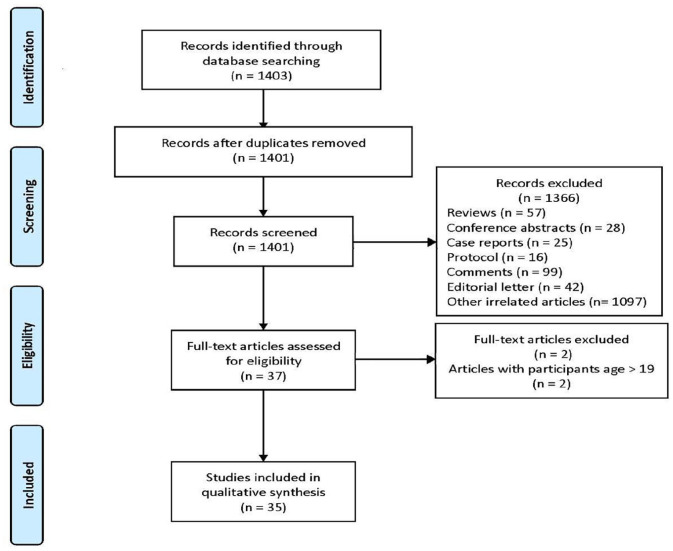
Objective: Mental health problems among children and adolescents are increasingly observed during the outbreak of COVID-19, leading to significant healthcare concerns. Survey studies provide unique opportunities for research during this pandemic, while there are no existing systematic reviews in this setting. The objective was to summarize existing survey studies addressing the effects of the current COVID-19 pandemic on the mental health of children and adolescents. Methods: For this systematic review, we performed an electronic search in multiple databases from December 2019 to December 2020. The quality appraisal of the included studies was performed with the Critical Appraisal Skills Programme Qualitative Checklist. Because of the high methodological heterogeneity between studies, a narrative synthesis of the qualitative data was used. Results: In total, 35 survey studies with 65,508 participants, ranging from 4 to 19 years of age, are included in this review. Anxiety (28%), depression (23%), loneliness (5%), stress (5%), fear (5%), tension (3%), anger (3%), fatigue (3%), confusion (3%), and worry (3%) were the most common mental health issues reported. Children and adolescents with psychiatric and/or developmental disorders, such as severe obesity, chronic lung disease, attention deficit hyperactivity disorder, cystic fibrosis, and obsessive-compulsive disorders, were especially vulnerable to the mental health effects of the COVID-19 pandemic. Age, gender, psychological quality, and negative coping strategies were identified as risk factors for the development of mental health problems. Social and family support, along with a positive coping style, was associated with better outcomes. Conclusion: The impact of the COVID-19 pandemic on mental health of children and adolescents is multifaceted and substantial. Survey studies regarding child and adolescent mental health amid COVID-19 indicated that anxiety, depression, loneliness, stress, and tension are the most observed symptoms. Positive coping strategies with family and social support may be important to achieving better outcomes. Due to limited available evidence, more well-designed studies in this area are urgently needed.
Overview
The claims and statistics of this paper haven’t been checked yet.
Run the check — free, no account needed. It reads the open-access text and checks the sources it cites.
Integrity signals
Registry
Cites
Statistics
Figures
Verification
Claims the paper makes
The claims and statistics of this paper haven’t been checked yet.
Run the check — free, no account needed. It reads the open-access text and checks the sources it cites.
Claims other papers make about this one
Each is checked against this paper’s own text: does it say what the citing paper says it does?
The source backs part of the claim, not all of it — or backs it for a different population, condition or comparison.
In the citing paper
“Systematic reviews have estimated the global prevalence of childhood and teenage depression at 23% and anxiety at 28% [2]”
From Psychological Interventions and Those With Elements of Positive Psychology for Child and Youth Mental Health During the COVID-19 Pandemic: Literature Review, Lessons Learned, and Areas for Future Knowledge Dissemination (2024) · cites this paper as [2]
Experimental — accuracy not yet measuredThe cited source says what the claim attributes to it.
In the citing paper
“Furthermore, the COVID-19 pandemic has exerted a substantial influence on the mental well-being of children and adolescents, with specific subgroups being especially susceptible to the psychological consequences of the pandemic [55].”
From Clinical Efficacy of Psychotherapeutic Interventions for Post-Traumatic Stress Disorder in Children and Adolescents: A Systematic Review and Analysis. (2024) · cites this paper as [55]
In the citing paper
“Several systematic reviews also found that certain child and adolescent populations were at risk for experiencing poorer well-being outcomes, including older adolescents, girls, neurodivergent populations, and/or chronic physical conditions [23], and populations with psychiatric or developmental disorders (e.g., obesity, lung disease, attention deficit hyperactivity disorder (ADHD), obsessive comp”
From Loneliness and Well-Being in Children and Adolescents during the COVID-19 Pandemic: A Systematic Review (2023) · cites this paper as [25]
In the citing paper
“Methods of increasing children’s and adolescents’ feelings of belonging to a social group and experiencing positive social rewards can include access to physical exercise, social hobbies, and entertainment [25,71].”
From Loneliness and Well-Being in Children and Adolescents during the COVID-19 Pandemic: A Systematic Review (2023) · cites this paper as [25]
Self-check
Percentages, sums and reported differences re-computed from the paper’s own numbers.
The self-check needs the paper’s full text.
Citations
Cites
Liberati, A., Altman, D. G., Tetzlaff, J., Mulrow, C., Gøtzsche, P. C., Ioannidis, J. P. A., Clarke, M., Devereaux, P. J., Kleijnen, J., & Moher, D. (2009) · PLoS Medicine · doi:10.1371/journal.pmed.1000100 · Cited by 28,164
The Psychological Impact of Quarantine and How to Reduce It: Rapid Review of the Evidence
Brooks, S. K., Webster, R. K., Smith, L. E., Woodland, L., Wessely, S., Greenberg, N., & Rubin, G. J. (2020) · doi:10.2139/ssrn.3532534 · Cited by 16,394
The psychological impact of quarantine and how to reduce it: Rapid review of the evidence
Brooks, S. K., Webster, R. K., Smith, L. E., Woodland, L., Wessely, S., Greenberg, N., & Rubin, G. J. (2020) · The Lancet · doi:10.1016/s0140-6736(20)30460-8 · Cited by 16,378
Fegert, J. M., Vitiello, B., Plener, P. L., & Clemens, V. (2020) · Child and Adolescent Psychiatry and Mental Health · doi:10.1186/s13034-020-00329-3 · Cited by 1,807
Magson, N. R., Freeman, J. Y. A., Rapee, R. M., Richardson, C. E., Oar, E. L., & Fardouly, J. (2021) · Journal of Youth and Adolescence · doi:10.1007/s10964-020-01332-9 · Cited by 1,498
Behavioral and emotional disorders in children during the COVID-19 epidemic
Jiao, W. Y., Wang, L. N., Liu, J., Fang, S. F., Jiao, F. Y., Pettoello-Mantovani, M., & Somekh, E. (2020) · The Journal of Pediatrics · doi:10.1016/j.jpeds.2020.03.013 · Cited by 1,468
Zhou, S.-J., Zhang, L.-G., Wang, L.-L., Guo, Z.-C., Wang, J.-Q., Chen, J.-C., Liu, M., Chen, X., & Chen, J.-X. (2020) · European Child & Adolescent Psychiatry · doi:10.1007/s00787-020-01541-4 · Cited by 1,464
Posttraumatic stress disorder in parents and youth after health-related disasters
Sprang, G., & Silman, M. (2013) · Disaster Medicine and Public Health Preparedness · doi:10.1017/dmp.2013.22 · Cited by 1,114
Epidemiology of mental health problems in COVID-19: a review
Hossain, M. M., Tasnim, S., Sultana, A., Faizah, F., Mazumder, H., Zou, L., McKyer, E. L. J., Ahmed, H. U., & Ma, P. (2020) · F1000Research · doi:10.12688/f1000research.24457.1 · Cited by 1,113
The impact of COVID-19 lockdown on child and adolescent mental health: systematic review
Panchal, U., Salazar de Pablo, G., Franco, M., Moreno, C., Parellada, M., Arango, C., & Fusar-Poli, P. (2023) · European Child & Adolescent Psychiatry · doi:10.1007/s00787-021-01856-w · Cited by 1,028
Duan, L., Shao, X., Wang, Y., Huang, Y., Miao, J., Yang, X., & Zhu, G. (2020) · Journal of Affective Disorders · doi:10.1016/j.jad.2020.06.029 · Cited by 991
Ellis, W. E., Dumas, T. M., & Forbes, L. M. (2020) · Canadian Journal of Behavioural Science / Revue canadienne des sciences du comportement · doi:10.1037/cbs0000215 · Cited by 830
Cauberghe, V., Van Wesenbeeck, I., De Jans, S., Hudders, L., & Ponnet, K. (2021) · Cyberpsychology, Behavior, and Social Networking · doi:10.1089/cyber.2020.0478 · Cited by 564
Imran, N., Zeshan, M., & Pervaiz, Z. (2020) · Pakistan Journal of Medical Sciences · doi:10.12669/pjms.36.covid19-s4.2759 · Cited by 540
Oosterhoff, B., Palmer, C. A., Wilson, J., & Shook, N. (2020) · Journal of Adolescent Health · doi:10.1016/j.jadohealth.2020.05.004 · Cited by 480
Saurabh, K., & Ranjan, S. (2020) · The Indian Journal of Pediatrics · doi:10.1007/s12098-020-03347-3 · Cited by 468
Dong, H., Yang, F., Lu, X., & Hao, W. (2020) · Frontiers in Psychiatry · doi:10.3389/fpsyt.2020.00751 · Cited by 431
The Effect of Social Support on Mental Health in Chinese Adolescents During the Outbreak of COVID-19
Qi, M., Zhou, S., Guo, Z.-C., Zhang, L.-G., Min, H.-J., Li, X.-M., & Chen, J. (2020) · Journal of Adolescent Health · doi:10.1016/j.jadohealth.2020.07.001 · Cited by 406
Rogers, A. A., Ha, T., & Ockey, S. (2021) · Journal of Adolescent Health · doi:10.1016/j.jadohealth.2020.09.039 · Cited by 349
The Psychological Impact of the COVID-19 Pandemic on Teenagers in China
Zhang, C., Ye, M., Fu, Y., Yang, M., Fen, L., Yuan, J., & Tao, Q. (2020) · Journal of Adolescent Health · doi:10.1016/j.jadohealth.2020.08.026 · Cited by 342
Zhang, J., Shuai, L., Yu, H., Wang, Z., Qiu, M., Lu, L., Cao, X., Xia, W., Wang, Y., & Chen, R. (2020) · Asian Journal of Psychiatry · doi:10.1016/j.ajp.2020.102077 · Cited by 323
Longitudinal increases in childhood depression symptoms during the COVID-19 lockdown
Bignardi, G., Dalmaijer, E. S., Anwyl-Irvine, A. L., Smith, T. A., Šiugždaitė, R., Uh, S., & Astle, D. E. (2020) · Archives of Disease in Childhood · doi:10.1136/archdischild-2020-320372 · Cited by 269
Asanov, I., Flores, F., McKenzie, D., Mensmann, M., & Schulte, M. (2021) · World Development · doi:10.1016/j.worlddev.2020.105225 · Cited by 232
Masuyama, A., Shinkawa, H., & Kubo, T. (2020) · International Journal of Mental Health and Addiction · doi:10.1007/s11469-020-00368-z · Cited by 172
Kılınçel, Ş., Kılınçel, O., Muratdağı, G., Aydın, A., & Usta, M. B. (2021) · Asia-Pacific Psychiatry · doi:10.1111/appy.12406 · Cited by 171
de Ávila, M. A. G., Filho, P. T. H., Jacob, F. L. D. S., Alcântara, L. R. D. S., Berghammer, M. C., Nolbris, M. J., Olaya‐Contreras, P., & Nilsson, S. (2020) · International Journal of Environmental Research and Public Health · doi:10.3390/ijerph17165757 · Cited by 168
Yue, J., Zang, X., Le, Y., & An, Y. (2020) · Current Psychology · doi:10.1007/s12144-020-01191-4 · Cited by 159
Seçer, İ., & Ulaş, S. (2021) · International Journal of Mental Health and Addiction · doi:10.1007/s11469-020-00322-z · Cited by 142
Zhang, X., Zhu, W., Kang, S., Qiu, L., Lu, Z., & Sun, Y. L. (2020) · International Journal of Environmental Research and Public Health · doi:10.3390/ijerph17207666 · Cited by 133
Wiguna, T., Anindyajati, G., Kaligis, F., Ismail, R. I., Minayati, K., Hanafi, E., Murtani, B. J., Wigantara, N. A., Putra, A. A., & Pradana, K. (2020) · Frontiers in Psychiatry · doi:10.3389/fpsyt.2020.598756 · Cited by 109
Kang, S., Sun, Y. L., Zhang, X., Sun, F., Wang, B., & Zhu, W. (2020) · Journal of Epidemiology and Global Health · doi:10.2991/jegh.k.200908.001 · Cited by 106
Anxiety in Older Adolescents at the Time of COVID-19
Smirni, P., Lavanco, G., & Smirni, D. (2020) · Journal of Clinical Medicine · doi:10.3390/jcm9103064 · Cited by 106
Alves, J. M., Yunker, A. G., DEFENDIS, A. W., Xiang, A. H., & Page, K. A. (2021) · Pediatric Obesity · doi:10.1111/ijpo.12786 · Cited by 100
Effect of the COVID‐19 pandemic on anxiety among children with cystic fibrosis and their mothers
Şenkalfa, B., Eyüboğlu, T. Ş., Aslan, A. T., Gürsoy, T. R., Soysal, A. Ş., Yapar, D., & ILHAN, M. N. (2020) · Pediatric Pulmonology · doi:10.1002/ppul.24900 · Cited by 90
Chen, S., Cheng, Z., & Wu, J. (2020) · Globalization and Health · doi:10.1186/s12992-020-00627-7 · Cited by 83
COVID ‐19 related anxiety in children and adolescents with severe obesity: A mixed‐methods study
Abawi, O., Welling, M. S., van den Eynde, E., van Rossum, E. F. C., Halberstadt, J., van den Akker, E. L. T., & van der Voorn, B. (2020) · Clinical Obesity · doi:10.1111/cob.12412 · Cited by 66
Tural, D. A., Emiralioğlu, N., Hesapçıoğlu, S. T., Karahan, S., Özsezen, B., Sunman, B., Büyükşahin, H. N., Yalçın, E., Doğru, D., Özçelik, U., et al. (2020) · Pediatric Pulmonology · doi:10.1002/ppul.25082 · Cited by 65
Abdulah, D. M., Abdulla, B. M. O., & Liamputtong, P. (2020) · International Journal of Social Psychiatry · doi:10.1177/0020764020972439 · Cited by 65
Physical Activity, Screen Time, and Mood Disturbance Among Chinese Adolescents During COVID-19
Xiao, S., Yan, Z., & Zhao, L. (2021) · Journal of Psychosocial Nursing and Mental Health Services · doi:10.3928/02793695-20201104-04 · Cited by 63
Schwartz-Lifshitz, M., Basel, D., Lang, C., Hertz‐Palmor, N., Dekel, I., Zohar, J., & Gothelf, D. (2020) · Journal of Obsessive-Compulsive and Related Disorders · doi:10.1016/j.jocrd.2020.100610 · Cited by 56
Outbreak of COVID-19 infection in children: fear and serenity.
Pavone, P., Ceccarelli, M., Taibi, R., Rocca, G. L., & Nunnari, G. (2020) · PubMed · doi:10.26355/eurrev_202004_21043 · Cited by 43
Associations between Affect, Physical Activity, and Anxiety Among US Children During COVID-19Preprint
Alves, J. M., Yunker, A. G., DEFENDIS, A. W., et al. (2020) · medRxiv · doi:10.1101/2020.10.20.20216424 · Cited by 38
Demkowicz, O., Panayiotou, M., Parsons, S. D., Feltham, A., Arseneault, L., Ingram, B., Patalay, P., Edge, D., Pierce, M., Creswell, C., et al. (2021) · Frontiers in Psychiatry · doi:10.3389/fpsyt.2021.622562 · Cited by 23
The Well-Being Index (WBI) for schools: A brief measure of adolescents’ mental health.
Luthar, S. S., Ebbert, A. M., & Kumar, N. L. (2020) · Psychological Assessment · doi:10.1037/pas0000913 · Cited by 18
Metwally, A. M., El-Sonbaty, M. M., Elshaarawy, G. A., Etreby, L. A. E., Elsayed, H., Elsheshtawy, E., Elsaeid, A., & Ibrahim, N. A. (2020) · Open Access Macedonian Journal of Medical Sciences · doi:10.3889/oamjms.2020.4766 · Cited by 17
Gómez, G., Basagoitia, A., Burrone, M. S., Rivas, M., Solís-Soto, M. T., Dy Juanco, S., & Alley, H. (2021) · Frontiers in Psychiatry · doi:10.3389/fpsyt.2021.713407 · Cited by 8
Research works printed but not linked: 2
- Pavone P, 2020, Eur Rev Med Pharmacol Sci, 24, 4572
- Kilincel S, 2020, Asia Pac Psychiatry, 13
Cited by
Sorted by citations
Farrell, A. H., Vitoroulis, I., Eriksson, M., & Vaillancourt, T. (2023) · Children · doi:10.3390/children10020279 · Cited by 130
“…including older adolescents, girls, neurodivergent populations, and/or chronic physical conditions [23], and populations with psychiatric or developmental disorders (e.g., obesity, lung disease, attention deficit hyperactivity disorder (ADHD), obsessive compulsive disorder; ages 4 to 19 [25]).”
BackgroundNewlove‐Delgado, T., Russell, A. E., Mathews, F., Cross, L., Bryant, E., Gudka, R., Ukoumunne, O. C., & Ford, T. J. (2023) · Journal of Child Psychology and Psychiatry · doi:10.1111/jcpp.13716 · Cited by 100
“Our findings are in broad agreement with other reviews attempting to synthesise the evidence on this question, which also concluded there had been a deterioration, but with multifaceted effects (Samji et al., 2022; Theberath et al., 2022).”
Trends in Adolescent Health: Successes and Challenges From 2010 to the Present
Beckwith, S., Chandra‐Mouli, V., & Blum, R. W. (2024) · Journal of Adolescent Health · doi:10.1016/j.jadohealth.2024.04.015 · Cited by 90
Champion, K. E., Newton, N. C., Gardner, L. A., Chapman, C., Thornton, L. K., Slade, T. N., Sunderland, M., Hides, L. M., MCBRIDE, N. T., O’Dean, S., et al. (2023) · The Lancet Digital Health · doi:10.1016/s2589-7500(23)00028-6 · Cited by 69
Liverpool, S., Moinuddin, M., Aithal, S., Owen, M. B., Bracegirdle, K., Caravotta, M., Walker, R., Murphy, C., & Karkou, V. (2023) · PLoS ONE · doi:10.1371/journal.pone.0280689 · Cited by 66
“Our findings align with some of the previous research suggesting that age, gender expression and pre-existing conditions can place some students at risk of experiencing poorer mental health and wellbeing [7, 11, 12].”
BackgroundResult
Metadata
- Authors
- Theberath, M., Bauer, D., Chen, W., Salinas, M., Mohabbat, A. B., Yang, J., Chon, T. Y., Bauer, B. A., & Wahner-Roedler, D. L.
- Affiliations
- St. Olaf College (US)
- Century High School, Rochester, MN, USA
- Mayo Clinic (US)
- St. Olaf College, Northfield, MN, USA
- Venue
- SAGE Open Medicine
- Publisher
- SAGE Publications
- Published
- 2022-01
- Volume
- 10
- Pages
- 20503121221086712-20503121221086712
- ISSN
- 2050-3121 (ISSN-L)
- PMC
- PMC8972920
- OpenAlex
- W4225507166
- Cited by
- 244
- References
- 44
- Citations by year
- 2026: 21 · 2025: 35 · 2024: 77 · 2023: 89 · 2022: 21
- FWCI
- 9.28
- Type
- journal article
- Language
- en
- Open access
- gold
- doi.org
- Licence
- Locations
- SAGE Open Medicine (publishedVersion, cc-by-nc)
- PubMed Central (publishedVersion, cc-by-nc)
- PubMed (publishedVersion)
- DOAJ (DOAJ: Directory of Open Access Journals) (submittedVersion)
- Funders
- The HEAD Foundation, Singapore
- Topics
- Social Sciences › Psychology › Clinical Psychology › COVID-19 and Mental Health
- Social Sciences › Psychology › Clinical Psychology › Child and Adolescent Psychosocial and Emotional Development
- Health Sciences › Medicine › Public Health, Environmental and Occupational Health › Maternal Mental Health During Pregnancy and Postpartum
- Keywords
- COVID-19 pandemic, child mental health, adolescent mental health, anxiety, depression, loneliness, stress, coping strategies, social support, family support, mental illness, developmental disorders, attention deficit hyperactivity disorder, cystic fibrosis, obsessive-compulsive disorder, morbid obesity, chronic lung disease, risk factors
About these checks
Registry, retraction, Cites and statistics results are computed, not judged, with one exception: a printed reference that no index lists is read once by a model before it counts as a citation error. Claims are extracted by a model and kept only when their quote appears verbatim in the text; each cited source is then checked, with a model’s help, for whether it says what the claim relies on. Those verdicts can be wrong — read the claim’s quote and the cited source before relying on one.
Statistics and arithmetic are recomputed, not judged.
Confidence bands are shown only for fields calibrated on our annotated test set. None is calibrated yet, so no band is shown.
What counts as a claim ›How we measure confidence ›How we check this ›
Are you an author, or do you see a problem with this page? Request a review
