

What is data justice? The case for connecting digital rights and freedoms globally
Open accessThe DOI matches its Crossref record; 38 of the 41 references it cites were found in a registry or an index, and 3 are not checked yet.
Abstract
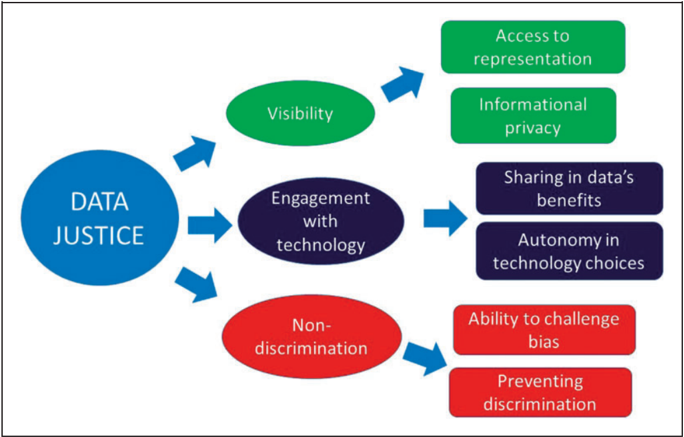
The increasing availability of digital data reflecting economic and human development, and in particular the availability of data emitted as a by-product of people’s use of technological devices and services, has both political and practical implications for the way people are seen and treated by the state and by the private sector. Yet the data revolution is so far primarily a technical one: the power of data to sort, categorise and intervene has not yet been explicitly connected to a social justice agenda by the agencies and authorities involved. Meanwhile, although data-driven discrimination is advancing at a similar pace to data processing technologies, awareness and mechanisms for combating it are not. This paper posits that just as an idea of justice is needed in order to establish the rule of law, an idea of data justice – fairness in the way people are made visible, represented and treated as a result of their production of digital data – is necessary to determine ethical paths through a datafying world. Bringing together the emerging scholarly perspectives on this topic, I propose three pillars as the basis of a notion of international data justice: (in)visibility, (dis)engagement with technology and antidiscrimination. These pillars integrate positive with negative rights and freedoms, and by doing so challenge both the basis of current data protection regulations and the growing assumption that being visible through the data we emit is part of the contemporary social contract.
Overview
The claims and statistics of this paper haven’t been checked yet.
Free: it reads the open-access text and checks the first 5 claims that cite a source we can check. Create a free account to check every claim.
Integrity signals
Registry
Cites
Statistics
Figures

Verification
Claims the paper makes
The claims and statistics of this paper haven’t been checked yet.
Free: it reads the open-access text and checks the first 5 claims that cite a source we can check. Create a free account to check every claim.
Claims other papers make about this one
Each is checked against this paper’s own text: does it say what the citing paper says it does?
The cited source says what the claim attributes to it.
In the citing paper
“It stresses the importance of developing individual freedoms in relation to how data are used and collected and advocates for enhanced autonomy and agency: people should be able to decide whether they want to participate in this system.”
From Staring Back at the Surveillance Gaze: The Resistance of LGBTQ+ Users on Social Media (2026) · cites this paper as Taylor 2017
The cited source says what the claim attributes to it.
In the citing paper
“Data justice frameworks are particularly invested in understanding the impacts, both negative and positive, of datafication and identifying ways to address them.”
From Staring Back at the Surveillance Gaze: The Resistance of LGBTQ+ Users on Social Media (2026) · cites this paper as Taylor 2017
The check wasn’t confident either way, so it gives no verdict — never disputed.
In the citing paper
“Because of this, the topic of data quality is beginning to transcend beyond the field of data management and into the realm of Human Computer Interaction (HCI), which accommodates holistic considerations such as how people search for relevant datasets [42], how developers perceive data work [64] and the best ways of using crowdsourcing to generate, evaluate or label data [71].”
From A Survey of Data Quality Requirements That Matter in ML Development Pipelines (2023) · cites this paper as [71]
Experimental — accuracy not yet measuredIn the citing paper
“Linnet Taylor (2017) advocates for a data justice framework acknowledging that, while there is a rapid development of data processing technologies, there is a lack of considerations of how datafication plays into broader social justice issues.”
From Staring Back at the Surveillance Gaze: The Resistance of LGBTQ+ Users on Social Media (2026) · cites this paper as Taylor 2017
In the citing paper
“For Taylor (2017), data justice revolves around three pillars: visibility, digital (dis)engagement, and countering data-driven discrimination.”
From Staring Back at the Surveillance Gaze: The Resistance of LGBTQ+ Users on Social Media (2026) · cites this paper as Taylor 2017
Self-check
Percentages, sums and reported differences re-computed from the paper’s own numbers.
The self-check needs the paper’s full text.
Citations
Cites
Clapp, J., & Sen, A. (1999) · International Journal Canada s Journal of Global Policy Analysis · doi:10.1177/002070200005500119 · Cited by 13,507
Clapp, J., & Sen, A. (1999) · International Journal · doi:10.2307/40203469 · Cited by 13,411
Sorting Things Out: Classification and Its Consequences
Bowker, G. C., & Star, S. L. (1999) · doi:10.7551/mitpress/6352.001.0001 · Cited by 6,188
(1993) · Oxford University Press eBooks · doi:10.1093/0198287976.001.0001 · Cited by 4,239
Toward a Field of Intersectionality Studies: Theory, Applications, and Praxis
Cho, S., Crenshaw, K. W., & McCall, L. (2013) · Signs: Journal of Women in Culture and Society · doi:10.1086/669608 · Cited by 4,126 · cited 2×
“This intersectionality (Cho et al., 2013) in the effects of datafication is an important component of the argument for a social justice perspective.”
BackgroundDoyle, T. (2017) · The Information Society · doi:10.1080/01972243.2017.1354593 · Cited by 3,071 · cited 3×
“O’Neil (2016) has warned that algorithmic models must be constantly recalibrated using feedback from the events they are supposed to predict.”
BackgroundNew York University Law Review
Rawls, J. (2017) · Justice · doi:10.4324/9781315193496-11 · Cited by 2,872
Lemke, T. (2001) · Economy and Society · doi:10.1080/03085140120042271 · Cited by 2,043 · cited 2×
“…designed to assure that people are not misusing state welfare funds and other publicly funded support are part of the apparatus of governmentality (Lemke, 2001); data-driven law enforcement focuses unequally on poor neighbourhoods which experience certain types of criminality (O’Neil, 2016); and…”
BackgroundSen, A. (2005) · Journal of Human Development · doi:10.1080/14649880500120491 · Cited by 1,966 · cited 5×
“Many states and regions, for example, take a perspective on rights that frames them as inseparable from corresponding duties, and also addresses the individual as part of the larger collective (Sen, 2005).”
BackgroundInfluentialLevin, K., Cashore, B., Bernstein, S., & Auld, G. (2012) · Policy Sciences · doi:10.1007/s11077-012-9151-0 · Cited by 1,839
Surveillance studies: an overview – By David Lyon
Kelly, T. (2008) · Journal of the Royal Anthropological Institute · doi:10.1111/j.1467-9655.2008.00511_33.x · Cited by 949
Surveillance studies: an overview
Kelly, T. (2008) · Journal of the Royal Anthropological Institute · Cited by 947
Annals of the American association of geographers
Paterson, G. (2016) · interactions · Cited by 762
The ethics of smart cities and urban science
Kitchin, R. (2016) · Philosophical Transactions of the Royal Society A: Mathematical, Physical and Engineering Sciences · doi:10.1098/rsta.2016.0115 · Cited by 491 · cited 2×
“…data reflecting economic and human development, and in particular of ‘data fumes’ (Thatcher, 2014) – data produced as a by-product of people’s use of technological devices and services – is driving a shift in policymaking worldwide from being data informed to being data driven (Kitchin, 2016).”
BackgroundGlobal Justice: A Cosmopolitan Account
Brock, G. (2009) · doi:10.1093/acprof:oso/9780199230938.001.0001 · Cited by 437
Configuring the Networked Self: Law, Code, and the Play of Everyday Practice
Cohen, J. E. (2012) · Cited by 431
Is the Notion of Human Rights a Western Concept?
Panikkar, R. (1982) · Diogenes · doi:10.1177/039219218203012005 · Cited by 350 · cited 1×
“The liberal individual notion of rights is not adopted by many societies which nevertheless have a strong philosophical and legal tradition of justice and fairness (Panikkar, 1982).”
BackgroundTowards data justice? The ambiguity of anti-surveillance resistance in political activism
Dencik, L., Hintz, A., & Cable, J. (2016) · Big Data & Society · doi:10.1177/2053951716679678 · Cited by 311 · cited 4×
“…another focusing on the ways in which data technologies can provide greater distributive justice through making the poor visible (Heeks and Renken, 2016) and another that is interested in how practices of dataveillance can impact on the work of social justice organisations (Dencik et al., 2016).”
BackgroundInfluentialICT4WHAT?—Using the choice framework to operationalise the capability approach to development
Kleine, D. (2010) · Journal of International Development · doi:10.1002/jid.1719 · Cited by 297
ICT4D: Information and Communication Technology for Development
James, J. (2010) · Journal of the American Society for Information Science and Technology · doi:10.1002/asi.21200 · Cited by 279 · cited 1×
“…with digital technologies in LMICs – has clearly established links between fostering human development and providing access to ICTs (Heeks, 2010; Unwin, 2009), this field is adjusting, like others, to the evolution of new data-producing technologies and analytics and is now starting to…”
BackgroundCritical Data Studies: A dialog on data and space
Dalton, C. M., Taylor, L., & Thatcher (alphabetical), J. (2016) · Big Data & Society · doi:10.1177/2053951716648346 · Cited by 264 · cited 5×
“This fits with a current trend where scholars worldwide are calling for change in terms of the way data’s social impacts are researched (Cohen, 2012; Dalton et al., 2016; Floridi, 2016; Kleine, 2010; Schwartz and Solove, 2011).”
BackgroundMethodInfluentialSelf-citationTurow, J., & Hennessy, M. (2015) · SSRN Electronic Journal · doi:10.2139/ssrn.2820060 · Cited by 203 · cited 1×
“Instead, evidence shows that the increasing necessity of data technologies in everyday life causes people to resign themselves to this distributed visibility rather than engaging with it politically (Turow et al., 2015).”
BackgroundKwan, M.-P. (2016) · Annals of the American Association of Geographers · doi:10.1080/00045608.2015.1117937 · Cited by 195 · cited 1×
“A second example comes from a system that at the time of writing was still at the conceptualisation stage, but which demonstrates how algorithmic uncertainty (Kwan, 2016) – the gap between virtual spatial information and physical ground truth – can translate into embedded injustice.”
BackgroundFrom open data to information justice
Johnson, J. A. (2014) · Ethics and Information Technology · doi:10.1007/s10676-014-9351-8 · Cited by 183 · cited 6×
“Johnson (2014) connects data justice primarily to open data.”
BackgroundInfluentialLiving on Fumes: Digital Footprints, Data Fumes, and the Limitations of Spatial Big Data
Thatcher, J. (2014) · International journal of communication · Cited by 180
Mann, L. (2018) · Development and Change · doi:10.1111/dech.12347 · Cited by 177
Open Data, Data Protection, and Group Privacy
Floridi, L. (2014) · Philosophy & Technology · doi:10.1007/s13347-014-0157-8 · Cited by 175 · cited 2×
“A more detailed framing of the needs for both visibility and informational privacy should take into account the work being done on privacy at the social margins (Arora, 2016; Gilliom, 2001; Jayaram, 2014), the risks to group privacy through collective profiling (Taylor, 2016b; Floridi, 2014; Raymond, 2016) and the ext…”
BackgroundBreaking Down Anonymity : Digital Surveillance of Irregular Migrants in Germany and the Netherlands
Broeders, D. (2009) · Amsterdam University Press eBooks · doi:10.5117/9789089641595 · Cited by 126 · cited 1×
“The problem of migrant rights goes far beyond data, but data systems underpin the way migrants can be included and excluded, and therefore their ability to claim their rights (Broeders, 2009).”
BackgroundKleine, D. (2010) · Ethics and Information Technology · doi:10.1007/s10676-010-9251-5 · Cited by 99
Overseers of the Poor: Surveillance, Resistance, and the Limits of Privacy
Hope, T. L., & Gilliom, J. (2003) · Contemporary Sociology A Journal of Reviews · doi:10.2307/3089153 · Cited by 87
From Open Data to Information JusticePreprint
Johnson, J. A. (2013) · SSRN Electronic Journal · doi:10.2139/ssrn.2241092 · Cited by 86
Development 2.0: the IT-enabled transformation of international development
Heeks, R. (2010) · Communications of the ACM · doi:10.1145/1721654.1721665 · Cited by 64 · cited 3×
“Although ICT-forDevelopment – the promotion of engagement with digital technologies in LMICs – has clearly established links between fostering human development and providing access to ICTs (Heeks, 2010; Unwin, 2009), this field is adjusting, like others, to the evolution of new data-producing technologies and analyti…”
BackgroundBinfield, K. (2015) · Johns Hopkins University Press eBooks · doi:10.1353/book.98247 · Cited by 61
“A Country in Order”: Technopolitics, Nation Building, and the Development of ICT in Ethiopia
Gagliardone, I. (2014) · Information Technologies and International Development · Cited by 43
Broeders, D., & Taylor, L. (2017) · Law, governance and technology series · doi:10.1007/978-3-319-47852-4_17 · Cited by 35
Self-citationMoore, L. J., & Currah, P. (2015) · Duke University Press eBooks · doi:10.1215/9780822375463-004 · Cited by 34
Hannah, M. G. (2010) · Cited by 23
The question of information justice
Johnson, J. A. (2016) · Communications of the ACM · doi:10.1145/2879878 · Cited by 19 · cited 1×
“As a way to address the problem, Johnson (2016: 29) advocates for ‘mak[ing] politics explicit’ with regard to data technologies, through collaborative research involving philosophers of technology, information scientists and social scientists.”
BackgroundPresidential Address: Survey Research, Its New Frontiers, and Democracy
Keeter, S. (2012) · Public Opinion Quarterly · doi:10.1093/poq/nfs044 · Cited by 14 · cited 1×
“If state population data is soon to be at least partly composed of commercially collected data (Keeter, 2012) and updated in real time, and those data can tell the government not only conventional facts about the population but instead almost everything, where does legitimate observation end and…”
BackgroundSurveillance and the Work of Antitrafficking
Kang, L. H. Y. (2015) · Duke University Press eBooks · doi:10.1215/9780822375463-003 · Cited by 13
Jiwani, Y. (2015) · Duke University Press eBooks · doi:10.1215/9780822375463-005 · Cited by 8
Research works printed but not linked: 19
- Alkire S (2011) The capability approach and human development. University of Oxford. Available at: http://www.ophi. org.uk/wp-content/uploads/OPHI-HDCA-SS11-Intro-tothe-Capability-Approach-SA.pdf (accessed 23 June 2017).
- Arora P (2016) Bottom of the data pyramid: Big data and the global south. International Journal of Communication 10: 19.
- Eubanks V (2014) Want to predict the future of surveillance? Ask poor communities. The American Prospect , pp. 1-4. Available at: http://prospect.org/article/want-predict-futuresurveillance-ask-poor-communities#.VXbsO\_Oh2k8.twitter (accessed 9 October 2017).
- Foucault M (1977) Discipline & punish -Panopticism. Discipline and Punish: The Birth of the Prison. New York: Vintage, pp. 195-228.
- Holvast J (2013) De Volkstelling van 1971 . Amsterdam: Uitgeverij Paris.
- Jayaram M (2014) India's big brother project. Boston Review . Available at: http://www.bostonreview.net/world/malavika-jayaram-india-unique-identification-biometrics (accessed 1 January 2016).
- Kroll JA, et al. (2016) Accountable algorithms. University of Pennsylvania Law Review 165(633): 633-705.
- Makulilo AB (2016) ''A person is a person through other persons'' - A critical analysis of privacy and culture in Africa, Beijing Law Review 7: 192-204.
- Masiero S (2016) Digital governance and the reconstruction of the Indian anti-poverty system. Oxford Development Studies 818: 1-16.
- Nussbaum MC (2006) Frontiers of Justice: Disability, Nationality, and Species Membership . Cambridge, MA: Harvard University Press.
- O'Neil C (2016) Weapons of Math Destruction: How Big Data Increases Inequality and Threatens Democracy . New York: Crown Publishing Group.
- Raymond NA (2016) Beyond ''do no harm'' and individual consent: Reckoning with the emerging ethical challenges of civil society's use of data. In: Taylor L, Floridi L and van der Sloot B (eds) Group Privacy: New Challenges of Data Technologies . Springer International, pp. 67-82.
- Shearmur R (2015) Dazzled by data: Big Data, the census and urban geography. Urban Geography 36(7): 965-968.
- Spivak GC (1988) Can the subaltern speak? In: Nelson C and Grossberg L (eds) Marxism and the Interpretation of Culture . University of Illinois Press, pp. 271-313.
- Taylor L (2016a) From zero to hero: How zero-rating became a debate about human rights. IEEE Internet Computing 20(4): 79-83.
- Taylor L (2016b) No place to hide? The ethics and analytics of tracking mobility using mobile phone data. Environment and Planning D: Society and Space 34(2): 319-336.
- Taylor L (2016c) Safety in numbers? Group privacy and big data analytics in the developing world. Group Privacy: New Challenges of Data Technologies . Dordrecht: Springer.
- Taylor L (2016d) The ethics of big data as a public good: Which public? Whose good? Philosophical Transactions of the Royal Society A 374: 1-13.
- Taylor L and Broeders D (2015) In the name of development: Power, profit and the datafication of the global South. Geoforum 64(4): 229-237.
Cited by
(2019) · doi:10.1080/1369118x.2019.1573914 · Cited by 719
“2016); the developing area of “data justice,” which seeks to transcend the focus on individual harms wrought by various data-driven systems and instead apply holistic principles of social justice at a broader level (Dencik, Hintz, and Cable 2016; Taylor 2017).”
BackgroundThe Politics of Digital Agricultural Technologies: A Preliminary Review
Rotz, S., Duncan, E., Small, M., Botschner, J., Dara, R., Mosby, I., Reed, M., & Fraser, E. D. G. (2019) · Sociologia Ruralis · doi:10.1111/soru.12233 · Cited by 455
Social Media and Democracy: The State of the Field, Prospects for Reform
(2020) · Cambridge University Press eBooks · doi:10.1017/9781108890960 · Cited by 295
China's Social Credit System: An Evolving Practice of Control
Creemers, R. (2018) · SSRN Electronic Journal · doi:10.2139/ssrn.3175792 · Cited by 377
Social Media, Echo Chambers, and Political Polarization
Barberá, P. (2020) · Social Media and Democracy · doi:10.1017/9781108890960.004 · Cited by 373
Metadata
- Authors
- Taylor, L.
- Affiliations
- Tilburg University (NL)
- Corresponding author
- Taylor, Linnet
- ORCID
- Taylor, Linnet
- Venue
- Big Data & Society
- Publisher
- SAGE Publications
- Published
- 2017-11
- Volume
- 4
- Issue
- 2
- Pages
- 205395171773633
- ISSN
- 2053-9517 (ISSN-L)
- OpenAlex
- W2590124083
- Cited by
- 802
- References
- 38
- Citations by year
- 2026: 127 · 2025: 168 · 2024: 99 · 2023: 126 · 2022: 89 · 2021: 55 · 2020: 74 · 2019: 47 · 2018: 17
- FWCI
- 86.62
- Type
- journal article
- Language
- en
- Open access
- gold
- doi.org
- Licence
- cc-by-nc-nd
- journals.sagepub.com/page/policies/text-and-data-mining-license (tdm)
- Locations
- Big Data & Society (publishedVersion, cc-by-nc-nd)
- Tilburg University Research Portal (publishedVersion, other-oa)
- Research portal (Tilburg University) (submittedVersion, other-oa)
- Data Archiving and Networked Services (DANS) (submittedVersion, other-oa)
- DOAJ (DOAJ: Directory of Open Access Journals) (submittedVersion, cc-by-sa)
- EUR Research Repository (Erasmus University Rotterdam) (submittedVersion)
- Funders
- European Commission (624583)
- Universiteit van Amsterdam
- Topics
- Physical Sciences › Computer Science › Artificial Intelligence › Ethics and Social Impacts of AI
- Social Sciences › Law › Digitalization, Law, and Regulation
- Social Sciences › Business, Management and Accounting › Industrial relations › Legal and Labor Studies
- Keywords
- data justice, digital rights, internet freedom, datafication, visibility, anti-discrimination, data protection regulation, social justice, digital data, social contract
About these checks
Registry, retraction, Cites and statistics results are computed, not judged, with one exception: a printed reference that no index lists is read once by a model before it counts as a citation error. Claims are extracted by a model and kept only when their quote appears verbatim in the text; each cited source is then checked, with a model’s help, for whether it says what the claim relies on. Those verdicts can be wrong — read the claim’s quote and the cited source before relying on one.
Statistics and arithmetic are recomputed, not judged.
Confidence bands are shown only for fields calibrated on our annotated test set. None is calibrated yet, so no band is shown.
What counts as a claim ›How we measure confidence ›How we check this ›
Are you an author, or do you see a problem with this page? Request a review
Data sources
Bibliographic data: Semantic Scholar, OpenAlex, Crossref.
Contains information from the Semantic Scholar Academic Graph Datasets, made available under the ODC Attribution License (ODC-BY 1.0).
Semantic Scholar’s data is described in: Kinney, R., et al. (2023). The Semantic Scholar Open Data Platform. arXiv:2301.10140.
