

What is data justice? The case for connecting digital rights and freedoms globally
Open accessThe DOI matches its Crossref record; 38 of the 41 references it cites were found in a registry or an index, and 3 are not checked yet.
Abstract
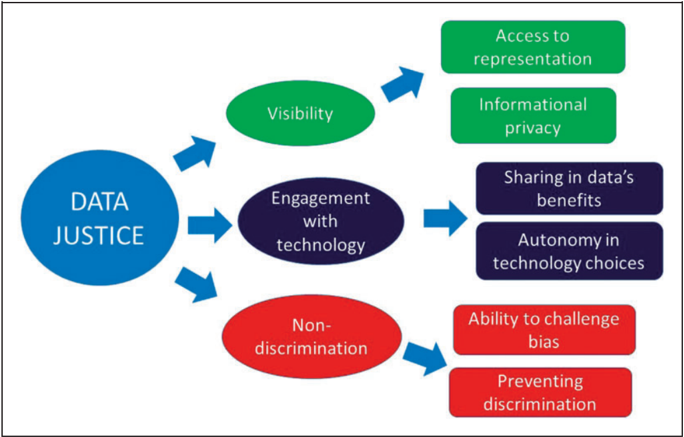
The increasing availability of digital data reflecting economic and human development, and in particular the availability of data emitted as a by-product of people’s use of technological devices and services, has both political and practical implications for the way people are seen and treated by the state and by the private sector. Yet the data revolution is so far primarily a technical one: the power of data to sort, categorise and intervene has not yet been explicitly connected to a social justice agenda by the agencies and authorities involved. Meanwhile, although data-driven discrimination is advancing at a similar pace to data processing technologies, awareness and mechanisms for combating it are not. This paper posits that just as an idea of justice is needed in order to establish the rule of law, an idea of data justice – fairness in the way people are made visible, represented and treated as a result of their production of digital data – is necessary to determine ethical paths through a datafying world. Bringing together the emerging scholarly perspectives on this topic, I propose three pillars as the basis of a notion of international data justice: (in)visibility, (dis)engagement with technology and antidiscrimination. These pillars integrate positive with negative rights and freedoms, and by doing so challenge both the basis of current data protection regulations and the growing assumption that being visible through the data we emit is part of the contemporary social contract.
Overview
The claims and statistics of this paper haven’t been checked yet.
Free: it reads the open-access text and checks the first 5 claims that cite a source we can check. Create a free account to check every claim.
Integrity signals
Registry
Cites
Statistics
Figures

Verification
Claims the paper makes
The claims and statistics of this paper haven’t been checked yet.
Free: it reads the open-access text and checks the first 5 claims that cite a source we can check. Create a free account to check every claim.
Claims other papers make about this one
Each is checked against this paper’s own text: does it say what the citing paper says it does?
The cited source says what the claim attributes to it.
In the citing paper
“It stresses the importance of developing individual freedoms in relation to how data are used and collected and advocates for enhanced autonomy and agency: people should be able to decide whether they want to participate in this system.”
From Staring Back at the Surveillance Gaze: The Resistance of LGBTQ+ Users on Social Media (2026) · cites this paper as Taylor 2017
The cited source says what the claim attributes to it.
In the citing paper
“Data justice frameworks are particularly invested in understanding the impacts, both negative and positive, of datafication and identifying ways to address them.”
From Staring Back at the Surveillance Gaze: The Resistance of LGBTQ+ Users on Social Media (2026) · cites this paper as Taylor 2017
The check wasn’t confident either way, so it gives no verdict — never disputed.
In the citing paper
“Because of this, the topic of data quality is beginning to transcend beyond the field of data management and into the realm of Human Computer Interaction (HCI), which accommodates holistic considerations such as how people search for relevant datasets [42], how developers perceive data work [64] and the best ways of using crowdsourcing to generate, evaluate or label data [71].”
From A Survey of Data Quality Requirements That Matter in ML Development Pipelines (2023) · cites this paper as [71]
Experimental — accuracy not yet measuredIn the citing paper
“Linnet Taylor (2017) advocates for a data justice framework acknowledging that, while there is a rapid development of data processing technologies, there is a lack of considerations of how datafication plays into broader social justice issues.”
From Staring Back at the Surveillance Gaze: The Resistance of LGBTQ+ Users on Social Media (2026) · cites this paper as Taylor 2017
In the citing paper
“For Taylor (2017), data justice revolves around three pillars: visibility, digital (dis)engagement, and countering data-driven discrimination.”
From Staring Back at the Surveillance Gaze: The Resistance of LGBTQ+ Users on Social Media (2026) · cites this paper as Taylor 2017
Self-check
Percentages, sums and reported differences re-computed from the paper’s own numbers.
The self-check needs the paper’s full text.
Citations
Cites
Clapp, J., & Sen, A. (1999) · International Journal Canada s Journal of Global Policy Analysis · doi:10.1177/002070200005500119 · Cited by 13,507
Clapp, J., & Sen, A. (1999) · International Journal · doi:10.2307/40203469 · Cited by 13,411
Sorting Things Out: Classification and Its Consequences
Bowker, G. C., & Star, S. L. (1999) · doi:10.7551/mitpress/6352.001.0001 · Cited by 6,188
(1993) · Oxford University Press eBooks · doi:10.1093/0198287976.001.0001 · Cited by 4,239
Toward a Field of Intersectionality Studies: Theory, Applications, and Praxis
Cho, S., Crenshaw, K. W., & McCall, L. (2013) · Signs: Journal of Women in Culture and Society · doi:10.1086/669608 · Cited by 4,126 · cited 2×
“This intersectionality (Cho et al., 2013) in the effects of datafication is an important component of the argument for a social justice perspective.”
BackgroundDoyle, T. (2017) · The Information Society · doi:10.1080/01972243.2017.1354593 · Cited by 3,071 · cited 3×
“O’Neil (2016) has warned that algorithmic models must be constantly recalibrated using feedback from the events they are supposed to predict.”
BackgroundNew York University Law Review
Rawls, J. (2017) · Justice · doi:10.4324/9781315193496-11 · Cited by 2,872
Lemke, T. (2001) · Economy and Society · doi:10.1080/03085140120042271 · Cited by 2,043 · cited 2×
“…designed to assure that people are not misusing state welfare funds and other publicly funded support are part of the apparatus of governmentality (Lemke, 2001); data-driven law enforcement focuses unequally on poor neighbourhoods which experience certain types of criminality (O’Neil, 2016); and…”
BackgroundSen, A. (2005) · Journal of Human Development · doi:10.1080/14649880500120491 · Cited by 1,966 · cited 5×
“Many states and regions, for example, take a perspective on rights that frames them as inseparable from corresponding duties, and also addresses the individual as part of the larger collective (Sen, 2005).”
BackgroundInfluentialLevin, K., Cashore, B., Bernstein, S., & Auld, G. (2012) · Policy Sciences · doi:10.1007/s11077-012-9151-0 · Cited by 1,839
Research works printed but not linked: 19
- Alkire S (2011) The capability approach and human development. University of Oxford. Available at: http://www.ophi. org.uk/wp-content/uploads/OPHI-HDCA-SS11-Intro-tothe-Capability-Approach-SA.pdf (accessed 23 June 2017).
- Arora P (2016) Bottom of the data pyramid: Big data and the global south. International Journal of Communication 10: 19.
- Eubanks V (2014) Want to predict the future of surveillance? Ask poor communities. The American Prospect , pp. 1-4. Available at: http://prospect.org/article/want-predict-futuresurveillance-ask-poor-communities#.VXbsO\_Oh2k8.twitter (accessed 9 October 2017).
- Foucault M (1977) Discipline & punish -Panopticism. Discipline and Punish: The Birth of the Prison. New York: Vintage, pp. 195-228.
- Holvast J (2013) De Volkstelling van 1971 . Amsterdam: Uitgeverij Paris.
- Jayaram M (2014) India's big brother project. Boston Review . Available at: http://www.bostonreview.net/world/malavika-jayaram-india-unique-identification-biometrics (accessed 1 January 2016).
- Kroll JA, et al. (2016) Accountable algorithms. University of Pennsylvania Law Review 165(633): 633-705.
- Makulilo AB (2016) ''A person is a person through other persons'' - A critical analysis of privacy and culture in Africa, Beijing Law Review 7: 192-204.
- Masiero S (2016) Digital governance and the reconstruction of the Indian anti-poverty system. Oxford Development Studies 818: 1-16.
- Nussbaum MC (2006) Frontiers of Justice: Disability, Nationality, and Species Membership . Cambridge, MA: Harvard University Press.
- O'Neil C (2016) Weapons of Math Destruction: How Big Data Increases Inequality and Threatens Democracy . New York: Crown Publishing Group.
- Raymond NA (2016) Beyond ''do no harm'' and individual consent: Reckoning with the emerging ethical challenges of civil society's use of data. In: Taylor L, Floridi L and van der Sloot B (eds) Group Privacy: New Challenges of Data Technologies . Springer International, pp. 67-82.
- Shearmur R (2015) Dazzled by data: Big Data, the census and urban geography. Urban Geography 36(7): 965-968.
- Spivak GC (1988) Can the subaltern speak? In: Nelson C and Grossberg L (eds) Marxism and the Interpretation of Culture . University of Illinois Press, pp. 271-313.
- Taylor L (2016a) From zero to hero: How zero-rating became a debate about human rights. IEEE Internet Computing 20(4): 79-83.
- Taylor L (2016b) No place to hide? The ethics and analytics of tracking mobility using mobile phone data. Environment and Planning D: Society and Space 34(2): 319-336.
- Taylor L (2016c) Safety in numbers? Group privacy and big data analytics in the developing world. Group Privacy: New Challenges of Data Technologies . Dordrecht: Springer.
- Taylor L (2016d) The ethics of big data as a public good: Which public? Whose good? Philosophical Transactions of the Royal Society A 374: 1-13.
- Taylor L and Broeders D (2015) In the name of development: Power, profit and the datafication of the global South. Geoforum 64(4): 229-237.
Cited by
(2019) · doi:10.1080/1369118x.2019.1573914 · Cited by 719
“2016); the developing area of “data justice,” which seeks to transcend the focus on individual harms wrought by various data-driven systems and instead apply holistic principles of social justice at a broader level (Dencik, Hintz, and Cable 2016; Taylor 2017).”
BackgroundThe Politics of Digital Agricultural Technologies: A Preliminary Review
Rotz, S., Duncan, E., Small, M., Botschner, J., Dara, R., Mosby, I., Reed, M., & Fraser, E. D. G. (2019) · Sociologia Ruralis · doi:10.1111/soru.12233 · Cited by 455
Social Media and Democracy: The State of the Field, Prospects for Reform
(2020) · Cambridge University Press eBooks · doi:10.1017/9781108890960 · Cited by 295
China's Social Credit System: An Evolving Practice of Control
Creemers, R. (2018) · SSRN Electronic Journal · doi:10.2139/ssrn.3175792 · Cited by 377
Social Media, Echo Chambers, and Political Polarization
Barberá, P. (2020) · Social Media and Democracy · doi:10.1017/9781108890960.004 · Cited by 373
Emerging models of data governance in the age of datafication
Micheli, M., Ponti, M., Craglia, M., & Berti Suman, A. (2020) · Big Data & Society · doi:10.1177/2053951720948087 · Cited by 332
“…decision-making, nudging and manipulation, and privacy violations are increasingly highlighted by research (e.g., Beer, 2017; Kitchin, 2017; Taylor, 2017), while scandals such as Cambridge Analytica raise the awareness among public opinion and policy makers, at least in Europe, that the…”
BackgroundExploring Data Justice: Conceptions, Applications and Directions
Dencik, L., Hintz, A., Redden, J., & Treré, E. (2019) · Information, Communication & Society · doi:10.1080/1369118x.2019.1606268 · Cited by 300
“…has, in some interpretations, led to new articulations of principles to underpin data governance that can better account for such inequalities (Heeks, 2017; Taylor, 2017), or practices in the handling of data that make asymmetries in the representation and power of data explicit (Johnson, 2018).”
BackgroundThe rising trend of Metaverse in education: challenges, opportunities, and ethical considerations
Kaddoura, S., & Al Husseiny, F. (2023) · PeerJ Computer Science · doi:10.7717/peerj-cs.1252 · Cited by 251
“Whatever the case, algorithmic governance involves unfairness and inequity that replicate data justice issues (Dencik, Hintz & Cable, 2016; Taylor, 2017) across various demographics (Benjamin, 2019; Noble, 2018) with potentially harmful outcomes.”
BackgroundMisinformation, Disinformation, and Online Propaganda
Guess, A. M., & Lyons, B. A. (2020) · Social Media and Democracy · doi:10.1017/9781108890960.003 · Cited by 284
Big Data and discrimination: perils, promises and solutions. A systematic review
Favaretto, M., De Clercq, E., & Elger, B. S. (2019) · Journal of Big Data · doi:10.1186/s40537-019-0177-4 · Cited by 184
“2017 [60], Taylor 2017 [79], Voigt 2017 [85] 3.”
BackgroundInfluentialKitchin, R. (2020) · Space and Polity · doi:10.1080/13562576.2020.1770587 · Cited by 214
“As with algorithmic governance in general, this unevenness and inequity is reproducing data justice issues (Dencik et al., 2016; Taylor, 2017) across class, race, ethnicity and gender (Benjamin, 2019; Eubanks, 2018; Noble, 2018) with potentially lethal”
BackgroundWhen digital health meets digital capitalism, how many common goods are at stake?
Sharon, T. (2018) · Big Data & Society · doi:10.1177/2053951718819032 · Cited by 183
“These values are the focus of the growing body of literature in critical data studies that draws on a political economy critique to address the development of new power asymmetries and discriminations emerging in Big Data infrastructures (Taylor, 2017; van Dijk, 2014; Zuboff, 2015).”
BackgroundEthics and diversity in artificial intelligence policies, strategies and initiatives
Roche, C., Wall, P. J., & Lewis, D. (2023) · AI and Ethics · doi:10.1007/s43681-022-00218-9 · Cited by 179
“The idea of data justice, as advanced by Taylor, which considers “ fairness in the way people are made visible, represented and treated as a result of their production of digital data ” [58, p. 1], is an evolving determination of ethical paths through a datafied landscape.”
BackgroundJhaver, S., Appling, D. S., Gilbert, E., & Bruckman, A. (2019) · Proceedings of the ACM on Human-Computer Interaction · doi:10.1145/3359294 · Cited by 139
“Each of these frameworks emphasize different sets of normative principles, ranging from rights-based legal approaches [32] and American civil rights law [16] to principles of social justice [35, 81, 83].”
BackgroundDecentering technology in discourse on discrimination
Peña Gangadharan, S., & Niklas, J. (2019) · Information, Communication & Society · doi:10.1080/1369118x.2019.1593484 · Cited by 104
“tice, scholars appeal to frameworks for wellbeing, to post-structural influenced theories of justice, and to constructivist understandings of technology (as always value-laden) (Dencik, Hintz, & Cable, 2016; Heeks & Renken, 2016; Johnson, 2014; Taylor, 2017).”
BackgroundMarcinkowski, F., Kieslich, K., Starke, C., & Lünich, M. (2020) · Proceedings of the 2020 Conference on Fairness, Accountability, and Transparency · doi:10.1145/3351095.3372867 · Cited by 159
“In Germany, for example, children of workers could be denied access to higher education simply because they are currently un-derrepresented at universities compared to middle-class children [6,20,35].”
BackgroundLearning Like a State: Statecraft in the Digital Age
Fourcade, M., & Gordon, J. (2020) · Journal of Law and Political Economy · doi:10.5070/lp61150258 · Cited by 149
Bibri, S. E., & Allam, Z. (2022) · Computational Urban Science · doi:10.1007/s43762-022-00050-1 · Cited by 180
“Regardless, algorithmic governance involves une-venness and inequity which reproduce data justice issues (Dencik et al., 2016; Taylor, 2017) across different demo-graphics (Benjamin, 2019; Noble, 2018) with potentially harmful consequences.”
BackgroundDiscrimination, artificial intelligence, and algorithmic decision-making
Borgesius, F. Z. (2025) · arXiv · doi:10.48550/arxiv.2510.13465 · Cited by 152
New but for whom? Discourses of innovation in precision agriculture
Duncan, E., Glaros, A., Ross, D. Z., & Nost, E. (2021) · Agriculture and Human Values · doi:10.1007/s10460-021-10244-8 · Cited by 174
“…broader questions around food production reform, including data justice for producers, defined as “fairness in the way people are made visible, represented, and treated as a result of their production of digital data” (Taylor 2017, p. 1; Fraser 2018; Bronson 2019; Lioutas and Charatsari 2020).”
BackgroundBibri, S. E., Allam, Z., & Krogstie, J. (2022) · Computational Urban Science · doi:10.1007/s43762-022-00051-0 · Cited by 156
“Algorithmic governance involves unevenness and inequity which reproduce data justice issues (Dencik et al., 2016; Taylor, 2017) across different demographics (Benjamin, 2019; Noble, 2018) with potentially harmful consequences.”
BackgroundDatafication, development and marginalised urban communities: an applied data justice framework
Heeks, R., & Shekhar, S. (2019) · Information, Communication & Society · doi:10.1080/1369118x.2019.1599039 · Cited by 130
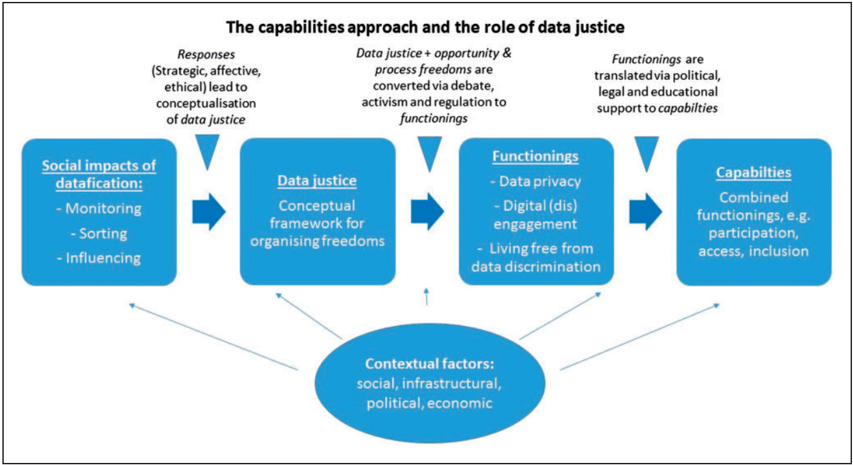
“This has been conceptualised from a capabilities perspective (Heeks & Renken, 2018; Taylor, 2017).”
BackgroundFit for purpose? The GDPR and the governance of European digital health
Marelli, L., Lievevrouw, E., & Van Hoyweghen, I. (2020) · Policy Studies · doi:10.1080/01442872.2020.1724929 · Cited by 137
Big Data, Big Waste? A Reflection on the Environmental Sustainability of Big Data Initiatives
Lucivero, F. (2020) · Science and Engineering Ethics · doi:10.1007/s11948-019-00171-7 · Cited by 136
“…insight into the situatedness and material substance of data centres (Burrington 2014; Hogan and Vonderau 2019; Holt and Vonderau 2015; Hu 2015; Taylor 2017a; Vonderau 2017) Besides highlighting the environmental implications of the materially heavy infrastructure that enables the data…”
BackgroundSocial equity in the data era: A systematic literature review of data‐driven public service research
Ruijer, E. H. J. M., Porumbescu, G. A., Porter, R., & Piotrowski, S. J. (2022) · Public Administration Review · doi:10.1111/puar.13585 · Cited by 153
Bibri, S. E., & Allam, Z. (2022) · Smart Cities · doi:10.3390/smartcities5020037 · Cited by 140
“Regardless, algorithmic governance involves unevenness and inequity, which reproduce data justice issues [48,49] across different demographics [50,51] with potentially harmful consequences.”
BackgroundSocial media and microtargeting: Political data processing and the consequences for Germany
Papakyriakopoulos, O., Hegelich, S., Shahrezaye, M., & Serrano, J. C. M. (2018) · Big Data & Society · doi:10.1177/2053951718811844 · Cited by 113
“, 2017), autonomy of the subject on having control of their own personal data (McDermott, 2017), and (in)visibility: the right of the subject to choose if and to know how personal data might be collected and used (Taylor, 2017), are stated as necessary for supporting someone’s privacy.”
BackgroundHelberger, N., Araujo, T., & de Vreese, C. H. (2020) · Computer Law & Security Review · doi:10.1016/j.clsr.2020.105456 · Cited by 118
Rethinking corporate governance in the digital economy: The role of stewardship
Sama, L. M., Stefanidis, A., & Casselman, R. M. (2021) · Business Horizons · doi:10.1016/j.bushor.2021.08.001 · Cited by 146
The growing ubiquity of algorithms in society: implications, impacts and innovations
Olhede, S. C., & Wolfe, P. J. (2018) · Philosophical Transactions of the Royal Society A: Mathematical, Physical and Engineering Sciences · doi:10.1098/rsta.2017.0364 · Cited by 120
“The public debate includes examples with disparate impacts in low- and middleincome countries [90,91], and clearly our understanding of global data flows and their impacts is still in its infancy.”
BackgroundExplainable Artificial Intelligence (XAI) in Insurance
Owens, E., Sheehan, B., Mullins, M., Cunneen, M., Ressel, J., & Castignani, G. (2022) · Risks · doi:10.3390/risks10120230 · Cited by 184
“The personal data of EU citizens is described as a fundamental right by the EU Charter of Fundamental Rights and has been addressed since 1995 by the Data Protection Directive (Taylor 2017; Yeung et al. 2019).”
BackgroundArora, P. (2019) · Television & New Media · doi:10.1177/1527476418806092 · Cited by 103
Data Matters: The Politics and Practices of Digital Border and Migration Management
Leese, M., Noori, S., & Scheel, S. (2021) · Geopolitics · doi:10.1080/14650045.2021.1940538 · Cited by 152
“In light of these questions it is no coincidence that feminist thought constitutes a central source of inspiration for research on data justice (Dencik et al. 2019; Taylor 2017).”
BackgroundVera, L. A., Walker, D., Murphy, M., Mansfield, B., Siad, L. M., Ogden, J., & EDGI (2019) · Information, Communication & Society · doi:10.1080/1369118x.2019.1596293 · Cited by 111
“Similarly, Linnet Taylor (2017) uses an ecosystemic ‘capabilities approach’ to justice, bridging three pillars into which DJ scholarship tends to separate: (in)visibility, (dis)engagement, and (anti)discrimination; her approach recognizes the impacts, responses, functionings, and capabilities of…”
MethodData inequalities and why they matter for development
Cinnamon, J. (2020) · Information Technology for Development · doi:10.1080/02681102.2019.1650244 · Cited by 109
“…self-determination, and ethics (e.g. Cinnamon, 2017; Crawford & Schultz, 2014; Dencik, Hintz, & Cable, 2016; Heeks & Renken, 2018; Shaw & Graham, 2017; Taylor, 2017; Zubo ff , 2016; Zwitter, 2014), building from research in law, surveillance studies, and information science (Du ff , 2006; Dwork &…”
Siegel, A. A. (2020) · Social Media and Democracy · doi:10.1017/9781108890960.005 · Cited by 99
Andrus, M., Spitzer, E., Brown, J., & Xiang, A. (2021) · Proceedings of the 2021 ACM Conference on Fairness, Accountability, and Transparency · doi:10.1145/3442188.3445888 · Cited by 111
“Similar to this work, important contributions emerging from various academic fields and activist communities on the issue of justice in data use interrogate when and where it is acceptable to collect what types of data and what degree of control data subjects should have over their data thereafter [17, 22, 60, 64, 66,…”
BackgroundData infrastructure studies on an unequal planet
Brodie, P. (2023) · Big Data & Society · doi:10.1177/20539517231182402 · Cited by 135
“…a glossary definition expresses the core issues, resonating with scholarly advocacy of data sovereignty (Rodriguez-Lonebear, 2016) and data justice (Taylor, 2017), data colonialism is put simply “the process by which governments, nongovernmental organizations and corporations claim ownership of…”
BackgroundInfluentialDatafying anti-poverty programmes: implications for data justice
Masiero, S., & Das, S. (2019) · Information, Communication & Society · doi:10.1080/1369118x.2019.1575448 · Cited by 103
“Theories of data justice , meaning ‘ fairness in the way people are made visible, represented and treated as a result of their production of digital data ’ (Taylor, 2017, p. 1), are relevant to illuminate the implications of data fi cation for anti-poverty programme recipients.”
BackgroundChild Data Citizen: How Tech Companies Are Profiling Us from before Birth
Barassi, V. (2020) · The MIT Press eBooks · doi:10.7551/mitpress/12415.001.0001 · Cited by 72
Datafication, dataveillance, and the social credit system as China’s new normal
Lee, C. S. (2019) · Online Information Review · doi:10.1108/oir-08-2018-0231 · Cited by 123
The chilling effects of algorithmic profiling: Mapping the issues
Büchi, M., Fosch-Villaronga, E., Lutz, C., Tamò-Larrieux, A., Velidi, S., & Viljoen, S. (2020) · Computer Law & Security Review · doi:10.1016/j.clsr.2019.105367 · Cited by 97
“…and affected by profiling activities, then they need to look for other (legal) remedies to address these challenges, such as non-discrimination law ( Schreurs et al., 2008 ; Schermer, 2011 ; Le Métayer and Le Clainche, 2012 ; Custers et al., 2013 ; Mantelero, 2014 ; Taylor, 2017 ; EU FRA 2018 ).”
BackgroundAt the Tensions of South and North: Critical Roles of Global South Stakeholders in AI Governance
Png, M.-T. (2022) · 2022 ACM Conference on Fairness Accountability and Transparency · doi:10.1145/3531146.3533200 · Cited by 85
“Non-state actors provide the body of a “political economy of resistance” - a subset of which has been described as "data activism" [53 ; 107 ; 52] - ranging from back-engineering statistical models [108] and advocacy for facial recognition moratoriums, to applying strategic litigation and co-developing policy proposal…”
BackgroundBetween surveillance and recognition: Rethinking digital identity in aid
Weitzberg, K., Cheesman, M., Martin, A. K., & Schoemaker, E. (2021) · Big Data & Society · doi:10.1177/20539517211006744 · Cited by 124
“We encourage scholars inspired by notions of ‘data justice’ (Taylor, 2017) to examine ‘emic’ responses to identity systems, and the dynamics underpinning data subjects’ everyday exercises of agency.”
BackgroundData justice and biodiversity conservation
Pritchard, R., Sauls, L. A., Oldekop, J. A., Kiwango, W. A., & Brockington, D. (2022) · Conservation Biology · doi:10.1111/cobi.13919 · Cited by 93
“And third, this distance combined with the increasing complexity of the analytical techniques applied to data means it is harder for data subjects to understand data use, recognize when there is bias, and challenge harmful misrepresentations (Taylor, 2017).”
BackgroundGlobal Digital Cultures: Perspectives from South Asia
Punathambekar, A., & Mohan, S. (2018) · University of Michigan Press eBooks · doi:10.3998/mpub.9561751 · Cited by 124
Exclusion and inclusion in identification: regulation, displacement and data justice
Martin, A. K., & Taylor, L. (2020) · Information Technology for Development · doi:10.1080/02681102.2020.1811943 · Cited by 117
“This approach (Heeks & Renken, 2018; Taylor, 2017) suggests that we need to bring together different bodies of theory to understand the implications of new practices of identification for affected people.”
BackgroundSelf-citationDigital earth: yesterday, today, and tomorrow
Annoni, A., Nativi, S., Çöltekin, A., Desha, C., Eremchenko, E. N., Gevaert, C. M., Giuliani, G., Chen, M., Perez-Mora, L., Strobl, J., et al. (2023) · International Journal of Digital Earth · doi:10.1080/17538947.2023.2187467 · Cited by 101
A Survey of Data Quality Requirements That Matter in ML Development Pipelines
Priestley, M., O’donnell, F., & Simperl, E. (2023) · Journal of Data and Information Quality · doi:10.1145/3592616 · Cited by 86
“However, data justice addresses inequalities in the way people are represented and treated as a result of the data that they emit [69].”
BackgroundDatafied Citizens in the Age of Coerced Digital Participation
Barassi, V. (2019) · Sociological Research Online · doi:10.1177/1360780419857734 · Cited by 121
Call, C. C., Eckstrand, K., Kasparek, S. W., Boness, C. L., Blatt, L. R., Jamal-Orozco, N. P., Novacek, D. M., Foti, D., & (SEED), S. F. E. E. A. D. (2022) · Perspectives on Psychological Science · doi:10.1177/17456916221137350 · Cited by 106
Calzada, I., Pérez-Batlle, M., & Montserrat, J. B. (2021) · Journal of Urban Affairs · doi:10.1080/07352166.2021.1994861 · Cited by 91
“In practical terms, human rights can be thought of as protection against standard threats—such as oppression, deprivation, and violence— that jeopardize human interests very much related to the notions of alienation and data justice (Taylor, 2017).”
BackgroundKrupiy, T. (2020) · Computer law & security review · doi:10.1016/j.clsr.2020.105429 · Cited by 96
Smart mobility, age and data justice
Sourbati, M., & Behrendt, F. (2020) · New Media & Society · doi:10.1177/1461444820902682 · Cited by 92
“, 2017), and shows the role data can play in marginalising individuals and groups – an issue of data justice (Taylor, 2017).”
BackgroundInfluentialNot all biases are bad: equitable and inequitable biases in machine learning and radiology
Pot, M., Kieusseyan, N., & Prainsack, B. (2021) · Insights into Imaging · doi:10.1186/s13244-020-00955-7 · Cited by 73
Smart cities: reviewing the debate about their ethical implications
Ziosi, M., Hewitt, B., Juneja, P., Taddeo, M., & Floridi, L. (2022) · AI & Society · doi:10.1007/s00146-022-01558-0 · Cited by 95
“Thus, smart cities must consider the impact of their technological deployments on the goal of data justice, or the fairness in the way people are made visible, or not, in their handling of digital data (Taylor 2017).”
BackgroundDigital identity for development: The quest for justice and a research agenda
Masiero, S., & Bailur, S. (2021) · Information Technology for Development · doi:10.1080/02681102.2021.1859669 · Cited by 68
Brown, M., & Klein, C. (2020) · The Journal of Higher Education · doi:10.1080/00221546.2020.1770045 · Cited by 64
“Institutions must make data extraction and use visible, ensure that students are able to control how they engage with technology, and work toward systems, policies, and networks that operate from a starting point of nondiscrimination (Prinsloo & Slade, 2015; Taylor, 2017).”
BackgroundInfluentialAitken, M., Toreini, E., Carmichael, P., Coopamootoo, K., Elliott, K., & van Moorsel, A. (2020) · Big Data & Society · doi:10.1177/2053951720908892 · Cited by 82
“The concept of SL was established as a means of addressing such injustices and as such may play an important role in ensuring data justice (Taylor, 2017).”
BackgroundDemocratic Transparency in the Platform Society
Gorwa, R., & Ash, T. G. (2020) · Social Media and Democracy · doi:10.1017/9781108890960.013 · Cited by 64
Assembling Accountability: Algorithmic Impact Assessment for the Public Interest
Moss, E., Watkins, E. A., Singh, R., Elish, M. C., & Metcalf, J. (2021) · doi:10.69985/rswq7227 · Cited by 61
Bozorgmehr, K., McKee, M., Muscat, N. A., Bartovic, J., Campos-Matos, I., Gerganova, T.-I., Hannigan, A., Janković, J., Kállayová, D., Kaplan, J., et al. (2023) · The Lancet Regional Health - Europe · doi:10.1016/j.lanepe.2023.100744 · Cited by 80
“Additionally, ethical concerns arise 62 regarding the potential misuse of data for non-health purposes, such as immigration enforcement.”
BackgroundMisinformation and Its Correction
Wittenberg, C., & Berinsky, A. J. (2020) · Social Media and Democracy · doi:10.1017/9781108890960.009 · Cited by 58
Raffaghelli, J. E. (2020) · Education Sciences · doi:10.3390/educsci10090233 · Cited by 92
“A number of authors have promoted ways to deal with the problem above, advocating for data justice [33], data activism [12], resistence and agency [34].”
BackgroundFostering the data welfare state: A Nordic perspective on datafication
Andreassen, R., Kaun, A., & Nikunen, K. (2021) · Nordicom review/NORDICOM review · doi:10.2478/nor-2021-0051 · Cited by 75
“Coming from a slightly different viewpoint, with a capabilities approach in mind, Taylor (2017) has introduced three pillars of data justice that partly coincide with the four pillars above.”
BackgroundAI in Global Health: The View from the Front Lines
Ismail, A., & Kumar, N. (2021) · Proceedings of the 2021 CHI Conference on Human Factors in Computing Systems · doi:10.1145/3411764.3445130 · Cited by 59
“Though such tools may leave ASHAs vulnerable to surveillance, it also indicates an opportunity to generate counter-data that questions dominant narratives, as proposed by feminist data scientists [70, 224].”
BackgroundTransforming land use governance: Global targets without equity miss the mark
McDermott, C. L., Montana, J., Bennett, A. E., Gueiros, C., Hamilton, R., Hirons, M. A., Maguire-Rajpaul, V. A., Parry, E., & Picot, L. E. (2022) · Environmental Policy and Governance · doi:10.1002/eet.2027 · Cited by 89
Ryan, M., Antoniou, J., Brooks, L., Jiya, T., Macnish, K., & Stahl, B. C. (2021) · Science and Engineering Ethics · doi:10.1007/s11948-021-00293-x · Cited by 80
“A key concern is that benefits will be reaped by powerful individuals and organisations, while the burden falls predominantly on poorer members of society (Taylor, 2017).”
BackgroundDencik, L., & Sanchez-Monedero, J. (2022) · Internet Policy Review · doi:10.14763/2022.1.1615 · Cited by 55
AI and the metaverse in the workplace: DEI opportunities and challenges
Marabelli, M., & Lirio, P. (2024) · Personnel Review · doi:10.1108/pr-04-2023-0300 · Cited by 74
Introduction: Gender, development and ICTs
O'Donnell, A. J., & Sweetman, C. (2018) · Gender & Development · doi:10.1080/13552074.2018.1489952 · Cited by 57
“But moreover – the concept of ‘ data justice ’ coined by Linnet Taylor (2017) speaks to bigger questions about how decisions are made, who is represented and whose voices are heard.”
BackgroundSchoemaker, E., Baslan, D., Pon, B., & Dell, N. L. (2020) · Information Technology for Development · doi:10.1080/02681102.2020.1785826 · Cited by 87
“We now draw on our analysis to explore what refugees ’ experiences of registration systems tell us about the outcome of these systems using Taylor (2017) theory of data justice.”
InfluentialThe Right to Have Digital Rights in Smart Cities
Calzada, I. (2021) · Sustainability · doi:10.3390/su132011438 · Cited by 65
“In practical terms, human rights can be thought of as protection against standard threats—such as oppression, deprivation, and violence—that jeopardize human interests very much related to the notion of alienation and data justice [44,85,93].”
Cross-cutting challenges to innovation in land tenure documentation
Lengoiboni, M., Richter, C., & Zevenbergen, J. A. (2019) · Land Use Policy · doi:10.1016/j.landusepol.2019.03.023 · Cited by 58
“Concerns regarding data and privacy protection, potential misuses and unanticipated uses of data, and the risks of visibility and commercialization of people’s data in the context of development (Heeks, 2016; Taylor, 2017) have recently found (renewed) resonance among the land surveying community (Georgiadou, 2017).”
BackgroundAI for Everyone? Critical Perspectives
(2021) · University of Westminster Press eBooks · doi:10.16997/book55 · Cited by 51
“This has, in some interpretations, led to articulations of principles to underpin data governance that can better account for such inequalities (Heeks 2017; Taylor 2017), or practices in the handling of data that make asymmetries in the representation and power of data explicit (Johnson 2018).”
How news media frame data risks in their coverage of big data and AI
Nguyen, D. (2023) · Internet Policy Review · doi:10.14763/2023.2.1708 · Cited by 78
Grassroots resource mobilization through counter-data action
Meng, A., & DiSalvo, C. (2018) · Big Data & Society · doi:10.1177/2053951718796862 · Cited by 51
“Using terms such as ‘‘data activism’’ (Schrock, 2016) and ‘‘data justice’’ (Taylor, 2017), scholars have argued that data can enable oppressed and disenchanted peoples to wield influence in situations that were previously difficult to shape and that data can offer a distinctive means for political action.”
BackgroundMethodInfluentialBehavioral Use Licensing for Responsible AI
Contractor, D., McDuff, D., Haines, J. K., Lee, J., Hines, C., Hecht, B., Vincent, N., & Li, H. (2022) · 2022 ACM Conference on Fairness Accountability and Transparency · doi:10.1145/3531146.3533143 · Cited by 54
“efforts to achieve “fairness in the way people are made visible, represented and treated as a result of their production of digital data” [60].”
BackgroundThe Inapplicability of Objectivity: Understanding the Work of Data Journalism
Tong, J., & Zuo, L. (2019) · Journalism Practice · doi:10.1080/17512786.2019.1698974 · Cited by 67
Embedding European values in data governance: a case for public data commons
Zygmuntowski, J. J., Zoboli, L., & Nemitz, P. (2021) · Internet Policy Review · doi:10.14763/2021.3.1572 · Cited by 69
Making global oceans governance in/visible with Smart Earth: The case of Global Fishing Watch
Drakopulos, L., Silver, J. J., Nost, E., Gray, N. J., & Hawkins, R. (2022) · Environment and Planning E Nature and Space · doi:10.1177/25148486221111786 · Cited by 54
“Transparency also begs the question of who and what is made more visible, and thus, power asymmetries emerge around rights to visibility and invisibility (Taylor, 2017; Vera et al., 2019).”
BackgroundHarnessing human and machine intelligence for planetary-level climate action
Debnath, R., Creutzig, F., Sovacool, B. K., & Shuckburgh, E. F. (2023) · npj Climate Action · doi:10.1038/s44168-023-00056-3 · Cited by 76
A Crisis of Opportunity: Market‐Making, Big Data, and the Consolidation of Migration as Risk
Taylor, L., & Meissner, F. (2019) · Antipode · doi:10.1111/anti.12583 · Cited by 63
“The use of migration data is a hard case which the project of global data justice (Taylor 2017) must address if it is to provide a meaningful framework for the progressive governance of data.”
BackgroundSelf-citationJust data? Solidarity and justice in data-driven medicine
Hummel, P., & Braun, M. (2020) · Life Sciences Society and Policy · doi:10.1186/s40504-020-00101-7 · Cited by 63
The sensor desert quandary: What does it mean (not) to count in the smart city?
Robinson, C., & Franklin, R. S. (2020) · Transactions of the Institute of British Geographers · doi:10.1111/tran.12415 · Cited by 66
Qureshi, S. (2020) · Information Technology for Development · doi:10.1080/02681102.2020.1736820 · Cited by 57
“This sentiment is echoed by many authours (Dencik et al., 2016; Heeks & Renken, 2018; Masiero & Das, 2019; McCarthy, 2016; Taylor, 2017; Thatcher, 2014; Zubo ff , 2015).”
BackgroundInfluentialLeonelli, S., Lovell, R., Wheeler, B. W., Fleming, L. E., & Williams, H. T. P. (2021) · Big Data & Society · doi:10.1177/20539517211010310 · Cited by 62
“…theory development, lack of sampling methods and justification, limited control over and information about data sources and difficulties in assessing the extent to which a given dataset is representative of a phenomenon of interest (Metcalf and Crawford, 2016, Taylor, 2017, Veale and Binns, 2017).”
BackgroundInfluentialData agency at stake: MyData activism and alternative frames of equal participation
Lehtiniemi, T., & Haapoja, J. (2019) · New Media & Society · doi:10.1177/1461444819861955 · Cited by 68
Data Journalism in favela : Made by, for, and about Forgotten and Marginalized Communities
de‐Lima‐Santos, M., & Mesquita, L. (2021) · Journalism Practice · doi:10.1080/17512786.2021.1922301 · Cited by 66
“In line with previous studies, data activism has political and practical implications for the way people are seen and treated by the state (Taylor 2017), echoing the activities promoted by data_labe.”
BackgroundResultInfluentialNa-Nan, K., Roopleam, T., & Wongsuwan, N. (2019) · Kybernetes · doi:10.1108/k-01-2019-0053 · Cited by 60
Citizen science as a data-based practice: A consideration of data justice
Christine, D. I., & Thinyane, M. (2021) · Patterns · doi:10.1016/j.patter.2021.100224 · Cited by 55
“The data justice concept builds from concerns regarding the adverse impacts of datafication on individuals and groups.(24,25) Framing citizen science from the data justice perspective provides a lens to identify the nature and diversity of social justice and the social injustice emanating from the data processes in ci…”
BackgroundData justice: social work and a more just future
Goldkind, L., Wolf, L., & LaMendola, W. F. (2021) · Journal of Community Practice · doi:10.1080/10705422.2021.1984354 · Cited by 47
“According to Taylor (2017), the “granular data sources which allow researchers to infer people’s movements, activities and behavior have ethical, political and practical implications for the way people are seen and treated” (p. 2).”
BackgroundInfluentialHealth data justice: building new norms for health data governance
Shaw, J., & Sekalala, S. R. (2023) · npj Digital Medicine · doi:10.1038/s41746-023-00780-4 · Cited by 59
Replika in the Metaverse: the moral problem with empathy in ‘It from Bit’
McStay, A. (2023) · AI and Ethics · doi:10.1007/s43681-022-00252-7 · Cited by 44
“Taylor [66] and Coeckelbergh [11] for example draw on African Ubuntu scholars, such as Mhlambi [44] and Makulilo [40], to expand ethical and human rights investigations, and foreground Ubuntu as means to a relational ethics (and to correct the lack of attention that African ethical 5 Other philosophers interested in f…”
BackgroundEthical aspects of AI use in the circular economy
Bashynska, I. (2025) · AI & Society · doi:10.1007/s00146-025-02436-1 · Cited by 61
“Moreover, the concept of “data justice” calls for examining how different social groups are differently impacted by the datafication of circular services, urging designers to consider inclusive and equitable governance frameworks (Taylor 2017; Heeks and Shekhar 2019).”
Paradoxes of Digital Disengagement: In Search of the Opt-Out Button
Kuntsman, A., & Miyake, E. (2022) · University of Westminster Press eBooks · doi:10.16997/book61 · Cited by 97
Rosenbaum, H. S., & Fichman, P. (2019) · Proceedings of the Association for Information Science and Technology · doi:10.1002/pra2.19 · Cited by 43
“One characteristic that is common to these approaches is that digital justice is not based on a foundation of individual rights because “ data injustice increasingly tends to occur on the collective level ” (Taylor, 2017, p. 8).”
BackgroundInfluentialShould we still be doing ICT4D research?
Masiero, S. (2022) · The Electronic Journal of Information Systems in Developing Countries · doi:10.1002/isd2.12215 · Cited by 63
“…(cf. Dencik et al., 2019; Taylor et al., 2020), the notion of data justice turns “ development ” on its head: from being the maker of a developmental technology transfer, the data governor is reframed as capable of injustice perpetrated through unilateral action on people's data (Taylor, 2017).”
BackgroundData justice and data solidarity
Braun, M., & Hummel, P. (2022) · Patterns · doi:10.1016/j.patter.2021.100427 · Cited by 49
“29 One central third challenge is how to establish clearly defined procedures to regulate how experiences of discrimination 15 that have been uncovered can and must be dealt with.”
BackgroundInfluentialKrishna, S. (2020) · Information Technology for Development · doi:10.1080/02681102.2020.1818544 · Cited by 57
Metadata
- Authors
- Taylor, L.
- Affiliations
- Tilburg University (NL)
- Corresponding author
- Taylor, Linnet
- ORCID
- Taylor, Linnet
- Venue
- Big Data & Society
- Publisher
- SAGE Publications
- Published
- 2017-11
- Volume
- 4
- Issue
- 2
- Pages
- 205395171773633
- ISSN
- 2053-9517 (ISSN-L)
- OpenAlex
- W2590124083
- Cited by
- 802
- References
- 38
- Citations by year
- 2026: 127 · 2025: 168 · 2024: 99 · 2023: 126 · 2022: 89 · 2021: 55 · 2020: 74 · 2019: 47 · 2018: 17
- FWCI
- 86.62
- Type
- journal article
- Language
- en
- Open access
- gold
- doi.org
- Licence
- cc-by-nc-nd
- journals.sagepub.com/page/policies/text-and-data-mining-license (tdm)
- Locations
- Big Data & Society (publishedVersion, cc-by-nc-nd)
- Tilburg University Research Portal (publishedVersion, other-oa)
- Research portal (Tilburg University) (submittedVersion, other-oa)
- Data Archiving and Networked Services (DANS) (submittedVersion, other-oa)
- DOAJ (DOAJ: Directory of Open Access Journals) (submittedVersion, cc-by-sa)
- EUR Research Repository (Erasmus University Rotterdam) (submittedVersion)
- Funders
- European Commission (624583)
- Universiteit van Amsterdam
- Topics
- Physical Sciences › Computer Science › Artificial Intelligence › Ethics and Social Impacts of AI
- Social Sciences › Law › Digitalization, Law, and Regulation
- Social Sciences › Business, Management and Accounting › Industrial relations › Legal and Labor Studies
- Keywords
- data justice, digital rights, internet freedom, datafication, visibility, anti-discrimination, data protection regulation, social justice, digital data, social contract
About these checks
Registry, retraction, Cites and statistics results are computed, not judged, with one exception: a printed reference that no index lists is read once by a model before it counts as a citation error. Claims are extracted by a model and kept only when their quote appears verbatim in the text; each cited source is then checked, with a model’s help, for whether it says what the claim relies on. Those verdicts can be wrong — read the claim’s quote and the cited source before relying on one.
Statistics and arithmetic are recomputed, not judged.
Confidence bands are shown only for fields calibrated on our annotated test set. None is calibrated yet, so no band is shown.
What counts as a claim ›How we measure confidence ›How we check this ›
Are you an author, or do you see a problem with this page? Request a review
Data sources
Bibliographic data: Semantic Scholar, OpenAlex, Crossref.
Contains information from the Semantic Scholar Academic Graph Datasets, made available under the ODC Attribution License (ODC-BY 1.0).
Semantic Scholar’s data is described in: Kinney, R., et al. (2023). The Semantic Scholar Open Data Platform. arXiv:2301.10140.
