

The DOI matches its Crossref record; 64 of the 64 references it cites were found in a registry or an index.
The impact of digital health interventions on health-related outcomes in the workplace: A systematic review
Open accessAbstract
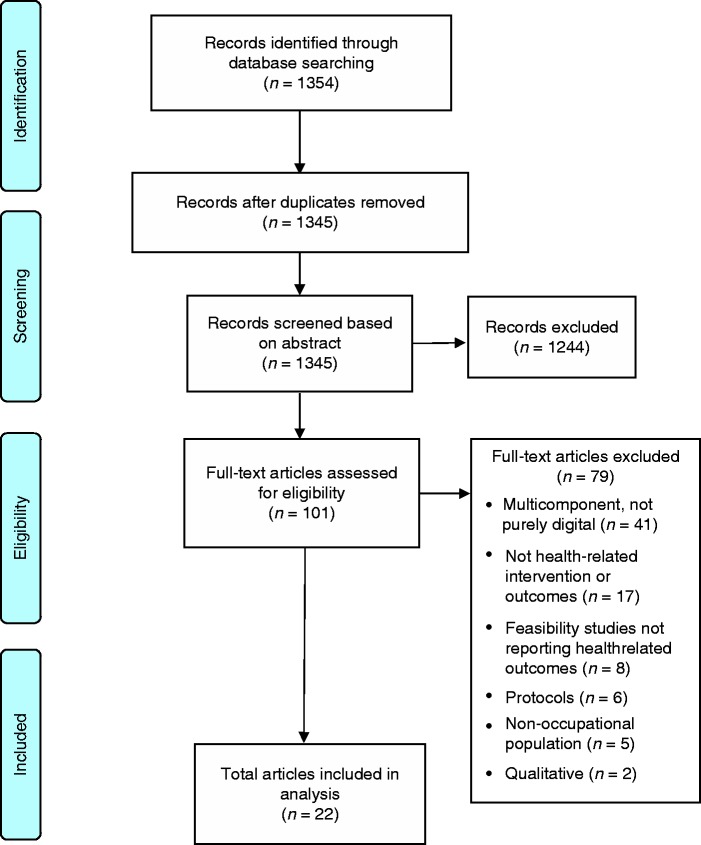
Background: The impact of employee health on productivity in the workplace is generally evidenced through absenteeism and presenteeism. Multicomponent worksite health programmes, with significant online elements, have gained in popularity over the last two decades, due in part to their scalability and low cost of implementation. However, little is known about the impact of digital-only interventions on health-related outcomes in employee groups. The aim of this systematic review was to assess the impact of pure digital health interventions in the workplace on health-related outcomes. Methods: Multiple databases, including MEDLINE, EMBASE, PubMed and PsycINFO, were used to review the literature using PRISMA guidelines. Results: Of 1345 records screened, 22 randomized controlled trial studies were found to be eligible. Although there was a high level of heterogeneity across these studies, significant improvements were found for a broad range of outcomes such as sleep, mental health, sedentary behaviours and physical activity levels. Standardized measures were not always used to quantify intervention impact. All but one study resulted in at least one significantly improved health-related outcome, but attrition rates ranged widely, suggesting sustaining engagement was an issue. Risk of bias assessment was low for one-third of the studies and unclear for the remaining ones. Conclusions: This review found modest evidence that digital-only interventions have a positive impact on health-related outcomes in the workplace. High heterogeneity impacted the ability to confirm what interventions might work best for which health outcomes, although less complex health outcomes appeared to be more likely to be impacted. A focus on engagement along with the use of standardized measures and reporting of active intervention components would be helpful in future evaluations.
Overview
The claims and statistics of this paper haven’t been checked yet.
Run the check — free, no account needed. It reads the open-access text and checks the sources it cites.
Integrity signals
Registry
Cites
Statistics
Figures
Verification
Claims the paper makes
The claims and statistics of this paper haven’t been checked yet.
Run the check — free, no account needed. It reads the open-access text and checks the sources it cites.
Claims other papers make about this one
Each is checked against this paper’s own text: does it say what the citing paper says it does?
The source backs part of the claim, not all of it — or backs it for a different population, condition or comparison.
In the citing paper
“These findings align with previous research39,40, underscoring the potential for digital tools in managing chronic conditions and providing a foundation for future innovations in this field.”
From Impact of digital health interventions on glycemic control and weight management. (2025) · cites this paper as [39]
Experimental — accuracy not yet measured
Self-check
Percentages, sums and reported differences re-computed from the paper’s own numbers.
The self-check needs the paper’s full text.
Citations
Cites
Preferred Reporting Items for Systematic Reviews and Meta-Analyses: the PRISMA statement
Moher, D., Liberati, A., Tetzlaff, J., Altman, D. G., & for the PRISMA Group (2009) · BMJ · doi:10.1136/bmj.b2535 · Cited by 83,823
Preferred Reporting Items for Systematic Reviews and Meta-Analyses: The PRISMA Statement
Moher, D., Liberati, A., Tetzlaff, J., Altman, D. G., & The PRISMA Group (2009) · PLoS Medicine · doi:10.1371/journal.pmed.1000097 · Cited by 64,042
The Cochrane Collaboration's tool for assessing risk of bias in randomised trials
Higgins, J. P. T., Altman, D. G., Gotzsche, P. C., Juni, P., Moher, D., Oxman, A. D., Savovic, J., Schulz, K. F., Weeks, L., Sterne, J. A. C., et al. (2011) · BMJ · doi:10.1136/bmj.d5928 · Cited by 33,817
Cochrane Handbook for Systematic Reviews of Interventions: Cochrane Book Series
(2008) · doi:10.1002/9780470712184 · Cited by 25,048
Dermyshi, E., Wang, Y., Yan, C., Hong, W., Qiu, G., Gong, X., & Zhang, T. (2017) · Neonatology · doi:10.1159/000454668 · Cited by 24,586
Wang, G., Ma, R., Qiao, G., Wada, K., Aizawa, Y., & Satoh, T. (2015) · Integrative Medicine International · doi:10.1159/000368408 · Cited by 18,762
The measurement of engagement and burnout: a two sample confirmatory factor analytic approach.
Schaufeli, W. B., Salanova, M., González-romá, V., & Bakker, A. B. (2002) · Journal of Happiness Studies · doi:10.1023/a:1015630930326 · Cited by 10,014
Michie, S., Richardson, M., Johnston, M., Abraham, C., Francis, J., Hardeman, W., Eccles, M. P., Cane, J., & Wood, C. E. (2013) · Annals of Behavioral Medicine · doi:10.1007/s12160-013-9486-6 · Cited by 7,629
The Validity and Reproducibility of a Work Productivity and Activity Impairment Instrument
Reilly, M. C., Zbrozek, A. S., & Dukes, E. M. (1993) · PharmacoEconomics · doi:10.2165/00019053-199304050-00006 · Cited by 3,071
Eysenbach, G. (2005) · Journal of Medical Internet Research · doi:10.2196/jmir.7.1.e11 · Cited by 2,524
Research works printed but not linked: 2
- 10.2196/jmir.9.2.e17 · DOI · Paper page
- 10.2196/jmir.3399 · DOI · Paper page
Cited by
Sorted by citations
The Handbook of Behavior Change
Hagger, M. S., Cameron, L. D., Hamilton, K., Hankonen, N. E., & Lintunen, T. (2020) · Cambridge University Press eBooks · doi:10.1017/9781108677318 · Cited by 446
Changing Behavior Using the Theory of Planned Behavior
Ajzen, I., & Schmidt, P. (2020) · Cambridge University Press eBooks · doi:10.1017/9781108677318.002 · Cited by 346
Buckingham, S. A., Williams, A. J., Morrissey, K., Price, L., & Harrison, J. (2019) · Digital Health · doi:10.1177/2055207619839883 · Cited by 202
“A recent review of general digital health interventions in the workplace concluded that the evaluation of smartphone apps in this context is an important ‘next step’ for future research.(28) Employee populations potentially have much to gain from mHealth interventions for PA and SB, yet little is known about the impac…”
BackgroundChanging Behavior Using the Model of Action Phases
Keller, L., Gollwitzer, P. M., & Sheeran, P. (2020) · The Handbook of Behavior Change · doi:10.1017/9781108677318.006 · Cited by 147
Digital Divide – Soziale Unterschiede in der Nutzung digitaler Gesundheitsangebote
Müller, A. C., Wachtler, B., & Lampert, T. (2020) · Bundesgesundheitsblatt - Gesundheitsforschung - Gesundheitsschutz · doi:10.1007/s00103-019-03081-y · Cited by 135
Gilbey, D., Morgan, H., Lin, A., & Perry, Y. (2020) · Journal of Medical Internet Research · doi:10.2196/20158 · Cited by 112
“This criterion was implemented because, in interventions that blend digital and human support, the impact of the intervention cannot be meaningfully attributed to the digital component alone [59].”
MethodChanging Behavior Using the Health Action Process Approach
Schwarzer, R., & Hamilton, K. (2020) · Cambridge University Press eBooks · doi:10.1017/9781108677318.007 · Cited by 114
Karamagi, H. C., Muneene, D., Droti, B., Jepchumba, V., Okeibunor, J., Nabyonga‐Orem, J., Asamani, J. A., Traoré, M., & Kipruto, H. (2022) · Journal of Global Health · doi:10.7189/jogh.12.04090 · Cited by 89
Weber, S., Lorenz, C., & Hemmings, N. (2019) · Frontiers in Psychology · doi:10.3389/fpsyg.2019.02745 · Cited by 74
Electronic Health Records: A Critical Appraisal of Strengths and Limitations
Kataria, S., & Ravindran, V. K. (2020) · The Journal of the Royal College of Physicians of Edinburgh · doi:10.4997/jrcpe.2020.309 · Cited by 84
Gardner, B., Rebar, A. L., & Lally, P. J. (2020) · Cambridge University Press eBooks · doi:10.1017/9781108677318.041 · Cited by 73
Assessing the Clinical Robustness of Digital Health Startups: Cross-sectional Observational Analysis
Day, S., Shah, V., Kaganoff, S., Powelson, S., & Mathews, S. C. (2022) · Journal of Medical Internet Research · doi:10.2196/37677 · Cited by 57
Changing Behavior Using Social Cognitive Theory
Łuszczyńska, A., & Schwarzer, R. (2020) · Cambridge University Press eBooks · doi:10.1017/9781108677318.003 · Cited by 81
Loughnane, C., Laiti, J., O’Donovan, R., & Dunne, P. J. (2025) · Frontiers in Digital Health · doi:10.3389/fdgth.2025.1536416 · Cited by 62
Moe-Byrne, T., Shepherd, J., Merecz-Kot, D., Sinokki, M., Naumanen, P., Hakkaart-van Roijen, L., & Van Der Feltz-Cornelis, C. (2022) · PLOS Digital Health · doi:10.1371/journal.pdig.0000123 · Cited by 55
“They explored the impact of digital interventions without further support from health professionals on health-related outcomes, and most of the interventions examined were not tailored to the individual employee [30,32,33].”
BackgroundWarner, L. M., & French, D. (2020) · Cambridge University Press eBooks · doi:10.1017/9781108677318.032 · Cited by 62
Changing Behavior Using Ecological Models
Salmon, J., Hesketh, K. D., Arundell, L., Downing, K. L., & Biddle, S. (2020) · Cambridge University Press eBooks · doi:10.1017/9781108677318.017 · Cited by 57
Waddell, A., Kunstler, B., Lennox, A., Pattuwage, L., Grundy, E. A. C., Tsering, D., Olivier, P. L., & Bragge, P. (2023) · Scandinavian Journal of Work Environment & Health · doi:10.5271/sjweh.4087 · Cited by 70
“Digital channels included websites containing health information, SMS and smart phone applications (45).”
BackgroundStara, V., Santini, S., Kropf, J., & D'Amen, B. (2020) · Journal of Medical Internet Research · doi:10.2196/17809 · Cited by 42
“Several studies demonstrated that technology can be very effective in promoting healthy lifestyles among older workers [23,29,39], but they often neglected the psychological and relational aspects of working in old age.”
BackgroundAssociation between Irregular Meal Timing and the Mental Health of Japanese Workers
Tahara, Y., Makino, S., Suiko, T., Nagamori, Y., Iwai, T., Aono, M., & Shibata, S. (2021) · Nutrients · doi:10.3390/nu13082775 · Cited by 48
“For implementing health management in workplaces, an integrated health intervention system should be developed with scientific evidence, including the results of this study [4].”
BackgroundEppes, E. V., Augustyn, M., Gross, S. J., Vernon, P., Caulfield, L. E., & Paige, D. M. (2022) · Journal of Medical Internet Research · doi:10.2196/40934 · Cited by 51
“Digital interventions are often low cost and relatively easy for public health organizations to implement compared with in-person interventions [8].”
Ponzo, S., Wickham, A. P., Bamford, R., Radović, T., Zhaunova, L., Peven, K., Klepchukova, A., & Payne, J. L. (2022) · Digital Health · doi:10.1177/20552076221145852 · Cited by 46
“Digital health interventions (DHI), such as internetbased resources and mobile apps, have become increasingly popular in the workplace due to their scalability, availability, and anonymity.(37,38) The latter aspect, anonymity, is particularly relevant for interventions addressing issues that are still surrounded by hi…”
BackgroundJoseph-Shehu, E. M., Ncama, B. P., Mooi, N. M., & Mashamba-Thompson, T. P. (2019) · BMJ Open · doi:10.1136/bmjopen-2019-029872 · Cited by 48
Cameron, G., Mulvenna, M. D., Ennis, E., O’Neill, S. M., Bond, R., Cameron, D., & Bunting, A. (2024) · JMIR Mental Health · doi:10.2196/67785 · Cited by 45
“Howarth et al [22] found that studies targeting one specific outcome, rather than multifactorial, were more effective.”
Changing Behavior Using Self-Determination Theory
Hagger, M. S., Hankonen, N. E., Chatzisarantis, N. L. D., & Ryan, R. M. (2020) · Cambridge University Press eBooks · doi:10.1017/9781108677318.008 · Cited by 67
Fischer, F. (2020) · Bundesgesundheitsblatt - Gesundheitsforschung - Gesundheitsschutz · doi:10.1007/s00103-020-03143-6 · Cited by 41
Impact of digital health interventions on glycemic control and weight management.
Veluvali, A., Dehghani Zahedani, A., Hosseinian, A., Aghaeepour, N., McLaughlin, T., Woodward, M., DiTullio, A., Hashemi, N., & Snyder, M. P. (2025) · npj Digital Medicine · doi:10.1038/s41746-025-01430-7 · Cited by 45
Planning and Implementation Intention Interventions
Rhodes, R. E., Grant, S. J., & de Bruijn, G. (2020) · Cambridge University Press eBooks · doi:10.1017/9781108677318.039 · Cited by 46
Attitudes and Persuasive Communication Interventions
Hamilton, K., & Johnson, B. T. (2020) · Cambridge University Press eBooks · doi:10.1017/9781108677318.031 · Cited by 44
Changing Behavior Using Habit Theory
Orbell, S., & Verplanken, B. (2020) · Cambridge University Press eBooks · doi:10.1017/9781108677318.013 · Cited by 50
Changing Behavior: A Theory- and Evidence-Based Approach
Hagger, M. S., Cameron, L. D., Hamilton, K., Hankonen, N. E., & Lintunen, T. (2020) · Cambridge University Press eBooks · doi:10.1017/9781108677318.001 · Cited by 47
Tarrant, M., Haslam, C., Carter, M., Calitri, R., & Haslam, S. A. (2020) · Cambridge University Press eBooks · doi:10.1017/9781108677318.044 · Cited by 38
Cunningham, A. C., Prentice, C., Peven, K., Wickham, A. P., Bamford, R., Radović, T., Klepchukova, A., Fomina, M., Cunningham, K., Hill, S. E., et al. (2024) · JMIR mhealth and uhealth · doi:10.2196/54124 · Cited by 41
“…that the observed improvements in health and well-being may have been driven by interaction with community-based tools such as Flo’s Secret Chats, which could help individuals normalize their menstrual cycle experiences and decrease feelings of loneliness or social exclusion [29,30,33,73,74].”
BackgroundMethodInfluentialChanging Behavior Using Integrated Theories
Hagger, M. S., & Hamilton, K. (2020) · Cambridge University Press eBooks · doi:10.1017/9781108677318.015 · Cited by 44
Paganin, G., & Simbula, S. (2021) · International Journal of Environmental Research and Public Health · doi:10.3390/ijerph18179366 · Cited by 37
Changing Behavior Using the Transtheoretical Model
DiClemente, C. C., & Graydon, M. M. (2020) · Cambridge University Press eBooks · doi:10.1017/9781108677318.010 · Cited by 35
Murei, A., Kamika, I. A., & Momba, M. N. B. (2023) · The Science of The Total Environment · doi:10.1016/j.scitotenv.2023.167484 · Cited by 31
Blake, H., Lai, B., Coman, E., Houdmont, J., & Griffiths, A. (2019) · International Journal of Environmental Research and Public Health · doi:10.3390/ijerph16183451 · Cited by 32
“There is modest evidence that digital-only interventions have a positive impact on health-related outcomes in the workplace; a review of 22 randomised controlled trials showed that significant improvements were found for a broad range of health outcomes including SB and PA levels [29].”
BackgroundResultMänttäri, S. K., Oksa, J., Lusa, S., Korkiakangas, E. E., Punakallio, A., Oksanen, T., & Laitinen, J. H. (2020) · Scandinavian Journal of Public Health · doi:10.1177/1403494820917532 · Cited by 31
“Wearable technology, such as activity monitors or fitness trackers, was not used in enhancing work ability by increasing PA although interventions using computer, mobile and wearable technologies appear to be effective in improving health and reducing sedentary behaviour [41].”
BackgroundChanging Behavior Using the Health Belief Model and Protection Motivation Theory
Orbell, S., Zahid, H., & Henderson, C. J. (2020) · Cambridge University Press eBooks · doi:10.1017/9781108677318.004 · Cited by 35
E-Mentoring to Address Youth Health: A Systematic Review
Kaufman, M. R., Levine, D., Casella, A., & DuBois, D. L. (2021) · Adolescent Research Review · doi:10.1007/s40894-021-00172-3 · Cited by 30
“Research referenced in chapters and prior literature reviews pertinent to e-mentoring were also reviewed for potential relevance (Howarth et al., 2018; Lindsay et al., 2018).”
Lee, V. V., Vijayakumar, S., Ng, W. Y., Lau, N. Y., Leong, Q. Y., Ooi, D. S. Q., Su, L. L., Lee, Y. S., Chan, S., Blasiak, A., et al. (2023) · npj Digital Medicine · doi:10.1038/s41746-023-00924-6 · Cited by 30
“Among nonclinical populations, DHIs have been shown to facilitate healthy behavior change in a variety of domains, including sleep, physical activity, diet and tobacco use 6 – 8 .”
The Physical Activity Wearables in the Police Force (PAW-Force) study: acceptability and impact
Buckingham, S. A., Morrissey, K., Williams, A. J., Price, L., & Harrison, J. (2020) · BMC Public Health · doi:10.1186/s12889-020-09776-1 · Cited by 34
Understanding Digital Work and its Use in Organizations from a Literature Review
Wibowo, S., Deng, H., & Duan, S. X. (2022) · Pacific Asia journal of the Association for Information Systems · doi:10.17705/1pais.14302 · Cited by 38
Alkish, I., Iyiola, K., Alzubi, A. B., & Aljuhmani, H. Y. (2025) · Sustainability · doi:10.3390/su17104365 · Cited by 35
Changing Behavior by Changing Environments
Marteau, T. M., Fletcher, P. C., Hollands, G. J., & Munafo, M. R. (2020) · Cambridge University Press eBooks · doi:10.1017/9781108677318.014 · Cited by 32
Ethische Fragen von Digital Public Health
Marckmann, G. (2020) · Bundesgesundheitsblatt - Gesundheitsforschung - Gesundheitsschutz · doi:10.1007/s00103-019-03091-w · Cited by 27
Haile, C., Kirk, A. F., Cogan, N. A., Janssen, X., Gibson, A., & MacDonald, B. (2020) · International Journal of Environmental Research and Public Health · doi:10.3390/ijerph17165763 · Cited by 27
The association between digitalization and mental health: The mediating role of wellbeing at work
Sun, J., Shen, H., Ibn-ul-Hassan, S., Riaz, A., & Domil, A. E. (2022) · Frontiers in Psychiatry · doi:10.3389/fpsyt.2022.934357 · Cited by 27
Design, Implementation, and Evaluation of Behavior Change Interventions: A Ten-Task Guide
Abraham, C., & Denford, S. (2020) · Cambridge University Press eBooks · doi:10.1017/9781108677318.019 · Cited by 27
Changing Behavior Using the Reflective-Impulsive Model
Deutsch, R., & Strack, F. (2020) · Cambridge University Press eBooks · doi:10.1017/9781108677318.012 · Cited by 30
The Interplay Between Poor Sleep and Work-Related Health
Fietze, I., Rosenblum, L., Salanitro, M., Ибатов, А. Д., Eliseeva, M. V., Penzel, T., Brand, D., & Westermayer, G. (2022) · Frontiers in Public Health · doi:10.3389/fpubh.2022.866750 · Cited by 33
The Role of Aesthetics in Intentions to Use Digital Health Interventions
Denison‐Day, J., Muir, S., Newell, C., & Appleton, K. M. (2023) · PLOS Digital Health · doi:10.1371/journal.pdig.0000274 · Cited by 24
Dyadic Behavior Change Interventions
Scholz, U., Berli, C., Lüscher, J., & Knoll, N. (2020) · Cambridge University Press eBooks · doi:10.1017/9781108677318.043 · Cited by 26
Chen, Q., Zhang, Y., & Li, H. (2024) · Frontiers in Nutrition · doi:10.3389/fnut.2023.1268599 · Cited by 24
“Regular employees had significantly higher knowledge and practice scores than other occupations, which could derive from more exposure to health-related information through employee health programs (30).”
BackgroundDeveloping Behavior Change Interventions
Hankonen, N. E., & Hardeman, W. (2020) · Cambridge University Press eBooks · doi:10.1017/9781108677318.021 · Cited by 28
Rothman, A. J., Klein, W. M. P., & Sheeran, P. (2020) · Cambridge University Press eBooks · doi:10.1017/9781108677318.020 · Cited by 26
Health status in the era of digital transformation and sustainable economic development
Bocean, C. G., & Vărzaru, A. A. (2025) · BMC Health Services Research · doi:10.1186/s12913-025-12498-y · Cited by 41
“Integrating digital technologies into medical education enables students and healthcare professionals to acquire the necessary skills and knowledge more interactively and efficiently [10, 19, 20].”
Imagery, Visualization, and Mental Simulation Interventions
Hagger, M. S., & Conroy, D. (2020) · Cambridge University Press eBooks · doi:10.1017/9781108677318.033 · Cited by 23
Changing Behavior Using the Common-Sense Model of Self-Regulation
Cameron, L. D., Fleszar‐Pavlović, S. E., & Khachikian, T. (2020) · Cambridge University Press eBooks · doi:10.1017/9781108677318.005 · Cited by 29
Economides, M., Bolton, H., Male, R., & Cavanagh, K. (2022) · JMIR Formative Research · doi:10.2196/34032 · Cited by 19
Kawadler, J. M., Hemmings, N. R., Ponzo, S., Morelli, D., Bird, G., & Plans, D. (2020) · JMIR Formative Research · doi:10.2196/18067 · Cited by 20
Engagement of Stakeholders in the Design, Evaluation, and Implementation of Complex Interventions
Hudson, J. L., Moon, Z., Hughes, L. D., & Moss-Morris, R. E. (2020) · Cambridge University Press eBooks · doi:10.1017/9781108677318.024 · Cited by 20
Schroeer, C., Voß, S., Jung‐Sievers, C., & Coenen, M. (2021) · Frontiers in Public Health · doi:10.3389/fpubh.2021.713159 · Cited by 22
“Digital interventions also become increasingly popular due to easy implementation, cost-effectiveness, and remote accessibility (50).”
BackgroundParks, A. M., Duffecy, J. L., McCabe, J. E., Breman, R. B., Milgrom, J., Hirshler, Y., Gemmill, A. W., Segre, L. S., Felder, J. N., & Uscher‐Pines, L. (2022) · JMIR Pediatrics and Parenting · doi:10.2196/35320 · Cited by 21
“Several digital trials across our study teams had above-average retention rates [31,32].”
Uri Gneezy, B., Kajackaite, A., & Meier, S. (2020) · Cambridge University Press eBooks · doi:10.1017/9781108677318.036 · Cited by 20
Shi, B., Li, G., Wu, S., Ge, H., Zhang, X., Chen, S., Pan, Y., & He, Q. (2024) · Journal of Medical Internet Research · doi:10.2196/58174 · Cited by 18
“In contrast to our findings, Howarth et al [93] evaluated the impact of a workplace digital health intervention on health-related outcomes and found that it could improve participants’ sleep quality.”
García-Pérez-de-Sevilla, G., Guido, O. B., la Cruz, M. D. L. P. D., Fernández, A. B., Alejo, L. B., Goercke, M. I. R., & Pérez, M. (2021) · International Journal of Environmental Research and Public Health · doi:10.3390/ijerph182212198 · Cited by 20
“However, according to a recent systematic review, there is modest evidence regarding the effectiveness of virtual interventions in the workplace on health-related outcomes [23].”
BackgroundMiller, I., Peake, E., Strauss, G., Vierra, E., Koepsell, X., Shalchi, B., Padmanabhan, A., & Lake, J. (2023) · JMIR Formative Research · doi:10.2196/43260 · Cited by 19
Weight Reduction Interventions Using Digital Health for Employees with Obesity: A Systematic Review
Lee, Y., Lee, N. Y., Lim, H. J., & Sung, S. (2022) · Diabetes Metabolic Syndrome and Obesity · doi:10.2147/dmso.s384450 · Cited by 19
“The previous review has reported that digital-only health interventions for employees in the workplace have a positive impact on health-related outcomes.(23) However, to our knowledge, no systematic review has been conducted on the development and implementation of weight-reduction interventions using digital health f…”
BackgroundMin, A., & Hong, H. C. (2022) · Safety and Health at Work · doi:10.1016/j.shaw.2022.12.001 · Cited by 25
User engagement with organizational mHealth stress management intervention – A mixed methods study
Kowalski, L., Finnes, A., Koch, S., & Bujacz, A. (2024) · Internet Interventions · doi:10.1016/j.invent.2023.100704 · Cited by 20
“The use of mobile health (mHealth) – mobile technology designed to support health - may aid in addressing these challenges, showing great potential as effective alternatives for implementing interventions within an organizational context (Howarth et al., 2018; Phillips et al., 2019).”
BackgroundMacDonald, B., Gibson, A., Janssen, X., & Kirk, A. F. (2020) · International Journal of Environmental Research and Public Health · doi:10.3390/ijerph17124538 · Cited by 18
“Although digital interventions can be effective on their own [42], it may be important that they are also adaptable and flexible in design, so that they can be added easily into existing programming by individual companies.”
BackgroundRuiter, R. A. C., Crutzen, R., de Leeuw, E., & Kok, G. (2020) · Cambridge University Press eBooks · doi:10.1017/9781108677318.018 · Cited by 20
Effectiveness of eHealth Interventions Targeting Employee Health Behaviors: Systematic Review
Sevic, A., Hashemi, N. S. P., Thørrisen, M. M., Strømstad, K., Skarpaas, L. S., Storm, M., & Brønnick, K. (2023) · Journal of Medical Internet Research · doi:10.2196/38307 · Cited by 19
“Regarding eHealth interventions targeting employees, Howarth et al [36] published a review of 22 randomized controlled trials (RCTs) focusing on the impact of purely digital interventions on health-related outcomes in the workplace.”
Healthcare System Digital Transformation across Four European Countries: A Multiple-Case Study
Fonda, F., Galazzi, A., Chiappinotto, S., Justi, L., Frydensberg, M. S., Boesen, R. L., Macur, M., Andrés, E., Reixach, E., & Palese, A. (2023) · Healthcare · doi:10.3390/healthcare12010016 · Cited by 16
Changing Behavior Using Social Identity Processes
Reynolds, K. J., Branscombe, N. R., Subašić, E., & Willis, L. (2020) · Cambridge University Press eBooks · doi:10.1017/9781108677318.016 · Cited by 21
Bell, O. J., Flynn, D., Clifford, T., West, D. J., Stevenson, E., & Avery, L. (2023) · International Journal of Behavioral Nutrition and Physical Activity · doi:10.1186/s12966-023-01425-1 · Cited by 17
“These behaviours may further explain why men access mental health services following prolonged periods of displaying symptoms and why one in four men will drop out of management regimens [39].”
BackgroundNicolson, G., Hayes, C. B., & Darker, C. D. (2021) · International Journal of Environmental Research and Public Health · doi:10.3390/ijerph18179292 · Cited by 16
“The findings also add to the literature suggesting the positive mental health impact of digital workplace interventions [95].”
ResultA scoping review of digital workplace wellness interventions in low- and middle-income countries
Thai, Y. C., Sim, D., McCaffrey, T. A., Ramadas, A., Malini, H., & Watterson, J. (2023) · PLoS ONE · doi:10.1371/journal.pone.0282118 · Cited by 15
Angelis, M. D., Volpi, L., Giusino, D., Pietrantoni, L., & Fraboni, F. (2024) · International Journal of Human-Computer Interaction · doi:10.1080/10447318.2024.2313892 · Cited by 19
“The inherent reachability of these applications and their sizable and sustained effects are key factors driving users toward them (Howarth et al., 2018, 2019; Lecomte et al., 2020).”
Kechagias, E. P., Papadopoulos, G. A., & Rokai, I. (2024) · Administrative Sciences · doi:10.3390/admsci14060131 · Cited by 15
“The literature has consistently shown that health matters such as absenteeism and presenteeism—employees physically at the work-place but underperforming on the job due to illness—are significantly associated with both workforce health and well-being (Howarth et al. 2018).”
BackgroundGarcía-Pérez-de-Sevilla, G., Guido, O. B., la Cruz, M. D. L. P. D., Fernández, A. B., Alejo, L. B., Martínez, M. M., & Pérez, M. (2021) · International Journal of Environmental Research and Public Health · doi:10.3390/ijerph18147510 · Cited by 19
“No randomized clinical trial has been found reporting a telematic intervention at the workplace that manages to increase PA levels [49,50] and to date, none carried out during the COVID-19 pandemic lockdown is described in the literature.”
BackgroundWebb, T. L., & de Bruin, M. (2020) · Cambridge University Press eBooks · doi:10.1017/9781108677318.037 · Cited by 16
An umbrella review of efficacy of digital health interventions for workers
Iwakura, M., Ozeki, C., Jung, S., Yamazaki, T., Miki, T., Nohara, M., & Nomura, K. (2025) · npj Digital Medicine · doi:10.1038/s41746-025-01578-2 · Cited by 19
Blended Health Coaching for Work-linked Couples: Coaches’ Intervention Fidelity and Empathy Matter!
Busch, C., Dreyer, R., & Janneck, M. (2022) · Coaching | Theorie & Praxis · doi:10.1365/s40896-022-00065-9 · Cited by 15
Robinson, N., Connolly, J., Suddrey, G., & Kavanagh, D. J. (2023) · International Journal of Social Robotics · doi:10.1007/s12369-023-01054-5 · Cited by 15
“Digital interventions in mental healthcare have shown clinical benefits for anxiety and depression for young adults and adolescents [25, 28], as well as for specialist domains such as within the workplace [30].”
Merolli, M., Hinman, R. S., Lawford, B. J., Choo, D., & Gray, K. M. (2021) · JMIR Research Protocols · doi:10.2196/25177 · Cited by 13
“However, the authors noted the continued highly heterogeneous nature of digital health research as well as difficulties in examining digital health use because of the lack of standardized measures for reporting on key active components of DHIs [27].”
BackgroundYeager, C. M., & Benight, C. C. (2022) · JMIR Mental Health · doi:10.2196/35048 · Cited by 12
“This supports previous short-term research that failed to find a relationship between engagement and outcomes [75-77] and underscores the importance of understanding and targeting the mechanisms of action between engagement and outcomes to improve DMHI efficacy.”
BackgroundOlaya, B., Feltz-Cornelis, C. M. V. D., Roijen, L. H., Merecz‐Kot, D., Sinokki, M., Naumanen, P., Shepherd, J., van Krugten, F. C. W., de Mul, M., Staszewska, K., et al. (2022) · Digital Health · doi:10.1177/20552076221131145 · Cited by 13
Critical and Qualitative Approaches to Behavior Change
Chamberlain, K., & Lyons, A. C. (2020) · Cambridge University Press eBooks · doi:10.1017/9781108677318.030 · Cited by 13
Virgillito, D., & Ledda, C. (2026) · Frontiers in Public Health · doi:10.3389/fpubh.2025.1718474 · Cited by 17
Maximizing User Engagement with Behavior Change Interventions
Yardley, L., Morrison, L. G., Müller, I., & Bradbury, K. J. (2020) · Cambridge University Press eBooks · doi:10.1017/9781108677318.025 · Cited by 11
Effectiveness of a Water Intake Program at the Workplace in Physical and Mental Health Outcomes
Luo, Y., Hsu, C. C., Lin, K. J., Fu, S., Chen, J. R., & Lai, C. (2022) · INQUIRY The Journal of Health Care Organization Provision and Financing · doi:10.1177/00469580221085778 · Cited by 12
“Nonetheless, studies implementing interventions in the workplace designed to manipulate health-related behaviors have often demonstrated well-being status improvements and further reductions in absenteeism and improved presenteeism among participants.(13) Modern equipment, such as digital interventions and application…”
BackgroundHerold, M., Simbula, S., & Gallucci, M. (2024) · Current Psychology · doi:10.1007/s12144-024-06534-z · Cited by 13
“At the same time, digital technologies are embracing our everyday life (Howarth et al., 2018 ; Liesa-Orús et al., 2020 ), and organizations have profited from digital technologies in various ways, such as reducing labour and production costs (Skoumpopoulou et al., 2018 ), a more remarkable ability…”
Digital Health Education for Chronic Lung Disease: Scoping Review
Sun, C., Dai, H., van der Kleij, R., Li, R., Wu, H.-P., Hallensleben, C., Willems, S. H., & Chavannes, N. H. (2025) · Journal of Medical Internet Research · doi:10.2196/53142 · Cited by 12
Benefits and Limitations of Implementing Mental Health Apps Among the Working Population
Jones, N. M., Johnson, M., Sathappan, A. V., & Torous, J. B. (2021) · Psychiatric Annals · doi:10.3928/00485713-20210112-01 · Cited by 11
Yeh, P. T., Kennedy, C. E., Minamitani, A., Baggaley, R. C., Shah, P., Verster, A. D., Luhmann, N., Mello, M. B., & Macdonald, V. (2022) · Journal of Medical Internet Research · doi:10.2196/40150 · Cited by 11
“These findings are broadly similar to those of other systematic reviews of digital health interventions with diverse health topics and populations [41-43].”
Digi-Exist: Eine digitale Plattform zur Gesundheitsförderung für junge Unternehmen
Ducki, A., Behrendt, D., Boß, L., Brandt, M., Janneck, M., Jent, S., Kunze, D., Lehr, D., Nissen, H., & Wappler, P. (2019) · Springer eBooks · doi:10.1007/978-3-662-59044-7_22 · Cited by 11
Brodie, A. M., Pavey, T., Newton, C. J., & Sendall, M. C. (2021) · PLoS ONE · doi:10.1371/journal.pone.0255225 · Cited by 11
“Of particular relevance to the time-pressured road transport industry, the burgeoning availability of smartphone technology and wireless internet access means digital technologies such as apps can be easily integrated into tools already used by the workplace and adapted to workers’ current state and context [33, 34].”
Background
Metadata
- Authors
- Howarth, A., Quesada, J., Silva, J., Judycki, S., & Mills, P. R.
- Affiliations
- St George's, University of London (GB)
- Cigna (United States) (US)
- Cigna, Global Well-being Solutions Ltd, UK
- Whittington Hospital (GB)
- Corresponding author
- Howarth, Ana
- Venue
- DIGITAL HEALTH
- Publisher
- SAGE Publications
- Published
- 2018-01
- Volume
- 4
- Pages
- 2055207618770861-2055207618770861
- ISSN
- 2055-2076 (ISSN-L)
- PMC
- PMC6016571
- OpenAlex
- W2800263550
- Cited by
- 240
- References
- 64
- Citations by year
- 2026: 16 · 2025: 40 · 2024: 33 · 2023: 27 · 2022: 36 · 2021: 18 · 2020: 63 · 2019: 7
- FWCI
- 3.98
- Type
- journal article
- Language
- en
- Open access
- gold
- doi.org
- Locations
- Digital Health (publishedVersion, cc-by-nc)
- Europe PMC (PubMed Central) (publishedVersion, cc-by-nc)
- PubMed Central (publishedVersion, cc-by-nc)
- PubMed (publishedVersion)
- DOAJ (DOAJ: Directory of Open Access Journals) (submittedVersion, cc-by-sa)
- Topics
- Health Sciences › Medicine › Public Health, Environmental and Occupational Health › Workplace Health and Well-being
- Social Sciences › Psychology › Applied Psychology › Digital Mental Health Interventions
- Health Sciences › Health Professions › General Health Professions › Mobile Health and mHealth Applications
- Keywords
- digital health interventions, workplace health, employee health, absenteeism, presenteeism, sleep, mental health, sedentary behavior, physical activity, user engagement, attrition
About these checks
Registry, retraction, Cites and statistics results are computed, not judged, with one exception: a printed reference that no index lists is read once by a model before it counts as a citation error. Claims are extracted by a model and kept only when their quote appears verbatim in the text; each cited source is then checked, with a model’s help, for whether it says what the claim relies on. Those verdicts can be wrong — read the claim’s quote and the cited source before relying on one.
Statistics and arithmetic are recomputed, not judged.
Confidence bands are shown only for fields calibrated on our annotated test set. None is calibrated yet, so no band is shown.
What counts as a claim ›How we measure confidence ›How we check this ›
Are you an author, or do you see a problem with this page? Request a review
