

The DOI matches its Crossref record; 64 of the 64 references it cites were found in a registry or an index.
The impact of digital health interventions on health-related outcomes in the workplace: A systematic review
Open accessAbstract
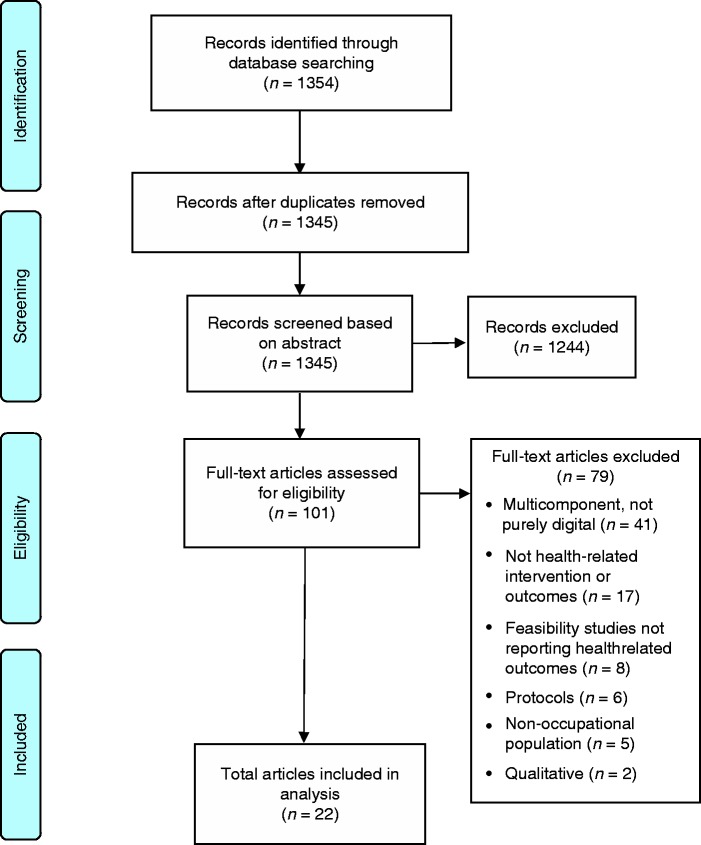
Background: The impact of employee health on productivity in the workplace is generally evidenced through absenteeism and presenteeism. Multicomponent worksite health programmes, with significant online elements, have gained in popularity over the last two decades, due in part to their scalability and low cost of implementation. However, little is known about the impact of digital-only interventions on health-related outcomes in employee groups. The aim of this systematic review was to assess the impact of pure digital health interventions in the workplace on health-related outcomes. Methods: Multiple databases, including MEDLINE, EMBASE, PubMed and PsycINFO, were used to review the literature using PRISMA guidelines. Results: Of 1345 records screened, 22 randomized controlled trial studies were found to be eligible. Although there was a high level of heterogeneity across these studies, significant improvements were found for a broad range of outcomes such as sleep, mental health, sedentary behaviours and physical activity levels. Standardized measures were not always used to quantify intervention impact. All but one study resulted in at least one significantly improved health-related outcome, but attrition rates ranged widely, suggesting sustaining engagement was an issue. Risk of bias assessment was low for one-third of the studies and unclear for the remaining ones. Conclusions: This review found modest evidence that digital-only interventions have a positive impact on health-related outcomes in the workplace. High heterogeneity impacted the ability to confirm what interventions might work best for which health outcomes, although less complex health outcomes appeared to be more likely to be impacted. A focus on engagement along with the use of standardized measures and reporting of active intervention components would be helpful in future evaluations.
Overview
The claims and statistics of this paper haven’t been checked yet.
Run the check — free, no account needed. It reads the open-access text and checks the sources it cites.
Integrity signals
Registry
Cites
Statistics
Figures
Verification
Claims the paper makes
The claims and statistics of this paper haven’t been checked yet.
Run the check — free, no account needed. It reads the open-access text and checks the sources it cites.
Claims other papers make about this one
Each is checked against this paper’s own text: does it say what the citing paper says it does?
The source backs part of the claim, not all of it — or backs it for a different population, condition or comparison.
In the citing paper
“These findings align with previous research39,40, underscoring the potential for digital tools in managing chronic conditions and providing a foundation for future innovations in this field.”
From Impact of digital health interventions on glycemic control and weight management. (2025) · cites this paper as [39]
Experimental — accuracy not yet measured
Self-check
Percentages, sums and reported differences re-computed from the paper’s own numbers.
The self-check needs the paper’s full text.
Citations
Cites
Preferred Reporting Items for Systematic Reviews and Meta-Analyses: the PRISMA statement
Moher, D., Liberati, A., Tetzlaff, J., Altman, D. G., & for the PRISMA Group (2009) · BMJ · doi:10.1136/bmj.b2535 · Cited by 83,823
Preferred Reporting Items for Systematic Reviews and Meta-Analyses: The PRISMA Statement
Moher, D., Liberati, A., Tetzlaff, J., Altman, D. G., & The PRISMA Group (2009) · PLoS Medicine · doi:10.1371/journal.pmed.1000097 · Cited by 64,042
The Cochrane Collaboration's tool for assessing risk of bias in randomised trials
Higgins, J. P. T., Altman, D. G., Gotzsche, P. C., Juni, P., Moher, D., Oxman, A. D., Savovic, J., Schulz, K. F., Weeks, L., Sterne, J. A. C., et al. (2011) · BMJ · doi:10.1136/bmj.d5928 · Cited by 33,817
Cochrane Handbook for Systematic Reviews of Interventions: Cochrane Book Series
(2008) · doi:10.1002/9780470712184 · Cited by 25,048
Dermyshi, E., Wang, Y., Yan, C., Hong, W., Qiu, G., Gong, X., & Zhang, T. (2017) · Neonatology · doi:10.1159/000454668 · Cited by 24,586
Wang, G., Ma, R., Qiao, G., Wada, K., Aizawa, Y., & Satoh, T. (2015) · Integrative Medicine International · doi:10.1159/000368408 · Cited by 18,762
The measurement of engagement and burnout: a two sample confirmatory factor analytic approach.
Schaufeli, W. B., Salanova, M., González-romá, V., & Bakker, A. B. (2002) · Journal of Happiness Studies · doi:10.1023/a:1015630930326 · Cited by 10,014
Michie, S., Richardson, M., Johnston, M., Abraham, C., Francis, J., Hardeman, W., Eccles, M. P., Cane, J., & Wood, C. E. (2013) · Annals of Behavioral Medicine · doi:10.1007/s12160-013-9486-6 · Cited by 7,629
The Validity and Reproducibility of a Work Productivity and Activity Impairment Instrument
Reilly, M. C., Zbrozek, A. S., & Dukes, E. M. (1993) · PharmacoEconomics · doi:10.2165/00019053-199304050-00006 · Cited by 3,071
Eysenbach, G. (2005) · Journal of Medical Internet Research · doi:10.2196/jmir.7.1.e11 · Cited by 2,524
Research works printed but not linked: 2
- 10.2196/jmir.9.2.e17 · DOI · Paper page
- 10.2196/jmir.3399 · DOI · Paper page
Cited by
Sorted by citations
Items 201–240 of 240
Eskilsson, M. (2020) · Lund University Publications Student Papers (Lund University)
Busch, C., & Dreyer, R. (2020) · Springer eBooks · doi:10.1007/978-3-658-29852-4_1
Hagger, M. S., Cameron, L. D., Hamilton, K., Hankonen, N. E., & Lintunen, T. (2020) · Cambridge University Press eBooks · doi:10.1017/9781108677318.047
Tan, L., Deady, M., Mead, O., Foright, R. M., Brenneman, E. M., Yeager, J. R., Bryant, R. A., & Harvey, S. B. (2022) · doi:10.2196/preprints.40145
Busch, C., & Dreyer, R. (2022) · Springer eBooks · doi:10.1007/978-3-658-34647-8_19
Posenau, A., Leinweber, J., & Barthel, M. (2022) · Springer Reference Pflege, Therapie, Gesundheit · doi:10.1007/978-3-662-54179-1_80-1
Effect of Weight Goals on Sitting and Moving during a Worksite Sedentary Time Reduction Intervention
Leonard, K. S., de Brito, J. N., Larouche, M. L., Rydell, S. A., Mitchell, N. R., Pereira, M. A., & Buman, M. P. (2022) · Translational Journal of the American College of Sports Medicine · doi:10.1249/tjx.0000000000000210
Filho, E. C. G., Vieira, L. M. S. M. D. A., & Sato, T. D. O. (2022) · Fisioterapia e Pesquisa · doi:10.1590/1809-2950/22001129032022pt
Göring, A., & Rudolph, S. (2022) · Springer eBooks · doi:10.1007/978-3-662-65344-9_17
Are You the One to Stick Around Despite the High Rate of Attrition?
Gupta, C. (2023) · Practice, progress, and proficiency in sustainability · doi:10.4018/978-1-6684-8223-0.ch013
Mondelo‐García, C., Varela-Rey, I., Bandín‐Vilar, E., Blanco, A. C., Torres, N. M., Fariña, B. A., González, D. G., Lema, I. B., Ramos, J. J. D. M., Ferro, I. Z., et al. (2023) · Nutrición Hospitalaria · doi:10.20960/nh.04720
Deldar, K., Khodabandelool, F., Arian, M., Hosseini, S., & Froutan, R. (2022) · AFMN Biomedicine · doi:10.5937/afmnai40-45800
Addanki, S., Macedo, L. G., MacDermid, J. C., & Moll, S. E. (2024) · doi:10.2196/preprints.57046
Kim, R., Park, H., Shinn, J., & Kim, H. (2024) · Cardiovascular Prevention and Pharmacotherapy · doi:10.36011/cpp.2024.6.e8
Raussi, V., Kujala, S., Hörhammer, I., Savolainen, K., Autio, R., & Koskela, T. (2024) · Journal of Medical Internet Research · doi:10.2196/49802
“There have been studies on digital health checks and internet-based risk assessments of subgroups, such as the employed, but there have been few studies focusing on digital health checks for unemployed individuals [33].”
Musakuro, R. N., & Gie, L. (2024) · International Journal of Research in Business and Social Science (2147-4478) · doi:10.20525/ijrbs.v13i7.3648 · Cited by 1
“The use of e-health tools enables mental health service delivery in the workplace by impacting how mental health services are designed and accessed, but more importantly how mental health services are delivered in formal and informal workplace settings (Howarth et al., 2018).”
Daniel, C., Leyrat, C., Gentina, É., Mesmer‐Magnus, J., Guidice, R. M., & Bailly, S. (2025) · Stress and Health · doi:10.1002/smi.70017
Busch, C., Keller-Landvogt, K., Dreyer, R., & Janneck, M. (2025) · Gruppe Interaktion Organisation Zeitschrift für Angewandte Organisationspsychologie (GIO) · doi:10.1007/s11612-025-00792-6
“Frauen in-teressieren sich generell stärker für Gesundheitsangebote, auch für digitale Angebote und nehmen eher daran teil als Männer (Howarth et al. 2018”
Impact of Digital Interventions in Occupational Health Care: A Systematic Review
Jern-Matintupa, M. M., Riipinen, A., & Laine, M. K. (2025) · Mayo Clinic Proceedings Digital Health · doi:10.1016/j.mcpdig.2025.100216
Criddle, J. M., Malvini, W., Jasper, H., & Bordieri, M. J. (2025) · Behavioral Sciences · doi:10.3390/bs15081095
“The obtained attrition rate of 46.8% is on the higher end of average rates in the reported literature on technologically delivered health trials, which typically fall between 26% and 49%, and up to 60% or more (e.g., Howarth et al., 2018; Meyerowitz-Katz et al., 2020; Prior et al., 2023).”
InfluentialMarckmann, G. (2025) · Springer eBooks · doi:10.1007/978-3-662-71115-6_9
Kowalski, L., Finnes, A., Koch, S., & Bujacz, A. (2025) · doi:10.2196/preprints.83753
Aranas, L. L., Alam, K., Nasir, B., & Martin, P. (2025) · BMJ Open · doi:10.1136/bmjopen-2025-107173 · Cited by 2
“Howarth et al 12 emphasised their potential for cost-effective workplace health interventions, particularly in enhancing physical activity and mental well-being, which can be vital for managing various chronic conditions.”
Bell, O. J., Flynn, D., Clifford, T., West, D., Stevenson, E., & Avery, L. (2023) · Figshare · doi:10.6084/m9.figshare.22626133
Bell, O. J., Flynn, D., Clifford, T., West, D., Stevenson, E., & Avery, L. (2023) · Figshare · doi:10.6084/m9.figshare.22626130
Balasundaram, E., Navalgund, N. R., Aranganathan, P., Hanji, S. V., & Shashidhar, M. (2025) · Advances in mental health and addiction · doi:10.1007/978-3-031-98979-7_3
Musakuro, R. N. (2025) · Clinical sociology review. · doi:10.36615/2pw1mb81
“…the workplace contexts, including SA HEIs, where they became the primary means to ensure the availability, continuity, and accessibility of DMHS during the COVID-19 pandemic, which included lockdowns and social distancing protocols among other measures (Howarth et al., 2018; Musakuro & Gie, 2024).”
Digitalization and Employee Health and Well-Being During COVID-19
Ha, H., Raghavan, A., Demircioğlu, M. A., & Hur, H. (2026) · Administrative Sciences · doi:10.3390/admsci16030156 · Cited by 1
Baldwin, T., Cadar, D., & Sigala, N. (2026) · BMC Digital Health · doi:10.1186/s44247-026-00268-7
“…broader evidence that digital interventions targeting specific health behaviours tend to be more engaging and effective than those addressing broader or multifactorial targets [21], and is further supported by the established efficacy of internet-delivered CBT-I in clinical populations [47, 57].”
Švihrová, R., Marzorati, D., Odello, T., Monachino, G., Staletti, T., Tieben, R., Luigies, R., Bodewes, N., Rutten, W., Barrett, G., et al. (2026) · medRxiv · doi:10.64898/2026.05.15.26353188
Gellner, C., Michael Fellmann, M. A., & Fuellen, G. (2026) · Lecture notes in computer science · doi:10.1007/978-3-032-29842-3_10
Sandel, C., McColl‐Kennedy, J. R., & Janda, M. (2026) · Digital Health · doi:10.1177/20552076261452162
“26 As research continues to validate the behaviour change impact of digital health interventions, 11 further advocacy is required to promote digital interventions to all types of workplaces.”
InfluentialSachdeva, A., Somasundaram, J., & Sharma, K. K. (2026) · Social Science & Medicine · doi:10.1016/j.socscimed.2026.119683
Zeb, A., Neven, A., Burtin, C., Janssens, L., Peters, B., Schyvens, A.-M., Oost, N. C. V., Meus, T., Timmermans, A. A. A., & Verbrugghe, J. (2026) · Applied Sciences · doi:10.3390/app16178353
Davis, J. (2026) · The Coaching Psychologist · doi:10.53841/bpstcp.2026.21.2.19
Wer macht mit – und wer hält durch?
Brenner, S., & Schneider, B. S. (2026) · Prävention und Gesundheitsförderung · doi:10.1007/s11553-026-01375-z
BabyFM Sensor Displacement Detection System: Performance Analysis with Clinical Dataset
Papić, T., Dakić, P., & Lang, J. (2026) · SN Computer Science · doi:10.1007/s42979-026-05352-3
“Structured interviews and surveys with parents, pediatricians, and hospital staff informed the design priorities of the BabyFM system, including real-time alerts, color-based temperature visualization, hospital information system interoperability, and medication tracking [42, 43].”
Maghraby, M. E. (2026) · PAIN JOINTS SPINE · doi:10.1922/pjs.16.5s.2026.1047
Metadata
- Authors
- Howarth, A., Quesada, J., Silva, J., Judycki, S., & Mills, P. R.
- Affiliations
- St George's, University of London (GB)
- Cigna (United States) (US)
- Cigna, Global Well-being Solutions Ltd, UK
- Whittington Hospital (GB)
- Corresponding author
- Howarth, Ana
- Venue
- DIGITAL HEALTH
- Publisher
- SAGE Publications
- Published
- 2018-01
- Volume
- 4
- Pages
- 2055207618770861-2055207618770861
- ISSN
- 2055-2076 (ISSN-L)
- PMC
- PMC6016571
- OpenAlex
- W2800263550
- Cited by
- 240
- References
- 64
- Citations by year
- 2026: 16 · 2025: 40 · 2024: 33 · 2023: 27 · 2022: 36 · 2021: 18 · 2020: 63 · 2019: 7
- FWCI
- 3.98
- Type
- journal article
- Language
- en
- Open access
- gold
- doi.org
- Locations
- Digital Health (publishedVersion, cc-by-nc)
- Europe PMC (PubMed Central) (publishedVersion, cc-by-nc)
- PubMed Central (publishedVersion, cc-by-nc)
- PubMed (publishedVersion)
- DOAJ (DOAJ: Directory of Open Access Journals) (submittedVersion, cc-by-sa)
- Topics
- Health Sciences › Medicine › Public Health, Environmental and Occupational Health › Workplace Health and Well-being
- Social Sciences › Psychology › Applied Psychology › Digital Mental Health Interventions
- Health Sciences › Health Professions › General Health Professions › Mobile Health and mHealth Applications
- Keywords
- digital health interventions, workplace health, employee health, absenteeism, presenteeism, sleep, mental health, sedentary behavior, physical activity, user engagement, attrition
About these checks
Registry, retraction, Cites and statistics results are computed, not judged, with one exception: a printed reference that no index lists is read once by a model before it counts as a citation error. Claims are extracted by a model and kept only when their quote appears verbatim in the text; each cited source is then checked, with a model’s help, for whether it says what the claim relies on. Those verdicts can be wrong — read the claim’s quote and the cited source before relying on one.
Statistics and arithmetic are recomputed, not judged.
Confidence bands are shown only for fields calibrated on our annotated test set. None is calibrated yet, so no band is shown.
What counts as a claim ›How we measure confidence ›How we check this ›
Are you an author, or do you see a problem with this page? Request a review
