

The DOI matches its Crossref record; 64 of the 64 references it cites were found in a registry or an index.
The impact of digital health interventions on health-related outcomes in the workplace: A systematic review
Open accessAbstract
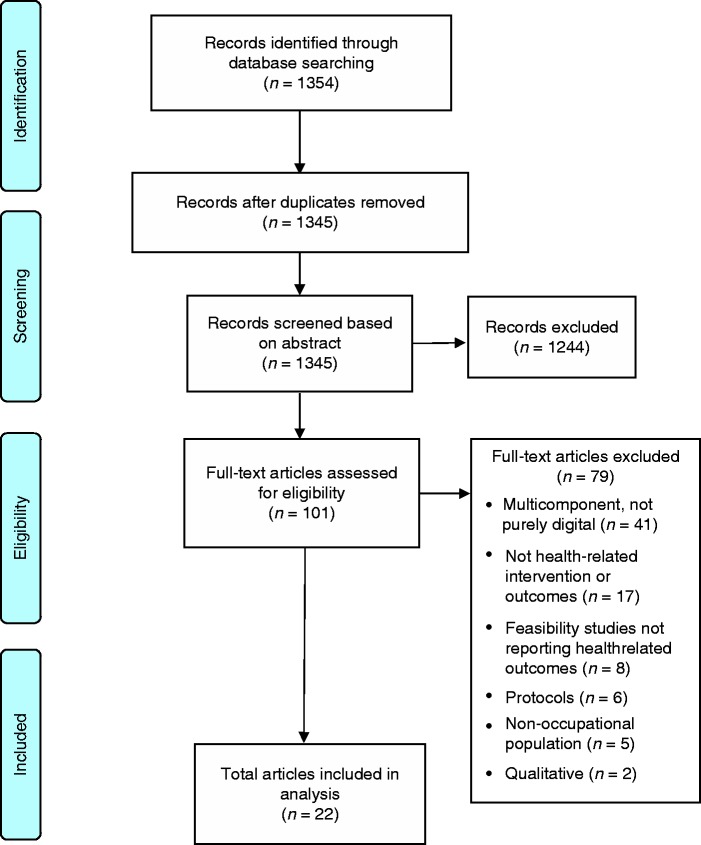
Background: The impact of employee health on productivity in the workplace is generally evidenced through absenteeism and presenteeism. Multicomponent worksite health programmes, with significant online elements, have gained in popularity over the last two decades, due in part to their scalability and low cost of implementation. However, little is known about the impact of digital-only interventions on health-related outcomes in employee groups. The aim of this systematic review was to assess the impact of pure digital health interventions in the workplace on health-related outcomes. Methods: Multiple databases, including MEDLINE, EMBASE, PubMed and PsycINFO, were used to review the literature using PRISMA guidelines. Results: Of 1345 records screened, 22 randomized controlled trial studies were found to be eligible. Although there was a high level of heterogeneity across these studies, significant improvements were found for a broad range of outcomes such as sleep, mental health, sedentary behaviours and physical activity levels. Standardized measures were not always used to quantify intervention impact. All but one study resulted in at least one significantly improved health-related outcome, but attrition rates ranged widely, suggesting sustaining engagement was an issue. Risk of bias assessment was low for one-third of the studies and unclear for the remaining ones. Conclusions: This review found modest evidence that digital-only interventions have a positive impact on health-related outcomes in the workplace. High heterogeneity impacted the ability to confirm what interventions might work best for which health outcomes, although less complex health outcomes appeared to be more likely to be impacted. A focus on engagement along with the use of standardized measures and reporting of active intervention components would be helpful in future evaluations.
Overview
The claims and statistics of this paper haven’t been checked yet.
Run the check — free, no account needed. It reads the open-access text and checks the sources it cites.
Integrity signals
Registry
Cites
Statistics
Figures
Verification
Claims the paper makes
The claims and statistics of this paper haven’t been checked yet.
Run the check — free, no account needed. It reads the open-access text and checks the sources it cites.
Claims other papers make about this one
Each is checked against this paper’s own text: does it say what the citing paper says it does?
The source backs part of the claim, not all of it — or backs it for a different population, condition or comparison.
In the citing paper
“These findings align with previous research39,40, underscoring the potential for digital tools in managing chronic conditions and providing a foundation for future innovations in this field.”
From Impact of digital health interventions on glycemic control and weight management. (2025) · cites this paper as [39]
Experimental — accuracy not yet measured
Self-check
Percentages, sums and reported differences re-computed from the paper’s own numbers.
The self-check needs the paper’s full text.
Citations
Cites
Preferred Reporting Items for Systematic Reviews and Meta-Analyses: the PRISMA statement
Moher, D., Liberati, A., Tetzlaff, J., Altman, D. G., & for the PRISMA Group (2009) · BMJ · doi:10.1136/bmj.b2535 · Cited by 83,823
Preferred Reporting Items for Systematic Reviews and Meta-Analyses: The PRISMA Statement
Moher, D., Liberati, A., Tetzlaff, J., Altman, D. G., & The PRISMA Group (2009) · PLoS Medicine · doi:10.1371/journal.pmed.1000097 · Cited by 64,042
The Cochrane Collaboration's tool for assessing risk of bias in randomised trials
Higgins, J. P. T., Altman, D. G., Gotzsche, P. C., Juni, P., Moher, D., Oxman, A. D., Savovic, J., Schulz, K. F., Weeks, L., Sterne, J. A. C., et al. (2011) · BMJ · doi:10.1136/bmj.d5928 · Cited by 33,817
Cochrane Handbook for Systematic Reviews of Interventions: Cochrane Book Series
(2008) · doi:10.1002/9780470712184 · Cited by 25,048
Dermyshi, E., Wang, Y., Yan, C., Hong, W., Qiu, G., Gong, X., & Zhang, T. (2017) · Neonatology · doi:10.1159/000454668 · Cited by 24,586
Wang, G., Ma, R., Qiao, G., Wada, K., Aizawa, Y., & Satoh, T. (2015) · Integrative Medicine International · doi:10.1159/000368408 · Cited by 18,762
The measurement of engagement and burnout: a two sample confirmatory factor analytic approach.
Schaufeli, W. B., Salanova, M., González-romá, V., & Bakker, A. B. (2002) · Journal of Happiness Studies · doi:10.1023/a:1015630930326 · Cited by 10,014
Michie, S., Richardson, M., Johnston, M., Abraham, C., Francis, J., Hardeman, W., Eccles, M. P., Cane, J., & Wood, C. E. (2013) · Annals of Behavioral Medicine · doi:10.1007/s12160-013-9486-6 · Cited by 7,629
The Validity and Reproducibility of a Work Productivity and Activity Impairment Instrument
Reilly, M. C., Zbrozek, A. S., & Dukes, E. M. (1993) · PharmacoEconomics · doi:10.2165/00019053-199304050-00006 · Cited by 3,071
Eysenbach, G. (2005) · Journal of Medical Internet Research · doi:10.2196/jmir.7.1.e11 · Cited by 2,524
Research works printed but not linked: 2
- 10.2196/jmir.9.2.e17 · DOI · Paper page
- 10.2196/jmir.3399 · DOI · Paper page
Cited by
Sorted by citations
Items 101–200 of 240
Progression of Digital Healthcare With Deep Learning and Blockchain Methods for Smart Cities
Mahammad, A. B., & Kumar, R. (2022) · Advances in electronic government, digital divide, and regional development book series · doi:10.4018/978-1-7998-9710-1.ch012 · Cited by 10
Oginni, J., Otinwa, G., & Gao, Z. (2024) · Journal of Clinical Medicine · doi:10.3390/jcm13030694 · Cited by 14
“However, a systematic review indicates limited evidence regarding the effectiveness of virtual workplace interventions in terms of health-related outcomes [28].”
BackgroundPees, S. O., van Oostrom, S. H., Lettinga, H., Schaafsma, F. G., & Proper, K. I. (2024) · Occupational and Environmental Medicine · doi:10.1136/oemed-2024-109454 · Cited by 10
“15 While these interventions show potential in improving mental health and reducing stress symptoms, the link with the specific work context is often lacking and important causes for work-related stress and burn-out can easily be missed and sustained.”
BackgroundThe Science of Behavior Change: The Road Ahead
Hagger, M. S., Cameron, L. D., Hamilton, K., Hankonen, N. E., & Lintunen, T. (2020) · Cambridge University Press eBooks · doi:10.1017/9781108677318.046 · Cited by 13
The Limited Level of Digital Skills and Competencies of Optometry Students
Nguyen, K. P., Luke, A. K., Cheng, Y.-T., John, A., & Cham, K. M. (2022) · Journal of Information Technology Education Research · doi:10.28945/4929 · Cited by 10
“It seems that current university -level health systems training is not st andardized to facilitate the transition from a student to an ideal “digital health worker” (Howarth et al., 2018).”
BackgroundSmart hospitals around the world: a systematic reviewPreprint
Kasrineh, M. R., Sharifzadeh, N., & Tabatabaei, S. M. (2021) · Research Square · doi:10.21203/rs.3.rs-258174/v1 · Cited by 10
“The eld of healthcare and medicine is one of the areas which has witnesses signi cant development through using digital tools [5-7].”
MethodPonzo, S., Wickham, A. P., Bamford, R., Radović, T., Zhaunova, L., Peven, K., Klepchukova, A., & Payne, J. L. (2022) · doi:10.31234/osf.io/as2eb · Cited by 10
Howarth, A., Quesada, J., Donnelly, T., & Mills, P. R. (2019) · DIGITAL HEALTH · doi:10.1177/2055207619852856 · Cited by 9
Self-citationThepha, T., Carr, G., Marais, D., Kuasri, J., Klangphaow, K., & Tangpukdee, J. (2024) · Digital Health · doi:10.1177/20552076241309520 · Cited by 11
Higuera‐Gómez, A., Ribot-Rodríguez, R., San-Cristóbal, R., Martín‐Hernández, R., Micó, V., Espinosa‐Salinas, I., de Molina, A. R., & Martínez, J. A. (2022) · Digital Health · doi:10.1177/20552076221138316 · Cited by 9
“Also, modest evidence was found in a systematic review about digital-only interventions having a positive impact on employee health for a broad range of outcomes such as sleep, mental health, sedentary behaviors and physical activity levels.(24) Therefore, it is recommended to carry out longer and quality eHealth stud…”
BackgroundAutonomy-Supportive Interventions
Reeve, J., & Cheon, S. H. (2020) · Cambridge University Press eBooks · doi:10.1017/9781108677318.035 · Cited by 13
Effectiveness of a Blended Web-Based Intervention to Raise Sleep Awareness at Workplace
Montagni, I., Dehman, A., Yu, Z., Martinez, M. J., Banner, S., Rimbert, S., Hayez, S., Foster, C. E., & Fontvieille, A.-M. (2019) · Journal of Occupational and Environmental Medicine · doi:10.1097/jom.0000000000001589 · Cited by 9
“form to collect personal details including sociodemographic information: nation and workplace site codes, family and given names, age in categories (18-34, 35-44, 45-54, 55-64), sex (male, female), height in meters and weight in kilos.”
BackgroundImplementation Science and Translation in Behavior Change
Łuszczyńska, A., Łobczowska, K., & Horodyska, K. (2020) · Cambridge University Press eBooks · doi:10.1017/9781108677318.023 · Cited by 10
Jordan, H. R., Sahni, S., Ahmed, M. M., Fares, J. E., Desai, B., Lenchur, C. N., & Jermyn, R. T. (2023) · Cureus · doi:10.7759/cureus.47639 · Cited by 8
Aye, L. M., Tan, M., Schaefer, A., Thurairajasingam, S., Geldsetzer, P., Soon, L.-K., Reininghaus, U., Bärnighausen, T., & Su, T. T. (2024) · Digital Health · doi:10.1177/20552076241278313 · Cited by 12
“25,26 However, Abd-Alrazaq et al. 45 found that there is still insuf fi cient evidence to prove the effectiveness and safety, and recommended that further studies are required to draw solid conclusions that their effect is clinically important.”
Backgroundde Ridder, D. T. D., Gillebaart, M., & Friese, M. (2020) · Cambridge University Press eBooks · doi:10.1017/9781108677318.040 · Cited by 9
Epton, T., & Armitage, C. J. (2020) · Cambridge University Press eBooks · doi:10.1017/9781108677318.038 · Cited by 8
Benhamida, F. Z., Navarro, J., Gómez–Carmona, O., Casado–Mansilla, D., López–de–Ipiña, D., & Zaballos, A. (2021) · Sensors · doi:10.3390/s21113640 · Cited by 8
“Other works have approached wellness interventions through digital technologies and have also been proposed for reducing sedentary behaviors [82] as well as to increase energy expenditure and promote more active periods [83,84].”
BackgroundMorris, A. S., Mackintosh, K. A., Owen, N., Dempsey, P. C., Dunstan, D. W., & McNarry, M. A. (2021) · International Journal of Environmental Research and Public Health · doi:10.3390/ijerph18189627 · Cited by 7
“Despite the importance of understanding the factors underpinning this relatively rapid decline in e-health intervention effectiveness, no studies have explored the contextual factors influencing adherence to smartphone prompts targeting total and prolonged sedentary bouts, and importantly, how they may change over tim…”
BackgroundThe role of internal CSR in guiding the digitalisation of work
Wolf, L., Ehlen, R., Bardmann, M.-M., Ruiner, C., Lanzl, J., Schoch, M., & Gimpel, H. (2024) · International Journal of Corporate Social Responsibility · doi:10.1186/s40991-024-00089-9 · Cited by 7
“Programmes such as “Exertime” and “Get Moving” (Howarth et al., 2018, p. 15), which aim to activate employees, were particularly successful in terms of engagement and health improvements.”
BackgroundMethodToh, S. H. Y., Lee, S. C., Kosasih, F. R., Lim, J. W., & Sündermann, O. (2023) · Digital Health · doi:10.1177/20552076231178616 · Cited by 7
“Self-guided apps, consisting of short and simple tasks, can then be incorporated into employees’ daily schedules, creating more opportunities for the desired behaviour to occur.(11) This benefits both the individual and the organization as a whole.”
BackgroundStøren, P. G., & Grønningsæter, H. (2023) · Work · doi:10.3233/wor-220115 · Cited by 7
“%) showing positive impact on presenteeism/productivity, were multicomponent programs implemented at two or more levels [35, 36, 38, 42, 43, 48, 50].”
InfluentialWest, A. B., Guo, Y. V., & Bucher, A. (2023) · Frontiers in Psychiatry · doi:10.3389/fpsyt.2023.1219229 · Cited by 7
“While digital support tools may not be sufficient to address all mental health concerns, many have been associated with significant reductions in symptoms and distress (42), and increases in productivity (43).”
BackgroundShi, H., Du, J. C., Jin, G., Yang, H., Guo, H., Yuan, G., Zhu, Z., Xu, W., Wang, S., Guo, H., et al. (2024) · International Journal of STD & AIDS · doi:10.1177/09564624241252457 · Cited by 6
Evaluation of Behavior Change Interventions
Matthews, L., & Simpson, S. A. (2020) · Cambridge University Press eBooks · doi:10.1017/9781108677318.022 · Cited by 8
Sunami, T., So, R., Ishii, H., Sadashima, E., Ueno, T., Yuzuriha, T., & Monji, A. (2022) · Journal of Occupational Health · doi:10.1002/1348-9585.12312 · Cited by 7
Varela, M. R. V., Ferreira, F. A. F., Ferreira, N. C. M. Q. F., & Correia, R. J. C. (2023) · International Transactions in Operational Research · doi:10.1111/itor.13336 · Cited by 8
Motivational Interviewing Interventions
Berman, A. H., Beckman, M., & Lindqvist, H. (2020) · Cambridge University Press eBooks · doi:10.1017/9781108677318.045 · Cited by 12
Elkefi, S. (2024) · Integrated science · doi:10.1007/978-3-031-70292-1_27 · Cited by 6
Pfitzer, E., Giger, O.-F., Kausch, C., & Kowatsch, T. (2025) · BMC Health Services Research · doi:10.1186/s12913-025-12748-z · Cited by 6
Fingas, S. M., Busch, C., Dreyer, R., & Lehmann‐Willenbrock, N. (2025) · Journal of Occupational and Organizational Psychology · doi:10.1111/joop.70021 · Cited by 6
Almoajel, A. M., Alnuwaysir, N., Alotaibi, A. G., Alzaidi, H., Al-Turki, H. A., Alsaeed, R., Alsubhan, W., Almadhi, M., Muhawwis, M., & Tharkar, S. (2025) · The Journal of Medicine Law & Public Health · doi:10.52609/jmlph.v5i4.229 · Cited by 6
Aziz, A. F. A., & Ong, T. (2024) · JMIR mhealth and uhealth · doi:10.2196/50356 · Cited by 6
“A systematic review of 22 randomized controlled trials found that digital health interventions in the workplace create a positive impact on health-related workplace outcomes such as diet, exercise, mental health, and job satisfaction [22].”
BackgroundMusakuro, R. N., & Gie, L. (2024) · South African journal of information management · doi:10.4102/sajim.v26i1.1897 · Cited by 6
“The use of e-health tools enables mental health service delivery in the workplace by impacting how mental health services are designed and accessed, but more importantly how mental health services are delivered in a formal and informal workplace setting (Howarth et al. 2018).”
Economic and Behavioral Economic Approaches to Behavior Change
Brown, P. M., Cameron, L. D., Wilkinson, M., & Taylor, D. (2020) · Cambridge University Press eBooks · doi:10.1017/9781108677318.042 · Cited by 7
Tolentino, D. A., Costa, D. K., & Jiang, Y. (2023) · CIN Computers Informatics Nursing · doi:10.1097/cin.0000000000001025 · Cited by 6
Precision prevention in worksite health–A scoping review on research trends and gaps
Mess, F., Blaschke, S., Schick, T. S., & Friedrich, J. (2024) · PLoS ONE · doi:10.1371/journal.pone.0304951 · Cited by 9
“…is often provided digitally (43%), which is greatly in line with the findings of Mauch et al. [3] and can be attributed to the fact that digital interventions (wearables, apps, etc.) have become increasingly accepted and utilized in occupational health management in recent years [75,78–81].”
Changing Behavior Using Integrative Self-Control Theory
Hofmann, W., Dohle, S., & Diel, K. (2020) · Cambridge University Press eBooks · doi:10.1017/9781108677318.011 · Cited by 7
Conner, M. T., Williams, D. M., & Rhodes, R. E. (2020) · Cambridge University Press eBooks · doi:10.1017/9781108677318.034 · Cited by 6
An intervention to address nurse educators' occupational well-being: A process evaluation
Rinne, J., Leino‐Kilpi, H., Koskinen, S., Saaranen, T. K., Pasanen, M., Vauhkonen, A., & Salminen, L. (2024) · Nurse Education Today · doi:10.1016/j.nedt.2024.106219 · Cited by 5
Alishahi, M., Mohajer, S., Namazinia, M., & Mazloum, S. (2024) · International Urology and Nephrology · doi:10.1007/s11255-024-04201-7 · Cited by 5
Digital Technologies in Heart Failure Management
Shah, M., Zimmer, R. J., Kollefrath, M., & Khandwalla, R. M. (2020) · Current Cardiovascular Risk Reports · doi:10.1007/s12170-020-00643-7 · Cited by 5
“turn led to the proliferation of novel digital medicine companies [21].”
BackgroundInformation Technologies of Digital Adaptive Medicine
Богомолов, А. В. (2021) · Informatics and Automation · doi:10.15622/20.5.6 · Cited by 5
Digital workplace health promotion: a pilot study during the SARS-CoV-2 pandemic in Germany
Nöhammer, E., & Fischmann, W. (2023) · International Journal of Workplace Health Management · doi:10.1108/ijwhm-03-2023-0041 · Cited by 5
Liu, W., Wang, Q., Zheng, D., Mei, J., Lu, J., Chen, G., Wang, W., & Ding, F. (2024) · Journal of Medical Internet Research · doi:10.2196/45422 · Cited by 5
Addressing Underserved Populations and Disparities in Behavior Change
Schüz, B., & Hooper, M. W. (2020) · Cambridge University Press eBooks · doi:10.1017/9781108677318.027 · Cited by 5
Evaluation of Social Impact Within Primary School Health Promotion: A Systematic Review
Robertson, D., Carins, J., Rundle-Thiele, S. R., & Harris, J. (2022) · Journal of School Health · doi:10.1111/josh.13160 · Cited by 11
“Sample sizes ranged for students (from ‘‘not reported’’ to 4808) and schools (1-193) making meaningful comparison equally challenging.”
BackgroundEspel‐Huynh, H., Baldwin, M. W., Puzia, M., & Huberty, J. (2022) · JMIR mhealth and uhealth · doi:10.2196/40500 · Cited by 5
Mental Healthcare in the ‘New Normal’: Digital Technologies for Pandemics
Clough, B. A., Cassimatis, M., Noorbala, L., Attary, T., Ghazizadeh, A., & Hamilton, K. (2022) · Springer series on bio- and neurosystems · doi:10.1007/978-3-031-10031-4_20 · Cited by 5
Changing Behavior in the Digital Age
Kavanagh, D. J. (2020) · Cambridge University Press eBooks · doi:10.1017/9781108677318.029 · Cited by 4
Chancay, J., Gross, S. M., Koegel, K., Pompa, C., Eppes, E. V., Kang, Y., Augustyn, M., Castellanos-Brown, K., Paige, D. M., & Caulfield, L. E. (2024) · Journal of the Academy of Nutrition and Dietetics · doi:10.1016/j.jand.2024.07.163 · Cited by 4
Effects of a Workplace-Based Virtual-Run Intervention Among University Employees
Wattanapisit, A., Amaek, W., Promma, W., Srirug, P., Cheangsan, U., Khwanchum, S., Chadakorn, W., Eardmak, K., & Chadakorn, N. (2020) · International Journal of Environmental Research and Public Health · doi:10.3390/ijerph17082745 · Cited by 4
“The attrition prevalence of our study is comparable with that of other digital health interventions in workplaces (range, 0% to 60%; median, 21%) [23].”
ResultSmart hospitals worldwide: a systematic review
Kasrineh, M. R., Sharifzadeh, N., Soodejani, M. T., & Tabatabaei, S. M. (2023) · Physiology and Pharmacology · doi:10.61186/phypha.27.3.234 · Cited by 4
Ghadiri, A., Sturz, D.-L., & Mohajerzad, H. (2022) · International Journal of Environmental Research and Public Health · doi:10.3390/ijerph19159370 · Cited by 4
The Potentials of Digital Workplace Health Promotion
Nöhammer, E., & Drexel, M. (2024) · International Journal of Environmental Research and Public Health · doi:10.3390/ijerph21070902 · Cited by 6
“Also, the applicability of DWHP is broad and can cover all aspects of health [30,31], e.g., physical activity [32], medical checks [33], mental health [34] and eating habits [35].”
BackgroundMethodInfluentialLeveraging Trauma Informed Care for Digital Health Intervention Development in Opioid Use Disorder
Venkatasubramanian, K., Appleton, J., Ranalli, T.-M., Mankodiya, K., Solanki, D., & Carreiro, S. (2024) · Journal of Medical Toxicology · doi:10.1007/s13181-024-01040-x · Cited by 2
Moll, S. E., Ricciardelli, R., Carleton, R. N., MacDermid, J. C., Czarnuch, S. M., & MacPhee, R. S. (2025) · International Journal of Environmental Research and Public Health · doi:10.3390/ijerph22081269 · Cited by 3
Alhassan, A., Odonkor, F. O., Otchere, A. B., Gunu, A. I., Mintah, Y. D., Bobuafor, C., Klu, D., & Doe, P. F. (2025) · Discover Public Health · doi:10.1186/s12982-025-01146-9 · Cited by 6
“These studies have explored technical, infra-structural, and policy-related barriers to implementation [26, 27] and have assessed the impact of digital health on healthcare efficiency and patient outcomes [28–30].”
ASHER, I. B., Ritholz, M. D., Horwitz, D. L., Manejwala, O., Behar, E., & Fundoiano-Hershcovitz, . (2024) · JMIR Formative Research · doi:10.2196/50506 · Cited by 3
“Additional research suggests that a successful approach to addressing digital health interventions is through a multicomponent design [13], using features such as tailored messages, reporting of thoughts, feelings, or behaviors [31]; relaxations features [5]; integrated therapist contact and other…”
BackgroundRoberts, W., Lyson, H., Speer, C., Tovar, E., Paz, E., & Zimlichman, E. (2025) · Value in Health · doi:10.1016/j.jval.2025.01.025 · Cited by 3
Strategies for sustainable adoption of e-health tools for digital mental health services
Musakuro, R. N., & Gie, L. (2025) · SA Journal of Human Resource Management · doi:10.4102/sajhrm.v23i0.3053 · Cited by 4
Tung, C.-Y., Chang, C.-C., Jian, J.-W., Du, Y.-S., & Wu, C.-T. (2022) · Informatics for Health and Social Care · doi:10.1080/17538157.2022.2042303 · Cited by 5
“Existing evidence indicated that WHT interventions show promise as a method for improving various aspects of employee health.(6,7) Such WHT combined with apps can be used as a tool to offer perinatal health information and personalized health counseling services.”
MethodYoo, C. S., Haseki, M., & Gwaka, L. (2021) · SSRN Electronic Journal · doi:10.2139/ssrn.3760674 · Cited by 3
“…connectivity initiatives have on development dimensions (health, education, social) in the tribal communities. available studies indicate that little is known about the impacts of connectivity initiatives such as SCTDV and Connected North on different development dimensions (Howarth et al., 2018).”
Impact of Digitalization in Maternal Healthcare
Gupta, M., Mishra, A., & Kumar, P. (2024) · Advances in medical technologies and clinical practice book series · doi:10.4018/979-8-3693-3711-0.ch009 · Cited by 2
Individual Work Attitudes and Work Ability
Magnavita, N., Chiorri, C., Chirico, F., & Meraglia, I. (2025) · European Journal of Investigation in Health Psychology and Education · doi:10.3390/ejihpe15040053 · Cited by 6
“Several authors who have critically reviewed the literature have suggested that such programs should focus on work engagement (Brand et al., 2017; Howarth et al., 2018; Maidment et al., 2024).”
Gesundheit, Produktivität und Digitale Gesundheitsförderung in der New Work
Gellner, C., Cheliadzinskaya, A., & Michael Fellmann, M. A. (2025) · HMD Praxis der Wirtschaftsinformatik · doi:10.1365/s40702-025-01230-3 · Cited by 2
“Bisherige Studien zeigen, dass digitale betriebliche Gesundheitsangebote die physische und mentale Gesundheit von Beschäftigten fördern und somit einen Beitrag zur Gesund-heitsförderung und -prävention leisten können (Howarth et al. 2018 (Mayring 2022).”
Kavaratzis, S., & Choi, E. (2026) · Work & Stress · doi:10.1080/02678373.2026.2631980 · Cited by 2
“…effort allowed us to move beyond prior reviews that examine a specific type of programme or treatment (Bartlett et al., 2019; Carolan et al., 2017; Fuentes et al., 2019; Howarth et al., 2018), enabling our work to draw conclusions about the extent to which paradoxes exist and in what circumstance.”
Changing Behavior Using Control Theory
Mansell, W. (2020) · Cambridge University Press eBooks · doi:10.1017/9781108677318.009 · Cited by 11
What do we know about alcohol internet interventions aimed at employees?—A scoping review
Sundström, C., Forsström, D., Berman, A. H., Khadjesari, Z., & Sundqvist, K. (2023) · Frontiers in Public Health · doi:10.3389/fpubh.2023.929782 · Cited by 2
Effektivität digitaler Pflegeanwendungen bei Pflegebedürftigen im häuslichen Umfeld
Scheibe, S., Timpel, P., Mäder, M., Heinrich, R., Kugler, J., & Schönfelder, T. (2024) · Pflege · doi:10.1024/1012-5302/a000983 · Cited by 2
Yang, J. M., & Hwang, J. (2025) · Experimental Gerontology · doi:10.1016/j.exger.2025.112681 · Cited by 2
Yoga, mindfulness and acupuncture impact on burnout: a preliminary meta-analysis
Esperança, M. B., Ferreira, A. I., & Costa, S. P. (2025) · Psychology Health & Medicine · doi:10.1080/13548506.2025.2465658 · Cited by 2
“…the workplace (Merrill et al., 2011; Patel et al., 2010), leading researchers to conclude that unhealthy lifestyle behaviours related with lower productivity are highly modifiable (e.g. poor management of health conditions, obesity, insomnia, lack of physical activity, etc.) (Howarth et al., 2018).”
Musakuro, R. N. (2025) · International Journal of Research in Business and Social Science (2147-4478) · doi:10.20525/ijrbs.v14i1.3841 · Cited by 2
“The use of e-health tools enables mental health service delivery in the workplace by impacting how mental health services are designed and accessed, but more importantly how mental health services are delivered in a formal and informal workplace setting (Howarth et al., 2018).”
Algeo, N., Bennett, K., Brennan, L. K., & Connolly, D. (2025) · British Journal of Occupational Therapy · doi:10.1177/03080226251319900 · Cited by 2
Kowalski, L., Finnes, A., Koch, S., & Bujacz, A. (2025) · JMIR Formative Research · doi:10.2196/71032 · Cited by 4
Behavior Change in Community Contexts
Trickett, E. J., & Paterson, S. E. (2020) · Cambridge University Press eBooks · doi:10.1017/9781108677318.028 · Cited by 2
Kuhlberg, H., Kujala, S., Hörhammer, I., & Koskela, T. (2021) · JMIR Research Protocols · doi:10.2196/27668 · Cited by 2
“There have been studies on online health checks and internet-based risk assessments of subgroups such as the employed, but there have been few studies focusing on online health checks for the unemployed [20].”
BackgroundKulkarni, H., Chong, C., & Lam, M. (2023) · Springer eBooks · doi:10.1007/978-981-99-2613-8_6 · Cited by 2
Cost-Effectiveness Evaluations of Behavior Change Interventions
Wang, T., Downes, M., Byrnes, J., & Scuffham, P. (2020) · Cambridge University Press eBooks · doi:10.1017/9781108677318.026 · Cited by 1
Development of a responsive website to promote behavior changes in computer users
Filho, E. C. G., Vieira, L. M. S. M. D. A., & Sato, T. D. O. (2022) · Fisioterapia e Pesquisa · doi:10.1590/1809-2950/22001129032022en · Cited by 2
Wong, C. C.-K., Kwok, R. C.-W., & Zhang, S. (2023) · Journal of Information Technology Case and Application Research · doi:10.1080/15228053.2023.2186673 · Cited by 2
“Physical activity and wellness programs, such as aerobic, strength, and flexibility exercises, have been commonly used in the workplace to stress management and reduce stress symptoms (Buckingham et al., 2019; Howarth et al., 2018; Quick et al., 1997).”
BackgroundCoda, A., Hawke, F., Santos, D., Stevenson, E., Gironès, X., Ruiz, X., Escalona‐Marfil, C., Sanson‐Fisher, R., & Fellas, A. (2025) · Discover Education · doi:10.1007/s44217-025-00450-5 · Cited by 1
“This information is essential for providing continuity of care and ensuring that patients receive the best possible treatment [37, 46].”
May, N., Kasten, S., Schwan, T., Scharle, M., Tautz, A., Letzel, S., & Dietz, P. (2025) · International Archives of Occupational and Environmental Health · doi:10.1007/s00420-025-02145-8 · Cited by 1
“However, the scientific database on this issue is under-researched, and it can be assumed that the acceptance of digital workplace health promotion differs according to sociodemographic characteristics (Howarth et al. 2018; Robroek et al. 2021).”
Effectiveness of a workplace wellness program for adolescents and young adults
Griffin, K. W., WILLIAMS, C. R., & Botvin, G. J. (2025) · Journal of Workplace Behavioral Health · doi:10.1080/15555240.2025.2533995 · Cited by 1
“For example, interventions that are made available in online formats offer more flexibility and could increase employee engagement (Howarth et al., 2018).”
Osei, E., Asante, L. S., Ampon-Wireko, S., & Abdulai, P. M. (2025) · Digital Health · doi:10.1177/20552076251379770 · Cited by 1
Frazier, M. C., Pullin, M. J., & Harden, S. M. (2025) · Frontiers in Public Health · doi:10.3389/fpubh.2025.1634264 · Cited by 1
“Virtual interventions are particularly promising for improving CHE health and wellbeing (17).”
Addanki, S., Macedo, L., MacDermid, J. C., & Moll, S. E. (2026) · JMIR mhealth and uhealth · doi:10.2196/57046 · Cited by 1
du Prel, J., & Borchart, D. (2026) · BMC Health Services Research · doi:10.1186/s12913-026-14398-1 · Cited by 1
“In addition, there is a greater variety of services if DiHPO are provided along-side face-to-face programmes [17].”
InfluentialKillian, C. M., D’Agostino, E. M., Urtel, M. G., Long, B., Arangio, O., & Webster, C. A. (2026) · Journal of School Health · doi:10.1111/josh.70143 · Cited by 1
Collective Action for Wellness in the Malaysian Workplace: Protocol for a Feasibility Study
Thai, Y. C., McCaffrey, T. A., Ramadas, A., Chandrasekara, D., Koh, S. G. M., Choi, T. S. T., Malini, H., Xie, J., Olivier, P. L., Zain, A. Z. M., et al. (2022) · JMIR Research Protocols · doi:10.2196/39238 · Cited by 3
“Over the past 2 decades, growing research has been conducted to evaluate the effectiveness and feasibility of digital health interventions in the workplace context of many countries [13-15], but relatively few studies have been conducted in low- and middle-income countries (LMICs).”
BackgroundPosenau, A., Leinweber, J., & Barthel, M. (2022) · Springer Reference Pflege, Therapie, Gesundheit · doi:10.1007/978-3-662-65219-0_80 · Cited by 1
Recursos digitais na promoção da saúde mental de trabalhadores: Protocolo de revisão sistemática
Jacques, J. P. B., Pinhatti, E. D. G., Aroni, P., Leachi, H. F. L., & Ribeiro, R. P. (2023) · Enfermería actual en Costa Rica · doi:10.15517/ca2ffh57 · Cited by 1
Kowalski, L., Finnes, A., Koch, S., Stenling, A., & Bujacz, A. (2024) · BMC Digital Health · doi:10.1186/s44247-024-00120-w · Cited by 1
Theobald, P., Herold, F., Gronwald, T., & Müller, N. G. (2024) · BMC Sports Science Medicine and Rehabilitation · doi:10.1186/s13102-024-00985-4 · Cited by 1
“…limitations (e.g., requiring digital infrastructure and digital skills) [4, 16, 17], several studies [18–22] have shown that digital health applications, for instance, can be used to deliver physical training interventions [19, 23–26] and behavioural therapies in younger and older adults [21, 27].”
BackgroundKervinen, E., Vähätalo, L., Siukola, A., Reho, T., Winell, K., & Sauni, R. (2025) · Digital Health · doi:10.1177/20552076241297409 · Cited by 1
Fragmented care in lupus: Patient experiences and insights
Bam, A. (2025) · African Journal of Disability · doi:10.4102/ajod.v14i0.1562 · Cited by 2
Böttcher, N., & Kauffeld, S. (2025) · Gruppe Interaktion Organisation Zeitschrift für Angewandte Organisationspsychologie (GIO) · doi:10.1007/s11612-025-00795-3 · Cited by 1
“Behavioral interventions may benefit from face-to-face elements, which provide immediate feedback, facilitate interpersonal interactions, and offer structured support to help participants translate intentions into actions (see also Howarth et al., 2018).”
Musakuro, R. N. (2025) · International Journal of Business Ecosystem and Strategy (2687-2293) · doi:10.36096/ijbes.v7i2.698 · Cited by 1
“The use of e-health tools enables DMHS delivery in the workplace by impacting how mental health services are designed and accessed, but more importantly how mental health services are delivered in a formal and informal workplace setting (Howarth et al., 2018).”
InfluentialAl‐Jabr, H., Salt, E., Stephenson, J. R., Hamdan, E., & Helliwell, T. (2025) · JMIR Research Protocols · doi:10.2196/67675 · Cited by 1
“DH plays a significant role in health care, and it can be seen in many medical specialties [6,7].”
Hayvon, J. C. (2025) · Howard Journal of Communications · doi:10.1080/10646175.2025.2535604 · Cited by 1
“To illustrate with more concreteness, the following discussions draw upon the field of health media or digital health (Howarth et al., 2018; Widmer et al., 2015), in which a variety of both non-fictional and creative works have been created to meet key marginalized health needs.”
Metadata
- Authors
- Howarth, A., Quesada, J., Silva, J., Judycki, S., & Mills, P. R.
- Affiliations
- St George's, University of London (GB)
- Cigna (United States) (US)
- Cigna, Global Well-being Solutions Ltd, UK
- Whittington Hospital (GB)
- Corresponding author
- Howarth, Ana
- Venue
- DIGITAL HEALTH
- Publisher
- SAGE Publications
- Published
- 2018-01
- Volume
- 4
- Pages
- 2055207618770861-2055207618770861
- ISSN
- 2055-2076 (ISSN-L)
- PMC
- PMC6016571
- OpenAlex
- W2800263550
- Cited by
- 240
- References
- 64
- Citations by year
- 2026: 16 · 2025: 40 · 2024: 33 · 2023: 27 · 2022: 36 · 2021: 18 · 2020: 63 · 2019: 7
- FWCI
- 3.98
- Type
- journal article
- Language
- en
- Open access
- gold
- doi.org
- Locations
- Digital Health (publishedVersion, cc-by-nc)
- Europe PMC (PubMed Central) (publishedVersion, cc-by-nc)
- PubMed Central (publishedVersion, cc-by-nc)
- PubMed (publishedVersion)
- DOAJ (DOAJ: Directory of Open Access Journals) (submittedVersion, cc-by-sa)
- Topics
- Health Sciences › Medicine › Public Health, Environmental and Occupational Health › Workplace Health and Well-being
- Social Sciences › Psychology › Applied Psychology › Digital Mental Health Interventions
- Health Sciences › Health Professions › General Health Professions › Mobile Health and mHealth Applications
- Keywords
- digital health interventions, workplace health, employee health, absenteeism, presenteeism, sleep, mental health, sedentary behavior, physical activity, user engagement, attrition
About these checks
Registry, retraction, Cites and statistics results are computed, not judged, with one exception: a printed reference that no index lists is read once by a model before it counts as a citation error. Claims are extracted by a model and kept only when their quote appears verbatim in the text; each cited source is then checked, with a model’s help, for whether it says what the claim relies on. Those verdicts can be wrong — read the claim’s quote and the cited source before relying on one.
Statistics and arithmetic are recomputed, not judged.
Confidence bands are shown only for fields calibrated on our annotated test set. None is calibrated yet, so no band is shown.
What counts as a claim ›How we measure confidence ›How we check this ›
Are you an author, or do you see a problem with this page? Request a review
