

TINF2 mutations result in very short telomeres: analysis of a large cohort of patients with dyskeratosis congenita and related bone marrow failure syndromes
Open accessThe DOI matches its Crossref record; 26 of the 26 references it cites were found in a registry or an index.
Abstract
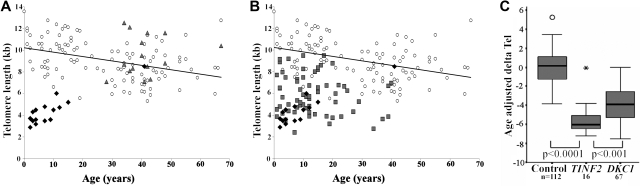
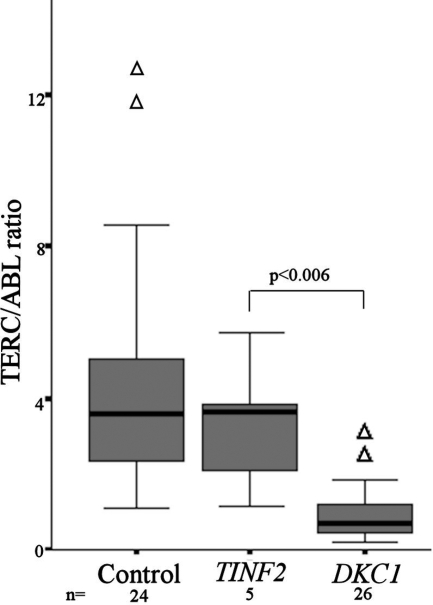
Dyskeratosis congenita (DC) is a multisystem bone marrow failure syndrome characterized by a triad of mucocutaneous abnormalities and a predisposition to cancer. The genetic basis of DC remains unknown in more than 60% of patients. Mutations have been identified in components of the telomerase complex (dyskerin, TERC, TERT, NOP10, and NHP2), and recently in one component of the shelterin complex TIN2 (gene TINF2). To establish the role of TINF2 mutations, we screened DNA from 175 uncharacterised patients with DC as well as 244 patients with other bone marrow failure disorders. Heterozygous coding mutations were found in 33 of 175 previously uncharacterized DC index patients and 3 of 244 other patients. A total of 21 of the mutations affected amino acid 282, changing arginine to histidine (n = 14) or cysteine (n = 7). A total of 32 of 33 patients with DC with TINF2 mutations have severe disease, with most developing aplastic anaemia by the age of 10 years. Telomere lengths in patients with TINF2 mutations were the shortest compared with other DC subtypes, but TERC levels were normal. In this large series, TINF2 mutations account for approximately 11% of all DC, but they do not play a significant role in patients with related disorders. This study emphasises the role of defective telomere maintenance on human disease.
Overview
The claims and statistics of this paper haven’t been checked yet.
Free: it reads the open-access text and checks the first 5 claims that cite a source we can check. Create a free account to check every claim.
Integrity signals
Registry
Cites
Statistics
Figures

Verification
Claims the paper makes
The claims and statistics of this paper haven’t been checked yet.
Free: it reads the open-access text and checks the first 5 claims that cite a source we can check. Create a free account to check every claim.
Claims other papers make about this one
Each is checked against this paper’s own text: does it say what the citing paper says it does?
The cited source says what the claim attributes to it.
In the citing paper
“Autosomal dominant forms are caused by mutations in TERT, TERC or the telomere binding protein TRF1-interacting nuclear factor 2 (156-159).”
From Telomeres and telomerase in cancer (2010) · cites this paper as [157]
The cited source says what the claim attributes to it.
In the citing paper
“Shelterin mutations have been found in some cases of aplastic anemia and dyskeratosis congenita (Savage et al., 2008; Walne et al., 2008; Zhong et al., 2011).”
From The Hallmarks of Aging (2013) · cites this paper as Walne et al., 2008
Self-check
Percentages, sums and reported differences re-computed from the paper’s own numbers.
The self-check needs the paper’s full text.
Citations
Cites
SIFT: predicting amino acid changes that affect protein function
Ng, P. C. (2003) · Nucleic Acids Research · doi:10.1093/nar/gkg509 · Cited by 6,577
Multiple sequence alignment with hierarchical clustering
Corpet, F. (1988) · Nucleic Acids Research · doi:10.1093/nar/16.22.10881 · Cited by 5,393
Shelterin: the protein complex that shapes and safeguards human telomeres
de Lange, T. (2005) · Genes & Development · doi:10.1101/gad.1346005 · Cited by 3,056
Heiss, N. S., Knight, S. W., Vulliamy, T. J., Klauck, S. M., Wiemann, S., Mason, P. J., Poustka, A., & Dokal, I. (1998) · Nature Genetics · doi:10.1038/ng0598-32 · Cited by 976
Self-citationThe RNA component of telomerase is mutated in autosomal dominant dyskeratosis congenita
Vulliamy, T., Marrone, A., Goldman, F., Dearlove, A., Bessler, M., Mason, P. J., & Dokal, I. (2001) · Nature · doi:10.1038/35096585 · Cited by 960
Self-citationMutations in TERT, the Gene for Telomerase Reverse Transcriptase, in Aplastic Anemia
Yamaguchi, H., Calado, R. T., Ly, H., Kajigaya, S., Baerlocher, G. M., Chanock, S. J., Lansdorp, P. M., & Young, N. S. (2005) · New England Journal of Medicine · doi:10.1056/nejmoa042980 · Cited by 723
Vulliamy, T., Marrone, A., Szydlo, R., Walne, A., Mason, P. J., & Dokal, I. (2004) · Nature Genetics · doi:10.1038/ng1346 · Cited by 461
Self-citationGilson, E., & Géli, V. (2007) · Nature Reviews Molecular Cell Biology · doi:10.1038/nrm2259 · Cited by 457
Armanios, M., Chen, J.-L., Chang, Y.-P. C., Brodsky, R. A., Hawkins, A., Griffin, C. A., Eshleman, J. R., Cohen, A. R., Chakravarti, A., Hamosh, A., et al. (2005) · Proceedings of the National Academy of Sciences · doi:10.1073/pnas.0508124102 · Cited by 452
Savage, S. A., Giri, N., Baerlocher, G. M., Orr, N., Lansdorp, P. M., & Alter, B. P. (2008) · The American Journal of Human Genetics · doi:10.1016/j.ajhg.2007.10.004 · Cited by 414
Cited by
Items 101–200 of 315
Bartocci, C., Diedrich, J. K., Ouzounov, I., Li, J., Piunti, A., Pasini, D., Yates, J. R., & Lazzerini Denchi, E. (2014) · Cell Reports · doi:10.1016/j.celrep.2014.04.002 · Cited by 49
“…disease is caused by mutations affecting either telomere elongation factors (dyskerin and hTERT) or telomere-associated proteins (Dokal, 2000; Kirwan and Dokal, 2009; Mitchell et al., 1999; Sarper et al., 2010; Shay and Wright, 1999; Touzot et al., 2010; Vulliamy et al., 2004; Walne et al., 2008).”
BackgroundMontanaro, L. (2010) · The Journal of Pathology · doi:10.1002/path.2777 · Cited by 53
p16INK4a protects against dysfunctional telomere–induced ATR-dependent DNA damage responses
Wang, Y., Sharpless, N., & Chang, S. (2013) · Journal of Clinical Investigation · doi:10.1172/jci69574 · Cited by 48
“Dys-functional telomeres arising from mutations in telomerase or TIN2 initiate proliferative defects in stem cells, resulting in the onset of human BM failure diseases including dyskeratosis congenita, aplastic anemia, and myelodysplastic syndromes (4–7).”
Molecular mechanisms of ageing and related diseases
Liu, J. (2014) · Clinical and Experimental Pharmacology and Physiology · doi:10.1111/1440-1681.12247 · Cited by 56
Heterogeneous telomere defects in patients with severe forms of dyskeratosis congenita
Touzot, F., Gaillard, L., Vasquez, N., Guen, T. L., Bertrand, Y., Bourhis, J., Leblanc, T. M., Fischer, A., Soulier, J., de Villartay, J., et al. (2011) · Journal of Allergy and Clinical Immunology · doi:10.1016/j.jaci.2011.09.043 · Cited by 53
Telomere Dysfunction, Chromosomal Instability and Cancer
Meena, J. K., Rudolph, K. L., & Güneş, Ç. (2015) · Recent results in cancer research/Recent Results in Cancer Research · doi:10.1007/978-3-319-20291-4_3 · Cited by 61
Binding of TPP1 Protein to TIN2 Protein Is Required for POT1a,b Protein-mediated Telomere Protection
Frescas, D., & de Lange, T. (2014) · Journal of Biological Chemistry · doi:10.1074/jbc.m114.592592 · Cited by 47
Changes of telomere status with aging: An update
Ishikawa, N., Nakamura, K., Izumiyama‐Shimomura, N., Aida, J., Matsuda, Y., Arai, T., & Takubo, K. (2016) · Geriatrics and gerontology international/Geriatrics & gerontology international · doi:10.1111/ggi.12772 · Cited by 51
Lamm, N., Elly, O., Shponkin, R., Richler, C., Aker, M., & Tzfati, Y. (2009) · PLoS ONE · doi:10.1371/journal.pone.0005666 · Cited by 49
“also associated with severe telomere shortening [24] and so far”
BackgroundInfluentialFernandes, S. G., Dsouza, R., & Khattar, E. (2021) · Environmental Toxicology and Pharmacology · doi:10.1016/j.etap.2021.103633 · Cited by 48
Telomere biology and translational research
Mason, P. J., & Perdigones, N. (2013) · Translational research · doi:10.1016/j.trsl.2013.08.009 · Cited by 45
“telomerase complex, TINF2 (49, 50) which encodes a component of shelterin, TCAB1 (51)”
BackgroundInfluentialGenome stability from the perspective of telomere length
Lu, X., & Liu, L. (2023) · Trends in Genetics · doi:10.1016/j.tig.2023.10.013 · Cited by 50
Telomere-Regulating Genes and the Telomere Interactome in Familial Cancers
Robles‐Espinoza, C. D., Velasco‐Herrera, M. D. C., Hayward, N. K., & Adams, D. J. (2015) · Molecular Cancer Research · doi:10.1158/1541-7786.mcr-14-0305 · Cited by 47
“An inherited form has been associated with mutations in the shelterin complex members TERF1 (an intronic variant) and TINF2, and in the telomerase components TERT and TERC (101, 109, 110) (Figure 2a-c).”
BackgroundInfluentialTripathi, E., & Smith, S. H. (2016) · The EMBO Journal · doi:10.15252/embj.201695135 · Cited by 42
“…TIN2 mutations exhibit premature loss of sister telomere cohesion (Canudas et al , 2011) and have extremely short telomeres (Savage et al , 2008; Walne et al , 2008), suggesting that telomere cohesion may be important for telomere lengthening by telomerase or by recombination (Canudas et al ,…”
Vulliamy, T., Beswick, R., Kirwan, M., Hossain, U., Walne, A., & Dokal, I. (2012) · Clinical Genetics · doi:10.1111/j.1399-0004.2010.01605.x · Cited by 39
“Both of the mutations to the Arg282 residue have been reported previously as disease causing and are seen to occur repetitively among patients who have a relatively severe form of the disease (4, 5, 14).”
BackgroundResultInfluentialSelf-citationRecent progress in dyskeratosis congenita
Nishio, N., & Kojima, S. (2010) · International Journal of Hematology · doi:10.1007/s12185-010-0695-5 · Cited by 45
Hallmarks of Cancers: Primary Antibody Deficiency Versus Other Inborn Errors of Immunity
Abolhassani, H., Wang, Y., Hammarström, L. L. G., & Pan‐Hammarström, Q. (2021) · Frontiers in Immunology · doi:10.3389/fimmu.2021.720025 · Cited by 43
Gramatges, M. M., Qi, X., Sasa, G., Chen, J. J. ‐., & Bertuch, A. A. (2013) · Blood · doi:10.1182/blood-2012-08-447755 · Cited by 44
He, H., Li, W., Comiskey, D. F., Liyanarachchi, S., Nieminen, T. T., Wang, Y., DeLap, K. E., Brock, P. L., & de la Chapelle, A. (2020) · Thyroid · doi:10.1089/thy.2019.0156 · Cited by 46
“The most common mutations are missense mutations found at amino acids 280–282, but nonsense mutations have also been reported (39,42).”
BackgroundHigh-throughput STELA provides a rapid test for the diagnosis of telomere biology disorders
Norris, K., Walne, A. J., Ponsford, M., Cleal, K., Grimstead, J. W., Ellison, A., Alnajar, J., Dokal, I. S., Vulliamy, T., & Baird, D. M. (2021) · Human Genetics · doi:10.1007/s00439-021-02257-4 · Cited by 43
Self-citationTelomerase and Telomeres in Endometrial Cancer
Alnafakh, R., Adishesh, M., Button, L., Saretzki, G. C., & Hapangama, D. K. (2019) · Frontiers in Oncology · doi:10.3389/fonc.2019.00344 · Cited by 64
Telomere length maintenance in stem cell populations
Allen, N. D., & Baird, D. M. (2009) · Biochimica et Biophysica Acta (BBA) - Molecular Basis of Disease · doi:10.1016/j.bbadis.2009.02.004 · Cited by 41
“(DC): a disease characterised by mutations in genes that result in impaired telomere length maintenance, such as components of the telomerase complex that results in haploinsufficiency for telomerase activity [25-27], or components of the shelterin complex [28].”
BackgroundTINF2 mutations in children with severe aplastic anemia
Du, H., Mason, P. J., Bessler, M., & Wilson, D. B. (2008) · Pediatric Blood & Cancer · doi:10.1002/pbc.21903 · Cited by 35
“We focused our mutational analysis on exon 6 of the gene, the site of all known TINF2 mutations linked to DC [1,2].”
InfluentialTelomere protein complexes and interactions with telomerase in telomere maintenance
Pinto, A. R., Li, H., Nicholls, C., & Liu, J. (2010) · Frontiers in bioscience · doi:10.2741/3683 · Cited by 42
“In addition, a significant number of human patients with dyskeratosis congenita have mutations in the TIN2 gene (143-144).”
BackgroundFioredda, F., Rotulo, G. A., Farruggia, P., Dagliano, F., Pillon, M., Trizzino, A., Notarangelo, L. D., Luti, L., Lanza, T., Terranova, P., et al. (2020) · Blood Advances · doi:10.1182/bloodadvances.2020002793 · Cited by 36
“12-15 This might be in keeping with the hypothesis that LO-Np may herald an immune deficiency or an immune dysregulation that will develop later over the disease time course.”
The relationship between DNA methylation and telomere length in dyskeratosis congenita
Gadalla, S. M., Katki, H. A., Shebl, F. M., Giri, N., Alter, B. P., & Savage, S. A. (2011) · Aging Cell · doi:10.1111/j.1474-9726.2011.00755.x · Cited by 38
“Several studies suggest that telomere shortening caused by TERT or TERC mutations is less severe than what has been observed in patients with TINF2 mutations (Walne et al., 2008; Du et al., 2009a; Vulliamy et al., 2010; Sasa et al., 2011).”
BackgroundBlombery, P. A., Fox, L. C., Ryland, G. L., Thompson, E. R., Lickiss, J., McBean, M., Yerneni, S., Hughes, D., Greenway, A. L., Mechinaud, F. M., et al. (2020) · Haematologica · doi:10.3324/haematol.2019.237693 · Cited by 33
Akt regulates TPP 1 homodimerization and telomere protection
Han, X., Liu, D., Zhang, Y., Li, Y., Lu, W., Chen, J., & Songyang, Z. (2013) · Aging Cell · doi:10.1111/acel.12137 · Cited by 35
“…complex components (e.g., dyskerin) and telosome/shelterin subunits (e.g., TIN2) have been identified in diseases with premature aging phenotypes and predisposition to cancer (Heiss et al., 1998; Savage et al., 2008; Vulliamy et al., 2008; Walne et al., 2008; Zhong et al., 2011; Sasa et al., 2012).”
BackgroundAtaxia and pancytopenia caused by a mutation in TINF2
Tsangaris, E., Adams, S., Yoon, G., Chitayat, D. A., Lansdorp, P. M., Dokal, I. S., & Dror, Y. (2008) · Human Genetics · doi:10.1007/s00439-008-0576-7 · Cited by 32
“The mutations in telomere maintenance genes in our patient and in other patients with DC who had ataxia (Savage et al. 2008; Walne et al. 2008; Heiss et al. 1998) indicate that ataxia is another manifestation of telomere disorders.”
BackgroundSelf-citationDyskerin, telomerase and the DNA damage response
Gu, B.-W., Bessler, M., & Mason, P. J. (2009) · Cell Cycle · doi:10.4161/cc.8.1.7265 · Cited by 33
Karremann, M., Neumaier‐Probst, E., Schlichtenbrede, F. C., Beier, F., Brümmendorf, T. H., Cremer, F. W., Bader, P., & Dürken, M. (2020) · Orphanet Journal of Rare Diseases · doi:10.1186/s13023-020-01553-y · Cited by 36
“Nevertheless, the same mutations in TINF2 may be found in classical DKC patients presenting clinically without the distinct RS phenotype, hence, the genotype alone is not able to define RS [20, 25, 26].”
BackgroundResultRole of angiotensin II in aging
Yi, W., Chen, F., Zhang, H., Tang, P., Yuan, M., Wen, J., Wang, S., & Cai, Z. (2022) · Frontiers in Aging Neuroscience · doi:10.3389/fnagi.2022.1002138 · Cited by 35
“Concomitantly, studies reported aplastic anemia and dyskeratosis congenita possessed mutations in the shelterin protein complex, particularly of TINF2 (Savage et al., 2008; Walne et al., 2008).”
BackgroundTelomere dysfunction in human diseases: the long and short of it!
Carroll, K. A., & Ly, H. (2009) · Europe PMC (PubMed Central) · Cited by 40
Do ribosomopathies explain some cases of common variable immunodeficiency?
Khan, S., Pereira, J., Darbyshire, P. J., Holding, S., Doré, P. C., Sewell, W. A. C., & Huissoon, A. P. (2010) · Clinical & Experimental Immunology · doi:10.1111/j.1365-2249.2010.04280.x · Cited by 31
Manguán-García, C., Pintado‐Berninches, L., Carrillo, J., Machado-Pinilla, R., Sastre, L., Pérez-Quilis, C., Esmorís, I., Gimeno, A., García‐Giménez, J. L., Pallardó, F. V., et al. (2014) · PLoS ONE · doi:10.1371/journal.pone.0101424 · Cited by 35
“On the other hand the consequences of A353V-X-DC mutation on DNA damage resemble to those found in cells with mutations in Tin2 and Pot1, which are structural components of telomeres [38] [39].”
Essential roles for Pot1b in HSC self-renewal and survival
Wang, Y., Shen, M., & Chang, S. S. (2011) · Blood · doi:10.1182/blood-2011-06-361527 · Cited by 31
Nelson, N. D., Dodson, L. M., Escudero, L., Sukumar, A. T., Williams, C. L., Mihalek, I., Baldan, A., Baird, D. M., & Bertuch, A. A. (2018) · Molecular and Cellular Biology · doi:10.1128/mcb.00025-18 · Cited by 28
“DC-associated TINF2 mutations are most frequently de novo, yet, strikingly result in drastically short telomeres within a single generation (15).”
Gastrointestinal Hemorrhage: A Manifestation of the Telomere Biology Disorders
Himes, R., Chiou, E., Queliza, K., Shouval, D. S., Somech, R., Agarwal, S., Jajoo, K., Ziegler, D. S., Kratz, C. P., Huang, J. N., et al. (2020) · The Journal of Pediatrics · doi:10.1016/j.jpeds.2020.09.038 · Cited by 31
TINF2Gene Mutation in a Patient with Pulmonary Fibrosis
Hoffman, T. W., van der Vis, J. J., van Oosterhout, M. F. M., van Es, H. W., van Kessel, D. A., Grutters, J. C., & van Moorsel, C. H. M. (2016) · Case Reports in Pulmonology · doi:10.1155/2016/1310862 · Cited by 29
Patel, M. M., Talcott, K. E., Kim, D. Y., Agarwal, S., & Mukai, S. (2017) · Ophthalmic Genetics · doi:10.1080/13816810.2016.1275019 · Cited by 31
“This mutation has not previously been described in Revesz syndrome but is likely pathogenic, given that TINF2 mutations in the same location (exon 6) are known to cause this disease, that amino acid 284 is highly conserved through evolution, and that this residue is altered in other cases of DKC/ Revesz syndrome.(8,9,…”
BackgroundResultTIN2 Stability Is Regulated by the E3 Ligase Siah2
Bhanot, M., & Smith, S. H. (2012) · Molecular and Cellular Biology · doi:10.1128/mcb.06227-11 · Cited by 32
“Of particular interest was the most C-terminal (potential) site at amino acid position 283 in TIN2 comprising PTVMLFP, since it falls within the cluster of amino acids that are mutated in TIN2-associated dyskeratosis congenita (42, 50), an inherited bone marrow failure syndrome that is caused by defects in telomere ma…”
BackgroundNovel variants in Nordic patients referred for genetic testing of telomere-related disorders
Norberg, A., Rosén, A., Raaschou‐Jensen, K., Kjeldsen, L., Moilanen, J. S., Paulsson-Karlsson, Y., Baliakas, P., Lohi, O., Ahmed, A. B., Kittang, A. O., et al. (2018) · European Journal of Human Genetics · doi:10.1038/s41431-018-0112-8 · Cited by 27
“Different variants in a telomere related gene may cause different disorders, and individuals with the same variant may show different clinical features, ranging from very mild to severe [7].”
InfluentialGüneş, Ç., Avila, A. I., & Rudolph, K. L. (2017) · Differentiation · doi:10.1016/j.diff.2017.12.004 · Cited by 31
Gurung, R. L., Dorajoo, R., Yiamunaa, M., Wang, L., Liu, S., Liu, J., Shao, Y. M., Chen, Y., Sim, X., Ang, K., et al. (2021) · Clinical Kidney Journal · doi:10.1093/ckj/sfab067 · Cited by 25
“8 syndrome diseases such as dyskeratosis congenita (DKC) and idiopathic pulmonary fibrosis (34-36).”
BackgroundGenetic and environmental factors influencing human diseases with telomere dysfunction.
Ly, H. (2009) · PubMed Central · Cited by 26
Dysfunctional telomeres and hematological disorders
Fiorini, E., Santoni, A., & Colla, S. (2018) · Differentiation · doi:10.1016/j.diff.2018.01.001 · Cited by 26
“Because shelterin plays an essential role in cellular viability, the deletion of each shelterin component, except RAP1, in mice causes embryonic lethality; thus, only pathological mutations in TIN2 (Sarper et al., 2010; Savage et al., 2008; Walne et al., 2008) and more rarely in TPP1 (Guo et al.”
BackgroundInfluentialMultisystemic Manifestations in Rare Diseases: The Experience of Dyskeratosis Congenita
Callea, M., Martinelli, D., Cammarata-Scalisi, F., Grimaldi, C., Jilani, H., Grimaldi, P., Willoughby, C. E., & Morabito, A. (2022) · Genes · doi:10.3390/genes13030496 · Cited by 30
“, intrauterine growth retardation [16], psychomotor delay, microcephaly [17], premature aging, early graying of hair [3] and short stature [18].”
BackgroundDu, H., Guo, Y., Ma, D., Tang, K.-J., Cai, D., Luo, Y., & Xie, C. (2018) · Medicine · doi:10.1097/md.0000000000010724 · Cited by 22
Yamaguchi, H., Sakaguchi, H., Yoshida, K., Yabe, M., Yabe, H., Okuno, Y., Muramatsu, H., Takahashi, Y., Yui, S., Shiraishi, Y., et al. (2015) · International Journal of Hematology · doi:10.1007/s12185-015-1861-6 · Cited by 22
“1 3 (TERC) [7]; telomerase reverse transcriptase (TERT) [8]; NOP10 [9]; NHP2 [10]; TRF-interacting nuclear protein (TINF2), which forms a shelterin complex [11, 12]; and TCAB1, which transports the telomerase complex to intranuclear Cajal bodies [13].”
BackgroundA child with severe form of dyskeratosis congenita and TINF2 mutation of shelterin complex
Sarper, N., Zengin, E., & Kılıç, S. Ç. (2010) · Pediatric Blood & Cancer · doi:10.1002/pbc.22624 · Cited by 21
“All are critical for telomere maintenance [1,2].”
BackgroundTelomere shortening as genetic risk factor of liver cirrhosis
Carulli, L. (2015) · World Journal of Gastroenterology · doi:10.3748/wjg.v21.i2.379 · Cited by 23
Choo, S.-A. S., Lorbeer, F. K., Regalado, S. G., Short, S. B., Wu, S., Rieser, G., Bertuch, A. A., & Hockemeyer, D. F. (2022) · Blood · doi:10.1182/blood.2021013750 · Cited by 24
Revesz syndrome masquerading as bilateral cicatricial retinopathy of prematurity
McElnea, E. M., van der Spek, N., Smith, O. P., Fitzsimon, S., Patel, C. K., & O'Marcaigh, A. S. (2013) · Journal of American Association for Pediatric Ophthalmology and Strabismus · doi:10.1016/j.jaapos.2013.07.016 · Cited by 19
“Males are affected approximately three times more commonly than females.(6) Nearly all have de novo mutations.”
BackgroundInfluentialRolles, B., Tometten, M., Meyer, R., Kirschner, M., Beier, F., & Brümmendorf, T. H. (2024) · Transfusion Medicine and Hemotherapy · doi:10.1159/000540109 · Cited by 18
“1; Table 2) [15, 44, 72, 83, 85, 87, 88].”
BackgroundZhang, Y., Calado, R. T., Rao, M., Hong, J. A., Meeker, A. K., Dumitriu, B., Atay, S. M., McCormick, P. J., Garfield, S. H., Wangsa, D., et al. (2014) · PLoS ONE · doi:10.1371/journal.pone.0101010 · Cited by 19
“9%), or individuals with aplastic anemia [20;21], and was comparable to that previously reported for patients with bone marrow failure and dyskeratosis congenita (DC) [22].”
ResultChu, T. W., MacNeil, D., & Autexier, C. (2016) · Journal of Biological Chemistry · doi:10.1074/jbc.m116.714782 · Cited by 20
Understanding Idiopathic Interstitial Pneumonia: A Gene-Based Review of Stressed Lungs
van Moorsel, C. H. M., Hoffman, T. W., van Batenburg, A. A., Klay, D., van der Vis, J. J., & Grutters, J. C. (2015) · BioMed Research International · doi:10.1155/2015/304186 · Cited by 20
Mezníková, M., Erdmann, N., Allsopp, R., & Harrington, L. A. (2009) · Disease Models & Mechanisms · doi:10.1242/dmm.004069 · Cited by 19
“…to inactivating mutations in the telomerase or dyskerin complexes (the telomerase RNA, TERT, NHP2, NOP10) or components of the telomere-associated shelterin complex (TRF1, TRF2, TIN2) (Savage et al., 2006; Vulliamy et al., 2008; Walne et al., 2008; Carroll and Ly, 2009; Kirwan and Dokal, 2009).”
Hematopoietic stem cells are acutely sensitive to Acd shelterin gene inactivation
Jones, M., Osawa, G., Regal, J. A., Weinberg, D. N., Taggart, J., Kocak, H., Friedman, A., Ferguson, D. O., Keegan, C. E., & Maillard, I. (2014) · Journal of Clinical Investigation · doi:10.1172/jci67871 · Cited by 18
A role for sister telomere cohesion in telomere elongation by telomerase
Houghtaling, B. R., Canudas, S., & Smith, S. H. (2012) · Cell Cycle · doi:10.4161/cc.11.1.18633 · Cited by 21
Wang, P., & Xu, Z. (2021) · BMC Pulmonary Medicine · doi:10.1186/s12890-021-01645-w · Cited by 17
Inherited Predispositions to Myeloid Neoplasms: Pathogenesis and Clinical Implications
Liu, Y.-C., Eldomery, M. K., Maciaszek, J. L., & Klco, J. M. (2025) · Annual Review of Pathology: Mechanisms of Disease · doi:10.1146/annurev-pathmechdis-111523-023420 · Cited by 16
Pulmonary fibrosis associated withTINF2gene mutation: is somatic reversion required?
Kannengiesser, C., Borie, R., & Revy, P. (2014) · European Respiratory Journal · doi:10.1183/09031936.00038714 · Cited by 18
Germline variants in acquired aplastic anemia: current knowledge and future perspectives
Wang, P., Jiang, W., Lai, T., Liu, Q., Shen, Y., Ye, B., & Wu, D. (2024) · Haematologica · doi:10.3324/haematol.2023.284312 · Cited by 24
Pereboeva, L., Hubbard, M. G., Goldman, F. D., & Westin, E. R. (2016) · PLoS ONE · doi:10.1371/journal.pone.0148793 · Cited by 16
“TINF2mutations appear to be fundamentally different[34].”
Links between telomere dysfunction and hallmarks of aging
Li, S., Liu, Z., Zhang, J., & Li, L. (2023) · Mutation Research/Genetic Toxicology and Environmental Mutagenesis · doi:10.1016/j.mrgentox.2023.503617 · Cited by 16
When to consider inherited marrow failure syndromes in adults
Gutierrez‐Rodrigues, F., Patel, B. A., & Groarke, E. M. (2023) · Hematology · doi:10.1182/hematology.2023000488 · Cited by 15
Haploinsufficiency and telomere length homeostasis
Harrington, L. A. (2011) · Mutation research. Fundamental and molecular mechanisms of mutagenesis · doi:10.1016/j.mrfmmm.2011.11.004 · Cited by 17
Allogeneic hematopoietic stem cell transplantation for dyskeratosis congenita
Elmahadi, S., Muramatsu, H., & Kojima, S. (2016) · Current Opinion in Hematology · doi:10.1097/moh.0000000000000290 · Cited by 17
“BMF and abnormalities in other systems may appear before the skin manifestations.”
BackgroundInfluentialThe clinical impact of copy number variants in inherited bone marrow failure syndromes
Waespe, N., Dhanraj, S., Wahala, M., Tsangaris, E., Enbar, T., Zlateska, B., Li, H., Klaassen, R. J., Fernandez, C. V., Cuvelier, G. D. E., et al. (2017) · npj Genomic Medicine · doi:10.1038/s41525-017-0019-2 · Cited by 15
The Epigenetic Regulation of Telomere Maintenance in Aging
Shekhidem, H. A., & Atzmon, G. (2017) · Elsevier eBooks · doi:10.1016/b978-0-12-811060-7.00005-x · Cited by 17
Yamaguchi, H., Inokuchi, K., Takeuchi, J. S., Tamai, H., Mitamura, Y., Kosaka, F., Ly, H., & Dan, K. (2010) · British Journal of Haematology · doi:10.1111/j.1365-2141.2010.08278.x · Cited by 13
“%) as reported in patients of other ethnic groups (Caucasian, Black and Hispanic) (Walne et al, 2008; Du et al, 2009).”
BackgroundInfluentialPolygenic modifiers impact penetrance and expressivity in telomere biology disorders
Poeschla, M., Arora, U. P., Walne, A. J., McReynolds, L. J., Niewisch, M. R., Giri, N., Zeigler, L. P., Gusev, A., Machiela, M. J., Tummala, H., et al. (2025) · Journal of Clinical Investigation · doi:10.1172/jci191107 · Cited by 14
Self-citationTelomere dysfunction in human bone marrow failure syndromes
Shtessel, L., & Ahmed, S. C. (2011) · Nucleus · doi:10.4161/nucl.2.1.13993 · Cited by 15
Sequence analysis of the shelterin telomere protection complex genes in dyskeratosis congenita
Savage, S. A., Giri, N., Jessop, L., Pike, K., Plona, T. M., Burdett, L. A., & Alter, B. P. (2011) · Journal of Medical Genetics · doi:10.1136/jmg.2010.082727 · Cited by 12
Hartwig, F. P., & Collares, T. V. (2013) · Ageing Research Reviews · doi:10.1016/j.arr.2013.03.003 · Cited by 11
La dyskératose congénitale : mise au point
Mialou, V., Leblanc, T. M., de Latour, R. P., Dalle, J., & Socié, G. (2013) · Archives de Pédiatrie · doi:10.1016/j.arcped.2012.12.003 · Cited by 13
Introduction to Telomeres and Telomerase
Songyang, Z. (2011) · Methods in molecular biology · doi:10.1007/978-1-61779-092-8_1 · Cited by 12
Revesz syndrome masquerading as traumatic retinal detachment
Moussa, K., Huang, J. N., & Moore, A. T. (2017) · Journal of American Association for Pediatric Ophthalmology and Strabismus · doi:10.1016/j.jaapos.2017.04.016 · Cited by 11
Xin, Z., & Ly, H. (2011) · Clinical Genetics · doi:10.1111/j.1399-0004.2011.01784.x · Cited by 11
The role of telomere binding molecules for normal and abnormal hematopoiesis
Hosokawa, K., & Arai, F. (2018) · International Journal of Hematology · doi:10.1007/s12185-018-2432-4 · Cited by 13
TPP1 mutagenesis screens unravel shelterin interfaces and functions in hematopoiesis
Grill, S., Padmanaban, S., Friedman, A. D., Perkey, E., Allen, F., Tesmer, V. M., Chase, J., Khoriaty, R. N., Keegan, C. E., Maillard, I. P., et al. (2021) · JCI Insight · doi:10.1172/jci.insight.138059 · Cited by 12
“While there is no evidence for a direct TIN2-telomerase interaction, it must be noted that a cluster of TIN2 residues with no known binding partner represents a major mutational hotspot in telomeropathies (59, 63-67).”
BackgroundNovel Mutation of the TINF2 Gene in a Patient with Dyskeratosis Congenita
Panichareon, B., Seedapan, T., Thongnoppakhun, W., Limwongse, C., Pithukpakorn, M., & Limjindaporn, T. (2015) · Case Reports in Dermatology · doi:10.1159/000439042 · Cited by 11
Inherited Bone Marrow Failure Syndromes
Canham, L. E., & de Jong, J. L. O. (2024) · Elsevier eBooks · doi:10.1016/b978-0-443-15717-2.00131-1 · Cited by 10
Allo-SCT in a patient with CRMCC with aplastic anemia using a reduced intensity conditioning regimen
Asai, D., Osone, S., Imamura, T., Sakaguchi, H., Nishio, N., Kuroda, H., Kojima, S., & Hosoi, H. (2011) · Bone Marrow Transplantation · doi:10.1038/bmt.2011.221 · Cited by 9
Recurrent somatic mutations and low germline predisposition mutations in Korean ALL patients
Shin, S.-Y., Lee, H., Lee, S., Choi, J. R., Jung, C. W., Koo, H. H., & Kim, S. (2021) · Scientific Reports · doi:10.1038/s41598-021-88449-4 · Cited by 10
Pan, H., Kaur, P., Barnes, R. P., Detwiler, A. C., Sanford, S. L., Liu, M., Xu, P., Mahn, C., Tang, Q., Hao, P., et al. (2021) · Journal of Biological Chemistry · doi:10.1016/j.jbc.2021.101080 · Cited by 11
Quantitative telomeric chromatin isolation protocol for human cells
Majerská, J., Redon, S., & Lingner, J. (2016) · Methods · doi:10.1016/j.ymeth.2016.08.003 · Cited by 10
Begemann, S., Galimi, F., & Karlseder, J. (2009) · Aging · doi:10.18632/aging.100015 · Cited by 11
Xin, Z.-T., Carroll, K. A., Kumar, N., Song, K., & Ly, H. (2011) · PLoS ONE · doi:10.1371/journal.pone.0021333 · Cited by 8
“These efforts have led to the identification of several natural sequence variations in the TINF2 gene [16,17,18,19].”
BackgroundCommon Presentations and Diagnostic Approaches
Rezaei, N., de Vries, E., Gambineri, E., & Haddad, É. (2014) · Elsevier eBooks · doi:10.1016/b978-0-12-405546-9.00001-7 · Cited by 11
Dyskeratosis Congenita and the Telomere Biology Disorders
Dodson, L. M., & Bertuch, A. A. (2018) · Pediatric oncology · doi:10.1007/978-3-319-61421-2_6 · Cited by 8
Lu, Y., Wei, B., Zhang, T., Chen, Z., & Ye, J. (2013) · Protein & Cell · doi:10.1007/s13238-013-3002-4 · Cited by 8
Molecular Diagnosis and Precision Therapeutic Approaches for Telomere Biology Disorders
Perona, R., Iarriccio, L., Pintado‐Berninches, L., Rodríguez-Centeno, J., Manguán-García, C., Garcia, E., López‐Ayllón, B. D., & Sastre, L. (2016) · InTech eBooks · doi:10.5772/65353 · Cited by 12
Molecular Architecture of Full-length TRF1 Favors Its Interaction with DNA
Boskovic, J., Martínez-Gago, J., Méndez‐Pertuz, M., Buscato, A., Martinez-Torrecuadrada, J. L., & Blasco, M. A. (2016) · Journal of Biological Chemistry · doi:10.1074/jbc.m116.744896 · Cited by 8
“All of these shelterins except for Rap1 are essential for telomere protection (5, 20), and mutations in some of the shelterin proteins have been found both in premature aging syndromes associated to extremely short telomeres, the so-called telomere syndromes (21, 22), as well as in various familiar and sporadic tumors…”
BackgroundIsoda, T., Mitsuiki, N., Ohkawa, T., Kaneko, S., Endo, A., Ono, T., Aoki, Y., Tomizawa, D., Kajiwara, M., Araki, S., et al. (2013) · Journal of Pediatric Hematology/Oncology · doi:10.1097/mph.0b013e318279e5ca · Cited by 7
TERT and TERC mutations detected in cryptic dyskeratosis congenita suppress telomerase activity
Terada, K., Miyake, K., Yamaguchi, H., Miyake, N., Yamanaka, K., Kojima, S., Ito, E., Inokuchi, K., & Okada, T. (2020) · International Journal of Laboratory Hematology · doi:10.1111/ijlh.13176 · Cited by 8
Yin, S., Zhang, F., Song, L., Chen, W., Weng, K., Liu, D., Wang, C., He, Z., Chen, Y., Ma, W., et al. (2022) · Stem Cell Reports · doi:10.1016/j.stemcr.2022.03.005 · Cited by 8
“Many TIN2 pathogenetic mutations were identified in patients with DC, pulmonary fibrosis, or rarer cases of cancer (He et al., 2020; Savage et al., 2008; Schmutz et al., 2020; Walne et al., 2008).”
BackgroundCerrudo, C. S., Gómez, D. L. M., Gomez, D. E., & Ghiringhelli, P. D. (2015) · Journal of Proteome Research · doi:10.1021/pr500956k · Cited by 10
Ayas, M. F., & Ahmed, S. O. (2017) · Elsevier eBooks · doi:10.1016/b978-0-12-804152-9.00018-x · Cited by 8
Metadata
- Authors
- Walne, A. J., Vulliamy, T., Beswick, R., Kirwan, M., & Dokal, I.
- Affiliations
- Queen Mary University of London (GB)
- Corresponding author
- Walne, Amanda J.
- Vulliamy, Tom
- Venue
- Blood
- Publisher
- American Society of Hematology
- Published
- 2008-11-01
- Volume
- 112
- Issue
- 9
- Pages
- 3594-3600
- ISSN
- 0006-4971 (ISSN-L)
- 1528-0020
- PMC
- PMC2572788
- OpenAlex
- W2170632126
- Semantic Scholar
- 27e59f3d4e1da4c16a64b2ef3394a4dd4373f325
- Cited by
- 317
- References
- 26
- Citations by year
- 2026: 9 · 2025: 12 · 2024: 13 · 2023: 9 · 2022: 12 · 2021: 18 · 2020: 16 · 2019: 14 · 2018: 16 · 2017: 13 · 2016: 19 · 2015: 15 · 2014: 27 · 2013: 26 · 2012: 13
- FWCI
- 19.24
- Type
- journal article
- Language
- en
- Open access
- green
- europepmc.org
- Licence
- other-oa
- Locations
- Blood (publishedVersion)
- Europe PMC (PubMed Central) (publishedVersion, other-oa)
- PubMed Central (publishedVersion, cc-by-nc)
- PubMed (publishedVersion)
- Funders
- Queen Mary University of London
- Wellcome Trust
- Medical Research Council
- Topics
- Life Sciences › Biochemistry, Genetics and Molecular Biology › Cell Biology › Telomeres, Telomerase, and Senescence
- Health Sciences › Medicine › Hematology › Blood disorders and treatments
- Life Sciences › Immunology and Microbiology › Immunology › Immunodeficiency and Autoimmune Disorders
- Keywords
- TIN2, dyskeratosis congenita, bone marrow failure syndromes, telomere length, telomere maintenance, shelterin complex, TERC, telomerase reverse transcriptase, dyskerin, NOP10, NHP2, aplastic anemia, genetic mutations, disease severity
- MeSH terms
- Adolescent, Adult, Aged, Aged, 80 and over, Amino Acid Sequence, Base Sequence, Bone Marrow Diseases, Child, Child, Preschool, Female, Heterozygote, Humans, Infant, Infant, Newborn, Male, Middle Aged, Molecular Sequence Data, Mutation, RNA, Syndrome, Cohort Studies, Telomere, Sequence Homology, Amino Acid, DNA Primers, Telomerase, Dyskeratosis Congenita, Amino Acid Substitution, Telomere-Binding Proteins
About these checks
Registry, retraction, Cites and statistics results are computed, not judged, with one exception: a printed reference that no index lists is read once by a model before it counts as a citation error. Claims are extracted by a model and kept only when their quote appears verbatim in the text; each cited source is then checked, with a model’s help, for whether it says what the claim relies on. Those verdicts can be wrong — read the claim’s quote and the cited source before relying on one.
Statistics and arithmetic are recomputed, not judged.
Confidence bands are shown only for fields calibrated on our annotated test set. None is calibrated yet, so no band is shown.
What counts as a claim ›How we measure confidence ›How we check this ›
Are you an author, or do you see a problem with this page? Request a review
Data sources
Bibliographic data: Semantic Scholar, OpenAlex, Crossref.
Contains information from the Semantic Scholar Academic Graph Datasets, made available under the ODC Attribution License (ODC-BY 1.0).
Semantic Scholar’s data is described in: Kinney, R., et al. (2023). The Semantic Scholar Open Data Platform. arXiv:2301.10140.
