

TINF2 mutations result in very short telomeres: analysis of a large cohort of patients with dyskeratosis congenita and related bone marrow failure syndromes
Open accessThe DOI matches its Crossref record; 26 of the 26 references it cites were found in a registry or an index.
Abstract
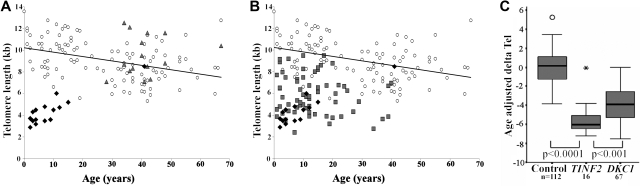
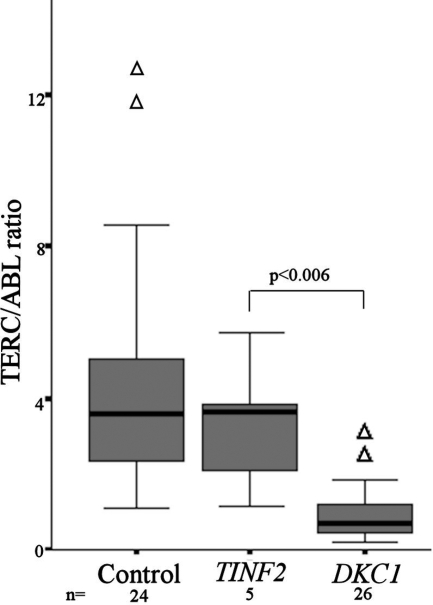
Dyskeratosis congenita (DC) is a multisystem bone marrow failure syndrome characterized by a triad of mucocutaneous abnormalities and a predisposition to cancer. The genetic basis of DC remains unknown in more than 60% of patients. Mutations have been identified in components of the telomerase complex (dyskerin, TERC, TERT, NOP10, and NHP2), and recently in one component of the shelterin complex TIN2 (gene TINF2). To establish the role of TINF2 mutations, we screened DNA from 175 uncharacterised patients with DC as well as 244 patients with other bone marrow failure disorders. Heterozygous coding mutations were found in 33 of 175 previously uncharacterized DC index patients and 3 of 244 other patients. A total of 21 of the mutations affected amino acid 282, changing arginine to histidine (n = 14) or cysteine (n = 7). A total of 32 of 33 patients with DC with TINF2 mutations have severe disease, with most developing aplastic anaemia by the age of 10 years. Telomere lengths in patients with TINF2 mutations were the shortest compared with other DC subtypes, but TERC levels were normal. In this large series, TINF2 mutations account for approximately 11% of all DC, but they do not play a significant role in patients with related disorders. This study emphasises the role of defective telomere maintenance on human disease.
Overview
The claims and statistics of this paper haven’t been checked yet.
Free: it reads the open-access text and checks the first 5 claims that cite a source we can check. Create a free account to check every claim.
Integrity signals
Registry
Cites
Statistics
Figures

Verification
Claims the paper makes
The claims and statistics of this paper haven’t been checked yet.
Free: it reads the open-access text and checks the first 5 claims that cite a source we can check. Create a free account to check every claim.
Claims other papers make about this one
Each is checked against this paper’s own text: does it say what the citing paper says it does?
The cited source says what the claim attributes to it.
In the citing paper
“Autosomal dominant forms are caused by mutations in TERT, TERC or the telomere binding protein TRF1-interacting nuclear factor 2 (156-159).”
From Telomeres and telomerase in cancer (2010) · cites this paper as [157]
The cited source says what the claim attributes to it.
In the citing paper
“Shelterin mutations have been found in some cases of aplastic anemia and dyskeratosis congenita (Savage et al., 2008; Walne et al., 2008; Zhong et al., 2011).”
From The Hallmarks of Aging (2013) · cites this paper as Walne et al., 2008
Self-check
Percentages, sums and reported differences re-computed from the paper’s own numbers.
The self-check needs the paper’s full text.
Citations
Cites
SIFT: predicting amino acid changes that affect protein function
Ng, P. C. (2003) · Nucleic Acids Research · doi:10.1093/nar/gkg509 · Cited by 6,577
Multiple sequence alignment with hierarchical clustering
Corpet, F. (1988) · Nucleic Acids Research · doi:10.1093/nar/16.22.10881 · Cited by 5,393
Shelterin: the protein complex that shapes and safeguards human telomeres
de Lange, T. (2005) · Genes & Development · doi:10.1101/gad.1346005 · Cited by 3,056
Heiss, N. S., Knight, S. W., Vulliamy, T. J., Klauck, S. M., Wiemann, S., Mason, P. J., Poustka, A., & Dokal, I. (1998) · Nature Genetics · doi:10.1038/ng0598-32 · Cited by 976
Self-citationThe RNA component of telomerase is mutated in autosomal dominant dyskeratosis congenita
Vulliamy, T., Marrone, A., Goldman, F., Dearlove, A., Bessler, M., Mason, P. J., & Dokal, I. (2001) · Nature · doi:10.1038/35096585 · Cited by 960
Self-citationMutations in TERT, the Gene for Telomerase Reverse Transcriptase, in Aplastic Anemia
Yamaguchi, H., Calado, R. T., Ly, H., Kajigaya, S., Baerlocher, G. M., Chanock, S. J., Lansdorp, P. M., & Young, N. S. (2005) · New England Journal of Medicine · doi:10.1056/nejmoa042980 · Cited by 723
Vulliamy, T., Marrone, A., Szydlo, R., Walne, A., Mason, P. J., & Dokal, I. (2004) · Nature Genetics · doi:10.1038/ng1346 · Cited by 461
Self-citationGilson, E., & Géli, V. (2007) · Nature Reviews Molecular Cell Biology · doi:10.1038/nrm2259 · Cited by 457
Armanios, M., Chen, J.-L., Chang, Y.-P. C., Brodsky, R. A., Hawkins, A., Griffin, C. A., Eshleman, J. R., Cohen, A. R., Chakravarti, A., Hamosh, A., et al. (2005) · Proceedings of the National Academy of Sciences · doi:10.1073/pnas.0508124102 · Cited by 452
Savage, S. A., Giri, N., Baerlocher, G. M., Orr, N., Lansdorp, P. M., & Alter, B. P. (2008) · The American Journal of Human Genetics · doi:10.1016/j.ajhg.2007.10.004 · Cited by 414
Cited by
López-Otín, C., Blasco, M. A., Partridge, L., Serrano, M., & Kroemer, G. (2013) · Cell · doi:10.1016/j.cell.2013.05.039 · Cited by 14,982
“Shelterin mutations have been found in some cases of aplastic anemia and dyskeratosis congenita (Savage et al., 2008; Walne et al., 2008; Zhong et al., 2011).”
BackgroundTelomeres: protecting chromosomes against genome instability
O'Sullivan, R. J., & Karlseder, J. (2010) · Nature Reviews Molecular Cell Biology · doi:10.1038/nrm2848 · Cited by 996
Armanios, M., & Blackburn, E. H. (2012) · Nature Reviews Genetics · doi:10.1038/nrg3246 · Cited by 982
Telomeres and telomerase in cancer
Artandi, S. E., & DePinho, R. A. (2010) · Carcinogenesis · doi:10.1093/carcin/bgp268 · Cited by 823
Pathophysiology and management of inherited bone marrow failure syndromes
Shimamura, A., & Alter, B. P. (2010) · Blood Reviews · doi:10.1016/j.blre.2010.03.002 · Cited by 552
Cancer in dyskeratosis congenita
Alter, B. P., Giri, N., Savage, S. A., & Rosenberg, P. S. (2009) · Blood · doi:10.1182/blood-2008-12-192880 · Cited by 478
“Median survival, y, by Kaplan-Meier method (95% CI)‡ 42 (37-49) 46 (39-55) 39 (35-44) .”
InfluentialTelomeric and extra-telomeric roles for telomerase and the telomere-binding proteins
Martínez, P., & Blasco, M. A. (2011) · Nature Reviews Cancer · doi:10.1038/nrc3025 · Cited by 468
“Mutations in TERF1 , TERF2 and TIN2 have been identified in patients with bone marrow failure syndromes, but mutations in POT1 , RAP1 and TPP1 have not yet been reporte”
BackgroundFinding the end: recruitment of telomerase to telomeres
Nandakumar, J., & Cech, T. R. (2013) · Nature Reviews Molecular Cell Biology · doi:10.1038/nrm3505 · Cited by 378
Regulation of human telomerase in homeostasis and disease
Roake, C. M., & Artandi, S. E. (2020) · Nature Reviews Molecular Cell Biology · doi:10.1038/s41580-020-0234-z · Cited by 346
Syndromes of Telomere Shortening
Armanios, M. (2009) · Annual Review of Genomics and Human Genetics · doi:10.1146/annurev-genom-082908-150046 · Cited by 317
“The majority of cases described have spontaneous mutations highlighting the detrimental effect of such mutations and their intolerance across generations (61,75) (Table 1).”
BackgroundInfluentialDokal, I. (2011) · Hematology · doi:10.1182/asheducation-2011.1.480 · Cited by 266
Self-citationDisruption of telomerase trafficking by TCAB1 mutation causes dyskeratosis congenita
Zhong, F., Savage, S. A., Shkreli, M., Giri, N., Jessop, L., Myers, T., Chen, R., Alter, B. P., & Artandi, S. E. (2011) · Genes & Development · doi:10.1101/gad.2006411 · Cited by 262
“Mutations in the telomere-binding protein TIN2 can also cause DC by leading to telomere shortening through unclear means (Savage et al. 2008; Walne et al. 2008).”
BackgroundSavage, S. A., & Alter, B. P. (2009) · Hematology/Oncology Clinics of North America · doi:10.1016/j.hoc.2009.01.003 · Cited by 262
“Patients who have RS also have abnormally short telomeres and, so far, mutations have been found in TINF2.(12,17) The authors propose that the appellation HH be restricted to patients who have DC and who have documented cerebellar hypoplasia and that the RS category requires”
BackgroundInfluentialG‐quadruplex nucleic acids and human disease
Wu, Y., & Brosh, R. M. (2010) · The FEBS Journal · doi:10.1111/j.1742-4658.2010.07760.x · Cited by 263
The genetics and clinical manifestations of telomere biology disorders
Savage, S. A., & Bertuch, A. A. (2010) · Genetics in Medicine · doi:10.1097/gim.0b013e3181f415b5 · Cited by 258
Telomerase and idiopathic pulmonary fibrosis
Armanios, M. (2012) · Mutation Research - Fundamental and Molecular Mechanisms of Mutagenesis · doi:10.1016/j.mrfmmm.2011.10.013 · Cited by 245
“Mutations in the TINF2 gene, encoding the telomere binding protein TIN2, cause severe DC which generally manifests in early childhood as a result of de novo mutations, but can rarely be transmitted in an autosomal dominant manner[33, 34].”
BackgroundGenetics of human telomere biology disorders
Revy, P., Kannengiesser, C., & Bertuch, A. A. (2023) · Nature Reviews Genetics · doi:10.1038/s41576-022-00527-z · Cited by 234
Telomere length is associated with disease severity and declines with age in dyskeratosis congenita
Alter, B. P., Rosenberg, P. S., Giri, N., Baerlocher, G. M., Lansdorp, P. M., & Savage, S. A. (2012) · Haematologica · doi:10.3324/haematol.2011.055269 · Cited by 238
“Male:female 28:12 12:2 3:1 4:3 47:18(1) 20:25 33:49 53:74(4) Age median (range) 17 (2-47) 2 (1-18) 4.”
Telomere Protection by TPP1/POT1 Requires Tethering to TIN2
Takai, K. K., Kibe, T., Donigian, J. R., Frescas, D., & de Lange, T. (2011) · Molecular Cell · doi:10.1016/j.molcel.2011.08.043 · Cited by 228
“The function of TIN2 is of particular interest because it is mutated in a subset of Dyskeratosis congenita patients (Savage et al., 2008; Walne et al., 2008; Tsangaris et al., 2008).”
BackgroundBallew, B. J., & Savage, S. A. (2013) · Expert Review of Hematology · doi:10.1586/ehm.13.23 · Cited by 209
Stewart, J. A., Chaiken, M. F., Wang, F., & Price, C. M. (2012) · Mutation Research - Fundamental and Molecular Mechanisms of Mutagenesis · doi:10.1016/j.mrfmmm.2011.08.011 · Cited by 209
“Interestingly, TIN2 is the only sheterin component thus far to be linked to human disease [51,52].”
Impact of genomic damage and ageing on stem cell function
Behrens, A., van Deursen, J. M., Rudolph, K. L., & Schumacher, B. (2014) · Nature Cell Biology · doi:10.1038/ncb2928 · Cited by 207
Telomere shortening in human diseases
Kong, C. M., Lee, X. W., & Wang, X. (2013) · The FEBS Journal · doi:10.1111/febs.12326 · Cited by 194
Parry, E. M., Alder, J. K., Qi, X., Chen, J. J.-L., & Armanios, M. (2011) · Blood · doi:10.1182/blood-2010-11-322149 · Cited by 194
Le Guen, T., Jullien, L., Touzot, F., Schertzer, M., Gaillard, L., Perderiset, M., Carpentier, W., Nitschke, P., Picard, C., Couillault, G., et al. (2013) · Human Molecular Genetics · doi:10.1093/hmg/ddt178 · Cited by 194
Telomeres in cancer and ageing
Donate, L. E., & Blasco, M. A. (2011) · Philosophical Transactions of the Royal Society B: Biological Sciences · doi:10.1098/rstb.2010.0291 · Cited by 190
Zimmermann, M., Kibe, T., Kabir, S., & de Lange, T. (2014) · Genes & Development · doi:10.1101/gad.251611.114 · Cited by 192
“TIN2 is mutated in dyskeratosis congenita (DC) and related disorders, causing severely shortened telomeres by a mechanism that is not fully understood (Savage et al. 2008; Walne et al. 2008; Sarper et al. 2010).”
BackgroundInTERTpreting telomerase structure and function
Wyatt, H. D. M., West, S. C., & Beattie, T. L. (2010) · Nucleic Acids Research · doi:10.1093/nar/gkq370 · Cited by 184
Exome Sequencing Identifies Mutant TINF2 in a Family With Pulmonary Fibrosis
Alder, J. K., Stanley, S. E., Wagner, C. L., Hamilton, M., Hanumanthu, V. S., & Armanios, M. (2015) · Chest · doi:10.1378/chest.14-1947 · Cited by 181
Dyskeratosis congenita, stem cells and telomeres
Kirwan, M., & Dokal, I. (2009) · Biochimica et Biophysica Acta (BBA) - Molecular Basis of Disease · doi:10.1016/j.bbadis.2009.01.010 · Cited by 180
“TINF2 mutations cause AD-DC [52] in around 11% of all cases of DC and in some cases HH [53].”
BackgroundSelf-citationNiewisch, M. R., & Savage, S. A. (2019) · Expert Review of Hematology · doi:10.1080/17474086.2019.1662720 · Cited by 174
“To date germline pathogenic variants causing HH have been identified in DKC1 [112], TERT [64], TERC [65], TINF2 [85,113],”
BackgroundTelomeropathies: An emerging spectrum disorder
Holohan, B., Wright, W. E., & Shay, J. W. (2014) · Journal of Cell Biology · doi:10.1083/jcb.201401012 · Cited by 175
“For example, within a cohort of TIN2 mutants from different families with mutation in the same residue of TIN2 (Arg282), the classic triad does not always appear, and classification of these patients ranges from aplastic anemia to HoyeraalHreidarsson syndrome; as a whole, only 35% of TIN2 mutants showed the classic tr…”
InfluentialTelomerase gene mutations are associated with cirrhosis formation
Hartmann, D., Srivastava, U., Thaler, M., Kleinhans, K. N., N'Kontchou, G., Scheffold, A., Bauer, K., Kratzer, R. F., Kloos, N., Katz, S.-F., et al. (2011) · Hepatology · doi:10.1002/hep.24217 · Cited by 173
Advances in the understanding of dyskeratosis congenita
Walne, A. J., & Dokal, I. (2009) · British Journal of Haematology · doi:10.1111/j.1365-2141.2009.07598.x · Cited by 175
“Mutations have been identified in the TINF2 component of shelterin in patients with DC, HH, aplastic anaemia and Revesz syndrome (Savage et al, 2008; Walne et al, 2008).”
BackgroundSelf-citationThe molecular genetics of the telomere biology disorders
Bertuch, A. A. (2016) · RNA Biology · doi:10.1080/15476286.2015.1094596 · Cited by 169
“For certain genes, such as DKC1 and particularly TINF2, which encodes TIN2, de novo mutations are common.(69,70) Notably, disease-associated heterozygous and homozygous or compound heterozygous mutations in TERT, RTEL1 and PARN have been observed, with the biallelic mutations associated with childhood onset and more s…”
BackgroundStop pulling my strings — what telomeres taught us about the DNA damage response
Lazzerini-Denchi, E., & Sfeir, A. (2016) · Nature Reviews Molecular Cell Biology · doi:10.1038/nrm.2016.43 · Cited by 170
Telomere length measurement as a clinical biomarker of aging and disease
Fasching, C. L. (2018) · Critical Reviews in Clinical Laboratory Sciences · doi:10.1080/10408363.2018.1504274 · Cited by 167
“[119,120] and TPP1 [121,122], are implicated in clinical”
BackgroundDeng, Z., Glousker, G., Molczan, A., Fox, A. J., Lamm, N., Dheekollu, J., Weizman, O.-E., Schertzer, M., Wang, Z., Vladimirova, O., et al. (2013) · Proceedings of the National Academy of Sciences · doi:10.1073/pnas.1300600110 · Cited by 161
“HHS-causing mutations have previously been found in telomerase and the shelterin component telomeric repeat binding factor 1 (TRF1)-interacting nuclear factor 2 (TIN2).”
BackgroundInfluentialThe Role of Telomere Biology in Cancer
Xu, L., Li, S., & Stohr, B. A. (2013) · Annual Review of Pathology: Mechanisms of Disease · doi:10.1146/annurev-pathol-020712-164030 · Cited by 160
The genetics of dyskeratosis congenita
Mason, P. J., & Bessler, M. (2011) · Cancer Genetics · doi:10.1016/j.cancergen.2011.11.002 · Cited by 161
“Curiously, although usually highly penetrant and severe, rare individuals carrying one of these mutations have been found that are silent carriers(82) or present with some DC features but not aplastic anemia(84).”
BackgroundDu, H.-Y., Pumbo, E., Ivanovich, J., An, P., Maziarz, R. T., Reiss, U. M., Chirnomas, D., Shimamura, A., Vlachos, A., Lipton, J. M., et al. (2009) · Blood · doi:10.1182/blood-2008-07-166421 · Cited by 158
“TINF2 exon 6: Recently mutations in exon 6 of TINF2 have been identified in patients with DC and short telomeres.(9,44) We therefore screened all patients with telomeres ≤1 percentile for mutations in TINF2 exon 6 (n=49).”
BackgroundTelomere-associated aging disorders
Opresko, P. L., & Shay, J. W. (2017) · Ageing Research Reviews · doi:10.1016/j.arr.2016.05.009 · Cited by 159
Apollo Contributes to G Overhang Maintenance and Protects Leading-End Telomeres
Wu, P., van Overbeek, M., Rooney, S., & de Lange, T. (2010) · Molecular Cell · doi:10.1016/j.molcel.2010.06.031 · Cited by 159
“DC is a bone marrow failure syndrome that can be caused by mutations in telomerase components and the shelterin component TIN2, but shelterin accessory factors had not been implicated in the disease (Mason et al., 2005; Savage et al., 2008; Walne et al., 2008).”
BackgroundUnraveling the pathogenesis of Hoyeraal–Hreidarsson syndrome, a complex telomere biology disorder
Glousker, G., Touzot, F., Revy, P., Tzfati, Y., & Savage, S. A. (2015) · British Journal of Haematology · doi:10.1111/bjh.13442 · Cited by 141
“Over 20 TINF2 mutations have been described for DC, and three of them also for HH (K280X, R282H, P283S; Fig 3C) (Podlevsky et al, 2008; Savage et al, 2008; Walne et al, 2008; Touzot et al, 2012).”
BackgroundInfluentialDyskeratosis congenita as a disorder of telomere maintenance
Nelson, N. D., & Bertuch, A. A. (2012) · Mutation Research - Fundamental and Molecular Mechanisms of Mutagenesis · doi:10.1016/j.mrfmmm.2011.06.008 · Cited by 140
“Although a family with autosomal inheritance of a TINF2 mutation has been reported [27], these mutations are most often de novo, and result in a dramatic telomere shortening within the first generation [27, 66].”
BackgroundInfluentialRole of shelterin in cancer and aging
Martínez, P., & Blasco, M. A. (2010) · Aging Cell · doi:10.1111/j.1474-9726.2010.00596.x · Cited by 136
“Similarly, mutations in TIN2, TRF2 and TRF1 have been linked to some cases of Dyskeratosis congenita and aplastic anemia (Savage et al., 2006, 2008; Tsangaris et al., 2008; Walne et al., 2008).”
BackgroundRTEL1: functions of a disease-associated helicase
Vannier, J., Sarek, G., & Boulton, S. J. (2014) · Trends in Cell Biology · doi:10.1016/j.tcb.2014.01.004 · Cited by 150
Intrinsic and extrinsic causes of malignancies in patients with primary immunodeficiency disorders
Hauck, F. H., Voss, R. K., Urban, C. E., & Seidel, M. G. (2017) · Journal of Allergy and Clinical Immunology · doi:10.1016/j.jaci.2017.06.009 · Cited by 143
Classification of Childhood Aplastic Anemia and Myelodysplastic Syndrome
Niemeyer, C. M., & Baumann, I. (2011) · Hematology · doi:10.1182/asheducation-2011.1.84 · Cited by 122
Zhang, M. Y., Keel, S. B., Walsh, T., Lee, M. K., Gulsuner, S., Watts, A. C., Pritchard, C. C., Salipante, S. J., Jeng, M. R., Hofmann, I., et al. (2015) · Haematologica · doi:10.3324/haematol.2014.113456 · Cited by 122
“A patient with aplastic anemia has previously been reported to harbor this variant as a heterozygote.(4) This variant is present with an allele frequency of 0.”
BackgroundRevertant Somatic Mosaicism by Mitotic Recombination in Dyskeratosis Congenita
Jongmans, M. C. J., Verwiel, E. T. P., Heijdra, Y., Vulliamy, T., Kamping, E. J., Hehir-Kwa, J. Y., Bongers, E. M. H. F., Pfundt, R., van Emst, L., van Leeuwen, F. N., et al. (2012) · The American Journal of Human Genetics · doi:10.1016/j.ajhg.2012.01.004 · Cited by 124
Self-citationGuo, Y., Kartawinata, M., Li, J., Pickett, H. A., Teo, J., Kilo, T., Barbaro, P. M., Keating, B., Chen, Y., Tian, L., et al. (2014) · Blood · doi:10.1182/blood-2014-08-596445 · Cited by 120
Control of telomerase action at human telomeres
Hockemeyer, D., & Collins, K. (2015) · Nature Structural & Molecular Biology · doi:10.1038/nsmb.3083 · Cited by 117
Telomere Replication Stress Induced by POT1 Inactivation Accelerates Tumorigenesis
Pinzaru, A. M., Hom, R. A., Beal, A., Phillips, A. F., Ni, E., Cardozo, T., Nair, N., Choi, J., Wuttke, D. S., Sfeir, A., et al. (2016) · Cell Reports · doi:10.1016/j.celrep.2016.05.008 · Cited by 114
“POT1 is anchored to telomeres by forming a heterodimer with TPP1, which is in turn tethered to the rest of the shelterin complex by TIN2 (Liu et al., 2004; Ye et al., 2004).”
BackgroundInfluentialJones, A. M., Beggs, A. D., Carvajal-Carmona, L., Farrington, S., Tenesa, A., Walker, M., Howarth, K., Ballereau, S., Hodgson, S. V., Zauber, A., et al. (2012) · Gut · doi:10.1136/gut.2011.239772 · Cited by 113
The role of telomeres in the ageing of human skin: Telomeres and skin ageing
Buckingham, E. M., & Klingelhutz, A. J. (2011) · Experimental Dermatology · doi:10.1111/j.1600-0625.2010.01242.x · Cited by 109
Molecular mechanisms of telomere biology disorders
Grill, S., & Nandakumar, J. (2020) · Journal of Biological Chemistry · doi:10.1074/jbc.rev120.014017 · Cited by 120
Mitochondrial Localization of Telomeric Protein TIN2 Links Telomere Regulation to Metabolic Control
Chen, L.-Y., Zhang, Y., Zhang, Q., Li, H., Luo, Z., Fang, H., Kim, S. H., Qin, L., Yotnda, P., Xu, J., et al. (2012) · Molecular Cell · doi:10.1016/j.molcel.2012.07.002 · Cited by 104
“Mutations in TIN2 have been linked to diseases with premature aging phenotypes and bone marrow failures such as dyskeratosis congenita, ataxia-pancytopenia, and aplastic anemia (Du et al., 2009; Sasa et al., 2011; Savage et al., 2008; Tsangaris et al., 2008; Walne et al., 2008; Yang et al., 2011a).”
BackgroundDisease progression and clinical outcomes in telomere biology disorders
Niewisch, M. R., Giri, N., McReynolds, L. J., Alsaggaf, R., Bhala, S., Alter, B. P., & Savage, S. A. (2022) · Blood · doi:10.1182/blood.2021013523 · Cited by 103
Dyskeratosis congenita and telomere biology disorders
Savage, S. A. (2022) · Hematology · doi:10.1182/hematology.2022000394 · Cited by 95
Inherited Predisposition to Acute Myeloid Leukemia
Godley, L. A. (2014) · Seminars in Hematology · doi:10.1053/j.seminhematol.2014.08.001 · Cited by 112
“Mutations in TINF2, which encodes the shelterin component TIN2, lead to extremely short telomeres and often present as de novo mutations, leading to severe DC or other genetic syndromes, with high penetrance and an early age of onset.(75,79) Recently, mutations in RTEL1, a gene encoding a telomere-associated elongatio…”
BackgroundVulliamy, T. J., Kirwan, M. J., Beswick, R., Hossain, U., Baqai, C., Ratcliffe, A., Marsh, J., Walne, A., & Dokal, I. (2011) · PLoS ONE · doi:10.1371/journal.pone.0024383 · Cited by 105
“From this same group of patients we have previously reported on 4 families with MDS/AML and mutations in TERC or TERT [53], as well as 33 families with mutations in the TINF2 gene [39,42] and have also identified 14 families with recurrent DKC1 mutations and 3 families with recurrent TERC mutations.”
BackgroundResultSelf-citationHe, H., Wang, Y., Guo, X., Ramchandani, S., Ma, J., Shen, M.-F., Garcia, D. A., Deng, Y., Multani, A. S., You, M. J., et al. (2009) · Molecular and Cellular Biology · doi:10.1128/mcb.01400-08 · Cited by 101
“The presence of mutations in the shelterin protein TIN2 in patients with DC supports this notion (29, 36 ).”
BackgroundA role for heterochromatin protein 1γ at human telomeres
Canudas, S., Houghtaling, B. R., Bhanot, M., Sasa, G., Savage, S. A., Bertuch, A. A., & Smith, S. H. (2011) · Genes & Development · doi:10.1101/gad.17325211 · Cited by 130
“GENES & DEVELOPMENT 25:1807–1819 2011 by Cold Spring Harbor Laboratory Press ISSN 0890-9369/11; www.genesdev.org 1807 (Savage et al. 2008; Walne et al. 2008; Sasa et al. 2011).”
BackgroundInfluentialWalne, A. J., Vulliamy, T., Beswick, R. W., Kirwan, M., & Dokal, I. S. (2010) · Human Molecular Genetics · doi:10.1093/hmg/ddq371 · Cited by 100
“Although some of these TINF2 mutations are inherited in a dominant fashion, the majority are de novo (9).”
BackgroundSelf-citationTouzot, F., Callebaut, I., Soulier, J., Gaillard, L., Azerrad, C., Durandy, A., Fischer, A., de Villartay, J.-P., & Revy, P. (2010) · Proceedings of the National Academy of Sciences · doi:10.1073/pnas.0914918107 · Cited by 95
“TIN2, TERT, and dyskerin mutations have been described in some patients with HH syndrome, but the molecular cause of most cases of DKC and HH syndrome remains undefined (8, 9).”
BackgroundThree novel truncating TINF2 mutations causing severe dyskeratosis congenita in early childhood
Sasa, G., Ribes‐Zamora, A., Nelson, N., & Bertuch, A. (2012) · Clinical Genetics · doi:10.1111/j.1399-0004.2011.01658.x · Cited by 88
“838A>T K280X Nonsense DC/HH/RS HH/RS 1 1 (11) c.”
BackgroundInfluentialShort telomeres: from dyskeratosis congenita to sporadic aplastic anemia and malignancy
Gramatges, M. M., & Bertuch, A. A. (2013) · Translational Research · doi:10.1016/j.trsl.2013.05.003 · Cited by 88
“The DCassociated mutations in this gene are autosomal dominant and comprise a substantial proportion of DC cases, between 10% and 30% in 2 large cohorts.(46,63) In contrast to individuals carrying heterozygous mutations in TERT or TERC, TINF2 mutations present most frequently in early childhood and are often de novo,…”
BackgroundAdvances in the understanding of congenital amegakaryocytic thrombocytopenia
Ballmaier, M., & Germeshausen, M. (2009) · British Journal of Haematology · doi:10.1111/j.1365-2141.2009.07706.x · Cited by 85
“…component), TERT (telomerase reverse transcriptase), or TINF2 (component of the shelterin telomere protection complex) can account for the autosomal dominant forms (MIM #127550), and NOP10 and NHP2 mutations can be involved in autosomal recessive DC (MIM #224230) (reviewed in Walne et al, 2008).”
BackgroundDorajoo, R., Chang, X., Gurung, R. L., Li, Z., Wang, L., Wang, R., Beckman, K. B., Adams‐Haduch, J. M., Yiamunaa, M., Liu, S., et al. (2019) · Nature Communications · doi:10.1038/s41467-019-10443-2 · Cited by 90
Cossu, F. (2010) · The Italian Journal of Pediatrics/Italian journal of pediatrics · doi:10.1186/1824-7288-36-76 · Cited by 103
“Various other genetic defects cause HHS both in male and female infants: ARHHS by homozygous mutations of the TERT gene encoding telomerase reverse-transcriptase [107]; ADHHS by heterozygous mutations of the TINF2 gene encoding TIN2 (TRF1-interacting nuclear protein 2), one of the components (six proteins) of the shel…”
BackgroundKam, M. L. W., Nguyen, T. T. T., & Ngeow, J. Y. Y. (2021) · npj Genomic Medicine · doi:10.1038/s41525-021-00198-5 · Cited by 96
Short Telomeres in Key Tissues Initiate Local and Systemic Aging in Zebrafish
Carneiro, M. C., Henriques, C. M., Nabais, J., Ferreira, T., Carvalho, T., & Ferreira, M. G. (2016) · PLOS Genetics · doi:10.1371/journal.pgen.1005798 · Cited by 87
“Dysfunction and disease severity can be predicted by the extent of short telomere accumulation in different tissues [27,28].”
BackgroundBessler, M., Wilson, D. B., & Mason, P. J. (2010) · FEBS Letters · doi:10.1016/j.febslet.2010.05.019 · Cited by 81
“Interestingly the recurrent A353V mutation in DKC1 and the R282H and R282C in TINF2 most frequently occur sporadically (see also above) suggesting that these occur within mutational hotspots and indeed these three mutations all arise from the relatively frequent CpG to TpG transitions that can occur by deamination of…”
BackgroundMolecular basis of telomere dysfunction in human genetic diseases
Sarek, G., Marzec, P., Margalef, P., & Boulton, S. J. (2015) · Nature Structural & Molecular Biology · doi:10.1038/nsmb.3093 · Cited by 89
Human Telomeres and Telomere Biology Disorders
Savage, S. A. (2014) · Progress in molecular biology and translational science · doi:10.1016/b978-0-12-397898-1.00002-5 · Cited by 82
Gu, P., & Chang, S. (2013) · Aging Cell · doi:10.1111/acel.12139 · Cited by 73
“Mutations in the shelterin component TIN2 result in a very severe form of DC, with patients bearing very short telomeres and displaying premature BM failure as early as 10 years of age, even though telomerase function remains intact (Savage et al., 2008; Walne et al., 2008).”
BackgroundThe biology and management of dyskeratosis congenita and related disorders of telomeres
Tummala, H., Walne, A. J., & Dokal, I. S. (2022) · Expert Review of Hematology · doi:10.1080/17474086.2022.2108784 · Cited by 79
“In some patients with clinical features of DC, HH, AA, and Revesz syndrome (RS), heterozygous TINF2 variants have been identified [19,20].”
BackgroundSelf-citationDyskeratosis congenita: The first NIH clinical research workshop
Savage, S. A., Dokal, I. S., Armanios, M. Y., Aubert, G., Cowen, E. W., Domingo, D. L., Giri, N., Greene, M. H., Orchard, P. J., Tolar, J., et al. (2009) · Pediatric Blood & Cancer · doi:10.1002/pbc.22061 · Cited by 71
“Three genes have been identified in AD DC, including the RNA subunit of telomerase (TERC), the telomerase enzyme (TERT), and a component of the shelterin telomere protection complex (TINF2) [11,12,13,14,15,16,17,18].”
BackgroundSelf-citationGiri, N., Lee, R. L., Faro, A., Huddleston, C. B., White, F. V., Alter, B. P., & Savage, S. A. (2011) · BMC Blood Disorders · doi:10.1186/1471-2326-11-3 · Cited by 70
Trahan, C., Martel, C., & Dragon, F. (2009) · Human Molecular Genetics · doi:10.1093/hmg/ddp551 · Cited by 86
Biological markers for the effects of yoga as a complementary and alternative medicine
Mohammad, A., Thakur, P., Kumar, R., Kaur, S., Saini, R. V., & Saini, A. K. (2019) · Journal of Complementary and Integrative Medicine · doi:10.1515/jcim-2018-0094 · Cited by 86
Dyskeratosis congenita: a literature review
Alsabbagh, M. M. (2020) · JDDG Journal der Deutschen Dermatologischen Gesellschaft · doi:10.1111/ddg.14268 · Cited by 91
Decreased dyskerin levels as a mechanism of telomere shortening in X-linked dyskeratosis congenita
Parry, E. M., Alder, J. K., Lee, S. S., Phillips, J. A., Loyd, J. E., Duggal, P., & Armanios, M. (2011) · Journal of Medical Genetics · doi:10.1136/jmg.2010.085100 · Cited by 66
Inherited bone marrow failure syndromes in adolescents and young adults
Wilson, D. B., Link, D. C., Mason, P. J., & Bessler, M. (2014) · Annals of Medicine · doi:10.3109/07853890.2014.915579 · Cited by 69
Tsangaris, E., Klaassen, R. J., Fernandez, C. V., Yanofsky, R., Shereck, E. B., Champagne, J., Silva, M., Lipton, J. H., Brossard, J., Michon, B., et al. (2011) · Journal of Medical Genetics · doi:10.1136/jmg.2011.089821 · Cited by 69
“mutations seems to be higher in North America than in Europe, and was reported in about 40–80% of the K/SCN patients.”
BackgroundTIN2 Protein Dyskeratosis Congenita Missense Mutants Are Defective in Association with Telomerase
Yang, D., He, Q., Kim, H., Ma, W., & Songyang, Z. (2011) · Journal of Biological Chemistry · doi:10.1074/jbc.m111.225870 · Cited by 80
Recognizing familial myeloid leukemia in adults
Nickels, E. M., Soodalter, J. A., Churpek, J. E., & Godley, L. A. (2013) · Therapeutic Advances in Hematology · doi:10.1177/2040620713487399 · Cited by 79
The Shelterin TIN2 Subunit Mediates Recruitment of Telomerase to Telomeres
Frank, A. K., Tran, D. C., Qu, R. W., Stohr, B. A., Segal, D. J., & Xu, L. (2015) · PLoS Genetics · doi:10.1371/journal.pgen.1005410 · Cited by 77
The shelterin complex and hematopoiesis
Jones, M., Bisht, K. K., Savage, S. A., Nandakumar, J., Keegan, C. E., & Maillard, I. P. (2016) · Journal of Clinical Investigation · doi:10.1172/jci84547 · Cited by 65
Telomere dysfunction and its role in haematological cancer
Jones, C. H., Pepper, C. J., & Baird, D. M. (2012) · British Journal of Haematology · doi:10.1111/j.1365-2141.2011.09022.x · Cited by 67
“…aplastic anaemia have been shown to have shortened TL that is attributed to mutations in telomere associated genes such as DKC1, TERC, TERT and TINF2 in DC and TERC, TERT and TERF1 in acquired aplastic anaemia (Vulliamy et al, 2002, 2004, 2005, 2008; Yamaguchi et al, 2003, 2005; Walne et al, 2008).”
BackgroundTelomere function and regulation from mouse models to human ageing and disease
Jones-Weinert, C. W., Mainz, L., & Karlseder, J. (2024) · Nature Reviews Molecular Cell Biology · doi:10.1038/s41580-024-00800-5 · Cited by 70
“Interestingly, mutations in TINF2 that occur in the vicinity of its interaction sites with TRF1, TRF2 and TPP1 have been shown to lead to TBDs, whereas mutations resulting in the impaired recruitment of TIN2 to telomeres have been linked to long telomeres and cancer predisposition 161 .”
InfluentialA TIN2 dyskeratosis congenita mutation causes telomerase-independent telomere shortening in mice
Frescas, D., & de Lange, T. (2014) · Genes & Development · doi:10.1101/gad.233395.113 · Cited by 68
“…Published by Cold Spring Harbor Laboratory Press; ISSN 0890-9369/14; www.genesdev.org 153 most common cause of DC is now known to arise from heterozygous mutations in the TINF2 gene, which encodes the TIN2 component of shelterin (Savage et al. 2008; Walne et al. 2008; Sarper et al. 2010).”
BackgroundPulmonary fibrosis in dyskeratosis congenita withTINF2gene mutation
Fukuhara, A., Tanino, Y., Ishii, T., Inokoshi, Y., Saito, K., Fukuhara, N., Sato, S., Saito, J., Ishida, T., Yamaguchi, H., et al. (2013) · European Respiratory Journal · doi:10.1183/09031936.00149113 · Cited by 55
“1 To the Editor: Dyskeratosis congenita (DC) is a rare inherited disorder of ectodermal dysplasia characterized by the classical mucocutaneous triad of abnormal skin pigmentation, nail dystrophy, and leukoplakia[1-3], at least one of which is present in around 80-90% of DC cases.”
BackgroundInfluentialTINF2 is a haploinsufficient tumor suppressor that limits telomere length
Schmutz, I., Mensenkamp, A. R., Takai, K., Haadsma, M., Spruijt, L., de Voer, R. M., Choo, S.-A. S., Lorbeer, F. K., van Grinsven, E. J., Hockemeyer, D. F., et al. (2020) · eLife · doi:10.7554/elife.61235 · Cited by 62
TIN2 Functions with TPP1/POT1 To Stimulate Telomerase Processivity
Pike, A. M., Strong, M. A., Ouyang, J. P. T., Connelly, C. J., & Greider, C. W. (2019) · Molecular and Cellular Biology · doi:10.1128/mcb.00593-18 · Cited by 60
“in a TIN2 domain of unknown function in exon 6 near the C terminus of TIN2 (25, 26)”
BackgroundTelomere and telomerase in chronic liver disease and hepatocarcinoma
Carulli, L., & Anzivino, C. (2014) · World Journal of Gastroenterology · doi:10.3748/wjg.v20.i20.6287 · Cited by 57
Genetic Interstitial Lung Disease
Devine, M., & Garcia, C. K. (2011) · Clinics in Chest Medicine · doi:10.1016/j.ccm.2011.11.001 · Cited by 58
Madonna, R., Novo, G., & Balistreri, C. R. (2016) · Mechanisms of Ageing and Development · doi:10.1016/j.mad.2016.03.005 · Cited by 54
Amir, M., Κhan, P., Queen, A., Dohare, R., Alajmi, M. F., Hussain, A., Islam, A., Ahmad, F., & Hassan, M. I. (2020) · Cells · doi:10.3390/cells9020359 · Cited by 58
“Mutation in this gene is mainly associated with variants of DC called Hoyeraal-Hreidarsson (HH) [124] and Revesz syndromes [92,125].”
Background
Metadata
- Authors
- Walne, A. J., Vulliamy, T., Beswick, R., Kirwan, M., & Dokal, I.
- Affiliations
- Queen Mary University of London (GB)
- Corresponding author
- Walne, Amanda J.
- Vulliamy, Tom
- Venue
- Blood
- Publisher
- American Society of Hematology
- Published
- 2008-11-01
- Volume
- 112
- Issue
- 9
- Pages
- 3594-3600
- ISSN
- 0006-4971 (ISSN-L)
- 1528-0020
- PMC
- PMC2572788
- OpenAlex
- W2170632126
- Semantic Scholar
- 27e59f3d4e1da4c16a64b2ef3394a4dd4373f325
- Cited by
- 317
- References
- 26
- Citations by year
- 2026: 9 · 2025: 12 · 2024: 13 · 2023: 9 · 2022: 12 · 2021: 18 · 2020: 16 · 2019: 14 · 2018: 16 · 2017: 13 · 2016: 19 · 2015: 15 · 2014: 27 · 2013: 26 · 2012: 13
- FWCI
- 19.24
- Type
- journal article
- Language
- en
- Open access
- green
- europepmc.org
- Licence
- other-oa
- Locations
- Blood (publishedVersion)
- Europe PMC (PubMed Central) (publishedVersion, other-oa)
- PubMed Central (publishedVersion, cc-by-nc)
- PubMed (publishedVersion)
- Funders
- Queen Mary University of London
- Wellcome Trust
- Medical Research Council
- Topics
- Life Sciences › Biochemistry, Genetics and Molecular Biology › Cell Biology › Telomeres, Telomerase, and Senescence
- Health Sciences › Medicine › Hematology › Blood disorders and treatments
- Life Sciences › Immunology and Microbiology › Immunology › Immunodeficiency and Autoimmune Disorders
- Keywords
- TIN2, dyskeratosis congenita, bone marrow failure syndromes, telomere length, telomere maintenance, shelterin complex, TERC, telomerase reverse transcriptase, dyskerin, NOP10, NHP2, aplastic anemia, genetic mutations, disease severity
- MeSH terms
- Adolescent, Adult, Aged, Aged, 80 and over, Amino Acid Sequence, Base Sequence, Bone Marrow Diseases, Child, Child, Preschool, Female, Heterozygote, Humans, Infant, Infant, Newborn, Male, Middle Aged, Molecular Sequence Data, Mutation, RNA, Syndrome, Cohort Studies, Telomere, Sequence Homology, Amino Acid, DNA Primers, Telomerase, Dyskeratosis Congenita, Amino Acid Substitution, Telomere-Binding Proteins
About these checks
Registry, retraction, Cites and statistics results are computed, not judged, with one exception: a printed reference that no index lists is read once by a model before it counts as a citation error. Claims are extracted by a model and kept only when their quote appears verbatim in the text; each cited source is then checked, with a model’s help, for whether it says what the claim relies on. Those verdicts can be wrong — read the claim’s quote and the cited source before relying on one.
Statistics and arithmetic are recomputed, not judged.
Confidence bands are shown only for fields calibrated on our annotated test set. None is calibrated yet, so no band is shown.
What counts as a claim ›How we measure confidence ›How we check this ›
Are you an author, or do you see a problem with this page? Request a review
Data sources
Bibliographic data: Semantic Scholar, OpenAlex, Crossref.
Contains information from the Semantic Scholar Academic Graph Datasets, made available under the ODC Attribution License (ODC-BY 1.0).
Semantic Scholar’s data is described in: Kinney, R., et al. (2023). The Semantic Scholar Open Data Platform. arXiv:2301.10140.
