

TINF2 mutations result in very short telomeres: analysis of a large cohort of patients with dyskeratosis congenita and related bone marrow failure syndromes
Open accessThe DOI matches its Crossref record; 26 of the 26 references it cites were found in a registry or an index.
Abstract
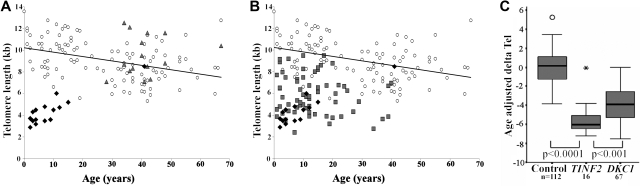
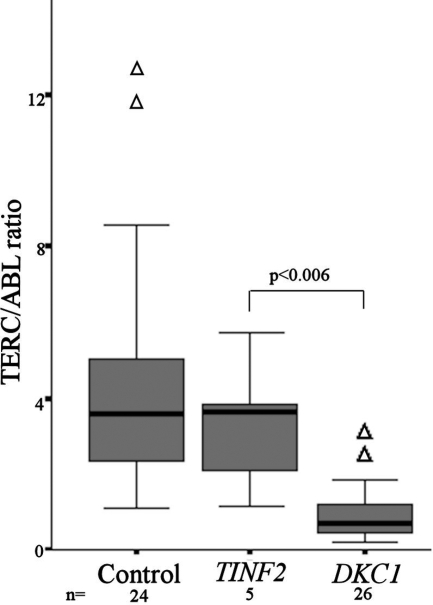
Dyskeratosis congenita (DC) is a multisystem bone marrow failure syndrome characterized by a triad of mucocutaneous abnormalities and a predisposition to cancer. The genetic basis of DC remains unknown in more than 60% of patients. Mutations have been identified in components of the telomerase complex (dyskerin, TERC, TERT, NOP10, and NHP2), and recently in one component of the shelterin complex TIN2 (gene TINF2). To establish the role of TINF2 mutations, we screened DNA from 175 uncharacterised patients with DC as well as 244 patients with other bone marrow failure disorders. Heterozygous coding mutations were found in 33 of 175 previously uncharacterized DC index patients and 3 of 244 other patients. A total of 21 of the mutations affected amino acid 282, changing arginine to histidine (n = 14) or cysteine (n = 7). A total of 32 of 33 patients with DC with TINF2 mutations have severe disease, with most developing aplastic anaemia by the age of 10 years. Telomere lengths in patients with TINF2 mutations were the shortest compared with other DC subtypes, but TERC levels were normal. In this large series, TINF2 mutations account for approximately 11% of all DC, but they do not play a significant role in patients with related disorders. This study emphasises the role of defective telomere maintenance on human disease.
Overview
The claims and statistics of this paper haven’t been checked yet.
Free: it reads the open-access text and checks the first 5 claims that cite a source we can check. Create a free account to check every claim.
Integrity signals
Registry
Cites
Statistics
Figures

Verification
Claims the paper makes
The claims and statistics of this paper haven’t been checked yet.
Free: it reads the open-access text and checks the first 5 claims that cite a source we can check. Create a free account to check every claim.
Claims other papers make about this one
Each is checked against this paper’s own text: does it say what the citing paper says it does?
The cited source says what the claim attributes to it.
In the citing paper
“Autosomal dominant forms are caused by mutations in TERT, TERC or the telomere binding protein TRF1-interacting nuclear factor 2 (156-159).”
From Telomeres and telomerase in cancer (2010) · cites this paper as [157]
The cited source says what the claim attributes to it.
In the citing paper
“Shelterin mutations have been found in some cases of aplastic anemia and dyskeratosis congenita (Savage et al., 2008; Walne et al., 2008; Zhong et al., 2011).”
From The Hallmarks of Aging (2013) · cites this paper as Walne et al., 2008
Self-check
Percentages, sums and reported differences re-computed from the paper’s own numbers.
The self-check needs the paper’s full text.
Citations
Cites
SIFT: predicting amino acid changes that affect protein function
Ng, P. C. (2003) · Nucleic Acids Research · doi:10.1093/nar/gkg509 · Cited by 6,577
Multiple sequence alignment with hierarchical clustering
Corpet, F. (1988) · Nucleic Acids Research · doi:10.1093/nar/16.22.10881 · Cited by 5,393
Shelterin: the protein complex that shapes and safeguards human telomeres
de Lange, T. (2005) · Genes & Development · doi:10.1101/gad.1346005 · Cited by 3,056
Heiss, N. S., Knight, S. W., Vulliamy, T. J., Klauck, S. M., Wiemann, S., Mason, P. J., Poustka, A., & Dokal, I. (1998) · Nature Genetics · doi:10.1038/ng0598-32 · Cited by 976
Self-citationThe RNA component of telomerase is mutated in autosomal dominant dyskeratosis congenita
Vulliamy, T., Marrone, A., Goldman, F., Dearlove, A., Bessler, M., Mason, P. J., & Dokal, I. (2001) · Nature · doi:10.1038/35096585 · Cited by 960
Self-citationMutations in TERT, the Gene for Telomerase Reverse Transcriptase, in Aplastic Anemia
Yamaguchi, H., Calado, R. T., Ly, H., Kajigaya, S., Baerlocher, G. M., Chanock, S. J., Lansdorp, P. M., & Young, N. S. (2005) · New England Journal of Medicine · doi:10.1056/nejmoa042980 · Cited by 723
Vulliamy, T., Marrone, A., Szydlo, R., Walne, A., Mason, P. J., & Dokal, I. (2004) · Nature Genetics · doi:10.1038/ng1346 · Cited by 461
Self-citationGilson, E., & Géli, V. (2007) · Nature Reviews Molecular Cell Biology · doi:10.1038/nrm2259 · Cited by 457
Armanios, M., Chen, J.-L., Chang, Y.-P. C., Brodsky, R. A., Hawkins, A., Griffin, C. A., Eshleman, J. R., Cohen, A. R., Chakravarti, A., Hamosh, A., et al. (2005) · Proceedings of the National Academy of Sciences · doi:10.1073/pnas.0508124102 · Cited by 452
Savage, S. A., Giri, N., Baerlocher, G. M., Orr, N., Lansdorp, P. M., & Alter, B. P. (2008) · The American Journal of Human Genetics · doi:10.1016/j.ajhg.2007.10.004 · Cited by 414
Cited by
Items 201–300 of 315
Fioredda, F., Beccaria, A., Casartelli, P., Turrini, E., Contratto, C., Giarratana, M. C., Bagnasco, F., Saettini, F., Pillon, M., Marzollo, A., et al. (2024) · American Journal of Hematology · doi:10.1002/ajh.27221 · Cited by 7
“31 Since this variant has also been described in the literature in two patients with bone marrow aplasia its role remains debatable.”
BackgroundNovel mutation of the TINF2 gene resulting in severe phenotypic Revesz syndrome
Sakwit, A., Rojanaporn, D., Mekjaruskul, P., Suriyajakryuththana, W., Sasanakul, W., & Sirachainan, N. (2018) · Pediatric Blood & Cancer · doi:10.1002/pbc.27557 · Cited by 6
Diverse telomeres in trypanosomatids
Poláková, E., Záhonová, K., Albanaz, A. T. S., Butenko, A., Lukeš, J., & Yurchenko, V. (2021) · Parasitology · doi:10.1017/s0031182021000378 · Cited by 7
“…an orthologue of mammalian TINF2 (Jehi et al., 2014a; 2014b)] was suggested to be essential, as it is involved in shelterin (a protein complex implicated in telomere protection) assembly and telomerase-mediated telomere length maintenance in other organisms (Walne et al., 2008; Frank et al., 2015).”
BackgroundTelomerase and non-Telomerase Mechanisms of Telomere Maintenance
Morrish, T. A. (2019) · IntechOpen eBooks · doi:10.5772/intechopen.73734 · Cited by 8
Differential impact of a dyskeratosis congenita mutation in TPP1 on mouse hematopoiesis and germline
Graniel, J. V., Bisht, K. K., Friedman, A. D., White, J. S., Perkey, E., Vanderbeck, A., Moroz, A., Carrington, L. J., Brandstadter, J. D., Allen, F., et al. (2021) · Life Science Alliance · doi:10.26508/lsa.202101208 · Cited by 8
“DC mutations in the TINF2 gene coding for shelterin protein TIN2 have been modeled in mice, but their underlying mechanism is complicated, with several proposed models relying both on telomerase-dependent and independent modes of action (Savage et al. 2008; Walne et al. 2008; Canudas et al. 2011; Yang et al. 2011; Fre…”
BackgroundEffects of TIN2 on telomeres and chromosomes in the human gastric epithelial cell line GES-1
Fu, F., Hu, H., Yang, S., & Liang, X. (2018) · Oncology Letters · doi:10.3892/ol.2018.7927 · Cited by 6
“In dyskeratosis congenita, more serious symptoms are associated with mutant TIN2 genes compared with normal TIN2 genes (8).”
Dokal, I. S. (2014) · Elsevier eBooks · doi:10.1016/b978-0-12-405546-9.00011-x · Cited by 7
Self-citationWatanabe, K., Arakawa, Y., Kambe, T., Oguma, E., Kishimoto, H., & Koh, K. (2018) · Pediatric Blood & Cancer · doi:10.1002/pbc.27476 · Cited by 5
Dyskeratosis congenita: ein Literaturüberblick
Alsabbagh, M. M. (2020) · JDDG Journal der Deutschen Dermatologischen Gesellschaft · doi:10.1111/ddg.14268_g · Cited by 8
Roake, C. M., Juntilla, M. M., Agarwal, R., Artandi, S. E., & Kuo, C. S. (2021) · Human Pathology Case Reports · doi:10.1016/j.ehpc.2021.200517 · Cited by 8
Autoimmune Neutropenia and Immune-Dysregulation in a Patient Carrying a TINF2 Variant
Chianucci, B., Grossi, A., Dell’Orso, G., Palmisani, E., Lanciotti, M., Terranova, P., Pierri, F., Lupia, M., Arcuri, L., Laurino, M., et al. (2022) · International Journal of Molecular Sciences · doi:10.3390/ijms232314535 · Cited by 5
“Nonetheless, some cases with aplastic anemia carrying such a variant have been reported [21,32].”
BackgroundTargeting Telomerase in Hematologic Malignancy
Maritz, M. F., Napier, C. E., Wen, V. W., & MacKenzie, K. L. (2010) · Future Oncology · doi:10.2217/fon.10.42 · Cited by 5
“Recent studies have also revealed that the TINF2 gene, which encodes the telomere-binding protein TIN2, is mutated in 11% of the DC patients that present with classical features of the disease, including shortened telomeres and an autosomal dominant pattern of inheritance [122,123].”
BackgroundA novel spliced variant of the TIN2 shelterin is present in chronic lymphocytic leukemia
Ishdorj, G., Kost, S. E. F., Beiggi, S., Zang, Y., Gibson, S. B., & Johnston, J. B. (2017) · Leukemia Research · doi:10.1016/j.leukres.2017.05.017 · Cited by 6
Reyes, M. A., & Eisen, D. B. (2010) · Dermatologic Therapy · doi:10.1111/j.1529-8019.2010.01368.x · Cited by 6
“Another gene not associated with telomerase, TINF2 has also been shown to cause DC (263).”
BackgroundPanta, P., & Andreadis, D. (2019) · Springer eBooks · doi:10.1007/978-3-319-61255-3_1 · Cited by 5
Molecular insight of dyskeratosis congenita: Defects in telomere length homeostasis
Dorgaleleh, S., Naghipoor, K., Hajimohammadi, Z., Dastaviz, F., & Oladnabi, M. (2022) · Journal of Clinical and Translational Research · doi:10.18053/jctres.08.202201.002 · Cited by 9
“In addition to the triad symptoms of DC, pancytopenia and cerebellar hypoplasia can be seen in Revesz syndrome [44].”
BackgroundMiano, M., Lanciotti, M., Giardino, S., & Dufour, C. (2015) · Blood Cells Molecules and Diseases · doi:10.1016/j.bcmd.2015.01.002 · Cited by 5
Cell Cycle Regulated Phosphorylation of the Telomere-Associated Protein TIN2
Yang, S., & Counter, C. M. (2013) · PLoS ONE · doi:10.1371/journal.pone.0071697 · Cited by 5
“Alternatively, S295 and S330 reside close to mutation sites found in dyskeratosis congenital patients [33] that affect binding to heterochromatin protein 1c and telomere length [34], thus perhaps mitotic phosphorylation of TIN2 is instead involved in telomere length regulation.”
BackgroundCommon presentations and diagnostic approaches
Rezaei, N., de Vries, E., Gambineri, E., Meyts, I., & Haddad, É. (2020) · Elsevier eBooks · doi:10.1016/b978-0-12-816768-7.00001-6 · Cited by 7
GRIPT: a novel case-control analysis method for Mendelian disease gene discovery
Wang, J., Zhao, L., Wang, X., Chen, Y., Xu, M., Soens, Z. T., Ge, Z., Wang, P. R., Wang, F., & Chen, R. (2018) · Genome biology · doi:10.1186/s13059-018-1579-x · Cited by 5
“TINF2 is a known, disease-causing gene of AD Revesz syndrome 172 and Dyskeratosis congenital [23-25].”
BackgroundCerebroretinal microangiopathy with calcifications and cysts, Revesz syndrome and aplastic anemia
Linnankivi, T., Polvi, A., Mäkitie, O., Lehesjoki, A., & Kivelä, T. (2012) · Bone Marrow Transplantation · doi:10.1038/bmt.2012.107 · Cited by 5
Investigating telomere length in progeroid syndromes: implications for aging disorders
Srour, L., Qannan, A., Oshima, J., Mégarbané, A., Bejaoui, Y., & Hajj, N. E. (2025) · Aging · doi:10.18632/aging.206255 · Cited by 4
“Furthermore, they noted that telomere attrition depends on the gene, variant location, and disease severity, as they presented a single DKC patient with less severe symptoms with a specific variant in the TINF2 gene with normal telomere length [26].”
Pallavelangini, S., Senguttuvan, G., Bhatia, P., Chhabra, P., Singh, M., Khadwal, A., Jain, A., Sharma, P., Thakur, R., Sreedharanunni, S., et al. (2023) · Journal of Molecular Diagnostics · doi:10.1016/j.jmoldx.2023.06.009 · Cited by 6
Diet, lifestyle and telomere length: using Copula Graphical Models on NHANES data
Tedaldi, A. M., Behrouzi, P., & Grootswagers, P. (2025) · Aging · doi:10.18632/aging.206194 · Cited by 5
Syndromes Associated with Telomere Shortening
Nag, S. (2020) · IntechOpen eBooks · doi:10.5772/intechopen.88792 · Cited by 7
Introduction to Telomeres and Telomerase
Songyang, Z. (2017) · Methods in molecular biology · doi:10.1007/978-1-4939-6892-3_1 · Cited by 4
Telomere Maintenance and Genome Stability
Hernandez-Sanchez, W. M., Xu, M., & Taylor, D. J. (2016) · Elsevier eBooks · doi:10.1016/b978-0-12-803309-8.00021-5 · Cited by 5
Dynamics and plasticity of chromosome ends: consequences in human pathologies
Schluth‐Bolard, C., Ottaviani, A., Bah, A., Boussouar, A., Gilson, É., & Magdinier, F. (2011) · Atlas of Genetics and Cytogenetics in Oncology and Haematology · doi:10.4267/2042/44767 · Cited by 5
“In around 11% of cases of AD-DC, mutations in the TINF2 gene have been reported (Savage et al., 2008; Walne et al., 2008).”
BackgroundTargeted genomic integration and rearrangement using prime assembly
Levesque, S., Kawashima, N., Hwang, G., Zeng, J., Toskov, V., Barry, T., Mannherz, W. P., Homfeldt, L., Becerra, B., Schoonenberg, V. A. C., et al. (2026) · Nature · doi:10.1038/s41586-026-11024-2 · Cited by 7
Interstitial and Restrictive Pulmonary Disorders
Lawson, W. E., & Loyd, J. E. (2013) · Elsevier eBooks · doi:10.1016/b978-0-12-383834-6.00065-3 · Cited by 3
DNA Repair and Telomeres — An Intriguing Relationship
Boutou, E., Vlachodimitropoulos, D., Pappa, V., Stürzbecher, H.-W., & Constantinos, E. (2013) · InTech eBooks · doi:10.5772/56115 · Cited by 5
Genetic Interstitial Lung Disease
Garcia, C. K. (2017) · Elsevier eBooks · doi:10.1016/b978-0-323-48024-6.00001-x · Cited by 4
Atypical dyskeratosis congenita diagnosed using whole‐exome sequencing
Tamamitsu, A. M., Sugawa, M., Kato, M., Seki, M., Yoshida, K., Shiraishi, Y., Sakaguchi, H., Ogawa, S., & Takita, J. (2017) · Pediatrics International · doi:10.1111/ped.13314 · Cited by 3
Telomere biology disorder presented with de novo pneumocystis jirovecii pneumonia: A case report
Hamad, A., Joudeh, N., Saeed, A. M., Omar, A., Ibraheem, M., & AZAR, J. J. (2025) · Respiratory Medicine Case Reports · doi:10.1016/j.rmcr.2025.102313 · Cited by 2
Carlier, F. M., Planté-Bordeneuve, T., Froidure, A., Graux, C., van Dievoet, M., van Moorsel, C. H. M., & Hoffman, T. W. (2026) · Frontiers in Immunology · doi:10.3389/fimmu.2025.1718107 · Cited by 7
Hu, J., Mao, T., Huang, K., Yang, S., Yu, W., Huang, J., Jin, S., Sun, C., Jiapaer, Z., & Wang, X. (2026) · Cell Cycle · doi:10.1080/15384101.2025.2611968 · Cited by 3
Truncating TINF2 p.Tyr312Ter variant and inherited breast cancer susceptibility
Koivuluoma, S., Vorimo, S., Mattila, T. M., Tervasmäki, A., Kumpula, T. A., Kuismin, O., Winqvist, R., Moilanen, J. S., Mantere, T., & Pylkäs, K. (2022) · Familial Cancer · doi:10.1007/s10689-022-00295-z · Cited by 2
Novel TINF2 gene mutation in dyskeratosis congenita with extremely short telomeres: A case report
Picos-Cárdenas, V. J., Beltrán-Ontiveros, S. A., Cruz-Ramos, J. A., Contreras-Gutiérrez, J. A., Arámbula‐Meraz, E., Angulo‐Rojo, C., Guadrón‐Llanos, A. M., Leal-León, E., Cedano-Prieto, D. M., & Meza-Espinoza, J. P. (2022) · World Journal of Clinical Cases · doi:10.12998/wjcc.v10.i33.12440 · Cited by 2
Khakzad, M., Shahbazi, Z., Naderi, M., & Karimipoor, M. (2023) · Iranian Biomedical Journal · doi:10.52547/ibj.3783 · Cited by 2
“telomeres in a single generation [15] .”
Genetic Counseling and Family Screening Recommendations in Patients with Telomere Biology Disorders
Ongie, L. J., Raj, H. A., & Stevens, K. B. (2023) · Current Hematologic Malignancy Reports · doi:10.1007/s11899-023-00713-8 · Cited by 2
Genetic aspects of telomere biology disorders
de Tocqueville, S., Morel, H., Ba, I., Revy, P., & Kannengiesser, C. (2025) · Seminars in Hematology · doi:10.1053/j.seminhematol.2026.03.011 · Cited by 2
Myelodysplastic Syndrome in Children
Niemeyer, C. M. (2013) · Springer eBooks · doi:10.1007/978-3-642-36229-3_14 · Cited by 2
Genetic Basis of Inherited Bone Marrow Failure Syndromes
Dror, Y. (2011) · InTech eBooks · doi:10.5772/17388 · Cited by 3
Molecular Diagnosis of Genodermatoses
Wessagowit, V. (2012) · Methods in molecular biology · doi:10.1007/978-1-62703-227-8_3 · Cited by 3
Too short stature, too many stigmata
Kossiva, L., Vartzelis, G., Harisi, M., Logotheti, I., & Garoufi, A. (2010) · BMJ Case Reports · doi:10.1136/bcr.06.2010.3087 · Cited by 2
“Telomerase and shelterin protect and process the telomeres.(3) Genetically, DC is heterogeneous with three forms identified: X-linked recessive, autosomal dominant and autosomal recessive.”
Aplasies médullaires constitutionnelles
Mialou, V., Leblanc, T. M., de Latour, R. P., Dalles, J.-H., & Socié, G. (2011) · Encyclopédie médico-chirurgicale. Hématologie · doi:10.1016/s1155-1984(11)47150-8 · Cited by 2
Critical role of the POT1 OB domain in maintaining genomic stability
Pandita, T. K. (2016) · Oncogene · doi:10.1038/onc.2016.365 · Cited by 3
Babushok, D. V., Hsu, A. P., & Dokal, I. S. (2020) · Elsevier eBooks · doi:10.1016/b978-0-12-816768-7.00016-8 · Cited by 2
Self-citationTelomerase RNA: Structure, Function, and Molecular Mechanisms
Tzfati, Y., & Chen, J. J. ‐. (2012) · Wiley eBooks · doi:10.1002/9781118268667.ch2 · Cited by 2
Sánchez-Vazquez, R., García-Oteyza, S. B., Serrano, R., Flores, J. M., Martínez, P., & Blasco, M. A. (2025) · Genes & Development · doi:10.1101/gad.352855.125 · Cited by 2
“In particular, TPP1 and TIN2 mutations have been found in patients with bone marrow failure, dyskeratosis congenita, Hoyeraal – Hreidarsson syndrome, and Revesz syndrome (Savage et al. 2008; Walne et al. 2008; Armanios and Blackburn 2012; Guo et al. 2014; Kocak et al. 2014).”
Lv, Y., Li, J., Yu, S., Zhang, Y., Hu, H., Sun, K., Jia, D., Han, Y., Tu, J., Huang, Y., et al. (2024) · Journal of Biological Chemistry · doi:10.1016/j.jbc.2024.105772 · Cited by 2
“TINF2 is mutated in patients with dyskeratosis congenita, which is a heterogeneous inherited bone marrow failure syndrome (38).”
BackgroundMolecular diagnosis and therapeutic measures in patients with dyskeratosis congenita
Reiger, Z., Varga, G., Tóth, B., Maródi, L., & Erdös, M. (2010) · Orvosi Hetilap · doi:10.1556/oh.2010.28811 · Cited by 3
Carulli, L., Anzivino, C., Bertolotti, M., Loria, P., Richeldi, L., & Cerri, S. (2014) · Case Reports in Internal Medicine · doi:10.5430/crim.v2n1p11 · Cited by 2
“In fact other components of the telomere complex such as dyskerin and the telomere binding proteins have been shown to be important for telomerase activity ([22]), mutations in these components can lead to an impairment of telomere function; recently a mutation of the binding protein TIN2 has been involved in the evol…”
Seo, H.-J., Lee, S., Baik, H., Cheon, Y., Chun, T., Choi, I.-H., & Lee, K. (2011) · Journal of Animal Science and Technology · doi:10.5187/jast.2011.53.3.195 · Cited by 1
“A mutation of Tinf2 gene results in dyskeratosis congenital, which is a multisystem bone marrow failure syndrome (Walne et al., 2008).”
BackgroundAnemias and Bone Marrow Insufficiency
Nöebauer-Huhmann, I.-M., & Uffmann, M. (2012) · Medical radiology · doi:10.1007/174_2012_726 · Cited by 1
Juay, L., & Chandran, N. S. (2021) · Skin Appendage Disorders · doi:10.1159/000518299 · Cited by 1
Mohapatra, L., Sardana, K., Panda, M., & Mahajan, R. (2024) · Clinical and Experimental Dermatology · doi:10.1093/ced/llae322 · Cited by 1
TPP1 as a versatile player at the ends of chromosomes
Zhang, S., Luo, Z., Shi, G. W., Liu, D., Songyang, Z., & Huang, J. (2014) · Frontiers in Biology · doi:10.1007/s11515-014-1307-1 · Cited by 1
Wan, Y., An, W., Zhang, J. Y., Zhang, J. L., Zhang, R. R., Zhu, S., Chang, L. X., Zhang, Y. C., Liu, F., Yang, W. Y., et al. (2016) · PubMed Central · doi:10.3760/cma.j.issn.0253-2727.2016.03.008 · Cited by 3
“[7] Walne AJ, Vulliamy T, Beswick R, et al.”
BackgroundSucularlı, C., Thomas, P. E., Koçak, H., White, J. S., O’Connor, B. C., & Keegan, C. E. (2018) · Gene · doi:10.1016/j.gene.2018.09.002 · Cited by 1
“In humans, germline mutations in shelterin complex proteins have been associated with inherited bone marrow failure syndromes, such as dyskeratosis congenita (DC) (Savage et al., 2008; Walne et al., 2008) and Hoyeraal-Hreidarsson syndrome (HHS) (Kocak et al.”
BackgroundGenetic Determinants of Interstitial Lung Diseases
Mathai, S. K., Schwartz, D. A., & Borie, R. (2019) · Elsevier eBooks · doi:10.1016/b978-0-12-812532-8.00015-x · Cited by 1
Cancer-Prone Inherited Bone Marrow Failure, Myelodysplastic, and Acute Myeloid Leukemia Syndromes
Savage, S. A., McReynolds, L. J., Niewisch, M. R., Altintas, B., Gianferante, D. M., & Alter, B. P. (2021) · Springer eBooks · doi:10.1007/978-3-030-74448-9_10 · Cited by 1
Dyskeratosis Congenita Presenting with Idiopathic Pulmonary Fibrosis: A Rare Case Report
Malhotra, B., Rana, S., Patil, S. D., & Singh, S. (2022) · The Indian Journal of Chest Diseases and Allied Sciences · doi:10.5005/ijcdas-61-1-41 · Cited by 1
Jin, Y., Jin, T., & Li, W. (2023) · World Journal of Clinical Cases · doi:10.12998/wjcc.v11.i29.7200 · Cited by 1
Asai, D., Imamura, T., & Hosoi, H. (2012) · Brain and Development · doi:10.1016/j.braindev.2012.02.002 · Cited by 1
The Immunologic Complications and Genetic Origins of Telomere Disorders
Revy, P., & Touzot, F. (2016) · Elsevier eBooks · doi:10.1016/b978-0-12-374279-7.18007-5 · Cited by 2
Expressão do RNA telomérico não-codificante TERRA em leucemias agudas e telomeropatias
Zanelatto, L. C. (2019) · Digital Library of Theses and Dissertations (Universidade de São Paulo) · doi:10.11606/t.17.2019.tde-06092019-144820 · Cited by 1
Pan, H., Kaur, P., Liu, M., Xu, P., Mahn, C., Barnes, R. P., Tang, Q., Hao, P., Bhattaram, D., You, C., et al. (2020) · bioRxiv (Cold Spring Harbor Laboratory) · doi:10.1101/2020.09.12.286559 · Cited by 1
“Importantly, clinical studies further highlight the biological significance of TIN2 in telomere protection (43,44).”
BackgroundAsai, D., Osone, S., Imamura, T., Sakaguchi, H., Nishio, N., Kuroda, H., Kojima, S., & Hosoi, H. (2012) · Bone Marrow Transplantation · doi:10.1038/bmt.2012.108
Shampay, J. (2009) · Trends in Biochemical Sciences · doi:10.1016/j.tibs.2009.11.002
“Furthermore, a rare inherited conditionknown asdyskeratosis congenita, which has some features of premature aging, is linked to defects in telomerase, associated proteins and, most recently, to a component of the telomere protection complex [24, 25 ].”
BackgroundCongenital infection-like syndrome with intracranial calcification: Absence of TINF2 mutation
Mizuno, Y., Takahashi, K., Igarashi, T., Saito, M., & Mizuguchi, M. (2012) · Brain and Development · doi:10.1016/j.braindev.2012.02.014
Shelterin complex in telomere protection: recent insights and pathological significance
Loayza, D., & Kalan, S. (2014) · Cell Health and Cytoskeleton · doi:10.2147/chc.s49687 · Cited by 3
“62,63 These mutations are dominant and mostly cluster in a 15-residue segment present C-terminally to the TRF1, TRF2, and TPP1 interacting surfaces, and do not impact in an obvious way on their binding.”
Genetics of Dyskeratosis Congenita
Mason, P. J., Reeves, D. A., & Perdigones, N. (2013) · Wiley eBooks · doi:10.1002/9780470015902.a0024269
Structure and Functions of Telomeres in Organismal Homeostasis and Disease
Kroustallaki, P., & Gagos, S. (2015) · Springer eBooks · doi:10.1007/978-1-4939-3070-8_10
Cooper, J. N., & Young, N. S. (2017) · Elsevier eBooks · doi:10.1016/b978-0-12-804152-9.00015-4
Genomics of inherited bone marrow failure and myelodysplasia
Zhang, M. Y. (2015) · ResearchWorks at the University of Washington (University of Washington) · Cited by 1
New Insights into the Regulation of Hematopoietic Stem Cell Self-Renewal.
Jones, M. (2015) · Deep Blue (University of Michigan)
Abnormality of Telomere Regulation in Bone Marrow Failure Syndrome
Yamaguchi, H. (2015) · Nihon Ika Daigaku Igakkai Zasshi · doi:10.1272/manms.11.136
Suda, T. (2018) · Respiratory disease series · doi:10.1007/978-981-10-8144-6_7
Rodrigues, F. G. (2018) · Digital Library of Theses and Dissertations (Universidade de São Paulo) · doi:10.11606/t.17.2018.tde-25072018-110641
Telomeres and telomere dysfunctions
Dobre, E.-G., Dinescu, S., & Costache, M. (2018) · Reviews in Biological and Biomedical Sciences · doi:10.31178/rbbs.2019.2.1.3
Telomere-Related Gene Mutations and Lung Diseases: Pulmonary Fibrosis, Emphysema and Lung Cancer
Sastre, L., Molina‐Molina, M., & Perona, R. (2026) · Barcelona Respiratory Network · doi:10.23866/brnrev:2018-0010 · Cited by 2
Telomeropathies: rare disease syndromes
Pańczyszyn, A., & Boniewska‐Bernacka, E. (2018) · MEDICAL SCIENCE PULSE · doi:10.5604/01.3001.0012.1165
Westin, E. R., Klingelhutz, A. J., Wallrath, L. L., McCray, P. B., Davidson, B. L., & Knudson, C. M. (2010) · doi:10.17077/etd.2xq96sz4
Perona, R., Manguán-García, C., & Sastre, L. (2021) · Springer eBooks · doi:10.1007/978-3-030-22009-9_41
Telomere maintenance and genome stability
Huang, W., Hernandez-Sanchez, W. M., Xu, M., & Taylor, D. J. (2021) · Elsevier eBooks · doi:10.1016/b978-0-323-85679-9.00021-0
Faculty Opinions recommendation of The hallmarks of aging.
Hickson, I. D., & Mankouri, H. W. (2013) · Faculty Opinions – Post-Publication Peer Review of the Biomedical Literature · doi:10.3410/f.718061760.793481794
Perona, R., Manguán-García, C., & Sastre, L. (2019) · Springer eBooks · doi:10.1007/978-3-319-69892-2_41-1
de novo TINF2 C.845G>A: Pathogenic Variant in Patient with Dyskeratosis Congenita
Kocheva, S., Gjorgjievska, M., Мартинова, К., Trajkova-Antevska, Z., Jovanovska, A., & Plaseska‐Karanfilska, D. (2021) · Balkan Journal of Medical Genetics · doi:10.2478/bjmg-2021-0027
Rare Diffuse Lung Diseases of Genetic Origin
Spagnolo, P., & Bernardinello, N. (2023) · Springer eBooks · doi:10.1007/978-3-031-12950-6_28
The telomere tango: Liver disease in the genomic spotlight
Schmidt, K. A., & Simonetto, D. A. (2023) · Hepatology · doi:10.1097/hep.0000000000000697
Kannengiesser, C., & Revy, P. (2024) · Wiley eBooks · doi:10.1002/9781394300808.ch12
Aging and Senescence Studies in Human and Zebrafish
Hirata, H., Tezuka, T., & Ujibe, K. (2024) · Current topics in environmental health and preventive medicine · doi:10.1007/978-981-97-2712-4_1
The Immunologic Complications and Genetic Origins of Telomere Biology Disorders
de Tocqueville, S., Touzot, F., & Revy, P. (2024) · Elsevier eBooks · doi:10.1016/b978-0-128-24465-4.00040-5
Huang, C.-M., Shen, Y., Ho, C.-L., Chen, T.-E., Hsia, H.-Y., Songyang, Z., & Chen, L. (2025) · International Journal of Molecular Sciences · doi:10.3390/ijms26062414
“Mutations in TINF2 , the gene encoding TIN2, have been linked to telomere-related disorders such as dyskeratosis congenita [20–22], Revesz syndrome [23], and Hoyeraal–Hreidarsson syndrome [24].”
Banks, R., Munjal, A., Healy, E. H., & Harris, J. P. (2025) · Advances in Radiation Oncology · doi:10.1016/j.adro.2025.101828
Diagnosis of chronic myeloid neoplasms and approach to germline predisposition in children
Parisi, X., & Bledsoe, J. R. (2025) · Diagnostic histopathology · doi:10.1016/j.mpdhp.2025.07.002
Segmental dyskeratosis congenita – A diagnostic challenge
de Almeida, H. L., Facchini, C. M., Colpo, C. U., Maciel, M. S., Custódio, A. J. B., & Paganelli, A. (2025) · Anais Brasileiros de Dermatologia · doi:10.1016/j.abd.2025.501226
Disqueratose congênita segmentar – Um desafio diagnóstico
de Almeida, H. L., Facchini, C. M., Colpo, C. U., Maciel, M. S., Custódio, A. J. B., & Paganelli, A. (2025) · Anais Brasileiros de Dermatologia (Versão em Português) · doi:10.1016/j.abdp.2025.501226
Metadata
- Authors
- Walne, A. J., Vulliamy, T., Beswick, R., Kirwan, M., & Dokal, I.
- Affiliations
- Queen Mary University of London (GB)
- Corresponding author
- Walne, Amanda J.
- Vulliamy, Tom
- Venue
- Blood
- Publisher
- American Society of Hematology
- Published
- 2008-11-01
- Volume
- 112
- Issue
- 9
- Pages
- 3594-3600
- ISSN
- 0006-4971 (ISSN-L)
- 1528-0020
- PMC
- PMC2572788
- OpenAlex
- W2170632126
- Semantic Scholar
- 27e59f3d4e1da4c16a64b2ef3394a4dd4373f325
- Cited by
- 317
- References
- 26
- Citations by year
- 2026: 9 · 2025: 12 · 2024: 13 · 2023: 9 · 2022: 12 · 2021: 18 · 2020: 16 · 2019: 14 · 2018: 16 · 2017: 13 · 2016: 19 · 2015: 15 · 2014: 27 · 2013: 26 · 2012: 13
- FWCI
- 19.24
- Type
- journal article
- Language
- en
- Open access
- green
- europepmc.org
- Licence
- other-oa
- Locations
- Blood (publishedVersion)
- Europe PMC (PubMed Central) (publishedVersion, other-oa)
- PubMed Central (publishedVersion, cc-by-nc)
- PubMed (publishedVersion)
- Funders
- Queen Mary University of London
- Wellcome Trust
- Medical Research Council
- Topics
- Life Sciences › Biochemistry, Genetics and Molecular Biology › Cell Biology › Telomeres, Telomerase, and Senescence
- Health Sciences › Medicine › Hematology › Blood disorders and treatments
- Life Sciences › Immunology and Microbiology › Immunology › Immunodeficiency and Autoimmune Disorders
- Keywords
- TIN2, dyskeratosis congenita, bone marrow failure syndromes, telomere length, telomere maintenance, shelterin complex, TERC, telomerase reverse transcriptase, dyskerin, NOP10, NHP2, aplastic anemia, genetic mutations, disease severity
- MeSH terms
- Adolescent, Adult, Aged, Aged, 80 and over, Amino Acid Sequence, Base Sequence, Bone Marrow Diseases, Child, Child, Preschool, Female, Heterozygote, Humans, Infant, Infant, Newborn, Male, Middle Aged, Molecular Sequence Data, Mutation, RNA, Syndrome, Cohort Studies, Telomere, Sequence Homology, Amino Acid, DNA Primers, Telomerase, Dyskeratosis Congenita, Amino Acid Substitution, Telomere-Binding Proteins
About these checks
Registry, retraction, Cites and statistics results are computed, not judged, with one exception: a printed reference that no index lists is read once by a model before it counts as a citation error. Claims are extracted by a model and kept only when their quote appears verbatim in the text; each cited source is then checked, with a model’s help, for whether it says what the claim relies on. Those verdicts can be wrong — read the claim’s quote and the cited source before relying on one.
Statistics and arithmetic are recomputed, not judged.
Confidence bands are shown only for fields calibrated on our annotated test set. None is calibrated yet, so no band is shown.
What counts as a claim ›How we measure confidence ›How we check this ›
Are you an author, or do you see a problem with this page? Request a review
Data sources
Bibliographic data: Semantic Scholar, OpenAlex, Crossref.
Contains information from the Semantic Scholar Academic Graph Datasets, made available under the ODC Attribution License (ODC-BY 1.0).
Semantic Scholar’s data is described in: Kinney, R., et al. (2023). The Semantic Scholar Open Data Platform. arXiv:2301.10140.
