

TINF2 mutations result in very short telomeres: analysis of a large cohort of patients with dyskeratosis congenita and related bone marrow failure syndromes
Open accessThe DOI matches its Crossref record; 26 of the 26 references it cites were found in a registry or an index.
Abstract
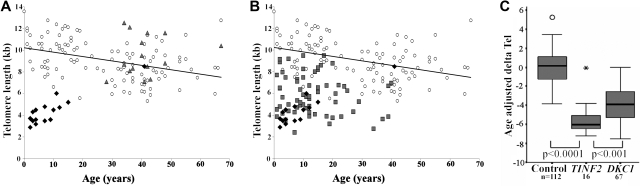
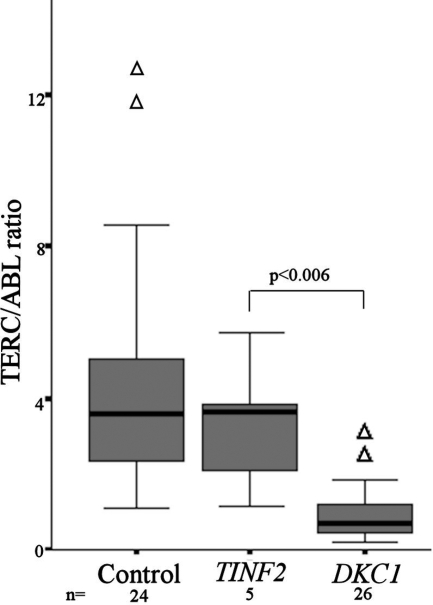
Dyskeratosis congenita (DC) is a multisystem bone marrow failure syndrome characterized by a triad of mucocutaneous abnormalities and a predisposition to cancer. The genetic basis of DC remains unknown in more than 60% of patients. Mutations have been identified in components of the telomerase complex (dyskerin, TERC, TERT, NOP10, and NHP2), and recently in one component of the shelterin complex TIN2 (gene TINF2). To establish the role of TINF2 mutations, we screened DNA from 175 uncharacterised patients with DC as well as 244 patients with other bone marrow failure disorders. Heterozygous coding mutations were found in 33 of 175 previously uncharacterized DC index patients and 3 of 244 other patients. A total of 21 of the mutations affected amino acid 282, changing arginine to histidine (n = 14) or cysteine (n = 7). A total of 32 of 33 patients with DC with TINF2 mutations have severe disease, with most developing aplastic anaemia by the age of 10 years. Telomere lengths in patients with TINF2 mutations were the shortest compared with other DC subtypes, but TERC levels were normal. In this large series, TINF2 mutations account for approximately 11% of all DC, but they do not play a significant role in patients with related disorders. This study emphasises the role of defective telomere maintenance on human disease.
Overview
The claims and statistics of this paper haven’t been checked yet.
Free: it reads the open-access text and checks the first 5 claims that cite a source we can check. Create a free account to check every claim.
Integrity signals
Registry
Cites
Statistics
Figures

Verification
Claims the paper makes
The claims and statistics of this paper haven’t been checked yet.
Free: it reads the open-access text and checks the first 5 claims that cite a source we can check. Create a free account to check every claim.
Claims other papers make about this one
Each is checked against this paper’s own text: does it say what the citing paper says it does?
The cited source says what the claim attributes to it.
In the citing paper
“Autosomal dominant forms are caused by mutations in TERT, TERC or the telomere binding protein TRF1-interacting nuclear factor 2 (156-159).”
From Telomeres and telomerase in cancer (2010) · cites this paper as [157]
The cited source says what the claim attributes to it.
In the citing paper
“Shelterin mutations have been found in some cases of aplastic anemia and dyskeratosis congenita (Savage et al., 2008; Walne et al., 2008; Zhong et al., 2011).”
From The Hallmarks of Aging (2013) · cites this paper as Walne et al., 2008
Self-check
Percentages, sums and reported differences re-computed from the paper’s own numbers.
The self-check needs the paper’s full text.
Citations
Cites
SIFT: predicting amino acid changes that affect protein function
Ng, P. C. (2003) · Nucleic Acids Research · doi:10.1093/nar/gkg509 · Cited by 6,577
Multiple sequence alignment with hierarchical clustering
Corpet, F. (1988) · Nucleic Acids Research · doi:10.1093/nar/16.22.10881 · Cited by 5,393
Shelterin: the protein complex that shapes and safeguards human telomeres
de Lange, T. (2005) · Genes & Development · doi:10.1101/gad.1346005 · Cited by 3,056
Heiss, N. S., Knight, S. W., Vulliamy, T. J., Klauck, S. M., Wiemann, S., Mason, P. J., Poustka, A., & Dokal, I. (1998) · Nature Genetics · doi:10.1038/ng0598-32 · Cited by 976
Self-citationThe RNA component of telomerase is mutated in autosomal dominant dyskeratosis congenita
Vulliamy, T., Marrone, A., Goldman, F., Dearlove, A., Bessler, M., Mason, P. J., & Dokal, I. (2001) · Nature · doi:10.1038/35096585 · Cited by 960
Self-citationMutations in TERT, the Gene for Telomerase Reverse Transcriptase, in Aplastic Anemia
Yamaguchi, H., Calado, R. T., Ly, H., Kajigaya, S., Baerlocher, G. M., Chanock, S. J., Lansdorp, P. M., & Young, N. S. (2005) · New England Journal of Medicine · doi:10.1056/nejmoa042980 · Cited by 723
Vulliamy, T., Marrone, A., Szydlo, R., Walne, A., Mason, P. J., & Dokal, I. (2004) · Nature Genetics · doi:10.1038/ng1346 · Cited by 461
Self-citationGilson, E., & Géli, V. (2007) · Nature Reviews Molecular Cell Biology · doi:10.1038/nrm2259 · Cited by 457
Armanios, M., Chen, J.-L., Chang, Y.-P. C., Brodsky, R. A., Hawkins, A., Griffin, C. A., Eshleman, J. R., Cohen, A. R., Chakravarti, A., Hamosh, A., et al. (2005) · Proceedings of the National Academy of Sciences · doi:10.1073/pnas.0508124102 · Cited by 452
Savage, S. A., Giri, N., Baerlocher, G. M., Orr, N., Lansdorp, P. M., & Alter, B. P. (2008) · The American Journal of Human Genetics · doi:10.1016/j.ajhg.2007.10.004 · Cited by 414
Cited by
Items 301–315 of 315
Wang, P., & Xu, Z. (2021) · Figshare · doi:10.6084/m9.figshare.16570235
Dyskeratosis congenita due to a de novo TINF2 mutation
Jain, A. (2026) · QJM · doi:10.1093/qjmed/hcag063
Ayas, M. F., & Ahmed, S. O. (2026) · Springer eBooks · doi:10.1007/978-3-032-02386-5_18
Glass, J., Groarke, E. M., & Young, N. S. (2026) · Springer eBooks · doi:10.1007/978-3-032-02386-5_17
Ferdousi, L. V. (2014) · theses.fr (ABES) · doi:10.70675/9d73199ez7949z4602zadcfz6763e4bdd1b0
Teissier, T. (2019) · theses.fr (ABES) · doi:10.70675/f49bc069z5ee6z4c49zb46fz0a1413dbba95
Rakotopare, J. (2024) · theses.fr (ABES) · doi:10.70675/cc79cc10zbaf8z4e88za003z8a8d37707576
Clonal Signatures of Telomere Biology Disorders
Arcuri, L., Groarke, E. M., Savage, S. A., & Gutierrez‐Rodrigues, F. (2026) · Current Hematologic Malignancy Reports · doi:10.1007/s11899-026-00777-2
“Somatic mutations in a specific domain of POT1 critical for its binding to telomeres, and for the negative regulation of telomerase, have been reported in different human cancers including cutaneous malignant melanoma and chronic lymphocytic leukemia; telomere elongation rather than its shortening is a feature BMF[ 11…”
InfluentialPaediatric dyskeratosis congenita presenting with progressive bone marrow failure
Pandey, D., Singh, G. P., Priyadarshini, P., & Singh, S. J. (2026) · Sri Lanka Journal of Child Health · doi:10.4038/sljch.v55i2.11575
Outcomes of Dyskeratosis Congenita: Results From the Canadian Inherited Marrow Failure Registry
Nuaimi, M. A., Català, A., Elias, E., Lim, Y. J., Zlateska, B., Klaassen, R. J., Cuvelier, G. D. E., Fernandez, C., Rayar, M. S., Steele, M., et al. (2026) · Journal of Pediatric Hematology/Oncology · doi:10.1097/mph.0000000000003222
Xie, T., Nong, H., Jiang, J., Yang, M., Liao, J., Lin, Z., Li, Y., Xie, B., & Wei, H. (2026) · Frontiers in Genetics · doi:10.3389/fgene.2026.1833814
“…with heterozygous mutations in TERT or TERC, which encode telomerase components, TINF2 variants are typically de novo , and are associated with earlier onset, shorter telomeres, and more severe clinical phenotypes (Alter et al., 2012; Savage et al., 2008; Walne et al., 2008; Norris et al., 2021).”
Telomeres, Epigenetics, and Aging
Londoño‐Vallejo, A. (2009) · Springer eBooks · doi:10.1007/978-1-4419-0639-7_12 · Cited by 3
Functional Analysis of ACD Mutations in Dyskeratosis Congenita.
Koçak, H. (2014) · Deep Blue (University of Michigan)
Metadata
- Authors
- Walne, A. J., Vulliamy, T., Beswick, R., Kirwan, M., & Dokal, I.
- Affiliations
- Queen Mary University of London (GB)
- Corresponding author
- Walne, Amanda J.
- Vulliamy, Tom
- Venue
- Blood
- Publisher
- American Society of Hematology
- Published
- 2008-11-01
- Volume
- 112
- Issue
- 9
- Pages
- 3594-3600
- ISSN
- 0006-4971 (ISSN-L)
- 1528-0020
- PMC
- PMC2572788
- OpenAlex
- W2170632126
- Semantic Scholar
- 27e59f3d4e1da4c16a64b2ef3394a4dd4373f325
- Cited by
- 317
- References
- 26
- Citations by year
- 2026: 9 · 2025: 12 · 2024: 13 · 2023: 9 · 2022: 12 · 2021: 18 · 2020: 16 · 2019: 14 · 2018: 16 · 2017: 13 · 2016: 19 · 2015: 15 · 2014: 27 · 2013: 26 · 2012: 13
- FWCI
- 19.24
- Type
- journal article
- Language
- en
- Open access
- green
- europepmc.org
- Licence
- other-oa
- Locations
- Blood (publishedVersion)
- Europe PMC (PubMed Central) (publishedVersion, other-oa)
- PubMed Central (publishedVersion, cc-by-nc)
- PubMed (publishedVersion)
- Funders
- Queen Mary University of London
- Wellcome Trust
- Medical Research Council
- Topics
- Life Sciences › Biochemistry, Genetics and Molecular Biology › Cell Biology › Telomeres, Telomerase, and Senescence
- Health Sciences › Medicine › Hematology › Blood disorders and treatments
- Life Sciences › Immunology and Microbiology › Immunology › Immunodeficiency and Autoimmune Disorders
- Keywords
- TIN2, dyskeratosis congenita, bone marrow failure syndromes, telomere length, telomere maintenance, shelterin complex, TERC, telomerase reverse transcriptase, dyskerin, NOP10, NHP2, aplastic anemia, genetic mutations, disease severity
- MeSH terms
- Adolescent, Adult, Aged, Aged, 80 and over, Amino Acid Sequence, Base Sequence, Bone Marrow Diseases, Child, Child, Preschool, Female, Heterozygote, Humans, Infant, Infant, Newborn, Male, Middle Aged, Molecular Sequence Data, Mutation, RNA, Syndrome, Cohort Studies, Telomere, Sequence Homology, Amino Acid, DNA Primers, Telomerase, Dyskeratosis Congenita, Amino Acid Substitution, Telomere-Binding Proteins
About these checks
Registry, retraction, Cites and statistics results are computed, not judged, with one exception: a printed reference that no index lists is read once by a model before it counts as a citation error. Claims are extracted by a model and kept only when their quote appears verbatim in the text; each cited source is then checked, with a model’s help, for whether it says what the claim relies on. Those verdicts can be wrong — read the claim’s quote and the cited source before relying on one.
Statistics and arithmetic are recomputed, not judged.
Confidence bands are shown only for fields calibrated on our annotated test set. None is calibrated yet, so no band is shown.
What counts as a claim ›How we measure confidence ›How we check this ›
Are you an author, or do you see a problem with this page? Request a review
Data sources
Bibliographic data: Semantic Scholar, OpenAlex, Crossref.
Contains information from the Semantic Scholar Academic Graph Datasets, made available under the ODC Attribution License (ODC-BY 1.0).
Semantic Scholar’s data is described in: Kinney, R., et al. (2023). The Semantic Scholar Open Data Platform. arXiv:2301.10140.
