

Ide-cel vs standard regimens in triple-class-exposed relapsed and refractory multiple myeloma: updated KarMMa-3 analyses.
Open accessThe DOI matches its Crossref record; 33 of the 33 references it cites were found in a registry or an index; 29 of the 41 sources its claims cite were checked for support.
Abstract
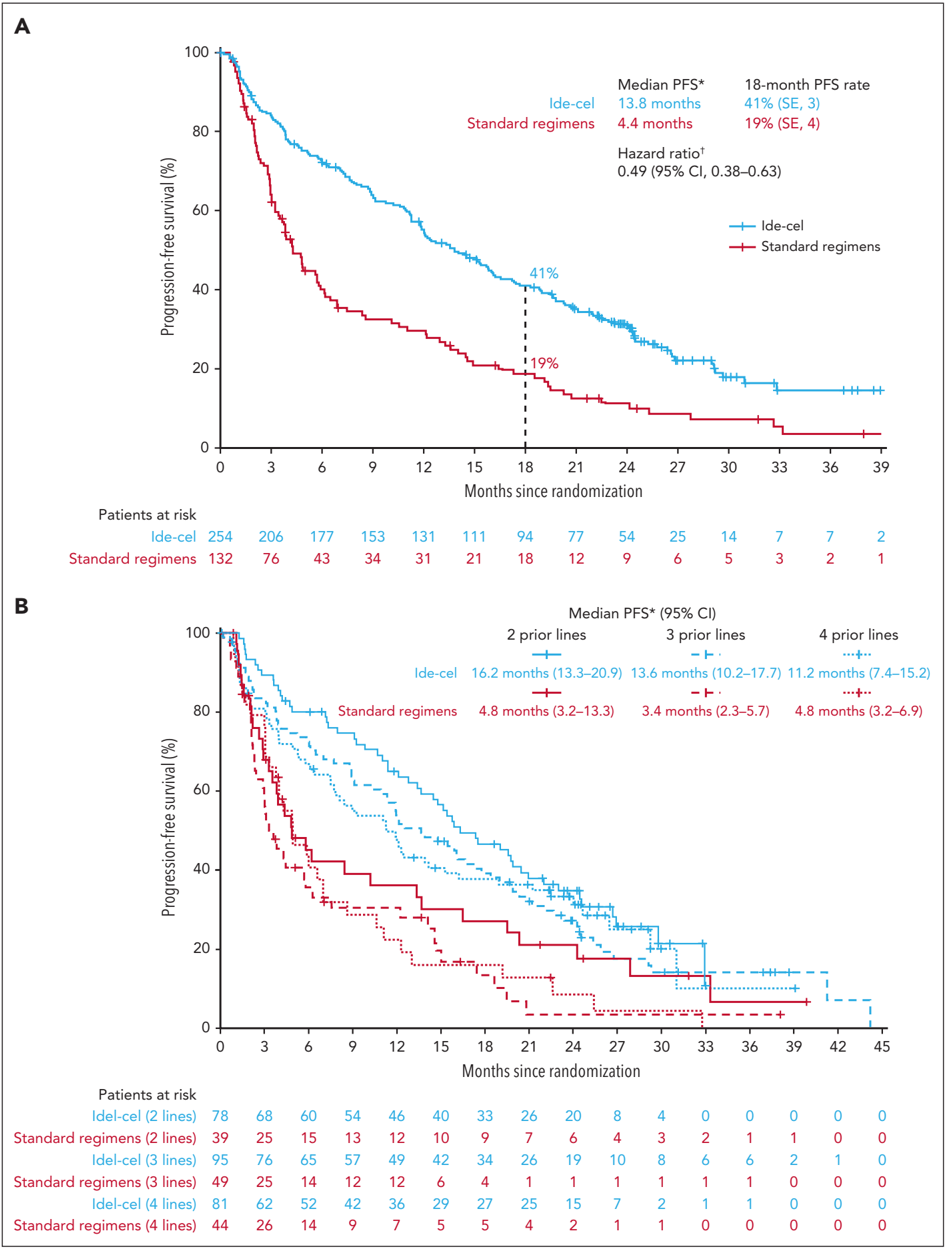
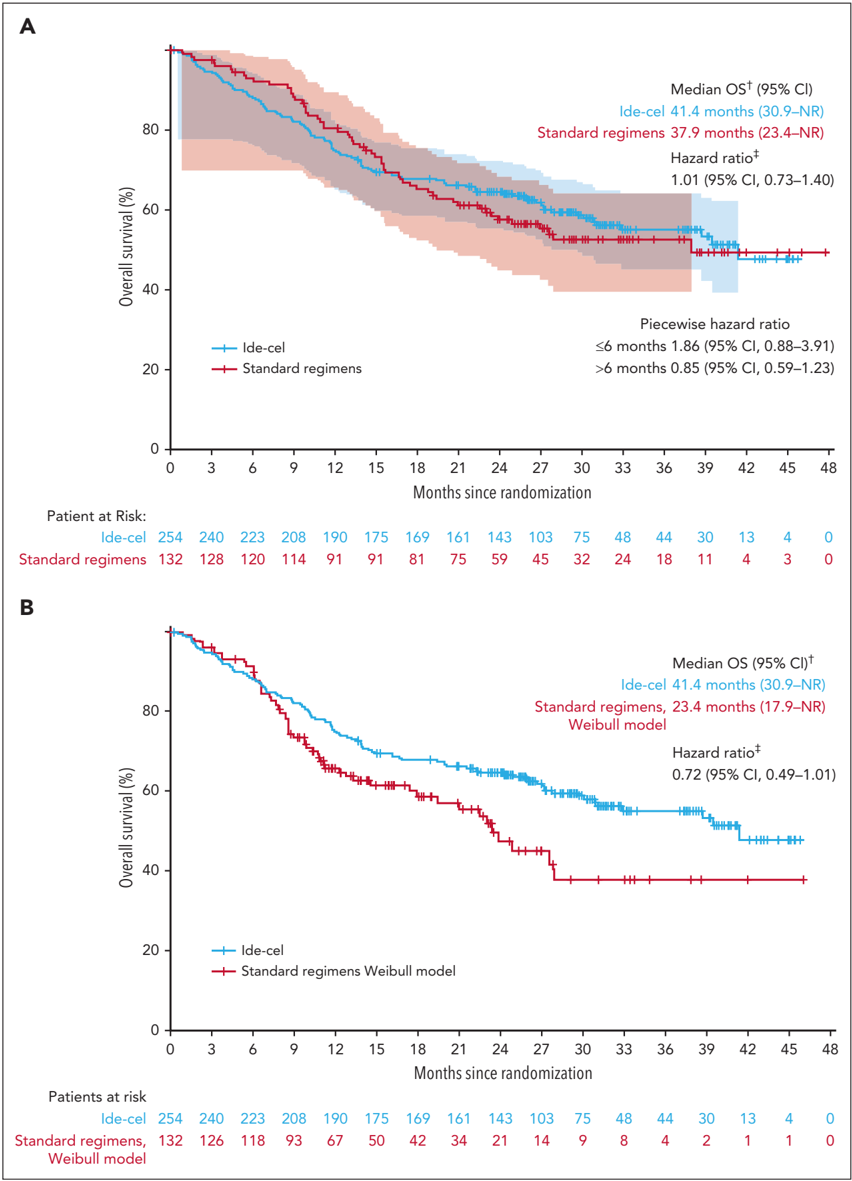
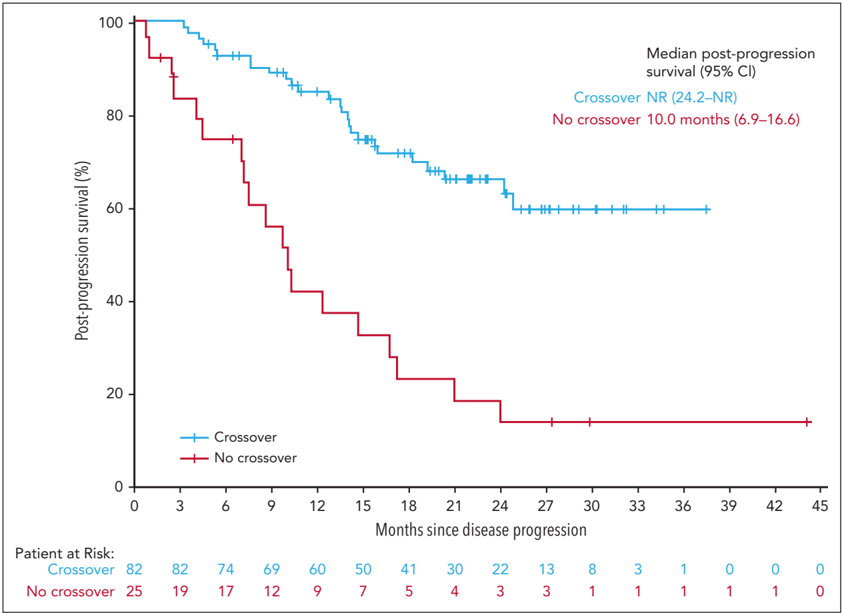
Outcomes are poor in triple-class-exposed (TCE) relapsed and refractory multiple myeloma (R/RMM). In the phase 3 KarMMa-3 trial, patients with TCE R/RMM and 2 to 4 prior regimens were randomized 2:1 to idecabtagene vicleucel (ide-cel) or standard regimens (SRs). An interim analysis (IA) demonstrated significantly longer median progression-free survival (PFS; primary end point; 13.3 vs 4.4 months; P < .0001) and higher overall response rate (ORR) with ide-cel vs SRs. At final PFS analysis (median follow-up, 30.9 months), ide-cel further improved median PFS vs SRs (13.8 vs 4.4 months; hazard ratio [HR], 0.49; 95% confidence interval [CI], 0.38-0.63). PFS benefit with ide-cel vs SRs was observed regardless of number of prior lines of therapy, with greatest benefit after 2 prior lines (16.2 vs 4.8 months, respectively). ORR benefit was maintained with ide-cel vs SRs (71% vs 42%; complete response, 44% vs 5%). Patient-centric design allowed crossover from SRs (56%) to ide-cel upon progressive disease, confounding overall survival (OS) interpretation. At IA of OS, median was 41.4 (95% CI, 30.9 to not reached [NR]) vs 37.9 (95% CI, 23.4 to NR) months with ide-cel and SRs, respectively (HR, 1.01; 95% CI, 0.73-1.40); median OS in both arms was longer than historical data (9-22 months). Two prespecified analyses adjusting for crossover showed OS favoring ide-cel. This trial highlighted the importance of individualized bridging therapy to ensure adequate disease control during ide-cel manufacturing. Ide-cel improved patient-reported outcomes vs SRs. No new safety signals were reported. These results demonstrate the continued favorable benefit-risk profile of ide-cel in early-line and TCE R/RMM. This trial was registered at www.ClinicalTrials.gov as #NCT03651128.
Overview
CoChat Summary
## TL;DR
In the preplanned final KarMMa-3 analysis with 30.9 months median follow-up, ide-cel continued to outperform standard regimens in triple-class-exposed relapsed/refractory multiple myeloma, with median PFS 13.8 vs 4.4 months and ORR 71% vs 42%. Overall survival was confounded by crossover, but crossover-adjusted analyses showed a trend favoring ide-cel, and safety remained consistent with prior reports.
## Key findings
- Median PFS was 13.8 months with ide-cel vs 4.4 months with standard regimens (HR 0.49; 95% CI, 0.38-0.63) at 30.9 months median follow-up.
- PFS benefit was seen across prior lines of therapy, with median PFS of 16.2 vs 4.8 months after 2 prior lines, 13.6 vs 3.4 months after 3 prior lines, and 11.2 vs 4.8 months after 4 prior lines.
- ORR was 71% with ide-cel vs 42% with standard regimens; CR rate was 44% vs 5%, and MRD-negative CR rate in evaluable patients was 35% vs 2%.
- Median OS was 41.4 months with ide-cel vs 37.9 months with standard regimens (HR 1.01; 95% CI, 0.73-1.40), but crossover-adjusted sensitivity analyses favored ide-cel (HR 0.72 and 0.87 in two prespecified models; post hoc IPCW HR 0.74).
## Methods
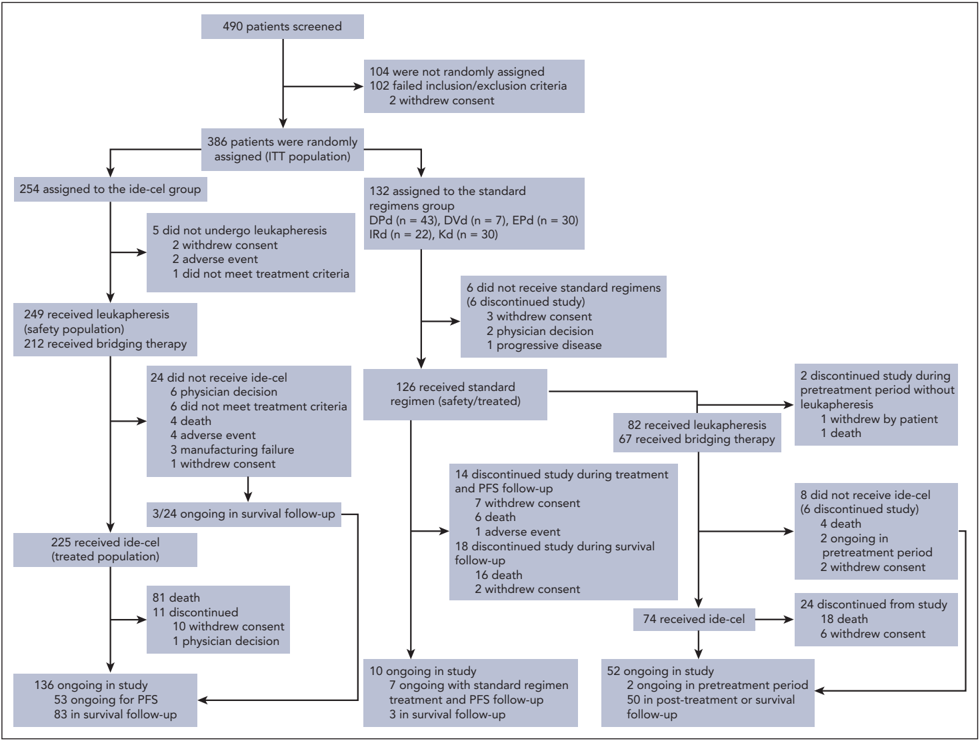
- KarMMa-3 was an international, randomized, open-label phase 3 trial in patients aged ≥18 years who had received 2 to 4 prior antimyeloma therapies including daratumumab, an immunomodulatory agent, and a proteasome inhibitor, with progressive disease within 60 days of last prior therapy.
- 386 patients were randomized 2:1 to ide-cel (n=254) or one of 5 investigator-selected standard regimens (n=132); after protocol amendment, crossover from standard regimens to ide-cel was allowed upon IRC-confirmed progression.
- Primary analysis was PFS by blinded independent review committee in the ITT population; secondary analyses included ORR, OS, MRD-negative CR, PFS2, HRQOL, and safety, with time-to-event outcomes analyzed by Kaplan-Meier and Cox models and OS sensitivity analyses adjusting for crossover.
## Limitations
- The paper states that the crossover design confounded OS interpretation.
- The text also notes that some bridging therapy may have insufficiently controlled disease before ide-cel infusion, contributing to early deaths; this is an evidence-based concern evident from the trial conduct and early-death pattern.
- No additional limitations are stated in the paper beyond prior reported KarMMa-3 limitations and crossover-related OS confounding.
Model-written summary. Check it against the paper before relying on it.
Integrity signals
Registry
Cites
Statistics
Figures
Verification
Claims the paper makes
16 Valid · 0 Not valid · 2 Not checked · 62 Own results and interpretations
The cited sources support only part of this claim — read each source’s verdict below.
In the paper
“Management of relapsed MM remains challenging; patients are becoming triple-class exposed (TCE) earlier in their treatment course, 4-8 with no standard of care for early TCE relapsed and refractory MM (R/RMM).”
What the sources say
- Not checked — no full text of the sourcecites [4] 4. [Dimopoulos MA, Richardson P, Lonial S. Treatment options for patients with heavily pretreated relapsed and refractory multiple myeloma. Clin Lymphoma Myeloma Leuk . 2022;22(7):460-473.](http://refhub.elsevier.com/S0006-4971(24)02313-9/sref4) source
- Not checked — no full text of the sourcecites [5] 5. [Chari A, Nair S, Lin X, Marshall A, Slavcev M, Kumar S. Real-world treatment patterns and clinical outcomes in patients with triple-class exposed relapsed or refractory multiple myeloma in United States clinical practice . Los Angeles, CA: Paper presented at: International Myeloma Workshop, Vol. P-237; 25-27 August 2021.](http://refhub.elsevier.com/S0006-4971(24)02313-9/sref5) Janssen, Oncopeptides, P fi zer, Roche, and Sano fi . The remaining authors declare no competing fi nancial interests. ORCID pro fi les: K.P., 0000-0002-8894-027X; S.M., 0000-0001-7653711X; N.C., 0000-0002-6975-1086; source
- Partly supportedcites [6] Gandhi, 2019, Outcomes of patients with multiple myeloma refractory to CD38-targeted monoclonal antibody therapy, Leukemia sourceExperimental — accuracy not yet measured
The Discussion (page unavailable) describes limited treatment options and poor outcomes after progression on CD38-targeted therapy. It does not establish that there is no standard of care specifically for patients who become triple-class exposed early in their treatment course. (LLM, conf=0.80)
- Partly supportedcites [7] Mateos, 2022, LocoMMotion: a prospective, non-interventional, multinational study of real-life current standards of care in patients with relapsed and/or refractory multiple myeloma, Leukemia sourceExperimental — accuracy not yet measured
The Discussion says there is no well-established real-world standard-of-care treatment for triple-class-exposed patients with relapsed/refractory multiple myeloma. However, the study focuses on heavily pretreated patients, and the cited passages do not establish that conclusion specifically for patients who become triple-class exposed early in treatment. (LLM, conf=0.87)
- Not checked — no full text of the sourcecites [8] Kumar, 2022, Treatment patterns and outcomes of patients with triple-class exposed relapsed or refractory multiple myeloma: analysis of the Optum electronic health records and commercial claims database, Clin Lymphoma Myeloma Leuk source
plain- Asserted: passes — The authors put it forward as true.
- Checkable: passes — It can be checked against evidence.
- Load-bearing: passes — The paper’s conclusions depend on it.
- Based: passes — The paper gives a reason why it holds.
Every source the paper cites for this claim was checked and supports it.
In the paper
“Baseline disease characteristics were generally balanced between treatment arms. 13”
What the sources say
- Supportedcites [13] Rodriguez-Otero, 2023, Ide-cel or standard regimens in relapsed and refractory multiple myeloma, N Engl J Med source
The Patients and Treatment section explicitly states that baseline characteristics were generally balanced between the ide-cel and standard-regimen groups. It notes an exception for Black race (7% versus 14%), consistent with the claim’s qualifier “generally.” (LLM, conf=0.95)
plainn = 386- Asserted: passes — The authors put it forward as true.
- Checkable: passes — It can be checked against evidence.
- Load-bearing: unclear — It is unclear whether the paper’s conclusions depend on it.
- Based: passes — The paper gives a reason why it holds.
- Supported
The sources with a verdict support this claim; the rest weren’t checked yet, have no full text we could read, or their verdicts aren’t rated yet.
In the paper
“The median OS in the ide-cel (41.4 months) and SRs arms (37.9 months) were substantially longer than historical real-world data in TCE R/RMM (~9-22 months), 512 with longer than expected OS in the SRs arm, likely resulting from ide-cel treatment in patients who crossed over.”
What the sources say
- Not checked — no full text of the sourcecites [5] 5. [Chari A, Nair S, Lin X, Marshall A, Slavcev M, Kumar S. Real-world treatment patterns and clinical outcomes in patients with triple-class exposed relapsed or refractory multiple myeloma in United States clinical practice . Los Angeles, CA: Paper presented at: International Myeloma Workshop, Vol. P-237; 25-27 August 2021.](http://refhub.elsevier.com/S0006-4971(24)02313-9/sref5) Janssen, Oncopeptides, P fi zer, Roche, and Sano fi . The remaining authors declare no competing fi nancial interests. ORCID pro fi les: K.P., 0000-0002-8894-027X; S.M., 0000-0001-7653711X; N.C., 0000-0002-6975-1086; source
- Supportedcites [12] Moreau, 2023, MM-464 LocoMMotion: a prospective, observational, multinational study of real-life current standards of care in patients with relapsed/refractory multiple myeloma–final analysis at 2-year follow-up, Clin Lymphoma Myeloma Leuk source
The LocoMMotion Abstract reports real-life standard-of-care outcomes in triple-class-exposed patients with relapsed/refractory multiple myeloma. Its median overall survival of 13.8 months falls within the cited historical range of approximately 9–22 months and is shorter than either arm’s survival reported in the citing sentence. (LLM, conf=0.88)
plain- Asserted: passes — The authors put it forward as true.
- Checkable: passes — It can be checked against evidence.
- Load-bearing: unclear — It is unclear whether the paper’s conclusions depend on it.
- Based: passes — The paper gives a reason why it holds.
The cited sources support only part of this claim — read each source’s verdict below.
In the paper
“In a prespeci fi ed KarMMa-3 interim analysis (IA) with 18.6 months median follow-up, a single ide-cel infusion demonstrated signi fi cantly longer median PFS vs SRs (13.3 vs 4.4 months), with a 51% lower risk of disease progression or death (hazard ratio [HR], 0.49; 95% con fi dence interval [CI], 0.38-0.65; P < .0001). 13”
What the sources say
- Partly supportedcites [13] Rodriguez-Otero, 2023, Ide-cel or standard regimens in relapsed and refractory multiple myeloma, N Engl J Med sourceExperimental — accuracy not yet measured
Split into 2 atoms — 0 confirmed, 2 partially supported, 0 disputed, 0 misattributed, 0 unverifiable. Expand the claim to see per-atom verdicts.
boostedstates a cause- Asserted: passes — The authors put it forward as true.
- Checkable: passes — It can be checked against evidence.
- Load-bearing: passes — The paper’s conclusions depend on it.
- Based: passes — The paper gives a reason why it holds.
- Partly supported
The sources with a verdict support this claim; the rest weren’t checked yet, have no full text we could read, or their verdicts aren’t rated yet.
In the paper
“Chimeric antigen receptor (CAR) T-cell therapy has shown promising ef fi cacy in patients with TCE R/RMM. 13-21”
What the sources say
- Supportedcites [13] Rodriguez-Otero, 2023, Ide-cel or standard regimens in relapsed and refractory multiple myeloma, N Engl J Med source
The Discussion identifies KarMMa-3 as a trial of CAR T-cell therapy in triple-class-exposed relapsed and refractory multiple myeloma. The Efficacy section reports a higher response rate with ide-cel than with standard regimens (71% versus 42%), supporting the claim of promising efficacy. (LLM, conf=0.93)
- Supportedcites [14] San-Miguel, 2023, Cilta-cel or standard care in lenalidomide-refractory multiple myeloma, N Engl J Med source
The Efficacy section (p. 5) reports a lower risk of progression or death with cilta-cel than with standard care, with similar effects in the triple-class-refractory subgroup. Those patients had necessarily been exposed to all three drug classes. The trial population was specifically lenalidomide-refractory and had received one to three prior lines of therapy. (LLM, conf=0.88)
- Supportedcites [15] Sidana, 2019, CAR T-cell therapy: is it prime time in myeloma?, Blood Adv source
The Abstract (p.1) states 'Early clinical studies have shown promising response rates in heavily pretreated patients,' and the Introduction frames the target population as patients 'refractory to proteasome inhibitors, immunomodulatory drugs, and anti-CD38 monoclonal antibody' (i.e., triple-class-exposed), concluding that 'CAR T-cell therapy has emerged as a promising treatment for relapsed and refractory MM.' Table 1 (Introduction) reports high ORRs (e.g., 81-100% in BCMA trials) in cohorts with median 3-11 prior lines, matching the claim's population and magnitude. The paper is a review reporting others' trial results rather than an original study, but the paraphrase does not attribute primary data to it. (LLM, conf=0.85)
- Supportedcites [16] Martin, 2023, Ciltacabtagene autoleucel, an anti-B-cell maturation antigen chimeric antigen receptor T-cell therapy, for relapsed/refractory multiple myeloma: CARTITUDE-1 2-year follow-up, J Clin Oncol source
The Methods passage says eligible patients had relapsed/refractory multiple myeloma and prior exposure to a proteasome inhibitor, immunomodulatory drug, and anti-CD38 therapy—the three classes in the claim. The Results > Efficacy passage reports a 97.9% overall response rate after cilta-cel CAR T-cell therapy, supporting the characterization of its efficacy as promising. (LLM, conf=0.94)
- Not checked — no full text of the sourcecites [17] Agha, 2021, CARTITUDE-2: efficacy and safety of ciltacabtagene autoleucel (cilta-cel), a BCMA-directed CAR T-cell therapy, in patients with progressive multiple myeloma (MM) after one to three prior lines of therapy, J Clin Oncol source
- Supportedcites [18] Munshi, 2021, Idecabtagene vicleucel in relapsed and refractory multiple myeloma, N Engl J Med source
The Discussion reports frequent and deep responses to ide-cel, a CAR T-cell therapy, in patients with triple-class-exposed relapsed and refractory myeloma. It reports a response in 73% of treated patients and a complete response or better in 33%, supporting the claim of promising efficacy. (LLM, conf=0.94)
- Supportedcites [19] Raje, 2019, Anti-BCMA CAR T-cell therapy bb2121 in relapsed or refractory multiple myeloma, N Engl J Med source
The Results—Patients section reports that 79% of participants had been exposed to proteasome inhibitors, immunomodulatory drugs, and daratumumab, consistent with triple-class exposure. Results—Efficacy reports an 85% objective response rate to bb2121 CAR T-cell therapy in the relapsed or refractory myeloma cohort. The claim says the therapy has shown promising efficacy in this population; it does not assert that every participant was triple-class exposed. Page numbers were not available in our copy. (LLM, conf=0.90)
- Supportedcites [20] Jagannath, 2021, KarMMa-RW: comparison of idecabtagene vicleucel with real-world outcomes in relapsed and refractory multiple myeloma, Blood Cancer J source
The Discussion (page not available in our copy) reports significantly improved responses and survival with ide-cel, a CAR T-cell therapy, compared with real-world treatment in triple-class-exposed relapsed and refractory multiple myeloma. It calls ide-cel a promising treatment option for this population. (LLM, conf=0.93)
- Not checked — no full text of the sourcecites [21] van de Donk, 2022, Biological correlative analyses and updated clinical data of ciltacabtagene autoleucel (cilta-cel), a BCMA-directed CAR-T cell therapy, in patients with multiple myeloma (MM) and early relapse after initial therapy: CARTITUDE-2, cohort B, J Clin Oncol source
plainstates a cause- Asserted: passes — The authors put it forward as true.
- Checkable: passes — It can be checked against evidence.
- Load-bearing: passes — The paper’s conclusions depend on it.
- Based: passes — The paper gives a reason why it holds.
- Supported
36 more claims · 2 with their cited sources checked
Create a free account to see all 80 claims and to verify the 1 reference still open.
- It may state two separate claims as one. 35
- The quote only partly states this claim. 1
- Probably not a substantial claim. 6
Self-check
Percentages, sums and reported differences re-computed from the paper’s own numbers.
Self-check results appear here once an independent check has confirmed them.
Cited works that were retracted
Works this paper cites that were later retracted, from the retraction notices publishers deposit. Major when the notice came out before this paper was published.
Rated major: it would touch a result — a value a result rests on, reported and recomputed p-values on opposite sides of the significance level, two passages that conflict with no sign which is right, or a cited work retracted before this paper was published.
Cited work 10.1016/j.clml.2022.01.005 · retracted 2022-01-10 · notice 10.1016/j.clml.2022.01.005 · this paper published 2024-12-05
Citations
Cites
1 retracted
Dimopoulos, M. A., Richardson, P. G. G., & Lonial, S. (2022) · Clinical Lymphoma Myeloma & Leukemia · doi:10.1016/j.clml.2022.01.005
RetractedAaronson, N. K., Ahmedzai, S., Bergman, B., Bullinger, M., Cull, A., Duez, N. J., Filiberti, A., Flechtner, H., Fleishman, S. B., Haes, J. C. J. M. D., et al. (1993) · JNCI Journal of the National Cancer Institute · doi:10.1093/jnci/85.5.365 · Cited by 16,005
Kumar, S., Paiva, B., Anderson, K. C., Durie, B., Landgren, O., Moreau, P., Munshi, N., Lonial, S., Bladé, J., Mateos, M.-V., et al. (2016) · The Lancet Oncology · doi:10.1016/s1470-2045(16)30206-6 · Cited by 3,061
Self-citationCurrent concepts in the diagnosis and management of cytokine release syndrome.
Lee, D. W., Gardner, R., Porter, D. L., Louis, C. U., Ahmed, N., Jensen, M., Grupp, S. A., & Mackall, C. L. (2014) · Blood · doi:10.1182/blood-2014-05-552729 · Cited by 2,806
Idecabtagene Vicleucel in Relapsed and Refractory Multiple Myeloma.
Munshi, N. C., Anderson, L. D., Shah, N., Madduri, D., Berdeja, J., Lonial, S., Raje, N., Lin, Y., Siegel, D., Oriol, A., et al. (2021) · New England Journal of Medicine · doi:10.1056/nejmoa2024850 · Cited by 2,560
Self-citationAnti-BCMA CAR T-cell therapy bb2121 in relapsed or refractory multiple myeloma.
Raje, N., Berdeja, J., Lin, Y., Siegel, D., Jagannath, S., Madduri, D., Liedtke, M., Rosenblatt, J., Maus, M. V., Turka, A., et al. (2019) · New England Journal of Medicine · doi:10.1056/nejmoa1817226 · Cited by 1,730
Self-citationCilta-cel or Standard Care in Lenalidomide-Refractory Multiple Myeloma.
San-Miguel, J., Dhakal, B., Yong, K., Spencer, A., Anguille, S., Mateos, M.-V., Fernández de Larrea, C., Martínez-López, J., Moreau, P., Touzeau, C., et al. (2023) · New England Journal of Medicine · doi:10.1056/nejmoa2303379 · Cited by 827
Self-citationIde-cel or Standard Regimens in Relapsed and Refractory Multiple Myeloma
Rodriguez-Otero, P., Ailawadhi, S., Arnulf, B., Patel, K., Cavo, M., Nooka, A. K., Manier, S., Callander, N., Costa, L. J., Vij, R., et al. (2023) · New England Journal of Medicine · doi:10.1056/nejmoa2213614 · Cited by 781
Self-citationMartin, T., Usmani, S. Z., Berdeja, J. G., Agha, M., Cohen, A. D., Hari, P., Avigan, D., Deol, A., Htut, M., Lesokhin, A., et al. (2023) · Journal of Clinical Oncology · doi:10.1200/jco.22.00842 · Cited by 663
Self-citationOutcomes of patients with multiple myeloma refractory to CD38-targeted monoclonal antibody therapy.
Gandhi, U. H., Cornell, R. F., Lakshman, A., Gahvari, Z. J., McGehee, E., Jagosky, M. H., Gupta, R., Varnado, W., Fiala, M. A., Chhabra, S., et al. (2019) · Leukemia · doi:10.1038/s41375-019-0435-7 · Cited by 616
Self-citation
Research works printed but not linked: 2
- 2010, Common Terminology Criteria for Adverse Events (CTCAE) v4. 03
- 2018, Question and Answer on Adjustment for Cross-Over in Estimating Effects in Oncology Trials
Cited by
Dimopoulos, M. A., Terpos, E., Boccadoro, M., Moreau, P., Mateos, M.-V., Zweegman, S., Cook, G., Engelhardt, M., Delforge, M., Hajek, R., et al. (2025) · Nature Reviews Clinical Oncology · doi:10.1038/s41571-025-01041-x · Cited by 165
“These decisions were based on the results of the phase III KarMMa-3 trial 117,118 in which 386 patients with RRMM who had received two to four prior lines of therapy (with the characteristics previously described) were randomly assigned (2:1) to receive either ide-cel (at a dose range of 150 × 10 6…”
Self-citationCAR-T cell therapy in Multiple Myeloma: current status and future challenges
Swan, D., Madduri, D., & Hocking, J. S. (2024) · Blood Cancer Journal · doi:10.1038/s41408-024-01191-8 · Cited by 122
New horizons in our understanding of precursor multiple myeloma and early interception
dos Santos, D. M. C., Toenges, R., Bertamini, L., Alberge, J.-B., & Ghobrial, I. M. (2024) · Nature reviews. Cancer · doi:10.1038/s41568-024-00755-x · Cited by 36
“With the advent of next-generation”
Opportunities and challenges for MRD assessment in the clinical management of multiple myeloma
Paiva, B., Shi, Q., Puig, N., Cedena, M., Órfão, A., Durie, B. G. M., Munshi, N. C., & Miguel, J. F. S. (2025) · Nature Reviews Clinical Oncology · doi:10.1038/s41571-025-01017-x · Cited by 41
“GPRC5D-targeted T cell-redirecting immunotherapies has resulted in substantially increased CR rates in patients with relapsed and/or refractory MM (RRMM), thereby creating momentum to also assess MRD in this setting 37,68,69 .”
van de Donk, N. W. C. J., Moreau, P., Miguel, J. F. S., Mateos, M., Dimopoulos, M. A., Zweegman, S., Gay, F., Engelhardt, M. M., Mina, R., Zamagni, E., et al. (2025) · The Lancet Haematology · doi:10.1016/s2352-3026(25)00117-6 · Cited by 33
Self-citationvan de Donk, N. W. C. J., Rasche, L., Sidana, S., Zweegman, S., & Garfall, A. L. (2024) · Blood Cancer Discovery · doi:10.1158/2643-3230.bcd-24-0124 · Cited by 29
van de Donk, N. W. C. J., Moreau, P., Miguel, J. F. S., Mateos, M., Dimopoulos, M. A., Zweegman, S., Gay, F., Engelhardt, M., Mina, R., Zamagni, E., et al. (2025) · HemaSphere · doi:10.1002/hem3.70260 · Cited by 26
Self-citationWu, F., Zhou, J., Zheng, X., Masilamani, M., Cheng, Y., Caia, A., Cook, M. A., Piasecki, J., & Lamba, M. (2025) · Clinical Pharmacokinetics · doi:10.1007/s40262-025-01531-2 · Cited by 10
“…RRMM who have received two to four prior lines of therapy, including an immunomodulatory agent, a proteasome inhibitor, and an anti-cluster of differentiation (CD)38 monoclonal antibody, using data from KarMMa-3 (NCT03651128), an international, randomized, open-label, phase 3 trial [6, 7, 9, 10].”
Self-citationMerz, M., Gagelmann, N., Smaili, S., Flossdorf, S., Sauer, S., Scheid, C., von Tresckow, B., Wulf, G. G., Weisel, K. C., Blau, I. W., et al. (2025) · Blood · doi:10.1182/blood.2025028330 · Cited by 19
Self-citationBesliu, C., Tănase, A., Rotaru, I., Espinoza, J., Vidal, L., Poelman, M., Juan, M., de Larrea, C. F., & Saini, K. S. (2025) · Cancers · doi:10.3390/cancers17030525 · Cited by 17
“Generally, in pivotal clinical trials, the ICANS and other non-ICANS neurotoxicity incidences were less frequent than CRS [28,64,66–70] (Table 2).”
Fortuna, G. G., Peres, L. C., Назаренко, Е. Б., Corraes, A. D. M. S., Hovanky, V. N., Shune, L. O., McGuirk, J. P., Avilla, G. D., Khouri, J., Dima, D., et al. (2025) · Blood Advances · doi:10.1182/bloodadvances.2025016966 · Cited by 13
Self-citationCAR T-cell therapy and bispecific antibodies in the management of multiple myeloma
Dima, D., Banerjee, R., & Hansen, D. K. (2025) · Hematology · doi:10.1182/hematology.2025000721 · Cited by 13
Forcing Ahead: Second-Line Treatment Options for Lenalidomide-Refractory Multiple Myeloma
Mancuso, K., Barbato, S., Raimondo, F. D., Gay, F., Musto, P., Offidani, M., Petrucci, M. T., Zamagni, E., Zambello, R., & Cavo, M. (2025) · Cancers · doi:10.3390/cancers17071168 · Cited by 10
“At final PFS analysis, with a median follow-up of 30.9 months, ide-cel retained the PFS benefit previously seen in comparison with standard regimens (13.8 vs. 4.4 months), and the best outcome was seen in patients with 2 prior LoTs (16.2 vs. 4.8 months, respectively) [75].”
InfluentialSelf-citationCani, L., Parikh, R., Joseph, N. S., Gupta, V. A., Hofmeister, C. C., Kaufman, J. L., Nooka, A. K., Lonial, S., & Mina, R. (2026) · Clinical Lymphoma Myeloma & Leukemia · doi:10.1016/j.clml.2026.03.003 · Cited by 8
Self-citationAilawadhi, S., Anderson, L. D., Dhakal, B., Shune, L. O., Sborov, D. W., & Hansen, D. K. (2025) · Clinical Lymphoma Myeloma & Leukemia · doi:10.1016/j.clml.2025.08.005 · Cited by 14
Self-citationCheng, Y., Hu, H., Ogasawara, K., & Li, Y. (2025) · Journal of Pharmaceutical Sciences · doi:10.1016/j.xphs.2025.103925 · Cited by 4
Moore, D. C., Elsey, G., McElwee, J., & Atrash, S. (2025) · Expert Opinion on Biological Therapy · doi:10.1080/14712598.2025.2595122 · Cited by 7
Goel, U., Zanwar, S., Cowan, A. J., Banerjee, R. K., Khouri, J., & Dima, D. (2025) · Cancer Management and Research · doi:10.2147/cmar.s510408 · Cited by 8
“47 With a higher efficacy observed in the pivotal trials and demonstrated improvement in OS, cilta-cel is often considered the preferred CAR T for use in patients with RRMM.”
Wu, F., Zheng, X., Burnett, J., Masilamani, M., Zhang, W., Zhong, X., Caia, A., Cook, M. A., Piasecki, J., Kondic, A. G., et al. (2025) · The Journal of Clinical Pharmacology · doi:10.1002/jcph.70075 · Cited by 4
Self-citationAbuhelwa, Z., Amisha, F., Fan, W., Avila, G. D., Hansen, D. K., Grajales-Cruz, A. F., Blue, B. J., Puglianini, O. A. C., Liu, H. D., Freeman, C. L., et al. (2025) · Frontiers in Oncology · doi:10.3389/fonc.2025.1663814 · Cited by 9
“In KarMMa-3, in patients with 2 – 4 prior lines, EMD was more broadly de fi ned to include both true extramedullary soft-tissue disease and bone-related soft-tissue plasmacytomas, with an incidence of 24%, and its presence correlated with signi fi cantly shorter PFS (21).”
Self-citationKorst, C. L. B. M., Plattel, W. J., de Kort, E., Smits, F., Croockewit, A. J., Levin, M., Westerman, M., de Weerdt, O., Nijhof, I. S., Wegman, J. J., et al. (2026) · The Lancet Haematology · doi:10.1016/s2352-3026(25)00298-4 · Cited by 7
Habib, A., Ahmed, N., Khan, A., Chang, D., Paul, B. A., Shaikh, H. G., Strouse, C. S., Struble, E., Vegel, A. J., Mahmoudjafari, Z., et al. (2026) · Current Oncology · doi:10.3390/curroncol33020080 · Cited by 8
“Clinical trials for ide-cel and cilta-cel have reported overall response rates (ORR) ranging from 73% to 96.9%, with CR rates between 33% and 67.9% [9–11].”
InfluentialDimopoulos, M. A., Schjesvold, F. H., Fu, C., Hartley-Brown, M. A., Gomez, C., Reece, D. E., Mikala, G., Alkharabsheh, O., Parrish, C., Crusoé, E. D. Q., et al. (2026) · The Lancet · doi:10.1016/s0140-6736(26)01088-3 · Cited by 9
SOHO State of the Art Updates and Next Questions | Late/Deferred ASCT in Myeloma
Mo, C. C., Liu, Y., Hartley-Brown, M. A., Nadeem, O., Midha, S., & Richardson, P. G. G. (2025) · Clinical Lymphoma Myeloma & Leukemia · doi:10.1016/j.clml.2025.06.003 · Cited by 4
Yan, W., Du, C., Lv, R., Zou, H., Zhang, S., Yu, T., Yan, Y., Zhang, Y., Peng, S., Wang, T., et al. (2026) · Journal of Clinical Oncology · doi:10.1200/jco-25-01969 · Cited by 7
Mancuso, K., Barbato, S., Talarico, M., Tacchetti, P., Zamagni, E., & Cavo, M. (2024) · Expert Opinion on Biological Therapy · doi:10.1080/14712598.2024.2433518 · Cited by 5
“Notably, no case of neurocognitive and other non-ICANS treat-ment emergent AEs were reported in the KarMMa-1 or KarMMa-3 trials [28,35,36,89].”
Self-citationTalarico, M., Barbato, S., Maisnar, V., Delimpasi, S., Puppi, M., Rizzello, I., Pantani, L., Tacchetti, P., Martello, M., Vigliotta, I., et al. (2025) · Journal of Cancer Research and Clinical Oncology · doi:10.1007/s00432-025-06326-3 · Cited by 4
“…novel immunotherapies, par - ticularly bispecific antibodies (Munshi et al. 2021; Berdeja et al. 2021; Martin et al. 2023; Rodriguez-Otero et al. 2023; Ailawadhi et al. 2024; San-Miguel et al. 2023; Moreau et al. 2022; Garfall et al. 2024; Lesokhin et al. 2023; Miles Prince et al. 2024; Bumma et…”
Self-citationCAR T-cells in multiple myeloma: the race to the start line
Bazarbachi, A. H., Bhutani, D., Hughes, M. S., Lentzsch, S., Mapara, M. Y., Muranski, P. J., Reshef, R., Wangjam, T., & Chakraborty, R. (2025) · Bone Marrow Transplantation · doi:10.1038/s41409-025-02787-9 · Cited by 3
Pharmacokinetics of CAR T cells in multiple myeloma – the good, the bad, and the ugly
Merz, M., Jurgens, E. M., Fandrei, D., Usmani, S. Z., & Mailankody, S. (2026) · Leukemia · doi:10.1038/s41375-026-02933-2 · Cited by 4
“Idecabtagene vicleucel (ide-cel) received regulatory approval based on the KarMMa-1 and KarMMa-3 studies for patients who have undergone at least two prior lines of therapy and have been exposed to a CD38-targeting antibody, a proteasome inhibitor (PI), and an immunomodulatory agent (IMiD) [5 – 8].”
Functional Cure as a New Concept of Therapy for Multiple Myeloma
Семочкин, С. В. (2025) · Clinical oncohematology · doi:10.21320/2500-2139-2025-18-2-105-120 · Cited by 3
Advances in NK cell therapy for multiple myeloma
Liu, N., Zeng, Y., Wang, Y., Wang, C., Li, N., & Xu, J. (2025) · Best Practice & Research Clinical Haematology · doi:10.1016/j.beha.2025.101639 · Cited by 3
Advances in RNA therapeutics and its delivery strategies against Multiple Myeloma
Luo, K., Zhang, Z., Yao, S., Wang, Y., Amiji, M. M., & Anderson, K. C. (2025) · Journal of Controlled Release · doi:10.1016/j.jconrel.2025.114048 · Cited by 4
Management of relapsed refractory multiple myeloma: Evidence-based guide to community oncologists
Mushtaq, A. H., Cheema, A. Y., Ali, H. M., Shatnawi, Y., Ashruf, O. S., Ahmad, E. N., Lytvynova, O., Munir, M., Asif, M. A., Ahmad, M., et al. (2025) · Blood Reviews · doi:10.1016/j.blre.2025.101339 · Cited by 5
SLAMF7: A Potential Target for CAR T-Cell Therapy in Multiple Myeloma
Alati, C., Pitea, M., Porto, G., Bilardi, E., Greve, M. B., Vincelli, I. D., Rizzuto, A., Policastro, G., Alvaro, M. E., Utano, G., et al. (2025) · Cancers · doi:10.3390/cancers17213471 · Cited by 5
Mina, R., Antonioli, E., Barilà, G., Bolli, N., Botta, C., Furlan, A., Liberatore, C., Martello, M., Móre, S. M. C., Oliva, S., et al. (2025) · Clinical Lymphoma Myeloma & Leukemia · doi:10.1016/j.clml.2025.12.016 · Cited by 3
Park, H., Robinson, J., Flanagan, C., Pawlyn, C., Jackson, G. H., & Jones, J. R. (2025) · Leukemia & lymphoma/Leukemia and lymphoma · doi:10.1080/10428194.2025.2560085 · Cited by 3
“Notably, the incidence of SPMs was comparable between the ide-cel and SOc arms within the KarMMa-3 trial, at 3.6 and 4.1 events per 100 patient years, respectively [26]. in addition, the incidence of SPMs was higher in the SOc arm (6.7”
InfluentialYi, J. H., Yoon, D. H., & Kım, K. (2025) · Seminars in Hematology · doi:10.1053/j.seminhematol.2025.11.003 · Cited by 2
Chimeric antigen receptor T-cell therapy for multiple myeloma
Liu, L., & Htut, M. (2025) · Current Opinion in Oncology · doi:10.1097/cco.0000000000001167 · Cited by 1
T cell redirecting therapy for relapsed multiple myeloma
Tan, M. S. Y., Hellou, T., & Dingli, D. (2025) · Discover Oncology · doi:10.1007/s12672-025-03432-z · Cited by 3
“The interim OS analysis did not demonstrate a statistically significant difference, and the crossover design likely influenced this outcome [36, 37].”
Wang, X., Cui, Y., Wang, Y., & Fang, B. (2025) · Annals of Hematology · doi:10.1007/s00277-025-06563-z · Cited by 3
“As studies like KarMMa-3 [66 ] and CARTITUDE-4 [ 67] continue to advance CAR-T therapy into earlier treatment settings, BsAbs are also being increasingly incorporated into combination regimens.”
Identification and transformation of novel targets for immunotherapy in multiple myeloma
Wang, Y., Wang, Y., Ma, J., Jing, H., Liu, L., Qiu, L., & Hao, M. (2025) · Chinese Medical Journal · doi:10.1097/cm9.0000000000003869 · Cited by 2
“[144,145] Cilta-cel, the second CAR-T cell therapy approved by the FDA for the treatment of MM, specifically targets BCMA.”
Suzuki, T., & Iida, S. (2025) · Journal of the Japan Society of the Reticuloendothelial System · doi:10.3960/jslrt.25038 · Cited by 2
“15 Real-world data further support the clinical utility of CAR T-cell therapies, demonstrating outcomes comparable to those observed in clinical trials.”
Self-citationPiron, B., Moreau, P., & Touzeau, C. (2026) · Biologics · doi:10.2147/btt.s539066 · Cited by 8
“Thus, their updated phase 3 analysis, with a 30.9-month follow-up for ide-cel 46 and a 33.6 month-follow-up for cilta-cel, 47 indicated a mPFS of 13.3 for ide-cel and a 30-month PFS rate of 59.4% for cilta-cel.”
InfluentialSelf-citationLopez-Munoz, N., Bar, N., Diels, J., Sanden, S. V., Mendes, J. V., Lee, S., Hernando, T., Lendvai, N. K., Patel, N., Ishida, T., et al. (2026) · Advances in Therapy · doi:10.1007/s12325-025-03479-y · Cited by 1
“The ide‑cel cohort comprised 254 patients randomized to receive ide‑cel in KarMMa‑3 [22].”
InfluentialGuo, Y.-L., Ma, L.-X., Yang, F., Fu, Z., Li, D.-Y., Liu, R., Cao, M., Wei, B., Dou, Y., Deng, B., et al. (2026) · Frontiers in Immunology · doi:10.3389/fimmu.2026.1756209 · Cited by 1
Kikuchi, T., Kondo, U., Sugita, S., Watanabe, M., Matsumoto, C., Nomura‐Yogo, M., Kunisada, K., Sato, K., Takei, T., Abe, Y., et al. (2026) · Transplantation and Cellular Therapy · doi:10.1016/j.jtct.2026.02.062 · Cited by 2
Challenges and Potential Solutions to Advance Global Cancer Drug Development
Glasmacher, A., Lyerly, H. K., Wolf, B., Zapella, P. D. A., Zielińska, L., Clark, E., Mauer, M. E. L., Paiva, B., Schiel, A. E., Sweeney, F., et al. (2026) · Therapeutic Innovation & Regulatory Science · doi:10.1007/s43441-026-00936-w · Cited by 2
Chari, A., Costello, C. L., Krishnan, A. Y., Patel, K. K., Banerjee, R. K., Berdeja, J. G., Biran, N., Callander, N. S., Costa, L. J., Dhakal, B., et al. (2026) · American Journal of Hematology · doi:10.1002/ajh.70339 · Cited by 4
Self-citationLee, A. R. Y. B., Wong, H. J., Lim, C. C., Mel, S. D., Ooi, M. G. M., Chng, W. J., Soon, Y. Y., & Soekojo, C. Y. (2026) · Transplantation and Cellular Therapy · doi:10.1016/j.jtct.2026.06.001 · Cited by 2
Benda, M., Reimann, P., Willenbacher, W., Gunsilius, E., Weisel, K. C., Straßl, I., Krauth, M. T., Knop, S., Winder, T., & Steiner, N. (2026) · Annals of Hematology · doi:10.1007/s00277-026-07140-8 · Cited by 5
“Seventeen studies (three early-phase, one phase III, 13 real-world) evaluated ide-cel in heavily pretreated cohorts [75–91].”
Moving forward in good KarMMa in myeloma
Bianchi, G. (2024) · Blood · doi:10.1182/blood.2024026428
Adoptive cellular therapies in multiple myeloma
Kegyes, D., Borlea, B., Damian, M., Țigu, A. B., Nistor, M., Cenariu, D., Munteanu, R. A., Gulei, D., DASCALESCU, A. S., Antohe, I., et al. (2025) · Best Practice & Research Clinical Haematology · doi:10.1016/j.beha.2025.101638
Mileage matters: long-distance performance of CARs in multiple myeloma
Jurgens, E. M., Usmani, S. Z., & Merz, M. (2025) · Journal for ImmunoTherapy of Cancer · doi:10.1136/jitc-2025-012730
Nakanishi, Y., Ri, M., Mizutani, S., Nishitarumizu, N., Furukawa, Y., Kato, Y., Sasaki, H., Asano, A. T., Kinoshita, S., Suzuki, T., et al. (2026) · Internal Medicine · doi:10.2169/internalmedicine.6289-25
“Previous studies have re-ported that patients who were triple-or penta-refractory had poor outcomes (10) related to failure to receive ide-cel infusion after leukapheresis (1, 2).”
Self-citationExtramedulläres Plasmozytom mit seltener peritonealer Manifestation
Qeriqi, B., Sousak, M., & Temel, E. (2026) · RöFo - Fortschritte auf dem Gebiet der Röntgenstrahlen und der bildgebenden Verfahren · doi:10.1055/a-2780-7712
Review of advances in CAR-T therapies in malignant hematology
Amirmokhtari, N., & Lutfi, F. U. (2026) · Frontiers in Oncology · doi:10.3389/fonc.2026.1768614
Kennedy, C. T., & Banerjee, R. K. (2026) · Therapeutic Advances in Hematology · doi:10.1177/20406207261441044
Kuipers, M. T., Migchelbrink, J., Kramer, A. M., Kouwenhoven, M. C. M., Zweegman, S., Groen, K., & van de Donk, N. W. C. J. (2026) · BioDrugs · doi:10.1007/s40259-026-00784-y
“[5].”
Sánta, H., Varga, G., & Mikala, G. (2026) · Advances in Translational Research · doi:10.1556/1661.2026.00011
High-Risk Multiple Myeloma: Redefining Risk and Rethinking Therapy
Morgan, G. J., Lee, D. D., Joseph, N. S., Lonial, S., Rodríguez‐Otero, P., & San-Miguel, J. (2026) · American Society of Clinical Oncology Educational Book · doi:10.1200/edbk-26-517494
Self-citationKikuchi, T., Kondo, U., Sugita, S., et al. (2026) · British Journal of Haematology · doi:10.1111/bjh.70602
“3 In addition, the day-30 bone marrow MRD assessment was negative in all but one patient; however, the extremely high rate of MRD negativity precluded meaningful stratification by MRD status at this time point.”
Hansen, D. K., Mateos, M., & Costa, L. J. (2026) · Blood Advances · doi:10.1182/bloodadvances.2026019699
Self-citationLipof, J. J., Bloudek, B., Ray, A., et al. (2026) · Clinical Lymphoma Myeloma & Leukemia · doi:10.1016/j.clml.2026.05.014
CAR T‐cell expansion after idecabtagene vicleucel is a predictor of outcomes in multiple myeloma
Ferment, B., Ouedrani, A., Talbot, A., Mouri, N., Zarnitzky, P., Stammler, R., Vaugeois, T., Diep, A., Harel, S., Royer, B., et al. (2026) · HemaSphere · doi:10.1002/hem3.70391
Self-citationTop advances of the year: Bispecific antibodies in early lines of therapy in multiple myeloma
Worth, H. A., & Costa, L. J. (2026) · Cancer · doi:10.1002/cncr.70519
“The therapeutic options for patients with RRMM and one to three ide - cel 19,20 and cilta - cel 21,22 have proven superiority over conventional regimens.”
Self-citationCAR-T-Zelltherapie: Spender- und produktabhängige Faktoren für das Therapieansprechen
Oulghazi, S. (2026) · Transfusionsmedizin · doi:10.1055/a-2829-7984
“Be - sonders konsistent ist der Einfluss der Tumorlast zum Zeit - punkt der CAR-T-Zellinfusion beschrieben worden [1, 2, 4– 6, 14, 17].”
2026 Myeloma Treatment Guidelines of the Turkish Myeloma Study Group
Beksaç, M., Mastanzade, M. G., Değirmenci, B. B., Oluk, B., Sağlam, B., Özlük, D. Ö., Cengiz, E., Alhan, F. N., Dikici, H. Z., Uygun, K. Y., et al. (2026) · Clinical Lymphoma Myeloma & Leukemia · doi:10.1016/j.clml.2026.08.008 · Cited by 3
How to treat hepatic extra-medullary involvement of myeloma: a case report and review of literature
VURAL, E. T., Aytekin, H., Durak, E., Öcal, R., Nevruz, O., Kuzu, I., Gül, S. Ş., & Beksaç, M. (2026) · Leukemia & lymphoma/Leukemia and lymphoma · doi:10.1080/10428194.2026.2715203
Li, S., Huang, J., Fang, R., Zhang, M., Jin, Y., Zhu, Y., & Ma, C. (2026) · Seminars in Oncology · doi:10.1016/j.seminoncol.2026.152541
Artzenroth, J. C., Kosch, R., Al-Bazaz, M., Bartke, L., Cords, L., Güsmer, C., Harzer, M., Heinrich, F., Kamili, A., Leypoldt, L. B., et al. (2026) · Transplantation and Cellular Therapy · doi:10.1016/j.jtct.2026.08.044
Yuasa, A., Nagano, M., Kamei, Y., Hatsuyama, K., Matsuda, H., Hlavacek, P. R., DiBonaventura, M., & Suzuki, K. (2026) · Journal of Medical Economics · doi:10.1080/13696998.2026.2730069
Korkmaz, G., Ceran, F., Dağdaş, S., Akgun, S., Kızılkaya, K., Ceylan, A., Ozturk, F., Aydın, M. S., Isleyen, E., Yon, M. E. E., et al. (2026) · Journal of Clinical Medicine · doi:10.3390/jcm15187184
“In the subsequent phase III KarMMa-3 trial, median PFS was 13.3 months with ide-cel compared with 4.4 months with standard regimens, while ORR was 71% and 42%, respectively [14].”
InfluentialWang, Y., Cao, Q., Jia, Y., Zhang, Y., Qi, W., Jiang, H., Song, J., & Fu, R. (2026) · Frontiers in Medicine · doi:10.3389/fmed.2026.1911590 · Cited by 1
CAR-T Cell Therapy: Engineering Remission in Refractory Myeloma
Sperling, A. S. (2026) · The Cancer Journal · doi:10.1097/ppo.0000000000000854
Myélome multiple en 2026 : stratégies thérapeutiques en situation de rechute
Debureaux, P.-É., Cazaubiel, T., Chalopin, T., & Talbot, A. (2026) · Bulletin du Cancer · doi:10.1016/j.bulcan.2026.07.008
Cazaubiel, T., Decaux, O., Perrot, A., Royer, B., Belhadj, K., Macro, M., Vincent, L., Karlin, L., Bobin, A., Chalopin, T., et al. (2026) · European Journal Of Haematology · doi:10.1111/ejh.70334
Reshaping the definition of high-risk disease in the immune effector therapy era in multiple myeloma
Nishimura, Y., Gaur, G., Cottini, F., & Zanwar, S. (2026) · Frontiers in Oncology · doi:10.3389/fonc.2026.1956522
Fleischer, A., Barakat, M., Peter, J., Kadel, S., Riedhammer, C., Strunz, P., Mersi, J., Waldschmidt, J., Kortüm, K. M., Einsele, H., et al. (2026) · Supportive Care in Cancer · doi:10.1007/s00520-026-11255-z
Metadata
- Authors
- Ailawadhi, S., Arnulf, B., Patel, K., Cavo, M., Nooka, A. K., Manier, S., Callander, N., Costa, L. J., Vij, R., Bahlis, N. J., Moreau, P., Solomon, S., Abrahamsen, I. W., Baz, R., Broijl, A., Chen, C., Jagannath, S., Raje, N., Scheid, C., Delforge, M., Benjamin, R., Pabst, T., Iida, S., Berdeja, J., Giralt, S., Truppel-Hartmann, A., Chen, Y., Zhong, X., Wu, F., Piasecki, J., Eliason, L., Dhanda, D., Felten, J., Caia, A., Cook, M., Popa McKiver, M., & Rodríguez-Otero, P.
- Affiliations
- Mayo Clinic in Florida (US)
- Université Paris Cité (FR)
- The University of Texas MD Anderson Cancer Center (US)
- 4Department of Medical and Surgical Sciences, Istituto di Ricovero e Cura a Carattere Scientifico, Azienda Ospedaliero-Universitaria di Bologna, Seràgnoli Institute of Hematology, Bologna University School of Medicine, Bologna, Italy
- Emory University (US)
- Université de Lille (FR)
- University of Wisconsin–Madison (US)
- University of Alabama at Birmingham (US)
- Washington University in St. Louis (US)
- University of Calgary (CA)
- Centre Hospitalier Universitaire de Nantes (FR)
- Northside Hospital (US)
- Oslo University Hospital (NO)
- Moffitt Cancer Center (US)
- Erasmus MC Cancer Institute (NL)
- Princess Margaret Cancer Centre (CA)
- Tisch Cancer Institute (US)
- Massachusetts General Hospital (US)
- University of Cologne (DE)
- Universitair Ziekenhuis Leuven (BE)
- King's College Hospital (GB)
- University Hospital of Bern (CH)
- Nagoya City University (JP)
- Sarah Cannon (US)
- Memorial Sloan Kettering Cancer Center (US)
- 262seventy bio, Cambridge, MA
- Bristol-Myers Squibb (United States) (US)
- Bristol-Myers Squibb (Switzerland) (CH)
- 27Bristol Myers Squibb, Princeton, NJ
- 29Department of Hematology, Clínica Universidad de Navarra, Pamplona, Spain
- Corresponding author
- Ailawadhi, Sikander
- ORCID
- Ailawadhi, Sikander
- Arnulf, Bertrand
- Patel, Krina
- Nooka, Ajay K.
- Manier, Salomon
- Callander, Natalie
- Costa, Luciano J.
- Bahlis, Nizar J.
- Moreau, Philippe
- Solomon, Scott
- Abrahamsen, Ingerid Weum
- Baz, Rachid
- Broijl, Annemiek
- Chen, Christine
- Jagannath, Sundar
- Raje, Noopur
- Scheid, Christof
- Delforge, Michel
- Benjamin, Reuben
- Pabst, Thomas
- Iida, Shinsuke
- Berdeja, Jesús
- Giralt, Sergio
- Truppel-Hartmann, Anna
- Chen, Yanping
- Zhong, Xiaobo
- Wu, Fan
- Piasecki, Julia
- Eliason, Laurie
- Dhanda, Devender
- Cook, Mark
- Rodríguez-Otero, Paula
- Venue
- Blood
- Publisher
- American Society of Hematology
- Published
- 2024-12-05
- Volume
- 144
- Issue
- 23
- Pages
- 2389-2401
- ISSN
- 0006-4971 (ISSN-L)
- 1528-0020
- OpenAlex
- W4401942365
- Cited by
- 79
- References
- 29
- Citations by year
- 2026: 40 · 2025: 34 · 2024: 5
- FWCI
- 24.40
- Type
- journal article
- Language
- en
- Open access
- hybrid
- doi.org
- Licence
- Locations
- Blood (publishedVersion, cc-by-nc-nd)
- PubMed (publishedVersion)
- Lirias (KU Leuven) (submittedVersion, other-oa)
- HAL (submittedVersion)
- EUR Research Repository (Erasmus University Rotterdam) (submittedVersion, cc-by-nc-nd)
- Funders
- Amgen
- Bristol-Myers Squibb
- Pfizer
- AstraZeneca
- GlaxoSmithKline
- Sanofi
- Gilead Sciences
- American Society of Clinical Oncology
- Celgene
- National Cancer Research Institute
- Regeneron Pharmaceuticals
- BeiGene
- Chugai Pharmaceutical
- Pharmacyclics
- Topics
- Health Sciences › Medicine › Hematology › Multiple Myeloma Research and Treatments
- Health Sciences › Medicine › Oncology › CAR-T cell therapy research
- Health Sciences › Medicine › Clinical Neurology › Multiple Sclerosis Research Studies
- Keywords
- idecabtagene vicleucel, relapsed/refractory multiple myeloma, CAR T-cell therapy, progression-free survival, overall survival, crossover, patient-reported outcomes, prior lines of therapy, complete response, safety signals, benefit-risk profile, CAR T cell manufacturing
- MeSH terms
- Receptors, Chimeric Antigen, Progression-Free Survival, Adult, Aged, Aged, 80 and over, Antineoplastic Combined Chemotherapy Protocols, Female, Humans, Male, Middle Aged, Multiple Myeloma, Neoplasm Recurrence, Local, Immunotherapy, Adoptive
About these checks
Registry, retraction, Cites and statistics results are computed, not judged, with one exception: a printed reference that no index lists is read once by a model before it counts as a citation error. Claims are extracted by a model and kept only when their quote appears verbatim in the text; each cited source is then checked, with a model’s help, for whether it says what the claim relies on. Those verdicts can be wrong — read the claim’s quote and the cited source before relying on one.
The claim verdicts this report counts are experimental: their accuracy is not yet measured.
A language model drew the claims from the paper on 2026-10-10, under version 3 of the claim definition (model deepseek-v4.1-flash, prompt extract-v3).
A second model labelled each claim on 2026-10-10 (model jev-1.13-20260917, definition revision gold-guideline-v0.2).
Cited sources are checked with a language model’s help (gpt-6-sol and qwen3.8-omni-flash).
Statistics and arithmetic are recomputed, not judged.
Confidence bands are shown only for fields calibrated on our annotated test set. None is calibrated yet, so no band is shown.
What counts as a claim ›How we measure confidence ›How we check this ›
Are you an author, or do you see a problem with this page? Request a review
Data sources
Bibliographic data: Semantic Scholar, OpenAlex, Crossref.
Contains information from the Semantic Scholar Academic Graph Datasets, made available under the ODC Attribution License (ODC-BY 1.0).
Semantic Scholar’s data is described in: Kinney, R., et al. (2023). The Semantic Scholar Open Data Platform. arXiv:2301.10140.
