

Nutritional status of school-age children - A scenario of urban slums in India
Open accessThe DOI matches its Crossref record; 38 of the 38 references it cites were found in a registry or an index.
Abstract
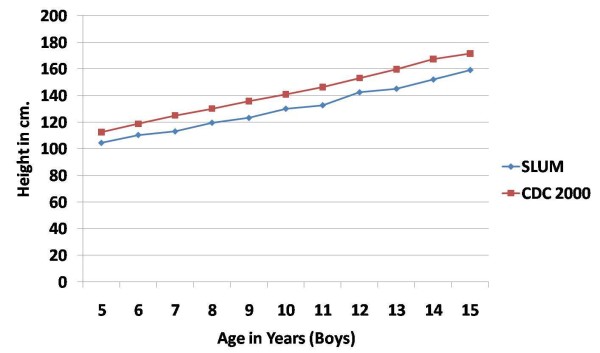
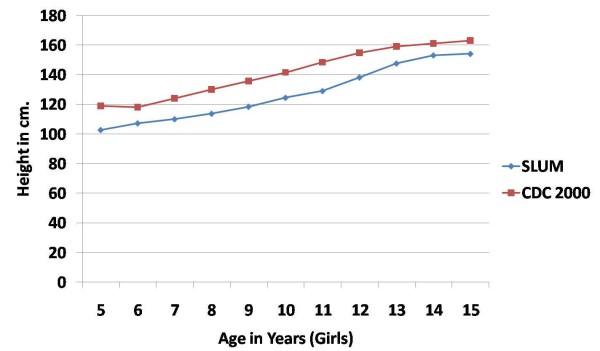
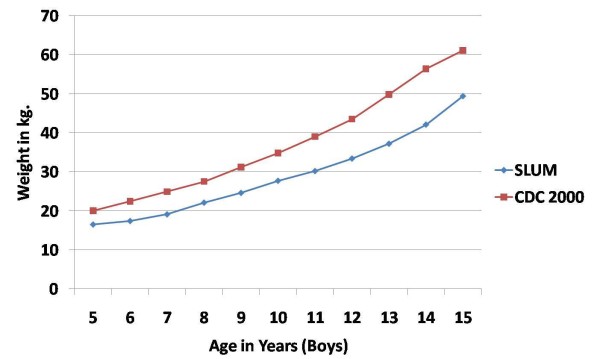
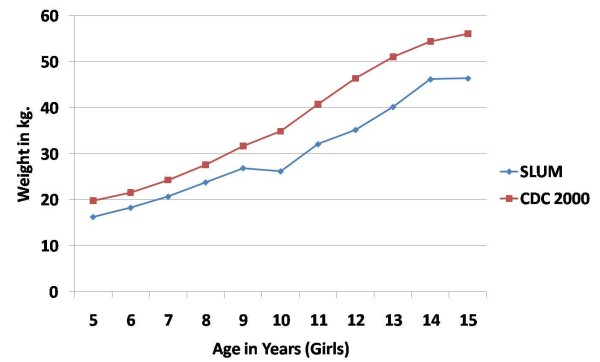
BACKGROUND: One of the greatest problems for India is undernutrition among children. The country is still struggling with this problem. Malnutrition, the condition resulting from faulty nutrition, weakens the immune system and causes significant growth and cognitive delay. Growth assessment is the measurement that best defines the health and nutritional status of children, while also providing an indirect measurement of well-being for the entire population. METHODS: A cross-sectional study, in which we explored nutritional status in school-age slum children and analyze factors associated with malnutrition with the help of a pre-designed and pre-tested questionnaire, anthropometric measurements and clinical examination from December 2010 to April 2011 in urban slums of Bareilly, Uttar-Pradesh (UP), India. RESULT: The mean height and weight of boys and girls in the study group was lower than the CDC 2000 (Centers for Disease Control and Prevention) standards in all age groups. Regarding nutritional status, prevalence of stunting and underweight was highest in age group 11 yrs to 13 yrs whereas prevalence of wasting was highest in age group 5 yrs to 7 yrs. Except refractive errors all illnesses are more common among girls, but this gender difference is statistically significant only for anemia and rickets. The risk of malnutrition was significantly higher among children living in joint families, children whose mother's education was [less than or equal to] 6th standard and children with working mothers. CONCLUSIONS: Most of the school-age slum children in our study had a poor nutritional status. Interventions such as skills-based nutrition education, fortification of food items, effective infection control, training of public healthcare workers and delivery of integrated programs are recommended.
Overview
The claims and statistics of this paper haven’t been checked yet.
Free: it reads the open-access text and checks the first 5 claims that cite a source we can check. Create a free account to check every claim.
Integrity signals
Registry
Cites
Statistics
Figures
Verification
Claims the paper makes
The claims and statistics of this paper haven’t been checked yet.
Free: it reads the open-access text and checks the first 5 claims that cite a source we can check. Create a free account to check every claim.
Claims other papers make about this one
Each is checked against this paper’s own text: does it say what the citing paper says it does?
The source backs part of the claim, not all of it — or backs it for a different population, condition or comparison.
In the citing paper
“Schools often provide essential nutrition and meals for children living in slums, and closing those institutions may deny children access to their only consistent meals [71].”
From Slum Health: Arresting COVID-19 and Improving Well-Being in Urban Informal Settlements (2020) · cites this paper as [71]
Experimental — accuracy not yet measured
Self-check
Percentages, sums and reported differences re-computed from the paper’s own numbers.
The self-check needs the paper’s full text.
Citations
Cites
2000 CDC Growth Charts for the United States: methods and development.
Kuczmarski, R. J., Ogden, C. L., Guo, S. S., Grummer‐Strawn, L. M., Flegal, K. M., Mei, Z., Wei, R. X., Curtin, L. R., Roche, A. F., & Johnson, C. L. (2002) · PubMed · Cited by 8,518
CDC GROWTH CHARTS FOR THE UNITED STATES: METHODS AND DEVELOPMENT 2000
Kuczmarski, R. J., Ogden, C. L., Guo, S. S., Strawn, L. G., Flegal, K. M., & Mei, Z. (2002) · Cited by 6,426
The assessment of the nutritional status of the community
Jelliffe, D. B. (1997) · Nutrition · doi:10.1016/s0899-9007(97)83027-4 · Cited by 1,599
Waterlow, J. C., Buzina, R., Keller, W., Lane, J. M., Nichaman, M. Z., & Tanner, J. M. (1977) · Europe PMC (PubMed Central) · Cited by 962
Maternal education and child health: Is there a strong causal relationship?
Desai, S., & Alva, S. (1998) · Demography · doi:10.2307/3004028 · Cited by 781 · cited 1×
“Earlier studies using household-level data have found mother’s education to be positively associated with a number of measures of child health and nutritional status [25-31].”
BackgroundExplaining Child Malnutrition in Developing Countries: A Cross-Country Analysis
(2000) · International Food Policy Research Institute eBooks · doi:10.2499/0896291146rr111 · Cited by 706 · cited 1×
“Women’s educational and social status, food availability, and access to safe water are well reported important underlying determinants that directly or indirectly cause malnutrition among children [23].”
BackgroundJelliffe, D. B. (1966) · PubMed · Cited by 633
How Does Mother's Education Affect Child Height?
Thomas, D., Strauss, J., & Henriques, M.-H. (1991) · The Journal of Human Resources · doi:10.2307/145920 · Cited by 599 · cited 1×
“Earlier studies using household-level data have found mother’s education to be positively associated with a number of measures of child health and nutritional status [25-31].”
BackgroundWomen's education, child welfare and child survival: a review of the evidence.
Hobcraft, J. (1993) · PubMed · Cited by 377
Maternal education and child nutritional status in Bolivia: finding the links
Frost, M. B., Forste, R., & Haas, D. W. (2005) · Social Science & Medicine · doi:10.1016/j.socscimed.2004.05.010 · Cited by 365 · cited 1×
“The pattern for wasting concurs with arguments found in several other studies [38,39] that wasting is influenced less by maternal characteristics than is stunting.”
Result
Research works printed but not linked: 6
- Labadarios D Swart R Maunder EMW Kruger HS Gericke GJ Kuzwayo PMM Ntsie PR Steyn NP Schloss I Dhansay MA Jooste PL Dannhauser A Nel JH Molefe D Kotze YJVW Executive summary of the national food consumption survey fortification baseline (NFCS-FB-1) South Africa, 2005 S Afr J Clin Nutr 2008 21 Suppl 2 245 300
- Gopalan C Harvinder Kaur Towards Better Nutrition - Problems and Policies Nutrition Foundation of India, Special Publication Series 1993 No.9 70 78
- Panda P Benjamin AI Zachariah P Growth and morbidity patterns among rural school children in Ludhiana, Punjab Health Popul Perspect Issues 1997 20 1 20 28
- Goyal RC Chavan UA Health status of school children in Ahmednagar city Indian J Maternal Child Health 1993 4 3 81 83
- Bishnoi P Sehgal S Kwatra A Anthropometric measurements of preschool children as effected by socio-economic factors Asian Pac J Clin Nutr 2004 13 132
- Moen AA The impact of child and maternal survival programmes on socio-economic development 1993 Center for Economic Research on Africa: School of Business, Montclair State University, Upper Montclair, New Jersey
Cited by
Items 201–269 of 269
Urban Poor Children: The Priority
Ambey, R., Gaur, A., Gupta, R., & Patel, G. (2013) · Australasian Medical Journal · doi:10.21767/amj.2013.1714 · Cited by 1
Chowdhury, M., Malik, M. A., Hoque, M., Das, D., Kabir, M. H., & Chowdhury, F. (2019) · BIRDEM Medical Journal · doi:10.3329/birdem.v9i1.39722 · Cited by 1
“Regarding nutritional status in an Indian study Srivastava et al.12 mentioned that the prevalence of stunting and underweight was found to be the highest in age group 5-6 years and 11-12 years respectively whereas maximum prevalence of wasting was found in age group 7- 8 years.”
BackgroundInfluentialNutritional Status and School Performance of Primary School Children in Ogun State, Nigeria
Ajuzie, N. C., Sanusi, R. A., & Makinde, Y. O. (2018) · Journal of Nutritional Health & Food Science · doi:10.15226/jnhfs.2018.001146 · Cited by 1
“Understanding the nutritional status of children has far-reaching implications for promoting the health of future generations [2].”
Singh, A., Mishra, R., Singh, K. K., & Verma, P. (2020) · Genus · doi:10.1186/s41118-020-00079-2 · Cited by 6
Ramalho, J., & Chant, S. (2020) · London School of Economics and Political Science Research Online (London School of Economics and Political Science) · Cited by 1
Nutritional Status of School-Going Adolescents in Eastern Part of Nepal
Kafle, T. K., Kafle, T. K., Hawlader, M. D. H., Rimal, H. S., & Sapkota, D. (2020) · Birat Journal of Health Sciences · doi:10.3126/bjhs.v5i1.29628 · Cited by 1
Akram, H., Akram, S., Tahir, S. K., & Ali, A. (2020) · Acta Scientifci Nutritional Health · doi:10.31080/asnh.2020.04.0761 · Cited by 1
Dietary intake and cognitive development among children in Kisumu county, Kenya
Sawe, C., Kogi‐Makau, W., Ettyang, G. A., & Kimamo, C. O. (2020) · African Journal of Food Agriculture Nutrition and Development · doi:10.18697/ajfand.94.19920 · Cited by 2
“Iron deficiency has also been linked to a reduction in IQ by almost 9 points and anemic preschoolers have been seen to be having problems in maintaining class concentration [13].”
BackgroundRaghuvanshi, R. S., Singh, R., Bhati, D., Khan, R., Jantwal, C., & Shukla, P. (2020) · The Indian Journal of Nutrition and Dietetics · doi:10.21048/ijnd.2020.57.4.24788 · Cited by 1
A study for the Assessment of Nutritional Deficiency Status of the School Going Girls
Singh, A., & Sharma, R. (2022) · Integrated Journal for Research in Arts and Humanities · doi:10.55544/ijrah.2.3.43 · Cited by 1
Kumar, S. (2023) · Indian Journal of Youth and Adolescent Health · doi:10.24321/2349.2880.202306 · Cited by 1
Intelligence and Nutritional Status of Lambani School Children
Naik, S. (2013) · Cited by 1
Vitamin D Status of Ghanaian 8-12 Year Old Children in Selected Schools in the Greater Accra Region
Oteng, S. A. (2018) · Cited by 1
Eniyew, T., Abebe, F., Gela, D., Asegid, A., & Tiruneh, D. (2019) · Research Square · doi:10.21203/rs.2.13718/v1 · Cited by 1
Emeagi, C. S., & Apugo, U. I. (2022) · medRxiv · doi:10.1101/2022.12.23.22283888 · Cited by 1
Mihretie, Y., Ayelign, A., & Zerfu, T. A. (2024) · Preprints.org · doi:10.20944/preprints202401.1799.v1 · Cited by 1
Health and Nutritional Profile of Working and Non-Working Slum Children
Haque, M. M., Uddin, A. K. M. M., Khan, M. Z. H., & Islam, K. (2014) · Chattagram Maa-O-Shishu Hospital Medical College Journal · doi:10.3329/cmoshmcj.v13i3.21016
Serum Vitamin A and Nutritional Status of Children Fed Gari and Beans Stew
Alatiah, G. A. (2013)
An anthropometric study on the primary school in a rural area of district Bareilly
Gupta, D. K., Maheshwari, S., Gupta, S. B., Shrotriya, V. P., Singh, A. K., Kumar, A., & Sinha, R. (2015) · International Journal of Health · doi:10.14419/ijh.v3i2.5438
Self-citationNatekar, M. D. S., & Mhaske, D. A. (2016) · IOSR Journal of Nursing and health Science · doi:10.9790/1959-0505052530
Nutritional Assessment of Children living in Slums Area of Maharajpur Village of Gwalior City
Tiwari, A., & Girls, V. R. G. (2014)
Saminathan, D., Prabakar, D., & Shiyamala, K. (2017) · Journal of Evolution of Medical and Dental Sciences · doi:10.14260/jemds/2017/880
Jolly, J., Hussain, M. A., Kumar, A., Adil, A. R. A., Singh, P. K., & Mukherjee, B. (2017) · Journal of Evolution of Medical and Dental Sciences · doi:10.14260/jemds/2017/1457
“2) 45(9) Intermediate and above 17 (3.”
Health profile of school dropout children in slums of the municipal corporation area of a city
Dhande, V. S., Gadekar, R. D., Doibale, M., Gattani, P. L., Domple, V. K., & Inamdar, I. F. (2019) · International Journal of Community Medicine and Public Health · doi:10.18203/2394-6040.ijcmph20192337
Fatimah, N. S., & Nindya, T. S. (2019) · Media Gizi Indonesia · doi:10.20473/mgi.v14i2.177-185
Paediatric Medicine in India and Bottlenecks of Development in Nurturing Demographic Assets
Shivangi (2019) · South Asia Research · doi:10.1177/0262728019861762
“Srivastava et al. (2012) found obvious relationships between growth status, school performance and intellectual achievement.”
BackgroundRani, P., & Sangwan, V. (2019) · FOOD SCIENCE RESEARCH JOURNAL · doi:10.15740/has/fsrj/10.2/144-148
Nutritional status and morbidity profile of school going adolescent boys in an urban area
Rajderkar, S. S., & Dudhabhate, B. T. (2020) · International Journal of Community Medicine and Public Health · doi:10.18203/2394-6040.ijcmph20201470
“Srivastav et al also mentioned that the risk of malnutrition was significantly higher among children living in joint families.(14)”
Daniel Rajendran, T. (2020) · Indian Journal of Forensic Medicine & Toxicology · doi:10.37506/ijfmt.v14i3.10685
“The classification of stunting and underweight was carried out based on CDC standards.[5] Data analysis Data was entered and analyzed using SPSS ver.”
MethodThe Micronutrient Consumption in Indian Elementary School Children across Socioeconomic Strata
Bansal, K., Sanghi, D., Parasher, R. K., & Bhatnagar, B. (2021) · International Journal of Child Health and Nutrition · doi:10.6000/1929-4247.2021.10.01.4
Evaluation of health appraisal project of primary school children: a study in Egypt
Rizk, H., Abdel-Razik, M. S. M., & Elsebaie, E. H. (2021) · The International Journal of Health Planning and Management · doi:10.1002/hpm.3155
Morphometric characteristics of girls 7–8 years old
Izatilloyevna, I. M. (2021) · ACADEMICIA An International Multidisciplinary Research Journal · doi:10.5958/2249-7137.2021.00467.5
Ndava, M., Musemwa, L., Ndhleve, S., & Zhou, L. (2021) · Journal of International Cooperation and Development · doi:10.36941/jicd-2021-0010
Assessing the Risk Factors of Malnutrition in Uttar Pradesh
Mishra, S., Dubey, A., Srivastava, M., & Singh, R. K. (2021) · International Journal of Current Research and Review · doi:10.31782/ijcrr.2021.132201
Narayana, G. V., Thasmiya, D. R., Chowdary, P. P., Veerabhadrappa, K. V., Madhale Milka, D., Kandula, U. R., & Reetha, M. (2021) · International Journal of Current Research and Review · doi:10.31782/ijcrr.2021.132206
A Study on Health and Nutrition Status of Children
Rani, T. J., & Seenivasan, R. (2022) · Shanlax International Journal of Economics · doi:10.34293/economics.v10i2.4666
Patruni, K., & Kaur, G. (2022) · Springer eBooks · doi:10.1007/978-981-16-8125-7_12
Some Nutritional Indices of Public and Private Secondary School Students in Igbanke, Edo State
Eidangbe, A. P., Onyeogo, V., & Oshiokhayamhe, I. K. (2022) · Saudi Journal of Biomedical Research · doi:10.36348/sjbr.2022.v07i07.002
“…than 200 million school age children are stunted and underweight and if no action is taken and at this rate, about one billion school children will be growing up by 2020 with impaired physical and mental development (Ara et al., 2011, UNICEF, 2011, Srivastava et al., 2012, Mekonnen et al., 2013).”
BackgroundA comparative study on body composition of government and public school students
Banerjee, D. (2022) · International Journal of Physical Education Sports and Health · doi:10.22271/kheljournal.2022.v9.i3d.2546
Jhanwar, M., & Kumari, D. (2022) · INTERNATIONAL JOURNAL OF SCIENTIFIC RESEARCH · doi:10.36106/ijsr/6225387
Emeagi, C. S., Clement, E. E., Gbenwee, B., & Obi, K. U. (2023) · EPRA International Journal of Multidisciplinary Research (IJMR) · doi:10.36713/epra12184
Emeagi, C. S., & Apugo, U. I. (2023) · International Journal of Scientific Research in Science Engineering and Technology · doi:10.32628/ijsrset2310116
Nutritional Security in India: An Overview of Basics, Status, Programmes and Prospects
Shahane, A. A., & Shivay, Y. S. (2023) · Acta Scientific Agriculture · doi:10.31080/asag.2023.07.1277
Naik, G., Pal, R., & Mohan Kumar, M. (2023) · D Y Patil Journal of Health Sciences · doi:10.4103/dypj.dypj_19_23
Handling classroom hunger : comparing modes of mid-day meal delivery in Anekal block, Karnataka
Seshadri, S. R., Rishikesh, B. S., Prasad, P., & Patil, S. (2020) · doi:10.61933/wps.19.2020.10 · Cited by 1
Why Breakfast should be an important meal among school children life?
Souza, S. H. D. (2023) · Bulletin of the National Nutrition Institute · doi:10.21608/enj.2023.247292.1020 · Cited by 5
“School age is one of the active growing phases for the physical growth and the mental development of the child (Srivastava et al., 2012 ) .”
BackgroundNutritional Status of Children- A Comparative Study among Students in Government and Private Schools
-, A. S. S., & -, A. C. R. (2023) · International Journal For Multidisciplinary Research · doi:10.36948/ijfmr.2023.v05i06.11009
“[20] Therefore, evaluating a child’s nutritional status will aid in identifying risk factors, which in turn helps in preventing future health consequences through awareness, prophylaxis, sustainable intervention in regard with healthy nutritional practices, encouragement of physical activity and…”
BackgroundAhmad, S., Ansari, A. H., Zulkifle, M., & Abrar, B. (2022) · Journal of Research in Unani Medicine · doi:10.4103/jrum.jrum_1_23
Utility of anthropometry in defining overweight and obesity in urban South Indian children
Solomon, R. S., & Solomon, A. R. (2024) · Journal of Family Medicine and Primary Care · doi:10.4103/jfmpc.jfmpc_1656_23
“[26] Even though we applied Indian reference growth charts, stunting and underweight were still prevalent in urban areas and were higher in boys.”
MethodTaşci, S. Ç., Kırbaş, Z. Ö., Erkılıç, T. O., & Demir, D. (2024) · Revista de Gestão Social e Ambiental · doi:10.24857/rgsa.v18n8-152 · Cited by 1
“In addition, it can also cause conditions such as a decrease in cognitive capacity, distraction and a decrease in school achievement (Srivastava et al., 2012).”
BackgroundAswanth, K. S., Rajvanshi, N., Kumar, V., Chacham, S., Naithani, M., Kumari, R., & Verma, P. K. (2024) · Journal of Family Medicine and Primary Care · doi:10.4103/jfmpc.jfmpc_471_24
Turridha, A., & Shim, J. E. (2024) · 대한지역사회영양학회지 · doi:10.5720/kjcn.2024.00241 · Cited by 3
Habtamu, A., & Million, T. (2025) · JPGN Reports · doi:10.1002/jpr3.70033
EFFECT OF ANAMEIA IN PRIMARY SCHOOL CHILDREN IN KHURJA BULANDSHAHR
kaushik, S. (2025) · INTERNATIONAL JOURNAL OF RESEARCH AND ANALYTICAL REVIEWS · doi:10.56975/ijrar.v12i2.313794
Musuka, G., Dzinamarira, T., Cuadros, D. F., Chingombe, I., Herrera, H., Mbunge, E., Murewanhema, G., Moyo, E., & Mapingure, M. P. (2025) · Research Square · doi:10.21203/rs.3.rs-6420926/v1
Rainbow Nutrition: A Pre Experimental Study among School Children
Uma., P. (2025) · International Journal of Advances in Nursing Management · doi:10.52711/2454-2652.2025.00032
Mohammed, S. A., Aden, E. H., & Ibrahim, K. H. (2025) · Nutrition · doi:10.1016/j.nut.2025.113025
Kaur, P., Gupta, M., & Bharti, B. (2025) · Journal of Family Medicine and Primary Care · doi:10.4103/jfmpc.jfmpc_1018_24
“[21] This finding is in contrast to another study conducted in India by Srivastava et al .”
Vitamin A supplementation and nutritional status among children 6–36 months in Northern Ghana
Nonterah, E. W., Christian, A. K., Welaga, P., Chatio, S., Dalaba, M., Oduro, A. R., Bawah, A., & Nonterah, E. (2025) · Academia Nutrition and Dietetics · doi:10.20935/acadnutr8006
Singh, S. K., Srivastava, S., & Chauhan, S. (2020) · Figshare · doi:10.6084/m9.figshare.13331595
Zeinalabedini, M., Zamani, B., Nasli‐Esfahani, E., & Azadbakht, L. (2023) · Figshare · doi:10.6084/m9.figshare.23255521
Singh, R., Nayak, G., & Satapathy, A. K. (2026) · Cureus · doi:10.7759/cureus.105874
“Higher prevalence has frequently been observed among children residing in rural areas, urban slums, and socio-economically disadvantaged populations [18-20].”
Tareen, Z., Sharma, S. K., Farooqi, K., Tareen, A. T., & Rafiqi, N. (2026) · International Journal of Child Health and Nutrition · doi:10.6000/1929-4247.2026.15.02.6
“The school-aged period constitutes an active phase of growth and development, during which there are changes in the physical, psychological, emotional, and social aspects; hence, from school-aged to school completion, fundamental health for life is established [7].”
InfluentialAccreditation as a catalyst for improving child nutrition services in residential care: A case study
Kartikawati, D., Rusyidi, B., Apsari, N. C., & Sulastri, S. (2026) · Journal of Education and Health Promotion · doi:10.4103/jehp.jehp_906_25
“[7] All these reforms help in the quantifiable improvements in the child nutrition services and they include improvement in service quality, improved anthropometric outcomes, improved accountability of caregivers and adherence to national and international health policy standards.”
Sanchez‐Macedo, L., Vidal-Espinoza, R., Villegas-Abrill, C., Quispe, V. I., Arocutipa, V. A., Sulla-Torres, J. A., Cossio-Bolaños, M., & Gómez‐Campos, R. (2026) · Annals of Human Biology · doi:10.1080/03014460.2026.2703612
Pathak, D. M. (2026) · International Journal of Community Medicine and Public Health · doi:10.18203/2394-6040.ijcmph20263664
Metadata
- Authors
- Srivastava, A., Mahmood, S. E., Srivastava, P. M., Shrotriya, V. P., & Kumar, B.
- Affiliations
- M.J.P. Rohilkhand University (IN)
- Corresponding author
- Srivastava, Anurag
- Venue
- Archives of Public Health
- Published
- 2012-04-17
- Volume
- 70
- Issue
- 1
- Pages
- 8-8
- ISSN
- 0778-7367 (ISSN-L)
- 2049-3258
- PMC
- PMC3436633
- OpenAlex
- W2155145217
- Cited by
- 270
- References
- 38
- Citations by year
- 2026: 5 · 2025: 11 · 2024: 24 · 2023: 22 · 2022: 24 · 2021: 25 · 2020: 36 · 2019: 27 · 2018: 23 · 2017: 22 · 2016: 15 · 2015: 11 · 2014: 14 · 2013: 10 · 2012: 1
- FWCI
- 10.76
- Type
- journal article
- Language
- en
- Open access
- gold
- doi.org
- Licence
- cc-by
- creativecommons.org/licenses/by/2.0 (tdm)
- Locations
- Archives of Public Health (publishedVersion, cc-by)
- Europe PMC (PubMed Central) (publishedVersion, cc-by)
- PubMed Central (publishedVersion, cc-by)
- PubMed (publishedVersion)
- Topics
- Health Sciences › Nursing › Nutrition and Dietetics › Child Nutrition and Water Access
- Health Sciences › Medicine › Pediatrics, Perinatology and Child Health › Public Health and Nutrition
- Social Sciences › Development › Poverty, Education, and Child Welfare
- Keywords
- child malnutrition, elementary school students, urban slums, stunting, underweight, wasting, anemia, rickets, maternal education, working mothers, joint family, nutritional status
About these checks
Registry, retraction, Cites and statistics results are computed, not judged, with one exception: a printed reference that no index lists is read once by a model before it counts as a citation error. Claims are extracted by a model and kept only when their quote appears verbatim in the text; each cited source is then checked, with a model’s help, for whether it says what the claim relies on. Those verdicts can be wrong — read the claim’s quote and the cited source before relying on one.
Statistics and arithmetic are recomputed, not judged.
Confidence bands are shown only for fields calibrated on our annotated test set. None is calibrated yet, so no band is shown.
What counts as a claim ›How we measure confidence ›How we check this ›
Are you an author, or do you see a problem with this page? Request a review
Data sources
Bibliographic data: Semantic Scholar, OpenAlex, Crossref.
Contains information from the Semantic Scholar Academic Graph Datasets, made available under the ODC Attribution License (ODC-BY 1.0).
Semantic Scholar’s data is described in: Kinney, R., et al. (2023). The Semantic Scholar Open Data Platform. arXiv:2301.10140.
