

Inhibition of dynamin-dependent endocytosis increases shedding of the amyloid precursor protein ectodomain and reduces generation of amyloid β protein
The DOI matches its Crossref record; 5 of the 5 references it cites were found in a registry or an index.
Abstract
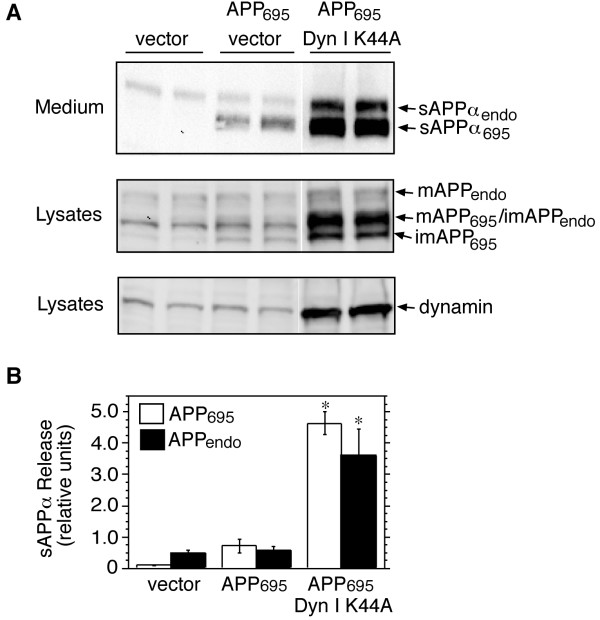
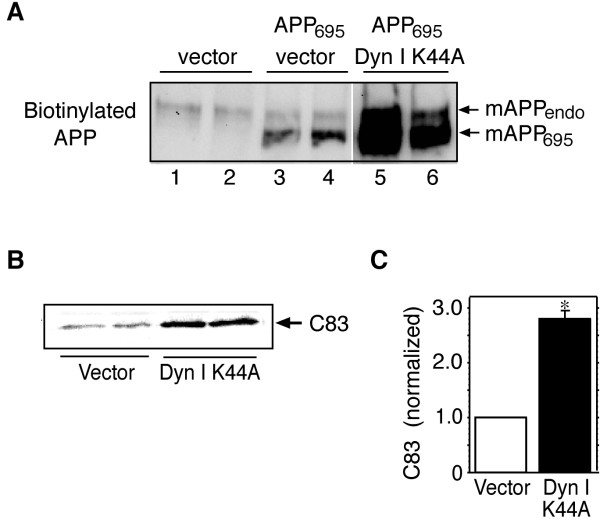
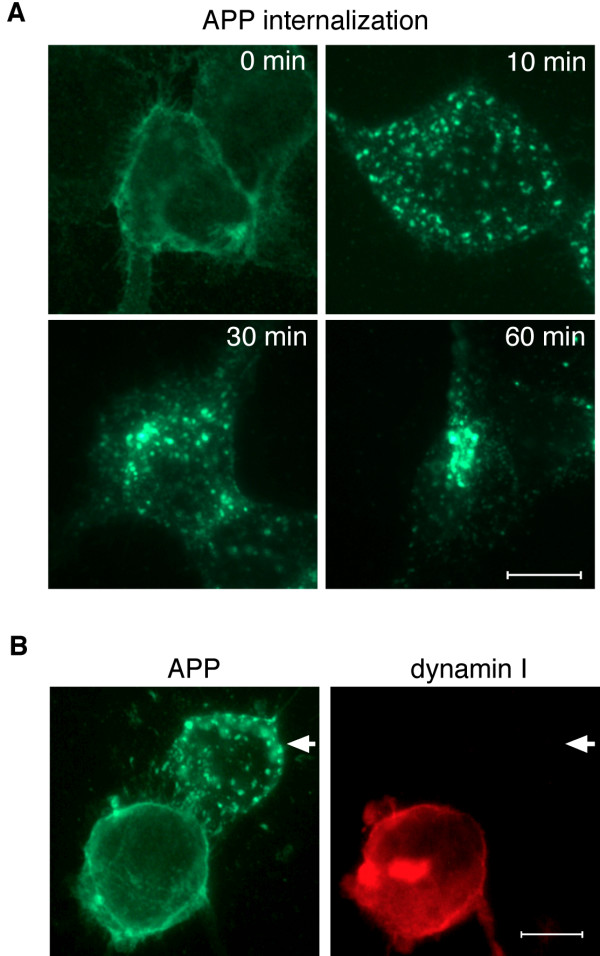
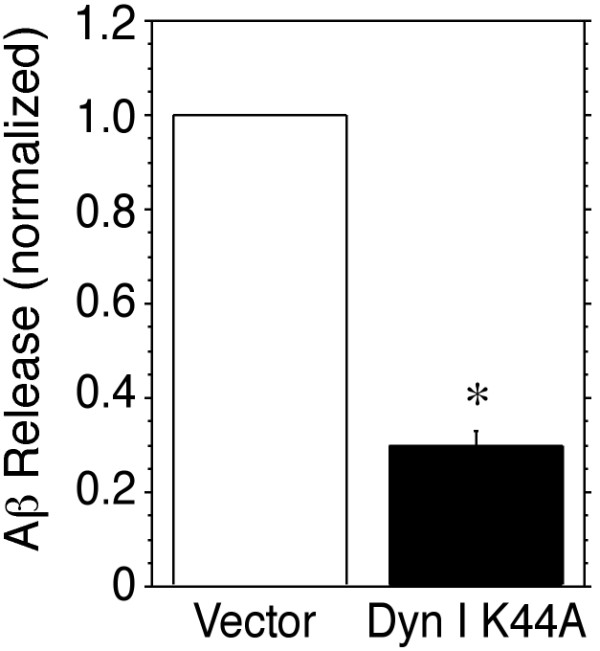
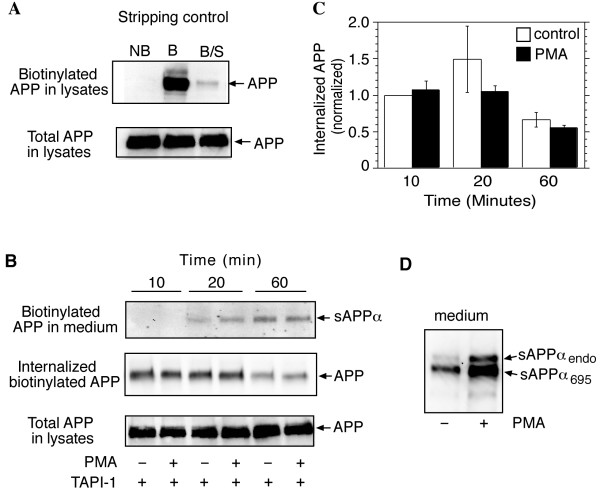
Background: The amyloid precursor protein (APP) is transported via the secretory pathway to the cell surface, where it may be cleaved within its ectodomain by α-secretase, or internalized within clathrin-coated vesicles. An alternative proteolytic pathway occurs within the endocytic compartment, where the sequential action of β- and γ-secretases generates the amyloid β protein (Aβ). In this study, we investigated the effects of modulators of endocytosis on APP processing. Results: Human embryonic kidney cells were transfected with a dominant negative mutant of dynamin I, an important mediator of clathrin-dependent endocytosis, and APP proteolysis was analyzed. Overexpression of the mutant dynamin (dyn I K44A) resulted in increased shedding of the APP ectodomain (sAPPα), accumulation of the C-terminal α-secretase product C83, and a reduction in the release of Aβ. Levels of mature APP on the cell surface were increased in cells expressing dyn I K44A, and internalization of surface-immunolabeled APP, assessed by fluorescence microscopy, was inhibited. Dynamin is a substrate for protein kinase C (PKC), and it was hypothesized that activators of PKC, which are known to stimulate α-secretase-mediated cleavage of APP, might exert their effects by inhibiting dynamin-dependent endocytosis. However, the internalization of surface-biotinylated APP was unaffected by treatment of cells with phorbol 12-myristate 13-acetate in the presence of the α-secretase inhibitor TAPI-1. Conclusion: The results indicate that APP is internalized by a dynamin-dependent process, and suggest that alterations in the activity of proteins that mediate endocytosis might lead to significant changes in Aβ production.
Overview
The claims and statistics of this paper haven’t been checked yet.
Free: it reads the open-access text and checks the first 5 claims that cite a source we can check. Create a free account to check every claim.
Integrity signals
Registry
Cites
Statistics
Figures
Verification
Claims the paper makes
The claims and statistics of this paper haven’t been checked yet.
Free: it reads the open-access text and checks the first 5 claims that cite a source we can check. Create a free account to check every claim.
Claims other papers make about this one
Each is checked against this paper’s own text: does it say what the citing paper says it does?
In the citing paper
“The shedding of the major substrate of BACE1, the amyloid precursor protein (APP), appears to occur mainly in early endosomal compartments.”
From ADP ribosylation factor 6 (ARF6) controls amyloid precursor protein (APP) processing by mediating the endosomal sorting of BACE1 (2011) · cites this paper as [10]
In the citing paper
“Indeed, factors that promote APP or BACE1 internalization (8, 9) enhance Aβ production, whereas, reversely, blocking their internalization decreases Aβ levels (10, 11).”
From ADP ribosylation factor 6 (ARF6) controls amyloid precursor protein (APP) processing by mediating the endosomal sorting of BACE1 (2011) · cites this paper as [10]
In the citing paper
“Inhibition of endocytosis reduces APP internalization and reduces Aβ production and release in cell lines”
From Endocytosis Is Required for Synaptic Activity-Dependent Release of Amyloid-β In Vivo (2008) · cites this paper as Carey et al., 2005
In the citing paper
“it has been reported that BACE activity is enriched in late or recycling endosomes and that endocytosis is required for the production of a significant portion of the Aβ secreted from nonneuronal and neuronal cells (Koo and Squazzo, 1994; Kinoshita et al., 2003; Carey et al., 2005).”
From Axonal amyloid precursor protein and its fragments undergo somatodendritic endocytosis and processing (2015) · cites this paper as Carey et al., 2005
Self-check
Percentages, sums and reported differences re-computed from the paper’s own numbers.
The self-check needs the paper’s full text.
Citations
Cites
Alzheimer's Disease: Genes, Proteins, and Therapy
Selkoe, D. J. (2001) · Physiological Reviews · doi:10.1152/physrev.2001.81.2.741 · Cited by 6,063
Cellular actions of beta-amyloid precursor protein and its soluble and fibrillogenic derivatives
Mattson, M. P. (1997) · Physiological Reviews · doi:10.1152/physrev.1997.77.4.1081 · Cited by 1,006
Nitsch, R. M., Slack, B. E., Wurtman, R. J., & Growdon, J. H. (1992) · Science · doi:10.1126/science.1411529 · Cited by 898
Self-citationDynamin-mediated Internalization of Caveolae
Henley, J. R., Krueger, E. W. A., Oswald, B. J., & McNiven, M. A. (1998) · The Journal of Cell Biology · doi:10.1083/jcb.141.1.85 · Cited by 767
Chyung, J. H., & Selkoe, D. J. (2003) · Journal of Biological Chemistry · doi:10.1074/jbc.m304989200 · Cited by 111
Research works printed but not linked: 44
- Suh YH Checler F Amyloid precursor protein, presenilins, and α-synuclein: Molecular pathogenesis and pharmacological applications in Alzheimer's disease Pharmacol Rev 2002 54 469 525 12223532 10.1124/pr.54.3.469 · DOI · Paper page
- Buxbaum JD Liu K-N Luo Y Slack JL Stocking KL Peschon JJ Johnson RS Castner BJ Cerretti DP Black RA Evidence that tumor necrosis factor α converting enzyme is involved in regulated α-secretase cleavage of the Alzheimer protein precursor J Biol Chem 1998 273 27765 27767 9774383 10.1074/jbc.273.43.27765 · DOI · Paper page
- Lammich S Kojro E Postina R Gilbert S Pfeiffer R Jasionowski M Haass C Fahrenholz F Constitutive and regulated α-secretase cleavage of Alzheimer's amyloid precursor protein by a disintegrin metalloprotease Proc Natl Acad Sci USA 1999 96 3922 3927 10097139 10.1073/pnas.96.7.3922 PMC22396 · DOI · Paper page
- Slack BE Ma LK Seah CC Constitutive shedding of the amyloid precursor protein ectodomain is up-regulated by tumour necrosis factor-α converting enzyme Biochem J 2001 357 787 794 11463349 10.1042/0264-6021:3570787 PMC1222008 · doi:10.1042/0264-6021:3570787 · Paper page
- Checler F Processing of the β-amyloid precursor protein and its regulation in Alzheimer's disease J Neurochem 1995 65 1431 1444 7561836 · DOI · Paper page
- Mills J Reiner PB Regulation of amyloid precursor protein cleavage J Neurochem 1999 72 443 460 9930716 10.1046/j.1471-4159.1999.0720443.x · DOI · Paper page
- Da Cruz e Silva OAB Iverfeldt K Oltersdorf T Sinha S Lieberburg I Ramabhadran TV Suzuki T Sisodia SS Gandy S Greengard P Regulated cleavage of Alzheimer β-amyloid precursor protein in the absence of the cytoplasmic tail Neuroscience 1993 57 873 877 8309547 10.1016/0306-4522(93)90031-A · DOI
- Hung AY Selkoe DJ Selective ectodomain phosphorylation and regulated cleavage of β-amyloid precursor protein EMBO J 1994 13 534 542 8313898 PMC394842 · DOI
- Efthimiopoulos S Felsenstein KM Sambamurti K Robakis NK Refolo LM Study of the phorbol ester effect on Alzheimer amyloid precursor processing: Sequence requirements and involvement of a cholera toxin sensitive protein J Neurosci Res 1994 38 81 90 8057394 10.1002/jnr.490380111 · DOI
- Reddy P Slack JL Davis R Cerretti DP Kozlosky CJ Blanton RA Shows D Peschon JJ Black RA Functional analysis of the domain structure of tumor necrosis factor-α converting enzyme J Biol Chem 2000 275 14608 14614 10799547 10.1074/jbc.275.19.14608 · DOI · Paper page
- Diaz-Rodriguez E Montera JC Esparis-Ogando A Yuste L Pandiella A Extracellular signal-regulated kinase phosphorylates tumor necrosis factor α-converting enzyme at threonine 735: a potential role in regulated shedding Mol Biol Cell 2002 13 2031 2044 12058067 10.1091/mbc.01-11-0561 PMC117622 · DOI · Paper page
- Xu HX Greengard P Gandy S Regulated formation of Golgi secretory vesicles containing Alzheimer β-amyloid precursor protein J Biol Chem 1995 270 23243 23245 7559474 10.1074/jbc.270.40.23243 · DOI · Paper page
- Nordstedt C Caporaso GL Thyberg J Gandy SE Greengard P Identification of the Alzheimer β/A4 amyloid precursor protein in clathrin-coated vesicles purified from PC12 cells J Biol Chem 1993 268 608 612 8416966 · DOI · Paper page
- Marquez-Sterling NR Lo ACY Sisodia SS Koo EH Trafficking of cell-surface β-amyloid precursor protein: Evidence that a sorting intermediate participates in synaptic vesicle recycling J Neurosci 1997 17 140 151 8987743 PMC6793693 · DOI · Paper page
- Mousavi SA Malerod L Berg T Kjeken R Clathrin-dependent endocytosis Biochem J 2004 377 1 16 14505490 10.1042/BJ20031000 PMC1223844 · DOI · Paper page
- Robinson PJ Sontag J-M Liu J-P Fykse EM Slaughter C McMahon H Südhof TC Dynamin GTPase regulated by protein kinase C phosphorylation in nerve terminals Nature 1993 365 163 166 8371759 10.1038/365163a0 · DOI · Paper page
- Powell KA Valova VA Malladi CS Jensen ON Larsen MR Robinson PJ Phosphorylation of dynamin I on Ser-795 by protein kinase C blocks its association with phospholipids J Biol Chem 2000 275 11610 11617 10766777 10.1074/jbc.275.16.11610 · DOI · Paper page
- Cousin MA Tan TC Robinson PJ Protein phosphorylation is required for endocytosis in nerve terminals: potential role for the dephosphins dynamin I and synaptojanin, but not AP180 or amphiphysin J Neurochem 2001 76 105 116 11145983 10.1046/j.1471-4159.2001.00049.x · DOI · Paper page
- Schmid SL McNiven MA De Camilli P Dynamin and its partners: a progress report Curr Opin Cell Biol 1998 10 504 512 9719872 10.1016/S0955-0674(98)80066-5 · DOI · Paper page
- Damke H Baba T Warnock DE Schmid SL Induction of mutant dynamin specifically blocks endocytic coated vesicle formation J Cell Biol 1994 127 915 934 7962076 10.1083/jcb.127.4.915 PMC2200053 · DOI · Paper page
- Haass C Hung AY Schlossmacher MG Teplow DB Selkoe DJ β-amyloid peptide and a 3-kDa fragment are derived by distinct cellular mechanisms J Biol Chem 1993 268 3021 3024 8428976 · DOI · Paper page
- Koo EH Squazzo SL Evidence that production and release of amyloid β-protein involves the endocytic pathway J Biol Chem 1994 269 17386 17389 8021238 · DOI · Paper page
- Perez RG Soriano S Hayes JD Ostaszewski B Xia W Selkoe DJ Chen X Stokin GB Koo EH Mutagenesis identifies new signals for β-amyloid precursor protein endocytosis, turnover, and the generation of secreted fragments, including Aβ42 J Biol Chem 1999 274 18851 18856 10383380 10.1074/jbc.274.27.18851 · DOI · Paper page
- De Strooper B Annaert W Proteolytic processing and cell biological functions of the amyloid precursor protein J Cell Sci 2000 113 1857 1870 10806097 · DOI · Paper page
- Cao X Südhof TC A transcriptively active complex of APP with Fe65 and histone acetyltransferase Tip60 Science 2001 293 115 120 11441186 10.1126/science.1058783 · DOI · Paper page
- Gao Y Pimplikar SW The gamma-secretase-cleaved C-terminal fragment of amyloid precursor protein mediates signaling to the nucleus Proc Natl Acad Sci USA 2001 98 14979 14984 11742091 10.1073/pnas.261463298 PMC64969 · DOI · Paper page
- Leissring MA Murphy MP Mead TR Akbari Y Sugarman MC Jannatipour M Anliker B Müller U Saftig P De Strooper B Wolfe MS Golde TE LaFerla FM A physiologic signaling role for the gamma-secretase-derived intracellular fragment of APP Proc Natl Acad Sci USA 2002 99 4697 4702 11917117 10.1073/pnas.072033799 PMC123710 · DOI · Paper page
- Soriano S Chyung ASC Chen X Stokin GB Lee VMY Koo EH Expression of β-amyloid precursor protein-CD3gamma chimeras to demonstrate the selective generation of amyloid β1–40 and amyloid β1–42 peptides within secretory and endocytic compartments J Biol Chem 1999 274 32295 32300 10542269 10.1074/jbc.274.45.32295 · DOI · Paper page
- Daugherty BL Green SA Endosomal sorting of amyloid precursor protein-P-selectin chimeras influences secretase processing Traffic 2001 2 908 916 11737828 10.1034/j.1600-0854.2001.21206.x · DOI · Paper page
- Grbovic OM Mathews PM Jiang Y Schmidt SD Dinakar R Summers-Terio NB Ceresa BP Nixon RA Cataldo AM Rab5-stimulated up-regulation of the endocytic pathway increases intracellular β-cleaved amyloid precursor protein carboxyl-terminal fragment levels and Aβ production J Biol Chem 2003 278 31261 31268 12761223 10.1074/jbc.M304122200 · DOI · Paper page
- Ehehalt R Keller P Haass C Thiele C Simons K Amyloidogenic processing of the Alzheimer β-amyloid precursor protein depends on lipid rafts J Cell Biol 2003 160 113 123 12515826 10.1083/jcb.200207113 PMC2172747 · DOI · Paper page
- Chyung JH Raper DM Selkoe DJ γ-Secretase exists on the plasma membrane as an intact complex that accepts substrates and effects intramembrane cleavage J Biol Chem 2005 280 4383 4392 15569674 10.1074/jbc.M409272200 · DOI · Paper page
- Hung AY Haass C Nitsch RM Qiu WQ Citron M Wurtman RJ Growdon JH Selkoe DJ Activation of protein kinase C inhibits cellular production of the amyloid β-protein J Biol Chem 1993 268 22959 22962 8226807 · DOI · Paper page
- Daniels GM Amara SG Regulated trafficking of the human dopamine transporter. Clathrin-mediated internalization and lysosomal degradation in response to phorbol esters J Biol Chem 1999 274 35794 35801 10585462 10.1074/jbc.274.50.35794 · DOI · Paper page
- Ng T Shima D Squire A Bastiaens PIH Gschmeissner S Humphries MJ Parker PJ PKCα regulates β1 integrin-dependent cell motility through association and control of integrin traffic EMBO J 1999 18 3909 3923 10406796 10.1093/emboj/18.14.3909 PMC1171467 · DOI · Paper page
- Filippova N Sedelnikova A Zong Y Fortinberry H Weiss DS Regulation of recombinant gamma-aminobutyric acid (GABA)(A) and GABA(C) receptors by protein kinase C Mol Pharmacol 2000 57 847 856 10779366 · DOI
- Loder MK Melikian HE The dopamine transporter constitutively internalizes and recycles in a protein kinase C-regulated manner in stably transfected PC12 cell lines J Biol Chem 2003 278 22168 22174 12682063 10.1074/jbc.M301845200 PMC2597781 · DOI · Paper page
- Ueda H Inoue M Matsumoto T Protein kinase C-mediated inhibition of μ-opioid recetor internalization and its involvement in the development of acute tolerance to peripheral μ-agonist analgesia J Neurosci 2001 21 2967 2973 11312280 PMC6762572 · DOI
- Jolly-Tornetta C Wolf BA Protein kinase C regulation of intracellular and cell surface amyloid precursor protein (APP) cleavage in CHO695 cells Biochemistry 2000 39 15282 15290 11106509 10.1021/bi001723y · DOI
- Rosen KM Ford BD Querfurth HW Downregulation and increased turnover of β-amyloid precursor protein in skeletal muscle cultures by neuregulin-1 Exp Neurol 2003 181 170 180 12781990 10.1016/S0014-4886(03)00031-1 · DOI
- Yao PJ Synaptic frailty and clathrin-mediated synaptic vesicle trafficking in Alzheimer's disease Trends Neurosci 2004 27 24 29 14698607 10.1016/j.tins.2003.10.012 · DOI
- Kelly BL Vassar R Ferreira A Beta-amyloid-induced dynamin 1 depletion in hippocampal neurons: A potential mechanism for early cognitive decline in Alzheimer's disease J Biol Chem 2005 JBC Papers in Press published on July 15, 2005 as doi:10.1074/jbc.M503259200. 16002400 PMC1364535 · DOI · Paper page
- Neve RL McPhie DL Chen Y Alzheimer's disease: a dysfunction of the amyloid precursor protein Brain Res 2000 886 54 66 11119687 10.1016/S0006-8993(00)02869-9 · DOI
- Petryniak MA Wurtman RJ Slack BE Elevated intracellular calcium concentration increases secretory processing of the amyloid precursor protein by a tyrosine phosphorylation-dependent mechanism Biochem J 1996 320 957 963 9003386 PMC1218021 · DOI
Cited by
Harold, D., Abraham, R., Hollingworth, P., Sims, R., Gerrish, A., Hamshere, M. L., Pahwa, J. S., Moskvina, V., Dowzell, K., Williams, A., et al. (2009) · Nature Genetics · doi:10.1038/ng.440 · Cited by 3,326
Trafficking and Proteolytic Processing of APP
Haass, C., Kaether, C., Thinakaran, G., & Sisodia, S. (2012) · Cold Spring Harbor Perspectives in Medicine · doi:10.1101/cshperspect.a006270 · Cited by 1,075
Endocytosis and signalling: intertwining molecular networks
Sorkin, A., & von Zastrow, M. (2009) · Nature Reviews Molecular Cell Biology · doi:10.1038/nrm2748 · Cited by 1,064
APP processing in Alzheimer’s disease.
Zhang, Y.-W., Thompson, R., Zhang, H., & Xu, H. (2011) · Molecular Brain · doi:10.1186/1756-6606-4-3 · Cited by 983
Endocytosis Is Required for Synaptic Activity-Dependent Release of Amyloid-β In Vivo
Cirrito, J. R., Kang, J.-E., Lee, J., Stewart, F. R., Verges, D. K., Silverio, L. M., Bu, G., Mennerick, S., & Holtzman, D. M. (2008) · Neuron · doi:10.1016/j.neuron.2008.02.003 · Cited by 635
Metadata
- Authors
- Carey, R. M., Balcz, B. A., Lopez-Coviella, I., & Slack, B. E.
- Venue
- BMC Cell Biology
- Published
- 2005-08-11
- Volume
- 6
- Issue
- 1
- ISSN
- 1471-2121
- PMC
- PMC1208872
- Cited by
- 112
- References
- 5
- Language
- en
About these checks
Registry, retraction, Cites and statistics results are computed, not judged, with one exception: a printed reference that no index lists is read once by a model before it counts as a citation error. Claims are extracted by a model and kept only when their quote appears verbatim in the text; each cited source is then checked, with a model’s help, for whether it says what the claim relies on. Those verdicts can be wrong — read the claim’s quote and the cited source before relying on one.
Statistics and arithmetic are recomputed, not judged.
Confidence bands are shown only for fields calibrated on our annotated test set. None is calibrated yet, so no band is shown.
What counts as a claim ›How we measure confidence ›How we check this ›
Are you an author, or do you see a problem with this page? Request a review
Data sources
Bibliographic data: Semantic Scholar, OpenAlex, Crossref.
Contains information from the Semantic Scholar Academic Graph Datasets, made available under the ODC Attribution License (ODC-BY 1.0).
Semantic Scholar’s data is described in: Kinney, R., et al. (2023). The Semantic Scholar Open Data Platform. arXiv:2301.10140.
