

A mechanism for the sharp transition of morphogen gradient interpretation in Xenopus
Open accessThe DOI matches its Crossref record; 45 of the 45 references it cites were found in a registry or an index.
Abstract
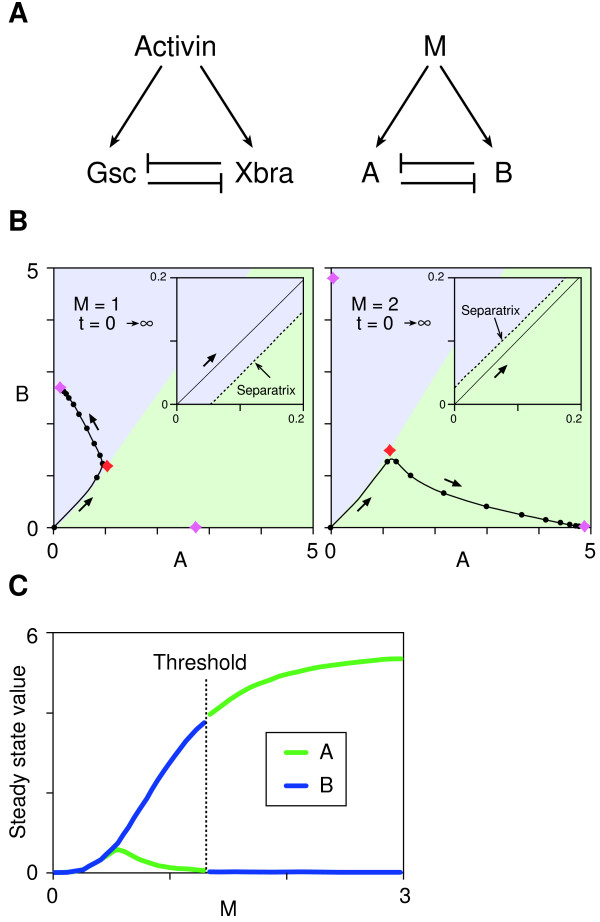
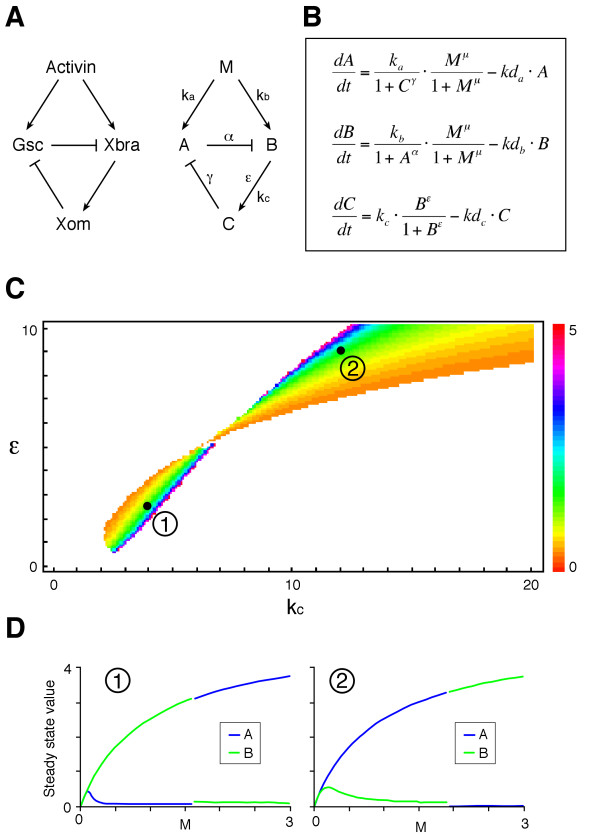
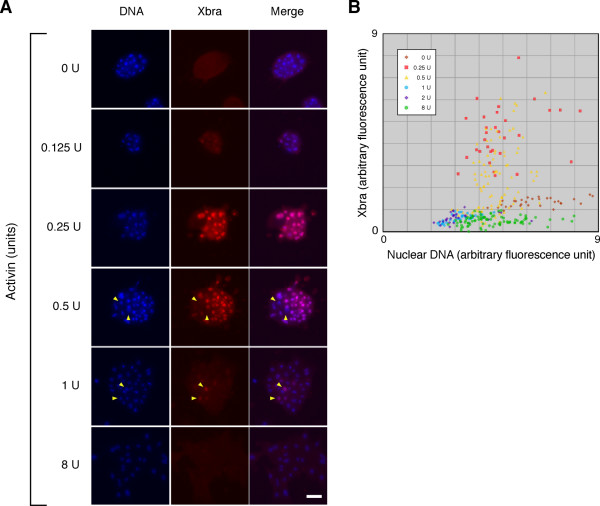
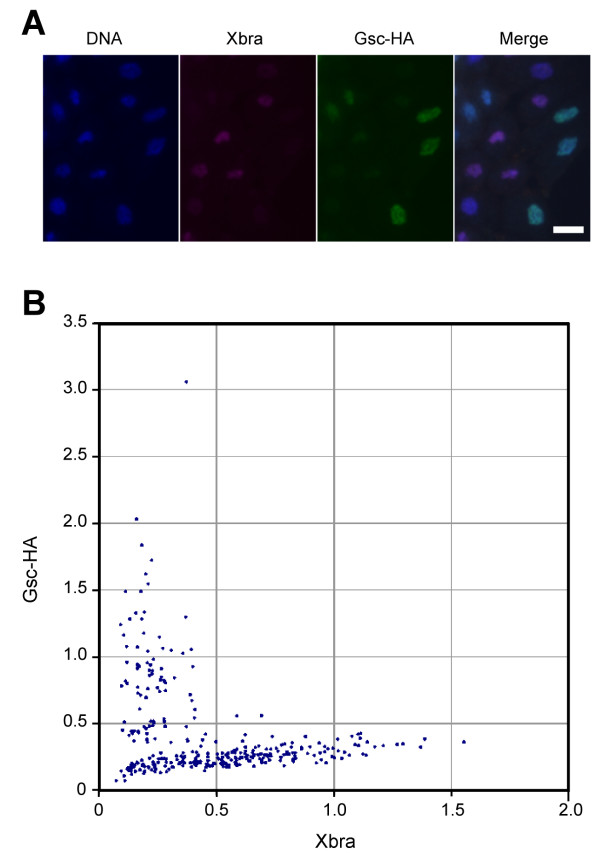
Background: One way in which positional information is established during embryonic development is through the graded distribution of diffusible morphogens. Unfortunately, little is known about how cells interpret different concentrations of morphogen to activate different genes or how thresholds are generated in a morphogen gradient. Results: Here we show that the concentration-dependent induction of the T-box transcription factor Brachyury (Xbra) and the homeobox-containing gene Goosecoid (Gsc) by activin in Xenopus can be explained by the dynamics of a simple network consisting of three elements with a mutual negative feedback motif that can function to convert a graded signal (activin) into a binary output (Xbra on and Gsc off, or vice versa). Importantly, such a system can display sharp thresholds. Consistent with the predictions of our model, Xenopus ectodermal cells display a binary response at the single cell level after treatment with activin. Conclusion: This kind of simple network with mutual negative feedback might provide a general mechanism for selective gene activation in response to different levels of a single external signal. It provides a mechanism by which a sharp boundary might be created between domains of different cell types in response to a morphogen gradient.
Overview
The claims and statistics of this paper haven’t been checked yet.
Free: it reads the open-access text and checks the first 5 claims that cite a source we can check. Create a free account to check every claim.
Integrity signals
Registry
Cites
Statistics
Figures
Verification
Claims the paper makes
The claims and statistics of this paper haven’t been checked yet.
Free: it reads the open-access text and checks the first 5 claims that cite a source we can check. Create a free account to check every claim.
Claims other papers make about this one
Each is checked against this paper’s own text: does it say what the citing paper says it does?
In the citing paper
“Distinct regulatory responses occur, dependent on the intensity of signalling, resulting in activation of different genes in different locations in the embryo, for example in response to an activin gradient in the pre-gastrular Xenopus embryo21.”
From Emerging properties of animal gene regulatory networks (2010) · cites this paper as [21]
Self-check
Percentages, sums and reported differences re-computed from the paper’s own numbers.
The self-check needs the paper’s full text.
Citations
Cites
Construction of a genetic toggle switch in Escherichia coli
Gardner, T. S., Cantor, C. R., & Collins, J. J. (2000) · Nature · doi:10.1038/35002131 · Cited by 4,268
Positional information and the spatial pattern of cellular differentiation
Wolpert, L. (1969) · Journal of Theoretical Biology · doi:10.1016/s0022-5193(69)80016-0 · Cited by 3,050
Stochasticity in gene expression: from theories to phenotypes
Kærn, M., Elston, T. C., Blake, W. J., & Collins, J. J. (2005) · Nature Reviews Genetics · doi:10.1038/nrg1615 · Cited by 2,320
Ferrell, J. E. (2002) · Current Opinion in Cell Biology · doi:10.1016/s0955-0674(02)00314-9 · Cited by 1,131
Briscoe, J., Pierani, A., Jessell, T. M., & Ericson, J. (2000) · Cell · doi:10.1016/s0092-8674(00)80853-3 · Cited by 1,112
Silberblick/Wnt11 mediates convergent extension movements during zebrafish gastrulation
Heisenberg, C.-P., Tada, M., Rauch, G.-J., Saúde, L., Concha, M. L., Geisler, R., Stemple, D. L., Smith, J. C., & Wilson, S. W. (2000) · Nature · doi:10.1038/35011068 · Cited by 1,013 · cited 1×
“Although transient, the ubiquitous expression of Xbra in mesoderm is essential for morphogenetic movements during gastrulation [36, 37 ].”
BackgroundSelf-citationMorphogen gradient interpretation
Gurdon, J. B., & Bourillot, P.-Y. (2001) · Nature · doi:10.1038/35101500 · Cited by 748
Tada, M., & Smith, J. C. (2000) · Development · doi:10.1242/dev.127.10.2227 · Cited by 675
Self-citationThe gradient morphogen bicoid is a concentration-dependent transcriptional activator
Struhl, G., Struhl, K., & Macdonald, P. M. (1989) · Cell · doi:10.1016/0092-8674(89)90062-7 · Cited by 643
The interpretation of morphogen gradients
Ashe, H. L., & Briscoe, J. (2006) · Development · doi:10.1242/dev.02238 · Cited by 486
Cited by
TGFβ–SMAD signal transduction: molecular specificity and functional flexibility
Schmierer, B., & Hill, C. S. (2007) · Nature Reviews Molecular Cell Biology · doi:10.1038/nrm2297 · Cited by 1,271
Making a commitment: cell lineage allocation and axis patterning in the early mouse embryo
Arnold, S. J., & Robertson, E. J. (2009) · Nature Reviews Molecular Cell Biology · doi:10.1038/nrm2618 · Cited by 816
Emerging properties of animal gene regulatory networks
Davidson, E. H. (2010) · Nature · doi:10.1038/nature09645 · Cited by 579
Balaskas, N., Ribeiro, A., Panovska, J., Dessaud, E., Sasai, N., Page, K. M., Briscoe, J., & Ribes, V. (2012) · Cell · doi:10.1016/j.cell.2011.10.047 · Cited by 463
Morphogen interpretation: concentration, time, competence, and signaling dynamics
Sagner, A., & Briscoe, J. (2017) · WIREs Developmental Biology · doi:10.1002/wdev.271 · Cited by 165
“This motif has been proposed to underlie differential expression of Gsc and Bra in response to Activin signaling.(117) Besides generating a binary output, the bistability induced by the cross-repression means that once the threshold Advanced Review wires.”
Background
Metadata
- Authors
- Saka, Y., & Smith, J. C.
- Affiliations
- University of Cambridge (GB)
- Corresponding author
- Saka, Yasushi
- ORCID
- Smith, James C
- Venue
- BMC Developmental Biology
- Published
- 2007-05-16
- Volume
- 7
- Issue
- 1
- Pages
- 47-47
- ISSN
- 1471-213X (ISSN-L)
- PMC
- PMC1885807
- OpenAlex
- W1971498349
- Cited by
- 54
- References
- 45
- Citations by year
- 2025: 1 · 2024: 1 · 2023: 2 · 2021: 3 · 2020: 1 · 2019: 3 · 2017: 5 · 2016: 6 · 2015: 1 · 2014: 5 · 2013: 1 · 2012: 7
- FWCI
- 1.99
- Type
- journal article
- Language
- en
- Open access
- hybrid
- doi.org
- Licence
- cc-by
- creativecommons.org/licenses/by/2.0 (tdm)
- creativecommons.org/licenses/by/2.0 (vor)
- Locations
- BMC Developmental Biology (publishedVersion, cc-by)
- PubMed Central (publishedVersion, cc-by)
- PubMed (publishedVersion)
- Aberdeen University Research Archive (Aberdeen University) (submittedVersion)
- DOAJ (DOAJ: Directory of Open Access Journals) (submittedVersion)
- Funders
- Wellcome Trust
- Topics
- Life Sciences › Biochemistry, Genetics and Molecular Biology › Molecular Biology › Developmental Biology and Gene Regulation
- Life Sciences › Biochemistry, Genetics and Molecular Biology › Molecular Biology › Gene Regulatory Network Analysis
- Life Sciences › Biochemistry, Genetics and Molecular Biology › Molecular Biology › Wnt/β-catenin signaling in development and cancer
- Keywords
- activin signaling, Brachyury, goosecoid, signal thresholding, positional information, cell fate specification
- MeSH terms
- Animals, Embryo, Nonmammalian, Xenopus, Signal Transduction, Transcriptional Activation, Gene Expression Regulation, Developmental, Body Patterning, T-Box Domain Proteins, Xenopus Proteins, Goosecoid Protein
About these checks
Registry, retraction, Cites and statistics results are computed, not judged, with one exception: a printed reference that no index lists is read once by a model before it counts as a citation error. Claims are extracted by a model and kept only when their quote appears verbatim in the text; each cited source is then checked, with a model’s help, for whether it says what the claim relies on. Those verdicts can be wrong — read the claim’s quote and the cited source before relying on one.
Statistics and arithmetic are recomputed, not judged.
Confidence bands are shown only for fields calibrated on our annotated test set. None is calibrated yet, so no band is shown.
What counts as a claim ›How we measure confidence ›How we check this ›
Are you an author, or do you see a problem with this page? Request a review
Data sources
Bibliographic data: Semantic Scholar, OpenAlex, Crossref.
Contains information from the Semantic Scholar Academic Graph Datasets, made available under the ODC Attribution License (ODC-BY 1.0).
Semantic Scholar’s data is described in: Kinney, R., et al. (2023). The Semantic Scholar Open Data Platform. arXiv:2301.10140.
