

RegPrecise 3.0–a resource for genome-scale exploration of transcriptional regulation in bacteria
Open accessThe DOI matches its Crossref record; 44 of the 44 references it cites were found in a registry or an index.
Abstract
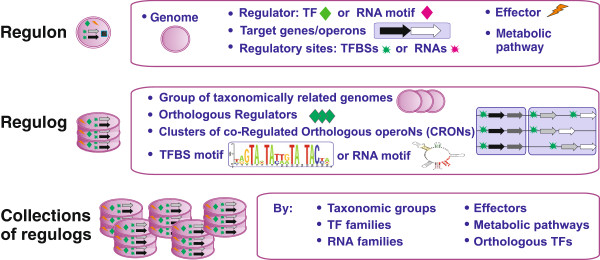
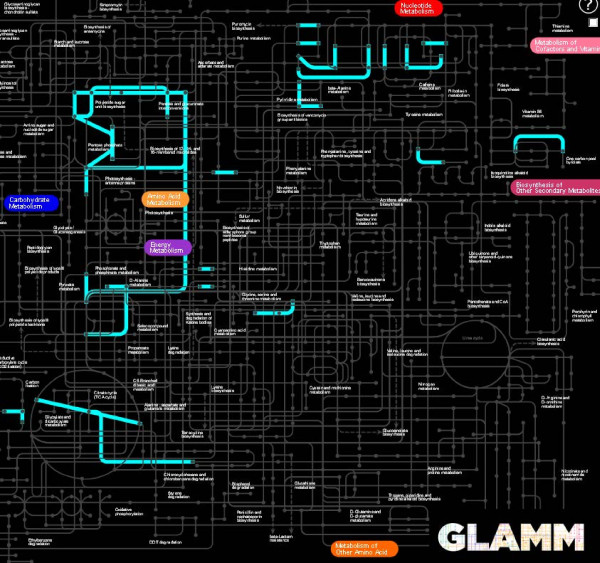
BACKGROUND: Genome-scale prediction of gene regulation and reconstruction of transcriptional regulatory networks in prokaryotes is one of the critical tasks of modern genomics. Bacteria from different taxonomic groups, whose lifestyles and natural environments are substantially different, possess highly diverged transcriptional regulatory networks. The comparative genomics approaches are useful for in silico reconstruction of bacterial regulons and networks operated by both transcription factors (TFs) and RNA regulatory elements (riboswitches). DESCRIPTION: RegPrecise (http://regprecise.lbl.gov) is a web resource for collection, visualization and analysis of transcriptional regulons reconstructed by comparative genomics. We significantly expanded a reference collection of manually curated regulons we introduced earlier. RegPrecise 3.0 provides access to inferred regulatory interactions organized by phylogenetic, structural and functional properties. Taxonomy-specific collections include 781 TF regulogs inferred in more than 160 genomes representing 14 taxonomic groups of Bacteria. TF-specific collections include regulogs for a selected subset of 40 TFs reconstructed across more than 30 taxonomic lineages. Novel collections of regulons operated by RNA regulatory elements (riboswitches) include near 400 regulogs inferred in 24 bacterial lineages. RegPrecise 3.0 provides four classifications of the reference regulons implemented as controlled vocabularies: 55 TF protein families; 43 RNA motif families; ~150 biological processes or metabolic pathways; and ~200 effectors or environmental signals. Genome-wide visualization of regulatory networks and metabolic pathways covered by the reference regulons are available for all studied genomes. A separate section of RegPrecise 3.0 contains draft regulatory networks in 640 genomes obtained by an conservative propagation of the reference regulons to closely related genomes. CONCLUSIONS: RegPrecise 3.0 gives access to the transcriptional regulons reconstructed in bacterial genomes. Analytical capabilities include exploration of: regulon content, structure and function; TF binding site motifs; conservation and variations in genome-wide regulatory networks across all taxonomic groups of Bacteria. RegPrecise 3.0 was selected as a core resource on transcriptional regulation of the Department of Energy Systems Biology Knowledgebase, an emerging software and data environment designed to enable researchers to collaboratively generate, test and share new hypotheses about gene and protein functions, perform large-scale analyses, and model interactions in microbes, plants, and their communities.
Overview
The claims and statistics of this paper haven’t been checked yet.
Free: it reads the open-access text and checks the first 5 claims that cite a source we can check. Create a free account to check every claim.
Integrity signals
Registry
Cites
Statistics
Figures
Verification
Claims the paper makes
The claims and statistics of this paper haven’t been checked yet.
Free: it reads the open-access text and checks the first 5 claims that cite a source we can check. Create a free account to check every claim.
Self-check
Percentages, sums and reported differences re-computed from the paper’s own numbers.
The self-check needs the paper’s full text.
Citations
Cites
The Pfam Protein Families Database
Bateman, A. (2002) · Nucleic Acids Research · doi:10.1093/nar/30.1.276 · Cited by 14,000
The COG database: an updated version includes eukaryotes
Tatusov, R. L., Fedorova, N. D., Jackson, J. D., Jacobs, A. R., Kiryutin, B., Koonin, E. V., Krylov, D. M., Mazumder, R., Mekhedov, S. L., Nikolskaya, A. N., et al. (2003) · BMC Bioinformatics · doi:10.1186/1471-2105-4-41 · Cited by 4,430 · cited 1×
“All studied TFs were classified into 55 protein families based on their domain composition in the Pfam [36], COG [37] and Superfamily [38] libraries (see TF families classification and domains architecture in Additional file 1).”
BackgroundThe Pfam protein families database
Punta, M., Coggill, P. C., Eberhardt, R. Y., Mistry, J., Tate, J., Boursnell, C., Pang, N., Forslund, K., Ceric, G., Clements, J., et al. (2012) · Nucleic Acids Research · doi:10.1093/nar/gkr1065 · Cited by 3,719 · cited 1×
“All studied TFs were classified into 55 protein families based on their domain composition in the Pfam [36], COG [37] and Superfamily [38] libraries (see TF families classification and domains architecture in Additional file 1).”
BackgroundThe Subsystems Approach to Genome Annotation and its Use in the Project to Annotate 1000 Genomes
Overbeek, R. (2005) · Nucleic Acids Research · doi:10.1093/nar/gki866 · Cited by 2,012 · cited 1×
“The RegPrecise 3.0 contains 235 pathways classified into 23 functional categories according to the biological subsystems classification from the SEED database [40].”
MethodInfluentialInfernal 1.0: inference of RNA alignments
Nawrocki, E. P., Kolbe, D. L., & Eddy, S. R. (2009) · Bioinformatics · doi:10.1093/bioinformatics/btp157 · Cited by 1,436
Rfam: updates to the RNA families database
Gardner, P. P., Daub, J., Tate, J. G., Nawrocki, E. P., Kolbe, D. L., Lindgreen, S., Wilkinson, A. C., Finn, R. D., Griffiths-Jones, S., Eddy, S. R., et al. (2009) · Nucleic Acids Research · doi:10.1093/nar/gkn766 · Cited by 919 · cited 2×
“First, RNA regulatory sites were identified in the studied genomes using the probabilistic covariance models for 43 RNA families from the Rfam database [28] and the Infernal program [29].”
MethodAccurate taxonomy assignments from 16S rRNA sequences produced by highly parallel pyrosequencers
Liu, Z., DeSantis, T. Z., Andersen, G. L., & Knight, R. (2008) · Nucleic Acids Research · doi:10.1093/nar/gkn491 · Cited by 592
Gama-Castro, S., Jimenez-Jacinto, V., Peralta-Gil, M., Santos-Zavaleta, A., Penaloza-Spinola, M. I., Contreras-Moreira, B., Segura-Salazar, J., Muniz-Rascado, L., Martinez-Flores, I., Salgado, H., et al. (2007) · Nucleic Acids Research · doi:10.1093/nar/gkm994 · Cited by 491 · cited 6×
“We are planning to incorporate supportive experimental evidences for reconstructed regulons and effectors using information from literature and other databases on microbial regulation including RegTransBase [25], RegulonDB [26], DBTBS [27], and CoryneRegNet [24].”
MethodInfluentialSUPERFAMILY—sophisticated comparative genomics, data mining, visualization and phylogeny
Wilson, D., Pethica, R., Zhou, Y., Talbot, C., Vogel, C., Madera, M., Chothia, C., & Gough, J. (2009) · Nucleic Acids Research · doi:10.1093/nar/gkn762 · Cited by 488 · cited 3×
“All studied TFs were classified into 55 protein families based on their domain composition in the Pfam [36], COG [37] and Superfamily [38] libraries (see TF families classification and domains architecture in Additional file 1).”
MethodMicrobesOnline: an integrated portal for comparative and functional genomics
Dehal, P. S., Joachimiak, M. P., Price, M. N., Bates, J. T., Baumohl, J. K., Chivian, D., Friedland, G. D., Huang, K. H., Keller, K., Novichkov, P. S., et al. (2010) · Nucleic Acids Research · doi:10.1093/nar/gkp919 · Cited by 432 · cited 3×
“Annotations of TF protein domains were collected from the MicrobesOnline database [39].”
BackgroundMethodInfluentialSelf-citationSierro, N., Makita, Y., de Hoon, M., & Nakai, K. (2008) · Nucleic Acids Research · doi:10.1093/nar/gkm910 · Cited by 412 · cited 3×
“We are planning to incorporate supportive experimental evidences for reconstructed regulons and effectors using information from literature and other databases on microbial regulation including RegTransBase [25], RegulonDB [26], DBTBS [27], and CoryneRegNet [24].”
MethodRodionov, D. A., Dubchak, I. L., Arkin, A. P., Alm, E. J., & Gelfand, M. S. (2005) · PLoS Computational Biology · doi:10.1371/journal.pcbi.0010055 · Cited by 297 · cited 1×
“Rex [14], NrdR [17], NrtR [30], NiaR [31], KdgR and ExuR [32], AraR and XylR [33], PsrA and LiuR [7], NsrR and NorR [16], Irr and IscR [18], BirA [34], and PaaR [35].”
BackgroundSelf-citationPhylogenetic footprinting of transcription factor binding sites in proteobacterial genomes
McCue, L. A. (2001) · Nucleic Acids Research · doi:10.1093/nar/29.3.774 · Cited by 255 · cited 4×
“RegPrecise 3.0 is a largest and fast growing web resource for comparative genomics of transcriptional regulation in Bacteria.”
MethodInfluentialComparative Genomic Reconstruction of Transcriptional Regulatory Networks in Bacteria
Rodionov, D. A. (2007) · Chemical Reviews · doi:10.1021/cr068309+ · Cited by 218
Self-citationConservation of the Biotin Regulon and the BirA Regulatory Signal in Eubacteria and Archaea
Rodionov, D. A., Mironov, A. A., & Gelfand, M. S. (2002) · Genome Research · doi:10.1101/gr.314502 · Cited by 207 · cited 1×
“Rex [14], NrdR [17], NrtR [30], NiaR [31], KdgR and ExuR [32], AraR and XylR [33], PsrA and LiuR [7], NsrR and NorR [16], Irr and IscR [18], BirA [34], and PaaR [35].”
BackgroundSelf-citationNovichkov, P. S., Laikova, O. N., Novichkova, E. S., Gelfand, M. S., Arkin, A. P., Dubchak, I., & Rodionov, D. A. (2010) · Nucleic Acids Research · doi:10.1093/nar/gkp894 · Cited by 179 · cited 3×
“The RegPrecise database contains detailed information on regulat ory in eractions and transcriptional regulons inferred by a comparative genomics in diver se bacterial genomes [21].”
BackgroundMethodInfluentialSelf-citationReconstruction of regulatory and metabolic pathways in metal-reducing δ-proteobacteria
Rodionov, D. A., Dubchak, I., Arkin, A., Alm, E., & Gelfand, M. S. (2004) · Genome Biology · doi:10.1186/gb-2004-5-11-r90 · Cited by 178 · cited 1×
“[7-20].”
Self-citationRodionov, D. A., Gelfand, M. S., Todd, J. D., Curson, A. R. J., & Johnston, A. W. B. (2006) · PLoS Computational Biology · doi:10.1371/journal.pcbi.0020163 · Cited by 148 · cited 2×
“Altogether, the orthologous TF collections include 443 regulogs that are valuable for comparative and evolutionary analysis of TF binding mot ifs and regulon contents, as illustrated by our previous publications on comparative gen omics analyses of numerous TFs including HexR [11], Rex [14], NrdR [17], NrtR [30], NiaR…”
BackgroundSelf-citationRavcheev, D. A., Li, X., Latif, H., Zengler, K., Leyn, S. A., Korostelev, Y., Kazakov, A. E., Novichkov, P. S., Osterman, A. L., & Rodionov, D. A. (2011) · Journal of Bacteriology · doi:10.1128/jb.06412-11 · Cited by 147 · cited 1×
“Rex [14], NrdR [17], NrtR [30], NiaR [31], KdgR and ExuR [32], AraR and XylR [33], PsrA and LiuR [7], NsrR and NorR [16], Irr and IscR [18], BirA [34], and PaaR [35].”
BackgroundSelf-citationNovichkov, P. S., Rodionov, D. A., Stavrovskaya, E. D., Novichkova, E. S., Kazakov, A. E., Gelfand, M. S., Arkin, A. P., Mironov, A. A., & Dubchak, I. (2010) · Nucleic Acids Research · doi:10.1093/nar/gkq531 · Cited by 135 · cited 2×
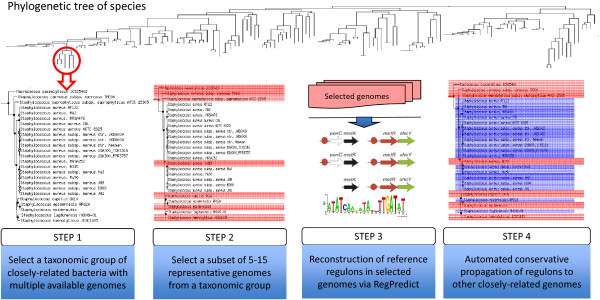
“We use RegPredict web server [6] for careful comparative analysis and manual curation of each regulog in RegPrecise.”
MethodSelf-citationComputer analysis of transcription regulatory patterns in completely sequenced bacterial genomes
Mironov, A. (1999) · Nucleic Acids Research · doi:10.1093/nar/27.14.2981 · Cited by 133
A Comparative Genomics Approach to Prediction of New Members of Regulons
Tan, K., Moreno‐Hagelsieb, G., Collado‐Vides, J., & Stormo, G. D. (2001) · Genome Research · doi:10.1101/gr.149301 · Cited by 130 · cited 4×
“RegPrecise 3.0 is a largest and fast growing web resource for comparative genomics of transcriptional regulation in Bacteria.”
MethodInfluentialKazakov, A. E., Rodionov, D. A., Alm, E. J., Arkin, A. P., Dubchak, I. L., & Gelfand, M. S. (2008) · Journal of Bacteriology · doi:10.1128/jb.01175-08 · Cited by 127 · cited 2×
“By applying this computational approach to a growing number of complete bacterial genomes, we inferred high-quality genome-scale TRNs for diverse taxonomic groups of bacteria, namely Shewanella , Thermotoga , Desulfovibrio , Bacillus , Lactobacillus , Streptococcus and Staphylococcus spp. [7-20].”
BackgroundSelf-citationRodionov, D. A., Novichkov, P. S., Stavrovskaya, E. D., Rodionova, I. A., Li, X., Kazanov, M. D., Ravcheev, D. A., Gerasimova, A. V., Kazakov, A. E., Kovaleva, G. Y., et al. (2011) · BMC Genomics · doi:10.1186/1471-2164-12-s1-s3 · Cited by 98 · cited 1×
“…TRNs for bacteria from six taxonomic collections ( Shewanella , Staphylococcus , Bacillales , Streptococcaceae , Lactobacillaceae and Ther-motogales ) have been described in our research papers [10,12,13,19,20], whereas publications on other taxonomic collections are currently in preparation.”
BackgroundSelf-citationRodionov, D. A., & Gelfand, M. S. (2005) · Trends in Genetics · doi:10.1016/j.tig.2005.05.011 · Cited by 91 · cited 1×
“Rex [14], NrdR [17], NrtR [30], NiaR [31], KdgR and ExuR [32], AraR and XylR [33], PsrA and LiuR [7], NsrR and NorR [16], Irr and IscR [18], BirA [34], and PaaR [35].”
BackgroundSelf-citationCipriano, M. J., Novichkov, P. N., Kazakov, A. E., Rodionov, D. A., Arkin, A. P., Gelfand, M. S., & Dubchak, I. (2013) · BMC Genomics · doi:10.1186/1471-2164-14-213 · Cited by 91 · cited 6×
“Cipriano MJ, Novichkov PN, Kazakov AE, Rodionov DA, Arkin AP, Gelfand MS, Dubchak I: RegTransBase – a database of regulatory sequences and interactions based on literature: a resource for investigating transcriptional regulation in prokaryotes.”
MethodInfluentialSelf-citationRodionov, D. A., Li, X., Rodionova, I. A., Yang, C., Sorci, L., Dervyn, E., Martynowski, D., Zhang, H., Gelfand, M. S., & Osterman, A. L. (2008) · Nucleic Acids Research · doi:10.1093/nar/gkn046 · Cited by 90 · cited 1×
“Rex [14], NrdR [17], NrtR [30], NiaR [31], KdgR and ExuR [32], AraR and XylR [33], PsrA and LiuR [7], NsrR and NorR [16], Irr and IscR [18], BirA [34], and PaaR [35].”
BackgroundSelf-citationRodionov, D. A., Mironov, A. A., & Gelfand, M. S. (2001) · FEMS Microbiology Letters · doi:10.1111/j.1574-6968.2001.tb10965.x · Cited by 87 · cited 1×
“Rex [14], NrdR [17], NrtR [30], NiaR [31], KdgR and ExuR [32], AraR and XylR [33], PsrA and LiuR [7], NsrR and NorR [16], Irr and IscR [18], BirA [34], and PaaR [35].”
BackgroundSelf-citationTranscriptional regulation of NAD metabolism in bacteria: NrtR family of Nudix-related regulators
Rodionov, D. A., De Ingeniis, J., Mancini, C., Cimadamore, F., Zhang, H., Osterman, A. L., & Raffaelli, N. (2008) · Nucleic Acids Research · doi:10.1093/nar/gkn047 · Cited by 79 · cited 1×
“Rex [14], NrdR [17], NrtR [30], NiaR [31], KdgR and ExuR [32], AraR and XylR [33], PsrA and LiuR [7], NsrR and NorR [16], Irr and IscR [18], BirA [34], and PaaR [35].”
BackgroundSelf-citationPredicting regulons and their cis-regulatory motifs by comparative genomics
Manson, A. L., & Church, G. M. (2000) · Nucleic Acids Research · doi:10.1093/nar/28.22.4523 · Cited by 74 · cited 1×
“Computational methods based on the comparison of TFBSs in related species proved to be efficient for predicting transcriptional regulons in Bacteria [2-5].”
MethodCoryneRegNet 4.0 – A reference database for corynebacterial gene regulatory networks
Baumbach, J. (2007) · BMC Bioinformatics · doi:10.1186/1471-2105-8-429 · Cited by 66 · cited 3×
“We are planning to incorporate supportive experimental evidences for reconstructed regulons and effectors using information from literature and other databases on microbial regulation including RegTransBase [25], RegulonDB [26], DBTBS [27], and CoryneRegNet [24].”
MethodControl of Proteobacterial Central Carbon Metabolism by the HexR Transcriptional Regulator
Leyn, S. A., Li, X., Zheng, Q.-X., Novichkov, P. S., Reed, S. B., Romine, M. F., Fredrickson, J. K., Yang, C., Osterman, A. L., & Rodionov, D. A. (2011) · Journal of Biological Chemistry · doi:10.1074/jbc.m111.267963 · Cited by 62
Self-citationGenomic reconstruction of the transcriptional regulatory network in Bacillus subtilis.
Leyn, S. A., Kazanov, M. D., Sernova, N. V., Ermakova, E. O., Novichkov, P. S., & Rodionov, D. A. (2013) · Journal of Bacteriology · doi:10.1128/jb.00140-13 · Cited by 58 · cited 3×
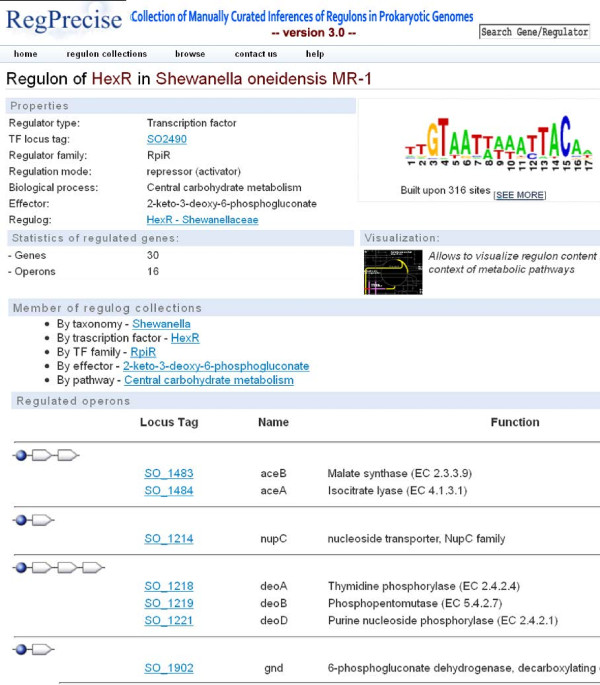
“The screenshot illustrates the experimental validation [10].”
BackgroundSelf-citationTranscriptional regulation of the carbohydrate utilization network in Thermotoga maritima
Rodionov, D. A., Rodionova, I. A., Li, X., Ravcheev, D. A., Tarasova, Y., Portnoy, V. A., Zengler, K., & Osterman, A. L. (2013) · Frontiers in Microbiology · doi:10.3389/fmicb.2013.00244 · Cited by 54 · cited 1×
“The reconstructed genome-wide TRNs for bacteria from six taxonomic collections (Shewanella, Staphylococcus, Bacillales, Streptococcaceae, Lactobacillaceae and Thermotogales) have been described in our research papers [10,12,13,19,20], whereas publications on other taxonomic collections are currently in preparation.”
BackgroundSelf-citationSun, E. I., Leyn, S. A., Kazanov, M. D., Saier, M. H., Novichkov, P. S., & Rodionov, D. A. (2013) · BMC Genomics · doi:10.1186/1471-2164-14-597 · Cited by 53 · cited 3×
“Thus, each inferred RNA regulog includes all genes/operons that are preceded by a candidate Rfam-family motif in a studied taxonomic group of genomes [23].”
BackgroundInfluentialSelf-citationKazanov, M. D., Li, X., Gelfand, M. S., Osterman, A. L., & Rodionov, D. A. (2012) · Nucleic Acids Research · doi:10.1093/nar/gks1184 · Cited by 50 · cited 1×
“[7-20].”
Self-citationRavcheev, D. A., Best, A. A., Tintle, N., DeJongh, M., Osterman, A. L., Novichkov, P. S., & Rodionov, D. A. (2011) · Journal of Bacteriology · doi:10.1128/jb.00350-11 · Cited by 49 · cited 1×
“The reconstructed genome-wide TRNs for bacteria from six taxonomic collections (Shewanella, Staphylococcus, Bacillales, Streptococcaceae, Lactobacillaceae and Thermotogales) have been described in our research papers [10,12,13,19,20], whereas publications on other taxonomic collections are currently in preparation.”
BackgroundSelf-citationSuvorova, I. A., Tutukina, M. N., Ravcheev, D. A., Rodionov, D. A., Ozoline, O. N., & Gelfand, M. S. (2011) · Journal of Bacteriology · doi:10.1128/jb.00277-11 · Cited by 44 · cited 2×
“Altogether, the orthologous TF collections include 443 regulogs that are valuable for comparative and evolutionary analysis of TF binding mot ifs and regulon contents, as illustrated by our previous publications on comparative gen omics analyses of numerous TFs including HexR [11], Rex [14], NrdR [17], NrtR [30], NiaR…”
BackgroundSelf-citationGenomic reconstruction of transcriptional regulatory networks in lactic acid bacteria
Ravcheev, D. A., Best, A. A., Sernova, N. V., Kazanov, M. D., Novichkov, P. S., & Rodionov, D. A. (2013) · BMC Genomics · doi:10.1186/1471-2164-14-94 · Cited by 42 · cited 1×
“…TRNs for bacteria from six taxonomic collections ( Shewanella , Staphylococcus , Bacillales , Streptococcaceae , Lactobacillaceae and Ther-motogales ) have been described in our research papers [10,12,13,19,20], whereas publications on other taxonomic collections are currently in preparation.”
BackgroundSelf-citationPhenylacetic Acid Catabolism and Its Transcriptional Regulation in Corynebacterium glutamicum
Chen, X., Kohl, T. A., Rückert, C., Rodionov, D. A., Li, L., Ding, J., Kalinowski, J., & Liu, S. (2012) · Applied and Environmental Microbiology · doi:10.1128/aem.01588-12 · Cited by 33 · cited 1×
“Rex [14], NrdR [17], NrtR [30], NiaR [31], KdgR and ExuR [32], AraR and XylR [33], PsrA and LiuR [7], NsrR and NorR [16], Irr and IscR [18], BirA [34], and PaaR [35].”
BackgroundSelf-citationShaik, G. M., Dráber, P., Dráber, P., Boubelík, M., & Dráber, P. (2008) · Nucleic Acids Research · doi:10.1093/nar/gkn421 · Cited by 27
GLAMM: Genome-Linked Application for Metabolic Maps
Bates, J. T., Chivian, D. C., & Arkin, A. P. (2011) · Nucleic Acids Research · doi:10.1093/nar/gkr433 · Cited by 26
Self-citationNovichkov, P. S., Brettin, T. S., Novichkova, E. S., Dehal, P., Arkin, A. P., Dubchak, I. L., & Rodionov, D. A. (2012) · Nucleic Acids Research · doi:10.1093/nar/gks562 · Cited by 26 · cited 2×
“In addition, the RegPrecise web services interface provides program matic access to all regulatory interactions and regulon data in the database [22].”
BackgroundSelf-citationKazakov, A. E., Rodionov, D. A., Price, M. N., Arkin, A. P., Dubchak, I. L., & Novichkov, P. S. (2012) · Journal of Bacteriology · doi:10.1128/jb.01977-12 · Cited by 17 · cited 1×
“[7-20].”
Self-citation
Cited by
KBase: The United States Department of Energy Systems Biology Knowledgebase
(2018) · doi:10.1038/nbt.4163 · Cited by 1,624
Self-citationGut bacteria that prevent growth impairments transmitted by microbiota from malnourished children
Blanton, L. V., Charbonneau, M. R., Salih, T., Barratt, M. J., Venkatesh, S., Ilkaveya, O., Subramanian, S., Manary, M. J., Trehan, I., Jorgensen, J. M., et al. (2016) · Science · doi:10.1126/science.aad3311 · Cited by 735
Self-citationEffects of microbiota-directed foods in gnotobiotic animals and undernourished children
Gehrig, J. L., Venkatesh, S., Chang, H.-W., Hibberd, M. C., Kung, V. L., Cheng, J., Chen, R. Y., Subramanian, S., Cowardin, C. A., Meier, M. F., et al. (2019) · Science · doi:10.1126/science.aau4732 · Cited by 431
“9 RegPrecise database of bacterial regulons (65).”
Self-citationNikolaichik, Y. A., & Damienikan, A. (2016) · PeerJ · doi:10.7717/peerj.2056 · Cited by 399
“RegTransBase – a database of regulatory sequences and interactions based on literature: a resource for investigating transcriptional regulation in prokaryotes.”
BackgroundMethodInfluentialRabus, R., Venceslau, S. S., Wöhlbrand, L., Voordouw, G., Wall, J. D., & Pereira, I. A. C. (2015) · Advances in Microbial Physiology · doi:10.1016/bs.ampbs.2015.05.002 · Cited by 358
Metadata
- Authors
- Novichkov, P. S., Kazakov, A. E., Ravcheev, D. A., Leyn, S. A., Kovaleva, G. Y., Sutormin, R. A., Kazanov, M. D., Riehl, W., Arkin, A. P., Dubchak, I., & Rodionov, D. A.
- Affiliations
- Lawrence Berkeley National Laboratory (US)
- Russian Academy of Sciences (RU)
- Corresponding author
- Novichkov, Pavel S
- Rodionov, Dmitry A
- ORCID
- Venue
- BMC Genomics
- Published
- 2013
- Volume
- 14
- Issue
- 1
- Pages
- 745
- ISSN
- 1471-2164 (ISSN-L)
- PMC
- PMC3840689
- OpenAlex
- W2142284828
- Cited by
- 451
- References
- 44
- Citations by year
- 2026: 39 · 2025: 39 · 2024: 44 · 2023: 35 · 2022: 36 · 2021: 44 · 2020: 28 · 2019: 35 · 2018: 33 · 2017: 38 · 2016: 39 · 2015: 27 · 2014: 12 · 2013: 2
- FWCI
- 17.67
- Type
- journal article
- Language
- en
- Open access
- gold
- doi.org
- Licence
- cc-by
- Locations
- BMC Genomics (publishedVersion, cc-by)
- Europe PMC (PubMed Central) (publishedVersion, cc-by)
- PubMed Central (publishedVersion, cc-by)
- PubMed (publishedVersion)
- Open Repository and Bibliography (University of Luxembourg) (submittedVersion, cc-by-nc-sa)
- OSTI OAI (U.S. Department of Energy Office of Scientific and Technical Information) (submittedVersion, other-oa)
- eScholarship (California Digital Library) (submittedVersion)
- eScholarship (California Digital Library) (submittedVersion, cc-by)
- Funders
- U.S. Department of Energy (-AC02-05CH11231, 05CH11231, DESC0004999, DE AC02 05CH11231, DE-AC02-)
- Russian Foundation for Basic Research
- Biological and Environmental Research (05CH11231, DE-AC02 − 05CH11231, AC02-05CH11231)
- Lawrence Berkeley National Laboratory (AC02‐05CH11231, DE-AC02-05CH11231, 05CH11231)
- Pacific Northwest National Laboratory (DE-AC02-05CH11231)
- Topics
- Life Sciences › Biochemistry, Genetics and Molecular Biology › Genetics › Bacterial Genetics and Biotechnology
- Life Sciences › Biochemistry, Genetics and Molecular Biology › Molecular Biology › Gene Regulatory Network Analysis
- Life Sciences › Biochemistry, Genetics and Molecular Biology › Molecular Biology › Microbial Metabolic Engineering and Bioproduction
- Keywords
- transcriptional regulation, transcription factors, riboswitches, RNA regulatory elements, transcriptional regulatory networks, comparative genomics, online resources, metabolic pathways
- MeSH terms
- Bacteria, Transcription Factors, User-Computer Interface, Genome, Bacterial, Internet, Databases, Genetic, Gene Regulatory Networks, Metabolic Networks and Pathways
About these checks
Registry, retraction, Cites and statistics results are computed, not judged, with one exception: a printed reference that no index lists is read once by a model before it counts as a citation error. Claims are extracted by a model and kept only when their quote appears verbatim in the text; each cited source is then checked, with a model’s help, for whether it says what the claim relies on. Those verdicts can be wrong — read the claim’s quote and the cited source before relying on one.
Statistics and arithmetic are recomputed, not judged.
Confidence bands are shown only for fields calibrated on our annotated test set. None is calibrated yet, so no band is shown.
What counts as a claim ›How we measure confidence ›How we check this ›
Are you an author, or do you see a problem with this page? Request a review
Data sources
Bibliographic data: Semantic Scholar, OpenAlex, Crossref.
Contains information from the Semantic Scholar Academic Graph Datasets, made available under the ODC Attribution License (ODC-BY 1.0).
Semantic Scholar’s data is described in: Kinney, R., et al. (2023). The Semantic Scholar Open Data Platform. arXiv:2301.10140.
