

Functional definition of the N450 event-related brain potential marker of conflict processing: a numerical stroop study
Open accessThe DOI matches its Crossref record; 54 of the 56 references it cites were found in a registry or an index.
Abstract
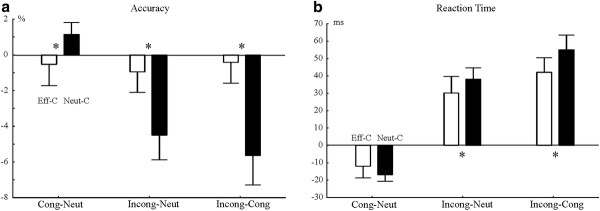
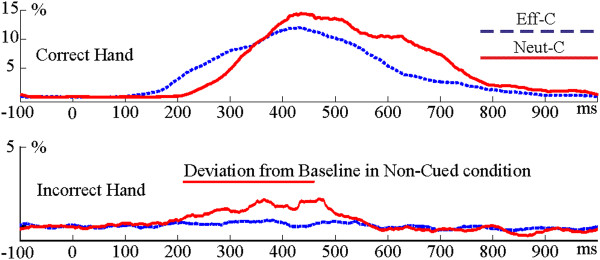
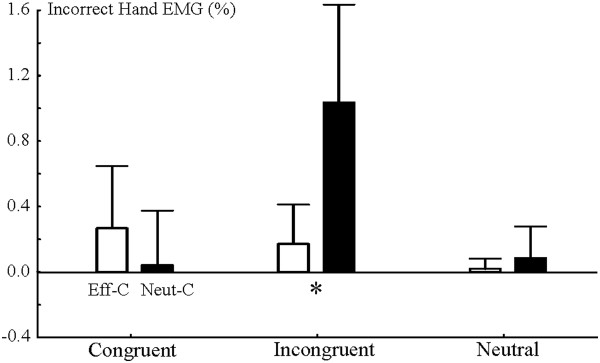
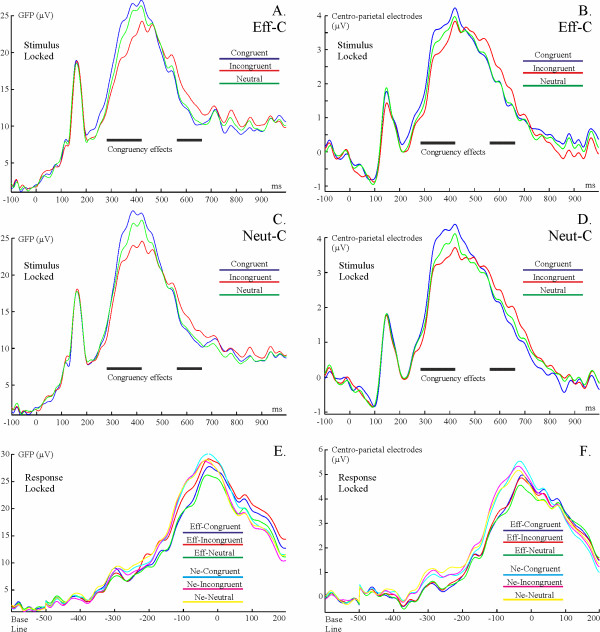
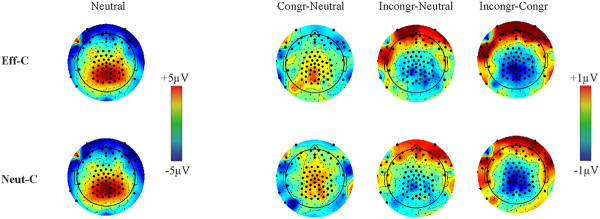
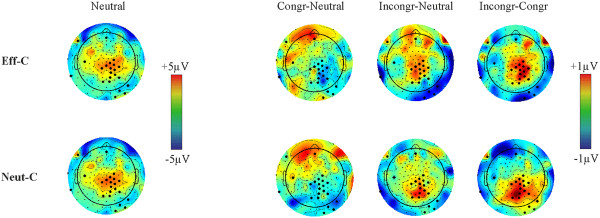
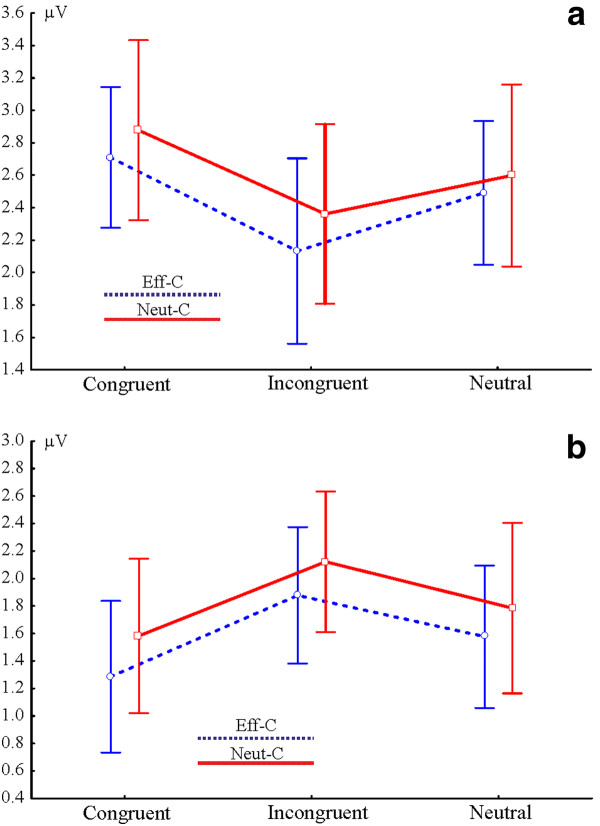
BACKGROUND: Several conflict processing studies aimed to dissociate neuroimaging phenomena related to stimulus and response conflict processing. However, previous studies typically did not include a paradigm-independent measure of either stimulus or response conflict. Here we have combined electro-myography (EMG) with event-related brain potentials (ERPs) in order to determine whether a particularly robust marker of conflict processing, the N450 ERP effect usually related to the activity of the Anterior Cingulate Cortex (ACC), is related to stimulus- or to response-conflict processing. EMG provided paradigm-independent measure of response conflict. In a numerical Stroop paradigm participants compared pairs of digits and pressed a button on the side where they saw the larger digit. 50% of digit-pairs were preceded by an effective cue which provided accurate information about the required response. 50% of trials were preceded by a neutral cue which did not communicate the side of response. RESULTS: EMG showed that response conflict was significantly larger in neutrally than in effectively cued trials. The N450 was similar when response conflict was high and when it was low. CONCLUSIONS: We conclude that the N450 is related to stimulus or abstract, rather than to response conflict detection/resolution. Findings may enable timing ACC conflict effects.
Overview
The claims and statistics of this paper haven’t been checked yet.
Free: it reads the open-access text and checks the first 5 claims that cite a source we can check. Create a free account to check every claim.
Integrity signals
Registry
Cites
Statistics
Figures
Verification
Claims the paper makes
The claims and statistics of this paper haven’t been checked yet.
Free: it reads the open-access text and checks the first 5 claims that cite a source we can check. Create a free account to check every claim.
Claims other papers make about this one
Each is checked against this paper’s own text: does it say what the citing paper says it does?
The cited source says what the claim attributes to it.
In the citing paper
“Although early accounts often linked the component broadly to response conflict, numerical Stroop studies combining ERP with electromyography suggest that the N450 may be more closely related to stimulus-level or abstract representational conflict than to motor response conflict per se [161].”
Self-check
Percentages, sums and reported differences re-computed from the paper’s own numbers.
The self-check needs the paper’s full text.
Citations
Cites
Conflict monitoring and cognitive control
Botvinick, M. M., Braver, T. S., Barch, D. M., Carter, C. S., & Cohen, J. D. (2001) · Psychological Review · doi:10.1037/0033-295x.108.3.624 · Cited by 7,351
Conflict monitoring and anterior cingulate cortex: an update
Botvinick, M. M., Cohen, J. D., & Carter, C. S. (2004) · Trends in Cognitive Sciences · doi:10.1016/j.tics.2004.10.003 · Cited by 3,623 · cited 2×
“According to a prominent theory, the conflict monitoring view [10-12], the activity of the ACC increases in response to conflicting information.”
BackgroundInformation Processing and Cognition: The Loyola Symposium
Brown, A. S., & Solso, R. L. (1976) · The American Journal of Psychology · doi:10.2307/1421430 · Cited by 2,382
Attention And Cognitive Control 1
Posner, M. I., & Snyder, C. R. R. (2024) · Information Processing and Cognition · doi:10.4324/9781032722450-4 · Cited by 2,264
Conflict monitoring versus selection-for-action in anterior cingulate cortex
Botvinick, M., Nystrom, L. E., Fissell, K., Carter, C. S., & Cohen, J. D. (1999) · Nature · doi:10.1038/46035 · Cited by 2,044 · cited 1×
“According to a prominent theory, the conflict monitoring view [10-12], the activity of the ACC increases in response to conflicting information.”
BackgroundDonchin, E. (1981) · Psychophysiology · doi:10.1111/j.1469-8986.1981.tb01815.x · Cited by 1,848
Guidelines for Human Electromyographic Research
Fridlund, A. J., & Cacioppo, J. T. (1986) · Psychophysiology · doi:10.1111/j.1469-8986.1986.tb00676.x · Cited by 1,737
Augmenting mental chronometry: The P300 as a measure of stimulus evaluation time
Kutas, M., McCarthy, G., & Donchin, E. (1977) · Science · doi:10.1126/science.887923 · Cited by 1,714 · cited 2×
“However, it is to note that while this view is suggested by some [37], it is debated by others [38,39].”
BackgroundReference-free identification of components of checkerboard-evoked multichannel potential fields
Lehmann, D., & Skrandies, W. (1980) · Electroencephalography and Clinical Neurophysiology · doi:10.1016/0013-4694(80)90419-8 · Cited by 1,552
Nieuwenhuis, S., Yeung, N., van den Wildenberg, W., & Ridderinkhof, K. R. (2003) · Cognitive, Affective, & Behavioral Neuroscience · doi:10.3758/cabn.3.1.17 · Cited by 1,250 · cited 1×
“A related question is whether the N450 is associated with the fronto-central N2 conflict effects, frequently related to ACC activity, appearing in flanker [45,46] and GoNo-Go tasks [47].”
Background
Cited by
Chang, Y., Alderman, B. L., Chu, C., Wang, C., Song, T., & Chen, F. (2017) · Psychophysiology · doi:10.1111/psyp.12784 · Cited by 129
Pozuelos, J. P., Combita, L. M., Abundis, A., Paz‐Alonso, P. M., Conejero, Á., Guerra, S., & Rueda, M. R. (2019) · Developmental Science · doi:10.1111/desc.12756 · Cited by 80
The development of stimulus and response interference control in midchildhood.
Cragg, L. (2016) · Developmental Psychology · doi:10.1037/dev0000074 · Cited by 86
Opitz, A., Beste, C., & Stock, A. (2020) · NeuroImage · doi:10.1016/j.neuroimage.2020.116524 · Cited by 75
Pellicioni, M. S., Núñez‐Peña, M. I., & Colomé, À. (2014) · PLoS ONE · doi:10.1371/journal.pone.0099579 · Cited by 77
Ludyga, S., Mücke, M., Andrä, C., Gerber, M., & Pühse, U. (2021) · Journal of sport and health science/Journal of Sport and Health Science · doi:10.1016/j.jshs.2021.01.001 · Cited by 62
Checa, P., Castellanos, M. C., Abundis-Gutiérrez, A., & Rosario Rueda, M. (2014) · Frontiers in Psychology · doi:10.3389/fpsyg.2014.00326 · Cited by 56
Donohue, S. E., Appelbaum, L. G., McKay, C. C., & Woldorff, M. G. (2016) · Neuropsychologia · doi:10.1016/j.neuropsychologia.2016.01.035 · Cited by 52
Ludyga, S., Mücke, M., Colledge, F., Pühse, U., & Gerber, M. (2019) · Neuroscience · doi:10.1016/j.neuroscience.2019.08.045 · Cited by 52
Zhao, J., Liang, W., Juan, C.-H., Wang, L., Wang, S., & Zhu, Z. (2014) · Biological Psychology · doi:10.1016/j.biopsycho.2014.12.001 · Cited by 56
Vuillier, L., Bryce, D., Szűcs, D., & Whitebread, D. (2016) · PLoS ONE · doi:10.1371/journal.pone.0165697 · Cited by 60
Self-citationExamining the Triple Code Model in numerical cognition: An fMRI study
Skagenholt, M., Träff, U., Västfjäll, D., & Skagerlund, K. (2018) · PLoS ONE · doi:10.1371/journal.pone.0199247 · Cited by 58
ERP Evidence for Inhibitory Control Deficits in Test-Anxious Individuals
Zhang, W., Beuckelaer, A. D., Chen, L., & Zhou, R. (2019) · Frontiers in Psychiatry · doi:10.3389/fpsyt.2019.00645 · Cited by 50
Hinault, T., Larcher, K. M.-H., Zazubovits, N., Gotman, J., & Dagher, A. (2018) · Human Brain Mapping · doi:10.1002/hbm.24356 · Cited by 47
Intertrial RT variability affects level of target‐related interference in cued task switching
Provost, A. L., Jamadar, S. D., Heathcote, A., Brown, S. D., & Karayanidis, F. (2017) · Psychophysiology · doi:10.1111/psyp.12971 · Cited by 41
Neural cascade of conflict processing: Not just time-on-task
McKay, C. C., van den Berg, B., & Woldorff, M. G. (2016) · Neuropsychologia · doi:10.1016/j.neuropsychologia.2016.12.022 · Cited by 30
“, 2000), a brain region that has correspondingly been found with fMRI to activate in response to incongruent trials relative to congruent trials in conflict paradigms (Larson et al., 2009; Szűcs and Soltész, 2012; West et al., 2004).”
ResultKillikelly, C., & Szűcs, D. (2013) · Cortex · doi:10.1016/j.cortex.2013.08.017 · Cited by 33
Self-citationSun, J., Sun, B., Zhang, L., Luo, Q., & Gong, H. (2013) · Journal of Biomedical Optics · doi:10.1117/1.jbo.18.9.096014 · Cited by 25
Stock, A., Steenbergen, L., Colzato, L. S., & Beste, C. (2016) · Human Brain Mapping · doi:10.1002/hbm.23325 · Cited by 27
Kóbor, A., Takács, Á., Bryce, D., Szűcs, D., Honbolygó, F., Nagy, P., & Csépe, V. (2015) · Developmental Neuropsychology · doi:10.1080/87565641.2015.1086770 · Cited by 29
Self-citationMa, J., Liu, C., & Chen, X. (2016) · Scientific Reports · doi:10.1038/srep31278 · Cited by 29
Pinhas, M., Donohue, S. E., Woldorff, M. G., & Brannon, E. M. (2014) · Journal of Cognitive Neuroscience · doi:10.1162/jocn_a_00631 · Cited by 21
The relationship between music training and cognitive flexibility: an ERP study
Hao, J., Zhong, Y., Pang, Y., Jing, Y., Liu, Y., Li, H., Li, J., & Zheng, M. (2023) · Frontiers in Psychology · doi:10.3389/fpsyg.2023.1276752 · Cited by 32
Bluschke, A., von der Hagen, M., Papenhagen, K., Roessner, V., & Beste, C. (2017) · NeuroImage Clinical · doi:10.1016/j.nicl.2017.02.014 · Cited by 25
ERP evidence for rapid within-trial adaptation of cognitive control during conflict resolution
Kałamała, P., Ociepka, M., & Chuderski, A. (2020) · Cortex · doi:10.1016/j.cortex.2020.07.012 · Cited by 23
Emotional Body-Word Conflict Evokes Enhanced N450 and Slow Potential
Ma, J., Liu, C., Zhong, X., Wang, L., & Chen, X. (2014) · PLoS ONE · doi:10.1371/journal.pone.0095198 · Cited by 22
Caldas, A. L., Machado‐Pinheiro, W., Souza, L., Ribeiro, G., & David, I. A. (2012) · Psychophysiology · doi:10.1111/j.1469-8986.2012.01407.x · Cited by 31
Event-Related Potentials and the Stroop Effect
Sahinoglu, B., & Doğan, G. (2016) · Eurasian Journal of Medicine · doi:10.5152/eurasianjmed.2016.16012 · Cited by 30
The use of a second language enhances the neural efficiency of inhibitory control: An ERP study
Kałamała, P., Walther, J., Zhang, H., Diaz, M. T., Senderecka, M., & Wodniecka, Z. (2021) · Bilingualism Language and Cognition · doi:10.1017/s1366728921000389 · Cited by 24
Fang, Z., Lynn, E., Huc, M., Fogel, S. M., Knott, V., & Jaworska, N. (2022) · Cortex · doi:10.1016/j.cortex.2022.07.010 · Cited by 25
Age-related changes in strategic variations during arithmetic problem solving
Hinault, T., & Lemaire, P. (2016) · Progress in brain research · doi:10.1016/bs.pbr.2016.03.009 · Cited by 23
Chmielewski, W. X., & Beste, C. (2019) · Journal of Cognitive Neuroscience · doi:10.1162/jocn_a_01424 · Cited by 21
Beldzik, E., Domagalik, A., Froncisz, W., & Marek, T. (2014) · Clinical Neurophysiology · doi:10.1016/j.clinph.2014.08.009 · Cited by 20
Liu, C., Yao, R., Wang, Z., & Zhou, R. (2014) · International Journal of Psychophysiology · doi:10.1016/j.ijpsycho.2014.05.007 · Cited by 19
The neural correlates of social anxiety modulating conflict-driven cognitive control: An ERP study
Cao, J., Si, F., Li, X., & Guo, C. (2022) · Neuroscience Letters · doi:10.1016/j.neulet.2022.136721 · Cited by 16
Brain cortical organization in entrepreneurs during a visual Stroop decision task
Ortiz-Terán, E., Turrero, Santos, Bryant, P., & Ortiz (2013) · Neuroscience and Neuroeconomics · doi:10.2147/nan.s48243 · Cited by 20
Inference for dependent error functional data with application to event-related potentials
Huang, K., Zheng, S., & Yang, L. (2022) · Test · doi:10.1007/s11749-022-00820-3 · Cited by 14
Distinct mechanisms underlying cross-modal semantic conflict and response conflict processing
Xu, H., Yang, G., Wu, H., Xiao, J., Li, Q., & Liu, X. (2024) · Cerebral Cortex · doi:10.1093/cercor/bhad539 · Cited by 14
Electrophysiological correlates of the reverse Stroop effect: Results from a simulated handgun task
Díaz-Piedra, C., Gianfranchi, E., Catena, A., & Stasi, L. L. D. (2022) · International Journal of Psychophysiology · doi:10.1016/j.ijpsycho.2022.02.006 · Cited by 11
Auditory Conflict Resolution Correlates with Medial–Lateral Frontal Theta/Alpha Phase Synchrony
Huang, S., Rossi, S., Hämäläinen, M., & Ahveninen, J. (2014) · PLoS ONE · doi:10.1371/journal.pone.0110989 · Cited by 15
Zink, N., Stock, A., Vahid, A., & Beste, C. (2018) · Frontiers in Human Neuroscience · doi:10.3389/fnhum.2018.00411 · Cited by 15
Perceptual conflict-induced late positive complex in a modified Stroop task
Li, G., Wang, S., Duan, Y., & Zhu, Z. (2013) · Neuroscience Letters · doi:10.1016/j.neulet.2013.01.056 · Cited by 12
Chen, Q., Zhao, J., Gu, H., & Li, X. (2022) · Frontiers in Psychiatry · doi:10.3389/fpsyt.2022.897595 · Cited by 9
Conflict in a word‐based approach‐avoidance task is stronger with positive words
Klackl, J., Blechert, J., Lender, A., & Jonas, E. (2023) · Brain and Behavior · doi:10.1002/brb3.3008 · Cited by 8
Scrivano, R. M., & Kieffaber, P. D. (2021) · Aging Neuropsychology and Cognition · doi:10.1080/13825585.2021.1874278 · Cited by 10
The influence of clothing pressure exerted by girdle on inhibition ability of young females
Liu, Y., & Chen, D. (2016) · International Journal of Clothing Science and Technology · doi:10.1108/ijcst-07-2015-0085 · Cited by 8
Chmielewski, W. X., & Beste, C. (2019) · Cortex · doi:10.1016/j.cortex.2019.02.006 · Cited by 7
RetractedChen, X., & Deng, X. (2022) · International Journal of Environmental Research and Public Health · doi:10.3390/ijerph19052891 · Cited by 13
Beldzik, E., Domagalik, A., Gawłowska, M., Marek, T., & Mojsa‐Kaja, J. (2017) · Brain Structure and Function · doi:10.1007/s00429-017-1527-7 · Cited by 7
Rainey, V. R., Stockdale, L., Flores, V. C., Kahrilas, I. J., Mullins, T. L., Gjorgieva, E., Morrison, R., & Silton, R. L. (2021) · Psychophysiology · doi:10.1111/psyp.13813 · Cited by 10
Xu, H., Yang, G., Göschl, F., Nolte, G., Ren, Q., Li, Z., Wu, H., Engel, A. K., Li, Q., & Liu, X. (2024) · Cerebral Cortex · doi:10.1093/cercor/bhae105 · Cited by 7
Huo, S., Li, J., Guo, J., Yan, H., Deng, X., Liu, Y., & Zhao, J. L. (2023) · International Journal of Environmental Research and Public Health · doi:10.3390/ijerph20126122 · Cited by 5
Li, Y., Huang, P., HUANG, J. C., Zhong, Z., Zhou, S., Dong, H., Xie, J., Wu, Y. H., & Li, P. (2022) · Frontiers in Neuroscience · doi:10.3389/fnins.2022.936975 · Cited by 5
Sharma, V. V., Thaut, M. H., Russo, F., & Alain, C. (2021) · Cerebral Cortex Communications · doi:10.1093/texcom/tgab043 · Cited by 6
Pekár, J., Hofmann, W., Knakker, B., Tamm, S., & Kinder, A. (2023) · Brain Sciences · doi:10.3390/brainsci13050702 · Cited by 3
Galashan, D., Siemann, J., & Herrmann, M. (2019) · bioRxiv (Cold Spring Harbor Laboratory) · doi:10.1101/807412 · Cited by 4
Temporal Course of Interference Control from Early to Late Young Adulthood: An ERP Study
Knežević, M. (2024) · Brain Sciences · doi:10.3390/brainsci14060536 · Cited by 4
Imbir, K. K., Duda‐Goławska, J., Pastwa, M., Sobieszek, A., Wielgopolan, A., Jankowska, M., Modzelewska, A., & Żygierewicz, J. (2022) · PLoS ONE · doi:10.1371/journal.pone.0270558 · Cited by 1
Conflicts between priming and episodic retrieval: a question of fluency?
Weller, P. D., Recio, G., Kaltwasser, L., Rostami, H. N., Stürmer, B., & Sommer, W. (2024) · Psychological Research · doi:10.1007/s00426-023-01919-4 · Cited by 1
Chmiel, J., & Kładna, A. (2026) · Journal of Clinical Medicine · doi:10.3390/jcm15155994
Pellicioni, M. S. (2014) · Dipòsit Digital de la Universitat de Barcelona (Universitat de Barcelona)
Pal, A. (2018) · University of North Texas Digital Library (University of North Texas) · doi:10.12794/metadc1157584
Begum, T., Ali, S. A., Reza, F., Fadzil, N. A., & Mustafar, F. (2022) · Jurnal Sains Kesihatan Malaysia · doi:10.17576/jskm-2022-2001-10
Common but different: An ERP study of single- and multi-source interference processing in MSIT
Paluch, K., Antonova, I., Nikadon, J., Dzianok, P., Jurewicz, K., Wojciechowski, J., & Kublik, E. (2026) · NeuroImage · doi:10.1016/j.neuroimage.2026.122030 · Cited by 1
Xing, J., Pourtois, G., & Yang, Q. (2025) · Biological Psychology · doi:10.1016/j.biopsycho.2025.109059 · Cited by 2
Liang, X., Jiang, B., Zhang, Z., & Wang, L. (2025) · Frontiers in Neuroscience · doi:10.3389/fnins.2025.1660727
Sun, T., Xi, J., Xu, P., Wang, Z., Zhang, J., Xiao, F., & Yuan, S. (2025) · Thinking Skills and Creativity · doi:10.1016/j.tsc.2025.102037 · Cited by 1
An ERP exploration of the perception of text-based deception
Avila, S. D., Schwartz, S. E., & Warren, C. M. (2025) · Language Cognition and Neuroscience · doi:10.1080/23273798.2025.2590696
Lin, Q., Huang, C., Mak, H. Y., Li, B., & Huang, H.-W. (2026) · Scientific Reports · doi:10.1038/s41598-026-38111-8
Duan, M., Liu, Z., & Sui, L. (2026) · NeuroSci · doi:10.3390/neurosci7020039
Hinault, T. (2016) · theses.fr (ABES) · doi:10.70675/2bbfafe6z9139z4b98zaa67zf5dcbd48bf90
Harada, Y., Hino, S., & Yamashita, S. (2026) · Behavioural Brain Research · doi:10.1016/j.bbr.2026.116392
Reactive Compensation for Proactive Deficits in Parkinson’s DiseasePreprint
Ficke, J., Kricheldorff, J., Debener, S., Janitzky, K., & Witt, K. (2026) · medRxiv · doi:10.64898/2026.09.10.26362782
Zhang, J., Xu, L., An, X., Li, Y., & Shao, Y. (2026) · SSRN Electronic Journal · doi:10.2139/ssrn.7643762
Metadata
- Authors
- Szűcs, D., & Soltész, F.
- Affiliations
- University of Cambridge (GB)
- Corresponding author
- Szűcs, Dénes
- ORCID
- Szűcs, Dénes
- Venue
- BMC Neuroscience
- Published
- 2012-03-27
- Volume
- 13
- Issue
- 1
- Pages
- 35-35
- ISSN
- 1471-2202 (ISSN-L)
- PMC
- PMC3383462
- OpenAlex
- W2068343862
- Cited by
- 73
- References
- 56
- Citations by year
- 2026: 6 · 2025: 4 · 2024: 4 · 2023: 4 · 2022: 9 · 2021: 5 · 2020: 2 · 2019: 5 · 2018: 5 · 2017: 3 · 2016: 10 · 2015: 2 · 2014: 9 · 2013: 4 · 2012: 1
- FWCI
- 2.62
- Type
- journal article
- Language
- en
- Open access
- gold
- doi.org
- Licence
- cc-by
- creativecommons.org/licenses/by/2.0 (tdm)
- Locations
- BMC Neuroscience (publishedVersion, cc-by)
- Europe PMC (PubMed Central) (publishedVersion, cc-by)
- PubMed Central (publishedVersion, cc-by)
- PubMed (publishedVersion)
- ePrints Soton (University of Southampton) (acceptedVersion)
- DOAJ (DOAJ: Directory of Open Access Journals) (submittedVersion)
- Apollo (University of Cambridge) (submittedVersion, cc-by)
- Apollo (cc-by)
- Funders
- Medical Research Council (G90951)
- Topics
- Life Sciences › Neuroscience › Cognitive Neuroscience › Neural and Behavioral Psychology Studies
- Life Sciences › Neuroscience › Cognitive Neuroscience › Neurobiology of Language and Bilingualism
- Social Sciences › Arts and Humanities › Philosophy › Free Will and Agency
- Keywords
- N450, event-related potentials, conflict processing, stimulus conflict, response conflict, anterior cingulate cortex, electromyography, cue validity, conflict detection
- MeSH terms
- Adult, Brain, Brain Mapping, Conflict, Psychological, Electromyography, Evoked Potentials, Female, Humans, Male, Reaction Time, Young Adult, Stroop Test, Neuroimaging
About these checks
Registry, retraction, Cites and statistics results are computed, not judged, with one exception: a printed reference that no index lists is read once by a model before it counts as a citation error. Claims are extracted by a model and kept only when their quote appears verbatim in the text; each cited source is then checked, with a model’s help, for whether it says what the claim relies on. Those verdicts can be wrong — read the claim’s quote and the cited source before relying on one.
Statistics and arithmetic are recomputed, not judged.
Confidence bands are shown only for fields calibrated on our annotated test set. None is calibrated yet, so no band is shown.
What counts as a claim ›How we measure confidence ›How we check this ›
Are you an author, or do you see a problem with this page? Request a review
Data sources
Bibliographic data: Semantic Scholar, OpenAlex, Crossref.
Contains information from the Semantic Scholar Academic Graph Datasets, made available under the ODC Attribution License (ODC-BY 1.0).
Semantic Scholar’s data is described in: Kinney, R., et al. (2023). The Semantic Scholar Open Data Platform. arXiv:2301.10140.
