

Functional definition of the N450 event-related brain potential marker of conflict processing: a numerical stroop study
Open accessThe DOI matches its Crossref record; 54 of the 56 references it cites were found in a registry or an index.
Abstract
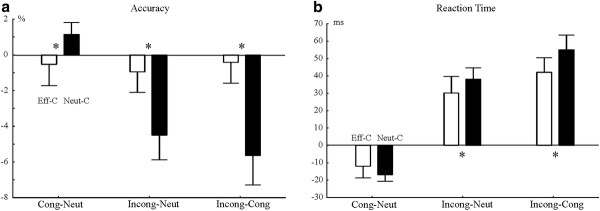
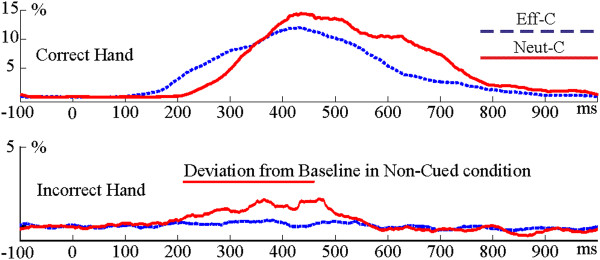
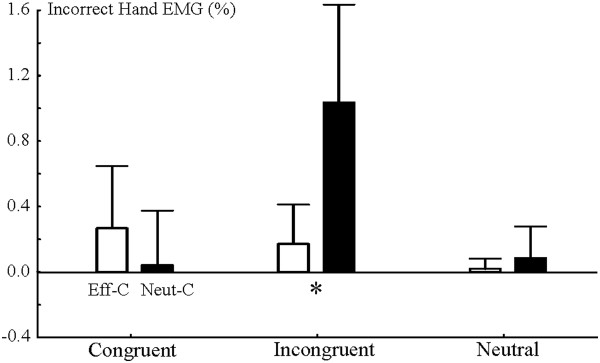
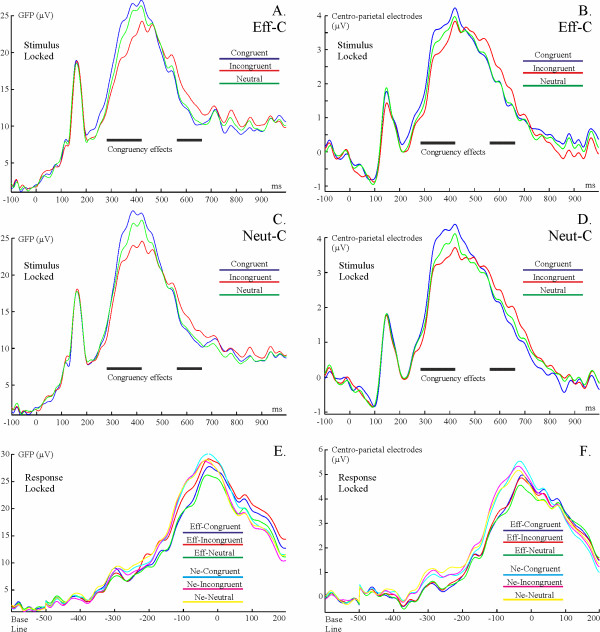
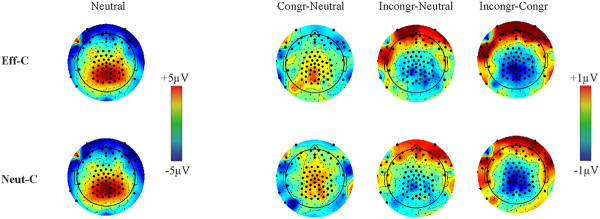
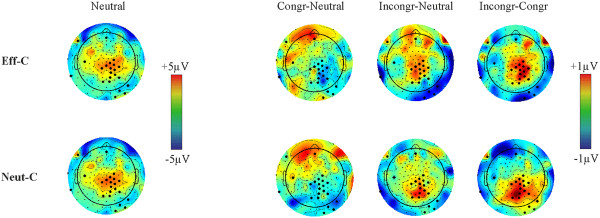
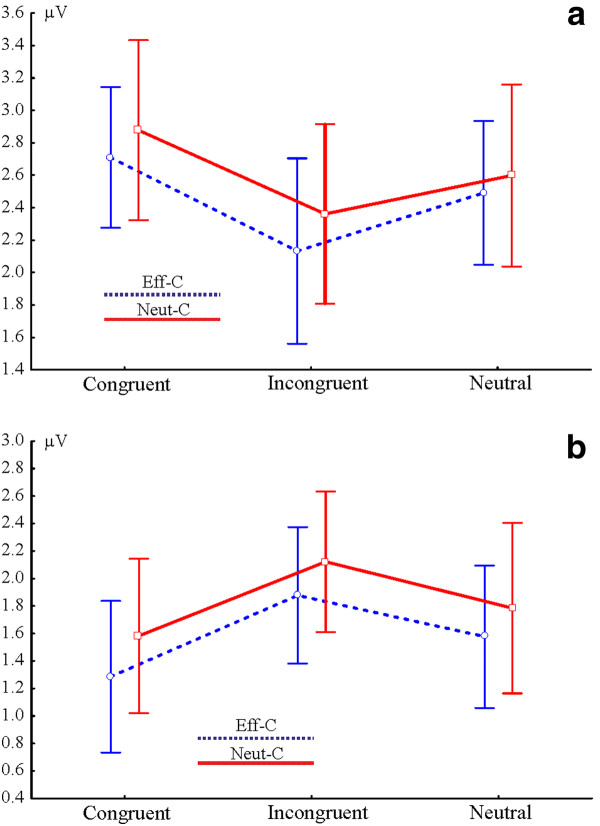
BACKGROUND: Several conflict processing studies aimed to dissociate neuroimaging phenomena related to stimulus and response conflict processing. However, previous studies typically did not include a paradigm-independent measure of either stimulus or response conflict. Here we have combined electro-myography (EMG) with event-related brain potentials (ERPs) in order to determine whether a particularly robust marker of conflict processing, the N450 ERP effect usually related to the activity of the Anterior Cingulate Cortex (ACC), is related to stimulus- or to response-conflict processing. EMG provided paradigm-independent measure of response conflict. In a numerical Stroop paradigm participants compared pairs of digits and pressed a button on the side where they saw the larger digit. 50% of digit-pairs were preceded by an effective cue which provided accurate information about the required response. 50% of trials were preceded by a neutral cue which did not communicate the side of response. RESULTS: EMG showed that response conflict was significantly larger in neutrally than in effectively cued trials. The N450 was similar when response conflict was high and when it was low. CONCLUSIONS: We conclude that the N450 is related to stimulus or abstract, rather than to response conflict detection/resolution. Findings may enable timing ACC conflict effects.
Overview
The claims and statistics of this paper haven’t been checked yet.
Free: it reads the open-access text and checks the first 5 claims that cite a source we can check. Create a free account to check every claim.
Integrity signals
Registry
Cites
Statistics
Figures
Verification
Claims the paper makes
The claims and statistics of this paper haven’t been checked yet.
Free: it reads the open-access text and checks the first 5 claims that cite a source we can check. Create a free account to check every claim.
Claims other papers make about this one
Each is checked against this paper’s own text: does it say what the citing paper says it does?
The cited source says what the claim attributes to it.
In the citing paper
“Although early accounts often linked the component broadly to response conflict, numerical Stroop studies combining ERP with electromyography suggest that the N450 may be more closely related to stimulus-level or abstract representational conflict than to motor response conflict per se [161].”
Self-check
Percentages, sums and reported differences re-computed from the paper’s own numbers.
The self-check needs the paper’s full text.
Citations
Cites
Conflict monitoring and cognitive control
Botvinick, M. M., Braver, T. S., Barch, D. M., Carter, C. S., & Cohen, J. D. (2001) · Psychological Review · doi:10.1037/0033-295x.108.3.624 · Cited by 7,351
Conflict monitoring and anterior cingulate cortex: an update
Botvinick, M. M., Cohen, J. D., & Carter, C. S. (2004) · Trends in Cognitive Sciences · doi:10.1016/j.tics.2004.10.003 · Cited by 3,623 · cited 2×
“According to a prominent theory, the conflict monitoring view [10-12], the activity of the ACC increases in response to conflicting information.”
BackgroundInformation Processing and Cognition: The Loyola Symposium
Brown, A. S., & Solso, R. L. (1976) · The American Journal of Psychology · doi:10.2307/1421430 · Cited by 2,382
Attention And Cognitive Control 1
Posner, M. I., & Snyder, C. R. R. (2024) · Information Processing and Cognition · doi:10.4324/9781032722450-4 · Cited by 2,264
Conflict monitoring versus selection-for-action in anterior cingulate cortex
Botvinick, M., Nystrom, L. E., Fissell, K., Carter, C. S., & Cohen, J. D. (1999) · Nature · doi:10.1038/46035 · Cited by 2,044 · cited 1×
“According to a prominent theory, the conflict monitoring view [10-12], the activity of the ACC increases in response to conflicting information.”
BackgroundDonchin, E. (1981) · Psychophysiology · doi:10.1111/j.1469-8986.1981.tb01815.x · Cited by 1,848
Guidelines for Human Electromyographic Research
Fridlund, A. J., & Cacioppo, J. T. (1986) · Psychophysiology · doi:10.1111/j.1469-8986.1986.tb00676.x · Cited by 1,737
Augmenting mental chronometry: The P300 as a measure of stimulus evaluation time
Kutas, M., McCarthy, G., & Donchin, E. (1977) · Science · doi:10.1126/science.887923 · Cited by 1,714 · cited 2×
“However, it is to note that while this view is suggested by some [37], it is debated by others [38,39].”
BackgroundReference-free identification of components of checkerboard-evoked multichannel potential fields
Lehmann, D., & Skrandies, W. (1980) · Electroencephalography and Clinical Neurophysiology · doi:10.1016/0013-4694(80)90419-8 · Cited by 1,552
Nieuwenhuis, S., Yeung, N., van den Wildenberg, W., & Ridderinkhof, K. R. (2003) · Cognitive, Affective, & Behavioral Neuroscience · doi:10.3758/cabn.3.1.17 · Cited by 1,250 · cited 1×
“A related question is whether the N450 is associated with the fronto-central N2 conflict effects, frequently related to ACC activity, appearing in flanker [45,46] and GoNo-Go tasks [47].”
BackgroundPre- and poststimulus activation of response channels: A psychophysiological analysis
Gratton, G., Coles, M. G. H., Sirevaag, E. J., Eriksen, C. W., & Donchin, E. (1988) · Journal of Experimental Psychology: Human Perception and Performance · doi:10.1037/0096-1523.14.3.331 · Cited by 895
Neuroimaging Studies of Mental Rotation: A Meta-analysis and Review
Zacks, J. M. (2008) · Journal of Cognitive Neuroscience · doi:10.1162/jocn.2008.20.1.1 · Cited by 792
Anterior cingulate cortex, conflict monitoring, and levels of processing
van Veen, V., Cohen, J. D., Botvinick, M. M., Stenger, V. A., & Carter, C. S. (2001) · NeuroImage · doi:10.1006/nimg.2001.0923 · Cited by 656 · cited 1×
“Initially, the conflict monitoring view mostly emphasized the role of ACC in detecting/resolving response conflict [1,13,14].”
BackgroundAn ERP study of the temporal course of the Stroop color-word interference effect
Liotti, M., Woldorff, M. G., Perez, R., & Mayberg, H. S. (2000) · Neuropsychologia · doi:10.1016/s0028-3932(99)00106-2 · Cited by 653 · cited 8×
“Previous ERP source localization attempts have consistently found that most variance in the topography of the N450 can be explained by dipoles in the ACC [3,6,26].”
BackgroundMethodResultInfluentialA psychophysiological investigation of the continuous flow model of human information processing.
Coles, M. G. H., Gratton, G., Bashore, T. R., Eriksen, C. W., & Donchin, E. (1985) · Journal of Experimental Psychology: Human Perception and Performance · doi:10.1037/0096-1523.11.5.529 · Cited by 633
N200 in the flanker task as a neurobehavioral tool for investigating executive control
KOPP, B., RIST, F., & MATTLER, U. (1996) · Psychophysiology · doi:10.1111/j.1469-8986.1996.tb00425.x · Cited by 618
Is three greater than five: The relation between physical and semantic size in comparison tasks
Henik, A., & Tzelgov, J. (1982) · Memory & Cognition · doi:10.3758/bf03202431 · Cited by 587
On the utility of P3 latency as an index of mental chronometry
Verleger, R. (1997) · Psychophysiology · doi:10.1111/j.1469-8986.1997.tb02125.x · Cited by 515
The Electrophysiological Dynamics of Interference during the Stroop Task
Hanslmayr, S., Pastötter, B., Bäuml, K.-H., Gruber, S., Wimber, M., & Klimesch, W. (2008) · Journal of Cognitive Neuroscience · doi:10.1162/jocn.2008.20020 · Cited by 510
Selection, Integration, and Conflict Monitoring
Badre, D., & Wagner, A. D. (2004) · Neuron · doi:10.1016/s0896-6273(03)00851-1 · Cited by 466
Anterior cingulate and prefrontal cortex: who's in control?
Cohen, J. D., Botvinick, M., & Carter, C. S. (2000) · Nature Neuroscience · doi:10.1038/74783 · Cited by 437
Strategic control and medial frontal negativity: Beyond errors and response conflict
Bartholow, B. D., Pearson, M. A., Dickter, C. L., Sher, K. J., Fabiani, M., & Gratton, G. (2005) · Psychophysiology · doi:10.1111/j.1469-8986.2005.00258.x · Cited by 387
Separating semantic conflict and response conflict in the Stroop task: A functional MRI study
van Veen, V., & Carter, C. S. (2005) · NeuroImage · doi:10.1016/j.neuroimage.2005.04.042 · Cited by 348
The Stroop Effect: Brain Potentials Localize the Source of Interference
Duncan-Johnson, C. C., & Kopell, B. S. (1981) · Science · doi:10.1126/science.7302571 · Cited by 332
Neural correlates of cognitive control and conflict detection in the Stroop and digit-location tasks
West, R. (2003) · Neuropsychologia · doi:10.1016/s0028-3932(02)00297-x · Cited by 331
Kerns, J. G. (2006) · NeuroImage · doi:10.1016/j.neuroimage.2006.06.012 · Cited by 311
Separate conflict-specific cognitive control mechanisms in the human brain
Egner, T., Delano, M., & Hirsch, J. (2007) · NeuroImage · doi:10.1016/j.neuroimage.2006.11.061 · Cited by 302
Weissman, D. H. (2004) · Cerebral Cortex · doi:10.1093/cercor/bhh125 · Cited by 299
Automatic and intentional processing of numerical information.
Tzelgov, J., Meyer, J., & Henik, A. (1992) · Journal of Experimental Psychology: Learning, Memory, and Cognition · doi:10.1037//0278-7393.18.1.166 · Cited by 284
Lehman, G. J., & McGill, S. M. (1999) · Journal of Manipulative and Physiological Therapeutics · doi:10.1016/s0161-4754(99)70032-1 · Cited by 262
Liston, C., Matalon, S., Hare, T. A., Davidson, M. C., & Casey, B. J. (2006) · Neuron · doi:10.1016/j.neuron.2006.04.015 · Cited by 256
An electromyographic examination of response competition
Eriksen, C. W., Coles, M. G. H., Morris, L. R., & O’hara, W. P. (1985) · Bulletin of the Psychonomic Society · doi:10.3758/bf03329816 · Cited by 217
Falkenstein, M., Hohnsbein, J., & Hoormann, J. (1994) · Electroencephalography and Clinical Neurophysiology/Evoked Potentials Section · doi:10.1016/0168-5597(94)90055-8 · Cited by 204
P300 and response time from a manual Stroop task
Ila, A. B., & Polich, J. (1999) · Clinical Neurophysiology · doi:10.1016/s0168-5597(98)00053-7 · Cited by 204
Wilkie, W. L. (1981) · ACR North American Advances · Cited by 191
Weissman, D. H., Giesbrecht, B., Song, A. W., Mangun, G. R., & Woldorff, M. G. (2003) · NeuroImage · doi:10.1016/s1053-8119(03)00167-8 · Cited by 178
Selective Attention to Words and Colours
Morton, J., & Chambers, S. M. (1973) · Quarterly Journal of Experimental Psychology · doi:10.1080/14640747308400360 · Cited by 172
Burle, B., Roger, C., Allain, S., Vidal, F., & Hasbroucq, T. (2008) · Journal of Cognitive Neuroscience · doi:10.1162/jocn.2008.20110 · Cited by 163
Verbal interference with encoding in a perceptual classification task.
Hock, H. S., & Egeth, H. E. (1970) · Journal of Experimental Psychology · doi:10.1037/h0028512 · Cited by 143
Szűcs, D., & Soltész, F. (2007) · Neuropsychologia · doi:10.1016/j.neuropsychologia.2007.06.013 · Cited by 111
Self-citationEvent-related potentials to Stroop and reverse Stroop stimuli
Atkinson, C. M., Drysdale, K., & Fulham, W. R. (2003) · International Journal of Psychophysiology · doi:10.1016/s0167-8760(02)00038-7 · Cited by 96
Appelbaum, L. G., Meyerhoff, K. L., & Woldorff, M. G. (2009) · Cerebral Cortex · doi:10.1093/cercor/bhp036 · Cited by 90
Szũcs, D., Soltész, F., Jármi, É., & Csépe, V. (2007) · Behavioral and Brain Functions · doi:10.1186/1744-9081-3-23 · Cited by 81
Self-citationSzűcs, D., & Soltész, F. (2010) · Brain Research · doi:10.1016/j.brainres.2010.02.011 · Cited by 75
Self-citationMASAKI, H., TAKASAWA, N., & YAMAZAKI, K. (2000) · Psychophysiology · doi:10.1017/s0048577200981976 · Cited by 75
Szűcs, D., Soltész, F., & White, S. L. J. (2009) · NeuroImage · doi:10.1016/j.neuroimage.2009.05.048 · Cited by 70
Self-citationSzűcs, D., & Soltész, F. (2007) · Brain Research · doi:10.1016/j.brainres.2007.11.010 · Cited by 65
Self-citationAge-related changes in cognitive conflict processing: An event-related potential study
Mager, R., Bullinger, A. H., Brand, S., Schmidlin, M., Schärli, H., Müller-Spahn, F., Stoermer, R., & Falkenstein, M. (2006) · Neurobiology of Aging · doi:10.1016/j.neurobiolaging.2006.08.001 · Cited by 65
Melcher, T., & Gruber, O. (2009) · Cortex · doi:10.1016/j.cortex.2007.06.004 · Cited by 59 · cited 1×
“However, evidence has now accumulated demonstrating that the ACC can be activated not only by response but also by stimulus conflict [2,15-18].”
BackgroundVisual information processing: topography of brain electrical activity
Skrandies, W. (1995) · Biological Psychology · doi:10.1016/0301-0511(95)05111-2 · Cited by 59
Szűcs, D., Soltész, F., Bryce, D., & Whitebread, D. (2009) · Journal of Cognitive Neuroscience · doi:10.1162/jocn.2009.21220 · Cited by 46
Self-citationThe function of skin conductance response recovery and rise time
Venables, P. H., Gartshore, S. A., & O'Riordan, P. W. (1980) · Biological Psychology · doi:10.1016/0301-0511(80)90002-2 · Cited by 39
Hemispheric Differences in Event‐Related Potentials to Stroop Stimuli
Aine, C. J., & Harter, M. R. (1984) · Annals of the New York Academy of Sciences · doi:10.1111/j.1749-6632.1984.tb23525.x · Cited by 34
Mismatch and Conflict: Neurophysiological and Behavioral Evidence for Conflict Priming
Mager, R., Meuth, S. G., Kräuchi, K., Schmidlin, M., Müller-Spahn, F., & Falkenstein, M. (2009) · Journal of Cognitive Neuroscience · doi:10.1162/jocn.2008.21154 · Cited by 17
Cited by
Chang, Y., Alderman, B. L., Chu, C., Wang, C., Song, T., & Chen, F. (2017) · Psychophysiology · doi:10.1111/psyp.12784 · Cited by 129
Pozuelos, J. P., Combita, L. M., Abundis, A., Paz‐Alonso, P. M., Conejero, Á., Guerra, S., & Rueda, M. R. (2019) · Developmental Science · doi:10.1111/desc.12756 · Cited by 80
The development of stimulus and response interference control in midchildhood.
Cragg, L. (2016) · Developmental Psychology · doi:10.1037/dev0000074 · Cited by 86
Opitz, A., Beste, C., & Stock, A. (2020) · NeuroImage · doi:10.1016/j.neuroimage.2020.116524 · Cited by 75
Pellicioni, M. S., Núñez‐Peña, M. I., & Colomé, À. (2014) · PLoS ONE · doi:10.1371/journal.pone.0099579 · Cited by 77
Metadata
- Authors
- Szűcs, D., & Soltész, F.
- Affiliations
- University of Cambridge (GB)
- Corresponding author
- Szűcs, Dénes
- ORCID
- Szűcs, Dénes
- Venue
- BMC Neuroscience
- Published
- 2012-03-27
- Volume
- 13
- Issue
- 1
- Pages
- 35-35
- ISSN
- 1471-2202 (ISSN-L)
- PMC
- PMC3383462
- OpenAlex
- W2068343862
- Cited by
- 73
- References
- 56
- Citations by year
- 2026: 6 · 2025: 4 · 2024: 4 · 2023: 4 · 2022: 9 · 2021: 5 · 2020: 2 · 2019: 5 · 2018: 5 · 2017: 3 · 2016: 10 · 2015: 2 · 2014: 9 · 2013: 4 · 2012: 1
- FWCI
- 2.62
- Type
- journal article
- Language
- en
- Open access
- gold
- doi.org
- Licence
- cc-by
- creativecommons.org/licenses/by/2.0 (tdm)
- Locations
- BMC Neuroscience (publishedVersion, cc-by)
- Europe PMC (PubMed Central) (publishedVersion, cc-by)
- PubMed Central (publishedVersion, cc-by)
- PubMed (publishedVersion)
- ePrints Soton (University of Southampton) (acceptedVersion)
- DOAJ (DOAJ: Directory of Open Access Journals) (submittedVersion)
- Apollo (University of Cambridge) (submittedVersion, cc-by)
- Apollo (cc-by)
- Funders
- Medical Research Council (G90951)
- Topics
- Life Sciences › Neuroscience › Cognitive Neuroscience › Neural and Behavioral Psychology Studies
- Life Sciences › Neuroscience › Cognitive Neuroscience › Neurobiology of Language and Bilingualism
- Social Sciences › Arts and Humanities › Philosophy › Free Will and Agency
- Keywords
- N450, event-related potentials, conflict processing, stimulus conflict, response conflict, anterior cingulate cortex, electromyography, cue validity, conflict detection
- MeSH terms
- Adult, Brain, Brain Mapping, Conflict, Psychological, Electromyography, Evoked Potentials, Female, Humans, Male, Reaction Time, Young Adult, Stroop Test, Neuroimaging
About these checks
Registry, retraction, Cites and statistics results are computed, not judged, with one exception: a printed reference that no index lists is read once by a model before it counts as a citation error. Claims are extracted by a model and kept only when their quote appears verbatim in the text; each cited source is then checked, with a model’s help, for whether it says what the claim relies on. Those verdicts can be wrong — read the claim’s quote and the cited source before relying on one.
Statistics and arithmetic are recomputed, not judged.
Confidence bands are shown only for fields calibrated on our annotated test set. None is calibrated yet, so no band is shown.
What counts as a claim ›How we measure confidence ›How we check this ›
Are you an author, or do you see a problem with this page? Request a review
Data sources
Bibliographic data: Semantic Scholar, OpenAlex, Crossref.
Contains information from the Semantic Scholar Academic Graph Datasets, made available under the ODC Attribution License (ODC-BY 1.0).
Semantic Scholar’s data is described in: Kinney, R., et al. (2023). The Semantic Scholar Open Data Platform. arXiv:2301.10140.
