

Mice do not require auditory input for the normal development of their ultrasonic vocalizations
Open accessThe DOI matches its Crossref record; 34 of the 34 references it cites were found in a registry or an index.
Abstract
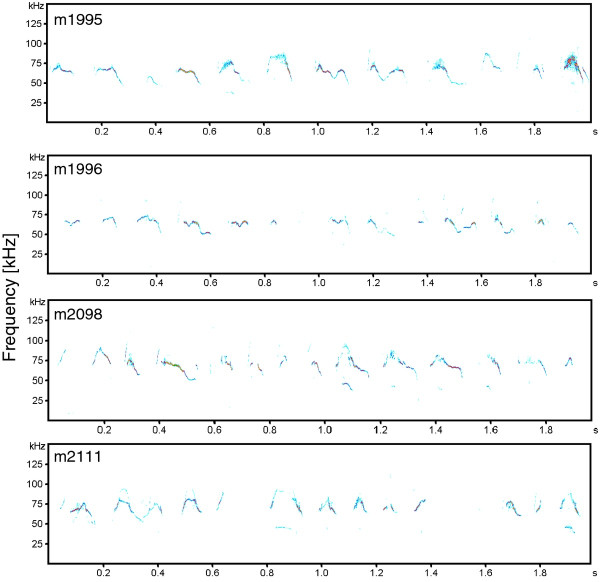
BACKGROUND: Transgenic mice have become an important tool to elucidate the genetic foundation of the human language faculty. While learning is an essential prerequisite for the acquisition of human speech, it is still a matter of debate whether auditory learning plays any role in the development of species-specific vocalizations in mice. To study the influence of auditory input on call development, we compared the occurrence and structure of ultrasonic vocalizations from deaf otoferlin-knockout mice, a model for human deafness DFNB9, to those of hearing wild-type and heterozygous littermates. RESULTS: We found that the occurrence and structure of ultrasonic vocalizations recorded from deaf otoferlin-knockout mice and hearing wild-type and heterozygous littermates do not differ. Isolation calls from 16 deaf and 15 hearing pups show the same ontogenetic development in terms of the usage and structure of their vocalizations as their hearing conspecifics. Similarly, adult courtship 'songs' produced by 12 deaf and 16 hearing males did not differ in the latency to call, rhythm of calling or acoustic structure. CONCLUSION: The results indicate that auditory experience is not a prerequisite for the development of species-specific vocalizations in mice. Thus, mouse models are of only limited suitability to study the evolution of vocal learning, a crucial component in the development of human speech. Nevertheless, ultrasonic vocalizations of mice constitute a valuable readout in studies of the genetic foundations of social and communicative behavior.
Overview
The claims and statistics of this paper haven’t been checked yet.
Free: it reads the open-access text and checks the first 5 claims that cite a source we can check. Create a free account to check every claim.
Integrity signals
Registry
Cites
Statistics
Figures



Verification
Claims the paper makes
The claims and statistics of this paper haven’t been checked yet.
Free: it reads the open-access text and checks the first 5 claims that cite a source we can check. Create a free account to check every claim.
Claims other papers make about this one
Each is checked against this paper’s own text: does it say what the citing paper says it does?
The source backs part of the claim, not all of it — or backs it for a different population, condition or comparison.
In the citing paper
“Previous studies suggest that the contribution of the newcomer to the vocalization is minor in comparison with that of the occupant (Hammerschmidt, et al. 2012).”
From DLX5/6 GABAergic Expression Affects Social Vocalization: Implications for Human Evolution (2021) · cites this paper as Hammerschmidt, et al. 2012
Experimental — accuracy not yet measured
Self-check
Percentages, sums and reported differences re-computed from the paper’s own numbers.
The self-check needs the paper’s full text.
Citations
Cites
Roux, I., Safieddine, S., Nouvian, R., Grati, M., Simmler, M.-C., Bahloul, A., Perfettini, I., Le Gall, M., Rostaing, P., Hamard, G., et al. (2006) · Cell · doi:10.1016/j.cell.2006.08.040 · Cited by 753
Holy, T. E., & Guo, Z. (2005) · PLoS Biology · doi:10.1371/journal.pbio.0030386 · Cited by 670
A humanized version of Foxp2 affects cortico-basal ganglia circuits in mice
Enard, W., Gehre, S., Hammerschmidt, K., Hölter, S. M., Blass, T., Somel, M., Brückner, M. K., Schreiweis, C., Winter, C., Sohr, R., et al. (2009) · Cell · doi:10.1016/j.cell.2009.03.041 · Cited by 605
Self-citationFitch, W. T. (2010) · doi:10.1017/cbo9780511817779 · Cited by 594
Jamain, S., Radyushkin, K., Hammerschmidt, K., Granon, S., Boretius, S., Varoqueaux, F., Ramanantsoa, N., Gallego, J., Ronnenberg, A., Winter, D., et al. (2008) · Proceedings of the National Academy of Sciences · doi:10.1073/pnas.0711555105 · Cited by 556
Self-citationUnusual repertoire of vocalizations in the BTBR T+tf/J mouse model of autism
Scattoni, M. L., Gandhy, S. U., Ricceri, L., & Crawley, J. N. (2008) · PLoS ONE · doi:10.1371/journal.pone.0003067 · Cited by 550
The different roles of social learning in vocal communication
Janik, V. M., & Slater, P. J. B. (2000) · Animal Behaviour · doi:10.1006/anbe.2000.1410 · Cited by 537
Scattoni, M. L., Crawley, J., & Ricceri, L. (2009) · Neuroscience & Biobehavioral Reviews · doi:10.1016/j.neubiorev.2008.08.003 · Cited by 473
Neural mechanisms of birdsong memory
Bolhuis, J. J., & Gahr, M. (2006) · Nature Reviews Neuroscience · doi:10.1038/nrn1904 · Cited by 374
Infant Rodent Ultrasounds ? A Gate to the Understanding of Sound Communication
Ehret, G. (2005) · Behavior Genetics · doi:10.1007/s10519-004-0853-8 · Cited by 323
Cited by
Arriaga, G., Zhou, E. P., & Jarvis, E. D. (2012) · PLoS ONE · doi:10.1371/journal.pone.0046610 · Cited by 296
Female mice ultrasonically interact with males during courtship displays
Neunuebel, J. P., Taylor, A. L., Arthur, B. J., & Egnor, S. R. (2015) · eLife · doi:10.7554/elife.06203 · Cited by 224
“…vocal behavior of adult mice, most experimental paradigms use pairs of mice (Bean et al., 1981; Choi et al., 2011; D’Amato and Moles, 2001; Hammerschmidt et al., 2012b; Nunez et al., 1978; Nyby et al., 1976; Ogawa et al., 2000; Pomerantz and Clemens, 1981; Rotschafer et al., 2012;…”
BackgroundMethodInfluentialThe origins of the vocal brain in humans
Belyk, M., & Brown, S. (2017) · Neuroscience & Biobehavioral Reviews · doi:10.1016/j.neubiorev.2017.03.014 · Cited by 144
Brain evolution by brain pathway duplication
Chakraborty, M., & Jarvis, E. D. (2015) · Philosophical Transactions of the Royal Society B: Biological Sciences · doi:10.1098/rstb.2015.0056 · Cited by 150
“The nuances for limited vocal plasticity and an associated neural circuit in mice and non-human primates are also still an ongoing debate that requires further investigation [104–111].”
BackgroundKas, M. J., Glennon, J. C., Buitelaar, J., Ey, E., Biemans, B., Crawley, J., Ring, R. H., Lajonchere, C., Esclassan, F., Talpos, J., et al. (2014) · Psychopharmacology · doi:10.1007/s00213-013-3268-5 · Cited by 132
Metadata
- Authors
- Hammerschmidt, K., Reisinger, E., Westekemper, K., Ehrenreich, L., Strenzke, N., & Fischer, J.
- Affiliations
- German Primate Center (DE)
- Universitätsmedizin Göttingen (DE)
- Corresponding author
- Hammerschmidt, Kurt
- Venue
- BMC Neuroscience
- Published
- 2012-04-25
- Volume
- 13
- Issue
- 1
- Pages
- 40-40
- ISSN
- 1471-2202 (ISSN-L)
- PMC
- PMC3350408
- OpenAlex
- W1999247495
- Cited by
- 123
- References
- 34
- Citations by year
- 2026: 5 · 2025: 7 · 2024: 4 · 2023: 12 · 2022: 6 · 2021: 13 · 2020: 10 · 2019: 5 · 2018: 6 · 2017: 9 · 2016: 6 · 2015: 12 · 2014: 12 · 2013: 12 · 2012: 4
- FWCI
- 9.88
- Type
- journal article
- Language
- en
- Open access
- gold
- doi.org
- Licence
- cc-by
- creativecommons.org/licenses/by/2.0 (tdm)
- Locations
- BMC Neuroscience (publishedVersion, cc-by)
- Europe PMC (PubMed Central) (publishedVersion, cc-by)
- PubMed Central (publishedVersion, cc-by)
- PubMed (publishedVersion)
- DOAJ (DOAJ: Directory of Open Access Journals) (submittedVersion)
- GoeScholar The Publication Server of the Georg-August-Universität Göttingen (Georg-August-Universität Göttingen) (submittedVersion, cc-by)
- GRO (submittedVersion, cc-by)
- Topics
- Life Sciences › Agricultural and Biological Sciences › Ecology, Evolution, Behavior and Systematics › Animal Vocal Communication and Behavior
- Social Sciences › Psychology › Developmental and Educational Psychology › Language Development and Disorders
- Social Sciences › Psychology › Experimental and Cognitive Psychology › Phonetics and Phonology Research
- Keywords
- ultrasonic vocalizations, auditory learning, deafness, DFNB9, isolation calls, courtship song, vocal development, vocal learning, social communication
- MeSH terms
- Acoustic Stimulation, Animals, Deafness, Female, Hearing, Male, Membrane Proteins, Sexual Behavior, Animal, Vocalization, Animal, Mice, Knockout, Mice
About these checks
Registry, retraction, Cites and statistics results are computed, not judged, with one exception: a printed reference that no index lists is read once by a model before it counts as a citation error. Claims are extracted by a model and kept only when their quote appears verbatim in the text; each cited source is then checked, with a model’s help, for whether it says what the claim relies on. Those verdicts can be wrong — read the claim’s quote and the cited source before relying on one.
Statistics and arithmetic are recomputed, not judged.
Confidence bands are shown only for fields calibrated on our annotated test set. None is calibrated yet, so no band is shown.
What counts as a claim ›How we measure confidence ›How we check this ›
Are you an author, or do you see a problem with this page? Request a review
How to cite
Cite CoChat for the checks on this page, and the paper for its own findings.
- This page
- CoChat. (2026). Citation check: Mice do not require auditory input for the normal development of their ultrasonic vocalizations. https://app.cochat.ai/papers/10.1186/1471-2202-13-40
- The paper
- Hammerschmidt, K., Reisinger, E., Westekemper, K., Ehrenreich, L., Strenzke, N., & Fischer, J. (2012). Mice do not require auditory input for the normal development of their ultrasonic vocalizations. BMC Neuroscience. https://doi.org/10.1186/1471-2202-13-40
Data sources
Bibliographic data: Semantic Scholar, OpenAlex, Crossref.
Contains information from the Semantic Scholar Academic Graph Datasets, made available under the ODC Attribution License (ODC-BY 1.0).
Semantic Scholar’s data is described in: Kinney, R., et al. (2023). The Semantic Scholar Open Data Platform. arXiv:2301.10140.
