

In vaginal fluid, bacteria associated with bacterial vaginosis can be suppressed with lactic acid but not hydrogen peroxide
Open accessThe DOI matches its Crossref record; 34 of the 34 references it cites were found in a registry or an index.
Abstract
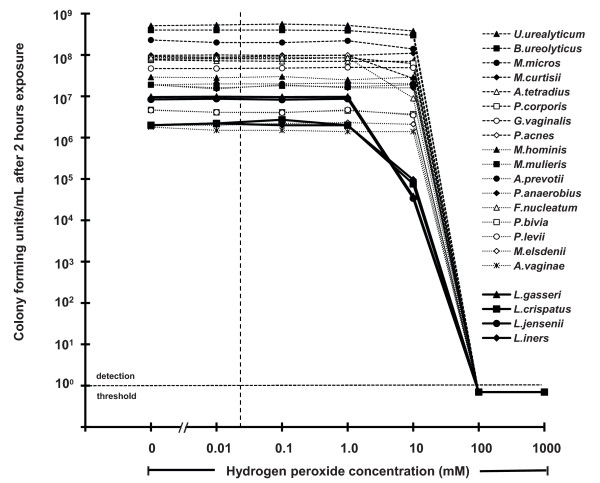
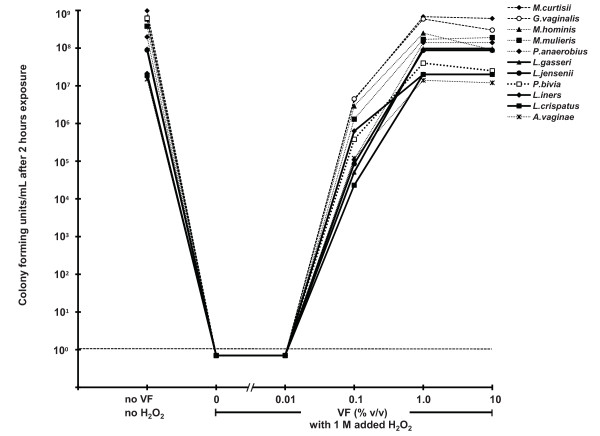
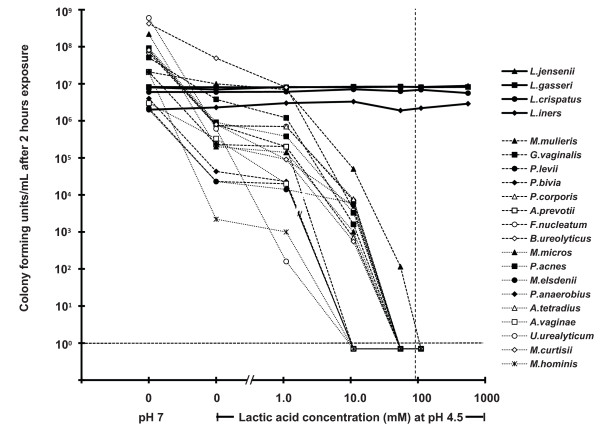
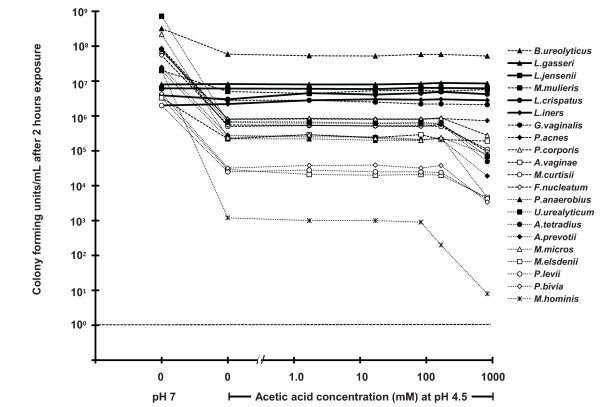
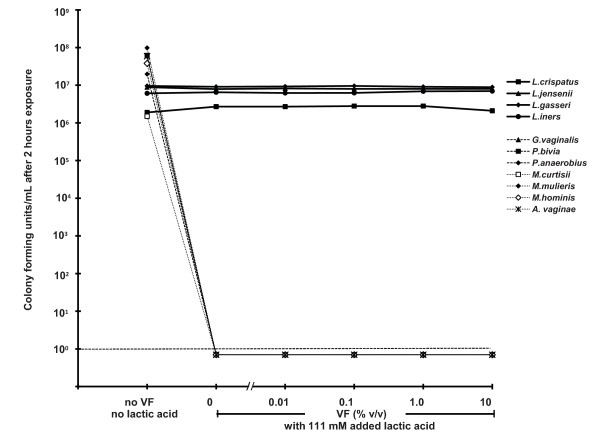
BACKGROUND: Hydrogen peroxide (H2O2) produced by vaginal lactobacilli is generally believed to protect against bacteria associated with bacterial vaginosis (BV), and strains of lactobacilli that can produce H2O2 are being developed as vaginal probiotics. However, evidence that led to this belief was based in part on non-physiological conditions, antioxidant-free aerobic conditions selected to maximize both production and microbicidal activity of H2O2. Here we used conditions more like those in vivo to compare the effects of physiologically plausible concentrations of H2O2 and lactic acid on a broad range of BV-associated bacteria and vaginal lactobacilli. METHODS: Anaerobic cultures of seventeen species of BV-associated bacteria and four species of vaginal lactobacilli were exposed to H2O2, lactic acid, or acetic acid at pH 7.0 and pH 4.5. After two hours, the remaining viable bacteria were enumerated by growth on agar media plates. The effect of vaginal fluid (VF) on the microbicidal activities of H2O2 and lactic acid was also measured. RESULTS: Physiological concentrations of H2O2 (< 100 μM) failed to inactivate any of the BV-associated bacteria tested, even in the presence of human myeloperoxidase (MPO) that increases the microbicidal activity of H2O2. At 10 mM, H2O2 inactivated all four species of vaginal lactobacilli but only one of seventeen species of BV-associated bacteria. Moreover, the addition of just 1% vaginal fluid (VF) blocked the microbicidal activity of 1 M H2O2. In contrast, lactic acid at physiological concentrations (55-111 mM) and pH (4.5) inactivated all the BV-associated bacteria tested, and had no detectable effect on the vaginal lactobacilli. Also, the addition of 10% VF did not block the microbicidal activity of lactic acid. CONCLUSIONS: Under optimal, anaerobic growth conditions, physiological concentrations of lactic acid inactivated BV-associated bacteria without affecting vaginal lactobacilli, whereas physiological concentrations of H2O2 produced no detectable inactivation of either BV-associated bacteria or vaginal lactobacilli. Moreover, at very high concentrations, H2O2 was more toxic to vaginal lactobacilli than to BV-associated bacteria. On the basis of these in vitro observations, we conclude that lactic acid, not H2O2, is likely to suppress BV-associated bacteria in vivo.
Overview
The claims and statistics of this paper haven’t been checked yet.
Free: it reads the open-access text and checks the first 5 claims that cite a source we can check. Create a free account to check every claim.
Integrity signals
Registry
Cites
Statistics
Figures
Verification
Claims the paper makes
The claims and statistics of this paper haven’t been checked yet.
Free: it reads the open-access text and checks the first 5 claims that cite a source we can check. Create a free account to check every claim.
Self-check
Percentages, sums and reported differences re-computed from the paper’s own numbers.
The self-check needs the paper’s full text.
Citations
Cites
Imlay, J. A. (2003) · Annual Review of Microbiology · doi:10.1146/annurev.micro.57.030502.090938 · Cited by 2,203 · cited 1×
“Hydrogen peroxide causes oxidative stress in bacterial cells [14], at least partially by oxidizing sulphydrals, and by oxidizing free iron to produce hydroxyl radicals that react with nucleic acids [15].”
BackgroundLactic Acid Permeabilizes Gram-Negative Bacteria by Disrupting the Outer Membrane
Alakomi, H.-L., Skyttä, E., Saarela, M., Mattila-Sandholm, T., Latva-Kala, K., & Helander, I. M. (2000) · Applied and Environmental Microbiology · doi:10.1128/aem.66.5.2001-2005.2000 · Cited by 1,093 · cited 1×
“Lactic acid has also been shown to have broad spectrum activity against Gram-negative bacteria, probably by weakening the cell wall [19].”
BackgroundMyeloperoxidase-Halide-Hydrogen Peroxide Antibacterial System
Klebanoff, S. J. (1968) · Journal of Bacteriology · doi:10.1128/jb.95.6.2131-2138.1968 · Cited by 815 · cited 1×
“All growth medium formulations contained at least ten-times more than the 1 mM concentration of chloride ions required for full activity of a myeloperoxidase-halide-H2O2 microbicidal system [26].”
BackgroundEschenbach, D. A., Davick, P. R., Williams, B. L., Klebanoff, S. J., Young-Smith, K., Critchlow, C. M., & Holmes, K. K. (1989) · Journal of Clinical Microbiology · doi:10.1128/jcm.27.2.251-256.1989 · Cited by 707 · cited 1×
“Women with H2O2-producing lactobacilli are less likely to have BV than are women without H2O2-producing lactobacilli [1-3].”
BackgroundSimplified Agar Plate Method for Quantifying Viable Bacteria
Jett, B. D., Hatter, K. L., Huycke, M. M., & Gilmore, M. S. (1997) · BioTechniques · doi:10.2144/97234bm22 · Cited by 567 · cited 1×
“2 depending on growth medium) and track-plated [27] onto the appropriate growth medium containing 1.”
BackgroundThe effects of fermentation acids on bacterial growth
Russell, J. B., & Diez-Gonzalez, F. (1997) · Advances in Microbial Physiology · doi:10.1016/s0065-2911(08)60017-x · Cited by 498 · cited 1×
“Lactic acid, under acidic conditions, can permeate cell membranes, acidify the cytosol [16,17], and induce osmotic stress [18].”
BackgroundRole played by lactobacilli in controlling the population of vaginal pathogens
Boris, S., & Barbés, C. (2000) · Microbes and Infection · doi:10.1016/s1286-4579(00)00313-0 · Cited by 427 · cited 1×
“Vaginal lactobacilli produce several target-specific antimicrobial factors, including bacteriocins [10,11], bacteriocins-like substances [12], and selective ligands [13].”
BackgroundDefense factors of vaginal lactobacilli
Aroutcheva, A., Gariti, D., Simon, M., Shott, S., Faro, J., Simoes, J. A., Gurguis, A., & Faro, S. (2001) · American Journal of Obstetrics and Gynecology · doi:10.1067/mob.2001.115867 · Cited by 424 · cited 1×
“Vaginal lactobacilli produce several target-specific antimicrobial factors, including bacteriocins [10,11], bacteriocins-like substances [12], and selective ligands [13].”
BackgroundControl of the Microbial Flora of the Vagina by H202-Generating Lactobacilli
Klebanoff, S. J., Hillier, S. L., Eschenbach, D. A., & Waltersdorph, A. M. (1991) · Journal of Infectious Diseases · doi:10.1093/infdis/164.1.94 · Cited by 420
Bioenergetics of lactic acid bacteria: cytoplasmic pH and osmotolerance
Kashket, E. R. (1987) · FEMS Microbiology Letters · doi:10.1111/j.1574-6968.1987.tb02463.x · Cited by 410
Research works printed but not linked: 1
- O'Hanlon DE Moench TR Harrold S Cone RA Microbicide production by vaginal lactobacilli: vaginal acidity (pH) and lactic acid or more potent than previously reported. Poster presentation Microbicides New Delhi 2008 Feb 24-28 2008
Cited by
Romero, R., Hassan, S. S., Gajer, P., Tarca, A. L., Fadrosh, D. W., Nikita, L., Galuppi, M., Lamont, R. F., Chaemsaithong, P., Miranda, J., et al. (2014) · Microbiome · doi:10.1186/2049-2618-2-4 · Cited by 852
The Vaginal Microenvironment: The Physiologic Role of Lactobacilli
Amabebe, E., & Anumba, D. O. C. (2018) · Frontiers in Medicine · doi:10.3389/fmed.2018.00181 · Cited by 785
“Lactic acid preferentially lyses bacteria other than Lactobacillus species (23, 36); and causes bacterial cell death by acidifying the cytosol, disrupting intracellular function (39), increasing the permeability of the cell membrane to H2O2, diacetyl etc.”
BackgroundVaginal Microbiome: Rethinking Health and Disease
Ma, B., Forney, L. J., & Ravel, J. (2012) · Annual Review of Microbiology · doi:10.1146/annurev-micro-092611-150157 · Cited by 729
“In addition, it appears that high concentrations of hydrogen peroxide are even more toxic to vaginal Lactobacillus than to bacterial vaginosis-associated bacteria (78).”
The role of lactic acid production by probiotic Lactobacillus species in vaginal health
Tachedjian, G., Aldunate, M., Bradshaw, C. S., & Cone, R. A. (2017) · Research in Microbiology · doi:10.1016/j.resmic.2017.04.001 · Cited by 557
Self-citationVaginal pH and Microbicidal Lactic Acid When Lactobacilli Dominate the Microbiota
O’Hanlon, D. E., Moench, T. R., & Cone, R. A. (2013) · PLoS ONE · doi:10.1371/journal.pone.0080074 · Cited by 547
“An LAH concentration this low can only partially inactivate BVassociated bacteria [23], and considerably more LAH is required to inactivate uropathogenic E.”
BackgroundMethodInfluentialSelf-citation
Metadata
- Authors
- O'Hanlon, D. E., Moench, T. R., & Cone, R. A.
- Affiliations
- ReProtect (United States) (US)
- Johns Hopkins University (US)
- ORCID
- Moench, Thomas R
- Venue
- BMC Infectious Diseases
- Published
- 2011-07-19
- Volume
- 11
- Issue
- 1
- Pages
- 200-200
- ISSN
- 1471-2334 (ISSN-L)
- PMC
- PMC3161885
- OpenAlex
- W2013553461
- Cited by
- 375
- References
- 34
- Citations by year
- 2026: 21 · 2025: 31 · 2024: 23 · 2023: 38 · 2022: 44 · 2021: 31 · 2020: 31 · 2019: 24 · 2018: 19 · 2017: 20 · 2016: 20 · 2015: 23 · 2014: 19 · 2013: 14 · 2012: 16
- FWCI
- 14.83
- Type
- journal article
- Language
- en
- Open access
- gold
- doi.org
- Licence
- cc-by
- creativecommons.org/licenses/by/2.0 (tdm)
- Locations
- BMC Infectious Diseases (publishedVersion, cc-by)
- Europe PMC (PubMed Central) (publishedVersion, cc-by)
- PubMed Central (publishedVersion, cc-by)
- PubMed (publishedVersion)
- DOAJ (DOAJ: Directory of Open Access Journals) (submittedVersion, cc-by-sa)
- Funders
- National Institutes of Health (5u01ai066726-04)
- National Institute of Allergy and Infectious Diseases (AI60598, AI 45967, AI66726, P01AI045967, U19AI060598)
- Topics
- Life Sciences › Immunology and Microbiology › Microbiology › Reproductive tract infections research
- Life Sciences › Agricultural and Biological Sciences › Food Science › Probiotics and Fermented Foods
- Life Sciences › Biochemistry, Genetics and Molecular Biology › Molecular Biology › Gut microbiota and health
- Keywords
- bacterial vaginosis, hydrogen peroxide, lactic acid, vaginal lactobacilli, vaginal secretions, probiotics, myeloperoxidase, anaerobic conditions, bacterial inactivation, acetic acid, vaginal microbiota, pH 4.5, vaginal dysbiosis
- MeSH terms
- Adolescent, Adult, Anaerobiosis, Anti-Bacterial Agents, Bacteria, Female, Humans, Hydrogen Peroxide, Hydrogen-Ion Concentration, Middle Aged, Colony Count, Microbial, Vaginosis, Bacterial, Lactic Acid, Vaginal Discharge, Young Adult
About these checks
Registry, retraction, Cites and statistics results are computed, not judged, with one exception: a printed reference that no index lists is read once by a model before it counts as a citation error. Claims are extracted by a model and kept only when their quote appears verbatim in the text; each cited source is then checked, with a model’s help, for whether it says what the claim relies on. Those verdicts can be wrong — read the claim’s quote and the cited source before relying on one.
Statistics and arithmetic are recomputed, not judged.
Confidence bands are shown only for fields calibrated on our annotated test set. None is calibrated yet, so no band is shown.
What counts as a claim ›How we measure confidence ›How we check this ›
Are you an author, or do you see a problem with this page? Request a review
How to cite
Cite CoChat for the checks on this page, and the paper for its own findings.
- This page
- CoChat. (2026). Citation check: In vaginal fluid, bacteria associated with bacterial vaginosis can be suppressed with lactic acid but not hydrogen peroxide. https://app.cochat.ai/papers/10.1186/1471-2334-11-200
- The paper
- O'Hanlon, D. E., Moench, T. R., & Cone, R. A. (2011). In vaginal fluid, bacteria associated with bacterial vaginosis can be suppressed with lactic acid but not hydrogen peroxide. BMC Infectious Diseases. https://doi.org/10.1186/1471-2334-11-200
Data sources
Bibliographic data: Semantic Scholar, OpenAlex, Crossref.
Contains information from the Semantic Scholar Academic Graph Datasets, made available under the ODC Attribution License (ODC-BY 1.0).
Semantic Scholar’s data is described in: Kinney, R., et al. (2023). The Semantic Scholar Open Data Platform. arXiv:2301.10140.
