

The DOI matches its Crossref record; 17 of the 17 references it cites were found in a registry or an index.
Clinical identification of bacteria in human chronic wound infections: culturing vs. 16S ribosomal DNA sequencing
Open accessAbstract
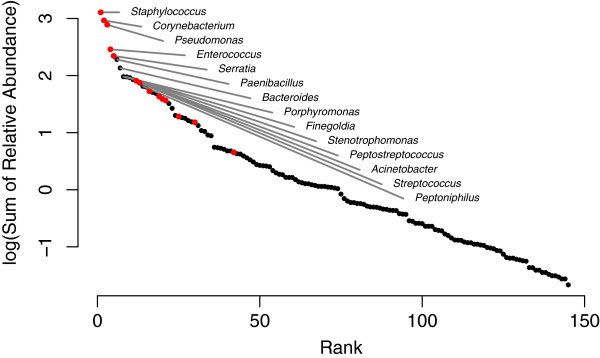
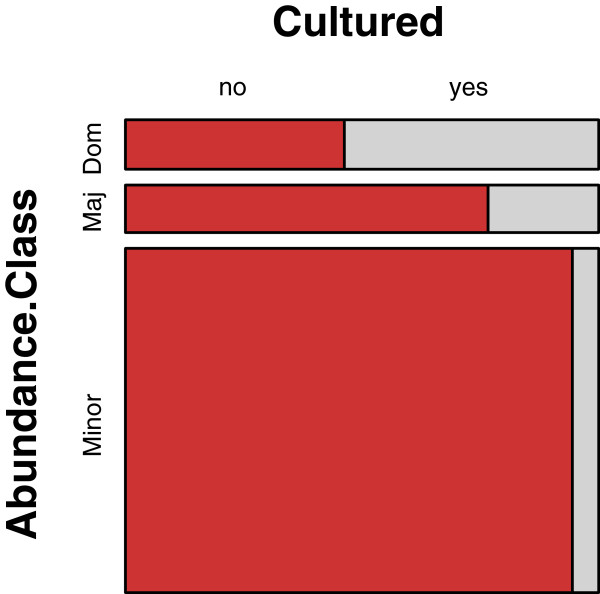
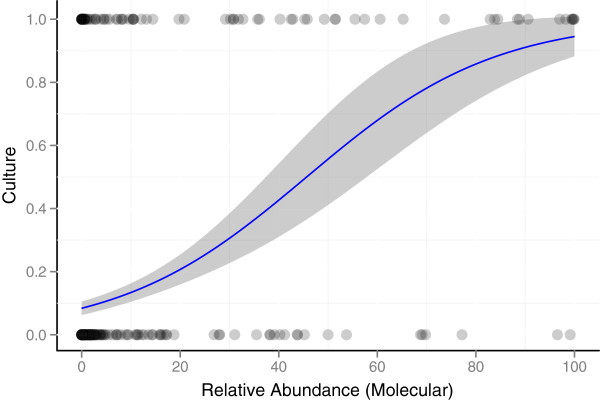
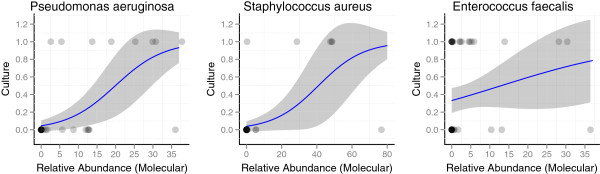
Background: Chronic wounds affect millions of people and cost billions of dollars in the United States each year. These wounds harbor polymicrobial biofilm communities, which can be difficult to elucidate using culturing methods. Clinical molecular microbiological methods are increasingly being employed to investigate the microbiota of chronic infections, including wounds, as part of standard patient care. However, molecular testing is more sensitive than culturing, which results in markedly different results being reported to clinicians. This study compares the results of aerobic culturing and molecular testing (culture-free 16S ribosomal DNA sequencing), and it examines the relative abundance score that is generated by the molecular test and the usefulness of the relative abundance score in predicting the likelihood that the same organism would be detected by culture. Methods: Parallel samples from 51 chronic wounds were studied using aerobic culturing and 16S DNA sequencing for the identification of bacteria. Results: One hundred forty-five (145) unique genera were identified using molecular methods, and 68 of these genera were aerotolerant. Fourteen (14) unique genera were identified using aerobic culture methods. One-third (31/92) of the cultures were determined to be < 1% of the relative abundance of the wound microbiota using molecular testing. At the genus level, molecular testing identified 85% (78/92) of the bacteria that were identified by culture. Conversely, culturing detected 15.7% (78/497) of the aerotolerant bacteria and detected 54.9% of the collective aerotolerant relative abundance of the samples. Aerotolerant bacterial genera (and individual species including Staphylococcus aureus , Pseudomonas aeruginosa , and Enterococcus faecalis ) with higher relative abundance scores were more likely to be detected by culture as demonstrated with regression modeling. Conclusion: Discordance between molecular and culture testing is often observed. However, culture-free 16S ribosomal DNA sequencing and its relative abundance score can provide clinicians with insight into which bacteria are most abundant in a sample and which are most likely to be detected by culture.
Overview
The claims and statistics of this paper haven’t been checked yet.
Run the check — free, no account needed. It reads the open-access text and checks the sources it cites.
Integrity signals
Registry
Cites
Statistics
Figures
Verification
Claims the paper makes
The claims and statistics of this paper haven’t been checked yet.
Run the check — free, no account needed. It reads the open-access text and checks the sources it cites.
Claims other papers make about this one
Each is checked against this paper’s own text: does it say what the citing paper says it does?
In the citing paper
“The identification of particular polymicrobial organisms (179) or the observation of high protease levels, such as MMPs or ADAMs (a disintegrin and metalloproteinases), found in the wound bed (180) are already being used to modify treatment plans and improve outcomes.”
From Wound repair and regeneration: Mechanisms, signaling, and translation (2014) · cites this paper as [179]
Self-check
Percentages, sums and reported differences re-computed from the paper’s own numbers.
The self-check needs the paper’s full text.
Citations
Cites
James, G. A., Swogger, E., Wolcott, R., Pulcini, E. D., Secor, P., Sestrich, J., Costerton, J. W., & Stewart, P. S. (2008) · Wound Repair and Regeneration · doi:10.1111/j.1524-475x.2007.00321.x · Cited by 1,543
Self-citationRecent findings on the viable but nonculturable state in pathogenic bacteria.
Oliver, J. (2010) · FEMS Microbiology Reviews · doi:10.1111/j.1574-6976.2009.00200.x · Cited by 1,231
Dowd, S. E., Sun, Y., Secor, P. R., Rhoads, D. D., Wolcott, B. M., James, G. A., & Wolcott, R. D. (2008) · BMC Microbiology · doi:10.1186/1471-2180-8-43 · Cited by 783
Self-citationDistribution, Organization, and Ecology of Bacteria in Chronic Wounds
Kirketerp‐Møller, K., Jensen, P. Ø., Fazli, M., Madsen, K. G., Pedersen, J., Moser, C. E., Tolker‐Nielsen, T., Høiby, N., Givskov, M., & Bjarnsholt, T. (2008) · Journal of Clinical Microbiology · doi:10.1128/jcm.00501-08 · Cited by 547
Towards diagnostic guidelines for biofilm-associated infections
Hall‐Stoodley, L., Stoodley, P., Kathju, S., Høiby, N., Moser, C. E., Costerton, J. W., Moter, A., & Bjarnsholt, T. (2012) · FEMS Immunology & Medical Microbiology · doi:10.1111/j.1574-695x.2012.00968.x · Cited by 366
Price, L. B., Liu, C. M., Melendez, J. H., Frankel, Y. M., Engelthaler, D., Aziz, M., Bowers, J., Rattray, R., Ravel, J., Kingsley, C., et al. (2009) · PLoS ONE · doi:10.1371/journal.pone.0006462 · Cited by 237
The microbiology of infected and noninfected leg ulcers
Bowler, P. G., & Davies, B. J. (1999) · International Journal of Dermatology · doi:10.1046/j.1365-4362.1999.00738.x · Cited by 233
Comparison of Culture and Molecular Identification of Bacteria in Chronic Wounds
Rhoads, D. D., Wolcott, R. D., Sun, Y., & Dowd, S. E. (2012) · International Journal of Molecular Sciences · doi:10.3390/ijms13032535 · Cited by 221
Self-citationCulture Enriched Molecular Profiling of the Cystic Fibrosis Airway Microbiome
Sibley, C. D., Grinwis, M. E., Field, T. R., Eshaghurshan, C. S., Faria, M. M. P., Dowd, S. E., Parkins, M. D., Rabin, H. R., & Surette, M. G. (2011) · PLoS ONE · doi:10.1371/journal.pone.0022702 · Cited by 196
Biofilms in wounds: management strategies
Rhoads, D. D., Wolcott, R. D., & Percival, S. L. (2008) · Journal of Wound Care · doi:10.12968/jowc.2008.17.11.31479 · Cited by 175
Self-citationMolecular Microbiology: New Dimensions for Cutaneous Biology and Wound Healing
Martin, J. M., Zenilman, J. M., & Lazarus, G. S. (2009) · Journal of Investigative Dermatology · doi:10.1038/jid.2009.221 · Cited by 162
The bacteriology of chronic venous leg ulcer examined by culture-independent molecular methods
Thomsen, T. R., Aasholm, M. S., Rudkjøbing, V. B., Saunders, A. M., Bjarnsholt, T., Givskov, M., Kirketerp‐Møller, K., & Nielsen, P. H. (2010) · Wound Repair and Regeneration · doi:10.1111/j.1524-475x.2009.00561.x · Cited by 141
Biofilms and bacterial imbalances in chronic wounds: anti‐Koch
Percival, S. L., Thomas, J. G., & Williams, D. W. (2010) · International Wound Journal · doi:10.1111/j.1742-481x.2010.00668.x · Cited by 111
Molecular diagnostics and personalised medicine in wound care: assessment of outcomes
Dowd, S. E., Wolcott, R. D., Kennedy, J. P., Jones, C., & Cox, S. B. (2011) · Journal of Wound Care · doi:10.12968/jowc.2011.20.5.232 · Cited by 86
Self-citationMelendez, J. H., Frankel, Y. M., An, A. T., Williams, L., Price, L. B., Wang, N., Lazarus, G. S., & Zenilman, J. M. (2009) · Clinical Microbiology and Infection · doi:10.1111/j.1469-0691.2010.03158.x · Cited by 81
Healing and healing rates of chronic wounds in the age of molecular pathogen diagnostics
Wolcott, R. D., Cox, S. B., & Dowd, S. E. (2010) · Journal of Wound Care · doi:10.12968/jowc.2010.19.7.48898 · Cited by 81
Self-citationUsing Gene Transcription Patterns (Bar Coding Scans) to Guide Wound Debridement and Healing
Tomic‐Canic, M., Ayello, E. A., Stojadinović, O., Golinko, M., & Brem, H. (2008) · Advances in Skin & Wound Care · doi:10.1097/01.asw.0000323563.59885.1c · Cited by 30
Cited by
Sorted by citations
Wound repair and regeneration: Mechanisms, signaling, and translation
Eming, S. A., Martin, P., & Tomic-Canic, M. (2014) · Science Translational Medicine · doi:10.1126/scitranslmed.3009337 · Cited by 3,562
Analysis of the chronic wound microbiota of 2,963 patients by 16S rDNA pyrosequencing
Wolcott, R. D., Hanson, J. D., Rees, E. J., Koenig, L., Phillips, C. D., Wolcott, R. A., Cox, S. B., & White, J. S. (2015) · Wound Repair and Regeneration · doi:10.1111/wrr.12370 · Cited by 432
Self-citationKalan, L., Meisel, J. S., Loesche, M. A., Horwinski, J., Soaita, I., Chen, X., Uberoi, A., Gardner, S. E., & Grice, E. A. (2019) · Cell Host & Microbe · doi:10.1016/j.chom.2019.03.006 · Cited by 423
Boers, S. A., Jansen, R., & Hays, J. P. (2019) · European Journal of Clinical Microbiology & Infectious Diseases · doi:10.1007/s10096-019-03520-3 · Cited by 297
Endometrial microbiota—new player in town
Moreno, I., & Franasiak, J. M. (2017) · Fertility and Sterility · doi:10.1016/j.fertnstert.2017.05.034 · Cited by 203
Metadata
- Authors
- Rhoads, D. D., Cox, S. B., Rees, E. J., Sun, Y., & Wolcott, R. D.
- Affiliations
- University of Pittsburgh Medical Center (US)
- Southwest Regional Wound Care Center (US)
- Corresponding author
- Wolcott, Randall D
- Venue
- BMC Infectious Diseases
- Published
- 2012-11-24
- Volume
- 12
- Issue
- 1
- Pages
- 321-321
- ISSN
- 1471-2334 (ISSN-L)
- PMC
- PMC3542000
- OpenAlex
- W2115171049
- Cited by
- 167
- References
- 17
- Citations by year
- 2026: 6 · 2025: 5 · 2024: 15 · 2023: 15 · 2022: 11 · 2021: 15 · 2020: 12 · 2019: 19 · 2018: 15 · 2017: 14 · 2016: 10 · 2015: 11 · 2014: 13 · 2013: 6
- FWCI
- 6.16
- Type
- journal article
- Language
- en
- Open access
- gold
- doi.org
- Licence
- Locations
- BMC Infectious Diseases (publishedVersion, cc-by)
- PubMed Central (publishedVersion, cc-by)
- PubMed (publishedVersion)
- D-Scholarship@Pitt (University of Pittsburgh) (acceptedVersion)
- DOAJ (DOAJ: Directory of Open Access Journals) (submittedVersion, cc-by-sa)
- Topics
- Health Sciences › Medicine › Microbiology (medical) › Bacterial Identification and Susceptibility Testing
- Health Sciences › Medicine › Surgery › Wound Healing and Treatments
- Health Sciences › Medicine › Microbiology (medical) › Actinomycetales infections and treatment
- Keywords
- chronic wound infection, wound microbiota, polymicrobial biofilms, Staphylococcus aureus, Pseudomonas aeruginosa, Enterococcus faecalis, bacterial identification
- MeSH terms
- Bacteria, Bacterial Infections, Bacteriological Techniques, Chronic Disease, DNA, Ribosomal, Humans, RNA, Ribosomal, 16S, United States, Wound Infection, Molecular Diagnostic Techniques
About these checks
Registry, retraction, Cites and statistics results are computed, not judged, with one exception: a printed reference that no index lists is read once by a model before it counts as a citation error. Claims are extracted by a model and kept only when their quote appears verbatim in the text; each cited source is then checked, with a model’s help, for whether it says what the claim relies on. Those verdicts can be wrong — read the claim’s quote and the cited source before relying on one.
Statistics and arithmetic are recomputed, not judged.
Confidence bands are shown only for fields calibrated on our annotated test set. None is calibrated yet, so no band is shown.
What counts as a claim ›How we measure confidence ›How we check this ›
Are you an author, or do you see a problem with this page? Request a review
