

Epidemiological trends in nosocomial candidemia in intensive care
Open accessThe DOI matches its Crossref record; 30 of the 30 references it cites were found in a registry or an index.
Abstract
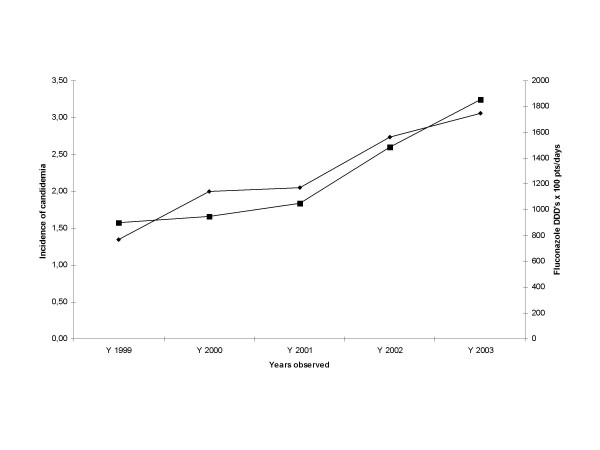
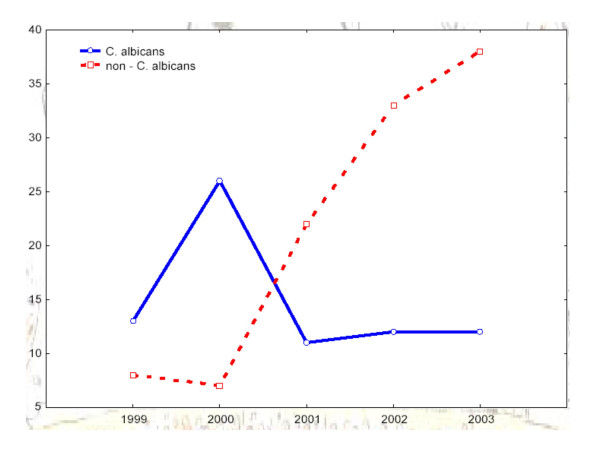
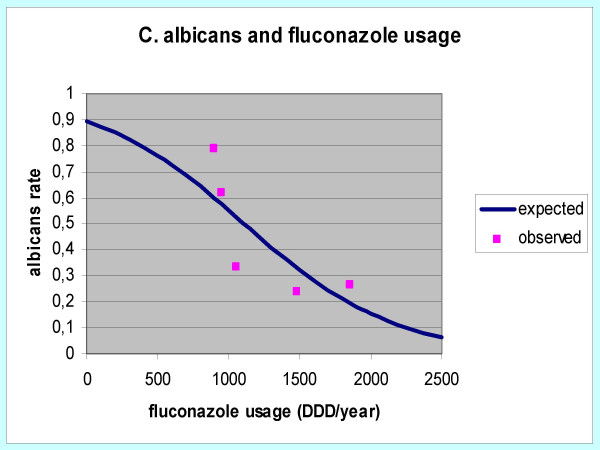
Background: Infection represents a frequent complication among patients in Intensive Care Units (ICUs) and mortality is high. In particular, the incidence of fungal infections, especially due to Candida spp., has been increasing during the last years. Methods: In a retrospective study we studied the etiology of candidemia in critically ill patients over a five-year period (1999–2003) in the ICU of the San Martino University Hospital in Genoa, Italy. Results: In total, 182 episodes of candidaemia were identified, with an average incidence of 2.22 episodes/10 000 patient-days/year (range 1.25–3.06 episodes). Incidence of candidemia increased during the study period from 1.25 in 1999 to 3.06/10 000 patient-days/year in 2003. Overall, 40% of the fungemia episodes (74/182) were due to C.albicans, followed by C. parapsilosis(23%), C.glabrata (15%), C.tropicalis (9%) and other species (13%). Candidemia due to non-albicans species increased and this was apparently correlated with an increasing use of azoles for prophylaxis or empirical treatment. Conclusion: The study demonstrates a shift in the species of Candida causing fungemia in a medical and surgical ICU population during a 5 year period. The knowledge of the local epidemiological trends in Candida species isolated in blood cultures is important to guide therapeutic choices.
Overview
The claims and statistics of this paper haven’t been checked yet.
Free: it reads the open-access text and checks the first 5 claims that cite a source we can check. Create a free account to check every claim.
Integrity signals
Registry
Cites
Statistics
Figures
Verification
Claims the paper makes
The claims and statistics of this paper haven’t been checked yet.
Free: it reads the open-access text and checks the first 5 claims that cite a source we can check. Create a free account to check every claim.
Claims other papers make about this one
Each is checked against this paper’s own text: does it say what the citing paper says it does?
The cited source says what the claim attributes to it.
In the citing paper
“The results of this study reflected a shift toward an increased rate of infection with non-albicans Candida species.”
From Management of invasive candidiasis and candidemia in adult non-neutropenic intensive care unit patients: part I. Epidemiology and diagnosis (2009) · cites this paper as [22]
The cited source says what the claim attributes to it.
In the citing paper
“The authors observed an increased incidence of candidemia over the years: overall, 40% of cases were due to C. albicans followed by C. parapsilosis (23%), C. glabrata (15%), C. tropicalis (9%), and other species (13%).”
From Management of invasive candidiasis and candidemia in adult non-neutropenic intensive care unit patients: part I. Epidemiology and diagnosis (2009) · cites this paper as [22]
The cited source says what the claim attributes to it.
In the citing paper
“A larger study conducted over a 5-year period in Italy recorded 182 episodes of ICU candidemia, with an average incidence of 2.22 episodes/10,000 patient-days/ year [22].”
From Management of invasive candidiasis and candidemia in adult non-neutropenic intensive care unit patients: part I. Epidemiology and diagnosis (2009) · cites this paper as [22]
Self-check
Percentages, sums and reported differences re-computed from the paper’s own numbers.
The self-check needs the paper’s full text.
Citations
Cites
The changing face of candidemia: emergence of non-Candida albicans species and antifungal resistance
Hong Nguyen, M., Peacock, J. E., Morris, A. J., Tanner, D. C., Nguyen, M. L., Snydman, D. R., Wagener, M. M., Rinaldi, M. G., & Yu, V. L. (1996) · The American Journal of Medicine · doi:10.1016/s0002-9343(95)00010-0 · Cited by 758
The Epidemiology of Hematogenous Candidiasis Caused by Different Candida Species
Abi‐Said, D., Anaissie, E., Uzun, O., Raad, I., Pinzcowski, H., & Vartivarian, S. (1997) · Clinical Infectious Diseases · doi:10.1086/513663 · Cited by 755
Pfaller, M. A., Diekema, D. J., Jones, R. N., Sader, H. S., Fluit, A. C., Hollis, R. J., Messer, S. A., & The SENTRY Participant Group (2001) · Journal of Clinical Microbiology · doi:10.1128/jcm.39.9.3254-3259.2001 · Cited by 521
Epidemiology of Candidemia in Swiss Tertiary Care Hospitals: Secular Trends, 1991–2000
Marchetti, O., Bille, J., Fluckiger, U., Eggimann, P., Ruef, C., Garbino, J., Calandra, T., Glauser, M., Tauber, M. G., Pittet, D., et al. (2004) · Clinical Infectious Diseases · doi:10.1086/380637 · Cited by 478
Komshian, S. V., Uwaydah, A. K., Sobel, J. D., & Crane, L. R. (1989) · Clinical Infectious Diseases · doi:10.1093/clinids/11.3.379 · Cited by 457
Fluconazole prophylaxis prevents intra-abdominal candidiasis in high-risk surgical patients
Eggimann, P., Francioli, P., Bille, J., Schneider, R., Wu, M.-M., Chapuis, G., Chiolero, R., Pannatier, A., Schilling, J., Geroulanos, S., et al. (1999) · Critical Care Medicine · doi:10.1097/00003246-199906000-00019 · Cited by 414
Pfaller, M. A., Jones, R. N., Doern, G. V., Sader, H. S., Messer, S. A., Houston, A., Coffman, S., Hollis, R. J., & The SENTRY Participant Group (2000) · Antimicrobial Agents and Chemotherapy · doi:10.1128/aac.44.3.747-751.2000 · Cited by 378
Pelz, R. K., Hendrix, C. W., Swoboda, S. M., Diener-West, M., Merz, W. G., Hammond, J., & Lipsett, P. A. (2001) · Annals of Surgery · doi:10.1097/00000658-200104000-00010 · Cited by 316
Pfaller, M. A., Jones, R. N., Doern, G. V., Sader, H. S., Hollis, R. J., Messer, S. A., & Group, F. T. S. P. (1998) · Journal of Clinical Microbiology · doi:10.1128/jcm.36.7.1886-1889.1998 · Cited by 281
High rate of non-albicans candidemia in Brazilian tertiary care hospitals
Lopes Colombo, A., Nucci, M., Salomão, R., Branchini, M. L. M., Richtmann, R., Derossi, A., & Wey, S. B. (1999) · Diagnostic Microbiology and Infectious Disease · doi:10.1016/s0732-8893(99)00042-5 · Cited by 201
Levin, A. S., Costa, S. F., Mussi, N. S., Basso, M., Sinto, S. I., Machado, C., Geiger, D. C., Villares, M. C. B., Schreiber, A. Z., Barone, A. A., et al. (1998) · Diagnostic Microbiology and Infectious Disease · doi:10.1016/s0732-8893(98)00006-6 · Cited by 197
Increasing Incidence of Candidemia: Results from a 20-Year Nationwide Study in Iceland
Ásmundsdóttir, L. R., Erlendsdóttir, H., & Gottfredsson, M. (2002) · Journal of Clinical Microbiology · doi:10.1128/jcm.40.9.3489-3492.2002 · Cited by 188
Nosocomial Candidemia in Non-Neutropenic Patients at an Italian Tertiary Care Hospital
Luzzati, R., Amalfitano, G., Lazzarini, L., Soldani, F., Bellino, S., Solbiati, M., Danzi, M. C., Vento, S., Todeschini, G., Vivenza, C., et al. (2000) · European Journal of Clinical Microbiology & Infectious Diseases · doi:10.1007/s100960000325 · Cited by 179
Fluconazole prophylaxis in critically ill surgical patients: A meta-analysis*
Shorr, A. F., Chung, K., Jackson, W. L., Waterman, P. E., & Kollef, M. H. (2005) · Critical Care Medicine · doi:10.1097/01.ccm.0000178352.14703.49 · Cited by 166
Mg, C., & Ma, P. (1995) · PubMed · Cited by 154
White, M. H. (1997) · Clinical Infectious Diseases · doi:10.1086/513661 · Cited by 151
Pfaller, M. A. (1995) · Journal of Hospital Infection · doi:10.1016/0195-6701(95)90036-5 · Cited by 140
Candidemia in intensive care unit patients: Risk factors for mortality
Voss, A., Meis, J. F. G. M., Lunel, F. M. V., le Noble, J. L. M. L., & Foudraine, N. A. (1997) · Infection · doi:10.1007/bf02113499 · Cited by 138
Trends in Antifungal Use and Epidemiology of Nosocomial Yeast Infections in a University Hospital
Berrouane, Y. F., Herwaldt, L. A., & Pfaller, M. A. (1999) · Journal of Clinical Microbiology · doi:10.1128/jcm.37.3.531-537.1999 · Cited by 136
Hope, W. W., Morton, A., & Eisen, D. P. (2002) · Journal of Hospital Infection · doi:10.1053/jhin.2001.1131 · Cited by 130
Yamamura, D. L. R., Rotstein, C., Nicolle, L. E., & Ioannou, S. (1999) · Europe PMC (PubMed Central) · Cited by 103
Rocco, T. R. (2000) · Archives of Surgery · doi:10.1001/archsurg.135.2.160 · Cited by 88
Outcome in critically ill patients with candidal fungaemia: Candida albicans vs. Candida glabrata
Blot, S., Vandewoude, K., Hoste, E., Poelaert, J., & Colardyn, F. (2001) · Journal of Hospital Infection · doi:10.1053/jhin.2000.0918 · Cited by 73
Safdar, A., Perlin, D. S., & Armstrong, D. (2002) · Diagnostic Microbiology and Infectious Disease · doi:10.1016/s0732-8893(02)00423-6 · Cited by 71
Candidaemia in a London teaching hospital: analysis of 128 cases over a 7‐year period
Schelenz, S., & Gransden, W. R. (2003) · Mycoses · doi:10.1046/j.0933-7407.2003.00907.x · Cited by 56
Janssen, P. A., & van den Bossche, H. (1982) · PubMed · Cited by 54
Trends in species causing fungaemia in a tertiary care medical centre over 12 years
Malani, P. N., Bradley, S. F., Little, R. S., & Kauffman, C. A. (2001) · Mycoses · doi:10.1046/j.1439-0507.2001.00662.x · Cited by 54
Distribution of Candida species among bloodstream isolates
Al-Jasser, A. M., & Elkhizzi, N. A. (2004) · Saudi Medical Journal · doi:10.15537/1658-3175.2402 · Cited by 47
A prospective epidemiological survey of candidaemia in Sweden
Klingspor, L., Törnqvist, E., Johansson, A., Petrini, B., Forsum, U., & Hedin, G. (2004) · Scandinavian Journal of Infectious Diseases · doi:10.1080/00365540310017447 · Cited by 46
McMullan, R., McClurg, R. B., Xu, J., Moore, J. E., Millar, B. C., Crowe, M. J., & Hedderwick, S. A. (2002) · Journal of Infection · doi:10.1053/jinf.2002.0999 · Cited by 28
Cited by
Silva, S., Negri, M., Henriques, M., Oliveira, R., Williams, D. W., & Azeredo, J. (2012) · FEMS Microbiology Reviews · doi:10.1111/j.1574-6976.2011.00278.x · Cited by 969
Candida parapsilosis, an Emerging Fungal Pathogen
Trofa, D., Gácser, A., & Nosanchuk, J. D. (2008) · Clinical Microbiology Reviews · doi:10.1128/cmr.00013-08 · Cited by 854
Candida albicans—The Virulence Factors and Clinical Manifestations of Infection
Talapko, J., Juzbašić, M., Matijević, T., Pustijanac, E., Bekić, S., Kotris, I., & Škrlec, I. (2021) · Journal of Fungi · doi:10.3390/jof7020079 · Cited by 794
Nosocomial fungal infections: epidemiology, diagnosis, and treatment
Perlroth, J., Choi, B., & Spellberg, B. (2007) · Medical Mycology · doi:10.1080/13693780701218689 · Cited by 738
Hospital Epidemiology and Infection Control in Acute-Care Settings
Sydnor, E. R. M., & Perl, T. M. (2011) · Clinical Microbiology Reviews · doi:10.1128/cmr.00027-10 · Cited by 652
Metadata
- Authors
- Bassetti, M., Righi, E., Costa, A., Fasce, R., Molinari, M. P., Rosso, R., Pallavicini, F. B., & Viscoli, C.
- Affiliations
- Ospedale Policlinico San Martino (IT)
- Corresponding author
- Bassetti, Matteo
- Venue
- BMC Infectious Diseases
- Published
- 2006-02-10
- Volume
- 6
- Issue
- 1
- Pages
- 21-21
- ISSN
- 1471-2334 (ISSN-L)
- PMC
- PMC1379648
- OpenAlex
- W1485519026
- Cited by
- 332
- References
- 30
- Citations by year
- 2026: 2 · 2025: 4 · 2024: 1 · 2023: 6 · 2022: 8 · 2021: 11 · 2020: 7 · 2019: 17 · 2018: 8 · 2017: 22 · 2016: 20 · 2015: 27 · 2014: 30 · 2013: 27 · 2012: 21
- FWCI
- 13.85
- Type
- journal article
- Language
- en
- Open access
- gold
- doi.org
- Licence
- Locations
- BMC Infectious Diseases (publishedVersion, cc-by)
- PubMed Central (publishedVersion, cc-by)
- PubMed (publishedVersion)
- DOAJ (DOAJ: Directory of Open Access Journals) (submittedVersion)
- CINECA IRIS Institutial Research Information System (University of Genoa) (submittedVersion)
- Topics
- Health Sciences › Medicine › Infectious Diseases › Antifungal resistance and susceptibility
- Health Sciences › Medicine › Critical Care and Intensive Care Medicine › Nosocomial Infections in ICU
- Health Sciences › Medicine › Infectious Diseases › Fungal Infections and Studies
- Keywords
- nosocomial candidemia, Candida species, intensive care unit, critically ill patients, Candida albicans, Candida parapsilosis, Candida glabrata, Candida tropicalis, non-albicans Candida, azole prophylaxis, empirical antifungal therapy, fungemia, epidemiological trends, range shifts
- MeSH terms
- Adult, Aged, Antifungal Agents, Candida, Candidiasis, Cross Infection, Drug Utilization, Female, Humans, Male, Middle Aged, Retrospective Studies, Fluconazole, Logistic Models, Fungemia
About these checks
Registry, retraction, Cites and statistics results are computed, not judged, with one exception: a printed reference that no index lists is read once by a model before it counts as a citation error. Claims are extracted by a model and kept only when their quote appears verbatim in the text; each cited source is then checked, with a model’s help, for whether it says what the claim relies on. Those verdicts can be wrong — read the claim’s quote and the cited source before relying on one.
Statistics and arithmetic are recomputed, not judged.
Confidence bands are shown only for fields calibrated on our annotated test set. None is calibrated yet, so no band is shown.
What counts as a claim ›How we measure confidence ›How we check this ›
Are you an author, or do you see a problem with this page? Request a review
Data sources
Bibliographic data: Semantic Scholar, OpenAlex, Crossref.
Contains information from the Semantic Scholar Academic Graph Datasets, made available under the ODC Attribution License (ODC-BY 1.0).
Semantic Scholar’s data is described in: Kinney, R., et al. (2023). The Semantic Scholar Open Data Platform. arXiv:2301.10140.
