

Gastric inhibitory polypeptide receptor: association analyses for obesity of several polymorphisms in large study groups
Open accessThe DOI matches its Crossref record; 44 of the 44 references it cites were found in a registry or an index.
Abstract
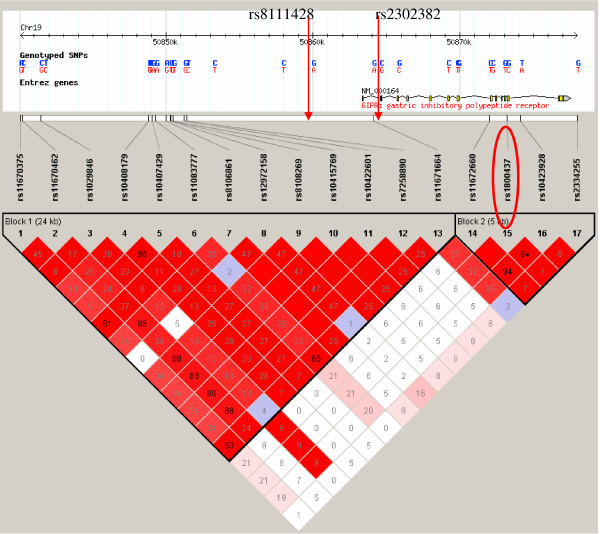
Background: Gastric inhibitory polypeptide (GIP) is postulated to be involved in type 2 diabetes mellitus and obesity. It exerts its function through its receptor, GIPR. We genotyped three GIPR SNPs (rs8111428, rs2302382 and rs1800437) in German families with at least one obese index patient, two case-control studies and two cross-sectional population-based studies. Methods: Genotyping was performed by MALDI-TOF, ARMS-PCR and RFLP. The family-study: 761 German families with at least one extremely obese child or adolescent (n = 1,041) and both parents (n = 1,522). Case-control study: (a) German obese children (n = 333) and (b) obese adults (n = 987) in comparison to 588 adult lean controls. The two cross-sectional population-based studies: KORA (n = 8,269) and SHIP (n = 4,310). Results: We detected over-transmission of the A-allele of rs2302382 in the German families (p TDT-Test = 0.0089). In the combined case-control sample, we estimated an odd ratio of 1.54 (95%CI 1.09;2.19, p CA-Test = 0.014) for homozygotes of the rs2302382 A-allele compared to individuals with no A-allele. A similar trend was found in KORA where the rs2302382 A-allele led to an increase of 0.12 BMI units (p = 0.136). In SHIP, however, the A-allele of rs2302382 was estimated to contribute an average decrease of 0.27 BMI units (p-value = 0.031). Conclusion: Our data suggest a potential relevance of GIPR variants for obesity. However, additional studies are warranted in light of the conflicting results obtained in one of the two population-based studies.
Overview
The claims and statistics of this paper haven’t been checked yet.
Free: it reads the open-access text and checks the first 5 claims that cite a source we can check. Create a free account to check every claim.
Integrity signals
Registry
Cites
Statistics
Figures
Verification
Claims the paper makes
The claims and statistics of this paper haven’t been checked yet.
Free: it reads the open-access text and checks the first 5 claims that cite a source we can check. Create a free account to check every claim.
Claims other papers make about this one
Each is checked against this paper’s own text: does it say what the citing paper says it does?
The check wasn’t confident either way, so it gives no verdict — never disputed.
In the citing paper
“In the SURMOUNT-3 trial, the effects of tirzepatide were assessed in obese subjects without T2D that underwent intensive lifestyle modifications; the supplemental therapeutic treatment with tirzepatide for 72 weeks reduced body weight by −18.4%, relative to a 2.5% weight gain evident in placebo controls144.”
From Transforming obesity: The advancement of multi-receptor drugs (2024) · cites this paper as [144]
Experimental — accuracy not yet measured
Self-check
Percentages, sums and reported differences re-computed from the paper’s own numbers.
The self-check needs the paper’s full text.
Citations
Cites
Genome-wide association study of 14,000 cases of seven common diseases and 3,000 shared controls
The Wellcome Trust Case Control Consortium, Management Committee, Burton, P. R., Clayton, D. G., Cardon, L. R., Craddock, N., Deloukas, P., Duncanson, A., Kwiatkowski, D. P., McCarthy, M. I., et al. (2007) · Nature · doi:10.1038/nature05911 · Cited by 9,442
Frayling, T. M., Timpson, N. J., Weedon, M. N., Zeggini, E., Freathy, R. M., Lindgren, C. M., Perry, J. R. B., Elliott, K. S., Lango, H., Rayner, N. W., et al. (2007) · Science · doi:10.1126/science.1141634 · Cited by 4,531
The Wellcome Trust Case Control Consortium, U.K.
Mossman, K. (2008) · Scientific American · doi:10.1038/scientificamerican0108-42a · Cited by 2,684
Scuteri, A., Sanna, S., Chen, W.-M., Uda, M., Albai, G., Strait, J., Najjar, S., Nagaraja, R., Orrú, M., Usala, G., et al. (2007) · PLoS Genetics · doi:10.1371/journal.pgen.0030115 · Cited by 1,724
the GIANT Consortium (2009) · Nature Genetics · doi:10.1038/ng.287 · Cited by 1,720
Thorleifsson, G., Walters, G. B., Gudbjartsson, D. F., Steinthorsdottir, V., Sulem, P., Helgadottir, A., Styrkarsdottir, U., Gretarsdottir, S., Thorlacius, S., Jonsdottir, I., et al. (2009) · Nature Genetics · doi:10.1038/ng.274 · Cited by 1,375
An efficient procedure for genotyping single nucleotide polymorphisms
Ye, S. (2001) · Nucleic Acids Research · doi:10.1093/nar/29.17.e88 · Cited by 1,005
Inhibition of gastric inhibitory polypeptide signaling prevents obesity
Miyawaki, K., Yamada, Y., Ban, N., Ihara, Y., Tsukiyama, K., Zhou, H., Fujimoto, S., Oku, A., Tsuda, K., Toyokuni, S., et al. (2002) · Nature Medicine · doi:10.1038/nm727 · Cited by 963 · cited 3×
“Under high fat diet Gipr-/- mice, in comparison to WT mice, have a reduced fat storage; they use fat as the main energy substrate and do not develop obesity, insulin resistance, diabetes mellitus, impaired glucose tolerance, and fatty liver like the WT [ 6 ,7,15-18].”
BackgroundInfluentialGenetics of body-weight regulation
Barsh, G. S., Farooqi, I. S., & O'Rahilly, S. (2000) · Nature · doi:10.1038/35007519 · Cited by 778
A common genetic variant is associated with adult and childhood obesity.
Herbert, A., Gerry, N. P., McQueen, M. B., Heid, I. M., Pfeufer, A., Illig, T., Wichmann, H.-E., Meitinger, T., Hunter, D., Hu, F. B., et al. (2006) · Science · doi:10.1126/science.1124779 · Cited by 732
Meyre, D., Delplanque, J., Chèvre, J.-C., Lecoeur, C., Lobbens, S., Gallina, S., Durand, E., Vatin, V., Degraeve, F., Proença, C., et al. (2009) · Nature Genetics · doi:10.1038/ng.301 · Cited by 652
The role of gut hormones in glucose homeostasis
Drucker, D. J. (2007) · Journal of Clinical Investigation · doi:10.1172/jci30076 · Cited by 614
Dudbridge, F. (2008) · Human Heredity · doi:10.1159/000119108 · Cited by 612
Hinney, A., Nguyen, T. T., Scherag, A., Friedel, S., Brönner, G., Müller, T. D., Grallert, H., Illig, T., Wichmann, H.-E., Rief, W., et al. (2007) · PLoS ONE · doi:10.1371/journal.pone.0001361 · Cited by 511
Self-citationMiyawaki, K., Yamada, Y., Yano, H., Niwa, H., Ban, N., Ihara, Y., Kubota, A., Fujimoto, S., Kajikawa, M., Kuroe, A., et al. (1999) · Proceedings of the National Academy of Sciences · doi:10.1073/pnas.96.26.14843 · Cited by 454 · cited 1×
“GIP, also known as glucose-dependent insulinotropic peptide, is a gastrointestinal hormone of 42 amino acids secreted by endocrine K cells from the duodenum in response to meal ingestion, especially for meal containing fat or glucose [7, 9].”
BackgroundKORA-gen - Resource for Population Genetics, Controls and a Broad Spectrum of Disease Phenotypes
Wichmann, H.-E., Gieger, C., & Illig, T. (2005) · Das Gesundheitswesen · doi:10.1055/s-2005-858226 · Cited by 417
Self-citationExtrapancreatic incretin receptors modulate glucose homeostasis, body weight, and energy expenditure
Hansotia, T., Maida, A., Flock, G., Yamada, Y., Tsukiyama, K., Seino, Y., & Drucker, D. J. (2007) · Journal of Clinical Investigation · doi:10.1172/jci25483 · Cited by 290 · cited 2×
“Under high fat diet Gipr-/- mice, in comparison to WT mice, have a reduced fat storage; they use fat as the main energy substrate and do not develop obesity, insulin resistance, diabetes mellitus, impaired glucose tolerance, and fatty liver like the WT [6,7,15-18].”
BackgroundMcClean, P. L., Irwin, N., Cassidy, R. S., Holst, J. J., Gault, V. A., & Flatt, P. R. (2007) · American Journal of Physiology-Endocrinology and Metabolism · doi:10.1152/ajpendo.00460.2007 · Cited by 239
National Cancer Institute (2020) · Definitions · doi:10.32388/f4olbl · Cited by 227
Hinney, A., Bettecken, T., Tarnow, P., Brumm, H., Reichwald, K., Lichtner, P., Scherag, A., Nguyen, T. T., Schlumberger, P., Rief, W., et al. (2006) · The Journal of Clinical Endocrinology & Metabolism · doi:10.1210/jc.2005-2056 · Cited by 209
Self-citationA Powerful Strategy to Account for Multiple Testing in the Context of Haplotype Analysis
Becker, T., & Knapp, M. (2004) · The American Journal of Human Genetics · doi:10.1086/424390 · Cited by 167
Regional disparities of hypertension prevalence and management within Germany
Meisinger, C., Heier, M., Völzke, H., Löwel, H., Mitusch, R., Hense, H.-W., & Lüdemann, J. (2006) · Journal of Hypertension · doi:10.1097/01.hjh.0000200508.10324.8e · Cited by 160
Self-citationSNP-Based Analysis of Genetic Substructure in the German Population
Steffens, M., Lamina, C., Illig, T., Bettecken, T., Vogler, R., Entz, P., Suk, E.-K., Toliat, M. R., Klopp, N., Caliebe, A., et al. (2006) · Human Heredity · doi:10.1159/000095850 · Cited by 146
Self-citationVaccination against GIP for the Treatment of Obesity
Fulurija, A., Lutz, T. A., Sladko, K., Osto, M., Wielinga, P. Y., Bachmann, M. F., & Saudan, P. (2008) · PLoS ONE · doi:10.1371/journal.pone.0003163 · Cited by 136 · cited 1×
“Recently, a study in mice [20] showed that vaccination against GIP prevents its binding to the GIP receptor, consequently reducing body weight gain under high fat diets.”
BackgroundDefinable Somatic Disorders in Overweight Children and Adolescents
Reinehr, T., Hinney, A., de Sousa, G., Austrup, F., Hebebrand, J., & Andler, W. (2007) · The Journal of Pediatrics · doi:10.1016/j.jpeds.2007.01.042 · Cited by 132
Self-citationIrwin, N., McClean, P. L., O'Harte, F. P. M., Gault, V. A., Harriott, P., & Flatt, P. R. (2007) · Diabetologia · doi:10.1007/s00125-007-0692-2 · Cited by 106
Molecular regulation of eating behavior: new insights and prospects for therapeutic strategies
Ahima, R. S., & Osei, S. Y. (2001) · Trends in Molecular Medicine · doi:10.1016/s1471-4914(01)01989-x · Cited by 97
Gastric inhibitory polypeptide modulates adiposity and fat oxidation under diminished insulin action
Zhou, H., Yamada, Y., Tsukiyama, K., Miyawaki, K., Hosokawa, M., Nagashima, K., Toyoda, K., Naitoh, R., Mizunoya, W., Fushiki, T., et al. (2005) · Biochemical and Biophysical Research Communications · doi:10.1016/j.bbrc.2005.07.164 · Cited by 82
A novel GIP receptor splice variant influences GIP sensitivity of pancreatic β-cells in obese mice
Harada, N., Yamada, Y., Tsukiyama, K., Yamada, C., Nakamura, Y., Mukai, E., Hamasaki, A., Liu, X., Toyoda, K., Seino, Y., et al. (2008) · American Journal of Physiology-Endocrinology and Metabolism · doi:10.1152/ajpendo.00358.2007 · Cited by 79
Almind, K., Ambye, L., Urhammer, S. A., Hansen, T. F., Echwald, S. M., Holst, J. J., Gromada, J., Thorens, B., & Pedersen, O. B. (1998) · Diabetologia · doi:10.1007/s001250051051 · Cited by 68
Flatt, P. R. (2008) · Diabetic Medicine · doi:10.1111/j.1464-5491.2008.02455.x · Cited by 68
Kubota, A., Yamada, Y., Hayami, T., Yasuda, K., Someya, Y., Ihara, Y., Kagimoto, S., Watanabe, R., Taminato, T., Tsuda, K., et al. (1996) · Diabetes · doi:10.2337/diab.45.12.1701 · Cited by 62
Lack of Support for the Association between GAD2 Polymorphisms and Severe Human Obesity
Swarbrick, M. M., Waldenmaier, B., Pennacchio, L. A., Lind, D. L., Cavazos, M. M., Geller, F., Merriman, R., Ustaszewska, A., Malloy, M., Scherag, A., et al. (2005) · PLoS Biology · doi:10.1371/journal.pbio.0030315 · Cited by 51
Self-citationPhysiology of GIP - A Lesson from GIP Receptor Knockout Mice
Yamada, Y., & Seino, Y. (2004) · Hormone and Metabolic Research · doi:10.1055/s-2004-826162 · Cited by 48
Yamada, C., Yamada, Y., Tsukiyama, K., Yamada, K., Yamane, S., Harada, N., Miyawaki, K., Seino, Y., & Inagaki, N. (2007) · Biochemical and Biophysical Research Communications · doi:10.1016/j.bbrc.2007.09.128 · Cited by 47
Flatt, P. R. (2007) · Diabetes and Vascular Disease Research · doi:10.3132/dvdr.2007.034 · Cited by 47
Association analyses of GIP and GIPR polymorphisms with traits of the metabolic syndrome
Nitz, I., Fisher, E., Weikert, C., Burwinkel, B., Li, Y., Möhlig, M., Boeing, H., Schreiber, S., Schrezenmeir, J., & Döring, F. (2007) · Molecular Nutrition & Food Research · doi:10.1002/mnfr.200700048 · Cited by 43
Antonini, S. R. R., N’Diaye, N., Baldacchino, V., Hamet, P., Tremblay, J., & Lacroix, A. (2004) · The Journal of Steroid Biochemistry and Molecular Biology · doi:10.1016/j.jsbmb.2004.03.120 · Cited by 38
Baldacchino, V., Oble, S., Décarie, P.-O., Bourdeau, I., Hamet, P., Tremblay, J., & Lacroix, A. (2005) · Journal of Molecular Endocrinology · doi:10.1677/jme.1.01765 · Cited by 37
Friedel, S., Reichwald, K., Scherag, A., Brumm, H., Wermter, A., Fries, H.-R., Koberwitz, K., Wabitsch, M., Meitinger, T., Platzer, M., et al. (2007) · BMC Genetics · doi:10.1186/1471-2156-8-17 · Cited by 30
Self-citationKubota, A., Yamada, Y., Hayami, T., et al. (1996) · Diabetes · doi:10.2337/diabetes.45.12.1701 · Cited by 12
Irwin, N., Hunter, K., & Flatt, P. R. (2007) · Peptides · doi:10.1016/j.peptides.2007.08.008 · Cited by 9
Genetic Factors for Overweight and CAD
Brönner, G., Erdmann, J., Mayer, B., Hinney, A., & Hebebrand, J. (2006) · Herz · doi:10.1007/s00059-006-2797-7 · Cited by 7
Self-citationGastric inhibitory polypeptide links overnutrition to obesity
Ballinger, A. (2003) · Gut · doi:10.1136/gut.52.3.319 · Cited by 7
Research works printed but not linked: 2
- Hebebrand J Heseker H Himmelmann GW Schäfer H Remschmidt H Altersperzentilen für den Body Mass Index aus Daten der Nationalen Verzehrsstudie einschließlich einer Übersicht zu relevanten Einflußfaktoren Aktuel Ernährungsmed 1994 19 259 265
- Völzke H Neuhauser H Moebus S Baumert J Berger K Stang A Ellert U Werner A Döring A Rauchen: regionale Unterschied in Deutschland Deutsches Ärzteblatt 2006 103 A2784 A2790
Cited by
Incretin hormones: Their role in health and disease
Nauck, M. A., & Meier, J. J. (2018) · Diabetes, Obesity and Metabolism · doi:10.1111/dom.13129 · Cited by 950
“Some human GIP receptor polymorphisms are associated with differences in body weight.(126) In contrast, exogenous GLP-1 reduces appetite, increases satiety, and reduces food intake,(53) perhaps even at physiological concentrations.”
BackgroundGenome‐Wide Association Study of Alcohol Dependence Implicates a Region on Chromosome 11
Edenberg, H. J., Koller, D. L., Xuei, X., Wetherill, L., McClintick, J. N., Almasy, L., Bierut, L. J., Bucholz, K. K., Goate, A., Aliev, F., et al. (2010) · Alcoholism: Clinical and Experimental Research · doi:10.1111/j.1530-0277.2010.01156.x · Cited by 293
Estep, M., Armistead, D. L., Hossain, N., Elarainy, H. A., Goodman, Z. D., Baranova, A. V., Chandhoke, V., & Younossi, Z. M. (2010) · Alimentary Pharmacology & Therapeutics · doi:10.1111/j.1365-2036.2010.04366.x · Cited by 158
Transforming obesity: The advancement of multi-receptor drugs
Kusminski, C. M., Perez-Tilve, D., Müller, T. D., DiMarchi, R. D., Tschöp, M. H., & Scherer, P. E. (2024) · Cell · doi:10.1016/j.cell.2024.06.003 · Cited by 126
Glucose-dependent insulinotropic polypeptide (GIP)
Müller, T. D., Adriaenssens, A. E., Ahrén, B., Blüher, M., Birkenfeld, A. L., Campbell, J. E., Coghlan, M. P., D’Alessio, D. D., Deacon, C. F., DelPrato, S., et al. (2025) · Molecular Metabolism · doi:10.1016/j.molmet.2025.102118 · Cited by 114
Metadata
- Authors
- Vogel, C. I., Scherag, A., Brönner, G., Nguyen, T. T., Wang, H.-J., Grallert, H., Bornhorst, A., Rosskopf, D., Völzke, H., Reinehr, T., Rief, W., Illig, T., Wichmann, H.-E., Schäfer, H., Hebebrand, J., & Hinney, A.
- Affiliations
- University of Duisburg-Essen (DE)
- University of Würzburg (DE)
- Philipps University of Marburg (DE)
- Helmholtz Munich (DE)
- Universität Greifswald (DE)
- Witten/Herdecke University (DE)
- Corresponding author
- Hinney, Anke
- ORCID
- Venue
- BMC Medical Genetics
- Published
- 2009-03-02
- Volume
- 10
- Issue
- 1
- Pages
- 19-19
- ISSN
- 1471-2350 (ISSN-L)
- PMC
- PMC2654891
- OpenAlex
- W2051707558
- Cited by
- 30
- References
- 43
- Citations by year
- 2025: 3 · 2024: 5 · 2023: 2 · 2022: 1 · 2021: 3 · 2020: 2 · 2019: 2 · 2018: 4 · 2017: 1 · 2016: 2
- FWCI
- 0.97
- Type
- journal article
- Language
- en
- Open access
- gold
- doi.org
- Licence
- Locations
- BMC Medical Genetics (publishedVersion, cc-by)
- PubMed Central (publishedVersion, cc-by)
- PubMed (publishedVersion)
- DOAJ (DOAJ: Directory of Open Access Journals) (submittedVersion, cc-by-sa)
- Open access LMU (Ludwid Maxmilian's Universitat Munchen) (submittedVersion)
- Site cant be reached (submittedVersion, cc-by)
- Greater South Information System
- Funders
- European Commission (FP6 LSHMCT-2003-503041)
- Deutsche Forschungsgemeinschaft (HE 1446/4-1)
- Bundesministerium für Bildung und Forschung (01GS0830, 01GS0823, 01GS0820, 01GS08197, ZZ9603)
- Universität Greifswald
- Ministry of Cultural Affairs
- Topics
- Life Sciences › Biochemistry, Genetics and Molecular Biology › Genetics › Genetic Associations and Epidemiology
- Life Sciences › Neuroscience › Endocrine and Autonomic Systems › Regulation of Appetite and Obesity
- Health Sciences › Medicine › Endocrinology, Diabetes and Metabolism › Adipokines, Inflammation, and Metabolic Diseases
- Keywords
- GIPR, obesity, single nucleotide polymorphisms, genetic association, family-based association, transmission disequilibrium test, body mass index, type 2 diabetes, German families
- MeSH terms
- Adolescent, Adult, Child, Cross-Sectional Studies, Female, Genotype, Germany, Humans, Male, Middle Aged, Obesity, Receptors, Gastrointestinal Hormone, Body Mass Index, Case-Control Studies, Genetic Predisposition to Disease, Polymorphism, Single Nucleotide, Young Adult
About these checks
Registry, retraction, Cites and statistics results are computed, not judged, with one exception: a printed reference that no index lists is read once by a model before it counts as a citation error. Claims are extracted by a model and kept only when their quote appears verbatim in the text; each cited source is then checked, with a model’s help, for whether it says what the claim relies on. Those verdicts can be wrong — read the claim’s quote and the cited source before relying on one.
Statistics and arithmetic are recomputed, not judged.
Confidence bands are shown only for fields calibrated on our annotated test set. None is calibrated yet, so no band is shown.
What counts as a claim ›How we measure confidence ›How we check this ›
Are you an author, or do you see a problem with this page? Request a review
Data sources
Bibliographic data: Semantic Scholar, OpenAlex, Crossref.
Contains information from the Semantic Scholar Academic Graph Datasets, made available under the ODC Attribution License (ODC-BY 1.0).
Semantic Scholar’s data is described in: Kinney, R., et al. (2023). The Semantic Scholar Open Data Platform. arXiv:2301.10140.
