

Gestational diabetes and pregnancy outcomes - a systematic review of the World Health Organization (WHO) and the International Association of Diabetes in Pregnancy Study Groups (IADPSG) diagnostic criteria
Open accessThe DOI matches its Crossref record; 30 of the 30 references it cites were found in a registry or an index.
Abstract
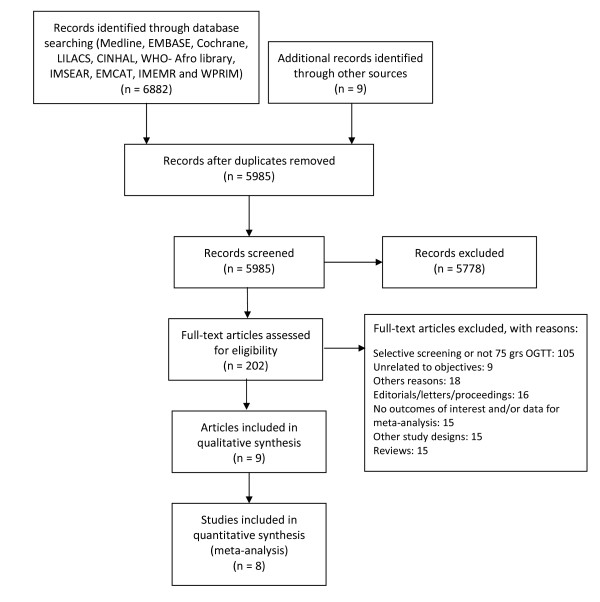
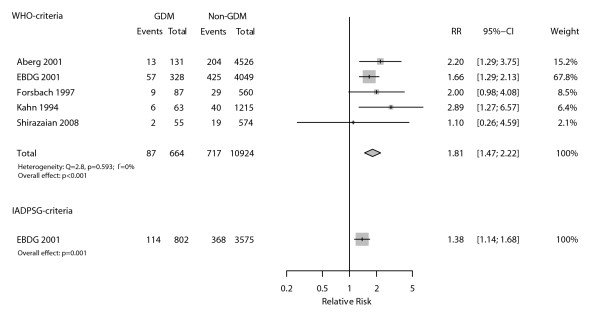
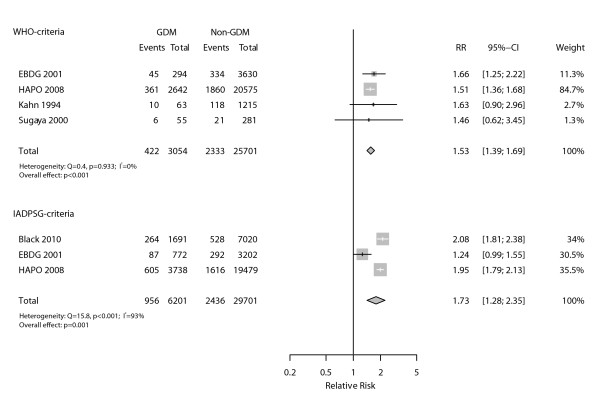
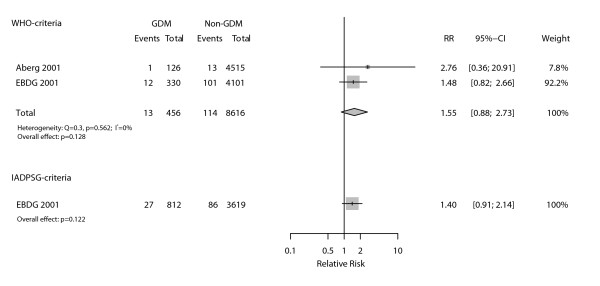
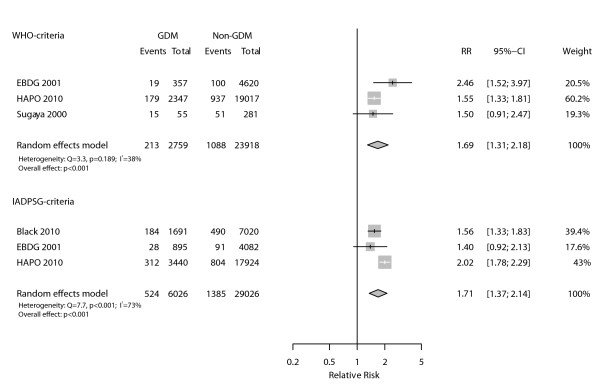
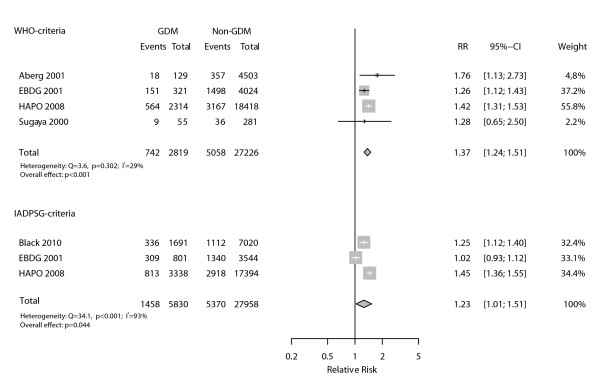
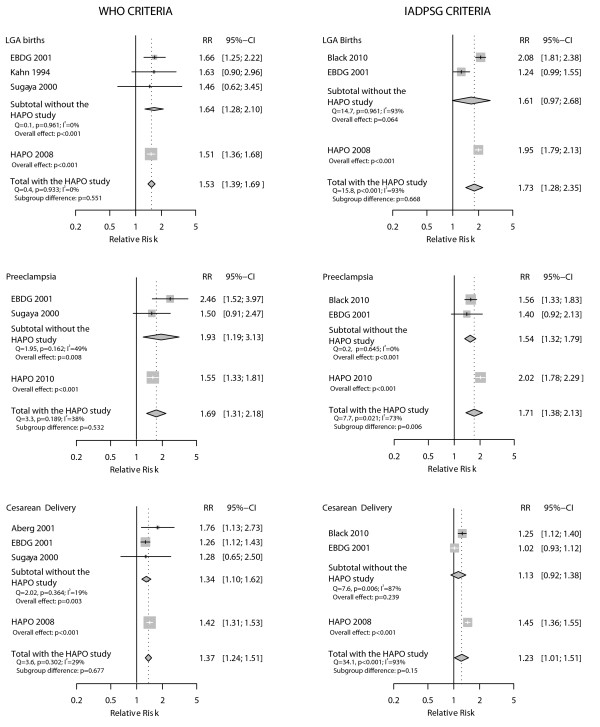
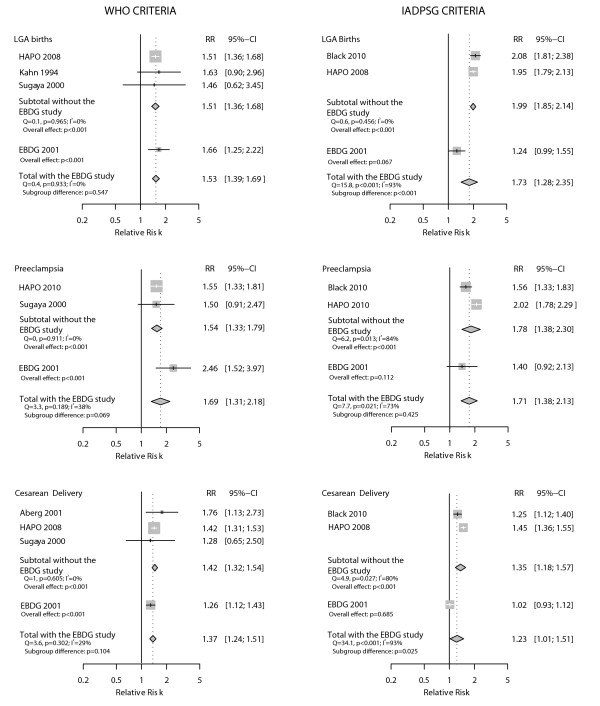
BACKGROUND: Two criteria based on a 2 h 75 g OGTT are being used for the diagnosis of gestational diabetes (GDM), those recommended over the years by the World Health Organization (WHO), and those recently recommended by the International Association for Diabetes in Pregnancy Study Group (IADPSG), the latter generated in the HAPO study and based on pregnancy outcomes. Our aim is to systematically review the evidence for the associations between GDM (according to these criteria) and adverse outcomes. METHODS: We searched relevant studies in MEDLINE, EMBASE, LILACS, the Cochrane Library, CINHAL, WHO-Afro library, IMSEAR, EMCAT, IMEMR and WPRIM. We included cohort studies permitting the evaluation of GDM diagnosed by WHO and or IADPSG criteria against adverse maternal and perinatal outcomes in untreated women. Only studies with universal application of a 75 g OGTT were included. Relative risks (RRs) and their 95% confidence intervals (CI) were obtained for each study. We combined study results using a random-effects model. Inconsistency across studies was defined by an inconsistency index (I2) > 50%. RESULTS: Data were extracted from eight studies, totaling 44,829 women. Greater risk of adverse outcomes was observed for both diagnostic criteria. When using the WHO criteria, consistent associations were seen for macrosomia (RR = 1.81; 95%CI 1.47-2.22; p < 0.001); large for gestational age (RR = 1.53; 95%CI 1.39-1.69; p < 0.001); perinatal mortality (RR = 1.55; 95% CI 0.88-2.73; p = 0.13); preeclampsia (RR = 1.69; 95%CI 1.31-2.18; p < 0.001); and cesarean delivery (RR = 1.37;95%CI 1.24-1.51; p < 0.001). Less data were available for the IADPSG criteria, and associations were inconsistent across studies (I2 ≥ 73%). Magnitudes of RRs and their 95%CIs were 1.73 (1.28-2.35; p = 0.001) for large for gestational age; 1.71 (1.38-2.13; p < 0.001) for preeclampsia; and 1.23 (1.01-1.51; p = 0.04) for cesarean delivery. Excluding either the HAPO or the EBDG studies minimally altered these associations, but the RRs seen for the IADPSG criteria were reduced after excluding HAPO. CONCLUSIONS: The WHO and the IADPSG criteria for GDM identified women at a small increased risk for adverse pregnancy outcomes. Associations were of similar magnitude for both criteria. However, high inconsistency was seen for those with the IADPSG criteria. Full evaluation of the latter in settings other than HAPO requires additional studies.
Overview
The claims and statistics of this paper haven’t been checked yet.
Free: it reads the open-access text and checks the first 5 claims that cite a source we can check. Create a free account to check every claim.
Integrity signals
Registry
Cites
Statistics
Figures
Verification
Claims the paper makes
The claims and statistics of this paper haven’t been checked yet.
Free: it reads the open-access text and checks the first 5 claims that cite a source we can check. Create a free account to check every claim.
Claims other papers make about this one
Each is checked against this paper’s own text: does it say what the citing paper says it does?
In the citing paper
“Potential adverse offspring outcomes vary by age group (Table 4) and avoidance of one outcome does not indicate reduction in risk of other adverse outcomes.21,24,25”
From Gestational Diabetes Mellitus (2019) · cites this paper as [25]
Self-check
Percentages, sums and reported differences re-computed from the paper’s own numbers.
The self-check needs the paper’s full text.
Citations
Cites
Bias in meta-analysis detected by a simple, graphical test
Egger, M., Smith, G. D., Schneider, M., & Minder, C. (1997) · BMJ · doi:10.1136/bmj.315.7109.629 · Cited by 56,722 · cited 1×
“Publication bias was tested using a funnel plot and Egger’s test based on weighted regression [11].”
Quantifying heterogeneity in a meta‐analysis
Higgins, J. P. T., & Thompson, S. G. (2002) · Statistics in Medicine · doi:10.1002/sim.1186 · Cited by 36,763 · cited 1×
“Inconsistency indexes (I) were also calculated, and a value greater than 50% was considered an indicator of high inconsistency between studies [10].”
Conducting Meta-Analyses in R with the metafor Package
Viechtbauer, W. (2010) · Journal of Statistical Software · doi:10.18637/jss.v036.i03 · Cited by 20,464 · cited 1×
“6-0 [9].”
Hyperglycemia and adverse pregnancy outcomes
(2008) · New England Journal of Medicine · doi:10.1056/nejmoa0707943 · Cited by 5,563 · cited 6×
“HAPO, 2008, 2010 [7,19] Yes Yes Yes Yes”
InfluentialInternational Association of Diabetes and Pregnancy Study Groups Consensus Panel (2010) · Diabetes Care · doi:10.2337/dc09-1848 · Cited by 5,390 · cited 1×
“More recently, the International Association of the Diabetes in Pregnancy Study Group (IADPSG), after extensive analyses of the Hyperglycemia and Adverse Pregnancy Outcomes (HAPO) study [7], recommended new diagnostic criteria for GDM [8] based on the 2 h 75 g OGTT: a fasting glucose ≥ 5.”
Classification and diagnosis of diabetes mellitus and other categories of glucose intolerance.
National Diabetes Data Group (1979) · Diabetes · doi:10.2337/diab.28.12.1039 · Cited by 4,909
Standards of Medical Care in Diabetes—2009
American Diabetes Association (2009) · Diabetes Care · doi:10.2337/dc09-s013 · Cited by 2,167
Metzger, B. E., Gabbe, S. G., Persson, B., Lowe, L. P., Dyer, A. R., Oats, J. J. N., & Buchanan, T. A. (2010) · Diabetes Care · doi:10.2337/dc10-0719 · Cited by 1,888
Pepe, M. S. (2004) · American Journal of Epidemiology · doi:10.1093/aje/kwh101 · Cited by 1,276 · cited 1×
“Nevertheless, even if GDM diagnostic criteria were to reach relative risks close to 3 for these adverse outcomes in such settings, the relative risks would still be unlikely to reflect major diagnostic discrimination in terms of post test probabilities [21].”
(1964) · PubMed · Cited by 1,230
Sacks, D. A., Hadden, D. R., Maresh, M., Deerochanawong, C., Dyer, A. R., Metzger, B. E., Lowe, L. P., Coustan, D. R., Hod, M., Oats, J. J. N., et al. (2012) · Diabetes Care · doi:10.2337/dc11-1641 · Cited by 687 · cited 1×
“However, as this rate in HAPO varied from 24% (Thailand) to 74% (Barbados)[23], whether these differences resulted from incomplete fasting or from other specific study or population particularity cannot be concluded from current information.”
Hyperglycemia and Adverse Pregnancy Outcomes
Metzger, B. E., Lowe, L. P., Dyer, A. R., Trimble, E. R., Chaovarindr, U., Coustan, D. R., Hadden, D. R., McCance, D. R., Hod, M., McIntyre, H. D., et al. (2009) · Obstetric Anesthesia Digest · doi:10.1097/01.aoa.0000344706.95925.dc · Cited by 479
Schmidt, M. I., Duncan, B. B., Reichelt, A. J., Branchtein, L., Matos, M. C., Costa e Forti, A., Spichler, E. R., Pousada, J. M. D. C., Teixeira, M. M., Yamashita, T., et al. (2001) · Diabetes Care · doi:10.2337/diacare.24.7.1151 · Cited by 390 · cited 6×
“Included studies Data on the adverse outcomes associated with diagnostic criteria were extracted from 8 studies (9 publications) [7,12-19], all of which were published in full in peer reviewed journals (Table 1).”
InfluentialSelf-citationGestational diabetes and perinatal mortality rate
O'Sullivan, J. B., Charles, D., Mahan, C. M., & Dandrow, R. V. (1973) · American Journal of Obstetrics and Gynecology · doi:10.1016/s0002-9378(16)33834-0 · Cited by 297
Screening for gestational diabetes: a systematic review and economic evaluation
Scott, D. A., Loveman, E., McIntyre, L., & Waugh, N. (2002) · Health Technology Assessment · doi:10.3310/hta6110 · Cited by 203 · cited 1×
“Second, as we excluded studies conducted with selective screening and studies not allowing analysis of untreated women, we eliminated several otherwise good studies which were included in other reviews on GDM screening [24].”
Agarwal, M. M., Dhatt, G. S., & Shah, S. M. (2010) · Diabetes Care · doi:10.2337/dc10-0572 · Cited by 181
The Potential Diabetic and Her Treatment in Pregnancy
(2003) · Obstetrics & Gynecology · doi:10.1097/00006250-200307000-00004 · Cited by 175
Åberg, A., Rydhstroem, H., & Frid, A. H. (2001) · American Journal of Obstetrics and Gynecology · doi:10.1067/mob.2001.108085 · Cited by 161 · cited 5×
“Included studies Data on the adverse outcomes associated with diagnostic criteria were extracted from 8 studies (9 publications) [7,12-19], all of which were published in full in peer reviewed journals (Table 1).”
InfluentialBlack, M. H., Sacks, D. A., Xiang, A. H., & Lawrence, J. M. (2010) · Diabetes Care · doi:10.2337/dc10-1445 · Cited by 160
Hyperglycemia and Adverse Pregnancy Outcome (HAPO) study: preeclampsia
(2010) · American Journal of Obstetrics and Gynecology · doi:10.1016/j.ajog.2010.01.024 · Cited by 155
Sugaya, A., Sugiyama, T., Nagata, M., & Toyoda, N. (2000) · Diabetes Research and Clinical Practice · doi:10.1016/s0168-8227(00)00135-2 · Cited by 34 · cited 6×
“Included studies Data on the adverse outcomes associated with diagnostic criteria were extracted from 8 studies (9 publications) [7,12-19], all of which were published in full in peer reviewed journals (Table 1).”
InfluentialPitkin, R. (2003) · Obstetrics & Gynecology · doi:10.1016/s0029-7844(02)03064-8 · Cited by 25
INCIDENCIA DE DIABETES GESTACIONAL SEGÚN DISTINTOS MéTODOS DIAGNóSTICOS Y SUS IMPLICANCIAS CLíNICAS
Belmar, C., Pablo Salinas, C., Becker, J., V, Fernando Abarzúa, C., Pablo Olmos, C., Pedro González, B., & Enrique Oyarzún, E. (2004) · Revista chilena de obstetricia y ginecología · doi:10.4067/s0717-75262004000100002 · Cited by 24
Shirazian, N., Mahboubi, M., Emdadi, R., Nooraie, R. Y., Fazel-Sarjuei, Z., Sedighpour, N., Fadaki, S.-F., Emami, P., Hematyar, M., Rahimi, N., et al. (2008) · Endocrine Practice · doi:10.4158/ep.14.3.312 · Cited by 22 · cited 5×
“Shirazian 2008 [17] Iran 670 12.”
InfluentialRelationship of Fetal Macrosomia to a 75g Glucose Challenge Test in Nondiabetic Pregnant Women
Khan, K. S., Syed, A. H., Hashmi, F. A., & Rizvi, J. H. (1994) · Australian and New Zealand Journal of Obstetrics and Gynaecology · doi:10.1111/j.1479-828x.1994.tb01033.x · Cited by 18
Gestational diabetes mellitus and glucose intolerance in a Mexican population
Forsbach, G., Cantú‐Diaz, C., Vázquez‐Lara, J., Villanueva‐Cuellar, M. A., Alvarez y Garcı́a, C., & Rodrı́guez‐Ramı́rez, E. (1997) · International Journal of Gynecology & Obstetrics · doi:10.1016/s0020-7292(97)00221-x · Cited by 16 · cited 4×
“One study was performed in the United States [13], one in Asia [18], two in the Middle East [17], one in Europe [12], two in Latin America [14,16] and one was a multi country study [7,19].”
InfluentialHyperglycemia and Pregnancy Outcome (HAPO) Study:preeclampsia
Metzger, B. (2010) · American Journal of Obstetrics and Gynecology · Cited by 12
Corcoy, R., Lumbreras, B., Bartha, J. L., & Ricart, W. (2010) · Endocrinología y Nutrición · doi:10.1016/j.endonu.2010.03.020 · Cited by 11
Alberti (1998) · doi:10.1002/(sici)1096-9136(199807)15:7<539::aid-dia668>3.0.co;2-s · cited 1×
“8 mmol/l or 140 mg/dl) [6] and, over the years has maintained their recommendations.”
(1980) · PubMed
Cited by
Gestational diabetes mellitus: mechanisms, treatment, and complications
Johns, E. C., Denison, F. C., Norman, J. E., & Reynolds, R. M. (2018) · Trends in Endocrinology & Metabolism · doi:10.1016/j.tem.2018.09.004 · Cited by 828
Hod, M., Kapur, A., Sacks, D. A., Hadar, E., Agarwal, M., Di Renzo, G. C., Roura, L. C., McIntyre, H. D., Morris, J. L., & Divakar, H. (2015) · International Journal of Gynecology & Obstetrics · doi:10.1016/s0020-7292(15)30033-3 · Cited by 767
DeSisto, C. L., Kim, S. Y., & Sharma, A. J. (2014) · Preventing Chronic Disease · doi:10.5888/pcd11.130415 · Cited by 577
Lee, K. W., Ching, S. M., Ramachandran, V., Yee, A., Hoo, F. K., Chia, Y. C., Wan Sulaiman, W. A., Suppiah, S., Mohamed, M. H., & Veettil, S. K. (2018) · BMC Pregnancy and Childbirth · doi:10.1186/s12884-018-2131-4 · Cited by 546
Diagnostic Criteria and Classification of Hyperglycaemia First Detected in Pregnancy
Agarwal, M., Boulvain, M., Coetzee, E. J., Colagiuri, S., Falavigna, M., Hod, M., Meltzer, S. J., Metzger, B. E., Omori, Y., Rasa, I., et al. (2013) · Cited by 759
Self-citation
Metadata
- Authors
- Wendland, E. M., Torloni, M. R., Falavigna, M., Trujillo, J., Dode, M. A., Campos, M. A., Duncan, B. B., & Schmidt, M. I.
- Affiliations
- Universidade Federal de Ciências da Saúde de Porto Alegre (BR)
- Universidade Federal de São Paulo (BR)
- Universidade Federal do Rio Grande do Sul (BR)
- Universidade Federal de Pelotas (BR)
- Grupo Hospitalar Conceição (BR)
- Corresponding author
- Wendland, Eliana M
- ORCID
- Venue
- BMC Pregnancy and Childbirth
- Published
- 2012-03-31
- Volume
- 12
- Issue
- 1
- Pages
- 23-23
- ISSN
- 1471-2393 (ISSN-L)
- PMC
- PMC3352245
- OpenAlex
- W2072554726
- Semantic Scholar
- 4f4bdfa6654e25b19f29307a37b32e0a2a5e0be3
- Cited by
- 626
- References
- 30
- Citations by year
- 2026: 29 · 2025: 32 · 2024: 48 · 2023: 54 · 2022: 60 · 2021: 59 · 2020: 47 · 2019: 48 · 2018: 52 · 2017: 34 · 2016: 40 · 2015: 46 · 2014: 38 · 2013: 36 · 2012: 3
- FWCI
- 6.42
- Type
- journal article
- Language
- en
- Open access
- gold
- doi.org
- Licence
- cc-by
- creativecommons.org/licenses/by/2.0 (tdm)
- Locations
- BMC Pregnancy and Childbirth (publishedVersion, cc-by)
- PubMed Central (publishedVersion, cc-by)
- PubMed (publishedVersion)
- LA Referencia (Red Federada de Repositorios Institucionales de Publicaciones Científicas) (publishedVersion, other-oa)
- Americanae (AECID Library) (submittedVersion, cc-by-nc-sa)
- Americanae (AECID Library) (submittedVersion, other-oa)
- DOAJ (DOAJ: Directory of Open Access Journals) (submittedVersion, cc-by-sa)
- LA Referencia (Red Federada de Repositorios Institucionales de Publicaciones Científicas) (submittedVersion, other-oa)
- Funders
- World Health Organization
- Topics
- Health Sciences › Medicine › Obstetrics and Gynecology › Gestational Diabetes Research and Management
- Health Sciences › Medicine › Public Health, Environmental and Occupational Health › Pregnancy and Medication Impact
- Health Sciences › Medicine › Obstetrics and Gynecology › Pregnancy and preeclampsia studies
- Keywords
- gestational diabetes mellitus, diagnostic criteria, WHO criteria, IADPSG criteria, 75 g oral glucose tolerance test, adverse pregnancy outcomes, macrosomia, large for gestational age, perinatal mortality, preeclampsia, cesarean section, maternal outcomes, HAPO study, inconsistency index, risk of bias, quality of evidence
- MeSH terms
- Adolescent, Analysis of Variance, Female, Glucose Tolerance Test, Humans, Pregnancy, Pregnancy Outcome, Sensitivity and Specificity, World Health Organization, Cohort Studies, Diabetes, Gestational
About these checks
Registry, retraction, Cites and statistics results are computed, not judged, with one exception: a printed reference that no index lists is read once by a model before it counts as a citation error. Claims are extracted by a model and kept only when their quote appears verbatim in the text; each cited source is then checked, with a model’s help, for whether it says what the claim relies on. Those verdicts can be wrong — read the claim’s quote and the cited source before relying on one.
Statistics and arithmetic are recomputed, not judged.
Confidence bands are shown only for fields calibrated on our annotated test set. None is calibrated yet, so no band is shown.
What counts as a claim ›How we measure confidence ›How we check this ›
Are you an author, or do you see a problem with this page? Request a review
Data sources
Bibliographic data: Semantic Scholar, OpenAlex, Crossref.
Contains information from the Semantic Scholar Academic Graph Datasets, made available under the ODC Attribution License (ODC-BY 1.0).
Semantic Scholar’s data is described in: Kinney, R., et al. (2023). The Semantic Scholar Open Data Platform. arXiv:2301.10140.
