

Chloroquine potentiates the anti-cancer effect of 5-fluorouracil on colon cancer cells
Open accessThe DOI matches its Crossref record; 34 of the 34 references it cites were found in a registry or an index.
Abstract
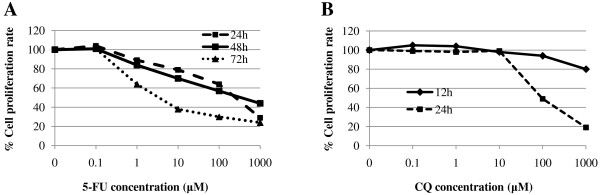
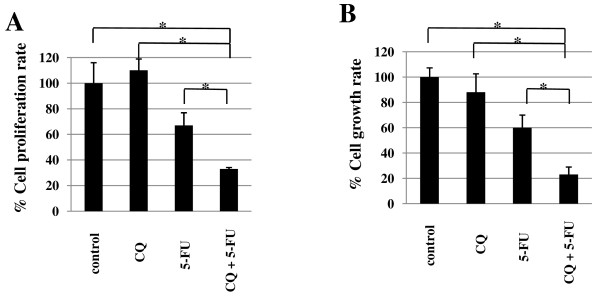
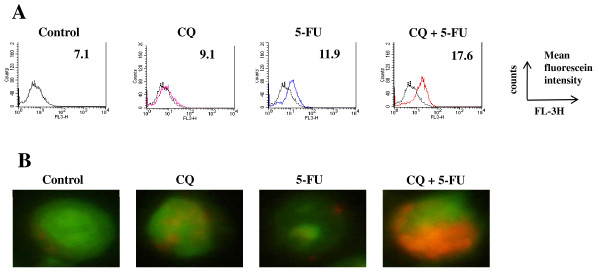
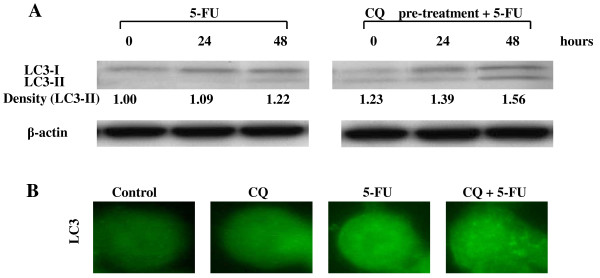
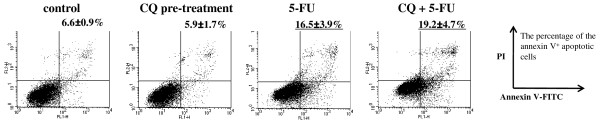
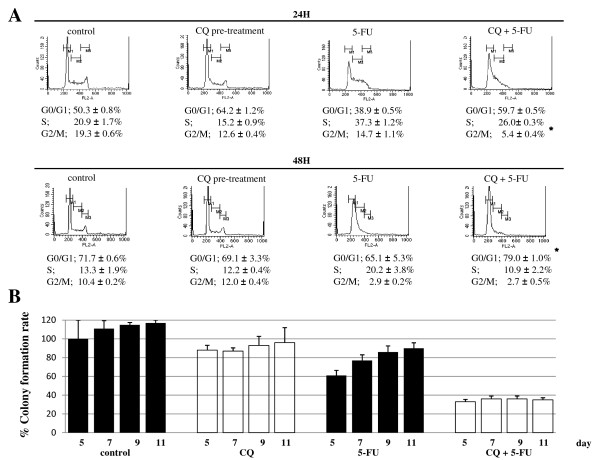
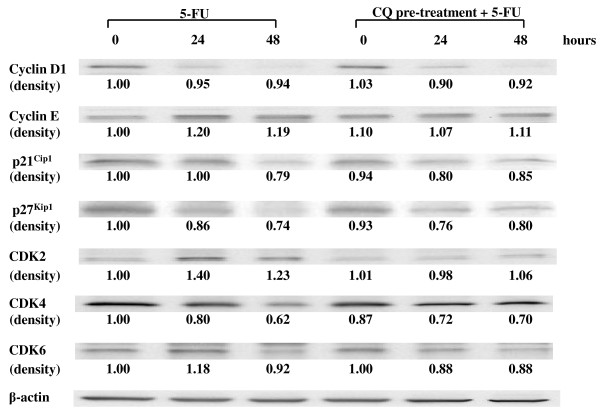
BACKGROUND: Chloroquine (CQ), the worldwide used anti-malarial drug, has recently being focused as a potential anti-cancer agent as well as a chemosensitizer when used in combination with anti-cancer drugs. It has been shown to inhibit cell growth and/or to induce cell death in various types of cancer. 5-Fluorouracil (5-FU) is the chemotherapeutic agent of first choice in colorectal cancer, but in most cases, resistance to 5-FU develops through various mechanisms. Here, we focused on the combination of CQ as a mechanism to potentiate the inhibitory effect of 5-FU on human colon cancer cells. METHODS: HT-29 cells were treated with CQ and/or 5-FU, and their proliferative ability, apoptosis and autophagy induction effects, and the affection of the cell cycle were evaluated. The proliferative ability of HT-29 was analyzed by the MTS assay. Apoptosis was quantified by flow-cytometry after double-staining of the cells with AnnexinV/PI. The cell cycle was evaluated by flow-cytometry after staining of cells with PI. Autophagy was quantified by flow-cytometry and Western blot analysis. Finally, to evaluate the fate of the cells treated with CQ and/or 5-FU, the colony formation assay was performed. RESULTS: 5-FU inhibited the proliferative activity of HT-29 cells, which was mostly dependent on the arrest of the cells to the G0/G1-phase but also partially on apoptosis induction, and the effect was potentiated by CQ pre-treatment. The potentiation of the inhibitory effect of 5-FU by CQ was dependent on the increase of p21Cip1 and p27Kip1 and the decrease of CDK2. Since CQ is reported to inhibit autophagy, the catabolic process necessary for cell survival under conditions of cell starvation or stress, which is induced by cancer cells as a protective mechanism against chemotherapeutic agents, we also analyzed the induction of autophagy in HT-29. HT-29 induced autophagy in response to 5-FU, and CQ inhibited this induction, a possible mechanism of the potentiation of the anti-cancer effect of 5-FU. CONCLUSION: Our findings suggest that the combination therapy with CQ should be a novel therapeutic modality to improve efficacy of 5-FU-based chemotherapy, possibly by inhibiting autophagy-dependent resistance to chemotherapy.
Overview
The claims and statistics of this paper haven’t been checked yet.
Free: it reads the open-access text and checks the first 5 claims that cite a source we can check. Create a free account to check every claim.
Integrity signals
Registry
Cites
Statistics
Figures
Verification
Claims the paper makes
The claims and statistics of this paper haven’t been checked yet.
Free: it reads the open-access text and checks the first 5 claims that cite a source we can check. Create a free account to check every claim.
Claims other papers make about this one
Each is checked against this paper’s own text: does it say what the citing paper says it does?
In the citing paper
“A series of preclinical studies have demonstrated that autophagy inhibitors, such as chloroquine/3-methyladenine, can reverse CRC resistance by inhibiting 5-FU-induced activation of autophagy [43,44].”
From Drug Resistance in Colorectal Cancer: From Mechanism to Clinic (2022) · cites this paper as [43]
Self-check
Percentages, sums and reported differences re-computed from the paper’s own numbers.
The self-check needs the paper’s full text.
Citations
Cites
5-Fluorouracil: mechanisms of action and clinical strategies
Longley, D. B., Harkin, D. P., & Johnston, P. G. (2003) · Nature Reviews Cancer · doi:10.1038/nrc1074 · Cited by 5,332 · cited 1×
“Intracellular metabolites of 5-FU can exert cytotoxic effects via inhibition of thymidylate synthetase, or through incorporation into RNA and DNA, events that ultimately activate apoptosis [2].”
Backgroundp21 is a universal inhibitor of cyclin kinases
Xiong, Y., Hannon, G. J., Zhang, H., Casso, D., Kobayashi, R., & Beach, D. (1993) · Nature · doi:10.1038/366701a0 · Cited by 3,368
Polyak, K., Lee, M.-H., Erdjument-Bromage, H., Koff, A., Roberts, J. M., Tempst, P., & Massagué, J. (1994) · Cell · doi:10.1016/0092-8674(94)90572-x · Cited by 2,118
Autophagy inhibition enhances therapy-induced apoptosis in a Myc-induced model of lymphoma
Amaravadi, R. K., Yu, D., Lum, J. J., Bui, T., Christophorou, M. A., Evan, G. I., Thomas-Tikhonenko, A., & Thompson, C. B. (2007) · Journal of Clinical Investigation · doi:10.1172/jci28833 · Cited by 1,137
Chloroquine and its analogs: A new promise of an old drug for effective and safe cancer therapies
Solomon, V. R., & Lee, H. (2009) · European Journal of Pharmacology · doi:10.1016/j.ejphar.2009.06.063 · Cited by 516
The Roles of Therapy-Induced Autophagy and Necrosis in Cancer Treatment
Amaravadi, R. K., & Thompson, C. B. (2007) · Clinical Cancer Research · doi:10.1158/1078-0432.ccr-07-1595 · Cited by 465
Li, J., Hou, N., Faried, A., Tsutsumi, S., & Kuwano, H. (2010) · European Journal of Cancer · doi:10.1016/j.ejca.2010.02.021 · Cited by 318
Inhibition of Autophagy by 3-MA Enhances the Effect of 5-FU-Induced Apoptosis in Colon Cancer Cells
Li, J., Hou, N., Faried, A., Tsutsumi, S., Takeuchi, T., & Kuwano, H. (2009) · Annals of Surgical Oncology · doi:10.1245/s10434-008-0260-0 · Cited by 291 · cited 3×
“Other combination therapies for 5-FU, such as Irinotecan, aspirin, proteasome inhibitor, 3-MA are being attempted [15,32-34], and CQ is a new candidate.”
BackgroundDissection of Autophagosome Biogenesis into Distinct Nucleation and Expansion Steps
Abeliovich, H., Dunn, W. A., Kim, J., & Klionsky, D. J. (2000) · The Journal of Cell Biology · doi:10.1083/jcb.151.5.1025 · Cited by 279
Maclean, K. H., Dorsey, F. C., Cleveland, J. L., & Kastan, M. B. (2008) · Journal of Clinical Investigation · doi:10.1172/jci33700 · Cited by 272
Cited by
Items 301–352 of 352
Targeted Mevalonate Pathway and Autophagy in Antitumor Immunotherapy
Xing, Z., Jiang, X., Wu, Y., & Yu, Z. (2024) · Current Cancer Drug Targets · doi:10.2174/0115680096273730231206054104 · Cited by 1
Evaluation of the Selective Anti-Cancer Activity of Natural and Synthetic Alkaloids
Griffin, C. (2011) · Scholarship at UWindsor (University of Windsor) · Cited by 1
Evaluation of the interaction between melatonin and rapamycin for head and neck cancer therapy
Shen, Y. (2018) · Institutional Repository of the University of Granada (University of Granada) · Cited by 1
Multi‐Drug Resistance in Cancer
Malviya, R., Singh, A. K., & Yadav, D. (2023) · Wiley eBooks · doi:10.1002/9781394209866.ch1 · Cited by 1
Optimization of Autophagic Controls in Human Embryonic Kidney Cells
Foley, I., & NC DOCKS at Western Carolina University (2023) · NC Digital Online Collection of Knowledge and Scholarship (The University of North Carolina at Greensboro) · Cited by 1
Influence of hypoxia on tumour cell susceptibility to cytotoxic T lymphocyte mediated lysis
Noman, M. Z. (2012) · theses.fr (ABES) · doi:10.70675/306da2eez5bc3z478ez83c5zdc39407a896e · Cited by 1
Aimé, A. (2013) · theses.fr (ABES) · doi:10.70675/cda6758cz0ee5z4b6az9f72z2e822ca5d5cd · Cited by 1
Airiau, K. (2012) · theses.fr (ABES) · doi:10.70675/bf87e163z09f5z4e4bzb5b2z45c3aa05c104 · Cited by 1
Cambios en la expresión génica inducidos por las mitramicinas
Pérez, C. V. S. (2014) · Dipòsit Digital de la Universitat de Barcelona (Universitat de Barcelona)
6-phosphofructo-2-kinase inhibition induces autophagy as a survival mechanism.
Klarer, A. C. (2013) · ThinkIR: The University of Louisville's Institutional Repository (University of Louisville) · doi:10.18297/etd/760
Autophagy in Cancer Therapy: Progress and Issues
Shi, J.-J., & Meng, L. (2015) · Journal of cancer research updates · doi:10.6000/1929-2279.2015.04.01.1
The Characterization of the Novel Chloroquine Derivative VR23 for its Anticancer Properties
Pundir, S. (2015) · uO Research (University of Ottawa) · doi:10.20381/ruor-4368
Regulation of IGF-1 receptor signaling by autophagy in human neuroblastoma cell lines
Soori, M. M. (2014) · Library, Museums and Press - UDSpace (University of Delaware) · doi:10.58088/f1dv-p109
Targeting SRC family kinases in lung cancer
Rupniewska, E. (2012) · doi:10.25560/9234
Kim, S. O., & Choi, Y. H. (2016) · Journal of Life Science · doi:10.5352/jls.2016.26.9.1015
Aptamer-mediated siRNA delivery to target colon cancer stem cells
Shamaileh, H. A. (2016) · Deakin Research Online (Deakin University)
Porter, V. (2018) · cIRcle (University of British Columbia) · doi:10.14288/1.0363913
Kobia, F. (2016) · Archivio Istituzionale della Ricerca (Universita Degli Studi Di Milano) · doi:10.13130/kobia-francis-mungathia_phd2016-03-18
Chimiorésistance et nouvelles cibles thérapeutiques au niveau des cancers gynécologiques
Brasseur, K. (2017) · e-Theses (Université du Québec à Trois-Rivières)
Prenamjena lijekova kao strategija u razvoju novih lijekova
Kozlina, F., Mlinarić, Z., & Džolić, Z. R. (2018) · Farmaceutski glasnik : glasilo Hrvatskog farmaceutskog društva
Autophagy in Head and Neck Cancer Associated Fibroblasts
New, J. (2018) · KU ScholarWorks (The University of Kansas)
de Sá, M. S. (2011) · Americanae (AECID Library)
Moving miRNAs to therapeutic targets in colorectal cancer
McGregor, M., & Price, T. J. (2019) · EBioMedicine · doi:10.1016/j.ebiom.2019.04.051
Agustí, M. Q. (2019) · Dipòsit Digital de la Universitat de Barcelona (Universitat de Barcelona)
Low, F. (2019) · Aston Publications Explorer (Aston University) · doi:10.48780/publications.aston.ac.uk.00041153
Molecular insights into mechanisms of hepatoblastoma pathogenesis
Eloranta, K. (2021) · Helda - University of Helsinki Institutional Repository
Özerkan, D., Kalındemirtaş, F. D., & Tüzemen, N. (2023) · Düzce Üniversitesi Bilim ve Teknoloji Dergisi · doi:10.29130/dubited.993669
Çal, T., DİLSİZ, S. A., Canpınar, H., & Bucurgat, Ü. Ü. (2023) · Turkish Journal of Pharmaceutical Sciences · doi:10.4274/tjps.galenos.2023.69649
Charris, J., Gutiérrez, J. E., Fernández-Moreira, E., Sanctis, J. B. D., Gurská, S., Džubák, P., Hajdúch, M., & Ramírez, H. (2024) · Revista Colombiana de Química · doi:10.15446/rev.colomb.quim.v52n1.110787
In vitro investigation of the toxicological mechanisms of gemcitabine in colorectal cancer cells
Tatlıpınar, E., Boran, T., Zengin, Ö. S., & Özhan, G. (2024) · ACTA Pharmaceutica Sciencia · doi:10.23893/1307-2080.aps6256
Abdel-Mohsen, M. A., Badawy, A. M., Abu-Youssef, M. A. M., Yehia, M. A., Shamaa, L. D. A., & Mohamed, S. A. (2024) · Research Square · doi:10.21203/rs.3.rs-5263120/v1
Innovative horizons: harnessing drug repositioning for targeted therapeutics in colorectal cancer
Tarin, M., Oryani, M. A., Attarian, F., Sajjadi, S. S., Mehri, A., & Karimi‐Shahri, M. (2025) · Naunyn-Schmiedeberg s Archives of Pharmacology · doi:10.1007/s00210-025-04289-3
Cancer Markers Induction Potential and Adverse Effects of Anti-COVID- 19 Drugs in Rattus norvegicus
Aghahowa, S., Aghahowa, M. E., Amegor, F. O., Osadolor, H. B., Ebosele, A., Asogun, M., Ehikhuemen, P., Uwadione, J., Ikhimioya, J., Ogabo, M., et al. (2025) · Drug Discovery · doi:10.54905/disssi.v19i44.e24dd3017
Synthesis and evaluation of hybrid compounds based on antimalarial and anticancer pharmacophores
Nair, S. (2012) · Open University of Cape Town (University of Cape Town)
Einfluss von Autophagie-modulierenden Wirkstoffen auf die Proliferation von oralen Tumorzelllinien
Sampers, R. (2023) · Online Publication Service of Würzburg University (Würzburg University) · doi:10.25972/opus-32066
Karlıtepe, A. (2023) · eArsiv - Adu (Adnan Menderes University)
Paillas, S. (2011) · theses.fr (ABES) · doi:10.70675/185485eez159ez4fcaza3fcz8da97d26c77f
Etude des réponses induites par l’erlotinib dans des cellules de lignées de glioblastome
Eimer, S. (2011) · theses.fr (ABES) · doi:10.70675/48cf26bbz6b1cz4672za2d5zc83a7ce5752a
Liposomes thermosensibles furtifs pour l'administration du 5-Fluorouracile déclenchée par ultrasons
Sabbagh, C. A. (2014) · theses.fr (ABES) · doi:10.70675/5a3c0e26z98e5z415cz9732z10991cf07842
Rôles du couple TrkB/BDNF et de l’autophagie dans la survie de cellules de cancer colorectal
Mazouffre, C. (2016) · theses.fr (ABES) · doi:10.70675/aedaaa00z4cf5z4fd9za423z8fc1e4e533a5
Rôles de l’autophagie dans l'homéostasie des cellules souches intestinales
Trentesaux, C. (2018) · theses.fr (ABES) · doi:10.70675/6bad110bz19b1z4cd6z81d0z74d0fb1e27f3
Patched as a new target for adrenocortical carcinoma treatment
Hasanovic, A. (2018) · theses.fr (ABES) · doi:10.70675/e4759414z32e1z4e77zbb6fz743df9c365d0
Calcium Channels in Prostate Cancer Drug Resistance
Puthooru, D. K. (2025) · theses.fr (ABES) · doi:10.70675/2f003df4z6fcfz4df2za864z573fbb8c502a
大腸癌放射線療法におけるmTOR経路とオートファジーの活性化
Shiratori, H. (2020) · Institutional Repositories DataBase (IRDB) · doi:10.15083/0002005120
Nishikawa, R., 4787, & 100001948 (2021) · Institutional Repositories DataBase (IRDB)
Cytoskeleton governs exosome-mediated drug resistance under mechanical stress
Guo, Q., Chen, Y., Ji, G., Shu, C., Qiu, Y., & Fang, L. (2026) · Extracellular Vesicles and Circulating Nucleic Acids · doi:10.20517/evcna.2026.08
Autophagy and Necroptosis in Cancer
Tan, M., Tan, H. K., Moad, A. I. H., & Muhammad, T. S. T. (2014) · Springer eBooks · doi:10.1007/978-3-662-44006-3_14
Metadata
- Authors
- Sasaki, K., Tsuno, N. H., Sunami, E., Tsurita, G., Kawai, K., Okaji, Y., Nishikawa, T., Shuno, Y., Hongo, K., Hiyoshi, M., Kaneko, M., Kitayama, J., Takahashi, K., & Nagawa, H.
- Affiliations
- The University of Tokyo (JP)
- Corresponding author
- Sasaki, Kazuhito
- ORCID
- Venue
- BMC Cancer
- Published
- 2010-07-15
- Volume
- 10
- Issue
- 1
- Pages
- 370-370
- ISSN
- 1471-2407 (ISSN-L)
- PMC
- PMC2914703
- OpenAlex
- W2048571348
- Cited by
- 322
- References
- 34
- Citations by year
- 2026: 5 · 2025: 11 · 2024: 18 · 2023: 13 · 2022: 15 · 2021: 26 · 2020: 22 · 2019: 28 · 2018: 20 · 2017: 19 · 2016: 21 · 2015: 23 · 2014: 27 · 2013: 23 · 2012: 27
- FWCI
- 11.84
- Type
- journal article
- Language
- en
- Open access
- gold
- doi.org
- Licence
- Locations
- BMC Cancer (publishedVersion, cc-by)
- PubMed Central (publishedVersion, cc-by)
- PubMed (publishedVersion)
- DOAJ (DOAJ: Directory of Open Access Journals) (submittedVersion, cc-by-sa)
- Funders
- University of Tokyo
- Topics
- Health Sciences › Medicine › Oncology › Colorectal Cancer Treatments and Studies
- Life Sciences › Biochemistry, Genetics and Molecular Biology › Cell Biology › Autophagy in Disease and Therapy
- Life Sciences › Biochemistry, Genetics and Molecular Biology › Molecular Biology › Cancer therapeutics and mechanisms
- Keywords
- chloroquine, 5-fluorouracil, colon cancer, chemosensitization, combination chemotherapy, autophagy, apoptosis, cell cycle arrest, G0/G1 arrest, p21, p27, CDK2, chemoresistance, HT-29 cells, colorectal cancer, colony formation, drug repurposing
- MeSH terms
- Antimalarials, Antimetabolites, Antineoplastic, Antineoplastic Combined Chemotherapy Protocols, Autophagy, Cell Cycle, Chloroquine, Colonic Neoplasms, Colony-Forming Units Assay, Drug Synergism, Flow Cytometry, Fluorouracil, Humans, Immunoenzyme Techniques, Blotting, Western, Apoptosis, Cell Line, Tumor, Cell Proliferation
About these checks
Registry, retraction, Cites and statistics results are computed, not judged, with one exception: a printed reference that no index lists is read once by a model before it counts as a citation error. Claims are extracted by a model and kept only when their quote appears verbatim in the text; each cited source is then checked, with a model’s help, for whether it says what the claim relies on. Those verdicts can be wrong — read the claim’s quote and the cited source before relying on one.
Statistics and arithmetic are recomputed, not judged.
Confidence bands are shown only for fields calibrated on our annotated test set. None is calibrated yet, so no band is shown.
What counts as a claim ›How we measure confidence ›How we check this ›
Are you an author, or do you see a problem with this page? Request a review
Data sources
Bibliographic data: Semantic Scholar, OpenAlex, Crossref.
Contains information from the Semantic Scholar Academic Graph Datasets, made available under the ODC Attribution License (ODC-BY 1.0).
Semantic Scholar’s data is described in: Kinney, R., et al. (2023). The Semantic Scholar Open Data Platform. arXiv:2301.10140.
