

Post traumatic stress symptoms and heart rate variability in Bihar flood survivors following yoga: a randomized controlled study
Open accessThe DOI matches its Crossref record; 48 of the 48 references it cites were found in a registry or an index.
Abstract
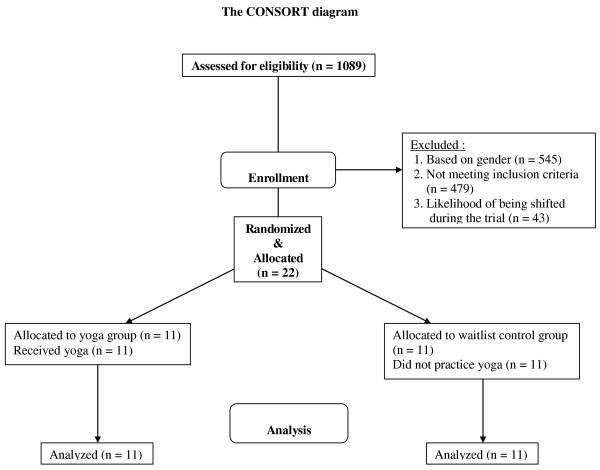
BACKGROUND: An earlier study showed that a week of yoga practice was useful in stress management after a natural calamity. Due to heavy rain and a rift on the banks of the Kosi river, in the state of Bihar in north India, there were floods with loss of life and property. A week of yoga practice was given to the survivors a month after the event and the effect was assessed. METHODS: Twenty-two volunteers (group average age +/- S.D, 31.5 +/- 7.5 years; all of them were males) were randomly assigned to two groups, yoga and a non-yoga wait-list control group. The yoga group practiced yoga for an hour daily while the control group continued with their routine activities. Both groups' heart rate variability, breath rate, and four symptoms of emotional distress using visual analog scales, were assessed on the first and eighth day of the program. RESULTS: There was a significant decrease in sadness in the yoga group (p < 0.05, paired t-test, post data compared to pre) and an increase in anxiety in the control group (p < 0.05, paired t-test, post data compared to pre). CONCLUSIONS: A week of yoga can reduce feelings of sadness and possibly prevent an increase in anxiety in flood survivors a month after the calamity. TRIAL REGISTRATION: Clinical Trials Registry of India: CTRI/2009/091/000285.
Overview
The claims and statistics of this paper haven’t been checked yet.
Free: it reads the open-access text and checks the first 5 claims that cite a source we can check. Create a free account to check every claim.
Integrity signals
Registry
Cites
Statistics
Figures
Verification
Claims the paper makes
The claims and statistics of this paper haven’t been checked yet.
Free: it reads the open-access text and checks the first 5 claims that cite a source we can check. Create a free account to check every claim.
Claims other papers make about this one
Each is checked against this paper’s own text: does it say what the citing paper says it does?
The source backs part of the claim, not all of it — or backs it for a different population, condition or comparison.
In the citing paper
“other yoga interventions for PTSD have employed rapid breathing and hyperventilation, but those interventions failed to elicit an increase in parasympathetic tone (Telles et al., 2010).”
From Maladaptive autonomic regulation in PTSD accelerates physiological aging (2015) · cites this paper as Telles et al., 2010
Experimental — accuracy not yet measuredIn the citing paper
“Yoga practices also decreased symptoms in PSTD after natural disasters (183, 184).”
From Vagus Nerve as Modulator of the Brain–Gut Axis in Psychiatric and Inflammatory Disorders (2018) · cites this paper as [184]
Self-check
Percentages, sums and reported differences re-computed from the paper’s own numbers.
The self-check needs the paper’s full text.
Citations
Cites
Baltosser, W. H., & Zar, J. H. (1996) · Ecology · doi:10.2307/2265725 · Cited by 35,166
Heart Rate Variability: Standards of Measurement, Physiological Interpretation, and Clinical Use
Electrophysiology, T. F. O. T. E. S. O. C. T. N. A. (1996) · Circulation · doi:10.1161/01.cir.93.5.1043 · Cited by 17,159
Heart rate variability: Standards of measurement, physiological interpretation, and clinical use
Malik, M., Bigger, J. T., Camm, A. J., Kleiger, R. E., Malliani, A., Moss, A. J., & Schwartz, P. J. (1996) · European Heart Journal · doi:10.1093/oxfordjournals.eurheartj.a014868 · Cited by 15,289
Mitchell, M. L., & Jolley, J. M. (1987) · Cited by 909
Software for advanced HRV analysis
Niskanen, J.-P., Tarvainen, M. P., Ranta-aho, P. O., & Karjalainen, P. A. (2004) · Computer Methods and Programs in Biomedicine · doi:10.1016/j.cmpb.2004.03.004 · Cited by 743 · cited 1×
“The data were analyzed using software developed by the Biomedical Signal Analysis Group, University of Kuopio, Finland [ 14 ].”
MethodLehrer, P. M., Vaschillo, E., & Vaschillo, B. (2000) · Applied Psychophysiology and Biofeedback · doi:10.1023/a:1009554825745 · Cited by 626 · cited 1×
“It was earlier shown that biofeedback training increased the amplitude of heart rate oscillations at approximately 0.1 Hz [ 40 ].”
BackgroundInfluentialHeart Rate Variability Biofeedback Increases Baroreflex Gain and Peak Expiratory Flow
Lehrer, P. M., Vaschillo, E., Vaschillo, B., Lu, S.-E., Eckberg, D. L., Edelberg, R., Shih, W. J., Lin, Y., Kuusela, T. A., Tahvanainen, K. U. O., et al. (2003) · Psychosomatic Medicine · doi:10.1097/01.psy.0000089200.81962.19 · Cited by 497 · cited 1×
“This is supported by acute increases in low frequency and total spectrum HRV and in vagal baroreflex gain, which is corrected by slow breathing periods with biofeedback [39].”
BackgroundMayou, R. A., Ehlers, A., & Hobbs, M. (2000) · British Journal of Psychiatry · doi:10.1192/bjp.176.6.589 · Cited by 475
Shalev, A. Y., Sahar, T., Freedman, S., Peri, T., Glick, N., Brandes, D., Orr, S. P., & Pitman, R. K. (1998) · Archives of General Psychiatry · doi:10.1001/archpsyc.55.6.553 · Cited by 429 · cited 1×
“This is particularly the case as previous studies have not demonstrated an increase in anxiety in untreated trauma survivors [25], or have shown an actual reduction in those treated with antianxiety medication [26] or group debriefing as an immediate effect of the session [27].”
ResultJanakiramaiah, N., Gangadhar, B. N., Naga Venkatesha Murthy, P. J., Harish, M. G., Subbakrishna, D. K., & Vedamurthachar, A. (2000) · Journal of Affective Disorders · doi:10.1016/s0165-0327(99)00079-8 · Cited by 384 · cited 1×
“Among yoga practices, Sudarshan Kriya yoga (SKY) is a technique which involves rhythmic hyperventilation at different rates of breathing [5].”
Method
Research works printed but not linked: 1
- Taimini IK The science of yoga 1986 Madras: The Theosophical Publishing House
Cited by
Items 101–138 of 138
Mind-Body Practices and the Neuro-psychology of Wellbeing
Gerbarg, P. L., Gootjes, L., & Brown, R. P. (2014) · Cross-cultural advancements in positive psychology · doi:10.1007/978-94-017-8950-9_12 · Cited by 5
Arya, J., Singh, D., Manav, H., Maity, K., Bhat, Y., Vinayak, R., Jyoti, S., Ahuja, S., Gautam, M., Kaur, N., et al. (2022) · Integrative Medicine Case Reports · doi:10.38205/imcr.030242 · Cited by 1
Systematic review and meta-analysis of interventions for mental health in extreme weather events
Das, J. K., Ali, A. A., Jangda, A. T., Riaz, N., & Bhutta, Z. A. (2026) · BMJ Global Health · doi:10.1136/bmjgh-2025-020407 · Cited by 2
Incorporating Complementary and Alternative Practices into Treatment of PTSD
Scarlet, J., & Lang, A. J. (2015) · Springer eBooks · doi:10.1007/978-3-319-08613-2_35-1 · Cited by 1
Havron, E., & Edan, Y. I. (2019) · Cogent Psychology · doi:10.1080/23311908.2019.1580917 · Cited by 1
Role of yoga in type 2 diabetes mellitus
Mahajan, M., & Mahajan, Y. (2023) · Indian Journal of Clinical Anatomy and Physiology · doi:10.18231/j.ijcap.2023.003 · Cited by 1
Roth, A. (2014) · University of Minnesota Digital Conservancy (University of Minnesota) · Cited by 2
The application of yoga as a biopsychosocial-spiritual approach to social work
Tsai, K. L. (2014) · Smith ScholarWorks (Smith College) · Cited by 1
Denman, L. (2015) · NC Digital Online Collection of Knowledge and Scholarship (The University of North Carolina at Greensboro) · doi:10.71889/5fylantbak.29861264
Is Yoga an Effective Treatment for Post-Traumatic Stress Disorder (PTSD)?
Ionna, M. (2016) · Digital Commons - PCOM (Philadelphia College of Osteopathic Medicine)
Vorkapic, C. F. (2017) · Advances in medical diagnosis, treatment, and care (AMDTC) book series · doi:10.4018/978-1-5225-2788-6.ch007
“…has demonstrated improvements in emotional self-regulation with consequent reductions in depression, stress, anxiety levels (Telles et al., 2009; Telles et al., 2010; Ferreira-Vorkapic & Rangé, 2010;Ferreira-Vorkapic et al., 2015; Chong, Tsunaka, Tsang, Chan, & Cheung, 2011), posttraumatic…”
Yoga in the Treatment of Trauma-Related Disorders: Connecting the Body and the Mind
Olsen, E.-K. H. (2017) · Advances in medical diagnosis, treatment, and care (AMDTC) book series · doi:10.4018/978-1-5225-2788-6.ch013 · Cited by 1
Complementary and Alternative Medicine for Trauma- and Stressor-Related Disorders
Wynn, G. H., & Benedek, D. M. (2018) · Oxford University Press eBooks · doi:10.1093/med/9780190457136.003.0024
Yogic Practices for High-Altitude Ailments
Majumdar, P., & Majumdar, D. (2018) · Elsevier eBooks · doi:10.1016/b978-0-12-813999-8.00015-x
Polignani, K. (2019) · Digital Commons at National Lewis University (National Lewis University)
Yoga as a Healing Modality of Trauma-Related Symptoms and Disorders: From Suffering to Thriving
Olsen, E.-K. H. (2020) · Advances in medical diagnosis, treatment, and care (AMDTC) book series · doi:10.4018/978-1-7998-3254-6.ch012 · Cited by 3
Gerbarg, P. L., Brown, R. P., Mansur, S., & Steidle, G. K. (2020) · Springer eBooks · doi:10.1007/978-3-319-70134-9_130-1
Managing Anxiety and Stress: Yoga, Mindfulness and ACT Strategies and Techniques
Gallo, S. (2021) · National University System Repository (National University System)
Russel, J., Manavalan, N., Alli, M. V., Subramanian, K., Gayathiri, N., & Nair, P. M. K. (2021) · AYUHOM · doi:10.4103/ayuhom.ayuhom_35_21
Mills, T. (2021) · MOspace Institutional Repository (University of Missouri) · doi:10.32469/10355/88134
Comparative Study of Effect of Specific Yogasanas and Exercise in Obesity
Chouragade, N. B. (2020) · Indian Journal of Forensic Medicine & Toxicology · doi:10.37506/ijfmt.v14i4.12613
Yoga in the Treatment of Trauma-Related Disorders: Connecting the Body and the Mind
Olsen, E.-K. H. (2018) · IGI Global eBooks · doi:10.4018/978-1-5225-7039-4.ch021
Clinical Roundup: Selected Treatment Options for Physical Trauma
(2019) · Alternative and Complementary Therapies · doi:10.1089/act.2019.29224.cru
Treatment Decisions for Psychological Trauma
Kiyimba, N., Buxton, C., Shuttleworth, J., & Pathe, E. (2022) · Springer eBooks · doi:10.1007/978-3-031-07711-1_4
ALTERNATIVE MEDICINE: THERAPIES AND TREAT THE DISEASES BY NEW WAYS
(2023) · International Research Journal of Modernization in Engineering Technology and Science · doi:10.56726/irjmets33003
The potential role of integrative medicine in disaster recovery needs more focus and attention
(2022) · Advances in Integrative Medicine · doi:10.1016/j.aimed.2023.02.007
A role of evidence-based resource and training in the indigenous practices of healthcare
Srivastava, D., Srivastava, S., Kukreti, A., & Sharma, S. (2025) · Elsevier eBooks · doi:10.1016/b978-0-443-29040-4.00008-6 · Cited by 1
Development, validation, and feasibility testing of Tele-Yoga Module for PTSD
Katla, N., Ilavarasu, J. V., Mavathur, R. N., Bhargav, H., Holla, B., Kumar, V., Ramsahaye, A., Thulasi, A., & Zaidi, S. Z. H. (2025) · Advances in Integrative Medicine · doi:10.1016/j.aimed.2025.100562
Conceptual Study of Nidra from Various Samhitas
Anukumar, S. (2025) · International journal of Indian medicine · doi:10.55552/ijim.2025.6913
Shankar, S., Ilyas, M. M., Shyamprakash, J., Narayanasamy, K., & Sargunam, M. (2025) · Industrial Psychiatry Journal · doi:10.4103/ipj.ipj_89_25
“[13] Yet, rigorous evaluations of such adapted programs remain sparse, leaving a critical gap in understanding their impact on Indian medical professionals.”
The Impact of Yoga Programs for People Who Have Experienced Trauma:A Systematic Review
Holt, M. B. (2018) · OhioLink ETD Center (Ohio Library and Information Network)
BODY PRACTICES FOR CORRECTION OF STRESS DISORDERS: A CURRENT STATE, WORLD PRACTICE AND KEY TRENDS
Smyrnov, V. V., & Ladyhina, О. V. (2025) · Ukrainian Psychological Journal · doi:10.17721/upj.2025.2(24).8
Contemplating Together: An Intersection of Community Healing and Contemplative Practices in India
Arya, O., & Grover, N. (2026) · IGI Global eBooks · doi:10.4018/979-8-2600-1202-4.ch001
Innovative Programs Support Recovery and Resiliency in Adult and Child Survivors of Mass Disasters
Gerbarg, P. L., Brown, R. P., Niyonzima, J. B. B., & Steidle, G. K. (2026) · Springer eBooks · doi:10.1007/978-3-319-70134-9_130-2
Incorporating Complementary and Alternative Practices into Treatment of PTSD
Scarlet, J., & Lang, A. J. (2016) · Springer eBooks · doi:10.1007/978-3-319-08359-9_35
Ayub, N., & Naqvi, I. (2026) · Pakistan Journal of Positive Psychology · doi:10.67785/pjpp.9.356
Metadata
- Authors
- Telles, S., Singh, N., Joshi, M., & Balkrishna, A.
- Corresponding author
- Telles, Shirley
- Venue
- BMC Psychiatry
- Published
- 2010-03-02
- Volume
- 10
- Issue
- 1
- Pages
- 18-18
- ISSN
- 1471-244X (ISSN-L)
- PMC
- PMC2836997
- OpenAlex
- W1981998085
- Cited by
- 131
- References
- 47
- Citations by year
- 2026: 5 · 2025: 5 · 2024: 8 · 2023: 8 · 2022: 5 · 2021: 14 · 2020: 6 · 2019: 8 · 2018: 6 · 2017: 7 · 2016: 7 · 2015: 13 · 2014: 14 · 2013: 9 · 2012: 10
- FWCI
- 8.76
- Type
- journal article
- Language
- en
- Open access
- gold
- doi.org
- Licence
- cc-by
- creativecommons.org/licenses/by/2.0 (tdm)
- Locations
- BMC Psychiatry (publishedVersion, cc-by)
- PubMed Central (publishedVersion, cc-by)
- PubMed (publishedVersion)
- DOAJ (DOAJ: Directory of Open Access Journals) (submittedVersion, cc-by-sa)
- Topics
- Social Sciences › Psychology › Clinical Psychology › Posttraumatic Stress Disorder Research
- Social Sciences › Psychology › Clinical Psychology › Mindfulness and Compassion Interventions
- Health Sciences › Medicine › Cardiology and Cardiovascular Medicine › Heart Rate Variability and Autonomic Control
- Keywords
- yoga, posttraumatic stress symptoms, heart rate variability, flood survivors, natural disasters, anxiety, sadness, emotional distress, Bihar
- MeSH terms
- Adult, Heart Rate, Humans, India, Male, Pain Measurement, Research Design, Stress Disorders, Post-Traumatic, Stress, Psychological, Waiting Lists, Yoga, Treatment Outcome, Survivors, Floods, Respiratory Rate
About these checks
Registry, retraction, Cites and statistics results are computed, not judged, with one exception: a printed reference that no index lists is read once by a model before it counts as a citation error. Claims are extracted by a model and kept only when their quote appears verbatim in the text; each cited source is then checked, with a model’s help, for whether it says what the claim relies on. Those verdicts can be wrong — read the claim’s quote and the cited source before relying on one.
Statistics and arithmetic are recomputed, not judged.
Confidence bands are shown only for fields calibrated on our annotated test set. None is calibrated yet, so no band is shown.
What counts as a claim ›How we measure confidence ›How we check this ›
Are you an author, or do you see a problem with this page? Request a review
Data sources
Bibliographic data: Semantic Scholar, OpenAlex, Crossref.
Contains information from the Semantic Scholar Academic Graph Datasets, made available under the ODC Attribution License (ODC-BY 1.0).
Semantic Scholar’s data is described in: Kinney, R., et al. (2023). The Semantic Scholar Open Data Platform. arXiv:2301.10140.
