

Post traumatic stress symptoms and heart rate variability in Bihar flood survivors following yoga: a randomized controlled study
Open accessThe DOI matches its Crossref record; 48 of the 48 references it cites were found in a registry or an index.
Abstract
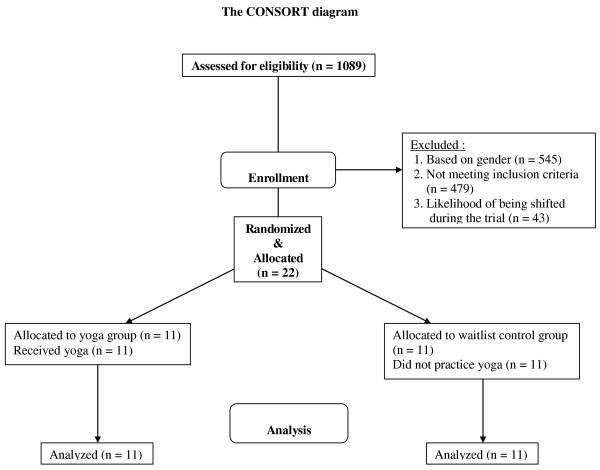
BACKGROUND: An earlier study showed that a week of yoga practice was useful in stress management after a natural calamity. Due to heavy rain and a rift on the banks of the Kosi river, in the state of Bihar in north India, there were floods with loss of life and property. A week of yoga practice was given to the survivors a month after the event and the effect was assessed. METHODS: Twenty-two volunteers (group average age +/- S.D, 31.5 +/- 7.5 years; all of them were males) were randomly assigned to two groups, yoga and a non-yoga wait-list control group. The yoga group practiced yoga for an hour daily while the control group continued with their routine activities. Both groups' heart rate variability, breath rate, and four symptoms of emotional distress using visual analog scales, were assessed on the first and eighth day of the program. RESULTS: There was a significant decrease in sadness in the yoga group (p < 0.05, paired t-test, post data compared to pre) and an increase in anxiety in the control group (p < 0.05, paired t-test, post data compared to pre). CONCLUSIONS: A week of yoga can reduce feelings of sadness and possibly prevent an increase in anxiety in flood survivors a month after the calamity. TRIAL REGISTRATION: Clinical Trials Registry of India: CTRI/2009/091/000285.
Overview
The claims and statistics of this paper haven’t been checked yet.
Free: it reads the open-access text and checks the first 5 claims that cite a source we can check. Create a free account to check every claim.
Integrity signals
Registry
Cites
Statistics
Figures
Verification
Claims the paper makes
The claims and statistics of this paper haven’t been checked yet.
Free: it reads the open-access text and checks the first 5 claims that cite a source we can check. Create a free account to check every claim.
Claims other papers make about this one
Each is checked against this paper’s own text: does it say what the citing paper says it does?
The source backs part of the claim, not all of it — or backs it for a different population, condition or comparison.
In the citing paper
“other yoga interventions for PTSD have employed rapid breathing and hyperventilation, but those interventions failed to elicit an increase in parasympathetic tone (Telles et al., 2010).”
From Maladaptive autonomic regulation in PTSD accelerates physiological aging (2015) · cites this paper as Telles et al., 2010
Experimental — accuracy not yet measuredIn the citing paper
“Yoga practices also decreased symptoms in PSTD after natural disasters (183, 184).”
From Vagus Nerve as Modulator of the Brain–Gut Axis in Psychiatric and Inflammatory Disorders (2018) · cites this paper as [184]
Self-check
Percentages, sums and reported differences re-computed from the paper’s own numbers.
The self-check needs the paper’s full text.
Citations
Cites
Baltosser, W. H., & Zar, J. H. (1996) · Ecology · doi:10.2307/2265725 · Cited by 35,166
Heart Rate Variability: Standards of Measurement, Physiological Interpretation, and Clinical Use
Electrophysiology, T. F. O. T. E. S. O. C. T. N. A. (1996) · Circulation · doi:10.1161/01.cir.93.5.1043 · Cited by 17,159
Heart rate variability: Standards of measurement, physiological interpretation, and clinical use
Malik, M., Bigger, J. T., Camm, A. J., Kleiger, R. E., Malliani, A., Moss, A. J., & Schwartz, P. J. (1996) · European Heart Journal · doi:10.1093/oxfordjournals.eurheartj.a014868 · Cited by 15,289
Mitchell, M. L., & Jolley, J. M. (1987) · Cited by 909
Software for advanced HRV analysis
Niskanen, J.-P., Tarvainen, M. P., Ranta-aho, P. O., & Karjalainen, P. A. (2004) · Computer Methods and Programs in Biomedicine · doi:10.1016/j.cmpb.2004.03.004 · Cited by 743 · cited 1×
“The data were analyzed using software developed by the Biomedical Signal Analysis Group, University of Kuopio, Finland [ 14 ].”
MethodLehrer, P. M., Vaschillo, E., & Vaschillo, B. (2000) · Applied Psychophysiology and Biofeedback · doi:10.1023/a:1009554825745 · Cited by 626 · cited 1×
“It was earlier shown that biofeedback training increased the amplitude of heart rate oscillations at approximately 0.1 Hz [ 40 ].”
BackgroundInfluentialHeart Rate Variability Biofeedback Increases Baroreflex Gain and Peak Expiratory Flow
Lehrer, P. M., Vaschillo, E., Vaschillo, B., Lu, S.-E., Eckberg, D. L., Edelberg, R., Shih, W. J., Lin, Y., Kuusela, T. A., Tahvanainen, K. U. O., et al. (2003) · Psychosomatic Medicine · doi:10.1097/01.psy.0000089200.81962.19 · Cited by 497 · cited 1×
“This is supported by acute increases in low frequency and total spectrum HRV and in vagal baroreflex gain, which is corrected by slow breathing periods with biofeedback [39].”
BackgroundMayou, R. A., Ehlers, A., & Hobbs, M. (2000) · British Journal of Psychiatry · doi:10.1192/bjp.176.6.589 · Cited by 475
Shalev, A. Y., Sahar, T., Freedman, S., Peri, T., Glick, N., Brandes, D., Orr, S. P., & Pitman, R. K. (1998) · Archives of General Psychiatry · doi:10.1001/archpsyc.55.6.553 · Cited by 429 · cited 1×
“This is particularly the case as previous studies have not demonstrated an increase in anxiety in untreated trauma survivors [25], or have shown an actual reduction in those treated with antianxiety medication [26] or group debriefing as an immediate effect of the session [27].”
ResultJanakiramaiah, N., Gangadhar, B. N., Naga Venkatesha Murthy, P. J., Harish, M. G., Subbakrishna, D. K., & Vedamurthachar, A. (2000) · Journal of Affective Disorders · doi:10.1016/s0165-0327(99)00079-8 · Cited by 384 · cited 1×
“Among yoga practices, Sudarshan Kriya yoga (SKY) is a technique which involves rhythmic hyperventilation at different rates of breathing [5].”
MethodYoga Asana Sessions Increase Brain GABA Levels: A Pilot Study
Streeter, C. C., Jensen, J. E., Perlmutter, R. M., Cabral, H. J., Tian, H., Terhune, D. B., Ciraulo, D. A., & Renshaw, P. F. (2007) · The Journal of Alternative and Complementary Medicine · doi:10.1089/acm.2007.6338 · Cited by 343 · cited 1×
“Apart from this, an hour of practicing yoga postures increased the levels of the inhibitory neurotransmitter gamma-aminobutyric acid (GABA) compared to an equal duration of time spent reading [33].”
BackgroundYoga Breathing, Meditation, and Longevity
Brown, R. P., & Gerbarg, P. L. (2009) · Annals of the New York Academy of Sciences · doi:10.1111/j.1749-6632.2009.04394.x · Cited by 282 · cited 1×
“A review article described breathing as fundamental for physical well-being as yoga breathing ‘can rapidly bring the mind to the present moment and reduce stress’ [7].”
BackgroundAutonomic and Respiratory Characteristics of Posttraumatic Stress Disorder and Panic Disorder
Blechert, J., Michael, T., Grossman, P., Lajtman, M., & Wilhelm, F. H. (2007) · Psychosomatic Medicine · doi:10.1097/psy.0b013e31815a8f6b · Cited by 270 · cited 11×
“The p (for PTSD) scores and d (for depression) scores of the 22 participants were not significantly different from the larger sample (n = 457) of males of a comparable age range [i.e., average p scores were 4.50 for the present group, and 4.37 for n = 457; average d scores were 3.35 for the present group, 3.19 for n =…”
BackgroundInfluentialGordon, J. S., Staples, J. K., Blyta, A., Bytyqi, M., & Wilson, A. T. (2008) · The Journal of Clinical Psychiatry · doi:10.4088/jcp.v69n0915 · Cited by 218 · cited 1×
“One hundred and thirty-nine high school students in Kosovo participated in three separate programs which included several mind-body interventions spaced two months apart [42].”
BackgroundMoyers, B. D., Flowers, B. S., & Grubin, D. (1993) · DigitalGeorgetown (Georgetown University Library) · Cited by 210
Descilo, T., Vedamurtachar, A., Gerbarg, P. L., Nagaraja, D., Gangadhar, B. N., Damodaran, B., Adelson, B., Braslow, L. H., Marcus, S., & Brown, R. P. (2010) · Acta Psychiatrica Scandinavica · doi:10.1111/j.1600-0447.2009.01466.x · Cited by 210 · cited 2×
“This study [18], unlike the present study had a large sample, a long duration of follow-up, and used validated instruments.”
BackgroundResultPreliminary report of psychiatric disorders in survivors of a severe earthquake
(1996) · American Journal of Psychiatry · doi:10.1176/ajp.153.4.556 · Cited by 191 · cited 1×
“In August 2008 due to preceding heavy monsoon rains there was a breach in the embankments of the Kosi River near the Indo-Nepal border [1].”
BackgroundPreventing the Incidence of New Cases of Mental Disorders: A Meta-Analytic Review
Cuijpers, P., Van Straten, A., & Smit, F. (2005) · Journal of Nervous & Mental Disease · doi:10.1097/01.nmd.0000152810.76190.a6 · Cited by 180 · cited 11×
“The p (for PTSD) scores and d (for depression) scores of the 22 participants were not significantly different from the larger sample (n = 457) of males of a comparable age range [i.e., average p scores were 4.50 for the present group, and 4.37 for n = 457; average d scores were 3.35 for the present group, 3.19 for n =…”
BackgroundInfluentialSpecific respiratory patterns distinguish among human basic emotions
Bloch, S., Lemeignan, M., & Aguilera-Torres, N. (1991) · International Journal of Psychophysiology · doi:10.1016/0167-8760(91)90006-j · Cited by 176 · cited 1×
“In fact, the close connection between emotional states and breathing has been demonstrated since six basic emotions have characteristically different sets of breathing patterns [24].”
BackgroundRaghuraj, P., & Telles, S. (2008) · Applied Psychophysiology and Biofeedback · doi:10.1007/s10484-008-9055-0 · Cited by 168 · cited 2×
“In contrast, fast breathing practices (kapalabhati) have been associated with increased sympathetic nervous system activity [41], while slower breathing practices (anulom-vilom pranayama) have been associated with reduced sympathetic nervous system activity [36].”
BackgroundSelf-citationEmotional or educational debriefing after psychological trauma: Randomised controlled trial
Sijbrandij, M., Olff, M., Reitsma, J. B., Carlier, I. V. E., & Gersons, B. P. R. (2006) · British Journal of Psychiatry · doi:10.1192/bjp.bp.105.021121 · Cited by 156
Wellness through a comprehensive Yogic breathing program – A controlled pilot trial
Kjellgren, A., Bood, S. Å., Axelsson, K., Norlander, T., & Saatcioglu, F. (2007) · BMC Complementary and Alternative Medicine · doi:10.1186/1472-6882-7-43 · Cited by 151
Effects of two yoga based relaxation techniques on heart rate variability (HRV).
Sarang, P., & Telles, S. (2006) · International Journal of Stress Management · doi:10.1037/1072-5245.13.4.460 · Cited by 116
Self-citationFactor-analytic support for DSM-III's post-traumatic stress disorder for vietnam veterans
Silver, S. M., & Iacono, C. V. (1984) · Journal of Clinical Psychology · doi:10.1002/1097-4679(198401)40:1<5::aid-jclp2270400102>3.0.co;2-n · Cited by 102 · cited 1×
“Visual analog scales (VAS) were designed for participants to self-rate their (i) fear, (ii) anxiety, (iii) disturbed sleep, and (iv) sadness as these are indicators of emotional distress commonly reported by disaster survivors [15].”
BackgroundYoga Reduces Symptoms of Distress in Tsunami Survivors in the Andaman Islands
Telles, S., Naveen, K. V., & Dash, M. (2007) · Evidence-Based Complementary and Alternative Medicine · doi:10.1093/ecam/nem069 · Cited by 90 · cited 8×
“These were: (i) a control group, since participants were randomized as yoga and wait-list control groups, (ii) recording of heart rate variability as an objective measure of autonomic nervous system function, and (iii) using a yoga program which had similar components as the program used earlier [8], though there was…”
BackgroundMethodResultInfluentialSelf-citationMaes, M. H. J., Delmeire, L., Mylle, J. J. C., & Altamura, C. A. (2001) · Journal of Affective Disorders · doi:10.1016/s0165-0327(00)00173-7 · Cited by 85 · cited 11×
“The p (for PTSD) scores and d (for depression) scores of the 22 participants were not significantly different from the larger sample (n = 457) of males of a comparable age range [i.e., average p scores were 4.50 for the present group, and 4.37 for n = 457; average d scores were 3.35 for the present group, 3.19 for n =…”
BackgroundInfluentialPositive impact of cyclic meditation on subsequent sleep.
Patra, S., & Telles, S. (2009) · PubMed · Cited by 78
Self-citationEvaluation of Siddha Samadhi Yoga for Anxiety and Depression Symptoms: A Preliminary Study
Kozasa, E. H., Santos, R. F., Rueda, A. D., Benedito-Silva, A. A., De Moraes Ornellas, F. L., & Leite, J. R. (2008) · Psychological Reports · doi:10.2466/pr0.103.1.271-274 · Cited by 75 · cited 2×
“reduced symptoms of anxiety and depression, while increasing feelings of wellbeing, compared to the control group [6].”
MethodKaushik, R., Kaushik, R. M., Mahajan, S. K., & Rajesh, V. (2005) · Complementary Therapies in Medicine · doi:10.1016/j.ctim.2005.04.004 · Cited by 69 · cited 1×
“However slow and deep breathing is known to increase the parasympathetic tone and is associated with a calm mental state [22].”
BackgroundEffect of a Yoga Practice Session and a Yoga Theory Session on State Anxiety
Telles, S., Gaur, V., & Balkrishna, A. (2009) · Perceptual and Motor Skills · doi:10.2466/pms.109.3.924-930 · Cited by 66 · cited 1×
“A combination of yoga postures and yoga breathing (similar to the practices used here) reduced state anxiety in normal volunteers [21].”
MethodSelf-citationGrodin, M. A., Piwowarczyk, L., Fulker, D., Bazazi, A. R., & Saper, R. B. (2008) · The Journal of Alternative and Complementary Medicine · doi:10.1089/acm.2007.0736 · Cited by 65 · cited 1×
“In another study refugees and survivors of torture appeared to respond positively to the practice of qi gong and t’aichi, based on observations made on four refugee survivors [43].”
BackgroundRisk of posttraumatic stress disorder and depression in survivors of the floods in Bihar , India
Telles, S., Singh, N., & Joshi, M. (2009) · Indian Journal of Medical Sciences · doi:10.4103/0019-5359.55883 · Cited by 64 · cited 1×
“The 1089 participants who were in the camp at the time the present study was conducted as well as another 200 participants (making the total number 1289) were given the Screening Questionnaire for Disaster Mental Health (SQD) to determine the scores for post traumatic stress disorder and depression [12].”
MethodSelf-citationSztajzel, J., Jung, M., & Bayes de Luna, A. (2008) · Annals of Noninvasive Electrocardiology · doi:10.1111/j.1542-474x.2008.00231.x · Cited by 64 · cited 1×
“The study was restricted to males as the heart rate variability is known to differ between the sexes, especially for the age group who formed the present sample [11].”
BackgroundWilhelm, F. H., Grossman, P., & Coyle, M. A. (2004) · Instrument Society of America · doi:10.5451/unibas-ep9419 · Cited by 62
Subjective Distress and Violence During Rape: Their Effects on Long-Term Fear
Girelli, S. A., Resick, P. A., Marhoefer-Dvorak, S., & Hutter, C. K. (1986) · Violence and Victims · doi:10.1891/0886-6708.1.1.35 · Cited by 59 · cited 13×
“The p (for PTSD) scores and d (for depression) scores of the 22 participants were not significantly different from the larger sample (n = 457) of males of a comparable age range [i.e., average p scores were 4.50 for the present group, and 4.37 for n = 457; average d scores were 3.35 for the present group, 3.19 for n =…”
BackgroundInfluentialSpouse contracting to increase antabuse compliance in alcoholic veterans
Keane, T. M., Foy, D. W., Nunn, B., & Rychtarik, R. G. (1984) · Journal of Clinical Psychology · doi:10.1002/1097-4679(198401)40:1<340::aid-jclp2270400162>3.0.co;2-j · Cited by 57
Historical Group Debriefing after Combat Exposure
Shalev, A. Y., Peri, T., Rogel-Fuchs, Y., Ursano, R. J., & Marlowe, D. (1998) · Military Medicine · doi:10.1093/milmed/163.7.494 · Cited by 46 · cited 1×
“This is particularly the case as previous studies have not demonstrated an increase in anxiety in untreated trauma survivors [25], or have shown an actual reduction in those treated with antianxiety medication [26] or group debriefing as an immediate effect of the session [27].”
ResultEffect of yoga on musculoskeletal discomfort and motor functions in professional computer users
Telles, S., Dash, M. K., & Naveen, K. V. (2009) · Work · doi:10.3233/wor-2009-0877 · Cited by 46 · cited 1×
“Apart from yoga postures, loosening exercises (sithilikarana vyayama) were shown to increase flexibility and reduce musculoskeletal discomfort in professional computer users [34].”
BackgroundSelf-citationFranzblau, S. H., Echevarria, S., Smith, M., & Van Cantfort, T. E. (2008) · Journal of Interpersonal Violence · doi:10.1177/0886260508314329 · Cited by 46 · cited 1×
“Yoga breathing practices were also found to benefit African-American and European women who had been abused and gave testimony about intimate partner violence [20].”
BackgroundPeriodic amplitude modulation of EEG
Novák, P., Lepicovska, V., & Dostálek, C. (1992) · Neuroscience Letters · doi:10.1016/0304-3940(92)90051-8 · Cited by 39 · cited 1×
“Apart from slow breathing, the present program also included rapid breathing techniques, which have been shown to be followed by periods of slow electroencephalogram (EEG) frequencies and subjectively rated calmness [23].”
BackgroundKapalabhati--yogic cleansing exercise. I. Cardiovascular and respiratory changes.
Stančák, A., Kuna, M., Srinivasan, Vishnudevananda, S., & Dostálek, C. (1991) · PubMed · Cited by 31
Scherwitz, L. W., Pullman, M., McHenry, P., Gao, B., & Ostaseski, F. (2006) · EXPLORE · doi:10.1016/j.explore.2006.04.001 · Cited by 30 · cited 1×
“that the yoga group had decreased fear of death at the end of the year [37].”
BackgroundChanges in Midlatency Auditory Evoked Potentials following Two Yoga-Based Relaxation Techniques
Subramanya, P., & Telles, S. (2009) · Clinical EEG and Neuroscience · doi:10.1177/155005940904000312 · Cited by 24
Self-citationAlprazolam reduces response to loud tones in panic disorder but not in posttraumatic stress disorder
Shalev, A. Y., Bloch, M., Peri, T., & Bonne, O. B. (1998) · Biological Psychiatry · doi:10.1016/s0006-3223(98)80008-5 · Cited by 23 · cited 1×
“This is particularly the case as previous studies have not demonstrated an increase in anxiety in untreated trauma survivors [25], or have shown an actual reduction in those treated with antianxiety medication [26] or group debriefing as an immediate effect of the session [27].”
ResultEVALUATION OF SIDDHA SAMADHI YOGA FOR ANXIETY AND DEPRESSION SYMPTOMS: A PRELIMINARY STUDY
Kozasa, E. H. (2008) · Psychological Reports · doi:10.2466/pr0.103.5.271-274 · Cited by 19
Disaster in Bihar: A Report from the TISS Assessment TeamPreprint
Jha, M. K., & Raghavan, V. (2008) · RePEc: Research Papers in Economics · Cited by 4
Hathayogic exercise jalandharabandha in its effect on cardiovascular response to apnoea.
Lepicovska, V., Dostálek, C., & Kovárová, M. (1990) · PubMed · Cited by 1
(1996) · PubMed
Research works printed but not linked: 1
- Taimini IK The science of yoga 1986 Madras: The Theosophical Publishing House
Cited by
Vagus Nerve as Modulator of the Brain–Gut Axis in Psychiatric and Inflammatory Disorders
Breit, S., Kupferberg, A., Rogler, G., & Hasler, G. (2018) · Frontiers in Psychiatry · doi:10.3389/fpsyt.2018.00044 · Cited by 1,189
“Yoga practices also decreased symptoms in PSTD after natural disasters (183, 184).”
BackgroundStreeter, C. C., Gerbarg, P. L., Saper, R. B., Ciraulo, D. A., & Brown, R. P. (2012) · Medical Hypotheses · doi:10.1016/j.mehy.2012.01.021 · Cited by 694
“Controlled studies have demonstrated that yoga practices decreased symptoms in PSTD, Obsessive Compulsive Disorder, Generalized Anxiety Disorder, Panic Disorder, and anxiety after natural disasters [29,30,98–100].”
BackgroundYoga as an Adjunctive Treatment for Posttraumatic Stress Disorder: A Randomized Controlled Trial
van der Kolk, B. A., Stone, L., West, J., Rhodes, A., Emerson, D., Suvak, M., & Spinazzola, J. (2014) · The Journal of Clinical Psychiatry · doi:10.4088/jcp.13m08561 · Cited by 389
A systematic review of randomised control trials on the effects of yoga on stress measures and mood
Pascoe, M. C., & Bauer, I. E. (2015) · Journal of Psychiatric Research · doi:10.1016/j.jpsychires.2015.07.013 · Cited by 366
Cheema, B. S., Houridis, A., Busch, L., Raschke-Cheema, V., Melville, G. W., Marshall, P. W., Chang, D., Machliss, B., Lonsdale, C., Bowman, J., et al. (2013) · BMC Complementary and Alternative Medicine · doi:10.1186/1472-6882-13-82 · Cited by 281
“[29] investigated the effect of a hatha”
Metadata
- Authors
- Telles, S., Singh, N., Joshi, M., & Balkrishna, A.
- Corresponding author
- Telles, Shirley
- Venue
- BMC Psychiatry
- Published
- 2010-03-02
- Volume
- 10
- Issue
- 1
- Pages
- 18-18
- ISSN
- 1471-244X (ISSN-L)
- PMC
- PMC2836997
- OpenAlex
- W1981998085
- Cited by
- 131
- References
- 47
- Citations by year
- 2026: 5 · 2025: 5 · 2024: 8 · 2023: 8 · 2022: 5 · 2021: 14 · 2020: 6 · 2019: 8 · 2018: 6 · 2017: 7 · 2016: 7 · 2015: 13 · 2014: 14 · 2013: 9 · 2012: 10
- FWCI
- 8.76
- Type
- journal article
- Language
- en
- Open access
- gold
- doi.org
- Licence
- cc-by
- creativecommons.org/licenses/by/2.0 (tdm)
- Locations
- BMC Psychiatry (publishedVersion, cc-by)
- PubMed Central (publishedVersion, cc-by)
- PubMed (publishedVersion)
- DOAJ (DOAJ: Directory of Open Access Journals) (submittedVersion, cc-by-sa)
- Topics
- Social Sciences › Psychology › Clinical Psychology › Posttraumatic Stress Disorder Research
- Social Sciences › Psychology › Clinical Psychology › Mindfulness and Compassion Interventions
- Health Sciences › Medicine › Cardiology and Cardiovascular Medicine › Heart Rate Variability and Autonomic Control
- Keywords
- yoga, posttraumatic stress symptoms, heart rate variability, flood survivors, natural disasters, anxiety, sadness, emotional distress, Bihar
- MeSH terms
- Adult, Heart Rate, Humans, India, Male, Pain Measurement, Research Design, Stress Disorders, Post-Traumatic, Stress, Psychological, Waiting Lists, Yoga, Treatment Outcome, Survivors, Floods, Respiratory Rate
About these checks
Registry, retraction, Cites and statistics results are computed, not judged, with one exception: a printed reference that no index lists is read once by a model before it counts as a citation error. Claims are extracted by a model and kept only when their quote appears verbatim in the text; each cited source is then checked, with a model’s help, for whether it says what the claim relies on. Those verdicts can be wrong — read the claim’s quote and the cited source before relying on one.
Statistics and arithmetic are recomputed, not judged.
Confidence bands are shown only for fields calibrated on our annotated test set. None is calibrated yet, so no band is shown.
What counts as a claim ›How we measure confidence ›How we check this ›
Are you an author, or do you see a problem with this page? Request a review
Data sources
Bibliographic data: Semantic Scholar, OpenAlex, Crossref.
Contains information from the Semantic Scholar Academic Graph Datasets, made available under the ODC Attribution License (ODC-BY 1.0).
Semantic Scholar’s data is described in: Kinney, R., et al. (2023). The Semantic Scholar Open Data Platform. arXiv:2301.10140.
