

Waist circumference, abdominal obesity, and depression among overweight and obese U.S. adults: national health and nutrition examination survey 2005-2006
Open accessThe DOI matches its Crossref record; 56 of the 56 references it cites were found in a registry or an index.
Abstract
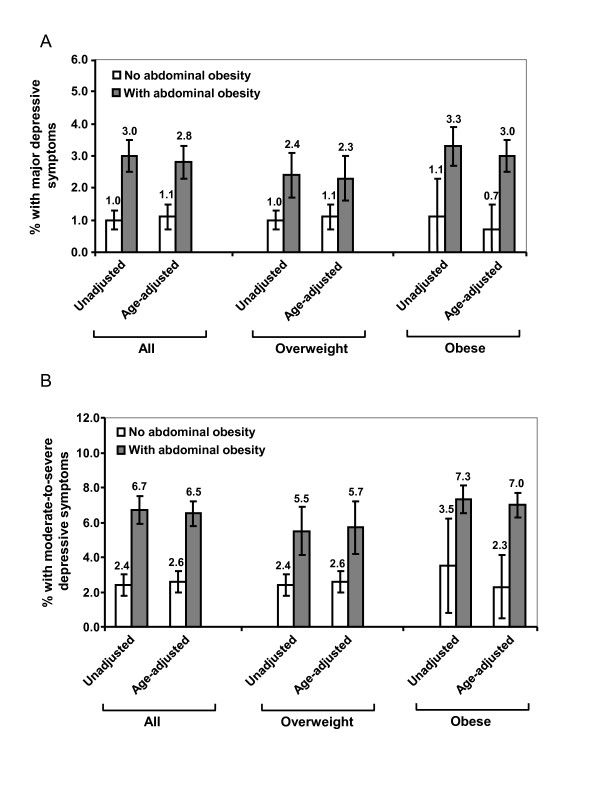
BACKGROUND: Obesity is associated with an increased risk of mental illness; however, evidence linking body mass index (BMI)-a measure of overall obesity, to mental illness is inconsistent. The objective of this study was to examine the association of depressive symptoms with waist circumference or abdominal obesity among overweight and obese U.S. adults. METHODS: A cross-sectional, nationally representative sample from the 2005-2006 National Health and Nutrition Examination Survey was used. We analyzed the data from 2,439 U.S. adults (1,325 men and 1,114 nonpregnant women) aged ≥ 20 years who were either overweight or obese with BMI of ≥ 25.0 kg/m2. Abdominal obesity was defined as waist circumference of > 102 cm for men and > 88 cm for women. Depressive symptoms (defined as having major depressive symptoms or moderate-to-severe depressive symptoms) were assessed by the Patient Health Questionnaire-9 diagnostic algorithm. The prevalence and the odds ratios (ORs) with 95% confidence intervals (CIs) for having major depressive symptoms and moderate-to-severe depressive symptoms were estimated using logistic regression analysis. RESULTS: After multivariate adjustment for demographics and lifestyle factors, waist circumference was significantly associated with both major depressive symptoms (OR: 1.03, 95% CI: 1.01-1.05) and moderate-to-severe depressive symptoms (OR: 1.02, 95% CI: 1.01-1.04), and adults with abdominal obesity were significantly more likely to have major depressive symptoms (OR: 2.18, 95% CI: 1.35-3.59) or have moderate-to-severe depressive symptoms (OR: 2.56, 95% CI: 1.34-4.90) than those without. These relationships persisted after further adjusting for coexistence of multiple chronic conditions and persisted in participants who were overweight (BMI: 25.0-< 30.0 kg/m2) when stratified analyses were conducted by BMI status. CONCLUSION: Among overweight and obese U.S. adults, waist circumference or abdominal obesity was significantly associated with increased likelihoods of having major depressive symptoms or moderate-to-severe depressive symptoms. Thus, mental health status should be monitored and evaluated in adults with abdominal obesity, particularly in those who are overweight.
Overview
The claims and statistics of this paper haven’t been checked yet.
Free: it reads the open-access text and checks the first 5 claims that cite a source we can check. Create a free account to check every claim.
Integrity signals
Registry
Cites
Statistics
Figures
Verification
Claims the paper makes
The claims and statistics of this paper haven’t been checked yet.
Free: it reads the open-access text and checks the first 5 claims that cite a source we can check. Create a free account to check every claim.
Claims other papers make about this one
Each is checked against this paper’s own text: does it say what the citing paper says it does?
The source backs part of the claim, not all of it — or backs it for a different population, condition or comparison.
In the citing paper
“The odds of depression are higher when evaluating the waist-to-hip ratio [16,17] which provides a better estimate of visceral adiposity and metabolic dysfunction than BMI [18].”
From The menace of obesity to depression and anxiety prevalence (2022) · cites this paper as [16]
Experimental — accuracy not yet measured
Self-check
Percentages, sums and reported differences re-computed from the paper’s own numbers.
The self-check needs the paper’s full text.
Citations
Cites
The PHQ-9: Validity of a brief depression severity measure
Kroenke, K., Spitzer, R. L., & Williams, J. B. W. (2001) · Journal of General Internal Medicine · doi:10.1046/j.1525-1497.2001.016009606.x · Cited by 44,910
A New Equation to Estimate Glomerular Filtration Rate
Levey, A. S., Stevens, L. A., Schmid, C. H., Zhang, Y. (., Castro, A. F., Feldman, H. I., Kusek, J. W., Eggers, P., Van Lente, F., Greene, T., et al. (2009) · Annals of Internal Medicine · doi:10.7326/0003-4819-150-9-200905050-00006 · Cited by 25,603 · cited 1×
“For kidney disease, we estimated glomerular filtration rate using the CKD-EPI (Chronic Kidney Disease Epidemiology Collaboration) equation [38], and participants with a glomerular filtration rate of < 60 mL/min/1.”
MethodChobanian, A. V., Bakris, G. L., Black, H. R., Cushman, W. C., Green, L. A., Izzo, J. L., Jones, D. W., Materson, B. J., Oparil, S., Wright, J. T., et al. (2003) · Hypertension · doi:10.1161/01.hyp.0000107251.49515.c2 · Cited by 13,271 · cited 1×
“According to the Joint National Committee on Prevention, Detection, Evaluation, and Treatment of High Blood Pressure reports [37], participants who were on antihypertension medications or had systolic blood pressure ≥ 140 mmHg or diastolic blood pressure ≥ 90 mmHg were defined as having hypertension.”
MethodPrevalence and Trends in Obesity Among US Adults, 1999-2008
Flegal, K. M. (2010) · JAMA · doi:10.1001/jama.2009.2014 · Cited by 7,580 · cited 1×
“The prevalence of obesity, defined as a body mass index (BMI) of ≥ 30 kg/m(2), was 32% in the United States during 2001-2004 and increased slightly to 34% during 2005-2006 [2].”
BackgroundThe PHQ-9: A New Depression Diagnostic and Severity Measure
Kroenke, K., & Spitzer, R. L. (2002) · Psychiatric Annals · doi:10.3928/0048-5713-20020901-06 · Cited by 5,898 · cited 3×
“Their scores for each item were then added to produce a total depression severity score, and the cutoff point of ≥ 10 was used to identify participants as having moderate-to-severe depressive symptoms [34,35].”
BackgroundMethodDepression, chronic diseases, and decrements in health: results from the World Health Surveys
Moussavi, S., Chatterji, S., Verdes, E., Tandon, A., Patel, V., & Ustun, B. (2007) · The Lancet · doi:10.1016/s0140-6736(07)61415-9 · Cited by 4,070 · cited 1×
“, associated with great burden of diseases and increased mortality, disability, and reduced quality of life) [16,17].”
BackgroundGuh, D. P., Zhang, W., Bansback, N., Amarsi, Z., Birmingham, C. L., & Anis, A. H. (2009) · BMC Public Health · doi:10.1186/1471-2458-9-88 · Cited by 3,855 · cited 1×
“The health impact of obesity is tremendous, as shown by an increased risk for multiple chronic diseases and conditions including hypertension, diabetes, hypercholesterolemia, coronary heart disease, asthma, arthritis, cancers, and many others [3-5].”
BackgroundFox, C. S., Massaro, J. M., Hoffmann, U., Pou, K. M., Maurovich-Horvat, P., Liu, C.-Y., Vasan, R. S., Murabito, J. M., Meigs, J. B., Cupples, L. A., et al. (2007) · Circulation · doi:10.1161/circulationaha.106.675355 · Cited by 2,882 · cited 1×
“In fact, studies have consistently shown that abdominal visceral fat is more pathogenic than subcutaneous fat on metabolic risk profiles [24,25] and that fat distribution (central adiposity vs general obesity, or visceral vs subcutaneous fat) is differentially associated with depressive symptoms [20,26,27].”
BackgroundWang, Y., Beydoun, M. A., Liang, L., Caballero, B., & Kumanyika, S. K. (2008) · Obesity · doi:10.1038/oby.2008.351 · Cited by 1,518 · cited 1×
“The continuing increases in BMI and waist circumference in the United States [54,55] and the projected increases in the prevalence of overweight and obesity [1,56] suggest that mental health status should be screened, monitored, and evaluated especially in people with abdominal obesity.”
BackgroundValidity of the brief patient health questionnaire mood scale (PHQ-9) in the general population
Martin, A., Rief, W., Klaiberg, A., & Braehler, E. (2006) · General Hospital Psychiatry · doi:10.1016/j.genhosppsych.2005.07.003 · Cited by 1,379 · cited 1×
“Using a structured mental health professional interview as the criterion standard, a PHQ-9 score of ≥ 10 had a sensitivity of 88% and a specificity of 88% for major depression, and, regardless of diagnostic status, typically represents clinically significant depression [34-36].”
MethodAssociation between obesity and psychiatric disorders in the US adult population
Simon, G. E., Von Korff, M., Saunders, K., Miglioretti, D. L., Crane, P. K., van Belle, G., & Kessler, R. C. (2006) · Archives of General Psychiatry · doi:10.1001/archpsyc.63.7.824 · Cited by 1,338 · cited 1×
“, depression, bipolar disorder, panic disorder, anxiety, or many others) [7-15] that have a substantial impact on public health (e.”
BackgroundDo stress reactions cause abdominal obesity and comorbidities?
Björntorp, P. (2001) · Obesity Reviews · doi:10.1046/j.1467-789x.2001.00027.x · Cited by 1,138
The Public Health Impact of Obesity
Visscher, T. L., & Seidell, J. C. (2001) · Annual Review of Public Health · doi:10.1146/annurev.publhealth.22.1.355 · Cited by 1,008 · cited 1×
“The health impact of obesity is tremendous, as shown by an increased risk for multiple chronic diseases and conditions including hypertension, diabetes, hypercholesterolemia, coronary heart disease, asthma, arthritis, cancers, and many others [3-5].”
BackgroundRosmond, R., Dallman, M. F., & Björntorp, P. (1998) · The Journal of Clinical Endocrinology & Metabolism · doi:10.1210/jcem.83.6.4843 · Cited by 871
Zhang, C., Rexrode, K. M., van Dam, R. M., Li, T. Y., & Hu, F. B. (2008) · Circulation · doi:10.1161/circulationaha.107.739714 · Cited by 856 · cited 2×
“In addition, obesity, especially abdominal obesity, is associated with increased all-cause, cardiovascular, or cancer mortality [6].”
BackgroundFlegal, K. M., Shepherd, J. A., Looker, A. C., Graubard, B. I., Borrud, L. G., Ogden, C. L., Harris, T. B., Everhart, J. E., & Schenker, N. (2009) · The American Journal of Clinical Nutrition · doi:10.3945/ajcn.2008.26847 · Cited by 819 · cited 1×
“In addition, we did not include BMI as a covariate because we only focused on people who were overweight and obese and also because of the high correlation between waist circumference and BMI [46,47].”
BackgroundKumanyika, S. K., Obarzanek, E., Stettler, N., Bell, R., Field, A. E., Fortmann, S. P., Franklin, B. A., Gillman, M. W., Lewis, C. E., Poston, W. C., et al. (2008) · Circulation · doi:10.1161/circulationaha.108.189702 · Cited by 636
Rosmond, R. (1998) · Journal of Clinical Endocrinology & Metabolism · doi:10.1210/jc.83.6.1853 · Cited by 590
Petry, N. M., Barry, D., Pietrzak, R. H., & Wagner, J. A. (2008) · Psychosomatic Medicine · doi:10.1097/psy.0b013e3181651651 · Cited by 494 · cited 1×
“, depression, bipolar disorder, panic disorder, anxiety, or many others) [7-15] that have a substantial impact on public health (e.”
BackgroundDepression and anxiety among US adults: associations with body mass index
Zhao, G., Ford, E. S., Dhingra, S., Li, C., Strine, T. W., & Mokdad, A. H. (2009) · International Journal of Obesity · doi:10.1038/ijo.2008.268 · Cited by 423 · cited 1×
“, depression, bipolar disorder, panic disorder, anxiety, or many others) [7-15] that have a substantial impact on public health (e.”
BackgroundSelf-citationDepression and body mass index, a u-shaped association
de Wit, L. M., van Straten, A., van Herten, M., Penninx, B. W., & Cuijpers, P. (2009) · BMC Public Health · doi:10.1186/1471-2458-9-14 · Cited by 417 · cited 1×
“, depression, bipolar disorder, panic disorder, anxiety, or many others) [7-15] that have a substantial impact on public health (e.”
BackgroundBirnbaum, H. G., Kessler, R. C., Kelley, D., Ben-Hamadi, R., Joish, V. N., & Greenberg, P. E. (2010) · Depression and Anxiety · doi:10.1002/da.20580 · Cited by 380 · cited 1×
“, associated with great burden of diseases and increased mortality, disability, and reduced quality of life) [16,17].”
BackgroundBlaine, B. (2008) · Journal of Health Psychology · doi:10.1177/1359105308095977 · Cited by 372
Trends in Waist Circumference among U.S. Adults
Ford, E. S., Mokdad, A. H., & Giles, W. H. (2003) · Obesity Research · doi:10.1038/oby.2003.168 · Cited by 325 · cited 1×
“In addition, we did not include BMI as a covariate because we only focused on people who were overweight and obese and also because of the high correlation between waist circumference and BMI [46,47].”
BackgroundSelf-citationObesity and depression: results from the longitudinal Northern Finland 1966 Birth Cohort Study
Herva, A., Laitinen, J., Miettunen, J., Veijola, J., Karvonen, J. T., Läksy, K., & Joukamaa, M. (2006) · International Journal of Obesity · doi:10.1038/sj.ijo.0803174 · Cited by 324
Increasing Trends in Waist Circumference and Abdominal Obesity among U.S. Adults
Li, C., Ford, E. S., McGuire, L. C., & Mokdad, A. H. (2007) · Obesity · doi:10.1038/oby.2007.505 · Cited by 288
Self-citationDepression in the United States Household Population, 2005-2006: (565102009-001)
Pratt, L. A., & Brody, D. J. (2008) · PsycEXTRA Dataset · doi:10.1037/e565102009-001 · Cited by 283
Mather, A. A., Cox, B. J., Enns, M. W., & Sareen, J. (2009) · Journal of Psychosomatic Research · doi:10.1016/j.jpsychores.2008.09.008 · Cited by 275 · cited 1×
“, depression, bipolar disorder, panic disorder, anxiety, or many others) [7-15] that have a substantial impact on public health (e.”
BackgroundBjerkeset, O., Romundstad, P., Evans, J., & Gunnell, D. (2007) · American Journal of Epidemiology · doi:10.1093/aje/kwm280 · Cited by 246
Depression: An Important Comorbidity With Metabolic Syndrome in a General Population
Dunbar, J. A., Reddy, P., Davis-Lameloise, N., Philpot, B., Laatikainen, T., Kilkkinen, A., Bunker, S. J., Best, J. D., Vartiainen, E., Kai Lo, S., et al. (2008) · Diabetes Care · doi:10.2337/dc08-0175 · Cited by 241 · cited 5×
“Whether or not BMI should be included as a covariate in studies like ours or in studies dealing with metabolic syndrome [39-43] remains controversial at present.”
BackgroundMethodInfluentialDepressive Symptoms and Change in Abdominal Obesity in Older Persons
Vogelzangs, N., Kritchevsky, S. B., Beekman, A. T. F., Newman, A. B., Satterfield, S., Simonsick, E. M., Yaffe, K., Harris, T. B., & Penninx, B. W. J. H. (2008) · Archives of General Psychiatry · doi:10.1001/archpsyc.65.12.1386 · Cited by 200 · cited 1×
“On the other hand, longitudinal studies have shown that baseline depression is a significant predictor of visceral fat accumulation and obesity [48-50] and is associated with increased adrenal gland volume [49].”
BackgroundRivenes, A. C., Harvey, S. B., & Mykletun, A. (2008) · Journal of Psychosomatic Research · doi:10.1016/j.jpsychores.2008.07.012 · Cited by 186 · cited 2×
“In fact, studies have consistently shown that abdominal visceral fat is more pathogenic than subcutaneous fat on metabolic risk profiles [24,25] and that fat distribution (central adiposity vs general obesity, or visceral vs subcutaneous fat) is differentially associated with depressive symptoms [20,26,27].”
BackgroundMetabolic Syndrome Predisposes to Depressive Symptoms: A Population-Based 7-Year Follow-Up Study
Koponen, H., Jokelainen, J., Keinänen-Kiukaanniemi, S., Kumpusalo, E., & Vanhala, M. (2008) · The Journal of Clinical Psychiatry · doi:10.4088/jcp.v69n0202 · Cited by 177 · cited 3×
“The relationship between depression and waist circumference or abdominal obesity as a component of metabolic syndrome has been explored previously in studies examining the associations of metabolic syndrome with mental illness [39-43].”
BackgroundResultThe Relation of Body Mass Index to Depressive Symptoms
Johnston, E., Johnson, S., McLeod, P., & Johnston, M. (2004) · Canadian Journal of Public Health · doi:10.1007/bf03403643 · Cited by 176
Patterns of Abdominal Fat Distribution
Pou, K. M., Massaro, J. M., Hoffmann, U., Lieb, K., Vasan, R. S., O'Donnell, C. J., & Fox, C. S. (2009) · Diabetes Care · doi:10.2337/dc08-1359 · Cited by 171
Herva, A., Räsänen, P., Miettunen, J., Timonen, M., Läksy, K., Veijola, J., Laitinen, J., Ruokonen, A., & Joukamaa, M. (2006) · Psychosomatic Medicine · doi:10.1097/01.psy.0000203172.02305.ea · Cited by 169 · cited 3×
“The relationship between depression and waist circumference or abdominal obesity as a component of metabolic syndrome has been explored previously in studies examining the associations of metabolic syndrome with mental illness [39-43].”
BackgroundResultMa, J., & Xiao, L. (2010) · Obesity · doi:10.1038/oby.2009.213 · Cited by 157 · cited 4×
“Ma J, Xiao L: Obesity and Depression in US Women: Results From the 2005-2006 National Health and Nutritional Examination Survey.”
BackgroundResultInfluentialAssociation Between Metabolic Syndrome and Depressive Symptoms in Middle-Aged Adults
Akbaraly, T. N., Kivimäki, M., Brunner, E. J., Chandola, T., Marmot, M. G., Singh-Manoux, A., & Ferrie, J. E. (2009) · Diabetes Care · doi:10.2337/dc08-1358 · Cited by 157
Depression and anxiety symptoms in relation to anthropometry and metabolism in men
Ahlberg, A.-C., Ljung, T., Rosmond, R., McEwen, B. S., Holm, G., Åkesson, H. O., & Björntorp, P. A. (2002) · Psychiatry Research · doi:10.1016/s0165-1781(02)00192-0 · Cited by 127 · cited 1×
“In fact, studies have consistently shown that abdominal visceral fat is more pathogenic than subcutaneous fat on metabolic risk profiles [24,25] and that fat distribution (central adiposity vs general obesity, or visceral vs subcutaneous fat) is differentially associated with depressive symptoms [20,26,27].”
BackgroundHo, R. C. M., Niti, M., Kua, E. H., & Ng, T. (2008) · International Journal of Geriatric Psychiatry · doi:10.1002/gps.1893 · Cited by 126 · cited 3×
“Waist circumference, frequently used as a simple, inexpensive measure of central obesity in population-based studies, has been shown to be associated with depression in some studies [28,29] but not in others [21,23].”
BackgroundResultGender‐ethnic Disparity in BMI and Waist Circumference Distribution Shifts in US Adults
Beydoun, M. A., & Wang, Y. (2009) · Obesity · doi:10.1038/oby.2008.492 · Cited by 115 · cited 4×
“The continuing increases in BMI and waist circumference in the United States [54,55] and the projected increases in the prevalence of overweight and obesity [1,56] suggest that mental health status should be screened, monitored, and evaluated especially in people with abdominal obesity.”
BackgroundInfluentialDepressive Symptoms and Increased Visceral Fat in Middle-Aged Women
Everson-Rose, S. A., Lewis, T. T., Karavolos, K., Dugan, S. A., Wesley, D., & Powell, L. H. (2009) · Psychosomatic Medicine · doi:10.1097/psy.0b013e3181a20c9c · Cited by 114 · cited 4×
“In this study, we only focused on adults who were overweight and obese because abdominal obesity is more physiologically or psychologically relevant in this population than in people who are underweight or normal weight, among whom depressive symptoms are unrelated to visceral fat [27].”
BackgroundMethodInfluentialEffect of Mirtazapine Treatment on Body Composition and Metabolism
Laimer, M., Kramer-Reinstadler, K., Rauchenzauner, M., Lechner-Schoner, T., Strauss, R., Engl, J., Deisenhammer, E. A., Hinterhuber, H., Patsch, J. R., & Ebenbichler, C. F. (2006) · The Journal of Clinical Psychiatry · doi:10.4088/jcp.v67n0313 · Cited by 103 · cited 1×
“Finally, antidepressant treatments, which are associated with weight gain [53], were not taken into account in the present study.”
BackgroundOverweight and Obesity: An Overview of Prevalence, Clinical Impact, and Economic Impact
Friedman, N. M., & Fanning, L. (2004) · Disease Management · doi:10.1089/1093507042317152 · Cited by 77
A Prospective Study of Overweight, Physical Activity, and Depressive Symptoms in Young Women
Ball, K., Burton, N. W., & Brown, W. J. (2009) · Obesity · doi:10.1038/oby.2008.497 · Cited by 75 · cited 1×
“, depression, bipolar disorder, panic disorder, anxiety, or many others) [7-15] that have a substantial impact on public health (e.”
BackgroundAssociation of metabolic syndrome with depression and anxiety in Japanese men
Takeuchi, T., Nakao, M., Nomura, K., & Yano, E. (2008) · Diabetes & Metabolism · doi:10.1016/j.diabet.2008.06.006 · Cited by 75 · cited 3×
“The relationship between depression and waist circumference or abdominal obesity as a component of metabolic syndrome has been explored previously in studies examining the associations of metabolic syndrome with mental illness [39-43].”
BackgroundMethodKruszon-Moran, D., & McQuillan, G. M. (2005) · PsycEXTRA Dataset · doi:10.1037/e609182007-001 · Cited by 71
Obesity and the risk for mental disorders in a representative German adult sample
Hach, I., Ruhl, U. E., Klose, M., Klotsche, J., Kirch, W., & Jacobi, F. (2007) · The European Journal of Public Health · doi:10.1093/eurpub/ckl227 · Cited by 68 · cited 1×
“However, other studies showed that BMI was not [18-22] or was even inversely associated with some forms of mental illness [20,23].”
BackgroundDepressive Mood and Abdominal Fat Distribution in Overweight Premenopausal Women
Lee, E. S., Kim, Y. H., Beck, S., Lee, S., & Oh, S. W. (2005) · Obesity Research · doi:10.1038/oby.2005.43 · Cited by 61 · cited 2×
“Moreover, two studies conducted in middle-aged women (mean age 50.4 years) using the Center for Epidemiological Studies Depression scale [27] and in overweight premenopausal women using the Zung’s SelfRating Depression Scale [44] reported that central obesity measured as visceral fat (but not subcutaneous fat) was sig…”
MethodInfluentialWhich Measures of Obesity Are Related to Depressive Symptoms and in Whom?
Lim, W., Thomas, K. S., Bardwell, W. A., & Dimsdale, J. E. (2008) · Psychosomatics · doi:10.1176/appi.psy.49.1.23 · Cited by 59 · cited 1×
“, depression, bipolar disorder, panic disorder, anxiety, or many others) [7-15] that have a substantial impact on public health (e.”
BackgroundMoreira, R. O., Marca, K. F., Appolinário, J. C., & Coutinho, W. F. (2007) · Eating and Weight Disorders - Studies on Anorexia Bulimia and Obesity · doi:10.1007/bf03327770 · Cited by 57 · cited 2×
“Moreira et al.[29] reported that increasing in waist circumference was significantly associated with an increased prevalence of depressive symptoms and mood disorders in obese women; however, in that study, only simple correlation analysis was conducted and potential confounders were not taken into account.”
BackgroundResultKatz, J., Taylor, N., Goodrick, S., Perry, L., Yudkin, J. S., & Coppack, S. W. (2000) · International Journal of Obesity · doi:10.1038/sj.ijo.0801122 · Cited by 48 · cited 1×
“Waist circumference, frequently used as a simple, inexpensive measure of central obesity in population-based studies, has been shown to be associated with depression in some studies [28,29] but not in others [21,23].”
ResultUsing a Bony Landmark to Measure Waist Circumference
Chumlea, W. C., & Kuczmarski, R. J. (1995) · Journal of the American Dietetic Association · doi:10.1016/s0002-8223(95)00003-8 · Cited by 48 · cited 1×
“1 cm [31,32].”
Association of Depressive Symptoms and Lifestyle Behaviors among Latinos at Risk of Type 2 Diabetes
Pagoto, S. L., Ma, Y., Bodenlos, J. S., Olendzki, B., Rosal, M. C., Tellez, T., Merriam, P., & Ockene, I. S. (2009) · Journal of the American Dietetic Association · doi:10.1016/j.jada.2009.04.010 · Cited by 41 · cited 1×
“However, other studies showed that BMI was not [18-22] or was even inversely associated with some forms of mental illness [20,23].”
BackgroundTurley, M. L., Tobias, M. I., & Paul, S. (2006) · Australian and New Zealand Journal of Public Health · doi:10.1111/j.1467-842x.2006.tb00863.x · Cited by 33 · cited 3×
“Waist circumference, frequently used as a simple, inexpensive measure of central obesity in population-based studies, has been shown to be associated with depression in some studies [28,29] but not in others [21,23].”
BackgroundResultLudescher, B., Najib, A., Baar, S., Machann, J., Schick, F., Buchkremer, G., Claussen, C. D., & Eschweiler, G. W. (2008) · The International Journal of Psychiatry in Medicine · doi:10.2190/pm.38.3.a · Cited by 29 · cited 1×
“On the other hand, longitudinal studies have shown that baseline depression is a significant predictor of visceral fat accumulation and obesity [48-50] and is associated with increased adrenal gland volume [49].”
Background
Research works printed but not linked: 1
- Centers for Disease Control and Prevention The Third National Center for Health Statistics: National Health and Nutrition Examination Survey (NHANES III 1988-94) reference manuals and reports [CD-ROM] 1996 National Center for Health Statistics, Bethesda, MD
Cited by
The menace of obesity to depression and anxiety prevalence
Fulton, S., Décarie-Spain, L., Fioramonti, X., Guiard, B., & Nakajima, S. (2022) · Trends in Endocrinology & Metabolism · doi:10.1016/j.tem.2021.10.005 · Cited by 441
“The odds of depression are higher when evaluating the waist-to-hip ratio [16,17] which provides a better estimate of visceral adiposity and metabolic dysfunction than BMI [18].”
Singh, M. (2014) · Frontiers in Psychology · doi:10.3389/fpsyg.2014.00925 · Cited by 337
Pereira-Miranda, E., Costa, P. R. F., Queiroz, V. A. O., Pereira-Santos, M., & Santana, M. L. P. (2017) · Journal of the American College of Nutrition · doi:10.1080/07315724.2016.1261053 · Cited by 335
Metabolic disturbances connecting obesity and depression
Hryhorczuk, C., Sharma, S., & Fulton, S. E. (2013) · Frontiers in Neuroscience · doi:10.3389/fnins.2013.00177 · Cited by 322
Dietary fiber and its associations with depression and inflammation
Swann, O. G., Kilpatrick, M., Breslin, M., & Oddy, W. H. (2020) · Nutrition Reviews · doi:10.1093/nutrit/nuz072 · Cited by 185
Metadata
- Authors
- Zhao, G., Ford, E. S., Li, C., Tsai, J., Dhingra, S., & Balluz, L. S.
- Affiliations
- National Center for Chronic Disease Prevention and Health Promotion (US)
- Centers for Disease Control and Prevention (US)
- Corresponding author
- Zhao, Guixiang
- Venue
- BMC Psychiatry
- Published
- 2011-08-11
- Volume
- 11
- Issue
- 1
- Pages
- 130-130
- ISSN
- 1471-244X (ISSN-L)
- PMC
- PMC3163524
- OpenAlex
- W2170192024
- Cited by
- 214
- References
- 56
- Citations by year
- 2026: 4 · 2025: 13 · 2024: 16 · 2023: 12 · 2022: 13 · 2021: 11 · 2020: 17 · 2019: 10 · 2018: 11 · 2017: 12 · 2016: 21 · 2015: 22 · 2014: 19 · 2013: 19 · 2012: 13
- FWCI
- 16.04
- Type
- journal article
- Language
- en
- Open access
- gold
- doi.org
- Licence
- Locations
- BMC Psychiatry (publishedVersion, cc-by)
- Europe PMC (PubMed Central) (publishedVersion, cc-by)
- PubMed Central (publishedVersion, cc-by)
- PubMed (publishedVersion)
- DOAJ (DOAJ: Directory of Open Access Journals) (submittedVersion, cc-by-sa)
- Funders
- Centers for Disease Control and Prevention
- National Center for Chronic Disease Prevention and Health Promotion
- Topics
- Health Sciences › Medicine › Public Health, Environmental and Occupational Health › Obesity, Physical Activity, Diet
- Social Sciences › Psychology › Clinical Psychology › Eating Disorders and Behaviors
- Health Sciences › Medicine › Public Health, Environmental and Occupational Health › Obesity and Health Practices
- Keywords
- waist circumference, abdominal obesity, depressive symptoms, depression, obesity, overweight, body mass index, mental health
- MeSH terms
- Adult, Cross-Sectional Studies, Depression, Female, Humans, Male, Middle Aged, Nutrition Surveys, Obesity, Severity of Illness Index, United States, Prevalence, Overweight, Waist Circumference, Obesity, Abdominal
About these checks
Registry, retraction, Cites and statistics results are computed, not judged, with one exception: a printed reference that no index lists is read once by a model before it counts as a citation error. Claims are extracted by a model and kept only when their quote appears verbatim in the text; each cited source is then checked, with a model’s help, for whether it says what the claim relies on. Those verdicts can be wrong — read the claim’s quote and the cited source before relying on one.
Statistics and arithmetic are recomputed, not judged.
Confidence bands are shown only for fields calibrated on our annotated test set. None is calibrated yet, so no band is shown.
What counts as a claim ›How we measure confidence ›How we check this ›
Are you an author, or do you see a problem with this page? Request a review
Data sources
Bibliographic data: Semantic Scholar, OpenAlex, Crossref.
Contains information from the Semantic Scholar Academic Graph Datasets, made available under the ODC Attribution License (ODC-BY 1.0).
Semantic Scholar’s data is described in: Kinney, R., et al. (2023). The Semantic Scholar Open Data Platform. arXiv:2301.10140.
