

The working alliance in a randomized controlled trial comparing online with face-to-face cognitive-behavioral therapy for depression
Open accessThe DOI matches its Crossref record; 47 of the 51 references it cites were found in a registry or an index.
Abstract
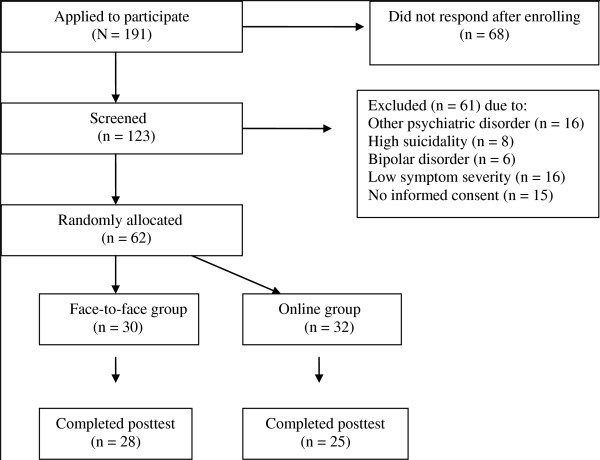
Background: Although numerous efficacy studies in recent years have found internet-based interventions for depression to be effective, there has been scant consideration of therapeutic process factors in the online setting. In face-to face therapy, the quality of the working alliance explains variance in treatment outcome. However, little is yet known about the impact of the working alliance in internet-based interventions, particularly as compared with face-to-face therapy. Methods: This study explored the working alliance between client and therapist in the middle and at the end of a cognitive-behavioral intervention for depression. The participants were randomized to an internet-based treatment group (n = 25) or face-to-face group (n = 28). Both groups received the same cognitive behavioral therapy over an 8-week timeframe. Participants completed the Beck Depression Inventory (BDI) post-treatment and the Working Alliance Inventory at mid- and post- treatment. Therapists completed the therapist version of the Working Alliance Inventory at post-treatment. Results: With the exception of therapists' ratings of the tasks subscale, which were significantly higher in the online group, the two groups' ratings of the working alliance did not differ significantly. Further, significant correlations were found between clients' ratings of the working alliance and therapy outcome at post-treatment in the online group and at both mid- and post-treatment in the face-to-face group. Correlation analysis revealed that the working alliance ratings did not significantly predict the BDI residual gain score in either group. Conclusions: Contrary to what might have been expected, the working alliance in the online group was comparable to that in the face-to-face group. However, the results showed no significant relations between the BDI residual gain score and the working alliance ratings in either group. Trial registration: ACTRN12611000563965
Overview
The claims and statistics of this paper haven’t been checked yet.
Free: it reads the open-access text and checks the first 5 claims that cite a source we can check. Create a free account to check every claim.
Integrity signals
Registry
Cites
Statistics
Figures
Verification
Claims the paper makes
The claims and statistics of this paper haven’t been checked yet.
Free: it reads the open-access text and checks the first 5 claims that cite a source we can check. Create a free account to check every claim.
Claims other papers make about this one
Each is checked against this paper’s own text: does it say what the citing paper says it does?
The source backs part of the claim, not all of it — or backs it for a different population, condition or comparison.
In the citing paper
“Since ARM data was collected at post-intervention only, it was not possible to perform the analyses on an intention-to-treat basis [24].”
From Therapeutic alliance with a fully automated mobile phone and web-based intervention: secondary analysis of a randomized controlled trial (2016) · cites this paper as [24]
Experimental — accuracy not yet measuredThe cited source says what the claim attributes to it.
In the citing paper
“similar TA scores have been found for face-to-face therapy and IBIs [3,14,18,19,20]”
The cited source says what the claim attributes to it.
In the citing paper
“The majority of evidence relating to the therapeutic alliance in Internet-delivered interventions derives from studies of interventions that are therapist-assisted to some extent.”
From Therapeutic alliance with a fully automated mobile phone and web-based intervention: secondary analysis of a randomized controlled trial (2016) · cites this paper as [24]
In the citing paper
“Similarly, Preschl et al [73] found that high WAI ratings, equivalent to the face-to-face comparison group, were not associated with treatment outcomes following a supported digital intervention for depression.”
From The therapeutic alliance in digital mental health interventions for serious mental illnesses: narrative review (2020) · cites this paper as [73]
In the citing paper
“While alliance was present and comparable in the two groups, it could not predict treatment outcome in any of the two treatment groups.”
From Internet-based psychological treatments for depression (2012) · cites this paper as [40]
Self-check
Percentages, sums and reported differences re-computed from the paper’s own numbers.
The self-check needs the paper’s full text.
Citations
Cites
Cohen, J. (1992) · Psychological Bulletin · doi:10.1037//0033-2909.112.1.155 · Cited by 8,771
(1997) · Obesity Surgery · doi:10.1381/096089297765555359 · Cited by 3,916
Development and validation of the working alliance inventory
Horvath, A. O., & Greenberg, L. S. (1989) · Journal of Counseling Psychology · doi:10.1037//0022-0167.36.2.223 · Cited by 3,520 · cited 10×
“Therapists completed the therapist version of the Working Alliance Inventory at post-treatment.”
MethodInfluentialRelation of the therapeutic alliance with outcome and other variables: a meta-analytic review
Martin, D. J., Garske, J. P., & Davis, M. K. (2000) · Journal of Consulting and Clinical Psychology · doi:10.1037//0022-006x.68.3.438 · Cited by 3,355 · cited 1×
“In a review article, Martin and colleagues [50] reported a moderate but consistent relationship between the therapeutic alliance and outcomes of faceto-face psychotherapy.”
BackgroundRelation between working alliance and outcome in psychotherapy: A meta-analysis
Horvath, A. O., & Symonds, B. D. (1991) · Journal of Counseling Psychology · doi:10.1037/0022-0167.38.2.139 · Cited by 2,673 · cited 2×
“Numerous empirical studies have demonstrated the importance of the working alliance– that is, the relationship or collaboration between therapist and patient–for therapeutic outcomes in conventional treatment settings [16].”
BackgroundInternet-based cognitive behaviour therapy for symptoms of depression and anxiety: A meta-analysis
SPEK, V., CUIJPERS, P., NYKLÍČEK, I., RIPER, H., KEYZER, J., & POP, V. (2007) · Psychological Medicine · doi:10.1017/s0033291706008944 · Cited by 1,586 · cited 1×
“This pattern of results replicates the findings of a previously published meta-analysis [6].”
ResultCredibility of analogue therapy rationales
Borkovec, T. D., & Nau, S. D. (1972) · Journal of Behavior Therapy and Experimental Psychiatry · doi:10.1016/0005-7916(72)90045-6 · Cited by 1,553 · cited 1×
“Nevertheless, both groups rated the intervention as similarly satisfying (Treatment Satisfaction Questionnaire-Modified, TSQ; [26]) and credible (Treatment Credibility Scale, TCS-M; [27]).”
MethodFactor structure of the working alliance inventory
Tracey, T. J., & Kokotovic, A. M. (1989) · Psychological Assessment: A Journal of Consulting and Clinical Psychology · doi:10.1037/1040-3590.1.3.207 · Cited by 1,501 · cited 1×
“In this study, both the client and the therapist version of the 12-item WAI-S [36] were administered at post-treatment.”
MethodInternet-Based and Other Computerized Psychological Treatments for Adult Depression: A Meta-Analysis
Andersson, G., & Cuijpers, P. (2009) · Cognitive Behaviour Therapy · doi:10.1080/16506070903318960 · Cited by 1,368 · cited 6×
“Spek V, Nyklicek I, Smits N, Cuijpers P, Riper H, Keyzer J, Pop V: Internetbased cognitive behavioural therapy for subthreshold depression in people over 50 years old: a randomized controlled clinical trial.”
BackgroundInfluentialBarak, A., Hen, L., Boniel-Nissim, M., & Shapira, N. (2008) · Journal of Technology in Human Services · doi:10.1080/15228830802094429 · Cited by 1,283 · cited 1×
“In the past decade, accumulating research has demonstrated that internet-based interventions can have beneficial effects on psychological health [1].”
Background
Research works printed but not linked: 7
- Hautzinger M Cognitive Behaviour Therapy of Depression 2003 6 Weinheim, Beltz
- Maercker A Lebensrückblicksinterventionen als wirksame Therapietechniken [Life-review interventions as effective psychotherapeutic techniques] Ärztliche Psychotherapie 2009 4 10 16
- Beck AT Steer RA Brown GK Manual for the Beck Depression Inventory-II 1996 San Antonio, Psychological Corporation
- Fidy R Psychologische Suizidalitäts-Diagnostik im Internet [Internet diagnosis of suicidal ideation] Unpublished Lizenziat thesis 2008
- Hautzinger M Keller F Kühner C Das Beck Depressionsinventar II. Deutsche Bearbeitung und Handbuch zum BDI II [The Beck Depression Inventory II. German version and manual for the BDI II] 2006 Frankfurt am Main, Harcourt Test Services
- Franke G SCL-90-R. Die Symptom-Checkliste von Derogatis. [SCL-90-R. The Symptom-Checklist from Derogatis] 1995 Göttingen, Beltz Test GmbH
- Maercker A Posttraumatic Stress Scale-10 (PTSS-10) - German version adapted after Schüffel & Schade (unpublished) 1998 Dresden
Cited by
Items 101–156 of 156
Elvira, A. C., Santacreu, M., Giráldez, C. A. M., & Shih, P. (2021) · Clinical Psychology & Psychotherapy · doi:10.1002/cpp.2571 · Cited by 4
Bulut, S. (2020) · Psychology and Psychotherapy Research Study · doi:10.31031/pprs.2020.03.000581 · Cited by 5
Kucer, A., Derella, O. J., Kilbride, A., & Zayde, A. (2024) · International Journal of Group Psychotherapy · doi:10.1080/00207284.2024.2319627 · Cited by 4
“This result is consistent with other findings that the therapeutic alliance developed within a therapy group is just as strong over telehealth as it is in person (Lopez et al., 2020; Morland et al., 2014; Preschl et al., 2011).”
BackgroundResultDie therapeutische Beziehung in internetbasierten Behandlungsansätzen
Berger, T. (2017) · Springer eBooks · doi:10.1007/978-3-662-54310-8_9 · Cited by 4
Reynolds, D. J., Stiles, W. B., & Hanley, T. (2015) · doi:10.1515/9783110473858-004 · Cited by 5
Mental health practitioners’ perceptions of online working: a literature review
Roddy, J., Gabriel, L., Sheehy, R., Charura, D., Dunn, E., Hall, J., Moller, N. P., Smith, K., & Cooper, M. (2024) · British Journal of Guidance and Counselling · doi:10.1080/03069885.2024.2373179 · Cited by 6
“…into the working alliance, which encompassed relational factors between client and therapist such as trust as well as a focus on goals and tasks (Preschl et al., 2011), described the online working alliance as strong yet inferior to face-to-face working (Norwood et al., 2018), and an earlier…”
Thomas, P. C., Bark, P., & Rowe, S. L. (2025) · JMIR Formative Research · doi:10.2196/68846 · Cited by 6
(2023) · Journal of Psychology and Neuroscience · doi:10.47485/2693-2490.1069 · Cited by 3
Schmidt, V., Treml, J., Deller, J., & Kersting, A. (2023) · Cognitive Therapy and Research · doi:10.1007/s10608-023-10383-8 · Cited by 7
Internet- und mobilbasierte Interventionen zur Prävention und Behandlung psychischer Störungen
Ebert, D. D., Zarski, A., Berking, M., & Baumeister, H. (2016) · Springer eBooks · doi:10.1007/978-3-662-49504-9_20 · Cited by 5
Morrison, J., & Browning, A. (2018) · Insight (University of Cumbria) · Cited by 4
Replication of the learning alliance inventory to blended student populations
Andrews, K., Bath, D. M., & Smith, C. (2018) · Journal of Adult and Continuing Education · doi:10.1177/1477971418771090 · Cited by 3
Kuester, A., Niemeyer, H., Schumacher, S., Engel, S., Spies, J., Weiß, D., Muschalla, B., Burchert, S., Tamm, S., Weidmann, A., et al. (2020) · Journal of Behavioral and Cognitive Therapy · doi:10.1016/j.jbct.2020.03.003 · Cited by 5
Voderholzer, U., Beintner, I., Backes, B., Esguerra, E., & Hessler, J. B. (2021) · Verhaltenstherapie · doi:10.1159/000513643 · Cited by 3
“…our sample, however, are within the range or above what has been reported for German outpatients with different diagnoses [Munder et al., 2010] and for patients with depression in international outcome studies of different designs [Reis and Grenyer, 2004; Preschl et al., 2011; Webb et al., 2011].”
ResultVernmark, K. (2017) · doi:10.3384/diss.diva-142389 · Cited by 7
Allegri, B., Deste, G., Brenna, V., Gritti, E. S., Confalonieri, L., Puzzini, A., Corbani, I. E., Zucchetti, A., Mazza, U., Rabà, T., et al. (2025) · Brain Sciences · doi:10.3390/brainsci15090963 · Cited by 3
Blair, S. A., Brockmann, A. N., Arroyo, K. M., Carpenter, C. A., & Ross, K. M. (2022) · JMIR mhealth and uhealth · doi:10.2196/34102 · Cited by 4
“Interestingly, participants in web-based therapy have reported both similar [27] and significantly higher [28] levels of therapeutic alliance than levels reported by participants in face-to-face therapy.”
ONLINE PSYCOEDUCATION PROGRAMS: A SYSTEMATIC REVIEW
Bolat, Y. (2023) · International Journal Of Eurasia Social Sciences · doi:10.35826/ijoess.3268 · Cited by 2
Arens, E. A., Donnerstag, L., Hofmann, S. G., & Stangier, U. (2023) · Verhaltenstherapie · doi:10.1159/000534381 · Cited by 2
“Dies deckt sich mit Befunden aus weiteren Studien, die ebenfalls für die gute Etab-lierbarkeit einer therapeutischen Beziehung sprechen [Preschl et al., 2011].”
BackgroundText-based psychotherapy: analyzing opportunities and challenges beyond the session
Flaherty, H. B., & Beckerman, N. L. (2025) · Social Work in Mental Health · doi:10.1080/15332985.2025.2468277 · Cited by 5
“…such personalized and interactive therapy experiences, with studies demonstrating its effectiveness in helping patients confront and reduce their anxieties in a structured, virtual space (Cook & Doyle, 2002; Fitzpatrick et al., 2017; Kumar et al., 2023; Preschl et al., 2011; Torous et al., 2024).”
Neue Technologien in der Psychotherapie
Wilhelm, F. H., Pfaltz, M. C., & Wagner, B. (2018) · Springer eBooks · doi:10.1007/978-3-662-54911-7_46 · Cited by 5
Self-citationHow are online and face-to-face psychotherapy perceived by clients? A metaphor analysis
Yılmaz, T., & Bekaroğlu, E. (2023) · Psihologija · doi:10.2298/psi230130022y · Cited by 3
Etyczne aspekty prowadzenia terapii online: analiza wybranych stron internetowych
Rudnicka, P., Pindych, A., & Probierz, E. (2018) · Annales Universitatis Paedagogicae Cracoviensis Studia de Cultura · doi:10.24917/20837275.10.4.6 · Cited by 2
Mathiasen, K., Andersen, T. E., Lichtenstein, M. B., Riper, H., Kleiboer, A., & Roessler, K. K. (2022) · doi:10.2196/preprints.36577 · Cited by 2
Pugh, N. E. (2014) · oURspace (University of Regina) · doi:10.82465/5755 · Cited by 6
Kramuschke, M., Reinhardt, J., Dölemeyer, R., Kaiser, J., & Kersting, A. (2024) · BMC Psychology · doi:10.1186/s40359-024-01751-4 · Cited by 2
“Findings were mixed, revealing either an association [29, 30] or no association between WA and improvement in treatment outcomes [31].”
BackgroundBarakat, S., Rom, S., Kim, M., Aouad, P., & Maguire, S. (2025) · European Eating Disorders Review · doi:10.1002/erv.3176 · Cited by 5
“…alliance reported by clinician‐supported participants was high ( > 80% of total possible WAI‐TECH‐SF score) and aligns with other supported online CBT interventions and some trials of face‐to‐face CBT for anxiety and depression (Hadjistavropoulos et al. 2017; Preschl, Maercker, and Wagner 2011).”
Emotional engagement and perceived empathy in live vs. automated psychological interviews
Nyman, T. J., Noromies, A.-K., Pompedda, F., Santtila, P. O., & Antfolk, J. (2025) · PLoS ONE · doi:10.1371/journal.pone.0323490 · Cited by 1
Salgado, J., Gomes, M., Csabai, M., Daele, T. V., Doyle, F., Eimontas, J., Elster, R. N., Gosar, D., Haddouk, L., Karekla, M., et al. (2026) · European Psychologist · doi:10.1027/1016-9040/a000588 · Cited by 1
Web-Based Interventions for Substance Abuse
Schaub, M. P. (2016) · Springer eBooks · doi:10.1007/978-3-319-43172-7_9 · Cited by 1
Dreier, M., & Wölfling, K. (2023) · Springer eBooks · doi:10.1007/978-3-662-67489-5_9 · Cited by 2
Are perceptions of the psychotherapist affected by the audiovisual quality of a teletherapy session?
Glasgow, O. G., & Berman, J. S. (2024) · Psychotherapy Research · doi:10.1080/10503307.2024.2429010 · Cited by 1
“This failure to find a difference in perceptions based on video or audio therapy segments would seem consistent with past studies in which the outcome of treat-ment was not found to vary between modalities (Preschl et al., 2011; Wagner et al., 2014).”
Benson, J. G., MacLean, P. C., Hsi, A., & Erickson, S. J. (2017) · UNM’s Digital Repository (University of New Mexico) · Cited by 1
La nuova sfida della video psicoterapia su Internet
Smaniotto, C., Ceschin, R., Gualtieri, E., Nai, S., & Zappalà, A. (2021) · QUADERNI DI PSICOTERAPIA COGNITIVA · doi:10.3280/qpc47-2020oa11209 · Cited by 2
Exploring the therapeutic relationship in the digital age
Rashid, S. (2018) · City Research Online (City University London) · Cited by 5
Lebensrückblick als Modul eines Computerprogramms
Preschl, B. (2012) · Springer eBooks · doi:10.1007/978-3-642-28199-0_9
Self-citationInternet-based cognitive behavioural therapy
Høifødt, R. S. (2015)
Wie wirksam sind internetbasierte Programme?
Meyer, B., Jacob, G. A., & Weiss, M. (2014) · NeuroTransmitter · doi:10.1007/s15016-014-0587-7
Online therapy : client and counsellor experiences
Khan, S. (2014) · cIRcle (University of British Columbia) · doi:10.14288/1.0135566 · Cited by 2
“Furthermore, there is emerging evidence suggesting that meaningful therapeutic alliances can be established online (Cook & Doyle, 2002; Hanley, 2009, 2012; Leibert, Archer, Munson, & York, 2006, Reynolds et al., 2013; Preschl et al., 2011; Whitty & Joinson, 2009).”
BackgroundEbert, D. D., Hannig, W., Tarnowski, T., Sieland, B., Götzky, B., Berking, M., Klinische, A. F., & Marburg, P.-U. (2013)
Social Robots as Therapists: Preliminary Tests of Feasibility
Robinson, N. (2018) · Queensland University of Technology · doi:10.5204/thesis.eprints.119160
Miguel-Álvaro, A., & Panadero, S. (2021) · Clínica Contemporánea · doi:10.5093/cc2021a13 · Cited by 2
Hartmann-Strauss, S. (2020) · Psychotherapie: Praxis · doi:10.1007/978-3-662-62091-5_2
Bur, O. T., Bielinski, L. L., Krauss, S., Häfliger, A., Guggisberg, J., Krieger, T., & Berger, T. (2022) · SSRN Electronic Journal · doi:10.2139/ssrn.4195794
Gerton, J. M., Bludworth, J., & Spanierman, L. B. (2023) · Journal of Technology in Behavioral Science · doi:10.1007/s41347-023-00375-6
Tanaka, T. (2025) · Springer eBooks · doi:10.1007/978-981-96-2325-9_28
McKenzie, R., Hwang, L. J., Feng, B., & Phillips, E. J. (2025) · Journal of American College Health · doi:10.1080/07448481.2025.2496979 · Cited by 1
“While there is evidence suggesting the development of the working alliance is possible via mediated channels, 64–66 other work highlights the variability in patients’ and thera-pists’ preferences for in-person versus mediated therapy.”
Internet psychoeducation and psychotherapy for obsessive-compulsive disorder - review
Pasztor, J., Praško, J., Vaněk, J., Višňovský, J., Zaťková, M., Šlepecký, M., Sollár, T., & Nesnídal, V. (2025) · Psychiatrie pro praxi · doi:10.36290/psy.2025.018
Person, C. L., Phillips, N., Venkatachalam, K., & Gaveras, G. (2025) · JMIR Formative Research · doi:10.2196/77243
Coustet, L. (2025) · Soins Psychiatrie · doi:10.1016/j.spsy.2025.09.010
Sjöström, M. (2014) · DiVA at Umeå University (Umeå University) · Cited by 1
Kramuschke, M., Reinhardt, J., Dölemeyer, R., Kaiser, J., & Kersting, A. (2024) · Figshare · doi:10.6084/m9.figshare.25770369
Gallegos-Carrillo, K., Ramírez‐Palacios, P., Chávez‐Iñiguez, A., Cupertino, A. P., Cartujano‐Barrera, F., & Rodríguez-Bolaños, R. (2026) · Tobacco Induced Diseases · doi:10.18332/tid/213755 · Cited by 1
“Previous studies suggest that alliance scores are similar between internet-based and face-to-face therapies 11,12 .”
Hesslow, T., & Nilsson, M. (2015) · DiVA (Stockholm University)
Metadata
- Authors
- Preschl, B., Maercker, A., & Wagner, B.
- Affiliations
- University of Zurich (CH)
- University Hospital Leipzig (DE)
- Corresponding author
- Wagner, Birgit
- ORCID
- Wagner, Birgit
- Venue
- BMC Psychiatry
- Published
- 2011-12
- Volume
- 11
- Issue
- 1
- Pages
- 189-189
- ISSN
- 1471-244X (ISSN-L)
- PMC
- PMC3248847
- OpenAlex
- W2054662650
- Semantic Scholar
- 3b0a379e2524e63ff321fb5673d7260b25f27024
- Cited by
- 158
- References
- 51
- Citations by year
- 2026: 2 · 2025: 12 · 2024: 10 · 2023: 11 · 2022: 12 · 2021: 11 · 2020: 14 · 2019: 8 · 2018: 18 · 2017: 9 · 2016: 13 · 2015: 10 · 2014: 12 · 2013: 11 · 2012: 4
- FWCI
- 9.67
- Type
- journal article
- Language
- en
- Open access
- gold
- doi.org
- Licence
- Locations
- BMC Psychiatry (publishedVersion, cc-by)
- Europe PMC (PubMed Central) (publishedVersion, cc-by)
- PubMed Central (publishedVersion, cc-by)
- PubMed (publishedVersion)
- Zurich Open Repository and Archive (University of Zurich) (acceptedVersion, cc-by)
- DOAJ (DOAJ: Directory of Open Access Journals) (submittedVersion, cc-by-sa)
- Zurich Open Repository and Archive (University of Zurich)
- Topics
- Social Sciences › Psychology › Clinical Psychology › Psychotherapy Techniques and Applications
- Social Sciences › Psychology › Applied Psychology › Digital Mental Health Interventions
- Social Sciences › Psychology › Experimental and Cognitive Psychology › Anxiety, Depression, Psychometrics, Treatment, Cognitive Processes
- Keywords
- therapeutic relationship, internet-based cognitive behavioral therapy, depression, treatment outcome prediction, residual gain
- MeSH terms
- Adult, Depression, Depressive Disorder, Female, Humans, Male, Middle Aged, Professional-Patient Relations, Cognitive Behavioral Therapy, Treatment Outcome, Remote Consultation, Internet
About these checks
Registry, retraction, Cites and statistics results are computed, not judged, with one exception: a printed reference that no index lists is read once by a model before it counts as a citation error. Claims are extracted by a model and kept only when their quote appears verbatim in the text; each cited source is then checked, with a model’s help, for whether it says what the claim relies on. Those verdicts can be wrong — read the claim’s quote and the cited source before relying on one.
Statistics and arithmetic are recomputed, not judged.
Confidence bands are shown only for fields calibrated on our annotated test set. None is calibrated yet, so no band is shown.
What counts as a claim ›How we measure confidence ›How we check this ›
Are you an author, or do you see a problem with this page? Request a review
Data sources
Bibliographic data: Semantic Scholar, OpenAlex, Crossref.
Contains information from the Semantic Scholar Academic Graph Datasets, made available under the ODC Attribution License (ODC-BY 1.0).
Semantic Scholar’s data is described in: Kinney, R., et al. (2023). The Semantic Scholar Open Data Platform. arXiv:2301.10140.
