

The working alliance in a randomized controlled trial comparing online with face-to-face cognitive-behavioral therapy for depression
Open accessThe DOI matches its Crossref record; 47 of the 51 references it cites were found in a registry or an index.
Abstract
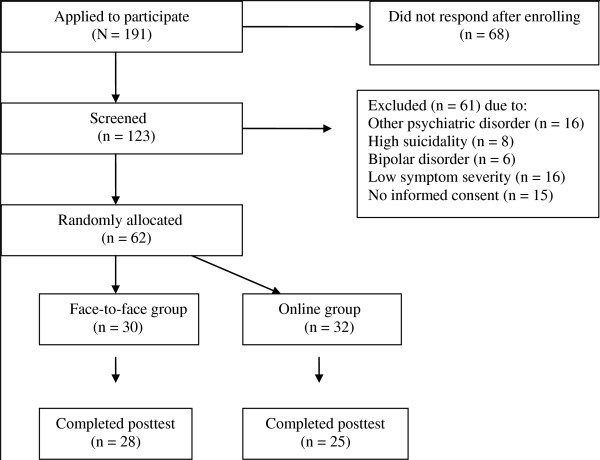
Background: Although numerous efficacy studies in recent years have found internet-based interventions for depression to be effective, there has been scant consideration of therapeutic process factors in the online setting. In face-to face therapy, the quality of the working alliance explains variance in treatment outcome. However, little is yet known about the impact of the working alliance in internet-based interventions, particularly as compared with face-to-face therapy. Methods: This study explored the working alliance between client and therapist in the middle and at the end of a cognitive-behavioral intervention for depression. The participants were randomized to an internet-based treatment group (n = 25) or face-to-face group (n = 28). Both groups received the same cognitive behavioral therapy over an 8-week timeframe. Participants completed the Beck Depression Inventory (BDI) post-treatment and the Working Alliance Inventory at mid- and post- treatment. Therapists completed the therapist version of the Working Alliance Inventory at post-treatment. Results: With the exception of therapists' ratings of the tasks subscale, which were significantly higher in the online group, the two groups' ratings of the working alliance did not differ significantly. Further, significant correlations were found between clients' ratings of the working alliance and therapy outcome at post-treatment in the online group and at both mid- and post-treatment in the face-to-face group. Correlation analysis revealed that the working alliance ratings did not significantly predict the BDI residual gain score in either group. Conclusions: Contrary to what might have been expected, the working alliance in the online group was comparable to that in the face-to-face group. However, the results showed no significant relations between the BDI residual gain score and the working alliance ratings in either group. Trial registration: ACTRN12611000563965
Overview
The claims and statistics of this paper haven’t been checked yet.
Free: it reads the open-access text and checks the first 5 claims that cite a source we can check. Create a free account to check every claim.
Integrity signals
Registry
Cites
Statistics
Figures
Verification
Claims the paper makes
The claims and statistics of this paper haven’t been checked yet.
Free: it reads the open-access text and checks the first 5 claims that cite a source we can check. Create a free account to check every claim.
Claims other papers make about this one
Each is checked against this paper’s own text: does it say what the citing paper says it does?
The source backs part of the claim, not all of it — or backs it for a different population, condition or comparison.
In the citing paper
“Since ARM data was collected at post-intervention only, it was not possible to perform the analyses on an intention-to-treat basis [24].”
From Therapeutic alliance with a fully automated mobile phone and web-based intervention: secondary analysis of a randomized controlled trial (2016) · cites this paper as [24]
Experimental — accuracy not yet measuredThe cited source says what the claim attributes to it.
In the citing paper
“similar TA scores have been found for face-to-face therapy and IBIs [3,14,18,19,20]”
The cited source says what the claim attributes to it.
In the citing paper
“The majority of evidence relating to the therapeutic alliance in Internet-delivered interventions derives from studies of interventions that are therapist-assisted to some extent.”
From Therapeutic alliance with a fully automated mobile phone and web-based intervention: secondary analysis of a randomized controlled trial (2016) · cites this paper as [24]
In the citing paper
“Similarly, Preschl et al [73] found that high WAI ratings, equivalent to the face-to-face comparison group, were not associated with treatment outcomes following a supported digital intervention for depression.”
From The therapeutic alliance in digital mental health interventions for serious mental illnesses: narrative review (2020) · cites this paper as [73]
In the citing paper
“While alliance was present and comparable in the two groups, it could not predict treatment outcome in any of the two treatment groups.”
From Internet-based psychological treatments for depression (2012) · cites this paper as [40]
Self-check
Percentages, sums and reported differences re-computed from the paper’s own numbers.
The self-check needs the paper’s full text.
Citations
Cites
Cohen, J. (1992) · Psychological Bulletin · doi:10.1037//0033-2909.112.1.155 · Cited by 8,771
(1997) · Obesity Surgery · doi:10.1381/096089297765555359 · Cited by 3,916
Development and validation of the working alliance inventory
Horvath, A. O., & Greenberg, L. S. (1989) · Journal of Counseling Psychology · doi:10.1037//0022-0167.36.2.223 · Cited by 3,520 · cited 10×
“Therapists completed the therapist version of the Working Alliance Inventory at post-treatment.”
MethodInfluentialRelation of the therapeutic alliance with outcome and other variables: a meta-analytic review
Martin, D. J., Garske, J. P., & Davis, M. K. (2000) · Journal of Consulting and Clinical Psychology · doi:10.1037//0022-006x.68.3.438 · Cited by 3,355 · cited 1×
“In a review article, Martin and colleagues [50] reported a moderate but consistent relationship between the therapeutic alliance and outcomes of faceto-face psychotherapy.”
BackgroundRelation between working alliance and outcome in psychotherapy: A meta-analysis
Horvath, A. O., & Symonds, B. D. (1991) · Journal of Counseling Psychology · doi:10.1037/0022-0167.38.2.139 · Cited by 2,673 · cited 2×
“Numerous empirical studies have demonstrated the importance of the working alliance– that is, the relationship or collaboration between therapist and patient–for therapeutic outcomes in conventional treatment settings [16].”
BackgroundInternet-based cognitive behaviour therapy for symptoms of depression and anxiety: A meta-analysis
SPEK, V., CUIJPERS, P., NYKLÍČEK, I., RIPER, H., KEYZER, J., & POP, V. (2007) · Psychological Medicine · doi:10.1017/s0033291706008944 · Cited by 1,586 · cited 1×
“This pattern of results replicates the findings of a previously published meta-analysis [6].”
ResultCredibility of analogue therapy rationales
Borkovec, T. D., & Nau, S. D. (1972) · Journal of Behavior Therapy and Experimental Psychiatry · doi:10.1016/0005-7916(72)90045-6 · Cited by 1,553 · cited 1×
“Nevertheless, both groups rated the intervention as similarly satisfying (Treatment Satisfaction Questionnaire-Modified, TSQ; [26]) and credible (Treatment Credibility Scale, TCS-M; [27]).”
MethodFactor structure of the working alliance inventory
Tracey, T. J., & Kokotovic, A. M. (1989) · Psychological Assessment: A Journal of Consulting and Clinical Psychology · doi:10.1037/1040-3590.1.3.207 · Cited by 1,501 · cited 1×
“In this study, both the client and the therapist version of the 12-item WAI-S [36] were administered at post-treatment.”
MethodInternet-Based and Other Computerized Psychological Treatments for Adult Depression: A Meta-Analysis
Andersson, G., & Cuijpers, P. (2009) · Cognitive Behaviour Therapy · doi:10.1080/16506070903318960 · Cited by 1,368 · cited 6×
“Spek V, Nyklicek I, Smits N, Cuijpers P, Riper H, Keyzer J, Pop V: Internetbased cognitive behavioural therapy for subthreshold depression in people over 50 years old: a randomized controlled clinical trial.”
BackgroundInfluentialBarak, A., Hen, L., Boniel-Nissim, M., & Shapira, N. (2008) · Journal of Technology in Human Services · doi:10.1080/15228830802094429 · Cited by 1,283 · cited 1×
“In the past decade, accumulating research has demonstrated that internet-based interventions can have beneficial effects on psychological health [1].”
BackgroundAndrews, G., Henderson, S., & Hall, W. (2001) · British Journal of Psychiatry · doi:10.1192/bjp.178.2.145 · Cited by 933
Krupnick, J. L., Sotsky, S. M., Simmens, S., Moyer, J., Elkin, I., Watkins, J., & Pilkonis, P. A. (1996) · Journal of Consulting and Clinical Psychology · doi:10.1037/0022-006x.64.3.532 · Cited by 605
Psychometric characteristics of the Scale for Suicide Ideation with psychiatric outpatients
Beck, A. T., Brown, G. K., & Steer, R. A. (1997) · Behaviour Research and Therapy · doi:10.1016/s0005-7967(97)00073-9 · Cited by 538 · cited 2×
“Fidy [33] found no significant differences between paper-and-pencil and online administration of the German versions of the BDI and the Beck Suicide Ideation Scale (BSIS), which were also used in the present study.”
MethodThe development of the Working Alliance Inventory.
Horvath, A. O., & Greenberg, L. S. (1986) · Cited by 529
Working Alliance in Online Therapy as Compared to Face-to-Face Therapy: Preliminary Results
Cook, J. E., & Doyle, C. (2002) · CyberPsychology & Behavior · doi:10.1089/109493102753770480 · Cited by 503 · cited 6×
“Although this procedure has proven valid and reliable in various previous studies [18,20,22-25], a structured clinical interview would have allowed a better quality of diagnosis of depression and the therapeutic relationship.”
BackgroundMethodResultInfluentialLange, A., Rietdijk, D., Hudcovicova, M., van de Ven, J.-P., Schrieken, B., & Emmelkamp, P. M. G. (2003) · Journal of Consulting and Clinical Psychology · doi:10.1037/0022-006x.71.5.901 · Cited by 495
Titov, N., Andrews, G., Davies, M., McIntyre, K., Robinson, E., & Solley, K. (2010) · PLoS ONE · doi:10.1371/journal.pone.0010939 · Cited by 406 · cited 1×
“For instance, Titov and colleagues [47] reported that 11% of participants in a clinician-assisted internet-delivered CBT for depression did not complete post treatment questionnaires.”
BackgroundKnaevelsrud, C., & Maercker, A. (2007) · BMC Psychiatry · doi:10.1186/1471-244x-7-13 · Cited by 398
Self-citationInternet-Based Cognitive-Behavioral Therapy for Complicated Grief: A Randomized Controlled Trial
Wagner, B., Knaevelsrud, C., & Maercker, A. (2006) · Death Studies · doi:10.1080/07481180600614385 · Cited by 376 · cited 1×
“For the online condition, the CBT treatment manual for depression [29] was adapted for use as an internetbased intervention, based on the principles applied in a number of previous studies [3,41-43].”
MethodSelf-citationClarke, G., Eubanks, D., Reid, E., Kelleher, C., O'Connor, E., DeBar, L. L., Lynch, F., Nunley, S., & Gullion, C. (2005) · Journal of Medical Internet Research · doi:10.2196/jmir.7.2.e16 · Cited by 372 · cited 1×
“Moreover, studies on entirely self-guided programs have shown not only reduced treatment effects, but also substantial attrition rates of up to 41% [7-11].”
BackgroundSPEK, V., NYKLÍČEK, I., SMITS, N., CUIJPERS, P., RIPER, H., KEYZER, J., & POP, V. (2007) · Psychological Medicine · doi:10.1017/s0033291707000542 · Cited by 307
Is internet-based CBT for panic disorder and agoraphobia as effective as face-to-face CBT?
Kiropoulos, L. A., Klein, B., Austin, D. W., Gilson, K., Pier, C., Mitchell, J., & Ciechomski, L. (2008) · Journal of Anxiety Disorders · doi:10.1016/j.janxdis.2008.01.008 · Cited by 290 · cited 3×
“Our study contributes to a better understanding of the working alliance in internet-supported therapeutic interventions, replicating previous findings [18,20,22-25] showing that a strong working alliance can be established in an online setting, comparable to that established in faceto-face settings.”
BackgroundMethodResultPalmqvist, B., Carlbring, P., & Andersson, G. (2007) · Expert Review of Pharmacoeconomics & Outcomes Research · doi:10.1586/14737167.7.3.291 · Cited by 290 · cited 1×
“Analyses have also revealed a significant correlation between the amount of therapist time in minutes per participant and the between-group effect sizes of internet-based interventions [12].”
BackgroundClarke, G., Reid, E., Eubanks, D., O'Connor, E., DeBar, L. L., Kelleher, C., Lynch, F., & Nunley, S. (2002) · Journal of Medical Internet Research · doi:10.2196/jmir.4.3.e14 · Cited by 256 · cited 1×
“Moreover, studies on entirely self-guided programs have shown not only reduced treatment effects, but also substantial attrition rates of up to 41% [7-11].”
BackgroundOnline randomized controlled trial of brief and full cognitive behaviour therapy for depression
CHRISTENSEN, H., GRIFFITHS, K. M., MACKINNON, A. J., & BRITTLIFFE, K. (2006) · Psychological Medicine · doi:10.1017/s0033291706008695 · Cited by 249 · cited 1×
“Moreover, studies on entirely self-guided programs have shown not only reduced treatment effects, but also substantial attrition rates of up to 41% [7-11].”
BackgroundWhat Makes Internet Therapy Work?
Andersson, G., Carlbring, P., Berger, T., Almlöv, J., & Cuijpers, P. (2009) · Cognitive Behaviour Therapy · doi:10.1080/16506070902916400 · Cited by 234 · cited 1×
“Based on the findings of their Swedish studies, Andersson and colleagues have suggested that it can be sufficient for the therapist to spend about 100 minutes per patient over a 10-week program giving comments on patients’ homework and providing feedback [13].”
BackgroundDigital Dating and Virtual Relating: Conceptualizing Computer Mediated Romantic Relationships
Merkle, E. R., & Richardson, R. A. (2000) · Family Relations · doi:10.1111/j.1741-3729.2000.00187.x · Cited by 227 · cited 1×
“” A study of online romantic relationships revealed that avoidance behavior and discontinuity are more likely in online relationships than in face-to face relationships [49].”
BackgroundVernmark, K., Lenndin, J., Bjärehed, J., Carlsson, M., Karlsson, J., Öberg, J., Carlbring, P., Eriksson, T., & Andersson, G. (2010) · Behaviour Research and Therapy · doi:10.1016/j.brat.2010.01.005 · Cited by 226 · cited 1×
“The latest studies indicate that increasing therapist contact time beyond a certain threshold may not facilitate further treatment gains [14].”
BackgroundComputerised cognitive-behavioural therapy for depression: systematic review
Kaltenthaler, E., Parry, G., Beverley, C., & Ferriter, M. (2008) · British Journal of Psychiatry · doi:10.1192/bjp.bp.106.025981 · Cited by 206
Assessing Outcomes in Clinical Practice
Ogles, B. M., Masters, K. S., & Lambert, M. J. (1996) · Medical Entomology and Zoology · Cited by 201
Christensen, H., Griffiths, K., Groves, C., & Korten, A. (2006) · Australian & New Zealand Journal of Psychiatry · doi:10.1080/j.1440-1614.2006.01743.x · Cited by 201 · cited 1×
“Moreover, studies on entirely self-guided programs have shown not only reduced treatment effects, but also substantial attrition rates of up to 41% [7-11].”
BackgroundKnaevelsrud, C., & Maercker, A. (2006) · Journal of Medical Internet Research · doi:10.2196/jmir.8.4.e31 · Cited by 184 · cited 14×
“Knaevelsrud and Maercker [22] discussed the importance of investigating the working alliance at several stages of the therapeutic process to elucidate the relationship between working alliance and outcome.”
BackgroundMethodResultInfluentialSelf-citationRuwaard, J., Schrieken, B., Schrijver, M., Broeksteeg, J., Dekker, J., Vermeulen, H., & Lange, A. (2009) · Cognitive Behaviour Therapy · doi:10.1080/16506070802408086 · Cited by 183 · cited 3×
“Internet-based interventions for depression can be delivered in different forms, from self-help treatments delivered without therapist guidance to mainly textbased interventions with high therapist involvement [3,4].”
BackgroundMethodAlliance structure assessed by the Agnew Relationship Measure (ARM)
Agnew‐Davies, R., Stiles, W. B., Hardy, G. E., Barkham, M., & Shapiro, D. A. (1998) · British Journal of Clinical Psychology · doi:10.1111/j.2044-8260.1998.tb01291.x · Cited by 182 · cited 2×
“Agnew-Davies R, Stiles WB, Hardy GE, Barkham M, Shapiro DA: Alliance structure assessed by the Agnew Relationship Measure (ARM).”
Nonverbal and Verbal Emotional Expression and Health
Berry, D. S., & Pennebaker, J. W. (2010) · Psychotherapy and Psychosomatics · doi:10.1159/000288640 · Cited by 170 · cited 1×
“, behavioral analysis of depressive symptoms, activity diaries, cognitive restructuring worksheets) based on the CBT approach and on the written disclosure procedure developed by Pennebaker and colleagues [3,44].”
MethodInternet-delivered psychotherapy for depression in adults
Titov, N. (2011) · Current Opinion in Psychiatry · doi:10.1097/yco.0b013e32833ed18f · Cited by 158 · cited 4×
“Titov N, Andrews G, Davies M, McIntyre K, Robinson E, Solley K: Internet treatment for depression: a randomized controlled trial comparing clinician vs. technician assistance.”
BackgroundInfluentialKlein, B., Mitchell, J., Abbott, J.-A., Shandley, K. A., Austin, D., Gilson, K., Kiropoulos, L. A., Cannard, G., & Redman, T. (2010) · Journal of Anxiety Disorders · doi:10.1016/j.janxdis.2010.04.005 · Cited by 149 · cited 3×
“Our study contributes to a better understanding of the working alliance in internet-supported therapeutic interventions, replicating previous findings [18,20,22-25] showing that a strong working alliance can be established in an online setting, comparable to that established in faceto-face settings.”
BackgroundMethodResultAn investigation of session impact and alliance in internet based psychotherapy: Preliminary results
Reynolds, D. J., Stiles, W. B., & Grohol, J. M. (2006) · Counselling and Psychotherapy Research · doi:10.1080/14733140600853617 · Cited by 125 · cited 4×
“In the same vein, Reynolds and colleagues [20] reported preliminary results (N = 16 therapists, N = 17 clients) on the therapeutic alliance as assessed by the Agnew Relationship Measure [21] in an online setting, which they compared with existing data from a face-to-face group.”
BackgroundMethodResultInfluentialRuwaard, J., Lange, A., Bouwman, M., Broeksteeg, J., & Schrieken, B. (2007) · Cognitive Behaviour Therapy · doi:10.1080/16506070701381863 · Cited by 99
Patient satisfaction with behavioral treatments for panic disorder with agoraphobia
Cox, B., Fergus, K., & Swinson, R. (1994) · Journal of Anxiety Disorders · doi:10.1016/0887-6185(94)90001-9 · Cited by 49
Andersson, G., Westöö, J., Johansson, L., & Carlbring, P. (2006) · Cognitive Behaviour Therapy · doi:10.1080/16506070500372469 · Cited by 48
Internet–based cognitive–behavioral self help for depression
Andersson, G. (2006) · Expert Review of Neurotherapeutics · doi:10.1586/14737175.6.11.1637 · Cited by 47 · cited 1×
“Internet-based interventions for depression can be delivered in different forms, from self-help treatments delivered without therapist guidance to mainly textbased interventions with high therapist involvement [3,4].”
BackgroundLange, A., Schrieken, B., Blankers, M., van de Ven, J.-P., & Slot, M. (2000) · Directieve therapie · doi:10.1007/bf03060234 · Cited by 38
Editorial Office (1995) · Obesity Surgery · doi:10.1381/096089295765558060 · Cited by 17
Chronischer Tinnitus: Für wen ist eine ambulante Kurzzeitpsychotherapie indiziert?
Heinecke, K., Weise, C., & Rief, W. (2010) · PPmP - Psychotherapie · Psychosomatik · Medizinische Psychologie · doi:10.1055/s-0029-1225334 · Cited by 11 · cited 1×
“Treatment outcome was assessed as (a) the BDI score at post-treatment (BDI-post) and (b) the BDI residual gain score (the difference between the z-transformed BDI scores at post-treatment and baseline multiplied by the correlation between the two scores [45]).”
MethodCognitive Behaviour Therapy for Depression
Tieu, Y., & Dobson, K. S. (2015) · Wiley eBooks · doi:10.1002/9781119114482.ch11 · Cited by 7
Lange, A. (1999) · UvA-DARE (University of Amsterdam) · Cited by 3
Research works printed but not linked: 7
- Hautzinger M Cognitive Behaviour Therapy of Depression 2003 6 Weinheim, Beltz
- Maercker A Lebensrückblicksinterventionen als wirksame Therapietechniken [Life-review interventions as effective psychotherapeutic techniques] Ärztliche Psychotherapie 2009 4 10 16
- Beck AT Steer RA Brown GK Manual for the Beck Depression Inventory-II 1996 San Antonio, Psychological Corporation
- Fidy R Psychologische Suizidalitäts-Diagnostik im Internet [Internet diagnosis of suicidal ideation] Unpublished Lizenziat thesis 2008
- Hautzinger M Keller F Kühner C Das Beck Depressionsinventar II. Deutsche Bearbeitung und Handbuch zum BDI II [The Beck Depression Inventory II. German version and manual for the BDI II] 2006 Frankfurt am Main, Harcourt Test Services
- Franke G SCL-90-R. Die Symptom-Checkliste von Derogatis. [SCL-90-R. The Symptom-Checklist from Derogatis] 1995 Göttingen, Beltz Test GmbH
- Maercker A Posttraumatic Stress Scale-10 (PTSS-10) - German version adapted after Schüffel & Schade (unpublished) 1998 Dresden
Cited by
The alliance in adult psychotherapy: A meta-analytic synthesis
Flückiger, C., Del Re, A. C., Wampold, B. E., & Horvath, A. O. (2018) · Psychotherapy · doi:10.1037/pst0000172 · Cited by 1,763
Interactive telemedicine: effects on professional practice and health care outcomes
Flodgren, G., Rachas, A., Farmer, A. J., Inzitari, M., & Shepperd, S. (2015) · Cochrane Database of Systematic Reviews · doi:10.1002/14651858.cd002098.pub2 · Cited by 806
Internet-based psychological treatments for depression
Johansson, R., & Andersson, G. (2012) · Expert Review of Neurotherapeutics · doi:10.1586/ern.12.63 · Cited by 509
Ebert, D. D., Van Daele, T., Nordgreen, T., Karekla, M., Compare, A., Zarbo, C., Brugnera, A., Øverland, S., Trebbi, G., Jensen, K. L., et al. (2018) · European Psychologist · doi:10.1027/1016-9040/a000318 · Cited by 437
“…not find a significant association between therapeutic alliance and outcome (Andersson, Paxling, Wiwe, et al., 2012; Knaevelsrud &Maercker, 2006; Preschl et al., 2011), others’ did (Anderson et al., 2012; Knaevelsrud & Maercker, 2007; Nordgren, Carlbring, Linna, & Andersson, 2013; Wagner,…”
BackgroundResultBerger, T. (2017) · Psychotherapy Research · doi:10.1080/10503307.2015.1119908 · Cited by 364
“In a study on Interapy for depression, Preschl, Maercker, and Wagner (2011) investigated the therapeutic alliance in a RCT directly comparing Interapy with conventional face-to-face CBT. Main results of this trial indicated significant symptom changes in both treatment conditions, but no…”
BackgroundResultInfluential
Metadata
- Authors
- Preschl, B., Maercker, A., & Wagner, B.
- Affiliations
- University of Zurich (CH)
- University Hospital Leipzig (DE)
- Corresponding author
- Wagner, Birgit
- ORCID
- Wagner, Birgit
- Venue
- BMC Psychiatry
- Published
- 2011-12
- Volume
- 11
- Issue
- 1
- Pages
- 189-189
- ISSN
- 1471-244X (ISSN-L)
- PMC
- PMC3248847
- OpenAlex
- W2054662650
- Cited by
- 158
- References
- 51
- Citations by year
- 2026: 2 · 2025: 12 · 2024: 10 · 2023: 11 · 2022: 12 · 2021: 11 · 2020: 14 · 2019: 8 · 2018: 18 · 2017: 9 · 2016: 13 · 2015: 10 · 2014: 12 · 2013: 11 · 2012: 4
- FWCI
- 9.67
- Type
- journal article
- Language
- en
- Open access
- gold
- doi.org
- Licence
- Locations
- BMC Psychiatry (publishedVersion, cc-by)
- Europe PMC (PubMed Central) (publishedVersion, cc-by)
- PubMed Central (publishedVersion, cc-by)
- PubMed (publishedVersion)
- Zurich Open Repository and Archive (University of Zurich) (acceptedVersion, cc-by)
- DOAJ (DOAJ: Directory of Open Access Journals) (submittedVersion, cc-by-sa)
- Zurich Open Repository and Archive (University of Zurich)
- Topics
- Social Sciences › Psychology › Clinical Psychology › Psychotherapy Techniques and Applications
- Social Sciences › Psychology › Applied Psychology › Digital Mental Health Interventions
- Social Sciences › Psychology › Experimental and Cognitive Psychology › Anxiety, Depression, Psychometrics, Treatment, Cognitive Processes
- Keywords
- therapeutic relationship, internet-based cognitive behavioral therapy, depression, treatment outcome prediction, residual gain
- MeSH terms
- Adult, Depression, Depressive Disorder, Female, Humans, Male, Middle Aged, Professional-Patient Relations, Cognitive Behavioral Therapy, Treatment Outcome, Remote Consultation, Internet
About these checks
Registry, retraction, Cites and statistics results are computed, not judged, with one exception: a printed reference that no index lists is read once by a model before it counts as a citation error. Claims are extracted by a model and kept only when their quote appears verbatim in the text; each cited source is then checked, with a model’s help, for whether it says what the claim relies on. Those verdicts can be wrong — read the claim’s quote and the cited source before relying on one.
Statistics and arithmetic are recomputed, not judged.
Confidence bands are shown only for fields calibrated on our annotated test set. None is calibrated yet, so no band is shown.
What counts as a claim ›How we measure confidence ›How we check this ›
Are you an author, or do you see a problem with this page? Request a review
Data sources
Bibliographic data: Semantic Scholar, OpenAlex, Crossref.
Contains information from the Semantic Scholar Academic Graph Datasets, made available under the ODC Attribution License (ODC-BY 1.0).
Semantic Scholar’s data is described in: Kinney, R., et al. (2023). The Semantic Scholar Open Data Platform. arXiv:2301.10140.
