

Efficacy of exposure versus cognitive therapy in anxiety disorders: systematic review and meta-analysis
Open accessThe DOI matches its Crossref record; 63 of the 65 references it cites were found in a registry or an index.
Abstract
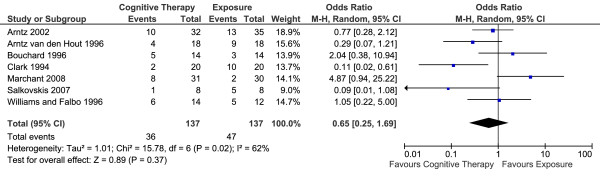
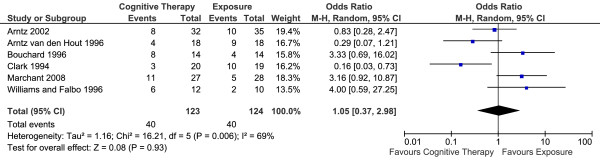
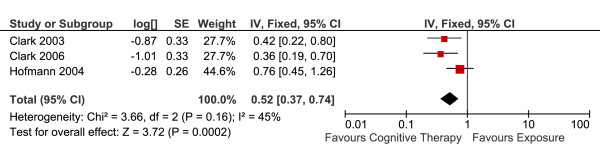
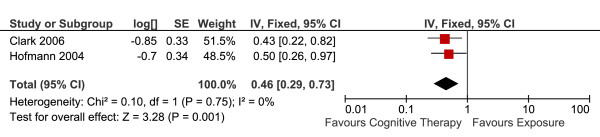
BACKGROUND: There is growing evidence of the effectiveness of Cognitive Behavioural Therapy (CBT) for a wide range of psychological disorders. There is a continued controversy about whether challenging maladaptive thoughts rather than use of behavioural interventions alone is associated with the greatest efficacy. However little is known about the relative efficacy of various components of CBT. This review aims to compare the relative efficacy of Cognitive Therapy (CT) versus Exposure (E) for a range of anxiety disorders using the most clinically relevant outcome measures and estimating the summary relative efficacy by combining the studies in a meta-analysis. METHODS: Psych INFO, MEDLINE and EMBASE were searched from the first available year to May 2010. All randomised controlled studies comparing the efficacy of exposure with cognitive therapy were included. Odds ratios (OR) or standardised means' differences (Hedges' g) for the most clinically relevant primary outcomes were calculated. Outcomes of the studies were grouped according to specific disorders and were combined in meta-analyses exploring short-term and long-term outcomes. RESULTS: 20 Randomised Controlled Trials with (n = 1,308) directly comparing the efficacy of CT and E in anxiety disorders were included in the meta-analysis. No statistically significant difference in the relative efficacy of CT and E was revealed in Post Traumatic Stress Disorder (PTSD), in Obsessive Compulsive Disorder (OCD) and in Panic Disorder (PD). There was a statistically significant difference favouring CT versus E in Social Phobia both in the short-term (Z = 3.72, p = 0.0002) and the long-term (Z = 3.28, p = 0.001) outcomes. CONCLUSIONS: On the basis of extant literature, there appears to be no evidence of differential efficacy between cognitive therapy and exposure in PD, PTSD and OCD and strong evidence of superior efficacy of cognitive therapy in social phobia.
Overview
The claims and statistics of this paper haven’t been checked yet.
Free: it reads the open-access text and checks the first 5 claims that cite a source we can check. Create a free account to check every claim.
Integrity signals
Registry
Cites
Statistics
Figures
Verification
Claims the paper makes
The claims and statistics of this paper haven’t been checked yet.
Free: it reads the open-access text and checks the first 5 claims that cite a source we can check. Create a free account to check every claim.
Claims other papers make about this one
Each is checked against this paper’s own text: does it say what the citing paper says it does?
The source backs part of the claim, not all of it — or backs it for a different population, condition or comparison.
In the citing paper
“Systematic reviews and meta-analyses support that CBT programs are effective in reducing OCD symptoms, with effect sizes ranging from 0.8 to 1.24 from pre to post treatment [10–15].”
From Study protocol for a randomised controlled trial of internet-based cognitive-behavioural therapy for obsessive-compulsive disorder (2014) · cites this paper as [15]
Experimental — accuracy not yet measuredThe cited source says what the claim attributes to it.
In the citing paper
“A recent study by Steketee, Siev, Yovel, Lit, and Wilhelm [32] as well as two meta-analyses showed that CT and ERP both reduced OC symptoms to a similar extent [33, 34].”
From Metacognitive Training for Obsessive-Compulsive Disorder: A study protocol for a randomized controlled trial (2020) · cites this paper as [34]
The cited source says what the claim attributes to it.
In the citing paper
“There is an exception for social anxiety disorder, where cognitive therapies appear to outperform exposure therapy [13,61,62].”
From Short-term effectiveness of web-based guided self-help for phobic outpatients: randomized controlled trial. (2014) · cites this paper as [62]
Self-check
Percentages, sums and reported differences re-computed from the paper’s own numbers.
The self-check needs the paper’s full text.
Citations
Cites
Baron, R. M., & Kenny, D. A. (1986) · Journal of Personality and Social Psychology · doi:10.1037/0022-3514.51.6.1173 · Cited by 91,532 · cited 1×
“The mediation argument is the most complex one as the criteria for mediation differs depending on the study design [53,54].”
BackgroundCochrane Handbook for Systematic Reviews of Interventions: Cochrane Book Series
(2008) · doi:10.1002/9780470712184 · Cited by 25,048
The Yale-Brown Obsessive Compulsive Scale: I. Development, Use, and Reliability
Goodman, W. K. (1989) · Archives of General Psychiatry · doi:10.1001/archpsyc.1989.01810110048007 · Cited by 7,712 · cited 1×
“This is a semi-structured clinician-administered interview providing a score (range 0-40) for both obsessions (range 0-20) and compulsions (range 0-20) along five dimensions: time spent, interference, distress, resistance, and control [19,20].”
BackgroundThe development of a Clinician-Administered PTSD Scale
Blake, D. D., Weathers, F. W., Nagy, L. M., Kaloupek, D. G., Gusman, F. D., Charney, D. S., & Keane, T. M. (1995) · Journal of Traumatic Stress · doi:10.1002/jts.2490080106 · Cited by 5,024 · cited 3×
“CAPS has 30 items, assessor-rated, rating frequency and intensity of the 17 PTSD symptoms and 8 associated features of PTSD (built over acts of commission or omission, survivor guilt, homicidality, disillusionment with authority, hopelessness, memory impairment and forgetfulness, sadness and depression and feeling ove…”
MethodInfluentialPsychotherapy by reciprocal inhibition
Wolpe, J. (1968) · Conditional Reflex · doi:10.1007/bf03000093 · Cited by 3,387
The empirical status of cognitive-behavioral therapy: A review of meta-analyses
Butler, A. C., Chapman, J. E., Forman, E. M., & Beck, A. T. (2006) · Clinical Psychology Review · doi:10.1016/j.cpr.2005.07.003 · Cited by 3,215
The Yale-Brown Obsessive Compulsive Scale: II. Validity
Goodman, W. K. (1989) · Archives of General Psychiatry · doi:10.1001/archpsyc.1989.01810110054008 · Cited by 2,799
Mediators and Moderators of Treatment Effects in Randomized Clinical Trials
Kraemer, H. C., Wilson, G. T., Fairburn, C. G., & Agras, W. S. (2002) · Archives of General Psychiatry · doi:10.1001/archpsyc.59.10.877 · Cited by 2,562 · cited 1×
“The mediation argument is the most complex one as the criteria for mediation differs depending on the study design [53,54].”
BackgroundReliability and validity of a brief instrument for assessing post-traumatic stress disorder
Foa, E. B., Riggs, D. S., Dancu, C. V., & Rothbaum, B. O. (1993) · Journal of Traumatic Stress · doi:10.1002/jts.2490060405 · Cited by 2,537 · cited 1×
“One study used PTSD Symptom Scale - Interview (PSS-I) [29] The scale contains 17 items that diagnose PTSD according to Diagnostic and Statistical Manual of Mental Disorders-III-Revised (DSM-III-R) criteria and assess the severity of PTSD symptoms.”
MethodThe Yale-Brown Obsessive-Compulsive Scale: Measures of internal consistency
Kim, S. W., Dysken, M. W., Pheley, A. M., & Hoover, K. M. (1994) · Psychiatry Research · doi:10.1016/0165-1781(94)90039-6 · Cited by 2,359
Research works printed but not linked: 1
- Higgins JPT Green S Eds Cochrane Handbook for Systematic Reviews of Interventions 2008 Chichester: Wiley-Blackwell
Cited by
Items 101–199 of 199
Brás, S., Soares, S. C., Cruz, T., Magalhães, T., Marques, B., Dantas, C., Fernandes, N., & Fernandes, J. M. (2018) · Brain and Behavior · doi:10.1002/brb3.1084 · Cited by 10
“Exposure interventions are rooted in classical conditioning, which assumes that the reduction of physiological responses occur through the repeated confrontation with the phobic stimulus (i.e., habituation), while behavioral and cognitive avoidance are prevented (see (Ougrin, 2011)).”
BackgroundBaumel, A. (2025) · Frontiers in Digital Health · doi:10.3389/fdgth.2025.1541676 · Cited by 8
Kurita, K., Obata, T., Sutoh, C., Matsuzawa, D., Yoshinaga, N., Kershaw, J., Chhatkuli, R. B., Ota, J., Shimizu, E., & Hirano, Y. (2023) · Frontiers in Psychiatry · doi:10.3389/fpsyt.2023.1233564 · Cited by 10
“…used in CT. Previous meta-analyses have reported that CT was superior to traditional exposure-based CBT in both short-and long-term outcomes for SAD (36), and individual CT based on the Clark and Wells model was the most cost-effective intervention among the various types of treatment for SAD (37).”
MethodValence/Arousal Estimation of Occluded Faces from VR Headsets
Gotsman, T., Polydorou, N., & Edalat, A. (2021) · IEEE International Conference on Cognitive Machine Intelligence (CogMI) · doi:10.1109/cogmi52975.2021.00021 · Cited by 8
Smith, D., Battersby, M., Harvey, P. W., Pols, R. G., & Ladouceur, R. (2013) · BMJ Open · doi:10.1136/bmjopen-2013-003244 · Cited by 9
ACT vs CBT: an Exercise in Idiosyncratic Language
Collard, J. J. (2019) · International Journal of Cognitive Therapy · doi:10.1007/s41811-019-00043-9 · Cited by 10
Monzel, M., Ågren, T., Tengler, M., & Reuter, M. (2023) · Psychophysiology · doi:10.1111/psyp.14271 · Cited by 12
Characterizing Consumer Smartphone Apps for Virtual Reality–Based Exposure Therapy: Content Analysis
Sunkara, C., Thakkar, R. N., Ong, T., & Bunnell, B. E. (2023) · Journal of Medical Internet Research · doi:10.2196/41807 · Cited by 6
“Exposure therapy is the most effective evidence-based treatment for phobias [7-9].”
Usta, E., & İnözü, M. (2023) · Current Psychology · doi:10.1007/s12144-023-05318-1 · Cited by 8
“This common trend for phobia can be associated with the use of exposure therapy, which is the broadly accepted traditional treatment method for phobia and involves systematically exposing the individual to the feared object or situation (Ougrin, 2011).”
Macdonald, C. (2024) · Frontiers in Virtual Reality · doi:10.3389/frvir.2024.1506938 · Cited by 10
von Spreckelsen, P., Jonker, N. C., Vugteveen, J., Wessel, I., Glashouwer, K. A., & de Jong, P. J. (2021) · PLoS ONE · doi:10.1371/journal.pone.0248219 · Cited by 6
“, anxiety disorders [41]; eating disorders [42]).”
Sewell, M. T., Wignall, N. D., & Richards, B. C. (2018) · Springer eBooks · doi:10.1007/978-3-319-70539-2_25 · Cited by 6
Konfrontationsverfahren in der Behandlung psychischer Störungen
Hauer, M., Reisenzein-Hirsch, E., & Voderholzer, U. (2014) · PSYCH up2date · doi:10.1055/s-0034-1370010 · Cited by 6
Lipschitz, J. M., Paiva, A. L., Redding, C. A., Levesque, D. A., Rossi, J. S., Weisberg, R. B., & Prochaska, J. O. (2016) · American Journal of Health Promotion · doi:10.1177/0890117116669493 · Cited by 7
“For example, several metaanalyses suggest exposure-only treatments perform equivalently to exposure plus cognitive treatments for most anxiety disorders.(14,15) Unfortunately, most individuals with anxiety disorders do not receive exposure therapy.”
BackgroundLow psychosocial functioning in obsessive–compulsive disorder and its clinical implications
Mavrogiorgou, P., Akyol, M., Siebers, F., Kienast, T., & Juckel, G. (2015) · Journal of Obsessive-Compulsive and Related Disorders · doi:10.1016/j.jocrd.2015.03.004 · Cited by 9
Lass‐Hennemann, J., Tuschen‐Caffier, B., & Michael, T. (2018) · Springer eBooks · doi:10.1007/978-3-662-54911-7_28 · Cited by 10
Identifying Reliable Change in Outcome Assessments for Behavioral Interventions
Frazier, T. W., Helton, M. R., Akouri, C., Chetcuti, L., & Uljarević, M. (2025) · Behavioral Interventions · doi:10.1002/bin.70007 · Cited by 5
Uduwa-vidanalage, E. S., Lee, J. D., Hermans, D., Engelhard, I. M., Scheveneels, S., & Meyerbröker, K. (2025) · BMC Psychiatry · doi:10.1186/s12888-025-06756-w · Cited by 6
“Exposure-based interventions, while effective for many anxiety disorders, often produce lower response rates in SAD than in other anxiety disorders, and its intensity can make it challenging especially for individuals with SAD to fully engage [78].”
Yilmaz, C., Nemani, A., Schittenhelm, J. M., Clark, D. M., Thew, G. R., & Stangier, U. (2025) · Behaviour Research and Therapy · doi:10.1016/j.brat.2025.104825 · Cited by 8
Pharmacological Treatment of Social Anxiety Disorder
Masdrakis, V. G., Turic, D., & Baldwin, D. S. (2013) · Modern trends in psychiatry · doi:10.1159/000351960 · Cited by 6
Social Anxiety Disorder: Assessment and Treatment
Ginzburg, D. M., Schreiber, F., & Stangier, U. (2014) · Wiley eBooks · doi:10.1002/9781118775349.ch47 · Cited by 6
Mechanisms of Action in the Treatment of Social Anxiety Disorder
Otto, M. W., Safren, S. A., & Hearon, B. A. (2014) · Social Anxiety · doi:10.1016/b978-0-12-394427-6.00027-3 · Cited by 5
Therapists’ perspectives on experience and treatment of mobility-related anxiety disorders
Ratering, C., van der Heijden, R. E. C. M., & Martens, K. (2024) · Transportation Research Part F Traffic Psychology and Behaviour · doi:10.1016/j.trf.2024.08.022 · Cited by 4
Smith, D., Fairweather‐Schmidt, A. K., Pols, R. G., Harvey, P. W., & Battersby, M. (2018) · Behaviour Change · doi:10.1017/bec.2018.18 · Cited by 3
“For instance, a ‘rapid response’ phenomenon may occur where the majority of observed improvement from CBT ensues in the early phase (first few weeks) of treatment (Ilardi & Craighead, 1999; Laurenceau et al., 2007; Ougrin, 2011; Ougrin et al., 2012; Wilson, 1999) prior to the potent components of pure cognitive techni…”
BackgroundObsesif Kompulsif Bozuklukta Bilişsel Yanlılık Değişimi
DERİN, S., & Yorulmaz, O. (2020) · Psikiyatride Guncel Yaklasimlar - Current Approaches in Psychiatry · doi:10.18863/pgy.620707 · Cited by 9
Treatment-Resistant Panic Disorder
Chen, M., & Tsai, S. (2018) · Springer eBooks · doi:10.1007/978-981-10-4358-1_13 · Cited by 5
Patient satisfaction with specialized mental health service for obsessive-compulsive disorder
Mavrogiorgou, P., Siebers, F., Juckel, G., & Kienast, T. (2013) · Annals of General Psychiatry · doi:10.1186/1744-859x-12-41 · Cited by 4
“A combination of cognitive and behavioural therapy [4,5] and pharmacological agents, preferentially serotonin reuptake inhibitors [6,7], improves OCD symptoms in about 70% of patients [8].”
BackgroundHolas, P., Suszek, H., Szaniawska, M., & Kokoszka, A. (2015) · Perspectives In Psychiatric Care · doi:10.1111/ppc.12115 · Cited by 5
Post-Traumatic Stress Disorder
Kinzie, J. D. (2015) · Elsevier eBooks · doi:10.1016/b978-0-08-097086-8.27051-7 · Cited by 7
Kopelovich, S. L., Wood, K. A., Cotes, R. O., & Goldsmith, D. R. (2020) · Journal of Psychiatric Practice · doi:10.1097/pra.0000000000000470 · Cited by 3
Fehm, L., & Knappe, S. (2020) · Springer eBooks · doi:10.1007/978-3-662-61814-1_49 · Cited by 4
de Mathis, M. A., Chacon, P., Boavista, R., de Oliveira, M. V. S., de Barros, P. M. F., Echevarria, M. A. N., Ferrão, Y. A., Vattimo, E. F. D. Q., Lopes, A. C., Torres, A. R., et al. (2023) · Brazilian Journal of Psychiatry · doi:10.47626/1516-4446-2023-3081 · Cited by 7
Augmented reality as an aid to behavior therapy for anxiety disorders: A narrative review
Rajkumar, R. P. (2024) · Cureus · doi:10.7759/cureus.69454 · Cited by 3
Langdon, P. E., Apanasionok, M. M., Scripps, E., Bunning, K., Filipczuk, M., Gillespie, D., Hastings, R. P., Jahoda, A. J., McNamara, R. L., Rai, D., et al. (2024) · Health Technology Assessment · doi:10.3310/mwtq5721 · Cited by 3
Hickey, M. (2019) · Springer eBooks · doi:10.1007/978-3-030-02723-0_1 · Cited by 3
Carpenter, J. K., Conroy, K., & Hofmann, S. G. (2018) · Cambridge University Press eBooks · doi:10.1017/9781108140416.029 · Cited by 5
Smith, D., Pols, R. G., Lavis, T., Battersby, M., & Harvey, P. W. (2015) · Journal of Gambling Studies · doi:10.1007/s10899-015-9589-z · Cited by 6
“to be clinically effective in treating psychological conditions such as post-traumatic stress disorder (PTSD) and social phobia (Ougrin 2011).”
BackgroundKazantzis, N., Ford, C., Paganini, C., Dattilio, F. M., & Farchione, D. (2017) · Journal of Anxiety Disorders · doi:10.1016/j.janxdis.2017.03.001 · Cited by 3
Association Splitting for Obsessive-Compulsive Disorder: A Systematic Review
Ching, T. H. W., Jelinek, L., Hauschildt, M., & Williams, M. T. (2019) · Current Psychiatry Research and Reviews · doi:10.2174/2352096512666190912143311 · Cited by 3
Barriers to Implementing Evidence-Based Treatments for Anxiety Disorders in Community Settings
Youn, S. J., Silvan, Y. A., Bartuska, A. D., & Marques, L. M. (2019) · Current clinical psychiatry · doi:10.1007/978-3-030-30687-8_18 · Cited by 6
Conquer Catharsis – A VR Environment for Anxiety Treatment of Children and Adolescents
Lenz, A., Hlavacs, H., Kothgassner, O. D., & Felnhofer, A. (2020) · Lecture notes in computer science · doi:10.1007/978-3-030-65736-9_14 · Cited by 3
Correcting and interpreting the effect of cognitive therapy versus exposure in anxiety disorders
Ebrahim, S., & Bance, S. (2012) · BMC Psychiatry · doi:10.1186/1471-244x-12-202 · Cited by 5
“Figure 4 in Ougrin (2011) presents the same error as above.”
BackgroundMethodInfluentialFracalanza, K. (2023) · doi:10.32920/ryerson.14657616.v1 · Cited by 4
Fear-related anxiety disorders and posttraumatic stress disorder
Moreland-Capuia, A. R., Vahabzadeh, A., Gillespie, C. F., & Ressler, K. J. (2023) · Neurobiology of Brain Disorders · doi:10.1016/b978-0-323-85654-6.00005-8 · Cited by 3
Cui, L., & Tang, X. (2026) · Behaviour Research and Therapy · doi:10.1016/j.brat.2026.105008 · Cited by 3
Technological Interventions for Anxiety Disorders
Baños, R., Vara, M. D., Mira, A., García‐Palacios, A., & Botella, C. (2020) · Elsevier eBooks · doi:10.1016/b978-0-12-818697-8.00008-x · Cited by 2
Virtual Reality Exposure Therapy and Physiological Data Analysis for Treatment of Stress Disorders
Trappey, C. V., Trappey, A. J. C., Chang, C., Tsai, M.-J., Kuo, R. R. T., & Lin, A. P. C. (2021) · Advances in medical technologies and clinical practice book series · doi:10.4018/978-1-7998-8371-5.ch010 · Cited by 2
Augmentation of Psychotherapy with D-Cycloserine in Patients with Anxiety Disorders
Lautenbacher, L. M., Pyrkosch, L., Mascarell-Maricic, L., & Ströhle, A. (2022) · Springer eBooks · doi:10.1007/978-3-030-62059-2_446 · Cited by 2
Virtual Reality: Characteristics and application in anxiety disorders and other clinical settings
Trotta, N., Leccese, A., Fiore, P., & Meyerbröker, K. (2024) · Rivista di Psicologia Clinica · doi:10.3280/rpc2-2023oa15823 · Cited by 2
de Vos, J. H., Lange, I., Goossens, L., Leibold, N. K., Cort, K. D., Bakker, J. M., Michielse, S., Marcelis, M. C., van Os, J., van Amelsvoort, T., et al. (2025) · Journal of Affective Disorders · doi:10.1016/j.jad.2025.01.133 · Cited by 3
Anxiety Disorders: From Bench to Bedside and Beyond
Starke, J., Fineberg, N. A., & Stein, D. J. (2018) · Springer eBooks · doi:10.1007/978-3-319-70554-5_2 · Cited by 4
Ezawa, I. D., & Hollon, S. D. (2023) · Oxford University Press eBooks · doi:10.1093/oso/9780197611012.003.0022 · Cited by 1
Examining Eating Disorder Treatment
DiLossi, J. (2025) · Advances in Psychiatry and Behavioral Health · doi:10.1016/j.ypsc.2025.01.004 · Cited by 1
Telepsychotherapy Improves Health-Related Quality of Life in Parkinson’s Disease
Liong, C., Interian, A., & Dobkin, R. D. (2025) · American Journal of Geriatric Psychiatry · doi:10.1016/j.jagp.2025.11.010 · Cited by 3
Upadhyay, R. K., Barman, D., & Bhardwaj, K. (2026) · Nonlinear Dynamics · doi:10.1007/s11071-026-12223-2 · Cited by 2
Akdağ, R., van der Voort, A., Tessensohn, L. M., Versteeg, J., & Vogelaar, S. (2026) · JMIR Formative Research · doi:10.2196/94578 · Cited by 1
“Traditional therapeutic approaches, such as cognitive behavioral therapy and exposure-based interventions, have been shown to effectively reduce anxiety [9].”
Bentkover, J. D., Aldern, C. P., Lerner, D., Richardson, E., Chadha, A. B., Jacques, C., & Bautista-Saeyan, S. (2015) · Harvard Review of Psychiatry · doi:10.1097/hrp.0000000000000056 · Cited by 3
Marić, M. (2017) · Tijdschrift voor Psychotherapie · doi:10.1007/s12485-017-0191-y · Cited by 1
Cognitive Behavioral Therapy for Anxiety Disorders
Wieman, S. T., Kind, S., & Baker, A. W. (2019) · Current clinical psychiatry · doi:10.1007/978-3-030-30687-8_12 · Cited by 2
From symptomology to resilience: Case illustrations of recovery from OCD using CBT
Soni, S., & Deb, A. (2021) · Journal of Human Behavior in the Social Environment · doi:10.1080/10911359.2021.1983740 · Cited by 1
“Exposure Response Therapy (ERP), a type of CBT is particularly useful in treating OCD patients (Ougrin, 2011; Rosa-Alcázar et al., 2008).”
BackgroundPanic Disorder and Agoraphobia
Koch, E. I., & Fernando, M. A. (2018) · Springer eBooks · doi:10.1007/978-3-319-70539-2_27 · Cited by 1
Treatment of phobia using modified form of exposure and response prevention
Kaur, T., Chavan, B., & Kaur, N. (2019) · Indian Journal of Social Psychiatry · doi:10.4103/ijsp.ijsp_56_18 · Cited by 1
“However, CBT was more effective than ERP in social phobia.[11] In a review article by Choy et al.”
BackgroundOuimet, A. J., & Ashbaugh, A. R. (2017) · Springer eBooks · doi:10.1007/978-3-319-49206-3_15 · Cited by 1
Halder, T., Michl, P., Flanagin, V. L., & Schenk, T. (2022) · Cognitive Therapy and Research · doi:10.1007/s10608-022-10301-4 · Cited by 2
“However, data on efficacy of CBT from randomized controlled trials is only available for patients without brain damage (Beck et al., 1992; Clum et al., 1993; Gould et al., 1995; Haby et al., 2006; Otte, 2011; Ougrin, 2011).”
McGuigan, H. A. (2013) · UA Campus Repository (The University of Arizona) · Cited by 2
Transdiagnostic Approaches to Cognitive Behavioral Therapy for Emotional Disorders
Farchione, T. J., Conklin, L. R., & Bullis, J. R. (2017) · Wiley eBooks · doi:10.1002/9781118877142.ch28 · Cited by 2
Caetano, K. A. D. S. (2017) · Digital Library of Theses and Dissertations (Universidade de São Paulo) · doi:10.11606/t.59.2017.tde-26062017-233129 · Cited by 1
Voßbeck-Elsebusch, A. N., & Ehring, T. W. (2014) · Wiley eBooks · doi:10.1002/9781118775349.ch36 · Cited by 3
Panic Disorder and Agoraphobia
Brown, L. A., & Craske, M. G. (2017) · Wiley eBooks · doi:10.1002/9781118877142.ch4 · Cited by 1
Katzman, M. A., Bleau, P., Blier, P., Chokka, P. R., Kjernisted, K. D., & Ameringen, M. V. (2023) · doi:10.32920/14638581.v1 · Cited by 1
Selwood, L. (2014) · Pharmacy management
Expanding the Foundation for Population-Based Anxiety Management Interventions
Lipschittz, J. (2015) · Digital Commons - URI (University of Rhode Island) · doi:10.23860/diss-lipschittz-jessica-2015
Smith, D., & Ladouceur, R. (2013)
Problems of Mood Dysregulation
Sauer-Zavala, S. E., & Conklin, L. R. (2017) · Wiley eBooks · doi:10.1002/9781118877142.ch19
Cognitive Behavioural Therapy for Compulsive Checking
Ishikawa, R. (2015) · Anxiety Disorder Research · doi:10.14389/jsad.7.1_92
A Complex Case of Obsessive-Compulsive Disorder (OCD)
Drummond, L. M., & Roney, A. (2018) · Springer eBooks · doi:10.1007/978-3-319-70311-4_4
Cognitieve therapie bij paniekstoornis
Scholten, W., van Rijsoort, M., & Kampman, M. (2019) · Bohn Stafleu van Loghum eBooks · doi:10.1007/978-90-368-2021-9_6
Augmentation of Psychotherapy with D-Cycloserine in Patients with Anxiety Disorders
Lautenbacher, L. M., Pyrkosch, L., Mascarell-Maricic, L., & Ströhle, A. (2021) · Springer eBooks · doi:10.1007/978-3-319-56015-1_446-1
Relationship between university students' cognitive behavioral variables and mental healthPreprint
Irie, T. (2019) · PsyArXiv (OSF Preprints) · doi:10.31234/osf.io/brqj7
DuBois, R. H. (2018) · Digital Repository Service (Northeastern University) · doi:10.17760/d20319820
Exposure for Multiple Anxiety Disorders
Stewart, K. E., & Antony, M. M. (2022) · Springer eBooks · doi:10.1007/978-3-031-04927-9_2
Reichenberg, L. W., & Seligman, L. (2016) · Wiley eBooks · doi:10.1002/9781394259465.ch6
Woodruff‐Borden, J., Lee, A. M., & Gramszlo, C. (2018) · Wiley eBooks · doi:10.1002/9781394258970.ch9
Prinzip 3: Gelassener Umgang mit eigenen Emotionen
Barnow, S. (2023) · Springer eBooks · doi:10.1007/978-3-662-67315-7_5
Loizou, S., Schlier, B., Fowler, D. G., & Hayward, M. (2024) · European Archives of Psychiatry and Clinical Neuroscience · doi:10.1007/s00406-024-01916-7 · Cited by 1
“Behavioural activation and exposure have been found to be effective in treating anxiety and depression [76 –78 ], but further research is required to explore the impact of this intervention on distressing voices.”
Radzenie sobie z lękiem przed matematyką: Podejście poznawczo-behawioralne
Szczygieł, M., & Lipińska, D. (2025) · Edukacja · doi:10.24131/3724.250106 · Cited by 2
Virtual Reality And Its Applications In Clinical Settings, Between Risks And Benefits
Ciulli, T. (2024) · Emerald Group Publishing Limited eBooks · doi:10.1108/979-8-88730-594-30251010
Ågren, T. (2012) · Uppsala University Publications (Uppsala University)
Ratajczak, W. (2025) · Progress in Neuro-Psychopharmacology and Biological Psychiatry · doi:10.1016/j.pnpbp.2025.111601 · Cited by 1
Unconscious Fear Requires Attention to Distort Vision in Safe Context
Wu, X., Zhang, X., Wang, L., & Jiang, Y. (2026) · Neuroscience Bulletin · doi:10.1007/s12264-026-01597-3 · Cited by 1
“Traditional therapies like cognitive-behavioral therapy [12] and exposure therapy [13, 14] aim to strengthen safety memories via repeated conscious exposure to previous fear cues in a safe context, leveraging this competitive dynamic to counteract unconscious threat memories.”
Bation, R. (2018) · theses.fr (ABES) · doi:10.70675/3c89240bzc242z45f4z9247z73969c8af558 · Cited by 1
Exposure for Pediatric Anxiety: Evidence-Based Clinical Practice in Context
Rudrabhatla, A., Kang, C., & Sanchez, A. L. (2026) · Elsevier eBooks · doi:10.1016/b978-0-443-29009-1.00021-4
Pedagogy of Practice: Toward Better Understanding of the Development of Leadership Skills
Detert, J. R., & McKee, S. E. (2026) · Academy of Management Learning and Education · doi:10.5465/amle.2025.0286 · Cited by 1
Alonso-Olea, I., Gual-Montolio, P., Díaz-Sanahuja, L., Niño-Ruiz, L., Mira, A., Casteleyn, S., Granell, C., García‐Palacios, A., & Bretón-López, J. M. (2026) · BMJ Open · doi:10.1136/bmjopen-2026-117124
Cobb, A. R., O’Connor, P., Dutcher, C., Cregg, D., Buskirk, L. V., Godfrey, L., Benjaminov, A., Hawkins, B., Wheless-Vreeland, N., & Telch, M. J. (2026) · Journal of Anxiety Disorders · doi:10.1016/j.janxdis.2026.103244
Riley, B. J., Cooper, D., Baigent, M. F., & Battersby, M. (2026) · Clinical Case Studies · doi:10.1177/15346501261500495
Metadata
- Authors
- Ougrin, D.
- Affiliations
- King's College London (GB)
- Corresponding author
- Ougrin, Dennis
- ORCID
- Ougrin, Dennis
- Venue
- BMC Psychiatry
- Published
- 2011-12
- Volume
- 11
- Issue
- 1
- Pages
- 200-200
- ISSN
- 1471-244X (ISSN-L)
- PMC
- PMC3347982
- OpenAlex
- W2167240603
- Cited by
- 201
- References
- 65
- Citations by year
- 2026: 10 · 2025: 12 · 2024: 10 · 2023: 14 · 2022: 8 · 2021: 15 · 2020: 17 · 2019: 22 · 2018: 16 · 2017: 14 · 2016: 12 · 2015: 14 · 2014: 18 · 2013: 16 · 2012: 3
- FWCI
- 1.57
- Type
- journal article
- Language
- en
- Open access
- gold
- doi.org
- Licence
- Locations
- BMC Psychiatry (publishedVersion, cc-by)
- Europe PMC (PubMed Central) (publishedVersion, cc-by)
- PubMed Central (publishedVersion, cc-by)
- PubMed (publishedVersion)
- Research Portal (King's College London) (publishedVersion, other-oa)
- DOAJ (DOAJ: Directory of Open Access Journals) (submittedVersion, cc-by-sa)
- Funders
- Psychiatry Research Trust
- Topics
- Social Sciences › Psychology › Experimental and Cognitive Psychology › Anxiety, Depression, Psychometrics, Treatment, Cognitive Processes
- Social Sciences › Psychology › Clinical Psychology › Psychological Treatments and Assessments
- Social Sciences › Psychology › Clinical Psychology › Psychotherapy Techniques and Applications
- Keywords
- cognitive therapy, exposure therapy, anxiety disorders, cognitive behavioral therapy, social anxiety disorder, post-traumatic stress disorder, obsessive-compulsive disorder, panic disorder, short-term and long-term outcomes
- MeSH terms
- Anxiety Disorders, Behavior Therapy, Humans, Implosive Therapy, Odds Ratio, Randomized Controlled Trials as Topic, Comparative Effectiveness Research
About these checks
Registry, retraction, Cites and statistics results are computed, not judged, with one exception: a printed reference that no index lists is read once by a model before it counts as a citation error. Claims are extracted by a model and kept only when their quote appears verbatim in the text; each cited source is then checked, with a model’s help, for whether it says what the claim relies on. Those verdicts can be wrong — read the claim’s quote and the cited source before relying on one.
Statistics and arithmetic are recomputed, not judged.
Confidence bands are shown only for fields calibrated on our annotated test set. None is calibrated yet, so no band is shown.
What counts as a claim ›How we measure confidence ›How we check this ›
Are you an author, or do you see a problem with this page? Request a review
Data sources
Bibliographic data: Semantic Scholar, OpenAlex, Crossref.
Contains information from the Semantic Scholar Academic Graph Datasets, made available under the ODC Attribution License (ODC-BY 1.0).
Semantic Scholar’s data is described in: Kinney, R., et al. (2023). The Semantic Scholar Open Data Platform. arXiv:2301.10140.
