

Efficacy of exposure versus cognitive therapy in anxiety disorders: systematic review and meta-analysis
Open accessThe DOI matches its Crossref record; 63 of the 65 references it cites were found in a registry or an index.
Abstract
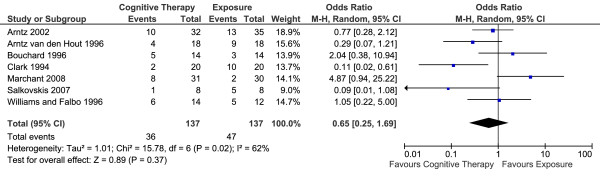
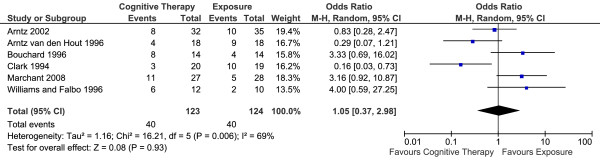
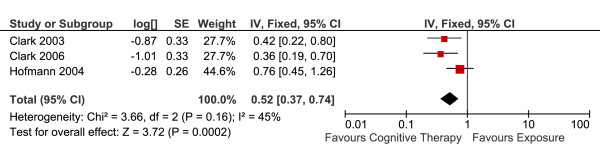
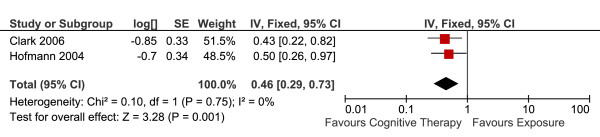
BACKGROUND: There is growing evidence of the effectiveness of Cognitive Behavioural Therapy (CBT) for a wide range of psychological disorders. There is a continued controversy about whether challenging maladaptive thoughts rather than use of behavioural interventions alone is associated with the greatest efficacy. However little is known about the relative efficacy of various components of CBT. This review aims to compare the relative efficacy of Cognitive Therapy (CT) versus Exposure (E) for a range of anxiety disorders using the most clinically relevant outcome measures and estimating the summary relative efficacy by combining the studies in a meta-analysis. METHODS: Psych INFO, MEDLINE and EMBASE were searched from the first available year to May 2010. All randomised controlled studies comparing the efficacy of exposure with cognitive therapy were included. Odds ratios (OR) or standardised means' differences (Hedges' g) for the most clinically relevant primary outcomes were calculated. Outcomes of the studies were grouped according to specific disorders and were combined in meta-analyses exploring short-term and long-term outcomes. RESULTS: 20 Randomised Controlled Trials with (n = 1,308) directly comparing the efficacy of CT and E in anxiety disorders were included in the meta-analysis. No statistically significant difference in the relative efficacy of CT and E was revealed in Post Traumatic Stress Disorder (PTSD), in Obsessive Compulsive Disorder (OCD) and in Panic Disorder (PD). There was a statistically significant difference favouring CT versus E in Social Phobia both in the short-term (Z = 3.72, p = 0.0002) and the long-term (Z = 3.28, p = 0.001) outcomes. CONCLUSIONS: On the basis of extant literature, there appears to be no evidence of differential efficacy between cognitive therapy and exposure in PD, PTSD and OCD and strong evidence of superior efficacy of cognitive therapy in social phobia.
Overview
The claims and statistics of this paper haven’t been checked yet.
Free: it reads the open-access text and checks the first 5 claims that cite a source we can check. Create a free account to check every claim.
Integrity signals
Registry
Cites
Statistics
Figures
Verification
Claims the paper makes
The claims and statistics of this paper haven’t been checked yet.
Free: it reads the open-access text and checks the first 5 claims that cite a source we can check. Create a free account to check every claim.
Claims other papers make about this one
Each is checked against this paper’s own text: does it say what the citing paper says it does?
The source backs part of the claim, not all of it — or backs it for a different population, condition or comparison.
In the citing paper
“Systematic reviews and meta-analyses support that CBT programs are effective in reducing OCD symptoms, with effect sizes ranging from 0.8 to 1.24 from pre to post treatment [10–15].”
From Study protocol for a randomised controlled trial of internet-based cognitive-behavioural therapy for obsessive-compulsive disorder (2014) · cites this paper as [15]
Experimental — accuracy not yet measuredThe cited source says what the claim attributes to it.
In the citing paper
“A recent study by Steketee, Siev, Yovel, Lit, and Wilhelm [32] as well as two meta-analyses showed that CT and ERP both reduced OC symptoms to a similar extent [33, 34].”
From Metacognitive Training for Obsessive-Compulsive Disorder: A study protocol for a randomized controlled trial (2020) · cites this paper as [34]
The cited source says what the claim attributes to it.
In the citing paper
“There is an exception for social anxiety disorder, where cognitive therapies appear to outperform exposure therapy [13,61,62].”
From Short-term effectiveness of web-based guided self-help for phobic outpatients: randomized controlled trial. (2014) · cites this paper as [62]
Self-check
Percentages, sums and reported differences re-computed from the paper’s own numbers.
The self-check needs the paper’s full text.
Citations
Cites
Baron, R. M., & Kenny, D. A. (1986) · Journal of Personality and Social Psychology · doi:10.1037/0022-3514.51.6.1173 · Cited by 91,532 · cited 1×
“The mediation argument is the most complex one as the criteria for mediation differs depending on the study design [53,54].”
BackgroundCochrane Handbook for Systematic Reviews of Interventions: Cochrane Book Series
(2008) · doi:10.1002/9780470712184 · Cited by 25,048
The Yale-Brown Obsessive Compulsive Scale: I. Development, Use, and Reliability
Goodman, W. K. (1989) · Archives of General Psychiatry · doi:10.1001/archpsyc.1989.01810110048007 · Cited by 7,712 · cited 1×
“This is a semi-structured clinician-administered interview providing a score (range 0-40) for both obsessions (range 0-20) and compulsions (range 0-20) along five dimensions: time spent, interference, distress, resistance, and control [19,20].”
BackgroundThe development of a Clinician-Administered PTSD Scale
Blake, D. D., Weathers, F. W., Nagy, L. M., Kaloupek, D. G., Gusman, F. D., Charney, D. S., & Keane, T. M. (1995) · Journal of Traumatic Stress · doi:10.1002/jts.2490080106 · Cited by 5,024 · cited 3×
“CAPS has 30 items, assessor-rated, rating frequency and intensity of the 17 PTSD symptoms and 8 associated features of PTSD (built over acts of commission or omission, survivor guilt, homicidality, disillusionment with authority, hopelessness, memory impairment and forgetfulness, sadness and depression and feeling ove…”
MethodInfluentialPsychotherapy by reciprocal inhibition
Wolpe, J. (1968) · Conditional Reflex · doi:10.1007/bf03000093 · Cited by 3,387
The empirical status of cognitive-behavioral therapy: A review of meta-analyses
Butler, A. C., Chapman, J. E., Forman, E. M., & Beck, A. T. (2006) · Clinical Psychology Review · doi:10.1016/j.cpr.2005.07.003 · Cited by 3,215
The Yale-Brown Obsessive Compulsive Scale: II. Validity
Goodman, W. K. (1989) · Archives of General Psychiatry · doi:10.1001/archpsyc.1989.01810110054008 · Cited by 2,799
Mediators and Moderators of Treatment Effects in Randomized Clinical Trials
Kraemer, H. C., Wilson, G. T., Fairburn, C. G., & Agras, W. S. (2002) · Archives of General Psychiatry · doi:10.1001/archpsyc.59.10.877 · Cited by 2,562 · cited 1×
“The mediation argument is the most complex one as the criteria for mediation differs depending on the study design [53,54].”
BackgroundReliability and validity of a brief instrument for assessing post-traumatic stress disorder
Foa, E. B., Riggs, D. S., Dancu, C. V., & Rothbaum, B. O. (1993) · Journal of Traumatic Stress · doi:10.1002/jts.2490060405 · Cited by 2,537 · cited 1×
“One study used PTSD Symptom Scale - Interview (PSS-I) [29] The scale contains 17 items that diagnose PTSD according to Diagnostic and Statistical Manual of Mental Disorders-III-Revised (DSM-III-R) criteria and assess the severity of PTSD symptoms.”
MethodThe Yale-Brown Obsessive-Compulsive Scale: Measures of internal consistency
Kim, S. W., Dysken, M. W., Pheley, A. M., & Hoover, K. M. (1994) · Psychiatry Research · doi:10.1016/0165-1781(94)90039-6 · Cited by 2,359
The Great Psychotherapy Debate: Models Methods and Findings
Horvath, A. O. (2002) · Psychotherapy Research · doi:10.1093/ptr/12.1.108 · Cited by 1,705
Dimidjian, S., Hollon, S. D., Dobson, K. S., Schmaling, K. B., Kohlenberg, R. J., Addis, M. E., Gallop, R., McGlinchey, J. B., Markley, D. K., Gollan, J. K., et al. (2006) · Journal of Consulting and Clinical Psychology · doi:10.1037/0022-006x.74.4.658 · Cited by 1,607 · cited 1×
“There is some evidence that cognitive interventions and behavioural interventions have similar effect sizes for certain conditions [10] or there is even a superiority of modified behavioural interventions compared with purely cognitive interventions [49].”
BackgroundFoa, E. B., Rothbaum, B. O., Riggs, D. S., & Murdock, T. B. (1991) · Journal of Consulting and Clinical Psychology · doi:10.1037/0022-006x.59.5.715 · Cited by 1,444 · cited 2×
“One study [26] used an aggregate PTSD severity index calculated by adding the interviewer’s severity rating of the following PTSD symptoms: reliving experiences, nightmares, flashbacks, avoidance of reminders and thoughts of the assault, impaired leisure activities (e.”
MethodTurner, S. M., Beidel, D. C., Dancu, C. V., & Stanley, M. A. (1989) · Psychological Assessment: A Journal of Consulting and Clinical Psychology · doi:10.1037/1040-3590.1.1.35 · Cited by 887 · cited 2×
“Two studies used a social phobia composite score as the main outcome measure and one study used Social Phobia and Anxiety Inventory (SPAI) as the main outcome measure.”
MethodResick, P. A., Galovski, T. E., Uhlmansiek, M. O., Scher, C. D., Clum, G. A., & Young-Xu, Y. (2008) · Journal of Consulting and Clinical Psychology · doi:10.1037/0022-006x.76.2.243 · Cited by 825 · cited 1×
“Five studies met the criteria for inclusion in this metaanalysis [23-27] (Table S2, additional file 3).”
Foa, E. B., Dancu, C. V., Hembree, E. A., Jaycox, L. H., Meadows, E. A., & Street, G. P. (1999) · Journal of Consulting and Clinical Psychology · doi:10.1037/0022-006x.67.2.194 · Cited by 808 · cited 1×
“Five studies met the criteria for inclusion in this metaanalysis [23-27] (Table S2, additional file 3).”
Clark, D. M., Salkovskis, P. M., Hackmann, A., Middleton, H., Anastasiades, P., & Gelder, M. (1994) · British Journal of Psychiatry · doi:10.1192/bjp.164.6.759 · Cited by 673 · cited 1×
“Seven studies met the criteria for inclusion in this metaanalysis [30-35] (Table S3, additional file 4).”
Psychological treatment of post-traumatic stress disorder (PTSD)
Bisson, J., & Andrew, M. (2005) · Cochrane Database of Systematic Reviews · doi:10.1002/14651858.cd003388.pub2 · Cited by 654 · cited 1×
“Both CT and E alone or in combination have considerable efficacy for a range of anxiety disorders [8-11].”
BackgroundClark, D. M., Ehlers, A., Hackmann, A., McManus, F., Fennell, M., Grey, N., Waddington, L., & Wild, J. (2006) · Journal of Consulting and Clinical Psychology · doi:10.1037/0022-006x.74.3.568 · Cited by 603 · cited 1×
“Three studies met the inclusion criteria for this meta-analysis [36-38] (Table S4, additional file 5).”
MethodThe researcher's own therapy allegiances: A "wild card" in comparisons of treatment efficacy.
Luborsky, L., Diguer, L., Seligman, D. A., Rosenthal, R., Krause, E. D., Johnson, S., Halperin, G., Bishop, M., Berman, J. S., & Schweizer, E. (1999) · Clinical Psychology: Science and Practice · doi:10.1093/clipsy.6.1.95 · Cited by 572 · cited 1×
“The potential impact of researcher allegiance has been much debated in psychotherapy research [56].”
BackgroundBorkovec, T. D., Newman, M. G., Pincus, A. L., & Lytle, R. (2002) · Journal of Consulting and Clinical Psychology · doi:10.1037/0022-006x.70.2.288 · Cited by 565 · cited 2×
“There are studies examining relative efficacy of exposure and cognitive therapy in other anxiety disorders: hypochondriasis [40] and generalised anxiety disorder (GAD) [41].”
BackgroundClark, D. M., Ehlers, A., McManus, F., Hackmann, A., Fennell, M., Campbell, H., Flower, T., Davenport, C., & Louis, B. (2003) · Journal of Consulting and Clinical Psychology · doi:10.1037/0022-006x.71.6.1058 · Cited by 561 · cited 1×
“Three studies met the inclusion criteria for this meta-analysis [36-38] (Table S4, additional file 5).”
MethodDo we need to challenge thoughts in cognitive behavior therapy?
Longmore, R. J., & Worrell, M. (2007) · Clinical Psychology Review · doi:10.1016/j.cpr.2006.08.001 · Cited by 499
Tarrier, N., Pilgrim, H., Sommerfield, C., Faragher, B., Reynolds, M., Graham, E., & Barrowclough, C. (1999) · Journal of Consulting and Clinical Psychology · doi:10.1037//0022-006x.67.1.13 · Cited by 462 · cited 1×
“Five studies met the criteria for inclusion in this metaanalysis [23-27] (Table S2, additional file 3).”
Psychological treatment of obsessive–compulsive disorder: A meta-analysis
Rosa-Alcázar, A. I., Sánchez-Meca, J., Gómez-Conesa, A., & Marín-Martínez, F. (2008) · Clinical Psychology Review · doi:10.1016/j.cpr.2008.07.001 · Cited by 444 · cited 2×
“There is some evidence that cognitive interventions and behavioural interventions have similar effect sizes for certain conditions [10] or there is even a superiority of modified behavioural interventions compared with purely cognitive interventions [49].”
BackgroundWhittal, M. L., Thordarson, D. S., & McLean, P. D. (2005) · Behaviour Research and Therapy · doi:10.1016/j.brat.2004.11.012 · Cited by 397 · cited 1×
“Their results were reported in six articles [13-18] (Table S1, additional file 2).”
BackgroundCognitive therapy and exposure in vivo in the treatment of obsessive–compulsive disorder
Van Oppen, P., De Haan, E., Van Balkom, A. J. L. M., Spinhoven, P., Hoogduin, K., & Van Dyck, R. (1995) · Behaviour Research and Therapy · doi:10.1016/0005-7967(94)00052-l · Cited by 350 · cited 1×
“Their results were reported in six articles [13-18] (Table S1, additional file 2).”
BackgroundCognitive mediation of treatment change in social phobia
Hofmann, S. G. (2004) · Journal of Consulting and Clinical Psychology · doi:10.1037/0022-006x.72.3.392 · Cited by 348 · cited 4×
“46) and in one study was based on a manual developed by the investigators and tested in previous studies [38].”
BackgroundMethodInfluentialPsychological treatment of social anxiety disorder: a meta-analysis
Acarturk, C., Cuijpers, P., van Straten, A., & de Graaf, R. (2009) · Psychological Medicine · doi:10.1017/s0033291708003590 · Cited by 333 · cited 1×
“Both CT and E alone or in combination have considerable efficacy for a range of anxiety disorders [8-11].”
BackgroundCognitive versus behavior therapy in the group treatment of obsessive–compulsive disorder
McLean, P. D., Whittal, M. L., Thordarson, D. S., Taylor, S., Söchting, I., Koch, W. J., Paterson, R., & Anderson, K. W. (2001) · Journal of Consulting and Clinical Psychology · doi:10.1037/0022-006x.69.2.205 · Cited by 332 · cited 1×
“The guideline development group conducted several comparisons, however only one study was used to compare the efficacy of CT v ERP [57].”
MethodThe researcher's own therapy allegiances: a ''wild card'' in comparisons of treatment efficacy
Luborsky, L. (1999) · Clinical Psychology Science and Practice · doi:10.1093/clipsy/6.1.95 · Cited by 308
Cottraux, J., Note, I., Yao, S. N., Lafont, S., Note, B., Mollard, E., Bouvard, M., Sauteraud, A., Bourgeois, M., & Dartigues, J.-F. (2001) · Psychotherapy and Psychosomatics · doi:10.1159/000056269 · Cited by 298 · cited 1×
“Their results were reported in six articles [13-18] (Table S1, additional file 2).”
BackgroundPsychological treatment of panic disorder with or without agoraphobia: A meta-analysis
Sánchez-Meca, J., Rosa-Alcázar, A. I., Marín-Martínez, F., & Gómez-Conesa, A. (2010) · Clinical Psychology Review · doi:10.1016/j.cpr.2009.08.011 · Cited by 291
Two psychological treatments for hypochondriasis: A randomised controlled trial
Clark, D. M., Salkovskis, P. M., Hackmann, A., Wells, A., Fennell, M., Ludgate, J., Ahmad, S., Richards, H. C., & Gelder, M. (1998) · British Journal of Psychiatry · doi:10.1192/bjp.173.3.218 · Cited by 270 · cited 1×
“There are studies examining relative efficacy of exposure and cognitive therapy in other anxiety disorders: hypochondriasis [40] and generalised anxiety disorder (GAD) [41].”
BackgroundSelf-images play a causal role in social phobia
Hirsch, C. R., Clark, D. M., Mathews, A., & Williams, R. (2003) · Behaviour Research and Therapy · doi:10.1016/s0005-7967(02)00103-1 · Cited by 265 · cited 1×
“For instance, the impact of video feedback, imagery work and the negative consequences of self-directed attention have all been demonstrated experimentally [47,48].”
BackgroundSocial phobia: Effects of external attention on anxiety, negative beliefs, and perspective taking
Wells, A., & Papageorgiou, C. (1998) · Behavior Therapy · doi:10.1016/s0005-7894(98)80037-3 · Cited by 252 · cited 1×
“In addition, there are studies demonstrating that behavioural experiments may be more effective in anxiety reduction than exposure alone [46] particularly when an external focus of attention is used for confronting social anxiety-provoking situations.”
BackgroundVAN BALKOM, A. J. L. M., DE HAAN, E., VAN OPPEN, P., SPINHOVEN, P., HOOGDUIN, K. A. L., & VAN DYCK, R. (1998) · The Journal of Nervous & Mental Disease · doi:10.1097/00005053-199808000-00007 · Cited by 250 · cited 2×
“Their results were reported in six articles [13-18] (Table S1, additional file 2).”
BackgroundHarvey, A. G., Clark, D. M., Ehlers, A., & Rapee, R. M. (2000) · Behaviour Research and Therapy · doi:10.1016/s0005-7967(99)00148-5 · Cited by 207 · cited 1×
“For instance, the impact of video feedback, imagery work and the negative consequences of self-directed attention have all been demonstrated experimentally [47,48].”
BackgroundCognitive therapy with obsessive-compulsive disorder: A comparative evaluation
Emmelkamp, P. M. G., & Beens, H. (1991) · Behaviour Research and Therapy · doi:10.1016/0005-7967(91)90120-r · Cited by 175 · cited 8×
“Exposure has been described as the most effective way to treat fear [6] Research indicates that the efficacy of exposure is optimal when it is graduated, repeated and prolonged with practice tasks clearly specified [6].”
BackgroundInfluentialSalkovskis, P. M., Hackmann, A., Adrian Wells, A., Gelder, M., & Clark, D. M. (2007) · Behaviour Research and Therapy · doi:10.1016/j.brat.2006.02.008 · Cited by 166 · cited 3×
“There is plenty of evidence documenting cognitive changes early in the cognitive treatment [33,52].”
BackgroundMethodCognitive therapy vs. exposure in vivo in the treatment of obsessive–compulsives
Emmelkamp, P. M. G., Visser, S., & Hoekstra, R. J. (1988) · Cognitive Therapy and Research · doi:10.1007/bf01172784 · Cited by 160 · cited 8×
“Exposure has been described as the most effective way to treat fear [6] Research indicates that the efficacy of exposure is optimal when it is graduated, repeated and prolonged with practice tasks clearly specified [6].”
BackgroundInfluentialSPECIFICITY OF COGNITIVE BIASES IN SOCIAL PHOBIA AND THEIR ROLE IN RECOVERY
McManus, F., Clark, D. M., & Hackmann, A. (2000) · Behavioural and Cognitive Psychotherapy · doi:10.1017/s1352465800003015 · Cited by 141 · cited 3×
“The literature on cognitive change as a mediator of improvement is growing, although it remains somewhat inconsistent [38,42,55].”
BackgroundCognitive mechanisms of social anxiety reduction: an examination of specificity and temporality
Smits, J. A. J., Rosenfield, D., McDonald, R., & Telch, M. J. (2006) · Journal of Consulting and Clinical Psychology · doi:10.1037/0022-006x.74.6.1203 · Cited by 138 · cited 1×
“The literature on cognitive change as a mediator of improvement is growing, although it remains somewhat inconsistent [38,42,55].”
Backgroundde Haan, E., van Oppen, P., van Balkom, A. J. L. M., Spinhoven, P., Hoogduin, K. A. L., & van Dyck, R. (1997) · Acta Psychiatrica Scandinavica · doi:10.1111/j.1600-0447.1997.tb09929.x · Cited by 136 · cited 1×
“Their results were reported in six articles [13-18] (Table S1, additional file 2).”
BackgroundMarks, I. M. (1979) · Psychological Medicine · doi:10.1017/s0033291700033961 · Cited by 129 · cited 1×
“Exposure has been described as the most effective way to treat fear [6] Research indicates that the efficacy of exposure is optimal when it is graduated, repeated and prolonged with practice tasks clearly specified [6].”
BackgroundWilliams, S. L., & Falbo, J. (1996) · Behaviour Research and Therapy · doi:10.1016/0005-7967(95)00063-1 · Cited by 124 · cited 1×
“Seven studies met the criteria for inclusion in this metaanalysis [30-35] (Table S3, additional file 4).”
Does behavioral treatment of social phobia lead to cognitive changes?
Newman, M. G., Hofmann, S. G., Trabert, W., Roth, W. T., & Taylor, C. B. (1994) · Behavior Therapy · doi:10.1016/s0005-7894(05)80160-1 · Cited by 121
Whittal, M. L., Robichaud, M., Thordarson, D. S., & McLean, P. D. (2008) · Journal of Consulting and Clinical Psychology · doi:10.1037/a0013076 · Cited by 110
Cognitive therapy versus interoceptive exposure as treatment of panic disorder without agoraphobia
Arntz, A. R. (2002) · Behaviour Research and Therapy · doi:10.1016/s0005-7967(01)00014-6 · Cited by 109 · cited 2×
“Seven studies met the criteria for inclusion in this metaanalysis [30-35] (Table S3, additional file 4).”
MethodOugrin, D., Zundel, T., Ng, A., Banarsee, R., Bottle, A., & Taylor, E. (2011) · Archives of Disease in Childhood · doi:10.1136/adc.2010.188755 · Cited by 106
Self-citationExposure versus cognitive restructuring in the treatment of panic disorder with agoraphobia
Bouchard, S., Gauthier, J., Laberge, B., French, D., Pelletier, M.-H., & Godbout, C. (1996) · Behaviour Research and Therapy · doi:10.1016/0005-7967(95)00077-1 · Cited by 102 · cited 1×
“Seven studies met the criteria for inclusion in this metaanalysis [30-35] (Table S3, additional file 4).”
Clark, D. A. (1995) · Journal of Cognitive Psychotherapy · doi:10.1891/0889-8391.9.3.153 · Cited by 91 · cited 1×
“For the purposes of this review the definition of cognitive therapy (CT) will be based on the work of David Clark [7] and could be summarised as follows: CT is the process of collaboration between the therapist and the patient leading to the identification of distorted thoughts (and/or maladaptive beliefs or assumptio…”
MethodCommentary. Rapid response to cognitive behavior therapy
Wilson, G. T. (1999) · Clinical Psychology Science and Practice · doi:10.1093/clipsy/6.3.289 · Cited by 90
Exposure and Response Prevention.
Rowa, K., Antony, M. M., & Swinson, R. P. (2007) · American Psychological Association eBooks · doi:10.1037/11543-004 · Cited by 71
Common misconceptions about cognitive mediation of treatment change: A commentary to
Hofmann, S. G. (2008) · Clinical Psychology Review · doi:10.1016/j.cpr.2007.03.003 · Cited by 62 · cited 1×
“There is a continued controversy about whether challenging maladaptive thoughts rather than use of behavioural interventions alone is associated with the greatest efficacy [2,3].”
BackgroundOugrin, D., Zundel, T., Kyriakopoulos, M., Banarsee, R., Stahl, D., & Taylor, E. (2012) · Psychological Assessment · doi:10.1037/a0025043 · Cited by 59 · cited 5×
“This issue appears central to any further enquiry into specific mediators of CBT effect.”
BackgroundInfluentialSelf-citationHayes, A. M., Hope, D. A., & Hayes, S. (2007) · Clinical Psychology Review · doi:10.1016/j.cpr.2007.01.006 · Cited by 37 · cited 1×
“The rapid response argument [50] centres on the idea that many patients show an improvement early in the course of CBT [51] making the effect of cognitive interventions an unlikely mediator of this change (on the assumptions that cognitive interventions require several weeks to be implemented fully) 3.”
BackgroundOzonoff, S. J. (2010) · The biomedical & life sciences collection. · doi:10.69645/gczv2449 · Cited by 37
Vögele, C., Ehlers, A., Meyer, A. H., Frank, M., Hahlweg, K., & Margraf, J. (2010) · Depression and Anxiety · doi:10.1002/da.20651 · Cited by 33 · cited 1×
“There is also growing evidence of the role cognitive mediation might play in achieving clinical improvement during exposure therapy [44].”
BackgroundMarchand, A., Coutu, M., Dupuis, G., Fleet, R. P., Borgeat, F., Todorov, C., & Mainguy, N. (2008) · Cognitive Behaviour Therapy · doi:10.1080/16506070701743120 · Cited by 27 · cited 1×
“Seven studies met the criteria for inclusion in this metaanalysis [30-35] (Table S3, additional file 4).”
Hecker, J. E., Fink, C. M., Vogeltanz, N., Thorpe, G., & Sigmon, S. T. (1998) · Behavioural and Cognitive Psychotherapy · doi:10.1017/s1352465898000137 · Cited by 16 · cited 1×
“The comparisons between cognitive and behavioural interventions used to inform the guideline development was based on two studies [30,58] one of which was excluded from this meta-analysis due to the main outcome measure not being reported [58].”
MethodMarks, I., Lovell, K., Noshirvani, H., Livanou, M., & Thrasher, S. (1998) · Archives of General Psychiatry · doi:10.1001/archpsyc.55.4.317 · Cited by 5 · cited 1×
“Five studies met the criteria for inclusion in this metaanalysis [23-27] (Table S2, additional file 3).”
Cognitive therapy: Looking backward, looking forward
Dobson (2000) · doi:10.1002/1097-4679(200007)56:7<907::aid-jclp9>3.0.co;2-i
Research works printed but not linked: 1
- Higgins JPT Green S Eds Cochrane Handbook for Systematic Reviews of Interventions 2008 Chichester: Wiley-Blackwell
Cited by
Katzman, M. A., Bleau, P., Blier, P., Chokka, P., Kjernisted, K., Van Ameringen, M., & the Canadian Anxiety Guidelines Initiative Group on behalf of the Anxiety Disorders Association of Canada/Association Canadienne des troubles anxieux and McGill University (2014) · BMC Psychiatry · doi:10.1186/1471-244x-14-s1-s1 · Cited by 1,090
“The guidelines include panic disorder, agoraphobia, specific phobia, social anxiety disorder (SAD), generalized anxiety disorder (GAD), as well as obsessive-compulsive disorder (OCD), and posttraumatic stress disorder (PTSD).”
BackgroundResultInfluentialCarpenter, J. K., Andrews, L. A., Witcraft, S. M., Powers, M. B., Smits, J. A. J., & Hofmann, S. G. (2018) · Depression and Anxiety · doi:10.1002/da.22728 · Cited by 846
“This is inconsistent with an earlier head-to-head comparison that led the author to conclude that exposure and cognitive treatments tend to be equally effective (Ougrin, 2011); however, this interpretation was based on comparisons of relatively small numbers of trials and thereforemay be biased.”
ResultBaldwin, D. S., Anderson, I. M., Nutt, D. J., Allgulander, C., Bandelow, B., den Boer, J. A., Christmas, D. M., Davies, S., Fineberg, N., Lidbetter, N., et al. (2014) · Journal of Psychopharmacology · doi:10.1177/0269881114525674 · Cited by 676
“CBT is efficacious in adults [I (M)] (Hofmann and Smits, 2008) and children [I (M)] (James et al., 2005): cognitive therapy appears superior to exposure therapy [I (M)] (Ougrin, 2011), but the evidence for the efficacy of social skills training is less strong [IV] (Ponniah and Hollon, 2008).”
BackgroundObsessive-Compulsive Disorder: Advances in Diagnosis and Treatment
Hirschtritt, M. E., Bloch, M. H., & Mathews, C. A. (2017) · JAMA · doi:10.1001/jama.2017.2200 · Cited by 493
Controlled trial of psychotherapy for Congolese survivors of sexual violence
Bass, J. K., Annan, J., McIvor Murray, S., Kaysen, D., Griffiths, S., Cetinoglu, T., Wachter, K., Murray, L. K., & Bolton, P. A. (2013) · New England Journal of Medicine · doi:10.1056/nejmoa1211853 · Cited by 423
“6 mo after end of treatment 12/138 (9) 73/175 (42) 4.”
Metadata
- Authors
- Ougrin, D.
- Affiliations
- King's College London (GB)
- Corresponding author
- Ougrin, Dennis
- ORCID
- Ougrin, Dennis
- Venue
- BMC Psychiatry
- Published
- 2011-12
- Volume
- 11
- Issue
- 1
- Pages
- 200-200
- ISSN
- 1471-244X (ISSN-L)
- PMC
- PMC3347982
- OpenAlex
- W2167240603
- Cited by
- 201
- References
- 65
- Citations by year
- 2026: 10 · 2025: 12 · 2024: 10 · 2023: 14 · 2022: 8 · 2021: 15 · 2020: 17 · 2019: 22 · 2018: 16 · 2017: 14 · 2016: 12 · 2015: 14 · 2014: 18 · 2013: 16 · 2012: 3
- FWCI
- 1.57
- Type
- journal article
- Language
- en
- Open access
- gold
- doi.org
- Licence
- Locations
- BMC Psychiatry (publishedVersion, cc-by)
- Europe PMC (PubMed Central) (publishedVersion, cc-by)
- PubMed Central (publishedVersion, cc-by)
- PubMed (publishedVersion)
- Research Portal (King's College London) (publishedVersion, other-oa)
- DOAJ (DOAJ: Directory of Open Access Journals) (submittedVersion, cc-by-sa)
- Funders
- Psychiatry Research Trust
- Topics
- Social Sciences › Psychology › Experimental and Cognitive Psychology › Anxiety, Depression, Psychometrics, Treatment, Cognitive Processes
- Social Sciences › Psychology › Clinical Psychology › Psychological Treatments and Assessments
- Social Sciences › Psychology › Clinical Psychology › Psychotherapy Techniques and Applications
- Keywords
- cognitive therapy, exposure therapy, anxiety disorders, cognitive behavioral therapy, social anxiety disorder, post-traumatic stress disorder, obsessive-compulsive disorder, panic disorder, short-term and long-term outcomes
- MeSH terms
- Anxiety Disorders, Behavior Therapy, Humans, Implosive Therapy, Odds Ratio, Randomized Controlled Trials as Topic, Comparative Effectiveness Research
About these checks
Registry, retraction, Cites and statistics results are computed, not judged, with one exception: a printed reference that no index lists is read once by a model before it counts as a citation error. Claims are extracted by a model and kept only when their quote appears verbatim in the text; each cited source is then checked, with a model’s help, for whether it says what the claim relies on. Those verdicts can be wrong — read the claim’s quote and the cited source before relying on one.
Statistics and arithmetic are recomputed, not judged.
Confidence bands are shown only for fields calibrated on our annotated test set. None is calibrated yet, so no band is shown.
What counts as a claim ›How we measure confidence ›How we check this ›
Are you an author, or do you see a problem with this page? Request a review
Data sources
Bibliographic data: Semantic Scholar, OpenAlex, Crossref.
Contains information from the Semantic Scholar Academic Graph Datasets, made available under the ODC Attribution License (ODC-BY 1.0).
Semantic Scholar’s data is described in: Kinney, R., et al. (2023). The Semantic Scholar Open Data Platform. arXiv:2301.10140.
