

The DOI matches its Crossref record; 97 of the 99 references it cites were found in a registry or an index; 19 of the 89 sources its claims cite were checked for support.
Metacognitive Training for Obsessive-Compulsive Disorder: a study protocol for a randomized controlled trial
Open accessAbstract
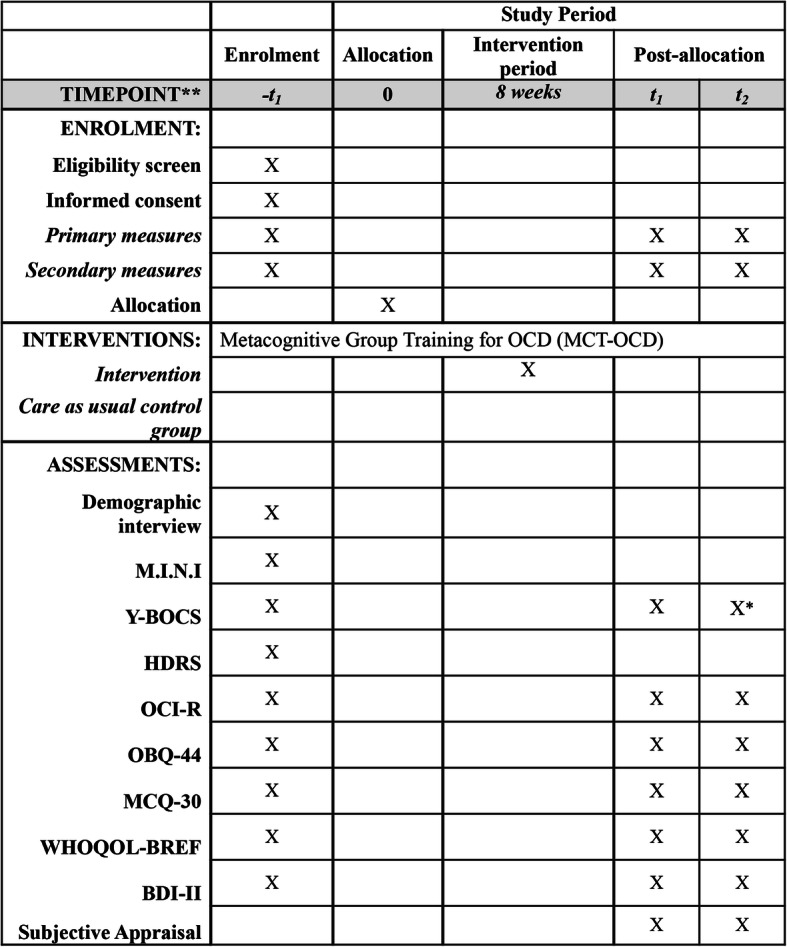
Background: A high number of patients with obsessive-compulsive disorder (OCD) do not receive cognitive-behavioral therapy with exposure and response prevention, which is the most effective treatment for OCD. Therefore, Metacognitive Training for OCD (MCT-OCD) was developed, which is a structured group therapy aiming at the modification of dysfunctional (meta-)cognitive biases, beliefs and coping styles. It can be administered by less trained personnel, thus may reach a higher number of patients. An uncontrolled pilot study (MCT-OCD pilot version) provided first evidence that the training is highly accepted by patients; OC symptoms decreased with a high effect size (η2partial = 0.50). The aim of the present study is to address the shortcomings of the pilot study (e.g., no control group) and to assess the efficacy of the revised version of the MCT-OCD in the framework of a randomized controlled trial. Methods: Eighty patients with OCD will be recruited. After a blinded assessment at baseline (-t1), patients will be randomly assigned either to the intervention group (MCT-OCD; n = 40) or to a care as usual control group (n = 40). The MCT-OCD aims to enhance patients' metacognitive competence in eight modules by addressing dysfunctional (meta-)cognitive biases and beliefs associated with OCD (e.g., intolerance of uncertainty). After 8 weeks, patients will be invited to a post assessment (t1), and then they will receive a follow-up online questionnaire 3 months following t1 (t2). The primary outcome is the Y-BOCS total score, and the secondary outcomes include the HDRS, OCI-R, OBQ-44, MCQ-30, WHOQOL-BREF, BDI-II, and subjective appraisal ratings of the MCT-OCD. We expect that OC symptoms will decrease more in the intervention group compared with the care as usual control group from-t1 to t1 and that treatment gains will be maintained until t2. Discussion: The planned study is the first to investigate the MCT-OCD, a promising new treatment, in a randomized controlled trial. The MCT-OCD may help to overcome existing treatment barriers for patients with OCD. Trial registration: German Registry for Clinical Studies (DRKS00013539), 22.02.2018. © 2020 The Author(s).
Overview
CoChat Summary
TL;DR
This paper is a study protocol for an assessor-blind randomized controlled trial testing revised Metacognitive Training for OCD (MCT-OCD) against care as usual in 80 patients with OCD. It aims to see whether the group intervention reduces Yale-Brown Obsessive Compulsive Scale (Y-BOCS) scores more than usual care over 8 weeks and whether gains persist at 3-month follow-up.
Key findings
- This is a protocol paper, so it reports no trial results yet; at submission, “no data had yet been analyzed.”
- The planned sample is 80 patients with OCD, randomized 40 to MCT-OCD and 40 to care as usual.
- The primary outcome is the Y-BOCS total score; secondary outcomes include HDRS, OCI-R, OBQ-44, MCQ-30, WHOQOL-BREF, BDI-II, and subjective appraisal ratings.
- The protocol is motivated by prior evidence from an uncontrolled pilot: acceptability was high, with 89.7% of patients saying they would recommend MCT-OCD, and OC symptoms decreased with a large effect size (η2partial = 0.50).
Methods
- Assessor-blind randomized controlled trial with two arms: MCT-OCD versus care as usual; baseline, post-treatment at 8 weeks, and follow-up at 3 months after post.
- Planned recruitment of 80 adults aged 18–70 with OCD, diagnosed by the MINI 7.0.2; participants could continue existing outpatient psychotherapy and/or pharmacological treatment.
- Main analysis plan: intention-to-treat and complete cases analyses, with ANCOVAs comparing groups and multiple imputation for missing values.
Limitations
- The paper states that the care as usual control group may not remove expectancy effects, unlike an active control.
- It also states that follow-up relies on self-rated Y-BOCS, which has disadvantages such as social desirability; this is a limitation the text explicitly acknowledges.
- Evident from the protocol design: this paper cannot report efficacy findings because it is a study protocol and, at submission, no data had yet been analyzed.
Model-written summary. Check it against the paper before relying on it.
Integrity signals
Registry
Cites
Statistics
Figures
Verification
Claims the paper makes
18 Valid · 1 Not valid · 35 Not checked · 28 Own results and interpretations
The cited sources support only part of this claim — read each source’s verdict below.
In the paper
“Moreover, the dropout rate for ERP is quite high (14.7%) [96]”
§ Metacognitive Training for Obsessive-Compulsive Disorder: a study protocol for a randomized controlled trial > Background > Psychological treatments for patients with OCD
What the sources say
- Partly supportedcites [96] Ong CW, Clyde JW, Bluett EJ, Levin ME, Twohig MP. Dropout rates in exposure with response prevention for obsessive-compulsive disorder: what do the data really say? J Anxiety Disord. 2016;40:8–17 https://doi.org/10.1016/J.JANXDIS.2016.03.006. sourceExperimental — accuracy not yet measured
Section 2.2 reports a weighted mean ERP dropout rate of 14.7%. The Discussion says this was lower than earlier estimates and comparable to dropout rates for other treatments, so the characterization 'quite high' is not supported by the paper's comparisons. (LLM, conf=0.88)
plain- Asserted: passes — The authors put it forward as true.
- Checkable: passes — It can be checked against evidence.
- Load-bearing: passes — The paper’s conclusions depend on it.
- Based: passes — The paper gives a reason why it holds.
- Partly supported
Every source the paper cites for this claim was checked and supports it.
In the paper
“OCD and depression have a very high comorbidity [61].”
- Also stated in: § Discussion · plain
“OCD and depression have a high comorbidity [61]”
§ Metacognitive Training for Obsessive-Compulsive Disorder: a study protocol for a randomized controlled trial > Methods > Intervention The MCT-OCD aims to modify dysfunctional (meta-)cognitive biases, beliefs as well as dysfunctional coping strategies that contribute to the development and maintenance of OC symptoms. The number of modules has been increased from four (pilot version) to eight (revised version) and the length of the sessions extended from 60 to 90 min (over the period of 8 weeks) in order to provide more time for the presentation of the content as well as for addressing the concerns of patients. Two persons who do not have much experience in conducting group therapies and have not completed a training course (one a psychologist undergoing post-graduate training and the other an assisting intern with a bachelor’s degree) will conduct the sessions. Three to ten patients will take part in each session. As the MCT-OCD has an open group format, patients can join the group at any time. At the beginning of their first session, patients will receive a booklet that includes a summary as well as exercises for each module. Six of the eight modules deal with one dysfunctional (meta-)cognitive belief, bias or coping strategy at a time and follow the same structure: (1) an explanation of the general idea of the metacognitive training (only if new participants join the group), (2) a discussion of the exercises from the previous session, (3) an introduction of the dysfunctional (meta-)cognitive belief, bias or dysfunctional coping strategy, (4) examples and emphasis of the relevance for OCD, (5) a presentation and the practicing of techniques to overcome these (meta-)cognitive biases, beliefs or coping strategies, (6) a recap of the main content of the present module, and (7) the possibility for patients to ask questions and to say what they found most helpful. One exception is module #1 (false assumptions about OCD), which teaches patients very basic information about OCD by clarifying false assumption about the disorder. The second exception is module #8 (biased attention/biased cognitive networks), which addresses two cognitive biases (both are relatively short), but the structure is the same as in the other modules. Modules #3 and #6 include additional slides on how to deal with depression and rumination because OCD and depression have a very high comorbidity [61]. If a participant reports negative effects from the MCT-OCD, the therapist will assist the patient in finding another treatment.
What the sources say
- Supportedcites [61] Rickelt J, Viechtbauer W, Lieverse R, Overbeek T, van Balkom AJ, van Oppen P, et al. The relation between depressive and obsessive-compulsive symptoms in obsessive-compulsive disorder: results from a large, naturalistic follow-up study. J Affect Disord. 2016;203:241–7 https://doi.org/10.1016/j.jad.2016.06.009. source
The Introduction describes major depressive disorder as one of the most frequent comorbid diagnoses in OCD and reports current comorbidity in approximately one third of patients and lifetime comorbidity in about two thirds. The Discussion also refers to the high prevalence of current and lifetime MDD in OCD patients. (LLM, conf=0.94)
boostedstates an association- Asserted: passes — The authors put it forward as true.
- Checkable: passes — It can be checked against evidence.
- Load-bearing: passes — The paper’s conclusions depend on it.
- Based: passes — The paper gives a reason why it holds.
- Also stated in: § Discussion · plain
Every source the paper cites for this claim was checked and supports it.
In the paper
“To detect a medium to large effect size of d = 0.80, with an alpha level of α = 0.05 and a power of 0.80, G*Power [66] calculated a sample size of N = 70.”
§ Metacognitive Training for Obsessive-Compulsive Disorder: a study protocol for a randomized controlled trial > Methods > Sample size
What the sources say
- Supportedcites [66] Faul F, Erdfelder E, Lang A-G, Buchner A. G*power 3: a flexible statistical power analysis program for the social, behavioral, and biomedical sciences. Behav Res Methods. 2007;39:175–91. source
The A Priori Power Analyses and Program Handling sections identify G*Power as a program that calculates sample size from effect size, significance level, and desired power. The citation identifies the software used for the citing authors’ calculation; the source paper does not itself report their N = 70 result. (LLM, conf=0.86)
plainn = 70- Asserted: passes — The authors put it forward as true.
- Checkable: passes — It can be checked against evidence.
- Load-bearing: passes — The paper’s conclusions depend on it.
- Based: passes — The paper gives a reason why it holds.
- Supported
Every source the paper cites for this claim was checked and supports it.
In the paper
“Using a non-randomized-design, Wells’ metacognitive therapy was compared to group CBT in OCD, and the metacognitive therapy showed a superior response rate (a 86.3% response rate for metacognitive therapy compared to a 64% response rate for CBT) [37].”
§ Metacognitive Training for Obsessive-Compulsive Disorder: a study protocol for a randomized controlled trial > Background > Psychological treatments for patients with OCD
What the sources say
- Supportedcites [37] Papageorgiou C, Carlile K, Thorgaard S, Waring H, Haslam J, Horne L, et al. Group cognitive-behavior therapy or group metacognitive therapy for obsessive-compulsive disorder? Benchmarking and Comparative Effectiveness in a Routine. Clin Serv Front Psychol. 2018;9:2551 https://doi.org/10.3389/fpsyg.2018.02551. source
Table 3 in the Results reports response rates of 82/95 (86.3%) for group MCT and 80/125 (64%) for group CBT; the Results also state that the difference was statistically significant. The Introduction describes the treatments as successive cohorts in a routine clinical service, consistent with a non-randomized comparison, and the Methods identify MCT as following Wells’ approach. Our copy provides no page numbers for these passages. (LLM, conf=0.94)
plainstates a cause- Asserted: passes — The authors put it forward as true.
- Checkable: passes — It can be checked against evidence.
- Load-bearing: passes — The paper’s conclusions depend on it.
- Based: passes — The paper gives a reason why it holds.
- Supported
The cited sources support only part of this claim — read each source’s verdict below.
In the paper
“because OCD and depression have a lifetime comorbidity of 56.6% [61] and share some dysfunctional beliefs and coping strategies, such as rumination [62–64].”
§ Metacognitive Training for Obsessive-Compulsive Disorder: a study protocol for a randomized controlled trial > Background > Specific contents of the MCT-OCD
What the sources say
- Not checked — no full text of the sourcecites [62] Abramowitz JS, Storch EA, Keeley M, Cordell E. Obsessive-compulsive disorder with comorbid major depression: what is the role of cognitive factors? Behav Res Ther. 2007;45:2257–67 https://doi.org/10.1016/j.brat.2007.04.003. source
- Partly supportedcites [63] Motivala SJ, Arellano M, Greco RL, Aitken D, Hutcheson N, Tadayonnejad R, et al. Relationships between obsessive-compulsive disorder, depression and functioning before and after exposure and response prevention therapy. Int J Psychiatry Clin Pract. 2018;22:40–6 https://doi.org/10.1080/13651501.2017.1351991. sourceExperimental — accuracy not yet measured
The Objective section describes rumination as important in depression and associated with OCD, and explains how beliefs in OCD can trigger rumination as a way to manage distressing thoughts. It does not establish that OCD and depression share the same dysfunctional beliefs, although it supports rumination as a process relevant to both. (LLM, conf=0.83)
- Not checked — no full text of the sourcecites [64] Shaw AM, Carbonella JY, Arditte Hall KA, Timpano KR. Obsessive-compulsive and depressive symptoms: the role of depressive cognitive styles. J Psychol. 2017;151:532–46 https://doi.org/10.1080/00223980.2017.1372341. source
plainstates an association- Asserted: passes — The authors put it forward as true.
- Checkable: passes — It can be checked against evidence.
- Load-bearing: passes — The paper’s conclusions depend on it.
- Based: passes — The paper gives a reason why it holds.
29 more claims · 9 with their cited sources checked
Create a free account to see all 82 claims and every source verdict.
- It may state two separate claims as one. 26
- Probably not a substantial claim. 32
Self-check
Percentages, sums and reported differences re-computed from the paper’s own numbers.
Rated minor: it would not touch a result — a value no result rests on, a p-value that stays on the same side of the significance level, or a conflict that is clerical, resolved elsewhere in the paper, or outside its own findings.
In the paper
“The severity is rated on a scale ranging from one to five, with a maximum rating of 52.”
§ Metacognitive Training for Obsessive-Compulsive Disorder: a study protocol for a randomized controlled trial > Methods > Secondary outcome measures
Reported 52 · recomputed 85
Citations
Cites
Faul, F., Erdfelder, E., Lang, A.-G., & Buchner, A. (2007) · Behavior Research Methods · doi:10.3758/bf03193146 · Cited by 65,971 · cited 2×
“To detect a medium to large effect size of d = 0.80, with an alpha level of α = 0.05 and a power of 0.80, G*Power [66] calculated a sample size of N = 70.”
BackgroundInfluentialHamilton, M. (1960) · Journal of Neurology, Neurosurgery & Psychiatry · doi:10.1136/jnnp.23.1.56 · Cited by 32,817 · cited 8×
“Inventory-II (BDI-II) [88] and the Hamilton Depression Rating Scale (HDRS) [70], which focus on different facets of depression.”
MethodInfluentialEysenck, H. J. (1985) · Behaviour Research and Therapy · doi:10.1016/0005-7967(85)90087-7 · Cited by 31,975
“Stress: appraisal and coping,”
Folkman, S. (2013) · Encyclopedia of Behavioral Medicine · doi:10.1007/978-1-4419-1005-9_215 · Cited by 27,833
(1998) · The Journal of Clinical Psychiatry · Cited by 19,139
Metacognition and cognitive monitoring: A new area of cognitive–developmental inquiry
Flavell, J. H. (1979) · American Psychologist · doi:10.1037/0003-066x.34.10.906 · Cited by 11,282 · cited 1×
“A treatment approach that builds upon the metacognitive model [10] and focuses on dysfunctional (1)Metacognition is defined as thinking about thinking or as cognition about cognitive processes [14].”
Background(1998) · PubMed · Cited by 10,216
The Yale-Brown Obsessive Compulsive Scale: I. Development, Use, and Reliability
Goodman, W. K. (1989) · Archives of General Psychiatry · doi:10.1001/archpsyc.1989.01810110048007 · Cited by 7,712 · cited 9×
“administered in person at baseline and post assessment and assessed online at follow-up [68].”
BackgroundInfluentialBeck, A. T., Steer, R. A., & Brown, G. (2011) · PsycTESTS Dataset · doi:10.1037/t00742-000 · Cited by 7,535
Emotional processing of fear: Exposure to corrective information.
Foa, E. B., & Kozak, M. J. (1986) · Psychological Bulletin · doi:10.1037/0033-2909.99.1.20 · Cited by 5,396
Research works printed but not linked: 5
- Wells A. Emotional disorders and metacognition: innovative cognitive therapy: Wiley; 2000.
- Bundespsychotherapeutenkammer. Ein Jahr nach der Reform der Psychotherapie-Richtlinie. Wartezeiten. 2018;2018:40.
- Schmidt K-H, Metzler P. Wortschatztest. Weihnheim: Beltz Test; 1992. https://katalog.ub.uni-heidelberg.de/cgi-bin/titel.cgi?katkey=65562637. Accessed 16 Aug 2018.
- Obsessive Compulsive Cognitions Working Group. Cognitive assessment of obsessive-compulsive disorder. Obsessive Compulsive Cognitions Working Group. Behav Res Ther. 1997;35:667–81. · DOI · Paper page
- Moritz S, Woodward TS. Metacognitive training for schizofrenia pazients (MTC): a pilot study on feasibility, treatment adherence, and subjective efficacy. Ger J Psychiatry. 2007;10:69–78.
Cited by
Metacognitive Training for Obsessive-Compulsive Disorder: A randomized controlled trial
Miegel, F. S., Moritz, S., Hottenrott, B., Demiralay, C., & Jelinek, L. (2021) · Journal of Obsessive-Compulsive and Related Disorders · doi:10.1016/j.jocrd.2021.100647 · Cited by 29
Self-citationSyaiful, S., Huda, N., Mukminin, A., & Kamid, K. (2022) · SN Social Sciences · doi:10.1007/s43545-022-00325-8 · Cited by 41
“By developing awareness in metacognition, students are expected to be consistently used to monitor, control, and evaluate what they have done (Faivre et al. 2020; Miegel et al. 2020; Thorslund et al. 2020; Yusnaeni et al. 2020).”
BackgroundGohari, E., Moore, R. C., Depp, C. A., Ackerman, R. A., Pinkham, A. E., & Harvey, P. D. (2022) · Psychiatry Research · doi:10.1016/j.psychres.2022.114487 · Cited by 20
Self-esteem mediates the relationship between perfectionism and obsessive-compulsive symptoms
Miegel, F. S., Moritz, S., Wagener, F., Cludius, B., & Jelinek, L. (2020) · Personality and Individual Differences · doi:10.1016/j.paid.2020.110239 · Cited by 21
Self-citationMiegel, F. S., Cludius, B., Hottenrott, B., Demiralay, C., & Jelinek, L. (2020) · Scientific Reports · doi:10.1038/s41598-020-73122-z · Cited by 13
Self-citation
Metadata
- Authors
- Miegel, F., Demiralay, C., Moritz, S., Wirtz, J., Hottenrott, B., & Jelinek, L.
- Affiliations
- University Medical Center Hamburg-Eppendorf (DE)
- Corresponding author
- Miegel, Franziska
- Venue
- BMC Psychiatry
- Published
- 2020-07-06
- Volume
- 20
- Issue
- 1
- Pages
- 350-350
- ISSN
- 1471-244X (ISSN-L)
- PMC
- PMC7336399
- OpenAlex
- W3040129653
- Cited by
- 18
- References
- 99
- Citations by year
- 2026: 1 · 2025: 1 · 2024: 2 · 2023: 3 · 2022: 8 · 2021: 1 · 2020: 2
- FWCI
- 1.40
- Type
- journal article
- Language
- en
- Open access
- gold
- doi.org
- Licence
- cc-by
- creativecommons.org/licenses/by/4.0 (tdm)
- creativecommons.org/licenses/by/4.0 (vor)
- Locations
- BMC Psychiatry (publishedVersion, cc-by)
- PubMed Central (publishedVersion, cc-by)
- PubMed (publishedVersion)
- DOAJ (DOAJ: Directory of Open Access Journals) (submittedVersion, cc-by-sa)
- Topics
- Social Sciences › Psychology › Clinical Psychology › Obsessive-Compulsive Spectrum Disorders
- Social Sciences › Psychology › Experimental and Cognitive Psychology › Anxiety, Depression, Psychometrics, Treatment, Cognitive Processes
- Social Sciences › Psychology › Clinical Psychology › Psychoanalysis and Psychopathology Research
- Keywords
- obsessive-compulsive disorder, metacognitive training, intolerance of uncertainty, group therapy, treatment efficacy, barriers to treatment, Yale-Brown Obsessive Compulsive Scale, maintenance therapy, metacognitive skills
- MeSH terms
- Metacognition, Humans, Obsessive-Compulsive Disorder, Pilot Projects, Psychotherapy, Group, Cognitive Behavioral Therapy, Treatment Outcome
About these checks
Registry, retraction, Cites and statistics results are computed, not judged, with one exception: a printed reference that no index lists is read once by a model before it counts as a citation error. Claims are extracted by a model and kept only when their quote appears verbatim in the text; each cited source is then checked, with a model’s help, for whether it says what the claim relies on. Those verdicts can be wrong — read the claim’s quote and the cited source before relying on one.
The claim verdicts this report counts are experimental: their accuracy is not yet measured.
A language model drew the claims from the paper on 2026-10-11, under version 3 of the claim definition (model deepseek-v4.1-flash, prompt extract-v3).
A second model labelled each claim on 2026-10-11 (model jev-1.13-20260917, definition revision gold-guideline-v0.2).
Cited sources are checked with a language model’s help (gpt-6-sol).
Statistics and arithmetic are recomputed, not judged.
Confidence bands are shown only for fields calibrated on our annotated test set. None is calibrated yet, so no band is shown.
What counts as a claim ›How we measure confidence ›How we check this ›
Are you an author, or do you see a problem with this page? Request a review
How to cite
Cite CoChat for the checks on this page, and the paper for its own findings.
- This page
- CoChat. (2026). Citation check: Metacognitive Training for Obsessive-Compulsive Disorder: a study protocol for a randomized controlled trial. https://app.cochat.ai/papers/10.1186/s12888-020-02648-3
- The paper
- Miegel, F., Demiralay, C., Moritz, S., Wirtz, J., Hottenrott, B., & Jelinek, L. (2020). Metacognitive Training for Obsessive-Compulsive Disorder: a study protocol for a randomized controlled trial. BMC Psychiatry. https://doi.org/10.1186/s12888-020-02648-3
Data sources
Bibliographic data: Semantic Scholar, OpenAlex, Crossref.
Contains information from the Semantic Scholar Academic Graph Datasets, made available under the ODC Attribution License (ODC-BY 1.0).
Semantic Scholar’s data is described in: Kinney, R., et al. (2023). The Semantic Scholar Open Data Platform. arXiv:2301.10140.
