

Quetiapine monotherapy in acute phase for major depressive disorder: a meta-analysis of randomized, placebo-controlled trials
Open accessThe DOI matches its Crossref record; 53 of the 53 references it cites were found in a registry or an index.
Abstract
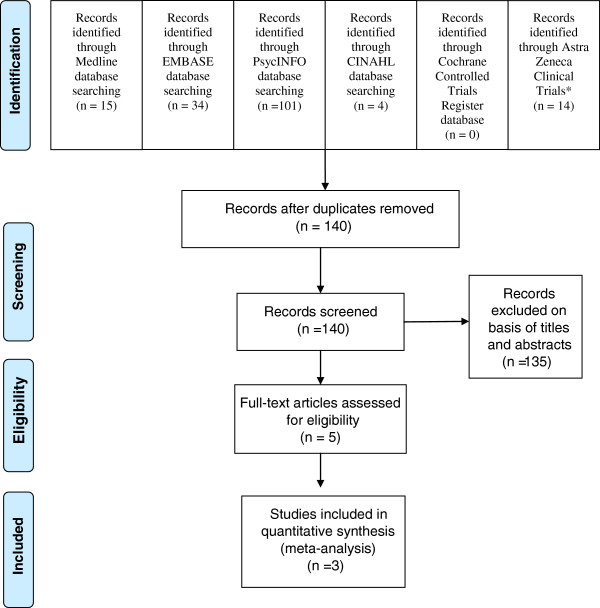
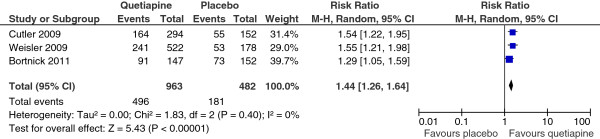
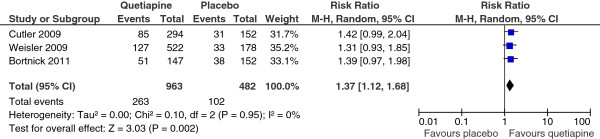
BACKGROUND: Schizophrenia and bipolar depression trials suggest that quetiapine may have an antidepressant effect. OBJECTIVES: This meta-analysis aimed to determine the efficacy, acceptability and tolerability of quetiapine treatment for major depressive disorder (MDD). Only the randomized controlled trials (RCTs) comparison between quetiapine and placebo were included. The authors searched such clinical trials carried out between 1991 and February 2012. DATA SOURCES: MEDLINE, EMBASE, CINHL, PsycINFO and Cochrane Controlled Trials Register were searched in February 2012. Study populations comprised adults with MDD or major depression. STUDY ELIGIBLE CRITERIA, PARTICIPANTS AND INTERVENTIONS: Eligible studies were randomized, placebo-controlled trials of quetiapine monotherapy carried out in adults with MDD and presenting endpoint outcomes relevant to: i) depression severity, ii) response rate, iii) overall discontinuation rate, or iv) discontinuation rate due to adverse events. No language restriction was applied. STUDY APPRAISAL AND SYNTHESIS METHODS: All abstracts identified by the electronic searches were examined. The full reports of relevant studies were assessed, and the data of interest were extracted. Based on the Cochrane methods of bias assessment, risks of bias were determined. The studies with two risks or less were included. The efficacy outcomes were the mean change scores of depression rating scales, the overall response rate, and the overall remission rates. The overall discontinuation rate was considered as a measure of acceptability. The discontinuation rate due to adverse events was a measure of tolerability. Relative risks (RRs) and weighted mean differences (WMDs) with 95% confidence intervals (CIs) were computed by using a random effect model. RESULTS: A total of 1,497 participants in three RCTs were included. All trials examined the quetiapine extended-release (XR). The pooled mean change scores of the Montgomery-Asberg Depression Rating Scale (MADRS) and the Hamilton Depression Rating Scale (HAM-D) of the quetiapine-treated group were higher than those of the placebo-treated group with the WMDs (95%CI) of -3.37 (-3.95, -2.79) and -2.46 (-3.47, -1.45), respectively. All studies defined the response and remission as ≥ 50% reduction of the MADRS total score and the MADRS total score of ≤8 at endpoint, respectively. The overall response and remission rates were significantly greater in the quetiapine-treated group with RRs (95%CIs) of 1.44 (1.26, 1.64) and 1.37 (1.12, 1.68), respectively. The pooled discontinuation rate was not significantly different between groups with an RR (95%CI) of 1.16 (0.97, 1.39). The pooled discontinuation rate due to adverse event was greater in the quetiapine group with an RR (95%CI) of 2.90 (1.87, 4.48). With respect to sleep time, the pooled mean change Pittsburgh Sleep Quality Index (PSQI) scores of the quetiapine-treated group was also significantly higher than that of the placebo-treated group [WMD (95%CI) of -1.21 (-1.81, -0.61)]. LIMITATIONS: Variety of quetiapine XR doses and the small number of RCTs were key limitations of this meta-analysis. CONCLUSIONS: Based on the limited evidence obtained from three RCTs, quetiapine XR is effective for adult patients with MDD. The high dropout rate due to adverse events suggests that some MDD patients may not be able to tolerate quetiapine XR. Due to the balance of its efficacy benefit and risk of side effects, as the overall discontinuation rate shown, the acceptability of this agent is not more than placebo. These results should be viewed as the very preliminary one. Further studies in this area are warranted. IMPLICATION OF KEY FINDINGS: Quetiapine may be an alternative antidepressant. However, both risk and benefit of this agent should be taken into account for an individual patient with MDD.
Overview
The claims and statistics of this paper haven’t been checked yet.
Free: it reads the open-access text and checks the first 5 claims that cite a source we can check. Create a free account to check every claim.
Integrity signals
Registry
Cites
Statistics
Figures


Verification
Claims the paper makes
The claims and statistics of this paper haven’t been checked yet.
Free: it reads the open-access text and checks the first 5 claims that cite a source we can check. Create a free account to check every claim.
Claims other papers make about this one
Each is checked against this paper’s own text: does it say what the citing paper says it does?
The source backs part of the claim, not all of it — or backs it for a different population, condition or comparison.
In the citing paper
“Quetiapine (level 1),241, 242, 243 lithium (level 2),244, 245, 246 lamotrigine (level 2)242, 247, 248 and lurasidone (level 2)249 are all recommended as first‐line treatment options with evidence for efficacy as monotherapy.”
From Canadian Network for Mood and Anxiety Treatments ( CANMAT ) and International Society for Bipolar Disorders ( ISBD ) 2018 guidelines for the management of patients with bipolar disorder (2018) · cites this paper as [241]
Experimental — accuracy not yet measured
Self-check
Percentages, sums and reported differences re-computed from the paper’s own numbers.
The self-check needs the paper’s full text.
Citations
Cites
Cochrane Handbook for Systematic Reviews of Interventions: Cochrane Book Series
(2008) · doi:10.1002/9780470712184 · Cited by 25,048
Assessing Risk of Bias in Included Studies
Higgins, J. P., & Altman, D. G. (2008) · Cochrane Handbook for Systematic Reviews of Interventions · doi:10.1002/9780470712184.ch8 · Cited by 3,396
Sleep disturbance and psychiatric disorders: A longitudinal epidemiological study of young Adults
Breslau, N., Roth, T., Rosenthal, L., & Andreski, P. (1996) · Biological Psychiatry · doi:10.1016/0006-3223(95)00188-3 · Cited by 1,831 · cited 1×
“Up to 31% of MDD patients may have insomnia [48].”
BackgroundGlobal burden of depressive disorders in the year 2000
Üstün, T. B., Ayuso-Mateos, J. L., Chatterji, S., Mathers, C., & Murray, C. J. L. (2004) · British Journal of Psychiatry · doi:10.1192/bjp.184.5.386 · Cited by 1,735 · cited 1×
“4% of the total disability adjusted life years or 12% of all total years lived with disability worldwide [4].”
BackgroundCipriani, A., Furukawa, T. A., Salanti, G., Geddes, J. R., Higgins, J. P., Churchill, R., Watanabe, N., Nakagawa, A., Omori, I. M., McGuire, H., et al. (2009) · The Lancet · doi:10.1016/s0140-6736(09)60046-5 · Cited by 1,654
Prevalence and incidence studies of anxiety disorders: A systematic review of the literature
Somers, J. M., Goldner, E. M., Waraich, P., & Hsu, L. (2006) · The Canadian Journal of Psychiatry · doi:10.1177/070674370605100206 · Cited by 1,114 · cited 1×
“5% for women) [1].”
Remission rates during treatment with venlafaxine or selective serotonin reuptake inhibitors
Thase, M. E., Entsuah, A. R., & Rudolph, R. L. (2001) · British Journal of Psychiatry · doi:10.1192/bjp.178.3.234 · Cited by 801
Sterne, J. A., Egger, M., & Moher, D. (2008) · Cochrane Handbook for Systematic Reviews of Interventions · doi:10.1002/9780470712184.ch10 · Cited by 651
Prevalence and Incidence Studies of Mood Disorders: A Systematic Review of the Literature
Waraich, P., Goldner, E. M., Somers, J. M., & Hsu, L. (2004) · The Canadian Journal of Psychiatry · doi:10.1177/070674370404900208 · Cited by 522
Mechanism of Action of Atypical Antipsychotic Drugs and the Neurobiology of Schizophrenia
Horacek, J., Bubenikova-Valesova, V., Kopecek, M., Palenicek, T., Dockery, C., Mohr, P., & H??schl, C. (2006) · CNS Drugs · doi:10.2165/00023210-200620050-00004 · Cited by 461
Antidepressants versus placebo for depression in primary care
Arroll, B., Elley, C. R., Fishman, T., Goodyear-Smith, F. A., Kenealy, T., Blashki, G., Kerse, N., & MacGillivray, S. (2009) · Cochrane Database of Systematic Reviews · doi:10.1002/14651858.cd007954 · Cited by 352
Jensen, N. H., Rodriguiz, R. M., Caron, M. G., Wetsel, W. C., Rothman, R. B., & Roth, B. L. (2008) · Neuropsychopharmacology · doi:10.1038/sj.npp.1301646 · Cited by 316
Thase, M. E., Haight, B. R., Richard, N., Rockett, C. B., Mitton, M., Modell, J. G., VanMeter, S., Harriett, A. E., & Wang, Y. (2005) · The Journal of Clinical Psychiatry · doi:10.4088/jcp.v66n0803 · Cited by 304 · cited 1×
“Similarly, a meta-analysis of 7 RCTs found that the response rates of bupropion and SSRIs treatment in MDD patients were 62 and 63%, respectively, compared with 51% for placebo [40].”
MethodWiebe, N., Vandermeer, B., Platt, R. W., Klassen, T. P., Moher, D., & Barrowman, N. J. (2006) · Journal of Clinical Epidemiology · doi:10.1016/j.jclinepi.2005.08.017 · Cited by 296
Measuring depression: comparison and integration of three scales in the GENDEP study
Uher, R., Farmer, A., Maier, W., Rietschel, M., Hauser, J., Marusic, A., Mors, O., Elkin, A., Williamson, R. J., Schmael, C., et al. (2008) · Psychological Medicine · doi:10.1017/s0033291707001730 · Cited by 293
Bienvenu, O. J., Samuels, J. F., Wuyek, L. A., Liang, K.-Y., Wang, Y., Grados, M. A., Cullen, B. A., Riddle, M. A., Greenberg, B. D., Rasmussen, S. A., et al. (2012) · Psychological Medicine · doi:10.1017/s0033291711000742 · Cited by 286
Gibbons, R. D., Hur, K., Brown, C. H., Davis, J. M., & Mann, J. J. (2012) · Archives of General Psychiatry · doi:10.1001/archgenpsychiatry.2011.2044 · Cited by 271 · cited 1×
“Regarding the response rates of other antidepressants in adults with MDD, the NNTs of fluoxetine and venlafaxine are between 5 and 7, which are comparable to the NNT of 8 for the quetiapine treatment in this population [42].”
BackgroundEntsuah, A. R., Huang, H., & Thase, M. E. (2001) · The Journal of Clinical Psychiatry · doi:10.4088/jcp.v62n1106 · Cited by 245
(2006) · PubMed · Cited by 207
Management of Patients With Treatment-Resistant Depression
Thase, M. E. (2008) · The Journal of Clinical Psychiatry · doi:10.4088/jcp.0308e08 · Cited by 158
Furukawa, T. A., McGuire, H., & Barbui, C. (2002) · BMJ · doi:10.1136/bmj.325.7371.991 · Cited by 157
Machado, M., Iskedjian, M., Ruiz, I., & Einarson, T. R. (2006) · Current Medical Research and Opinion · doi:10.1185/030079906x132415 · Cited by 144
Bauer, M., Tharmanathan, P., Volz, H., Moeller, H., & Freemantle, N. (2009) · European Archives of Psychiatry and Clinical Neuroscience · doi:10.1007/s00406-008-0849-0 · Cited by 137
Cutler, A. J., Montgomery, S. A., Feifel, D., Lazarus, A., Åström, M., & Brecher, M. (2009) · The Journal of Clinical Psychiatry · doi:10.4088/jcp.08m04592 · Cited by 137
Mallinckrodt, C. H., Watkin, J. G., Liu, C., Wohlreich, M. M., & Raskin, J. (2005) · BMC Psychiatry · doi:10.1186/1471-244x-5-1 · Cited by 134
Barbui, C., Furukawa, T. A., & Cipriani, A. (2007) · Canadian Medical Association Journal · doi:10.1503/cmaj.070693 · Cited by 121
Papakostas, G., Homberger, C., & Fava, M. (2008) · Journal of Psychopharmacology · doi:10.1177/0269881107083808 · Cited by 109
Weisler, R., Joyce, J. M., McGill, L., Lazarus, A., Szamosi, J., Eriksson, H., & Moonstone Study Group (2009) · CNS Spectrums · doi:10.1017/s1092852900020307 · Cited by 108
Bortnick, B., El-Khalili, N., Banov, M. D., Adson, D. E., Datto, C. J., Raines, S. R., Earley, W. R., & Eriksson, H. (2010) · Journal of Affective Disorders · doi:10.1016/j.jad.2010.06.031 · Cited by 93
Quetiapine: A Review of its Use in the Management of Bipolar Depression
Sanford, M., & Keating, G. M. (2012) · CNS Drugs · doi:10.2165/11203840-000000000-00000 · Cited by 88
Liebowitz, M., Lam, R. W., Lepola, U., Datto, C., Sweitzer, D., & Eriksson, H. (2010) · Depression and Anxiety · doi:10.1002/da.20740 · Cited by 86
Papakostas, G. I., Nelson, J. C., Kasper, S., & Möller, H.-J. (2008) · European Neuropsychopharmacology · doi:10.1016/j.euroneuro.2007.07.005 · Cited by 73 · cited 1×
“In addition, the overall dropout rates and the dropout rates due to adverse events are relatively high in the ranges of 25-39% and 9-17% [15,16], respectively, which suggest that many MDD patients cannot accept or tolerate currently available antidepressants [17].”
BackgroundShort-term efficacy of tricyclic antidepressants revisited: a meta-analytic study
Storosum, J. G., Elferink, A. J. A., van Zwieten, B. J., van den Brink, W., Gersons, B. P. R., STRIK, R. V., & Broekmans, A. W. (2001) · European Neuropsychopharmacology · doi:10.1016/s0924-977x(01)00083-9 · Cited by 73
Low dosage tricyclic antidepressants for depression
Furukawa, T. A., McGuire, H., & Barbui, C. (2003) · Cochrane Database of Systematic Reviews · doi:10.1002/14651858.cd003197 · Cited by 65
Rush, A. J., Wisniewski, S. R., Zisook, S., Fava, M., Sung, S. C., Haley, C. L., Chan, H. N., Gilmer, W. S., Warden, D., Nierenberg, A. A., et al. (2012) · Psychological Medicine · doi:10.1017/s0033291711002170 · Cited by 65
Beasley, C. M., Nilsson, M. E., Koke, S. C., & Gonzales, J. S. (2000) · The Journal of Clinical Psychiatry · doi:10.4088/jcp.v61n1003 · Cited by 62
Paroxetine in the treatment of melancholia and severe depression
Tignol, J., Stoker, M. J., & Dunbar, G. C. (1992) · International Clinical Psychopharmacology · doi:10.1097/00004850-199207020-00005 · Cited by 61
Mallinckrodt, C. H., PRAKASH, A., Andorn, A. C., Watkin, J. G., & Wohlreich, M. M. (2005) · Journal of Psychiatric Research · doi:10.1016/j.jpsychires.2005.08.010 · Cited by 59
Papakostas, G. I., & Fava, M. (2006) · The Canadian Journal of Psychiatry · doi:10.1177/070674370605101208 · Cited by 53
Citalopram in Depression—Meta-analysis of Intended and Unintended Effects
BECH, P., & CIALDELLA, P. (1992) · International Clinical Psychopharmacology · doi:10.1097/00004850-199206005-00005 · Cited by 52
Bakken, G. V., Rudberg, I., Molden, E., Refsum, H., & Hermann, M. (2011) · Therapeutic Drug Monitoring · doi:10.1097/ftd.0b013e31821160c4 · Cited by 50
Quetiapine for bipolar depression: a systematic review and meta-analysis
Chiesa, A., Chierzi, F., De Ronchi, D., & Serretti, A. (2012) · International Clinical Psychopharmacology · doi:10.1097/yic.0b013e32834e4c56 · Cited by 45
Addington, D. E., Mohamed, S., Rosenheck, R. A., Thomas, S., Stroup, T. S., McEvoy, J. P., Swartz, M. S., & Lieberman, J. A. (2010) · The Journal of Clinical Psychiatry · doi:10.4088/jcp.09m05258gre · Cited by 40
Understanding the Burden of Depression
Culpepper, L. (2011) · The Journal of Clinical Psychiatry · doi:10.4088/jcp.10126tx1c · Cited by 38
Papakostas, G. I., Charles, D., & Fava, M. (2010) · The World Journal of Biological Psychiatry · doi:10.3109/15622970701432528 · Cited by 36
Kjelby, E., Jørgensen, H. A., Kroken, R. A., Løberg, E., & Johnsen, E. (2011) · BMC Psychiatry · doi:10.1186/1471-244x-11-145 · Cited by 34
Effectiveness of venlafaxine treatment in a broad spectrum of depressed patients: a meta-analysis.
Entsuah, A. R., Rudolph, R. L., & Chitra, R. (1995) · PubMed · Cited by 33
Altamura, A. C., Moliterno, D., Paletta, S., Buoli, M., Dell’Osso, B. M., Mauri, M. C., & Bareggi, S. R. (2012) · Clinical Drug Investigation · doi:10.2165/11597330-000000000-00000 · Cited by 32
Antidepressant Treatment for Acute Bipolar Depression: An Update
Amit, B. H., & Weizman, A. (2012) · Depression Research and Treatment · doi:10.1155/2012/684725 · Cited by 31
The under-recognized role of dopamine in the treatment of major depressive disorder
Montgomery, S. A. (2008) · International Clinical Psychopharmacology · doi:10.1097/yic.0b013e3282f2b3cb · Cited by 31
Stewart, D. E., Wohlreich, M. M., Mallinckrodt, C. H., Watkin, J. G., & Kornstein, S. G. (2006) · Journal of Affective Disorders · doi:10.1016/j.jad.2006.04.006 · Cited by 31
Clinical impact of duloxetine treatment on sleep in patients with major depressive disorder
Brecht, S., Kajdasz, D. K., Ball, S. G., & Thase, M. E. (2008) · International Clinical Psychopharmacology · doi:10.1097/yic.0b013e328306a987 · Cited by 18
Goldstein, J. M., Nyberg, S., & Brecher, M. (2008) · European Psychiatry · doi:10.1016/j.eurpsy.2008.01.325 · Cited by 16
Research works printed but not linked: 1
- Papakostas GI Tolerability of modern antidepressants J Clin Psychiatry 2008 69 E1 8 13 18494538
Cited by
Yatham, L. N., Kennedy, S. H., Parikh, S. V., Schaffer, A., Bond, D. J., Frey, B. N., Sharma, V., Goldstein, B. I., Rej, S., Beaulieu, S., et al. (2018) · Bipolar Disorders · doi:10.1111/bdi.12609 · Cited by 1,852
Katzman, M. A., Bleau, P., Blier, P., Chokka, P., Kjernisted, K., Van Ameringen, M., & the Canadian Anxiety Guidelines Initiative Group on behalf of the Anxiety Disorders Association of Canada/Association Canadienne des troubles anxieux and McGill University (2014) · BMC Psychiatry · doi:10.1186/1471-244x-14-s1-s1 · Cited by 1,090
“[1396] and GAD [1397], as well as MDD with anxiety”
BackgroundManeeton, N., Maneeton, B., Srisurapanon, & Chittawatanarat, K. (2013) · Drug Design, Development and Therapy · doi:10.2147/dddt.s45575 · Cited by 94
Self-citationSecond-generation antipsychotics in the treatment of major depressive disorder: current evidence
Han, C., Wang, S.-M., Kato, M., Lee, S.-J., Patkar, A. A., Masand, P. S., & Pae, C.-U. (2013) · Expert Review of Neurotherapeutics · doi:10.1586/14737175.2013.811901 · Cited by 92
Maneeton, N., Maneeton, B., Woottiluk, P., Likhitsathian, S., Suttajit, S., Boonyanaruthee, V., & Srisurapanont, M. (2016) · Drug Design, Development and Therapy · doi:10.2147/dddt.s89485 · Cited by 77
Self-citation
Metadata
- Authors
- Maneeton, N., Maneeton, B., Srisurapanont, M., & Martin, S. D.
- Affiliations
- Chiang Mai University (TH)
- Corresponding author
- Maneeton, Benchalak
- Venue
- BMC Psychiatry
- Published
- 2012-09-27
- Volume
- 12
- Issue
- 1
- Pages
- 160-160
- ISSN
- 1471-244X (ISSN-L)
- PMC
- PMC3549283
- OpenAlex
- W2095811380
- Cited by
- 51
- References
- 53
- Citations by year
- 2026: 3 · 2025: 3 · 2024: 3 · 2023: 2 · 2022: 6 · 2021: 3 · 2020: 2 · 2019: 3 · 2018: 3 · 2017: 3 · 2016: 4 · 2015: 5 · 2014: 6 · 2013: 5
- FWCI
- 0.59
- Type
- journal article
- Language
- en
- Open access
- gold
- doi.org
- Licence
- Locations
- BMC Psychiatry (publishedVersion, cc-by)
- Europe PMC (PubMed Central) (publishedVersion, cc-by)
- PubMed Central (publishedVersion, cc-by)
- PubMed (publishedVersion)
- DOAJ (DOAJ: Directory of Open Access Journals) (submittedVersion)
- Greater South Information System
- Topics
- Health Sciences › Medicine › Pharmacology (medical) › Treatment of Major Depression
- Health Sciences › Medicine › Psychiatry and Mental health › Schizophrenia research and treatment
- Health Sciences › Medicine › Psychiatry and Mental health › Bipolar Disorder and Treatment
- Keywords
- quetiapine, major depressive disorder, antidepressant monotherapy, atypical antipsychotics, acute phase treatment, treatment response, remission, treatment discontinuation, adverse events, tolerability, sustained-release formulation, placebo comparison, risk of bias, depression rating scales, antidepressant efficacy, antidepressant tolerability, bipolar depression, atypical depression
- MeSH terms
- Quetiapine Fumarate, Acute Disease, Adolescent, Adult, Aged, Antidepressive Agents, Delayed-Action Preparations, Major Depressive Disorder, Dibenzothiazepines, Female, Humans, Male, Middle Aged, Placebos, Remission Induction, Randomized Controlled Trials as Topic
About these checks
Registry, retraction, Cites and statistics results are computed, not judged, with one exception: a printed reference that no index lists is read once by a model before it counts as a citation error. Claims are extracted by a model and kept only when their quote appears verbatim in the text; each cited source is then checked, with a model’s help, for whether it says what the claim relies on. Those verdicts can be wrong — read the claim’s quote and the cited source before relying on one.
Statistics and arithmetic are recomputed, not judged.
Confidence bands are shown only for fields calibrated on our annotated test set. None is calibrated yet, so no band is shown.
What counts as a claim ›How we measure confidence ›How we check this ›
Are you an author, or do you see a problem with this page? Request a review
Data sources
Bibliographic data: Semantic Scholar, OpenAlex, Crossref.
Contains information from the Semantic Scholar Academic Graph Datasets, made available under the ODC Attribution License (ODC-BY 1.0).
Semantic Scholar’s data is described in: Kinney, R., et al. (2023). The Semantic Scholar Open Data Platform. arXiv:2301.10140.
