

The DOI matches its Crossref record; 66 of the 66 references it cites were found in a registry or an index.
Is computerised CBT really helpful for adult depression?-A meta-analytic re-evaluation of CCBT for adult depression in terms of clinical implementation and methodological validity
Open accessAbstract
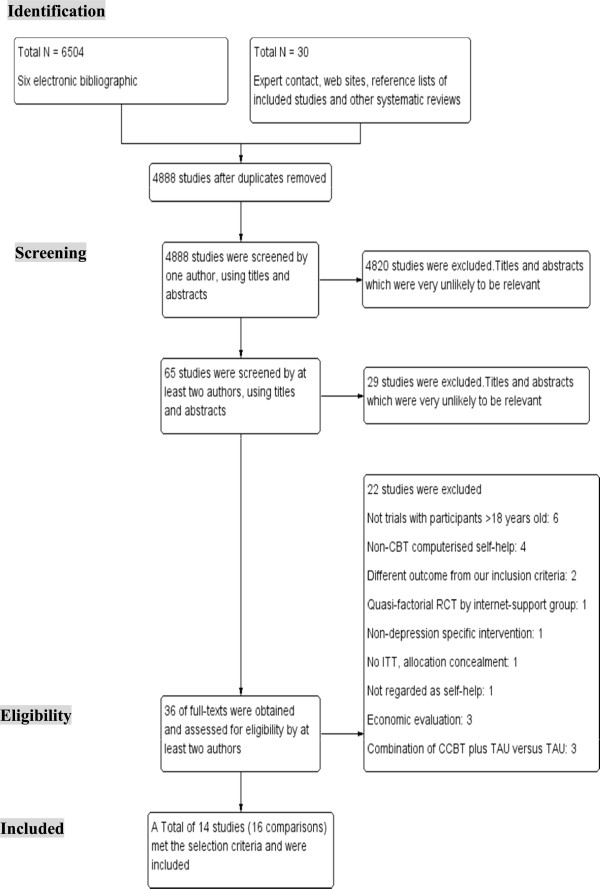
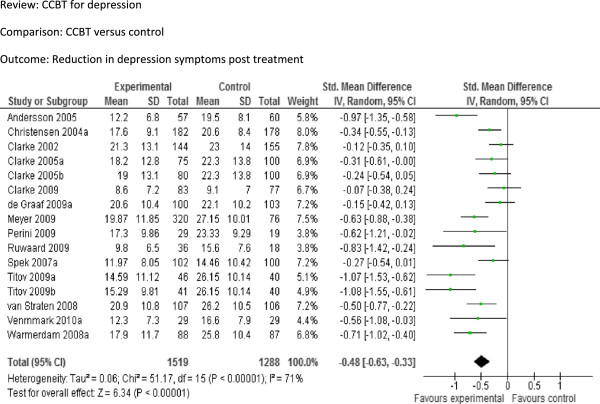
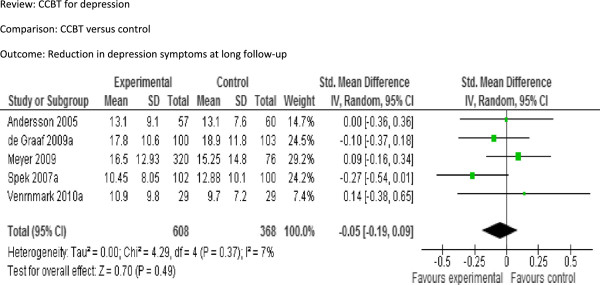
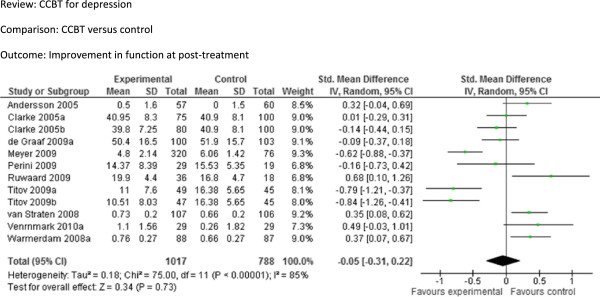
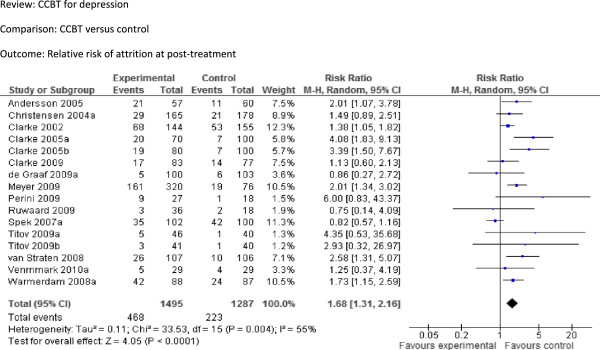
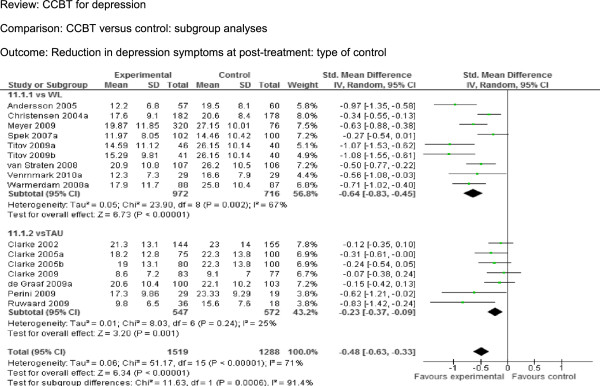
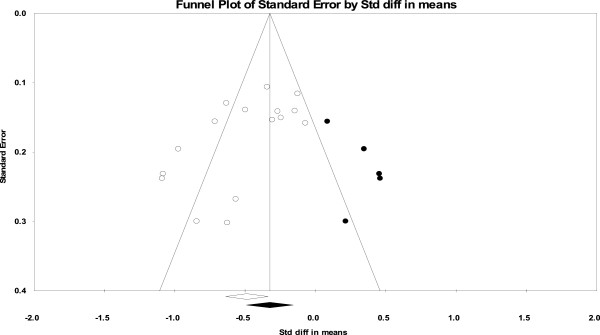
BACKGROUND: Depression is a major cause of disability worldwide, and computerised cognitive behavioural therapy (CCBT) is expected to be a more augmentative and efficient treatment. According to previous meta-analyses of CCBT, there is a need for a meta-analytic revaluation of the short-term effectiveness of this therapy and for an evaluation of its long-term effects, functional improvement and dropout. METHODS: Five databases were used (MEDLINE, PsycINFO, EMBASE, CENTRAL and CiNii). We included all RCTs with proper concealment and blinding of outcome assessment for the clinical effectiveness of CCBT in adults (aged 18 and over) with depression. Using Cohen's method, the standard mean difference (SMD) for the overall pooled effects across the included studies was estimated with a random effect model. The main outcome measure and the relative risk of dropout were included in the meta-analysis. RESULTS: Fourteen trials met the inclusion criteria, and sixteen comparisons from these were used for the largest meta-analysis ever. All research used appropriate random sequence generation and Intention-to-Treat analyses (ITT), and employed self-reported measures as the primary outcome. For the sixteen comparisons (2807 participants) comparing CCBT and control conditions, the pooled SMD was -0.48 [95% IC -0.63 to -0.33], suggesting similar effect to the past reviews. Also, there was no significant clinical effect at long follow-up and no improvement of function found. Furthermore, a significantly higher drop-out rate was found for CCBT than for controls. When including studies without BDI as a rating scale and with only modern imputation as sensitivity analysis, the pooled SMD remained significant despite the reduction from a moderate to a small effect. Significant publication bias was found in a funnel plot and on two tests (Begg's p = 0.09; Egger's p = 0.01). Using a trim and fill analysis, the SMD was -0.32 [95% CI -0.49 to -0.16]. CONCLUSION: Despite a short-term reduction in depression at post-treatment, the effect at long follow-up and the function improvement were not significant, with significantly high drop-out. Considering the risk of bias, our meta-analysis implied that the clinical usefulness of current CCBT for adult depression may need to be re-considered downwards in terms of practical implementation and methodological validity.
Overview
The claims and statistics of this paper haven’t been checked yet.
Run the check — free, no account needed. It reads the open-access text and checks the sources it cites.
Integrity signals
Registry
Cites
Statistics
Figures
Verification
Claims the paper makes
The claims and statistics of this paper haven’t been checked yet.
Run the check — free, no account needed. It reads the open-access text and checks the sources it cites.
Claims other papers make about this one
Each is checked against this paper’s own text: does it say what the citing paper says it does?
The cited source says what the claim attributes to it.
In the citing paper
“the effects were observed to be transient and the participants’ drop-out rate was high [5].”
The cited source says what the claim attributes to it.
In the citing paper
“A number of studies in the broader CCBT literature have found evidence of a publication bias. Studies reporting negative findings are less likely to be published [26,49,50].”
From Computerized cognitive behavior therapy for anxiety and depression in rural areas:a systematic review (2015) · cites this paper as [50]
In the citing paper
“Effect sizes have been estimated at d=0.44-1.90 for clinician-supported, and d=0.21-0.70 for self-guided, interventions [42-45,47,48].”
From MoodHacker Mobile Web App With Email for Adults to Self-Manage Mild-to-Moderate Depression: Randomized Controlled Trial (2016) · cites this paper as [45]
In the citing paper
“Thus there is currently ample evidence for the short and long term benefits for eHealth delivered Cognitive Behavioural Therapy (CBT) for treating anxiety and depressive conditions in both general population and clinical settings [21–23], with greater improvement shown for those interventions that include guidance throughout the intervention period [21,24].”
From Effectiveness of eHealth interventions for reducing mental health conditions in employees: A systematic review and meta-analysis (2017) · cites this paper as [22]
In the citing paper
“Internet-delivered CBT-based programs for depression symptom management have been shown to be effective both for adults with major depressive disorder and those with elevated, but subthreshold, depression symptoms, although one recent review identified concerns with dropout and lack of long-term effects [42-45].”
From MoodHacker Mobile Web App With Email for Adults to Self-Manage Mild-to-Moderate Depression: Randomized Controlled Trial (2016) · cites this paper as [45]
In the citing paper
“Although our results are consistent with a recent meta-analysis of computerized CBT programs showing that results of computer-based CBT programs typically attenuate over time [45]”
From MoodHacker Mobile Web App With Email for Adults to Self-Manage Mild-to-Moderate Depression: Randomized Controlled Trial (2016) · cites this paper as [45]
Self-check
Percentages, sums and reported differences re-computed from the paper’s own numbers.
The self-check needs the paper’s full text.
Citations
Cites
Bias in meta-analysis detected by a simple, graphical test
Egger, M., Smith, G. D., Schneider, M., & Minder, C. (1997) · BMJ · doi:10.1136/bmj.315.7109.629 · Cited by 56,722 · cited 3×
“Also, there was significant statistical evidence for study bias using both Begg’s test (p = 0.009) and Egger’s test (p = 0.01).”
MethodInfluentialAn inventory for measuring depression
BECK, A. T. (1961) · Archives of General Psychiatry · doi:10.1001/archpsyc.1961.01710120031004 · Cited by 38,032 · cited 1×
“I, BDI- I [30], and II [31], or according to the difference”
BackgroundOperating characteristics of a rank correlation test for publication bias
Begg, C. B., & Mazumdar, M. (1994) · Biometrics · doi:10.2307/2533446 · Cited by 16,955 · cited 1×
“Begg’s [33] and Egger’s [34] tests were also conducted for statistical checking.”
Method(1975) · Medical Entomology and Zoology · Cited by 7,245
Comparison of Beck Depression Inventories -IA and -II in psychiatric outpatients
Beck, A. T., Steer, R. A., Ball, R., & Ranieri, W. F. (1996) · Journal of Personality Assessment · doi:10.1207/s15327752jpa6703_13 · Cited by 5,965 · cited 1×
“I, BDI- I [30], and II [31], or according to the difference”
BackgroundDepression, chronic diseases, and decrements in health: results from the World Health Surveys
Moussavi, S., Chatterji, S., Verdes, E., Tandon, A., Patel, V., & Ustun, B. (2007) · The Lancet · doi:10.1016/s0140-6736(07)61415-9 · Cited by 4,070 · cited 1×
“over the world [1].”
The empirical status of cognitive-behavioral therapy: A review of meta-analyses
Butler, A. C., Chapman, J. E., Forman, E. M., & Beck, A. T. (2006) · Clinical Psychology Review · doi:10.1016/j.cpr.2005.07.003 · Cited by 3,215 · cited 1×
“as an alternative or addition to pharmacotherapy [5,6].”
BackgroundA Nonparametric “Trim and Fill” Method of Accounting for Publication Bias in Meta-Analysis
Duval, S., & Tweedie, R. (2000) · Journal of the American Statistical Association · doi:10.1080/01621459.2000.10473905 · Cited by 2,955 · cited 1×
“When a significant small study effect was noted, we assessed its influence through the trim-and-fill method [35].”
MethodCognitive Therapy and the Emotional Disorders
Ince, L. P. (1977) · American Journal of Psychotherapy · doi:10.1176/appi.psychotherapy.1977.31.4.633 · Cited by 2,889
Dimidjian, S., Hollon, S. D., Dobson, K. S., Schmaling, K. B., Kohlenberg, R. J., Addis, M. E., Gallop, R., McGlinchey, J. B., Markley, D. K., Gollan, J. K., et al. (2006) · Journal of Consulting and Clinical Psychology · doi:10.1037/0022-006x.74.4.658 · Cited by 1,607 · cited 1×
“reduction of symptoms [7].”
Research works printed but not linked: 3
- Department of Health: Treatment choice in psychological therapies and counselling. Evidence-based clinical practice guideline. 2001, In. London: DOH
- Moran PW, Lambert JM: A review of current assessment tools for monitoring changes in depression. The Measurement of Psychotherapy Outcome in Research and Evaluation. Edited by: Lambert MJ, Christensen ER, De Julio SS. 1983, New York: Wiley, 263-303.
- Moran PW: A Review of Current Assessment Tools for Monitoring Changes in Depression. 1982, Brigham Young University: Department of Psychology
Cited by
Sorted by citations
Philippe, T. J., Sikder, N., Jackson, A., Koblanski, M. E., Liow, E., Pilarinos, A., & Vasarhelyi, K. (2022) · JMIR Mental Health · doi:10.2196/35159 · Cited by 436
Gilbody, S., Littlewood, E., Hewitt, C., Brierley, G., Tharmanathan, P., Araya, R., Barkham, M., Bower, P., Cooper, C., Gask, L., et al. (2015) · BMJ · doi:10.1136/bmj.h5627 · Cited by 409
“33”
Insights from user reviews to improve mental health apps
Alqahtani, F., & Orji, R. (2020) · Health Informatics Journal · doi:10.1177/1460458219896492 · Cited by 286
Stratton, E., Lampit, A., Choi, I., Calvo, R. A., Harvey, S. B., & Glozier, N. (2017) · PLOS ONE · doi:10.1371/journal.pone.0189904 · Cited by 252
Kuester, A., Niemeyer, H., & Knaevelsrud, C. (2016) · Clinical Psychology Review · doi:10.1016/j.cpr.2015.11.004 · Cited by 261
Metadata
- Authors
- So, M., Yamaguchi, S., Hashimoto, S., Sado, M., Furukawa, T. A., & McCrone, P.
- Affiliations
- King's College London (GB)
- National Center of Neurology and Psychiatry (JP)
- Edogawa University (JP)
- Keio University (JP)
- Kyoto University (JP)
- Corresponding author
- So, Mirai
- Venue
- BMC Psychiatry
- Published
- 2013-04-15
- Volume
- 13
- Issue
- 1
- Pages
- 113-113
- ISSN
- 1471-244X (ISSN-L)
- PMC
- PMC3638010
- OpenAlex
- W1998160684
- Cited by
- 129
- References
- 66
- Citations by year
- 2026: 3 · 2025: 3 · 2024: 6 · 2023: 8 · 2022: 8 · 2021: 9 · 2020: 11 · 2019: 9 · 2018: 18 · 2017: 15 · 2016: 14 · 2015: 16 · 2014: 8 · 2013: 1
- FWCI
- 19.87
- Type
- journal article
- Language
- en
- Open access
- gold
- doi.org
- Licence
- Locations
- BMC Psychiatry (publishedVersion, cc-by)
- Europe PMC (PubMed Central) (publishedVersion, cc-by)
- PubMed Central (publishedVersion, cc-by)
- PubMed (publishedVersion)
- Research Portal (King's College London) (submittedVersion, other-oa)
- Funders
- Japan Society for the Promotion of Science (25293150)
- Topics
- Social Sciences › Psychology › Applied Psychology › Digital Mental Health Interventions
- Social Sciences › Psychology › Experimental and Cognitive Psychology › Anxiety, Depression, Psychometrics, Treatment, Cognitive Processes
- Social Sciences › Psychology › Clinical Psychology › Psychotherapy Techniques and Applications
- Keywords
- computerized cognitive behavioral therapy, adult depression, treatment effectiveness, long-term follow-up, functional improvement, dropout, publication bias, risk of bias, methodological validity, clinical implementation
- MeSH terms
- Adult, Depressive Disorder, Humans, Therapy, Computer-Assisted, Cognitive Behavioral Therapy, Treatment Outcome
About these checks
Registry, retraction, Cites and statistics results are computed, not judged, with one exception: a printed reference that no index lists is read once by a model before it counts as a citation error. Claims are extracted by a model and kept only when their quote appears verbatim in the text; each cited source is then checked, with a model’s help, for whether it says what the claim relies on. Those verdicts can be wrong — read the claim’s quote and the cited source before relying on one.
Statistics and arithmetic are recomputed, not judged.
Confidence bands are shown only for fields calibrated on our annotated test set. None is calibrated yet, so no band is shown.
What counts as a claim ›How we measure confidence ›How we check this ›
Are you an author, or do you see a problem with this page? Request a review
