

The DOI matches its Crossref record; 33 of the 33 references it cites were found in a registry or an index.
Impact of a mobile phone and web program on symptom and functional outcomes for people with mild-to-moderate depression, anxiety and stress: a randomised controlled trial
Open accessAbstract
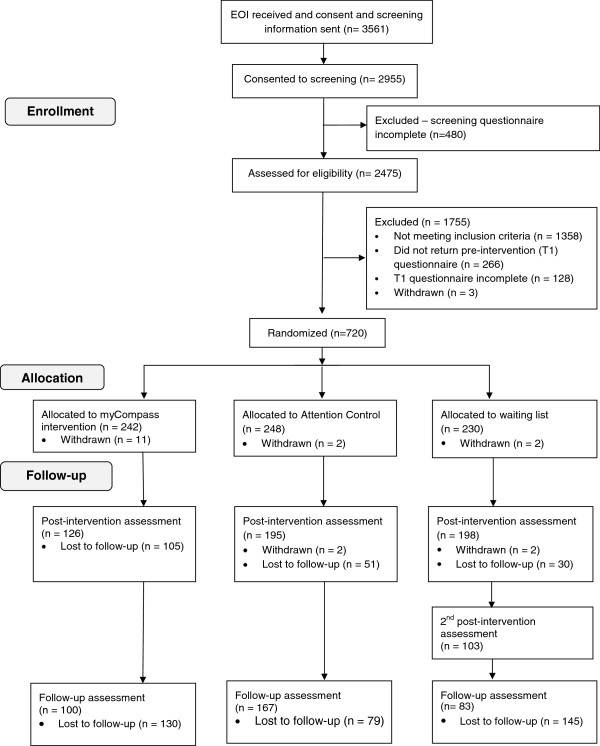
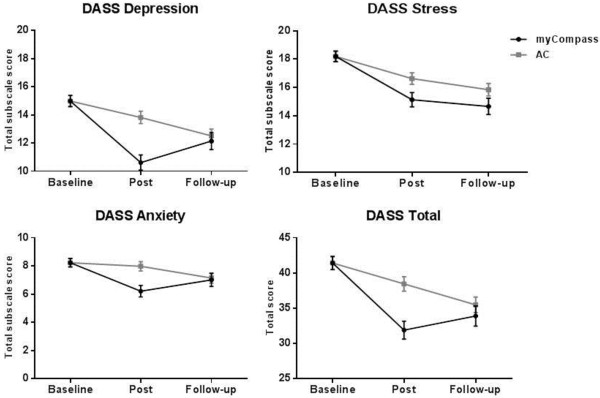
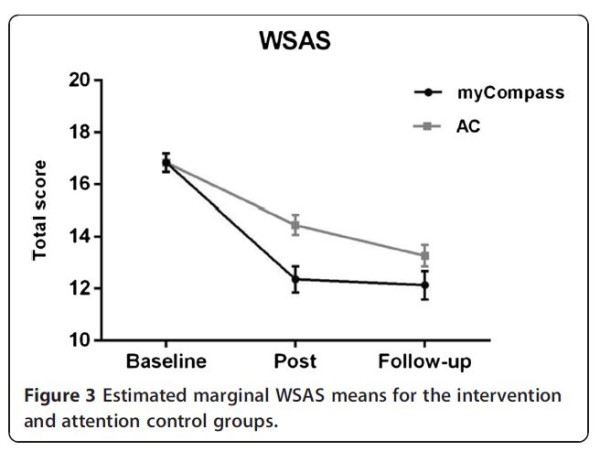
BACKGROUND: Mobile phone-based psychological interventions enable real time self-monitoring and self-management, and large-scale dissemination. However, few studies have focussed on mild-to-moderate symptoms where public health need is greatest, and none have targeted work and social functioning. This study reports outcomes of a CONSORT-compliant randomised controlled trial (RCT) to evaluate the efficacy of myCompass, a self-guided psychological treatment delivered via mobile phone and computer, designed to reduce mild-to-moderate depression, anxiety and stress, and improve work and social functioning. METHOD: Community-based volunteers with mild-to-moderate depression, anxiety and/or stress (N = 720) were randomly assigned to the myCompass program, an attention control intervention, or to a waitlist condition for seven weeks. The interventions were fully automated, without any human input or guidance. Participants' symptoms and functioning were assessed at baseline, post-intervention and 3-month follow-up, using the Depression, Anxiety and Stress Scale and the Work and Social Adjustment Scale. RESULTS: Retention rates at post-intervention and follow-up for the study sample were 72.1% (n = 449) and 48.6% (n = 350) respectively. The myCompass group showed significantly greater improvement in symptoms of depression, anxiety and stress and in work and social functioning relative to both control conditions at the end of the 7-week intervention phase (between-group effect sizes ranged from d = .22 to d = .55 based on the observed means). Symptom scores remained at near normal levels at 3-month follow-up. Participants in the attention control condition showed gradual symptom improvement during the post-intervention phase and their scores did not differ from the myCompass group at 3-month follow-up. CONCLUSIONS: The myCompass program is an effective public health program, facilitating rapid improvements in symptoms and in work and social functioning for individuals with mild-to-moderate mental health problems. TRIAL REGISTRATION: Australian New Zealand Clinical Trials Registry ACTRN 12610000625077.
Overview
The claims and statistics of this paper haven’t been checked yet.
Run the check — free, no account needed. It reads the open-access text and checks the sources it cites.
Integrity signals
Registry
Cites
Statistics
Figures
Verification
Claims the paper makes
The claims and statistics of this paper haven’t been checked yet.
Run the check — free, no account needed. It reads the open-access text and checks the sources it cites.
Claims other papers make about this one
Each is checked against this paper’s own text: does it say what the citing paper says it does?
The source backs part of the claim, not all of it — or backs it for a different population, condition or comparison.
In the citing paper
“The various AI-augmented applications presented in this review have achieved encouraging positive mental health outcomes, while leveraging and supporting the benefits of online platforms, including scalability, versatility, cost-effectiveness, and personalization (8, 9, 95–97).”
From Examining the role of AI technology in online mental healthcare: opportunities, challenges, and implications, a mixed-methods review (2024) · cites this paper as [96]
Experimental — accuracy not yet measuredThe source backs part of the claim, not all of it — or backs it for a different population, condition or comparison.
In the citing paper
“The reason for this null finding was unclear, as the program is highly similar to the original myCompass program (Proudfoot et al., 2013)”
From Predictors of acceptability and engagement in a self-guided online program for depression and anxiety (2021) · cites this paper as Proudfoot et al., 2013
Experimental — accuracy not yet measuredThe source backs part of the claim, not all of it — or backs it for a different population, condition or comparison.
In the citing paper
“Particularly in the case of PD, the use of mobile tools in treatment is promising, as the treatment intervenes where panic attacks take place, namely in the everyday lives of those affected (Christoforou et al., 2017; Ivanova et al., 2016; Proudfoot et al., 2013).”
From A mobile application for panic disorder and agoraphobia: Insights from a multi-methods feasibility study (2020) · cites this paper as Proudfoot et al., 2013
Experimental — accuracy not yet measuredThe source backs part of the claim, not all of it — or backs it for a different population, condition or comparison.
In the citing paper
“For secondary hypotheses (H3-4), a sample of 110 per condition is required to find a small effect size of f = 0.18 (based on a previous study by Proudfoot et al. [29]) between active conditions relative to control over the three assessment time points (baseline, post, and 6 month follow-up) with 90% power ( α = .05, r = 0.5 between repeated measures).”
From A brief intervention to increase uptake and adherence of an online program for depression and anxiety: Protocol for the Enhancing Engagement with Psychosocial Interventions (EEPI) Randomized Controlled Trial (2019) · cites this paper as [29]
Experimental — accuracy not yet measuredThe source backs part of the claim, not all of it — or backs it for a different population, condition or comparison.
In the citing paper
“A study evaluating a transdiagnostic EMI comprising online CBT modules and SMS reminders for treating stress and anxiety 37 was associated with lower stress levels than a waitlist control ( d = 0.34 at post-test).”
From Effectiveness of mobile technologies delivering Ecological Momentary Interventions for stress and anxiety: A systematic review (2016) · cites this paper as [37]
Experimental — accuracy not yet measured
The source backs part of the claim, not all of it — or backs it for a different population, condition or comparison.
In the citing paper
“Studies examining EMIs in reducing stress demonstrated positive effects for EMI relative to controls. 34,36,37”
From Effectiveness of mobile technologies delivering Ecological Momentary Interventions for stress and anxiety: A systematic review (2016) · cites this paper as [37]
Experimental — accuracy not yet measuredThe cited source says what the claim attributes to it.
In the citing paper
“The original myCompass self-guided program has been shown to reduce symptoms of depression and anxiety in previous community studies (n = 89; n = 720) (Clarke et al., 2016; Proudfoot et al., 2013).”
From Predictors of acceptability and engagement in a self-guided online program for depression and anxiety (2021) · cites this paper as Proudfoot et al., 2013
In the citing paper
“While some apps have demonstrated efficacy in definitive trials [2-5], others have performed poorly [6-9].”
From A Library of Analytic Indicators to Evaluate Effective Engagement with Consumer mHealth Apps for Chronic Conditions: Scoping Review (2019) · cites this paper as [2]
In the citing paper
“dropout attrition in the intervention arm of the RCT was high, especially among employed participants.”
From Therapeutic alliance with a fully automated mobile phone and web-based intervention: secondary analysis of a randomized controlled trial (2016) · cites this paper as [28]
In the citing paper
“We found only one such study specifically targeting adults with mild-to-moderate depression [50,51].”
From MoodHacker Mobile Web App With Email for Adults to Self-Manage Mild-to-Moderate Depression: Randomized Controlled Trial (2016) · cites this paper as [50]
In the citing paper
“Treatment gains were maintained at 3-month follow-up, and improvements in the attention control condition matched those of the myCompass group [50].”
From MoodHacker Mobile Web App With Email for Adults to Self-Manage Mild-to-Moderate Depression: Randomized Controlled Trial (2016) · cites this paper as [50]
In the citing paper
“In this study, participants who used the CBT-based myCompass app, delivered via mobile phone and Internet, reported improvements in depression and anxiety at 7-week post-test compared to an attention control intervention and a waiting list condition.”
From MoodHacker Mobile Web App With Email for Adults to Self-Manage Mild-to-Moderate Depression: Randomized Controlled Trial (2016) · cites this paper as [50]
In the citing paper
“Another important clinical consideration is that people experiencing severe depression and anxiety symptoms, and frequent suicidal ideation, use DMHIs once they are released into the community, although the programs are often not designed for these clients (eg, myCompass and THIS WAY UP) [40-42].”
Self-check
Percentages, sums and reported differences re-computed from the paper’s own numbers.
The self-check needs the paper’s full text.
Citations
Cites
Kessler, R. C., Berglund, P., Demler, O., Jin, R., Merikangas, K. R., & Walters, E. E. (2005) · Archives of General Psychiatry · doi:10.1001/archpsyc.62.6.593 · Cited by 20,391
Lovibond, P. F., & Lovibond, S. H. (1995) · Behaviour Research and Therapy · doi:10.1016/0005-7967(94)00075-u · Cited by 14,523
CONSORT 2010 Statement: updated guidelines for reporting parallel group randomised trials
the CONSORT Group, Schulz, K. F., Altman, D. G., & Moher, D. (2010) · BMC Medicine · doi:10.1186/1741-7015-8-18 · Cited by 13,371
(1995) · Cited by 6,909
No health without mental health
Prince, M. J., Patel, V., Saxena, S., Maj, M., Maselko, J., Phillips, M. R., & Rahman, A. (2007) · The Lancet · doi:10.1016/s0140-6736(07)61238-0 · Cited by 4,028
Gulliver, A., Griffiths, K. M., & Christensen, H. (2010) · BMC Psychiatry · doi:10.1186/1471-244x-10-113 · Cited by 3,292
Self-citationFerrari, A. J., Charlson, F. J., Norman, R. E., Patten, S. B., Freedman, G., Murray, C. J. L., Vos, T., & Whiteford, H. A. (2013) · PLoS Medicine · doi:10.1371/journal.pmed.1001547 · Cited by 3,115
The Work and Social Adjustment Scale: a simple measure of impairment in functioning
Mundt, J. C., Marks, I. M., Shear, M. K., & Greist, J. M. (2002) · British Journal of Psychiatry · doi:10.1192/bjp.180.5.461 · Cited by 2,515
Internet-Based and Other Computerized Psychological Treatments for Adult Depression: A Meta-Analysis
Andersson, G., & Cuijpers, P. (2009) · Cognitive Behaviour Therapy · doi:10.1080/16506070903318960 · Cited by 1,368
Andrews, G., Cuijpers, P., Craske, M. G., McEvoy, P., & Titov, N. (2010) · PLoS ONE · doi:10.1371/journal.pone.0013196 · Cited by 1,311
Research works printed but not linked: 2
- Commonwealth Department of Health and Ageing: National mental health reform 2011-2012: strengthening primary mental health care services. 2011, Canberra: Commonwealth of Australia
- International Telecommunication Union: The World in 2011: ICT facts and figures. 2011, Geneva: International Telecommunication Union
Cited by
Sorted by citations
Firth, J., Torous, J., Nicholas, J., Carney, R., Pratap, A., Rosenbaum, S., & Sarris, J. (2017) · World Psychiatry · doi:10.1002/wps.20472 · Cited by 1,097
Linardon, J., Cuijpers, P., Carlbring, P., Messer, M., & Fuller‐Tyszkiewicz, M. (2019) · World Psychiatry · doi:10.1002/wps.20673 · Cited by 860
Firth, J., Torous, J., Nicholas, J., Carney, R., Rosenbaum, S., & Sarris, J. (2017) · Journal of Affective Disorders · doi:10.1016/j.jad.2017.04.046 · Cited by 675
Torous, J., Lipschitz, J., Ng, M., & Firth, J. (2020) · Journal of Affective Disorders · doi:10.1016/j.jad.2019.11.167 · Cited by 546
Rathbone, A. L., & Prescott, J. (2017) · Journal of Medical Internet Research · doi:10.2196/jmir.7740 · Cited by 497
Metadata
- Authors
- Proudfoot, J., Clarke, J., Birch, M.-R., Whitton, A. E., Parker, G., Manicavasagar, V., Harrison, V., Christensen, H., & Hadzi-Pavlovic, D.
- Affiliations
- Black Dog Institute (AU)
- UNSW Sydney (AU)
- Corresponding author
- Proudfoot, Judith
- ORCID
- Venue
- BMC Psychiatry
- Published
- 2013-11-18
- Volume
- 13
- Issue
- 1
- Pages
- 312-312
- ISSN
- 1471-244X (ISSN-L)
- PMC
- PMC4225666
- OpenAlex
- W2122677855
- Cited by
- 264
- References
- 33
- Citations by year
- 2026: 4 · 2025: 5 · 2024: 17 · 2023: 21 · 2022: 20 · 2021: 25 · 2020: 29 · 2019: 24 · 2018: 30 · 2017: 33 · 2016: 21 · 2015: 25 · 2014: 10
- FWCI
- 28.76
- Type
- journal article
- Language
- en
- Open access
- gold
- doi.org
- Licence
- Locations
- BMC Psychiatry (publishedVersion, cc-by)
- Europe PMC (PubMed Central) (publishedVersion, cc-by)
- PubMed Central (publishedVersion, cc-by)
- PubMed (publishedVersion)
- Open Research Online - ORO (The Open University) (acceptedVersion)
- UNSWorks (UNSW Sydney) (submittedVersion, cc-by-nc-nd)
- Funders
- Australian Government
- Medical Research Council
- National Health and Medical Research Council (510135)
- Topics
- Social Sciences › Psychology › Applied Psychology › Digital Mental Health Interventions
- Social Sciences › Psychology › Experimental and Cognitive Psychology › Anxiety, Depression, Psychometrics, Treatment, Cognitive Processes
- Health Sciences › Health Professions › General Health Professions › Mobile Health and mHealth Applications
- Keywords
- self-guided treatment, mild to moderate depression, anxiety, stress, work functioning, social functioning, automated intervention, treatment retention
- MeSH terms
- Adolescent, Adult, Aged, Anxiety, Depression, Female, Humans, Male, Middle Aged, Patient Compliance, Self Care, Severity of Illness Index, Social Adjustment, Stress, Psychological, Therapy, Computer-Assisted, Program Evaluation, Treatment Outcome, Internet, Cell Phone
About these checks
Registry, retraction, Cites and statistics results are computed, not judged, with one exception: a printed reference that no index lists is read once by a model before it counts as a citation error. Claims are extracted by a model and kept only when their quote appears verbatim in the text; each cited source is then checked, with a model’s help, for whether it says what the claim relies on. Those verdicts can be wrong — read the claim’s quote and the cited source before relying on one.
Statistics and arithmetic are recomputed, not judged.
Confidence bands are shown only for fields calibrated on our annotated test set. None is calibrated yet, so no band is shown.
What counts as a claim ›How we measure confidence ›How we check this ›
Are you an author, or do you see a problem with this page? Request a review
