

Posttraumatic stress disorder is associated with an enhanced spontaneous production of pro-inflammatory cytokines by peripheral blood mononuclear cells
Open accessThe DOI matches its Crossref record; 44 of the 44 references it cites were found in a registry or an index.
Abstract
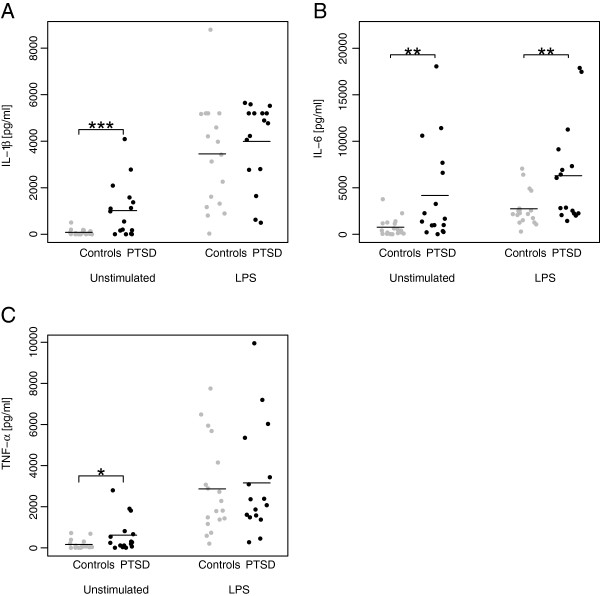
BACKGROUND: Posttraumatic stress disorder (PTSD) is associated with an enhanced risk for cardiovascular and other inflammatory diseases. Chronic low-level inflammation has been suggested as a potential mechanism linking these conditions. METHODS: We investigated plasma cytokine levels as well as spontaneous and lipopolysaccharide (LPS)-stimulated cytokine production by peripheral blood mononuclear cells (PBMCs) in a group of 35 severely traumatized PTSD patients compared to 25 healthy controls. RESULTS: Spontaneous production of interleukin (IL)-1β, IL-6 and tumor necrosis factor (TNF)-α by isolated PBMCs was significantly higher in the PTSD compared to the control group and even correlated with PTSD symptom severity within the PTSD group. In contrast, circulating plasma levels of pro- and anti-inflammatory cytokines such as IL-6, IL-8, IL-10, TNF-α, or monocyte chemotactic protein (MCP)-1 were not significantly altered in PTSD patients compared to healthy controls. CONCLUSIONS: Our findings indicate that PBMCs of PTSD patients are already pre-activated in vivo, providing further evidence for low-grade inflammation in PTSD. This might possibly represent one psychobiological pathway from PTSD to poor physical health.
Overview
The claims and statistics of this paper haven’t been checked yet.
Free: it reads the open-access text and checks the first 5 claims that cite a source we can check. Create a free account to check every claim.
Integrity signals
Registry
Cites
Statistics
Figures
Verification
Claims the paper makes
The claims and statistics of this paper haven’t been checked yet.
Free: it reads the open-access text and checks the first 5 claims that cite a source we can check. Create a free account to check every claim.
Claims other papers make about this one
Each is checked against this paper’s own text: does it say what the citing paper says it does?
The cited source says what the claim attributes to it.
In the citing paper
“There has also been one report that increased spontaneous production of IL-1 and TNF-α in PBMCs is present in individuals with PTSD compared with healthy controls (Gola et al, 2013).”
From Inflammation in Fear- and Anxiety-Based Disorders: PTSD, GAD, and Beyond (2017) · cites this paper as Gola et al, 2013
In the citing paper
“Peripheral blood cells isolated from stressed individuals show increased production of spontaneous IL-6 and in response to immune challenge [12, 13].”
From Interleukin-6 Induced by Social Stress Promotes a Unique Transcriptional Signature in the Monocytes That Facilitate Anxiety (2019) · cites this paper as [13]
Self-check
Percentages, sums and reported differences re-computed from the paper’s own numbers.
The self-check needs the paper’s full text.
Citations
Cites
R: A Language and Environment for Statistical Computing
R Core Team (2025) · doi:10.32614/r.manuals · Cited by 352,181
Hamilton, M. (1960) · Journal of Neurology, Neurosurgery & Psychiatry · doi:10.1136/jnnp.23.1.56 · Cited by 32,817 · cited 1×
“In addition, depressive symptoms were assessed with the Hamilton Depression Rating Scale HAM-D, [29].”
MethodA Simple Sequentially Rejective Multiple Test Procedure
(1979) · Scandinavian Journal of Statistics · doi:10.2307/4615733 · Cited by 21,526 · cited 1×
“In addition, we report p values corrected for multiple comparisons with Holm’s stepwise procedure [35], applied first for the five cytokines measured in plasma and then for the three cytokines produced by PBMCs measured in presence or absence of LPS.”
Method(1998) · The Journal of Clinical Psychiatry · Cited by 19,139
(1998) · PubMed · Cited by 10,216
Diagnostic and Statistical Manual of Mental Disorders (DSM-IV)
Hu, R. J. (2003) · Encyclopedia of the Neurological Sciences · doi:10.1016/b0-12-226870-9/01070-4 · Cited by 9,117
Inflammation in atherosclerosis
Libby, P. (2002) · Nature · doi:10.1038/nature01323 · Cited by 8,315
The mini international neuropsychiatric interview
Lecrubier, Y., Sheehan, D., Hergueta, T., & Weiller, E. (1998) · European Psychiatry · doi:10.1016/s0924-9338(99)80239-9 · Cited by 5,872
The development of a Clinician-Administered PTSD Scale
Blake, D. D., Weathers, F. W., Nagy, L. M., Kaloupek, D. G., Gusman, F. D., Charney, D. S., & Keane, T. M. (1995) · Journal of Traumatic Stress · doi:10.1002/jts.2490080106 · Cited by 5,024 · cited 7×
“Subsequently, PTSD symptom frequency and severity were assessed with the CAPS [25].”
BackgroundMethodInfluentialInflammation in Atherosclerosis
Libby, P. (2012) · Arteriosclerosis, Thrombosis, and Vascular Biology · doi:10.1161/atvbaha.108.179705 · Cited by 3,736 · cited 2×
“In addition, clinical studies affirm a correlation of circulating markers of inflammation with propensity to develop ischemic events and with prognosis after acute coronary syndromes [13,14].”
BackgroundResultMisunderstanding analysis of covariance.
Miller, G. A., & Chapman, J. P. (2001) · Journal of Abnormal Psychology · doi:10.1037/0021-843x.110.1.40 · Cited by 2,136 · cited 2×
“However, as both groups differed significantly in age, the preconditions for calculating and interpreting an Analysis of Covariance were not fulfilled [33,34].”
BackgroundInflammation as a Cardiovascular Risk Factor
Willerson, J. T., & Ridker, P. M. (2004) · Circulation · doi:10.1161/01.cir.0000129535.04194.38 · Cited by 1,304
Permutation, Parametric and Bootstrap Tests of Hypotheses
(2005) · Springer Series in Statistics · doi:10.1007/b138696 · Cited by 707
Regulatory T cells: friend or foe in immunity to infection?
Mills, K. H. G. (2004) · Nature Reviews Immunology · doi:10.1038/nri1485 · Cited by 702 · cited 1×
“For example, studies have reported lower cortisol levels [36] and a lower percentage of regulatory T cells [37] in those with PTSD, which are both crucial players in controlling inflammation thereby limiting immunopathological side effects of inflammatory processes [38,39].”
BackgroundPosttraumatic stress disorder and physical illness: results from clinical and epidemiologic studies
BOSCARINO, J. A. (2004) · Annals of the New York Academy of Sciences · doi:10.1196/annals.1314.011 · Cited by 691 · cited 2×
“; lincensee BioMed Central L Commons Attribution License (http://creativec reproduction in any medium, provided the or In addition to psychiatric morbidity, numerous studies have shown that traumatic stress and especially PTSD are associated with poor self-reported physical health, increased utilization of medical ser…”
Background(2000) · PubMed · Cited by 676
A paradox in the interpretation of group comparisons.
Lord, F. M. (1967) · Psychological Bulletin · doi:10.1037/h0025105 · Cited by 627 · cited 2×
“However, as both groups differed significantly in age, the preconditions for calculating and interpreting an Analysis of Covariance were not fulfilled [33,34].”
BackgroundNeuner, F., Schauer, M., Karunakara, U., Klaschik, C., Robert, C., & Elbert, T. (2004) · BMC Psychiatry · doi:10.1186/1471-244x-4-34 · Cited by 466 · cited 1×
“Repeated exposure to traumatic events such as rape, combat or natural disasters has dramatic effects on mental health [1-3].”
BackgroundSelf-citationTrauma and health: Physical health consequences of exposure to extreme stress.
(2004) · American Psychological Association eBooks · doi:10.1037/10723-000 · Cited by 437 · cited 1×
“Besides traditional behavioral cardiovascular risk factors such as smoking, alcohol abuse or low physical activity [11], chronic low-level inflammation has been discussed as a potential mechanism linking cardiovascular disease to PTSD [12].”
BackgroundBoscarino, J. A. (2008) · Psychosomatic Medicine · doi:10.1097/psy.0b013e31817bccaf · Cited by 434 · cited 1×
“In particular, it has been found that cardiovascular disease and its risk factors are more prevalent among individuals with PTSD [5,6,8], with two recent studies even demonstrating a prospective relationship between PTSD symptoms and coronary heart disease [9] or PTSD and cardiovascular mortality, respectively [10].”
Kubzansky, L. D., Koenen, K. C., Spiro, A., Vokonas, P. S., & Sparrow, D. (2007) · Archives of General Psychiatry · doi:10.1001/archpsyc.64.1.109 · Cited by 426 · cited 1×
“In particular, it has been found that cardiovascular disease and its risk factors are more prevalent among individuals with PTSD [5,6,8], with two recent studies even demonstrating a prospective relationship between PTSD symptoms and coronary heart disease [9] or PTSD and cardiovascular mortality, respectively [10].”
Anderson, M. J., & Legendre, P. (1999) · Journal of Statistical Computation and Simulation · doi:10.1080/00949659908811936 · Cited by 425 · cited 1×
“The p values reported below are given by the position of the original statistic in the empirical distribution of the permutation statistic [31,32].”
Methodvon Känel, R., Hepp, U., Kraemer, B., Traber, R., Keel, M., Mica, L., & Schnyder, U. (2007) · Journal of Psychiatric Research · doi:10.1016/j.jpsychires.2006.06.009 · Cited by 408 · cited 3×
“In contrast, other studies did not find significant group differences with respect to circulating levels of IL-1β [12], IL-6 [12,20], and CRP [12] or even reported lower levels of CRP [21] and IL-8 [20] in PTSD patients.”
BackgroundResultRohleder, N., Joksimovic, L., Wolf, J. M., & Kirschbaum, C. (2004) · Biological Psychiatry · doi:10.1016/j.biopsych.2003.11.018 · Cited by 393 · cited 2×
“Furthermore, as in previous studies [22,23], LPS-stimulated PBMCs from PTSD patients exhibited significantly higher IL-6 secretion compared to PBMCs from control subjects.”
ResultMaes, M., Lin, A.-H., Delmeire, L., Van Gastel, A., Kenis, G., De Jongh, R., & Bosmans, E. (1999) · Biological Psychiatry · doi:10.1016/s0006-3223(98)00131-0 · Cited by 387 · cited 1×
“Some studies reported higher levels of IL-1β [15,16], IL-6 [17], and TNF-α [12] in the plasma or elevated levels of IL-6 in the cerebrospinal fluid [18] of PTSD patients compared to control subjects.”
BackgroundKolassa, I.-T., Kolassa, S., Ertl, V., Papassotiropoulos, A., & De Quervain, D. J.-F. (2010) · Biological Psychiatry · doi:10.1016/j.biopsych.2009.10.009 · Cited by 245 · cited 1×
“Repeated exposure to traumatic events such as rape, combat or natural disasters has dramatic effects on mental health [1-3].”
BackgroundSelf-citationLow cortisol, high DHEA, and high levels of stimulated TNF‐α, and IL‐6 in women with PTSD
Gill, J., Vythilingam, M., & Page, G. G. (2008) · Journal of Traumatic Stress · doi:10.1002/jts.20372 · Cited by 240 · cited 5×
“Furthermore, as in previous studies [22,23], LPS-stimulated PBMCs from PTSD patients exhibited significantly higher IL-6 secretion compared to PBMCs from control subjects.”
ResultInfluentialPhysical health and post-traumatic stress disorder: review and synthesis.
Schnurr, P. P., & Jankowski, M. K. (1999) · PubMed · Cited by 239
Plasma and Cerebrospinal Fluid Interleukin-6 Concentrations in Posttraumatic Stress Disorder
Baker, D. G., Ekhator, N. N., Kasckow, J. W., Hill, K. K., Zoumakis, E., Dashevsky, B. A., Chrousos, G. P., & Geracioti Jr., T. D. (2001) · Neuroimmunomodulation · doi:10.1159/000049028 · Cited by 238
Deedwania, P. C. (2004) · Circulation · doi:10.1161/01.cir.0000110642.73995.bf · Cited by 236
Health Care Costs Associated With Posttraumatic Stress Disorder Symptoms in Women
Walker, E. A., Katon, W., Russo, J., Ciechanowski, P., Newman, E., & Wagner, A. W. (2003) · Archives of General Psychiatry · doi:10.1001/archpsyc.60.4.369 · Cited by 233 · cited 1×
“; lincensee BioMed Central L Commons Attribution License (http://creativec reproduction in any medium, provided the or In addition to psychiatric morbidity, numerous studies have shown that traumatic stress and especially PTSD are associated with poor self-reported physical health, increased utilization of medical ser…”
BackgroundSpontaneous remission from PTSD depends on the number of traumatic event types experienced.
Kolassa, I.-T., Ertl, V., Eckart, C., Kolassa, S., Onyut, L. P., & Elbert, T. (2010) · Psychological Trauma: Theory, Research, Practice, and Policy · doi:10.1037/a0019362 · Cited by 230
Self-citationElevated levels of serum interleukin-1β in combat-related posttraumatic stress disorder
Spivak, B., Shohat, B., Mester, R., Avraham, S., Gil-Ad, I., Bleich, A., Valevski, A., & Weizman, A. (1997) · Biological Psychiatry · doi:10.1016/s0006-3223(96)00375-7 · Cited by 214 · cited 1×
“Some studies reported higher levels of IL-1β [15,16], IL-6 [17], and TNF-α [12] in the plasma or elevated levels of IL-6 in the cerebrospinal fluid [18] of PTSD patients compared to control subjects.”
BackgroundSpitzer, C., Barnow, S., Völzke, H., Wallaschofski, H., John, U., Freyberger, H. J., Löwe, B., & Grabe, H. J. (2010) · Journal of Psychiatric Research · doi:10.1016/j.jpsychires.2009.06.002 · Cited by 205 · cited 1×
“[19] found that, in a sample of 3049 adults, PTSD positive participants had significantly higher odds for elevated levels of C-reactive protein (CRP) than those without PTSD.”
BackgroundPermutation, Parametric, and Bootstrap Tests of Hypotheses
Annis, D. H. (2005) · Journal of the American Statistical Association · doi:10.1198/jasa.2005.s48 · Cited by 195
Substantial reduction of naïve and regulatory T cells following traumatic stress
Sommershof, A., Aichinger, H., Engler, H., Adenauer, H., Catani, C., Boneberg, E.-M., Elbert, T., Groettrup, M., & Kolassa, I.-T. (2009) · Brain, Behavior, and Immunity · doi:10.1016/j.bbi.2009.07.003 · Cited by 172
Self-citationA New Approach to the Assessment of the Treatment Effects of Somatoform Disorders
Rief, W., & Hiller, W. (2003) · Psychosomatics · doi:10.1176/appi.psy.44.6.492 · Cited by 171 · cited 1×
“Somatic symptoms were assessed using a shortened version of Screening for Somatoform Symptoms-7 SOMS-7, [26].”
MethodTucker, P., Ruwe, W. D., Masters, B., Parker, D. E., Hossain, A., Trautman, R. P., & Wyatt, D. B. (2004) · Biological Psychiatry · doi:10.1016/j.biopsych.2004.03.009 · Cited by 148
de Kloet, C. S., Vermetten, E., Bikker, A., Meulman, E., Geuze, E., Kavelaars, A., Westenberg, H. G. M., & Heijnen, C. J. (2007) · Molecular Psychiatry · doi:10.1038/sj.mp.4001934 · Cited by 98 · cited 3×
“[24] even reported decreased TNF-α production in LPS-stimulated whole blood of PTSD patients compared to controls.”
BackgroundMethodResultSöndergaard, H. P., Hansson, L.-O., & Theorell, T. (2004) · Clinica Chimica Acta · doi:10.1016/j.cccn.2003.12.019 · Cited by 98 · cited 4×
“In contrast, other studies did not find significant group differences with respect to circulating levels of IL-1β [12], IL-6 [12,20], and CRP [12] or even reported lower levels of CRP [21] and IL-8 [20] in PTSD patients.”
BackgroundResultInfluentialSong, Y., Zhou, D., Guan, Z., & Wang, X. (2007) · Neuroimmunomodulation · doi:10.1159/000112050 · Cited by 69 · cited 2×
“In contrast, other studies did not find significant group differences with respect to circulating levels of IL-1β [12], IL-6 [12,20], and CRP [12] or even reported lower levels of CRP [21] and IL-8 [20] in PTSD patients.”
BackgroundResultRegulating inflammation by glucocorticoids
Besedovsky, H. O., & del Rey, A. (2006) · Nature Immunology · doi:10.1038/ni0606-537 · Cited by 51 · cited 1×
“For example, studies have reported lower cortisol levels [36] and a lower percentage of regulatory T cells [37] in those with PTSD, which are both crucial players in controlling inflammation thereby limiting immunopathological side effects of inflammatory processes [38,39].”
BackgroundVolpe, E. M., Quinn, C. R., Resch, K., Sommers, M. S., Wieling, E. A., & Cerulli, C. (2015) · Family & Community Health · doi:10.1097/fch.0000000000000072 · Cited by 32
Is Post-Traumatic Stress Disorder Related to Development of Heart Disease?
Kubzansky, L. D., & Koenen, K. C. (2007) · Future Cardiology · doi:10.2217/14796678.3.2.153 · Cited by 14 · cited 2×
“, myocardial infarction, stroke, and peripheral vascular disease, often observed in patients with PTSD [5,8].”
Background
Research works printed but not linked: 1
- Schauer M Neuner F Elbert T Narrative Exposure Therapy 2011 2nd Göttingen, Germany: Hogrefe & Huber
Cited by
So depression is an inflammatory disease, but where does the inflammation come from?
Berk, M., Williams, L. J., Jacka, F. N., O’Neil, A., Pasco, J. A., Moylan, S., Allen, N. B., Stuart, A. L., Hayley, A. C., Byrne, M. L., et al. (2013) · BMC Medicine · doi:10.1186/1741-7015-11-200 · Cited by 1,423
Inflammation in Fear- and Anxiety-Based Disorders: PTSD, GAD, and Beyond
Michopoulos, V., Powers, A., Gillespie, C. F., Ressler, K. J., & Jovanovic, T. (2017) · Neuropsychopharmacology · doi:10.1038/npp.2016.146 · Cited by 786
“…256 ................................................................................................................................................... Neuropsychopharmacology REVIEWS PBMCs is present in individuals with PTSD compared with healthy controls (Gola et al, 2013).”
Inflammation and post‐traumatic stress disorder
Hori, H., & Kim, Y. (2019) · Psychiatry and Clinical Neurosciences · doi:10.1111/pcn.12820 · Cited by 407
O’Donovan, A., Cohen, B. E., Seal, K. H., Bertenthal, D., Margaretten, M., Nishimi, K., & Neylan, T. C. (2015) · Biological Psychiatry · doi:10.1016/j.biopsych.2014.06.015 · Cited by 284
Blast-related traumatic brain injury
Rosenfeld, J. V., McFarlane, A. C., Bragge, P., Armonda, R. A., Grimes, J. B., & Ling, G. S. (2013) · The Lancet Neurology · doi:10.1016/s1474-4422(13)70161-3 · Cited by 282
Metadata
- Authors
- Gola, H., Engler, H., Sommershof, A., Adenauer, H., Kolassa, S., Schedlowski, M., Groettrup, M., Elbert, T., & Kolassa, I.-T.
- Affiliations
- University of Konstanz (DE)
- Essen University Hospital (DE)
- Systems, Applications & Products in Data Processing (Switzerland) (CH)
- Corresponding author
- Kolassa, Iris-Tatjana
- ORCID
- Venue
- BMC Psychiatry
- Published
- 2013-01-29
- Volume
- 13
- Issue
- 1
- Pages
- 40-40
- ISSN
- 1471-244X (ISSN-L)
- PMC
- PMC3574862
- OpenAlex
- W2001986928
- Cited by
- 225
- References
- 44
- Citations by year
- 2026: 5 · 2025: 13 · 2024: 15 · 2023: 12 · 2022: 20 · 2021: 16 · 2020: 14 · 2019: 14 · 2018: 30 · 2017: 24 · 2016: 21 · 2015: 14 · 2014: 15 · 2013: 11
- FWCI
- 22.62
- Type
- journal article
- Language
- en
- Open access
- gold
- doi.org
- Licence
- cc-by
- creativecommons.org/licenses/by/2.0 (tdm)
- creativecommons.org/licenses/by/2.0 (vor)
- Locations
- BMC Psychiatry (publishedVersion, cc-by)
- Europe PMC (PubMed Central) (publishedVersion, cc-by)
- PubMed Central (publishedVersion, cc-by)
- PubMed (publishedVersion)
- DOAJ (DOAJ: Directory of Open Access Journals) (submittedVersion, cc-by-sa)
- Lancaster EPrints (Lancaster University) (submittedVersion)
- KOPS (University of Konstanz) (submittedVersion)
- Funders
- Deutsche Forschungsgemeinschaft (FOR751)
- Universität Ulm
- Universität Konstanz
- European Refugee Fund
- Topics
- Social Sciences › Psychology › Clinical Psychology › Posttraumatic Stress Disorder Research
- Life Sciences › Neuroscience › Behavioral Neuroscience › Stress Responses and Cortisol
- Life Sciences › Neuroscience › Biological Psychiatry › Tryptophan and brain disorders
- Keywords
- post-traumatic stress disorder, inflammatory cytokines, peripheral blood mononuclear cells, spontaneous cytokine production, lipopolysaccharide stimulation, IL-1β, interleukin-6, TNF-α, low-grade inflammation, plasma cytokines, PTSD symptom severity, cardiovascular risk
- MeSH terms
- Adolescent, Adult, Female, Humans, Leukocytes, Mononuclear, Male, Middle Aged, Stress Disorders, Post-Traumatic, Tumor Necrosis Factor-alpha, Interleukin-6, Case-Control Studies, Cytokines, Interleukin-8, Interleukin-10, Chemokine CCL2, Interleukin-1beta, Young Adult
About these checks
Registry, retraction, Cites and statistics results are computed, not judged, with one exception: a printed reference that no index lists is read once by a model before it counts as a citation error. Claims are extracted by a model and kept only when their quote appears verbatim in the text; each cited source is then checked, with a model’s help, for whether it says what the claim relies on. Those verdicts can be wrong — read the claim’s quote and the cited source before relying on one.
Statistics and arithmetic are recomputed, not judged.
Confidence bands are shown only for fields calibrated on our annotated test set. None is calibrated yet, so no band is shown.
What counts as a claim ›How we measure confidence ›How we check this ›
Are you an author, or do you see a problem with this page? Request a review
Data sources
Bibliographic data: Semantic Scholar, OpenAlex, Crossref.
Contains information from the Semantic Scholar Academic Graph Datasets, made available under the ODC Attribution License (ODC-BY 1.0).
Semantic Scholar’s data is described in: Kinney, R., et al. (2023). The Semantic Scholar Open Data Platform. arXiv:2301.10140.
