

CBT for depression: a pilot RCT comparing mobile phone vs. computer
Open accessThe DOI matches its Crossref record; 35 of the 36 references it cites were found in a registry or an index, and 1 are not checked yet.
Abstract
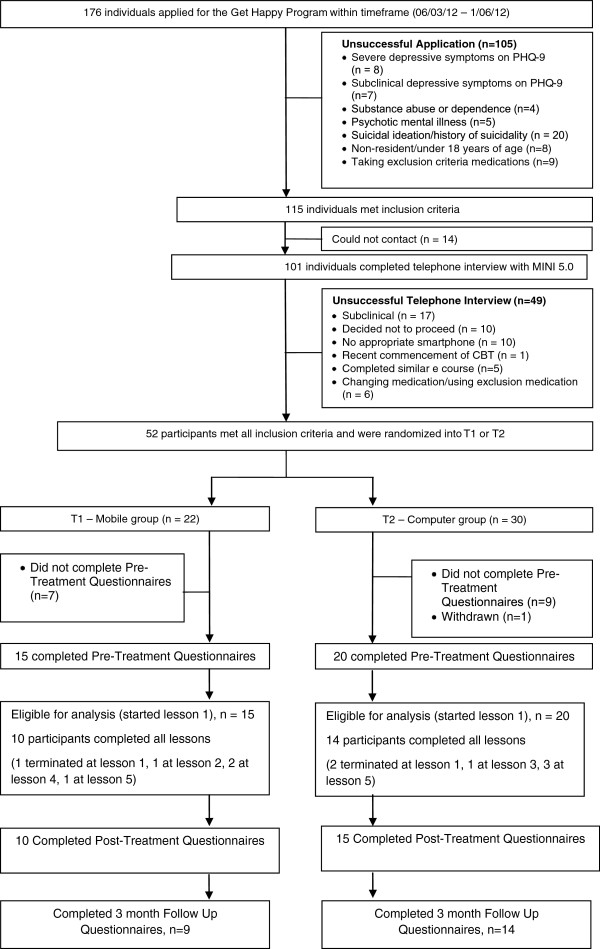
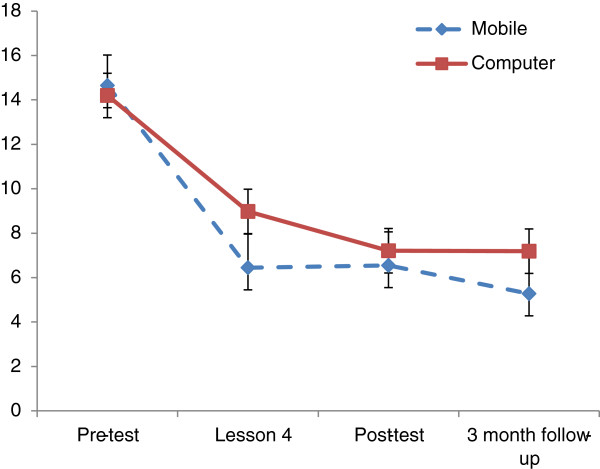
Background: This paper reports the results of a pilot randomized controlled trial comparing the delivery modality (mobile phone/tablet or fixed computer) of a cognitive behavioural therapy intervention for the treatment of depression. The aim was to establish whether a previously validated computerized program (The Sadness Program) remained efficacious when delivered via a mobile application. Method: 35 participants were recruited with Major Depression (80% female) and randomly allocated to access the program using a mobile app (on either a mobile phone or iPad) or a computer. Participants completed 6 lessons, weekly homework assignments, and received weekly email contact from a clinical psychologist or psychiatrist until completion of lesson 2. After lesson 2 email contact was only provided in response to participant request, or in response to a deterioration in psychological distress scores. The primary outcome measure was the Patient Health Questionnaire 9 (PHQ-9). Of the 35 participants recruited, 68.6% completed 6 lessons and 65.7% completed the 3-months follow up. Attrition was handled using mixed-model repeated-measures ANOVA. Results: Both the Mobile and Computer Groups were associated with statistically significantly benefits in the PHQ-9 at post-test. At 3 months follow up, the reduction seen for both groups remained significant. Conclusions: These results provide evidence to indicate that delivering a CBT program using a mobile application, can result in clinically significant improvements in outcomes for patients with depression. Trial registration: Australian New Zealand Clinical Trials Registry ACTRN 12611001257954
Overview
The claims and statistics of this paper haven’t been checked yet.
Free: it reads the open-access text and checks the first 5 claims that cite a source we can check. Create a free account to check every claim.
Integrity signals
Registry
Cites
Statistics
Figures
Verification
Claims the paper makes
The claims and statistics of this paper haven’t been checked yet.
Free: it reads the open-access text and checks the first 5 claims that cite a source we can check. Create a free account to check every claim.
Claims other papers make about this one
Each is checked against this paper’s own text: does it say what the citing paper says it does?
The cited source says what the claim attributes to it.
In the citing paper
“Some DMHIs, such as the Get Happy Program [13], consist of a series of lessons or modules that are designed to be completed in a sequential fashion over a specified number of weeks.”
From Digital Mental Health Interventions for Depression: Scoping Review of User Engagement (2022) · cites this paper as [13]
The cited source says what the claim attributes to it.
In the citing paper
“We have identified through our systematic review four apps in English that offer CBT or BA treatment for depression and have been studied by researchers and published in scientific papers, the Behavioural Activation Scheduling [50], the Get Happy Program [40], CBT Mobilwork [65] and Mobilyze [45].”
From A Systematic Review of Cognitive Behavioral Therapy and Behavioral Activation Apps for Depression (2016) · cites this paper as [40]
The cited source says what the claim attributes to it.
In the citing paper
“We have started to conduct trials in smartphone-delivered treatments and so did other research groups [Watts et al., 2013].”
From Internet-based treatments - Experiences from Sweden (2013) · cites this paper as Watts et al., 2013
The cited source says what the claim attributes to it.
In the citing paper
“Other studies also report positive outcomes with the use of mobile applications for the management of different mood disorders (106–108).”
From Mobile intervention for individuals with psychosis, dual disorders, and their common comorbidities: A literature review (2019) · cites this paper as [108]
The cited source says what the claim attributes to it.
In the citing paper
“and improving depressive symptoms (e.g., 107, 108, 112, 114)”
From Mobile intervention for individuals with psychosis, dual disorders, and their common comorbidities: A literature review (2019) · cites this paper as [108]
3 more claims about this paper
Create a free account to see every claim other papers make about this one.
Self-check
Percentages, sums and reported differences re-computed from the paper’s own numbers.
The self-check needs the paper’s full text.
Citations
Cites
The PHQ-9: Validity of a brief depression severity measure
Kroenke, K., Spitzer, R. L., & Williams, J. B. W. (2001) · Journal of General Internal Medicine · doi:10.1046/j.1525-1497.2001.016009606.x · Cited by 44,910
(1998) · The Journal of Clinical Psychiatry · Cited by 19,139
KESSLER, R. C., ANDREWS, G., COLPE, L. J., HIRIPI, E., MROCZEK, D. K., NORMAND, S.-L. T., WALTERS, E. E., & ZASLAVSKY, A. M. (2002) · Psychological Medicine · doi:10.1017/s0033291702006074 · Cited by 10,327
Self-citation(1998) · PubMed · Cited by 10,216
The mini international neuropsychiatric interview
Lecrubier, Y., Sheehan, D., Hergueta, T., & Weiller, E. (1998) · European Psychiatry · doi:10.1016/s0924-9338(99)80239-9 · Cited by 5,872
Higgins, S. M. F., Macken, A. P., Cullen, W., Saunders, J., Dunne, C. P., & O’Gorman, C. S. (2013) · PubMed · doi:10.34961/9953 · Cited by 4,808
Depression, chronic diseases, and decrements in health: results from the World Health Surveys
Moussavi, S., Chatterji, S., Verdes, E., Tandon, A., Patel, V., & Ustun, B. (2007) · The Lancet · doi:10.1016/s0140-6736(07)61415-9 · Cited by 4,070
Robins, L. N. (1988) · Archives of General Psychiatry · doi:10.1001/archpsyc.1988.01800360017003 · Cited by 2,909
Webb, T. L., Joseph, J., Yardley, L., & Michie, S. (2010) · Journal of Medical Internet Research · doi:10.2196/jmir.1376 · Cited by 2,517
Psychometric properties of the credibility/expectancy questionnaire
Devilly, G. J., & Borkovec, T. D. (2000) · Journal of Behavior Therapy and Experimental Psychiatry · doi:10.1016/s0005-7916(00)00012-4 · Cited by 2,295 · cited 3×
“All participants completed the questionnaire outcome measures (BDI-II, PHQ-9, K-10, CEQ, ERS and SDS) at 1-week post treatment and at 3-months follow up.”
Background
Research works printed but not linked: 4
- Murray CJL Lopez AD The Global Burden of Disease 1996 Geneva: World Health Organization, Harvard School of Public Health, World Bank
- International Telecommunication Union The World in 2011 ICT Facts and Figures 2011 Geneva, Switzerland: ITU 1 8
- Larson R Csikszentimihalyi M The experience sampling method: new directions for methodology Social Behavioural Science 1980 15 1 15
- Beck AT Steer RA Brown GK Beck Depression Inventory-II manual 1996 2 San Antonio, TX: Harcourt Brace
Cited by
Items 301–330 of 330
Integrating Technology Into Mental Health Care Delivery
Riboni, F. V., & Pagnini, F. (2020) · Elsevier eBooks · doi:10.1016/b978-0-12-818697-8.00012-1
Awareness of ADHD in primary carePreprint
French, B. (2019) · PsyArXiv (OSF Preprints) · doi:10.31234/osf.io/waqfd
Syakura, A., & Amin, E. S. (2021) · International Journal of Nursing and Health Services (IJNHS) · doi:10.35654/ijnhs.v4i5.498 · Cited by 5
“Almost have a smartphone and can access the internet, so therapy can be easily implemented and widely used by the community (16).”
Rocha, T. I. U. (2021) · Digital Library of Theses and Dissertations (Universidade de São Paulo) · doi:10.11606/d.5.2021.tde-13122021-141542 · Cited by 1
Toward an understanding of suicidal ideation among career firefighters
Henderson, E. L. (2020) · Digital Repository Service (Northeastern University) · doi:10.17760/d20356164
Lipschitz, J. M., Boxtel, R. V., Torous, J. B., Firth, J., Lebovitz, J. G., Burdick, K. E., & Hogan, T. P. (2022) · doi:10.2196/preprints.39204
Chapter 4. Structuring and Educating
(2017) · American Psychiatric Association Publishing eBooks · doi:10.1176/appi.books.9781615374823.jw04
Lan, A., Lee, A., Munroe, K., McRae, C., Kaleis, L., Keshavjee, K., & Guergachi, A. (2021) · doi:10.32920/14639691
100 Highly Cited Interventional Studies on Mobile Health: a Bibliometric Analysis (Preprint)Preprint
Ameri, A., Salmanizadeh, F., Keshvardoost, S., & Bahaadinbeigy, K. (2019) · doi:10.2196/preprints.17600
New Research in Obsessive-Compulsive Disorder and Major Depression
Aouizerate, B., & Haffen, É. (2019) · MDPI eBooks · doi:10.3390/books978-3-03921-091-6
Lan, A., Lee, A. M., Munroe, K., McRae, C., Kaleis, L., Keshavjee, K., & Guergachi, A. (2021) · doi:10.32920/14639691.v1
Smartphone-Based Treatment in Psychiatry: A Systematic Review
Faurholt‐Jepsen, M., Tønning, M. L., & Kessing, L. V. (2023) · Springer eBooks · doi:10.1007/978-3-031-10698-9_5
Meinlschmidt, G., Grossert, A., Meffert, C., Roemmel, N., Hess, V., Rochlitz, C. F., Pless, M., Hunziker, S., Wössmer, B., Geuter, U., et al. (2023) · JMIR Cancer · doi:10.2196/38515
“Previous studies indicated that smartphone-based interventions have the potential to reduce symptoms of mental disorders, such as anxiety and depression [9,10].”
BackgroundSTAYING RELEVANT IN THE TECHNICAL ERA? There’s an App for That!
Jojic, M. (2014) · JAACAP Connect · doi:10.62414/001c.92679
Ramos, N., Besoaín, F., Cancino, N., Gallardo, I., Albornoz, P. D., Fresno, A., Spencer, R., Schott, S., Núñez, D., Salgado, C., et al. (2024) · JMIR Research Protocols · doi:10.2196/52324
“Studies indicate a high effectiveness rate of web-based care, with smartphone-based psychological interventions reducing user anxiety [7] and depression [8,9].”
BackgroundRodríguez‐Bailón, M., Vidaña-Moya, L., Fernández-Solano, A. J., Grau, S., & Merchán-Baeza, J. A. (2024) · Disability and Rehabilitation Assistive Technology · doi:10.1080/17483107.2024.2327520 · Cited by 1
“For example, there are mobile applications that have applied cognitive behavioural therapy (CBT) virtually with wide-ranging benefits for people with anxiety and depression [50, 51].”
Online-Behandlung der Depression
Eichenberg, C. (2024) · PDP – Psychodynamische Psychotherapie · doi:10.21706/pdp-23-3-243
Zhao, Y., & Wang, J. (2025) · Lecture notes in computer science · doi:10.1007/978-3-031-93845-0_23
García-Batista, Z. E., Vindel, A. C., Guerra-Peña, K., Álvarez-Hernández, A., Cruz, I., Amparo, Ó. R., & Medrano, L. A. (2025) · Suma Psicológica · doi:10.14349/sumapsi.2025.v32.n2.2 · Cited by 1
Meta-Analysis on the Effectiveness of mHealth Interventions for Mental Health: A 10-Year Update
Tomlinson, C. S., Toevs, E. K., Gallagher, H. T., Angus, A., & Lindhiem, O. J. (2025) · Behavior Modification · doi:10.1177/01454455251380218 · Cited by 2
Velthuizen, S. L. M., Lutz, M. C., van den Bos, E., Miers, A. C., & Westenberg, P. M. (2025) · Cognitive Behaviour Therapy · doi:10.1080/16506073.2025.2583114 · Cited by 1
“For example, Watts et al. (2013) found similar effectiveness of internet-only CBT when delivered via smartphone app versus via computer in a small study though this needs to be replicated using a blended format with a larger sample size.”
Park, C., Zhu, J., Man, R. H. C., Rosenblat, J. D., Iacobucci, M., Gill, H., Mansur, R. B., & McIntyre, R. S. (2019) · Annals of Clinical Psychiatry · doi:10.1177/154733251903100409
Christensen, O. R., Frostholm, L., Rask, M. T., Rosendal, M., & Rask, C. U. (2025) · BMC Digital Health · doi:10.1186/s44247-025-00229-6
“Despite the concern for shallow use on mobiles, some studies suggest comparable statistically significant benefits when comparing the same treat-ment on a desktop and a mobile [36].”
Li, J., Cai, R., Ran, B., & Chen, X. M. (2026) · Lecture notes in computer science · doi:10.1007/978-3-032-13187-4_21
Scholze, K., Allenhof, C., & Hegerl, U. (2026) · JMIR mhealth and uhealth · doi:10.2196/58835
“Watts et al [14] similarly reported no significant differences in the number of sessions between the app and browser versions.”
Mei, X., Liu, J., Qiu, Y., Tong, M., Gu, J., Yue, Y., Yang, F., & Zhang, L. (2026) · BMC Public Health · doi:10.1186/s12889-026-27309-0
“Digital mental health interventions (DMHIs) have emerged as an essential component of global mental health treatment systems, leveraging internet platforms, mobile applications, and virtual reality technology to address mental health need [12–14].”
IDA: internetförmedlad behandling för vuxna med ADHD – en randomiserad kontrollerad studie
Meneses, F. D. C., & Tingstam, S. (2015) · DiVA (Stockholm University) · Cited by 1
Metadata
- Authors
- Watts, S., Mackenzie, A., Thomas, C., Griskaitis, A., Mewton, L., Williams, A., & Andrews, G.
- Affiliations
- UNSW Sydney (AU)
- Corresponding author
- Andrews, Gavin
- Venue
- BMC Psychiatry
- Published
- 2013-02-07
- Volume
- 13
- Issue
- 1
- Pages
- 49-49
- ISSN
- 1471-244X (ISSN-L)
- PMC
- PMC3571935
- OpenAlex
- W1968667849
- Cited by
- 329
- References
- 35
- Citations by year
- 2026: 4 · 2025: 11 · 2024: 16 · 2023: 14 · 2022: 24 · 2021: 25 · 2020: 33 · 2019: 37 · 2018: 34 · 2017: 42 · 2016: 32 · 2015: 31 · 2014: 16 · 2013: 10
- FWCI
- 45.35
- Type
- journal article
- Language
- en
- Open access
- gold
- doi.org
- Licence
- Locations
- BMC Psychiatry (publishedVersion, cc-by)
- Europe PMC (PubMed Central) (publishedVersion, cc-by)
- PubMed Central (publishedVersion, cc-by)
- PubMed (publishedVersion)
- DOAJ (DOAJ: Directory of Open Access Journals) (submittedVersion)
- Topics
- Social Sciences › Psychology › Applied Psychology › Digital Mental Health Interventions
- Social Sciences › Psychology › Experimental and Cognitive Psychology › Anxiety, Depression, Psychometrics, Treatment, Cognitive Processes
- Health Sciences › Health Professions › General Health Professions › Mobile Health and mHealth Applications
- Keywords
- cognitive behavioral therapy, depression, mobile health, mobile application, computer-based intervention, major depressive disorder, attrition, PHQ-9
- MeSH terms
- Adolescent, Adult, Computers, Major Depressive Disorder, Female, Humans, Male, Middle Aged, Patient Compliance, Pilot Projects, Psychiatric Status Rating Scales, Cognitive Behavioral Therapy, Treatment Outcome, Telemedicine, Cell Phone, Young Adult
About these checks
Registry, retraction, Cites and statistics results are computed, not judged, with one exception: a printed reference that no index lists is read once by a model before it counts as a citation error. Claims are extracted by a model and kept only when their quote appears verbatim in the text; each cited source is then checked, with a model’s help, for whether it says what the claim relies on. Those verdicts can be wrong — read the claim’s quote and the cited source before relying on one.
Statistics and arithmetic are recomputed, not judged.
Confidence bands are shown only for fields calibrated on our annotated test set. None is calibrated yet, so no band is shown.
What counts as a claim ›How we measure confidence ›How we check this ›
Are you an author, or do you see a problem with this page? Request a review
Data sources
Bibliographic data: Semantic Scholar, OpenAlex, Crossref.
Contains information from the Semantic Scholar Academic Graph Datasets, made available under the ODC Attribution License (ODC-BY 1.0).
Semantic Scholar’s data is described in: Kinney, R., et al. (2023). The Semantic Scholar Open Data Platform. arXiv:2301.10140.
