

CBT for depression: a pilot RCT comparing mobile phone vs. computer
Open accessThe DOI matches its Crossref record; 35 of the 36 references it cites were found in a registry or an index, and 1 are not checked yet.
Abstract
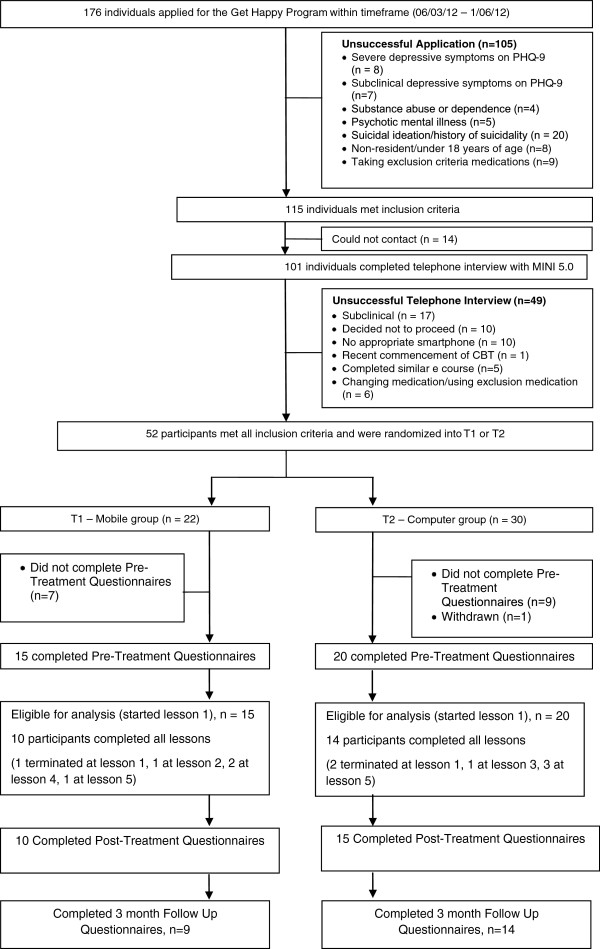
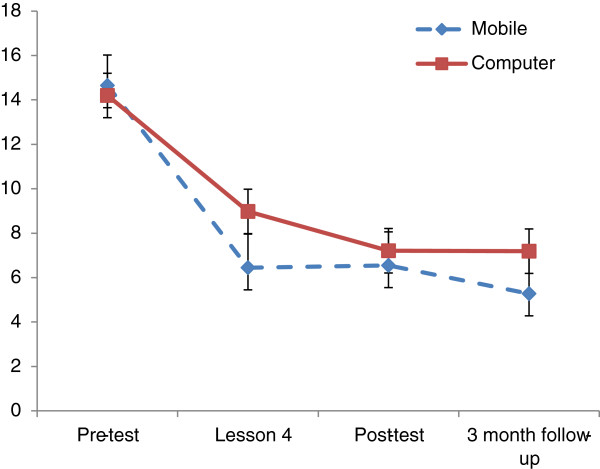
Background: This paper reports the results of a pilot randomized controlled trial comparing the delivery modality (mobile phone/tablet or fixed computer) of a cognitive behavioural therapy intervention for the treatment of depression. The aim was to establish whether a previously validated computerized program (The Sadness Program) remained efficacious when delivered via a mobile application. Method: 35 participants were recruited with Major Depression (80% female) and randomly allocated to access the program using a mobile app (on either a mobile phone or iPad) or a computer. Participants completed 6 lessons, weekly homework assignments, and received weekly email contact from a clinical psychologist or psychiatrist until completion of lesson 2. After lesson 2 email contact was only provided in response to participant request, or in response to a deterioration in psychological distress scores. The primary outcome measure was the Patient Health Questionnaire 9 (PHQ-9). Of the 35 participants recruited, 68.6% completed 6 lessons and 65.7% completed the 3-months follow up. Attrition was handled using mixed-model repeated-measures ANOVA. Results: Both the Mobile and Computer Groups were associated with statistically significantly benefits in the PHQ-9 at post-test. At 3 months follow up, the reduction seen for both groups remained significant. Conclusions: These results provide evidence to indicate that delivering a CBT program using a mobile application, can result in clinically significant improvements in outcomes for patients with depression. Trial registration: Australian New Zealand Clinical Trials Registry ACTRN 12611001257954
Overview
The claims and statistics of this paper haven’t been checked yet.
Free: it reads the open-access text and checks the first 5 claims that cite a source we can check. Create a free account to check every claim.
Integrity signals
Registry
Cites
Statistics
Figures
Verification
Claims the paper makes
The claims and statistics of this paper haven’t been checked yet.
Free: it reads the open-access text and checks the first 5 claims that cite a source we can check. Create a free account to check every claim.
Claims other papers make about this one
Each is checked against this paper’s own text: does it say what the citing paper says it does?
The cited source says what the claim attributes to it.
In the citing paper
“Some DMHIs, such as the Get Happy Program [13], consist of a series of lessons or modules that are designed to be completed in a sequential fashion over a specified number of weeks.”
From Digital Mental Health Interventions for Depression: Scoping Review of User Engagement (2022) · cites this paper as [13]
The cited source says what the claim attributes to it.
In the citing paper
“We have identified through our systematic review four apps in English that offer CBT or BA treatment for depression and have been studied by researchers and published in scientific papers, the Behavioural Activation Scheduling [50], the Get Happy Program [40], CBT Mobilwork [65] and Mobilyze [45].”
From A Systematic Review of Cognitive Behavioral Therapy and Behavioral Activation Apps for Depression (2016) · cites this paper as [40]
The cited source says what the claim attributes to it.
In the citing paper
“We have started to conduct trials in smartphone-delivered treatments and so did other research groups [Watts et al., 2013].”
From Internet-based treatments - Experiences from Sweden (2013) · cites this paper as Watts et al., 2013
The cited source says what the claim attributes to it.
In the citing paper
“Other studies also report positive outcomes with the use of mobile applications for the management of different mood disorders (106–108).”
From Mobile intervention for individuals with psychosis, dual disorders, and their common comorbidities: A literature review (2019) · cites this paper as [108]
The cited source says what the claim attributes to it.
In the citing paper
“and improving depressive symptoms (e.g., 107, 108, 112, 114)”
From Mobile intervention for individuals with psychosis, dual disorders, and their common comorbidities: A literature review (2019) · cites this paper as [108]
3 more claims about this paper
Create a free account to see every claim other papers make about this one.
Self-check
Percentages, sums and reported differences re-computed from the paper’s own numbers.
The self-check needs the paper’s full text.
Citations
Cites
The PHQ-9: Validity of a brief depression severity measure
Kroenke, K., Spitzer, R. L., & Williams, J. B. W. (2001) · Journal of General Internal Medicine · doi:10.1046/j.1525-1497.2001.016009606.x · Cited by 44,910
(1998) · The Journal of Clinical Psychiatry · Cited by 19,139
KESSLER, R. C., ANDREWS, G., COLPE, L. J., HIRIPI, E., MROCZEK, D. K., NORMAND, S.-L. T., WALTERS, E. E., & ZASLAVSKY, A. M. (2002) · Psychological Medicine · doi:10.1017/s0033291702006074 · Cited by 10,327
Self-citation(1998) · PubMed · Cited by 10,216
The mini international neuropsychiatric interview
Lecrubier, Y., Sheehan, D., Hergueta, T., & Weiller, E. (1998) · European Psychiatry · doi:10.1016/s0924-9338(99)80239-9 · Cited by 5,872
Higgins, S. M. F., Macken, A. P., Cullen, W., Saunders, J., Dunne, C. P., & O’Gorman, C. S. (2013) · PubMed · doi:10.34961/9953 · Cited by 4,808
Depression, chronic diseases, and decrements in health: results from the World Health Surveys
Moussavi, S., Chatterji, S., Verdes, E., Tandon, A., Patel, V., & Ustun, B. (2007) · The Lancet · doi:10.1016/s0140-6736(07)61415-9 · Cited by 4,070
Robins, L. N. (1988) · Archives of General Psychiatry · doi:10.1001/archpsyc.1988.01800360017003 · Cited by 2,909
Webb, T. L., Joseph, J., Yardley, L., & Michie, S. (2010) · Journal of Medical Internet Research · doi:10.2196/jmir.1376 · Cited by 2,517
Psychometric properties of the credibility/expectancy questionnaire
Devilly, G. J., & Borkovec, T. D. (2000) · Journal of Behavior Therapy and Experimental Psychiatry · doi:10.1016/s0005-7916(00)00012-4 · Cited by 2,295 · cited 3×
“All participants completed the questionnaire outcome measures (BDI-II, PHQ-9, K-10, CEQ, ERS and SDS) at 1-week post treatment and at 3-months follow up.”
BackgroundFURUKAWA, T. A., KESSLER, R. C., SLADE, T., & ANDREWS, G. (2003) · Psychological Medicine · doi:10.1017/s0033291702006700 · Cited by 1,570 · cited 1×
“The K-10 has good psychometric properties and can discriminate between cases and non-cases of DSM-IV affective disorders [27].”
BackgroundSelf-citationSheehan, D. V., Harnett-Sheehan, K., & Raj, B. A. (1996) · International Clinical Psychopharmacology · doi:10.1097/00004850-199606003-00015 · Cited by 1,440
Major depressive disorder: new clinical, neurobiological, and treatment perspectives
Kupfer, D. J., Frank, E., & Phillips, M. L. (2012) · The Lancet · doi:10.1016/s0140-6736(11)60602-8 · Cited by 894 · cited 1×
“Cognitive behavior therapy (CBT) has been shown to be effective in the treatment of depression [5,6].”
BackgroundKessler, R. C. (2012) · Psychiatric Clinics of North America · doi:10.1016/j.psc.2011.11.005 · Cited by 871
Cuijpers, P., Donker, T., van Straten, A., Li, J., & Andersson, G. (2010) · Psychological Medicine · doi:10.1017/s0033291710000772 · Cited by 832
Excess mortality in depression: a meta-analysis of community studies
Cuijpers, P., & Smit, F. (2002) · Journal of Affective Disorders · doi:10.1016/s0165-0327(01)00413-x · Cited by 775
The global burden of disease in 1990: summary results, sensitivity analysis and future directions.
Murray, C. J. L., López, A. D., & Jamison, D. T. T. (1994) · Europe PMC (PubMed Central) · Cited by 518
Internet-based psychological treatments for depression
Johansson, R., & Andersson, G. (2012) · Expert Review of Neurotherapeutics · doi:10.1586/ern.12.63 · Cited by 509 · cited 11×
“CBT via the internet (iCBT) has been shown to be as effective as face to face treatment for Major Depressive Disorder (MDD) and more cost effective [9,10].”
BackgroundMethodInfluentialDiagnostic accuracy of the mood module of the patient health questionnaire: a systematic review
Wittkampf, K. A., Naeije, L., Schene, A. H., Huyser, J., & van Weert, H. C. (2007) · General Hospital Psychiatry · doi:10.1016/j.genhosppsych.2007.06.004 · Cited by 493 · cited 1×
“The PHQ-9 has been shown to have good sensitivity and specificity [26] and excellent reliability and validity [24].”
BackgroundKessler, D., Lewis, G., Kaur, S., Wiles, N., King, M., Weich, S., Sharp, D. J., Araya, R., Hollinghurst, S., & Peters, T. J. (2009) · The Lancet · doi:10.1016/s0140-6736(09)61257-5 · Cited by 387 · cited 1×
“Cognitive behavior therapy (CBT) has been shown to be effective in the treatment of depression [5,6].”
BackgroundMobile Therapy: Case Study Evaluations of a Cell Phone Application for Emotional Self-Awareness
Morris, M. E., Kathawala, Q., Leen, T. K., Gorenstein, E. E., Guilak, F., Labhard, M., & Deleeuw, W. (2010) · Journal of Medical Internet Research · doi:10.2196/jmir.1371 · Cited by 384 · cited 1×
“Recently mobile apps have been utilized to deliver health treatments [14,15] and whilst a plethora of apps are available, evidence based, evaluated apps remain sparse.”
BackgroundClinician-Assisted Internet-Based Treatment is Effective for Panic: A Randomized Controlled Trial
Wims, E., Titov, N., Andrews, G., & Choi, I. (2010) · Australian & New Zealand Journal of Psychiatry · doi:10.3109/00048671003614171 · Cited by 290 · cited 4×
“The Get Happy Program was based on the principles of CBT and is a version of the previously evaluated Sadness Program [11,12].”
MethodResultInfluentialSelf-citationHedman, E., Andersson, G., Ljótsson, B., Andersson, E., Rück, C., Mörtberg, E., & Lindefors, N. (2011) · PLoS ONE · doi:10.1371/journal.pone.0018001 · Cited by 285
Proudfoot, J., Parker, G., Hadzi Pavlovic, D., Manicavasagar, V., Adler, E., & Whitton, A. (2010) · Journal of Medical Internet Research · doi:10.2196/jmir.1475 · Cited by 274 · cited 1×
“Proudfoot and colleagues found attitudes were positive towards using a mobile phone for mental health monitoring, however, participants identified the importance of privacy, security provisions and an easy to use program [19].”
BackgroundRizvi, S. L., Dimeff, L. A., Skutch, J., Carroll, D., & Linehan, M. M. (2011) · Behavior Therapy · doi:10.1016/j.beth.2011.01.003 · Cited by 271 · cited 1×
“Recently mobile apps have been utilized to deliver health treatments [14,15] and whilst a plethora of apps are available, evidence based, evaluated apps remain sparse.”
BackgroundClinician-Assisted Internet-Based Treatment is Effective for Depression: Randomized Controlled Trial
Perini, S., Titov, N., & Andrews, G. (2009) · Australian & New Zealand Journal of Psychiatry · doi:10.1080/00048670902873722 · Cited by 231
Self-citationZuithoff, N. P., Vergouwe, Y., King, M., Nazareth, I., van Wezep, M. J., Moons, K. G., & Geerlings, M. I. (2010) · BMC Family Practice · doi:10.1186/1471-2296-11-98 · Cited by 218
Transdiagnostic Internet treatment for anxiety disorders: A randomized controlled trial
Titov, N., Andrews, G., Johnston, L., Robinson, E., & Spence, J. (2010) · Behaviour Research and Therapy · doi:10.1016/j.brat.2010.05.014 · Cited by 196
Self-citationReid, S. C., Kauer, S. D., Hearps, S. J., Crooke, A. H., Khor, A. S., Sanci, L. A., & Patton, G. C. (2011) · BMC Family Practice · doi:10.1186/1471-2296-12-131 · Cited by 192 · cited 1×
“These advantages were evidenced in a recent study that showed people’s everyday mood, stresses, responses and general functioning, can be helpfully communicated to primary care practitioners by tracking and capturing data in context [18].”
BackgroundBasowitz, H., Persky, H., Korchin, S. J., & GRINKER, R. R. (1955) · Cited by 138
Transforming the delivery of health and social care: the case for fundamental change
Casey, D. (2013) · British Journal of General Practice · doi:10.3399/bjgp13x668104 · Cited by 98
The World Health Organization composite international diagnostic interview.
Kessler, R. C., & Üstün, T. B. (2008) · Cited by 67
Andrews, G., & Titov, N. (2007) · The Lancet · doi:10.1016/s0140-6736(07)61393-2 · Cited by 51
Self-citationMobile phone computing for in-situ cognitive behavioral therapy.
Bång, M., Timpka, T., Eriksson, H., Holm, E., & Nordin, C. (2007) · PubMed · Cited by 24
The Royal Australian and New Zealand College of Psychiatrists
Moyle, R. (2002) · Australasian Psychiatry · doi:10.1080/103985620840 · Cited by 18
The Royal Australian and New Zealand College of Psychiatrists
(1980) · Australian & New Zealand Journal of Psychiatry · doi:10.3109/00048678009159400 · Cited by 2
Research works printed but not linked: 4
- Murray CJL Lopez AD The Global Burden of Disease 1996 Geneva: World Health Organization, Harvard School of Public Health, World Bank
- International Telecommunication Union The World in 2011 ICT Facts and Figures 2011 Geneva, Switzerland: ITU 1 8
- Larson R Csikszentimihalyi M The experience sampling method: new directions for methodology Social Behavioural Science 1980 15 1 15
- Beck AT Steer RA Brown GK Beck Depression Inventory-II manual 1996 2 San Antonio, TX: Harcourt Brace
Cited by
Fitzpatrick, K. K., Darcy, A., & Vierhile, M. (2017) · JMIR Mental Health · doi:10.2196/mental.7785 · Cited by 2,730
Torous, J., Bucci, S., Bell, I. H., Kessing, L. V., Faurholt‐Jepsen, M., Whelan, P., Carvalho, A. F., Keshavan, M., Linardon, J., & Firth, J. (2021) · World Psychiatry · doi:10.1002/wps.20883 · Cited by 1,199
Smartphones for smarter delivery of mental health programs: A systematic review
Donker, T., Petrie, K., Proudfoot, J., Clarke, J., Birch, M.-R., & Christensen, H. (2013) · Journal of Medical Internet Research · doi:10.2196/jmir.2791 · Cited by 1,136
“…over 8 weeks; MHP Stand-alone mobile app on mobile phone + iPad n=20; CBT via computer n=15; CBT via mobile app Adults from the community MDDPilot RCT Watts et al (2013); Get Happy Program aposttest bfollow-up cwithin immediate coaching session dP<.05 eP<.001 fwithin-group effect size;…”
MethodFirth, J., Torous, J., Nicholas, J., Carney, R., Pratap, A., Rosenbaum, S., & Sarris, J. (2017) · World Psychiatry · doi:10.1002/wps.20472 · Cited by 1,097
Mental Health Smartphone Apps: Review and Evidence-Based Recommendations for Future Developments
Bakker, D., Kazantzis, N., Rickwood, D., & Rickard, N. (2016) · JMIR Mental Health · doi:10.2196/mental.4984 · Cited by 886
“CCBT interventions can be administered by a mobile device and still retain their therapeutic validity [50].”
Metadata
- Authors
- Watts, S., Mackenzie, A., Thomas, C., Griskaitis, A., Mewton, L., Williams, A., & Andrews, G.
- Affiliations
- UNSW Sydney (AU)
- Corresponding author
- Andrews, Gavin
- Venue
- BMC Psychiatry
- Published
- 2013-02-07
- Volume
- 13
- Issue
- 1
- Pages
- 49-49
- ISSN
- 1471-244X (ISSN-L)
- PMC
- PMC3571935
- OpenAlex
- W1968667849
- Cited by
- 329
- References
- 35
- Citations by year
- 2026: 4 · 2025: 11 · 2024: 16 · 2023: 14 · 2022: 24 · 2021: 25 · 2020: 33 · 2019: 37 · 2018: 34 · 2017: 42 · 2016: 32 · 2015: 31 · 2014: 16 · 2013: 10
- FWCI
- 45.35
- Type
- journal article
- Language
- en
- Open access
- gold
- doi.org
- Licence
- Locations
- BMC Psychiatry (publishedVersion, cc-by)
- Europe PMC (PubMed Central) (publishedVersion, cc-by)
- PubMed Central (publishedVersion, cc-by)
- PubMed (publishedVersion)
- DOAJ (DOAJ: Directory of Open Access Journals) (submittedVersion)
- Topics
- Social Sciences › Psychology › Applied Psychology › Digital Mental Health Interventions
- Social Sciences › Psychology › Experimental and Cognitive Psychology › Anxiety, Depression, Psychometrics, Treatment, Cognitive Processes
- Health Sciences › Health Professions › General Health Professions › Mobile Health and mHealth Applications
- Keywords
- cognitive behavioral therapy, depression, mobile health, mobile application, computer-based intervention, major depressive disorder, attrition, PHQ-9
- MeSH terms
- Adolescent, Adult, Computers, Major Depressive Disorder, Female, Humans, Male, Middle Aged, Patient Compliance, Pilot Projects, Psychiatric Status Rating Scales, Cognitive Behavioral Therapy, Treatment Outcome, Telemedicine, Cell Phone, Young Adult
About these checks
Registry, retraction, Cites and statistics results are computed, not judged, with one exception: a printed reference that no index lists is read once by a model before it counts as a citation error. Claims are extracted by a model and kept only when their quote appears verbatim in the text; each cited source is then checked, with a model’s help, for whether it says what the claim relies on. Those verdicts can be wrong — read the claim’s quote and the cited source before relying on one.
Statistics and arithmetic are recomputed, not judged.
Confidence bands are shown only for fields calibrated on our annotated test set. None is calibrated yet, so no band is shown.
What counts as a claim ›How we measure confidence ›How we check this ›
Are you an author, or do you see a problem with this page? Request a review
Data sources
Bibliographic data: Semantic Scholar, OpenAlex, Crossref.
Contains information from the Semantic Scholar Academic Graph Datasets, made available under the ODC Attribution License (ODC-BY 1.0).
Semantic Scholar’s data is described in: Kinney, R., et al. (2023). The Semantic Scholar Open Data Platform. arXiv:2301.10140.
