

CBT for depression: a pilot RCT comparing mobile phone vs. computer
Open accessThe DOI matches its Crossref record; 35 of the 36 references it cites were found in a registry or an index, and 1 are not checked yet.
Abstract
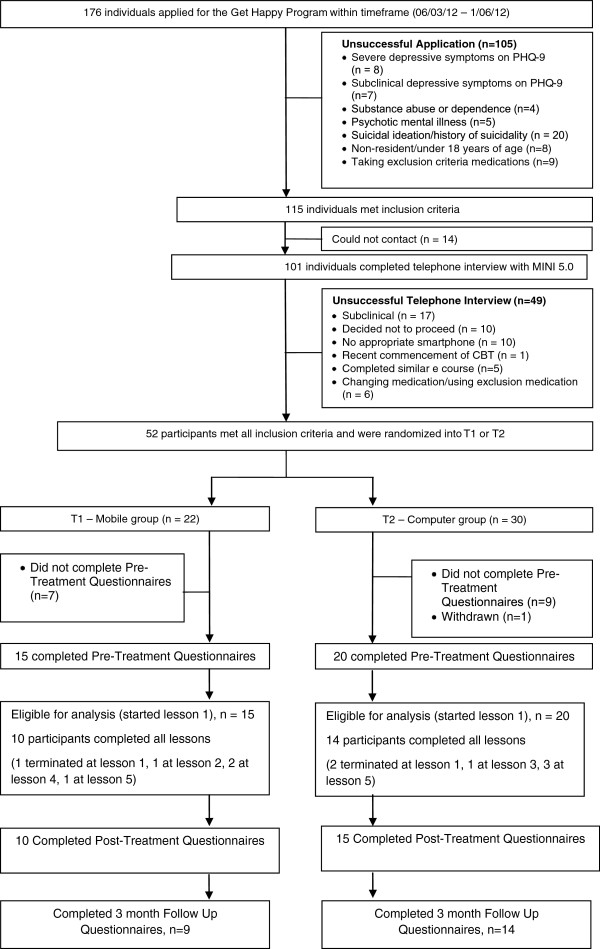
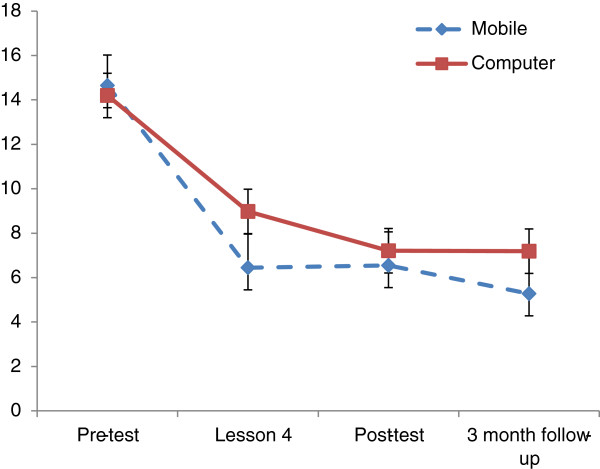
Background: This paper reports the results of a pilot randomized controlled trial comparing the delivery modality (mobile phone/tablet or fixed computer) of a cognitive behavioural therapy intervention for the treatment of depression. The aim was to establish whether a previously validated computerized program (The Sadness Program) remained efficacious when delivered via a mobile application. Method: 35 participants were recruited with Major Depression (80% female) and randomly allocated to access the program using a mobile app (on either a mobile phone or iPad) or a computer. Participants completed 6 lessons, weekly homework assignments, and received weekly email contact from a clinical psychologist or psychiatrist until completion of lesson 2. After lesson 2 email contact was only provided in response to participant request, or in response to a deterioration in psychological distress scores. The primary outcome measure was the Patient Health Questionnaire 9 (PHQ-9). Of the 35 participants recruited, 68.6% completed 6 lessons and 65.7% completed the 3-months follow up. Attrition was handled using mixed-model repeated-measures ANOVA. Results: Both the Mobile and Computer Groups were associated with statistically significantly benefits in the PHQ-9 at post-test. At 3 months follow up, the reduction seen for both groups remained significant. Conclusions: These results provide evidence to indicate that delivering a CBT program using a mobile application, can result in clinically significant improvements in outcomes for patients with depression. Trial registration: Australian New Zealand Clinical Trials Registry ACTRN 12611001257954
Overview
The claims and statistics of this paper haven’t been checked yet.
Free: it reads the open-access text and checks the first 5 claims that cite a source we can check. Create a free account to check every claim.
Integrity signals
Registry
Cites
Statistics
Figures
Verification
Claims the paper makes
The claims and statistics of this paper haven’t been checked yet.
Free: it reads the open-access text and checks the first 5 claims that cite a source we can check. Create a free account to check every claim.
Claims other papers make about this one
Each is checked against this paper’s own text: does it say what the citing paper says it does?
The cited source says what the claim attributes to it.
In the citing paper
“Some DMHIs, such as the Get Happy Program [13], consist of a series of lessons or modules that are designed to be completed in a sequential fashion over a specified number of weeks.”
From Digital Mental Health Interventions for Depression: Scoping Review of User Engagement (2022) · cites this paper as [13]
The cited source says what the claim attributes to it.
In the citing paper
“We have identified through our systematic review four apps in English that offer CBT or BA treatment for depression and have been studied by researchers and published in scientific papers, the Behavioural Activation Scheduling [50], the Get Happy Program [40], CBT Mobilwork [65] and Mobilyze [45].”
From A Systematic Review of Cognitive Behavioral Therapy and Behavioral Activation Apps for Depression (2016) · cites this paper as [40]
The cited source says what the claim attributes to it.
In the citing paper
“We have started to conduct trials in smartphone-delivered treatments and so did other research groups [Watts et al., 2013].”
From Internet-based treatments - Experiences from Sweden (2013) · cites this paper as Watts et al., 2013
The cited source says what the claim attributes to it.
In the citing paper
“Other studies also report positive outcomes with the use of mobile applications for the management of different mood disorders (106–108).”
From Mobile intervention for individuals with psychosis, dual disorders, and their common comorbidities: A literature review (2019) · cites this paper as [108]
The cited source says what the claim attributes to it.
In the citing paper
“and improving depressive symptoms (e.g., 107, 108, 112, 114)”
From Mobile intervention for individuals with psychosis, dual disorders, and their common comorbidities: A literature review (2019) · cites this paper as [108]
3 more claims about this paper
Create a free account to see every claim other papers make about this one.
Self-check
Percentages, sums and reported differences re-computed from the paper’s own numbers.
The self-check needs the paper’s full text.
Citations
Cites
The PHQ-9: Validity of a brief depression severity measure
Kroenke, K., Spitzer, R. L., & Williams, J. B. W. (2001) · Journal of General Internal Medicine · doi:10.1046/j.1525-1497.2001.016009606.x · Cited by 44,910
(1998) · The Journal of Clinical Psychiatry · Cited by 19,139
KESSLER, R. C., ANDREWS, G., COLPE, L. J., HIRIPI, E., MROCZEK, D. K., NORMAND, S.-L. T., WALTERS, E. E., & ZASLAVSKY, A. M. (2002) · Psychological Medicine · doi:10.1017/s0033291702006074 · Cited by 10,327
Self-citation(1998) · PubMed · Cited by 10,216
The mini international neuropsychiatric interview
Lecrubier, Y., Sheehan, D., Hergueta, T., & Weiller, E. (1998) · European Psychiatry · doi:10.1016/s0924-9338(99)80239-9 · Cited by 5,872
Higgins, S. M. F., Macken, A. P., Cullen, W., Saunders, J., Dunne, C. P., & O’Gorman, C. S. (2013) · PubMed · doi:10.34961/9953 · Cited by 4,808
Depression, chronic diseases, and decrements in health: results from the World Health Surveys
Moussavi, S., Chatterji, S., Verdes, E., Tandon, A., Patel, V., & Ustun, B. (2007) · The Lancet · doi:10.1016/s0140-6736(07)61415-9 · Cited by 4,070
Robins, L. N. (1988) · Archives of General Psychiatry · doi:10.1001/archpsyc.1988.01800360017003 · Cited by 2,909
Webb, T. L., Joseph, J., Yardley, L., & Michie, S. (2010) · Journal of Medical Internet Research · doi:10.2196/jmir.1376 · Cited by 2,517
Psychometric properties of the credibility/expectancy questionnaire
Devilly, G. J., & Borkovec, T. D. (2000) · Journal of Behavior Therapy and Experimental Psychiatry · doi:10.1016/s0005-7916(00)00012-4 · Cited by 2,295 · cited 3×
“All participants completed the questionnaire outcome measures (BDI-II, PHQ-9, K-10, CEQ, ERS and SDS) at 1-week post treatment and at 3-months follow up.”
Background
Research works printed but not linked: 4
- Murray CJL Lopez AD The Global Burden of Disease 1996 Geneva: World Health Organization, Harvard School of Public Health, World Bank
- International Telecommunication Union The World in 2011 ICT Facts and Figures 2011 Geneva, Switzerland: ITU 1 8
- Larson R Csikszentimihalyi M The experience sampling method: new directions for methodology Social Behavioural Science 1980 15 1 15
- Beck AT Steer RA Brown GK Beck Depression Inventory-II manual 1996 2 San Antonio, TX: Harcourt Brace
Cited by
Fitzpatrick, K. K., Darcy, A., & Vierhile, M. (2017) · JMIR Mental Health · doi:10.2196/mental.7785 · Cited by 2,730
Torous, J., Bucci, S., Bell, I. H., Kessing, L. V., Faurholt‐Jepsen, M., Whelan, P., Carvalho, A. F., Keshavan, M., Linardon, J., & Firth, J. (2021) · World Psychiatry · doi:10.1002/wps.20883 · Cited by 1,199
Smartphones for smarter delivery of mental health programs: A systematic review
Donker, T., Petrie, K., Proudfoot, J., Clarke, J., Birch, M.-R., & Christensen, H. (2013) · Journal of Medical Internet Research · doi:10.2196/jmir.2791 · Cited by 1,136
“…over 8 weeks; MHP Stand-alone mobile app on mobile phone + iPad n=20; CBT via computer n=15; CBT via mobile app Adults from the community MDDPilot RCT Watts et al (2013); Get Happy Program aposttest bfollow-up cwithin immediate coaching session dP<.05 eP<.001 fwithin-group effect size;…”
MethodFirth, J., Torous, J., Nicholas, J., Carney, R., Pratap, A., Rosenbaum, S., & Sarris, J. (2017) · World Psychiatry · doi:10.1002/wps.20472 · Cited by 1,097
Mental Health Smartphone Apps: Review and Evidence-Based Recommendations for Future Developments
Bakker, D., Kazantzis, N., Rickwood, D., & Rickard, N. (2016) · JMIR Mental Health · doi:10.2196/mental.4984 · Cited by 886
“CCBT interventions can be administered by a mobile device and still retain their therapeutic validity [50].”
Experience sampling methodology in mental health research: new insights and technical developments.
Myin‐Germeys, I., Kasanova, Z., Vaessen, T., Vachon, H., Kirtley, O., Viechtbauer, W., & Reininghaus, U. (2018) · World Psychiatry · doi:10.1002/wps.20513 · Cited by 709
Can Mobile Phone Apps Influence People’s Health Behavior Change? An Evidence Review
Zhao, J., Freeman, B., & Li, M. (2016) · Journal of Medical Internet Research · doi:10.2196/jmir.5692 · Cited by 618
Torous, J., Lipschitz, J., Ng, M., & Firth, J. (2020) · Journal of Affective Disorders · doi:10.1016/j.jad.2019.11.167 · Cited by 546
Linardon, J., & Fuller-Tyszkiewicz, M. (2020) · Journal of Consulting and Clinical Psychology · doi:10.1037/ccp0000459 · Cited by 573
Meta-analysis of dropout from cognitive behavioral therapy: Magnitude, timing, and moderators.
Fernandez, E., Salem, D., Swift, J. K., & Ramtahal, N. (2015) · Journal of Consulting and Clinical Psychology · doi:10.1037/ccp0000044 · Cited by 551
Martínez-Pérez, B., de la Torre-Díez, I., & López-Coronado, M. (2013) · Journal of Medical Internet Research · doi:10.2196/jmir.2600 · Cited by 550
“The papers and the commercial apps studied are summarized in Table 3 [77-97].”
BackgroundMethodPayne, H. E., Lister, C., West, J. H., & Bernhardt, J. M. (2015) · JMIR mHealth and uHealth · doi:10.2196/mhealth.3335 · Cited by 524
“Watts et al [38] measured depression and psychological distress among individuals diagnosed with major depression.”
BackgroundMental Health Mobile Apps for Preadolescents and Adolescents: A Systematic Review.
Grist, R., Porter, J., & Stallard, P. (2017) · Journal of Medical Internet Research · doi:10.2196/jmir.7332 · Cited by 518
Rathbone, A. L., & Prescott, J. (2017) · Journal of Medical Internet Research · doi:10.2196/jmir.7740 · Cited by 497
Josephine, K., Josefine, L., Philipp, D., David, E., & Harald, B. (2017) · Journal of Affective Disorders · doi:10.1016/j.jad.2017.07.021 · Cited by 341
User engagement in mental health apps: A review of measurement, reporting, and validity
Ng, M. M., Firth, J., Minen, M., & Torous, J. (2019) · Psychiatric Services · doi:10.1176/appi.ps.201800519 · Cited by 293
“just usability) (10, 12, 18, 21, 27, 30, 37, 41), 11 papers about two types of UEI (e.”
Mental health: there’s an app for that
Anthes, E. (2016) · Nature · doi:10.1038/532020a · Cited by 333
Prescribable mHealth apps identified from an overview of systematic reviews
Byambasuren, O., Sanders, S., Beller, E., & Glasziou, P. (2018) · npj Digital Medicine · doi:10.1038/s41746-018-0021-9 · Cited by 291
“Only one of the RCTs tested an app for depression against a previously validated web-based CBT program.(23) Both groups had equally significant improvements.”
BackgroundA Systematic Review of Cognitive Behavioral Therapy and Behavioral Activation Apps for Depression
Huguet, A., Rao, S., McGrath, P. J., Wozney, L., Wheaton, M., Conrod, J., & Rozario, S. (2016) · PLOS ONE · doi:10.1371/journal.pone.0154248 · Cited by 328
IntelliCare: An Eclectic, Skills-Based App Suite for the Treatment of Depression and Anxiety
Mohr, D. C., Tomasino, K. N., Lattie, E. G., Palac, H. L., Kwasny, M. J., Weingardt, K., Karr, C. J., Kaiser, S. M., Rossom, R. C., Bardsley, L. R., et al. (2017) · Journal of Medical Internet Research · doi:10.2196/jmir.6645 · Cited by 301
“Although websites can be designed to be responsive and accessible via multiple devices, including mobile phones, if interactional styles remain highly didactic this approach fails to consider the unique affordances and challenges of using mobile phone apps [17].”
BackgroundFinding a Depression App: A Review and Content Analysis of the Depression App Marketplace
Shen, N., Levitan, M.-J., Johnson, A., Bender, J. L., Hamilton-Page, M., Jadad, A. (. R., & Wiljer, D. (2015) · JMIR mHealth and uHealth · doi:10.2196/mhealth.3713 · Cited by 282
“While ICBT apps could be the prototypical depression app [26,88], non-depression ICBT apps were excluded to maintain consistency in assessing the relevance of other apps that provided an intervention (eg, binaural beats [81], yoga [89], spirituality [90]) where a case could be made for their inclusion.”
BackgroundLy, K. H., Trüschel, A., Jarl, L., Magnusson, S., Windahl, T., Johansson, R., Carlbring, P., & Andersson, G. (2014) · BMJ Open · doi:10.1136/bmjopen-2013-003440 · Cited by 269
“BACKGROUND Major depressive disorder (MDD) is a major health problem, which causes significant detrimental effects on the individual’s quality of life and generates enormous costs for society.1 2 Several forms of psychotherapy have been found to be effective in the treatment of MDD.3 For example, behavioural activatio…”
MethodInfluentialProudfoot, J., Clarke, J., Birch, M.-R., Whitton, A. E., Parker, G., Manicavasagar, V., Harrison, V., Christensen, H., & Hadzi-Pavlovic, D. (2013) · BMC Psychiatry · doi:10.1186/1471-244x-13-312 · Cited by 264
“Predominantly, extant research has been confined to small, non-controlled, and non-randomised studies without long-term follow-up [14], with only a few exceptions [15,16].”
BackgroundLopez-Fernandez, O., Kuss, D. J., Romo, L., Morvan, Y., Kern, L., Graziani, P., Rousseau, A., Rumpf, H.-J., Bischof, A., Gässler, A.-K., et al. (2017) · Journal of Behavioral Addictions · doi:10.1556/2006.6.2017.020 · Cited by 237
“Numerous studies have also demonstrated the ef fi cacy of mobile phone interventions designed to promote healthy behaviors (Fjeldsoe, Marshall, & Miller, 2009) or provide self-help-based psychological interventions (Watts et al., 2013).”
BackgroundVan Ameringen, M., Turna, J., Khalesi, Z., Pullia, K., & Patterson, B. (2017) · Depression and Anxiety · doi:10.1002/da.22657 · Cited by 234
“There are five studies exploring the efficacy of a treatment-based smartphone app targeting MDD symptoms (Burns et al., 2011; Ly et al., 2014; Mohr et al., 2017; Wahle, Kowatsch, Fleisch, Rufer, & Weidt, 2016; Watts et al., 2013).”
BackgroundMethodInfluentialTorous, J., Chan, S. R., Yee-Marie Tan, S., Behrens, J., Mathew, I., Conrad, E. J., Hinton, L., Yellowlees, P., & Keshavan, M. (2014) · JMIR Mental Health · doi:10.2196/mental.4004 · Cited by 228
“of patients suffering from major depressive disorder [1], bipolar disorder [2], anxiety disorders [3], substance abuse disorders, [4,5] and psychotic disorders [6,7].”
Evidence-based apps? A review of mental health mobile applications in a psychotherapy context
Lui, J. H. L., Marcus, D. K., & Barry, C. T. (2017) · Professional Psychology Research and Practice · doi:10.1037/pro0000122 · Cited by 217
“Some studies also found a significant reduction in comorbid symptoms and level of disability (Burns et al., 2011; Watts et al., 2013), whereas others did not (Ahmedani et al.”
BackgroundMethodInfluentialSmartphone Apps for the Treatment of Mental Disorders: Systematic Review
Miralles, I., Granell, C., Díaz-Sanahuja, L., Van Woensel, W., Bretón-López, J., Mira, A., Castilla, D., & Casteleyn, S. (2020) · JMIR mHealth and uHealth · doi:10.2196/14897 · Cited by 188
“7Cups [160], Be Good to Yourself [18], BlueWatch [161], Dcombat [162], Get Happy Program [163], HeadGear [164], iCare Prevent [165], MedLink [166], Mobile Sensing and Support [167], MoodHacker [168], Moodivate [169], MyGamePlan [170], PRIME-D [171], Push-D [172], SocioEmpathy [173], SPSRS [174], SuperBetter [175], The…”
BackgroundLindhiem, O., Bennett, C. B., Rosen, D., & Silk, J. (2015) · Behavior Modification · doi:10.1177/0145445515595198 · Cited by 197
“…to test the benefits of mobile devices, either as substitutes for regular contact with a clinician (e.g., Bauer, Okon, Meermann, & Kordy, 2012; Watts et al., 2013) or to supplement face-to-face time with a clinician (e.g., Gustafson et al., 2014; Oerlemans, van Cranenburgh, Herremans,…”
BackgroundMobile phones as medical devices in mental disorder treatment: an overview
Gravenhorst, F., Muaremi, A., Bardram, J., Grünerbl, A., Mayora, O., Wurzer, G., Frost, M., Osmani, V., Arnrich, B., Lukowicz, P., et al. (2015) · Personal and Ubiquitous Computing · doi:10.1007/s00779-014-0829-5 · Cited by 197
“As such, CBT behavioral training based on multimedia content (text, pictures, videos) can be provided directly to patients over the phone right in situations where it is needed.”
BackgroundInfluentialMantani, A., Kato, T., Furukawa, T. A., Horikoshi, M., Imai, H., Hiroe, T., Chino, B., Funayama, T., Yonemoto, N., Zhou, Q., et al. (2017) · Journal of Medical Internet Research · doi:10.2196/jmir.8602 · Cited by 192
“One pilot RCT compared the original Web-based CBT against its smartphone version in 35 participants with depression confirmed through telephone diagnostic interview [34].”
Ly, K. H., Topooco, N., Cederlund, H., Wallin, A., Bergström, J., Molander, O., Carlbring, P., & Andersson, G. (2015) · PLOS ONE · doi:10.1371/journal.pone.0126559 · Cited by 171
Versluis, A., Verkuil, B., Spinhoven, P., van der Ploeg, M. M., & Brosschot, J. F. (2016) · Journal of Medical Internet Research · doi:10.2196/jmir.5642 · Cited by 186
“Only 5 studies had a low risk of bias on this domain [52,57,58,61,62], with 5 other studies having a low risk of bias on “random sequence generation” and an unclear or high risk on “allocation concealment” [26,31,32,48,55].”
InfluentialBatra, S., Baker, R., Wang, T., Forma, F., DiBiasi, F., & Peters-Strickland, T. (2017) · Medical Devices: Evidence and Research · doi:10.2147/mder.s144158 · Cited by 169
Birney, A. J., Gunn, R., Russell, J. K., & Ary, D. V. (2016) · JMIR mHealth and uHealth · doi:10.2196/mhealth.4231 · Cited by 159
“Watts et al [55] reported statistically significant large within-group effect sizes for depression symptoms in a nonrandomized study of their CBT-based Get Happy mobile app, which was derived from, and evaluated against, its Web-based predecessor, The Sadness Program.”
Gamification and Adherence to Web-Based Mental Health Interventions: A Systematic Review
Brown, M., O'Neill, N., van Woerden, H., Eslambolchilar, P., Jones, M., & John, A. (2016) · JMIR Mental Health · doi:10.2196/mental.5710 · Cited by 178
A randomized controlled trial of three smartphone apps for enhancing public mental health
Bakker, D., Kazantzis, N., Rickwood, D., & Rickard, N. (2018) · Behaviour Research and Therapy · doi:10.1016/j.brat.2018.08.003 · Cited by 176
EmotionCheck: leveraging bodily signals and false feedback to regulate our emotions
Costa, J., Adams, A. T., Jung, M. F., Guimbretière, F., & Choudhury, T. (2016) · Proceedings of the 2016 ACM International Joint Conference on Pervasive and Ubiquitous Computing · doi:10.1145/2971648.2971752 · Cited by 168
“In addition to technologies designed for the general population, some technologies have been developed for individuals with emotional disorders, such as depression [48] and bipolar disorder [46].”
BackgroundIvanova, E., Lindner, P., Ly, K. H., Dahlin, M., Vernmark, K., Andersson, G., & Carlbring, P. (2016) · Journal of Anxiety Disorders · doi:10.1016/j.janxdis.2016.09.012 · Cited by 165
Mobile Assessment Procedures for Mental Health and Literacy Skills in Education
Stathopoulou, A., Karabatzaki, Z., Kokkalia, G., Dimitriou, E., Loukeri, P. I., Economou, A., & Drigas, A. (2018) · International Journal of Interactive Mobile Technologies (iJIM) · doi:10.3991/ijim.v12i3.8038 · Cited by 164
Wu, A., Scult, M. A., Barnes, E. D., Betancourt, J. A., Falk, A., & Gunning, F. M. (2021) · npj Digital Medicine · doi:10.1038/s41746-021-00386-8 · Cited by 161
Kerst, A., Zielasek, J., & Gäebel, W. (2019) · European Archives of Psychiatry and Clinical Neuroscience · doi:10.1007/s00406-018-0974-3 · Cited by 186
“The symptom assessment was done online [21, 24] or by a (phone-) interview [6, 20, 23].”
BackgroundMethodInfluentialRathnayaka, P., Mills, N., Burnett, D., De Silva, D., Alahakoon, D., & Gray, R. (2022) · Sensors · doi:10.3390/s22103653 · Cited by 155
“standard settings [11], as a mobile phone service [12], as an online service on the Internet [13], as a gamified smartphone application [14], and as a smartphone-based conversational agent [15].”
BackgroundTelemental health: A status update
Aboujaoude, E., Salame, W., & Naim, L. (2015) · World Psychiatry · doi:10.1002/wps.20218 · Cited by 154
“Both mobile CBT and cCBT were associated with a statistically significant reduction in depressive symptoms post-treatment and at the three-month follow-up (56).”
BackgroundMobile Apps the Educational Solution for Autistic Students in Secondary Education
Stathopoulou, A., Karabatzaki, Z., Tsiros, D., Katsantoni, S., & Drigas, A. S. (2019) · International Journal of Interactive Mobile Technologies (iJIM) · doi:10.3991/ijim.v13i02.9896 · Cited by 280
“Study reveal results in which the installation of a specific application in a mobile phone provides a cognitive behavioral therapy intervention for the treatment of depression [25].”
BackgroundWitkiewitz, K., Desai, S. A., Bowen, S., Leigh, B. C., Kirouac, M., & Larimer, M. E. (2014) · Psychology of Addictive Behaviors · doi:10.1037/a0034747 · Cited by 134
“With advances in computing technology, a number of researchers have developed interventions that can be administered on electronic devices (Rizvi, Dimeff, Skutch, Carroll, & Linehan, 2011; Stoner & Hendershot, 2012; Watts et al., 2013).”
BackgroundYe, X., Bapuji, S. B., Winters, S. E., Struthers, A., Raynard, M., Metge, C., Kreindler, S. A., Charette, C. J., Lemaire, J. A., Synyshyn, M., et al. (2014) · BMC Health Services Research · doi:10.1186/1472-6963-14-313 · Cited by 133
“There was, however, no difference in effect size between mobile phone-based and computer-based adult depression interventions [39].”
BackgroundOh, J., Jang, S., Kim, H., & Kim, J.-J. (2020) · International Journal of Medical Informatics · doi:10.1016/j.ijmedinf.2020.104171 · Cited by 124
Newby, J., Robins, L., Wilhelm, K., Smith, J., Fletcher, T., Gillis, I., Ma, T., Finch, A., Campbell, L., & Andrews, G. (2017) · Journal of Medical Internet Research · doi:10.2196/jmir.7274 · Cited by 123
Self-citationDagöö, J., Asplund, R. P., Bsenko, H. A., Hjerling, S., Holmberg, A., Westh, S., Öberg, L., Ljótsson, B., Carlbring, P., Furmark, T., et al. (2014) · Journal of Anxiety Disorders · doi:10.1016/j.janxdis.2014.02.003 · Cited by 121
Current research and trends in the use of smartphone applications for mood disorders
Torous, J., & Powell, A. C. (2015) · Internet Interventions · doi:10.1016/j.invent.2015.03.002 · Cited by 121
“We identified ten studies on the role of smartphone applications for major depressive disoder (Bush et al., 2013; Bindhim et al., 2015; Pelletier et al., 2013; Webb et al., 2013; Kauer et al., 2012; Hammonds et al., 2015; Schaffer et al., 2013; Ly et al., 2014; Watts et al., 2013; Burns et al., 2011).”
BackgroundDigital Mental Health Interventions for Depression: Scoping Review of User Engagement
Lipschitz, J. M., Van Boxtel, R., Torous, J., Firth, J., Lebovitz, J. G., Burdick, K. E., & Hogan, T. P. (2022) · Journal of Medical Internet Research · doi:10.2196/39204 · Cited by 105
“…with clinicians (n=5); and treatments involving a discrete number of lessons/modules typically to be completed on a weekly basis (n=4). al [13] a CBT: cognitive behavioral therapy. b TAU: treatment as usual. c N/A: no treatment administered. d The intervention in Ly et al [30] contained…”
InfluentialMcCloud, T., Jones, R., Lewis, G., Bell, V., & Tsakanikos, E. (2020) · JMIR mHealth and uHealth · doi:10.2196/15418 · Cited by 118
“Our results are in line with the oft-reported finding that the majority of the improvement associated with a CBT app (and traditional CBT [47]) is seen in the short term [48,49], but a longer follow-up period will be needed to ascertain whether our week 6 results represent a fluctuation typically seen around the 6-wee…”
ResultGuided internet-based CBT for common mental disorders
Andersson, G., Carlbring, P., Ljótsson, B., & Hedman, E. (2013) · Journal of Contemporary Psychotherapy · doi:10.1007/s10879-013-9237-9 · Cited by 119
“New technologies may open up new possibilities for the delivery of CBT and research has begun in this field (Watts et al. 2013).”
BackgroundJannati, N., Mazhari, S., Ahmadian, L., & Mirzaee, M. (2020) · International Journal of Medical Informatics · doi:10.1016/j.ijmedinf.2020.104145 · Cited by 118
O'moore, K. A., Newby, J. M., Andrews, G., Hunter, D. J., Bennell, K., Smith, J., & Williams, A. D. (2018) · Arthritis Care & Research · doi:10.1002/acr.23257 · Cited by 117
Self-citationShapira, S., Yeshua-Katz, D., Cohn-Schwartz, E., Aharonson-Daniel, L., Sarid, O., & Clarfield, A. M. (2021) · Internet Interventions · doi:10.1016/j.invent.2021.100368 · Cited by 117
Scott, I. A., Scuffham, P., Gupta, D., Harch, T. M., Borchi, J., & Richards, B. (2018) · Australian Health Review · doi:10.1071/ah18064 · Cited by 143
Yang, Q., & Van Stee, S. K. (2019) · JMIR mHealth and uHealth · doi:10.2196/11244 · Cited by 113
“…of mHealth interventions, it is crucial to take into consideration the control group design, including regular treatment [34], print-version [35] or computer-version [36] interventions, less intensive version of mHealth interventions [37], or interventions combining multiple channels [38].”
Costa, J. M. D. R., Guimbretière, F. V., Jung, M. F., & Choudhury, T. (2019) · Proceedings of the ACM on Interactive Mobile Wearable and Ubiquitous Technologies · doi:10.1145/3328911 · Cited by 142
“More recently, it has been growing the interest in using technologies to help individuals with emotional disorders, which led to the development of technologies for people with depression [86], anxiety [58], bipolar disorder [53], and suicidal behavior [72].”
BackgroundBry, L. J., Chou, T., Miguel, E., & Comer, J. S. (2018) · Behavior Therapy · doi:10.1016/j.beth.2017.07.008 · Cited by 106
“A uthor M anuscript A uthor M anuscript A uthor M anuscript A uthor M anuscript (Watts et al., 2013).”
BackgroundThe smart therapist: A look to the future of smartphones and mHealth technologies in psychotherapy.
Clough, B. A., & Casey, L. M. (2015) · Professional Psychology: Research and Practice · doi:10.1037/pro0000011 · Cited by 104
Forbes, A., Keleher, M. R., Venditto, M., & DiBiasi, F. (2023) · Journal of Medical Internet Research · doi:10.2196/43727 · Cited by 94
“%) or a difference in efficacy in terms of preintervention to postintervention scores on the PHQ-9, Beck Depression Inventory-II, or Kessler Psychological Distress Scale [156].”
Virtues, ecological momentary assessment/intervention and smartphone technology
Runyan, J. D., & Steinke, E. G. (2015) · Frontiers in Psychology · doi:10.3389/fpsyg.2015.00481 · Cited by 88
Computer-based and online therapy for depression and anxiety in children and adolescents
Stasiak, K., Fleming, T., Lucassen, M. F. G., Shepherd, M. J., Whittaker, R., & Merry, S. N. (2016) · Journal of Child and Adolescent Psychopharmacology · doi:10.1089/cap.2015.0029 · Cited by 87
“Results from studies of the efficacy of mobile phonebased programs for adults with depression have been encouraging (Harrison et al. 2011; Watts et al. 2013) and given the widespread use of mobile phones by young people, this is an area ripe for development.”
Williams, A. D., O’Moore, K., Blackwell, S. E., Smith, J., Holmes, E. A., & Andrews, G. (2015) · Journal of Affective Disorders · doi:10.1016/j.jad.2015.02.026 · Cited by 85
Self-citationYellowlees, P., Richard Chan, S., & Burke Parish, M. (2015) · International Review of Psychiatry · doi:10.3109/09540261.2015.1082987 · Cited by 83
“…et al., 2014; Motraghi et al., 2014; Opris et al., 2012) and Internet-based cognitive therapies (Alvarez-Jimenez et al., 2014; Gravenhorst et al., 2015; Heffner et al., 2015; Juarascio et al., 2015; Lal & Adair, 2014; Moock, 2014; Shen et al., 2015; Torous & Powell, 2015; Watts et al., 2013).”
BackgroundThe effectiveness of smartphone apps in improving financial capability
French, D., McKillop, D. G., & Stewart, E. (2019) · European Journal of Finance · doi:10.1080/1351847x.2019.1639526 · Cited by 118
“Smartphone app interventions have been demonstrated to be effective in promoting physical activity, weight management, the reduction of alcohol consumption and in the management of diabetes, depression and asthma (Watts et al. 2013; Glynn et al. 2014; Smith et al. 2014; Chan et al. 2018).”
BackgroundFunctionality of Top-Rated Mobile Apps for Depression: Systematic Search and Evaluation
Qu, C., Sas, C., Daudén Roquet, C., & Doherty, G. (2020) · JMIR Mental Health · doi:10.2196/15321 · Cited by 84
“Most human-computer interaction (HCI) studies on understanding [28-30] or supporting depression have focused on designing and evaluating mobile technologies in research contexts rather than marketplaces [31-33].”
Juarascio, A. S., Goldstein, S. P., Manasse, S. M., Forman, E. M., & Butryn, M. L. (2015) · International Journal of Medical Informatics · doi:10.1016/j.ijmedinf.2015.06.004 · Cited by 81
Antosik-Wójcińska, A. Z., Dominiak, M., Chojnacka, M., Kaczmarek‐Majer, K., Opara, K. R., Radziszewska, W., Olwert, A., & Święcicki, Ł. (2020) · International Journal of Medical Informatics · doi:10.1016/j.ijmedinf.2020.104131 · Cited by 93
Akechi, T., Yamaguchi, T., Uchida, M., Imai, F., Momino, K., Katsuki, F., Sakurai, N., Miyaji, T., Mashiko, T., Horikoshi, M., et al. (2023) · Journal of Clinical Oncology · doi:10.1200/jco.22.00699 · Cited by 78
Ly, K. H., Janni, E., Wrede, R., Sedem, M., Donker, T., Carlbring, P., & Andersson, G. (2015) · Internet Interventions · doi:10.1016/j.invent.2014.12.002 · Cited by 78
The impact of psychological distress tolerance in the treatment of depression
Williams, A. D., Thompson, J., & Andrews, G. (2013) · Behaviour Research and Therapy · doi:10.1016/j.brat.2013.05.005 · Cited by 77
Self-citationMobile Apps for Individuals With Rheumatoid Arthritis: A Systematic Review
Luo, D., Wang, P., Lu, F., Elias, J. S., Sparks, J. A., & Lee, Y. (2018) · JCR Journal of Clinical Rheumatology · doi:10.1097/rhu.0000000000000800 · Cited by 90
Harper Shehadeh, M. J., Abi Ramia, J., Cuijpers, P., El Chammay, R., Heim, E., Kheir, W., Saeed, K., van Ommeren, M., van’t Hof, E., Watts, S., et al. (2020) · Frontiers in Psychiatry · doi:10.3389/fpsyt.2019.00986 · Cited by 75
Self-citationWeber, S., Lorenz, C., & Hemmings, N. (2019) · Frontiers in Psychology · doi:10.3389/fpsyg.2019.02745 · Cited by 74
Torous, J., Levin, M. E., Ahern, D. K., & Oser, M. L. (2017) · Cognitive and Behavioral Practice · doi:10.1016/j.cbpra.2016.05.007 · Cited by 73
“Furthermore, another study (Watts et al., 2013) tested whether a mobile app was comparable in effectiveness to computer delivered CBT.”
InfluentialUsing Smartphone Apps to Promote Psychiatric and Physical Well-Being
Macias, C., Panch, T., Hicks, Y. M., Scolnick, J. S., Weene, D. L., Öngür, D., & Cohen, B. M. (2015) · Psychiatric Quarterly · doi:10.1007/s11126-015-9337-7 · Cited by 83
Bakker, D., & Rickard, N. S. (2019) · Australian Psychologist · doi:10.1111/ap.12383 · Cited by 86
Moments of Change: Analyzing Peer-Based Cognitive Support in Online Mental Health Forums
Pruksachatkun, Y., Pendse, S. R., & Sharma, A. (2019) · Proceedings of the 2019 CHI Conference on Human Factors in Computing Systems · doi:10.1145/3290605.3300294 · Cited by 71
“For instance, it has been administered successfully through the internet [19] and through mobile phones [69].”
Kennard, B. D., Biernesser, C., Wolfe, K. L., Foxwell, A. A., Craddock Lee, S. J., Rial, K. V., Patel, S., Cheng, C., Goldstein, T., McMakin, D., et al. (2015) · Journal of Technology in Human Services · doi:10.1080/15228835.2015.1106384 · Cited by 69
Ashford, R. D., Lynch, K. G., & Curtis, B. L. (2018) · Journal of Medical Internet Research · doi:10.2196/jmir.9172 · Cited by 78
“Recently, behavioral health apps have been developed that monitor psychiatric illnesses [10-14].”
BackgroundSmartphone-Based Psychotherapeutic Micro-Interventions to Improve Mood in a Real-World Setting
Meinlschmidt, G., Lee, J.-H., Stalujanis, E., Belardi, A., Oh, M., Jung, E. K., Kim, H.-C., Alfano, J., Yoo, S.-S., & Tegethoff, M. (2016) · Frontiers in Psychology · doi:10.3389/fpsyg.2016.01112 · Cited by 68
“…provide evidence that smartphone-based interventions have the potential to reduce symptoms of mental disorders, such as anxiety, depression, schizophrenia, and substance use disorders (Watts et al., 2013; Ben-Zeev et al., 2014; Gustafson et al., 2014; Ly et al., 2014; Ahmedani et al., 2015).”
BackgroundBakker, D., Kazantzis, N., Rickwood, D., & Rickard, N. (2018) · Cognitive and Behavioral Practice · doi:10.1016/j.cbpra.2018.07.002 · Cited by 68
Vinci, C. (2020) · Current Oncology Reports · doi:10.1007/s11912-020-00915-w · Cited by 82
mHealth Assessment and Intervention of Depression and Anxiety in Older Adults
Grossman, J. T., Frumkin, M. R., Rodebaugh, T. L., & Lenze, E. J. (2020) · Harvard Review of Psychiatry · doi:10.1097/hrp.0000000000000255 · Cited by 66
“Symptoms of depression were significantly reduced at posttreatment and three-month follow-up for both types of treatment, and effects between conditions did not differ.(93) It is currently uncertain whether mobile CBT may be adequate as a stand-alone treatment for depression, but other research suggests that mobile CB…”
BackgroundMenon, V., Rajan, T. M., & Sarkar, S. (2017) · Indian Journal of Psychological Medicine · doi:10.4103/0253-7176.198956 · Cited by 62
Marciniak, M. A., Shanahan, L., Rohde, J., Schulz, A., Wackerhagen, C., Kobylińska, D., Tuescher, O., Binder, H., Walter, H., Kalisch, R., et al. (2020) · JMIR mhealth and uhealth · doi:10.2196/19836 · Cited by 67
The Art of Exposure: Putting Science Into Practice
Peterman, J. S., Read, K. L., Wei, C., & Kendall, P. C. (2014) · Cognitive and Behavioral Practice · doi:10.1016/j.cbpra.2014.02.003 · Cited by 74
Ham, K., Chin, S., Suh, Y. J., Rhee, M., Yu, E.-S., Lee, H. J., Kim, J.-H., Kim, S. W., Koh, S.-J., & Chung, K.-M. (2019) · Frontiers in Psychology · doi:10.3389/fpsyg.2019.01592 · Cited by 61
Engagement with mobile health interventions for depression: A systematic review
Molloy, A., & Anderson, P. L. (2021) · Internet Interventions · doi:10.1016/j.invent.2021.100454 · Cited by 59
Mobile Mental Health: Navigating New Rules and Regulations for Digital Tools
Armontrout, J. A., Torous, J. B., Fisher, M., Drogin, E. Y., & Gutheil, T. G. (2016) · Current Psychiatry Reports · doi:10.1007/s11920-016-0726-x · Cited by 65
Smartphone apps for psychological health: A brief state of the science review.
Bush, N. E., Armstrong, C. M., & Hoyt, T. V. (2019) · Psychological Services · doi:10.1037/ser0000286 · Cited by 60
Methodology and Reporting of Mobile Health and Smartphone Application Studies for Schizophrenia
Torous, J., Firth, J., Mueller, N., Onnela, J. P., & Baker, J. T. (2017) · Harvard Review of Psychiatry · doi:10.1097/hrp.0000000000000133 · Cited by 59
Economides, M., Ranta, K., Nazander, A., Hilgert, O., Goldin, P. R., Raevuori, A., & Forman-Hoffman, V. (2019) · JMIR mHealth and uHealth · doi:10.2196/14284 · Cited by 56
“Indeed, the large effect reported here is consistent with other within-group (uncontrolled) effect sizes for app-and online-based depression interventions [55-57].”
Tudor-Sfetea, C., Rabee, R., Najim, M., Amin, N., Chadha, M., Jain, M., Karia, K., Kothari, V., Patel, T., Suseeharan, M., et al. (2018) · JMIR mHealth and uHealth · doi:10.2196/mhealth.9405 · Cited by 56
“Moreover, evidence has shown that, alongside CBT provided through a computer-based platform, CBT delivered via mobile apps could significantly improve outcomes for patients [26].”
BackgroundMobile Network Data for Public Health: Opportunities and Challenges
Oliver, N., Matic, A., & Frías-Martínez, E. (2015) · Frontiers in Public Health · doi:10.3389/fpubh.2015.00189 · Cited by 63
“The current literature reports several recent studies that have designed mobile intervention approaches to improve mental health conditions, including depression (64, 65), anxiety (66), stress (67), bipolar disorder, and schizophrenia (68).”
BackgroundHuman Support in App-Based Cognitive Behavioral Therapies for Emotional Disorders: Scoping Review
Bernstein, E. E., Weingarden, H., Wolfe, E. C., Hall, M. D., Snorrason, I., & Wilhelm, S. (2022) · Journal of Medical Internet Research · doi:10.2196/33307 · Cited by 54
“For example, coaching may make the most difference for users with more severe symptoms [94] or early on in treatment [44], or the frequency or tone of communications may need to change over time to remain engaging [107].”
BackgroundQuality and Usability of Arthritic Pain Self-Management Apps for Older Adults: A Systematic Review
Bhattarai, P., Newton-John, T. R. O., & Phillips, J. L. (2018) · Pain Medicine · doi:10.1093/pm/pnx090 · Cited by 54
Metadata
- Authors
- Watts, S., Mackenzie, A., Thomas, C., Griskaitis, A., Mewton, L., Williams, A., & Andrews, G.
- Affiliations
- UNSW Sydney (AU)
- Corresponding author
- Andrews, Gavin
- Venue
- BMC Psychiatry
- Published
- 2013-02-07
- Volume
- 13
- Issue
- 1
- Pages
- 49-49
- ISSN
- 1471-244X (ISSN-L)
- PMC
- PMC3571935
- OpenAlex
- W1968667849
- Cited by
- 329
- References
- 35
- Citations by year
- 2026: 4 · 2025: 11 · 2024: 16 · 2023: 14 · 2022: 24 · 2021: 25 · 2020: 33 · 2019: 37 · 2018: 34 · 2017: 42 · 2016: 32 · 2015: 31 · 2014: 16 · 2013: 10
- FWCI
- 45.35
- Type
- journal article
- Language
- en
- Open access
- gold
- doi.org
- Licence
- Locations
- BMC Psychiatry (publishedVersion, cc-by)
- Europe PMC (PubMed Central) (publishedVersion, cc-by)
- PubMed Central (publishedVersion, cc-by)
- PubMed (publishedVersion)
- DOAJ (DOAJ: Directory of Open Access Journals) (submittedVersion)
- Topics
- Social Sciences › Psychology › Applied Psychology › Digital Mental Health Interventions
- Social Sciences › Psychology › Experimental and Cognitive Psychology › Anxiety, Depression, Psychometrics, Treatment, Cognitive Processes
- Health Sciences › Health Professions › General Health Professions › Mobile Health and mHealth Applications
- Keywords
- cognitive behavioral therapy, depression, mobile health, mobile application, computer-based intervention, major depressive disorder, attrition, PHQ-9
- MeSH terms
- Adolescent, Adult, Computers, Major Depressive Disorder, Female, Humans, Male, Middle Aged, Patient Compliance, Pilot Projects, Psychiatric Status Rating Scales, Cognitive Behavioral Therapy, Treatment Outcome, Telemedicine, Cell Phone, Young Adult
About these checks
Registry, retraction, Cites and statistics results are computed, not judged, with one exception: a printed reference that no index lists is read once by a model before it counts as a citation error. Claims are extracted by a model and kept only when their quote appears verbatim in the text; each cited source is then checked, with a model’s help, for whether it says what the claim relies on. Those verdicts can be wrong — read the claim’s quote and the cited source before relying on one.
Statistics and arithmetic are recomputed, not judged.
Confidence bands are shown only for fields calibrated on our annotated test set. None is calibrated yet, so no band is shown.
What counts as a claim ›How we measure confidence ›How we check this ›
Are you an author, or do you see a problem with this page? Request a review
Data sources
Bibliographic data: Semantic Scholar, OpenAlex, Crossref.
Contains information from the Semantic Scholar Academic Graph Datasets, made available under the ODC Attribution License (ODC-BY 1.0).
Semantic Scholar’s data is described in: Kinney, R., et al. (2023). The Semantic Scholar Open Data Platform. arXiv:2301.10140.
